towing Seat Cordoba 2008 User Guide
[x] Cancel search | Manufacturer: SEAT, Model Year: 2008, Model line: Cordoba, Model: Seat Cordoba 2008Pages: 258, PDF Size: 7.87 MB
Page 147 of 258
Intelligent technology145
Safety First
Operating instructions
Tips and Maintenance
Te c h n i c a l D a t a
The TCS should be switched on again afterwards as soon as possible.
WARNING
•
It must be remembered that TCS cann
ot defy the laws of physics. This
should be kept in mind, particular ly on slippery and wet roads and when
towing a trailer.
•
Always adapt your driving style to suit the condition of the roads and
the traffic situation. Do not let the extra safety afforded by TCS tempt you
into taking any risks when driving, this can cause accidents.Caution
•
In order to ensure that TCS function correctly, all four wheels must be
fitted with the same tyres. Any differences in the rolling radius of the tyres can
cause the system to reduce engine power when this is not desired.
•
Modifications to the vehicle (e.g. to the engine, the brake system, running
gear or any components affecting the wh eels and tyres) could affect the effi-
ciency of the ABS and TCS.
Electronic stabilisation programme (ESP)*General notes
The electronic stabilisation programme increases the
vehicle’s stability on the road.The electronic stabilisation programme helps to reduce the danger of skid-
ding.
The electronic stabilisation programme (ESP) consists of ABS, EDL and TCS. Electronic Stabilising Program (ESP)*
ESP reduces the danger of skidding by braking the wheels individually.
The system uses the steering wheel angle and road speed to calculate the
changes of direction desired by the driver, and constantly compares them
with the actual behaviour of the vehi
cle. If the desired course is not being
maintained (for instance, if the car is starting to skid), then the ESP compen-
sates automatically by braking the appropriate wheel.
The forces acting on the braked wheel bring the vehicle back to a stable
condition. If the vehicle tends to oversteer, the system will act on the front
wheel on the outside of the turn.
WARNING
•
It must be remembered that ESP cann ot defy the laws of physics. This
should be kept in mind, particularly on slippery and wet roads and when
towing a trailer.
•
Always adapt your driving style to suit the condition of the roads and
the traffic situation. Do not let the extra safety afforded by ESP tempt you
into taking any risks when driving, this can cause accidents.Caution
•
In order to ensure that ESP functions correctly, all four wheels must be
fitted with the same tyres. Any differences in the rolling radius of the tyres can
cause the system to reduce engine power when this is not desired.
•
Modifications to the vehicle (e.g. to the engine, the brake system, running
gear or any components affecting the wheels and tyres) could affect the effi-
ciency of the ABS, EDL, ESP and TCS.Note
To disconnect using the ESP button ⇒page 128.
COR_ING_0707 Seite 145 Mittwoch, 1. August 2007 6:25 18
Page 156 of 258

Driving and the environment
154On the right headlight, if you are chan ging from driving on the left-hand side
to the right-hand side ⇒page 153, fig. 117 .
On the left headlight, if you are changing from driving on the left-hand side to
the right-hand side ⇒page 153, fig. 118 .Trailer towingWhat do you need to bear in mind when towing a trailer?Your vehicle may be used to tow a trailer when fitted with the correct equip-
ment.
If the car is supplied with a factory-fitted towing bracket it will already have
the necessary technical modifications and meet the statutory requirements
for towing a trailer. For the after-market fitting of a trailer towing bracket see
⇒ page 170.
Connectors
Your vehicle is fitted with a 12-pin connector for the electrical connection
between the trailer and the vehicle.
If the trailer has a 7-pin plug you will need to use an adapter cable. This is
available from any SEAT dealer.
Trailer weight / draw bar loading
Never exceed the authorised towing limit. If you do not load the trailer up to
the maximum permitted tr ailer weight, you can then climb correspondingly
steeper gradients.
The maximum trailer weights listed are only applicable for altitudes up to
1,000 m above sea level. With increasing altitude the engine power and
therefore the vehicle's climbing ability are impaired because of the reduced
air density. The maximum trailer weight has to be reduced accordingly. The weight of the vehicle and trailer co
mbination must be reduced by 10% for
every further 1,000 m (or part thereof). The gross combination weight is the
actual weight of the laden vehicle plus the actual weight of the laden trailer.
Where possible, operate the trailer with the maximum permitted draw bar
weight on the ball joint of the towing bracket, but do not exceed the specified
limit.
The figures for trailer weights and draw bar weights that are given on the
data plate of the towing bracket are for certification purposes only. The
correct figures for your spec ific model, which may be lower than these figures
for the towing bracket, are given in the registration documents ⇒Section
“Technical data”.
Distributing the load
Distribute loads in the trailer so that heavy objects are as near to the axle as
possible. Loads carried in the trailer must be secured to prevent them
moving.
Tyre pressure
Set tyre pressure to the maximum permissible pressure shown on the sticker
on the inside of the fuel tank flap. Set the tyre pressure of the trailer tyres in
accordance with the trailer manufacturer's recommendations.
Exterior mirrors
Check whether you can see enough of the road behind the trailer with the
standard mirrors. If this is not the case you should have additional mirrors
fitted. Both exterior mirrors shoul d be mounted on hinged extension
brackets. Adjust the mirrors to give sufficient vision to the rear.
WARNING
Never transport people in a trailer. This could result in fatal accidents.
COR_ING_0707 Seite 154 Mittwoch, 1. August 2007 6:25 18
Page 157 of 258

Driving and the environment155
Safety First
Operating instructions
Tips and Maintenance
Te c h n i c a l D a t a
Note
•
Towing a trailer places additional demands on the vehicle. We recom-
mend additional services between the normal inspection intervals if the
vehicle is used frequently for towing a trailer.
•
Find out whether special regulations apply to towing a trailer in your
country.
Ball coupling of towing bracket*
The ball coupling of the towing bracket is located in the tool
boxThe ball coupling is provided with instructions on fitting and removing the
ball coupling of the towing bracket.
WARNING
The towing bracket ball coupling must be stored securely in the luggage
compartment to prevent them being flung through the vehicle and causing
injury.
Note
•
By law, the ball coupling must be re moved if a trailer is not being towed
and it obscures the number plate.
Driving tips
Driving with a trailer always requires extra care.Weight distribution
The weight distribution of a loaded trailer with an unladen vehicle is very
unfavourable. However, if this cannot be avoided, drive extra slowly to allow
for the unbalanced we ight distribution.
Speed
The stability of the vehicle and trailer is reduced with increasing speed. For
this reason it is advisable not to drive at the maximum permissible speed in
unfavourable road, weather or wind conditions. This applies especially when
driving downhill.
You should always reduce speed immediately if the trailer shows the slightest
sign of snaking . Never try to stop the “s naking” by increasing speed.
Always brake in good time. If the trailer has an overrun brake, apply the
brakes gently at first and then firmly. This will pr event the jerking that can be
caused by the trailer wheel s locking. Select a low gear in good time before
going down a steep descent. This enables you to use the engine braking to
slow down the vehicle.
Heating
At very high temperatures and during prolonged ascents, driving in a low gear
and high engine speed, always monitor the temperature indicator for the
coolant ⇒page 51.
Electronic Stabilisation Program*
Do not switch off the ESP* when towing a trailer. The ESP* makes it easier to
stabilise if the trailer starts to snake.
COR_ING_0707 Seite 155 Mittwoch, 1. August 2007 6:25 18
Page 172 of 258
Accessories, parts replacement and modifications
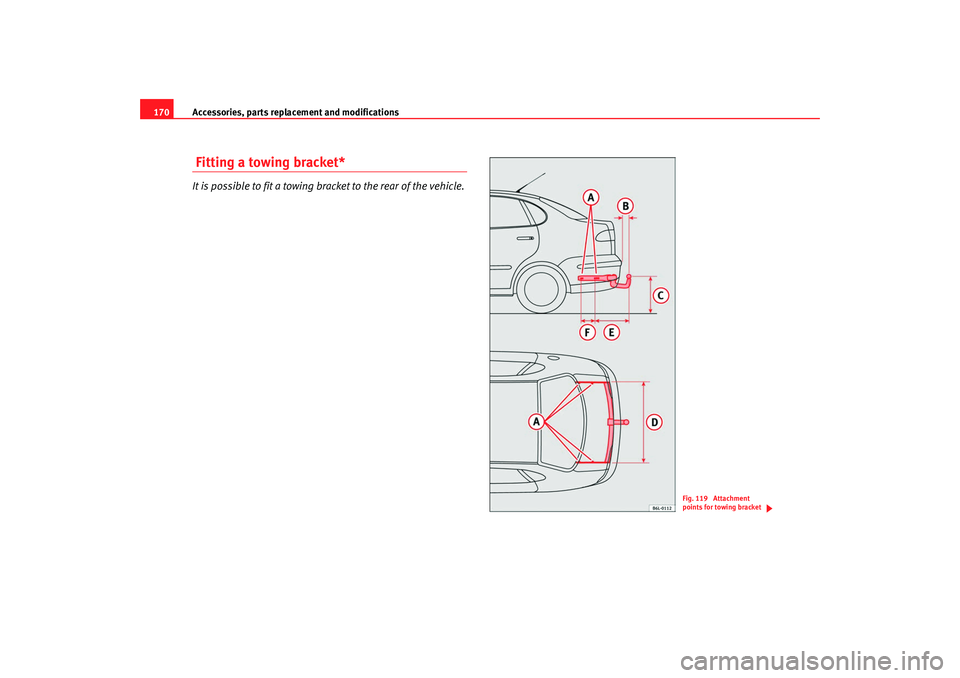
170 Fitting a towing bracket*It is possible to fit a towing bracket to the rear of the vehicle.
Fig. 119 Attachment
points for towing bracket
COR_ING_0707 Seite 170 Mittwoch, 1. August 2007 6:25 18
Page 173 of 258
Accessories, parts replacement and modifications171
Safety First
Operating instructions
Tips and Maintenance
Te c h n i c a l D a t a
If a towing bracket is to be fitted after the vehicle is purchased, this must be
completed according to the instructions of the towing bracket manufacturer.
The attachment points for the towing bracket are underneath the vehicle.
The distance between the centre of th
e ball coupling and the ground should
never be lower than the measurement indicated when the vehicle is fully
loaded including the maximum resting weight.
Measurement for securin g the towing bracket:
72 mm (minimum)
from 350 mm to 420 mm (fully laden vehicle)
958 mm
413 mm
166 mm
Fitting a towing bracket
•
Driving with a trailer implies additional work for the vehicle. Therefore,
before fitting a towing bracket, please contact an Authorised Service Centre
to check whether your cooling system needs modification.
•
Observe the legal requirements in yo ur country (e.g. the fitting of a sepa-
rate warning lamp).
•
Certain vehicle componen ts, e.g. the rear bumper must be removed and
reinstalled. The towing bracket securi ng bolts must be tightened using a
torque wrench, and an electrical sock et must be used to connect to the
vehicle's electrical system. This requires specialist knowledge and tools.
•
The figures in the illustration show the dimensions and attachment points
which must be observed if you are retrofitting a towing bracket.
WARNING
Towing brackets should be fitted by specialists.•
If the towing bracket is incorrectly installed, there is serious danger of
an accident.
•
For your own safety, please observe the instructions provided by the
manufacturer of the towing bracket.Caution
•
If the electrical socket is incorrectly installed, this could cause damage to
the vehicle's electrical system.
AA
ABACADAEAF
WARNING (continued)
COR_ING_0707 Seite 171 Mittwoch, 1. August 2007 6:25 18
Page 199 of 258
If and when197
Safety First
Operating instructions
Tips and Maintenance
Te c h n i c a l D a t a
Snow chains
For technical reasons, snow chains must not
be used on the compact tempo-
rary spare wheel.
If you should have a puncture on one of the front wheels when using snow
chains, fit the compact temporary spare in place of one of the rear wheels.
You can then attach the snow chains to the wheel taken from the rear and use
this wheel to replace the punctured front wheel.
WARNING
•
The tyre pressures must be checked and corrected as soon as possible.
•
Do not drive faster than 80 km/h. Higher speeds can cause an accident.
•
Avoid heavy acceleration, hard braking and fast cornering, risk of acci-
dent.
•
Never use two or more compact spare tyres at the same time, risk of
accident.
•
No other type of tyre (normal summer or winter tyre) may be fitted on
the compact temporary spare wheel rim.
Tyre repair kit*
The tyre repair kit (for vehicles not including a spare wheel) is
stored under the floor panel in the luggage compartment.Your vehicle is equipped with the Tyre Mobility System “Tyre repair kit”.
The tyre repair kit consists of a contai ner with sealing compound to repair the
puncture and a compressor to generate the required tyre pressure. The kit will
reliably seal punctures up to a size of about 4 mm caused by the penetration
of a foreign body into the tyre.
Note
•
Seek professional assistance if the repair of a tyre puncture is not
possible with the sealing compound.
Wheel changePreparation work
What you must do before changing a wheel.– If you have a flat tyre or puncture, park the vehicle as far away from the flow of traffic as possible. Choose a location that is as
level as possible.
– All passengers should leave the vehicle. They should wait in a
safe area (for instance behind the roadside crash barrier).
– Switch off the engine. Switch on the hazard warning lights.
–Apply the handbrake firmly.
– Engage the first gear , or put the selector lever to position P for
those vehicles with an automatic gearbox.
– If you are towing a trailer, unhitch it from your vehicle.
– Take the vehicle tools and the spare wheel out of the luggage
compartment.
COR_ING_0707 Seite 197 Mittwoch, 1. August 2007 6:25 18
Page 226 of 258
If and when
224To w i n g a n d t o w - s t a r t i n gTo w - s t a r t i n g *
The use of jump leads is preferable to tow-starting.We recommend that you do not t o w - s t a r t yo u r v e h i c l e . J u m p - s ta r t i n g
is preferable ⇒page 221.
However, if your vehicle has to be tow-started:
– Engage the 2
nd or the 3
rd gear.
– Keep the clutch pressed down.
– Switch on the ignition.
– Once both vehicles are moving, release the clutch.
– As soon as the engine starts, press the clutch and move the gear lever into neutral. This helps to prevent driving into the towing
vehicle.
WARNING
The risk of accidents is high when tow-starting. The vehicle being towed
can easily collide with the towing vehicle.
Caution
When tow-starting, fuel could enter the catalytic converter and damage it.
Towing eyesPlease observe the following points if you use a tow-rope:
Notes for the driver of the towing vehicle
– Drive slowly at first until the tow-rope is taut. Then accelerate gradually.
– Begin and change gears cautiously. If you are driving an auto- matic vehicle, accelerate gently.
– Remember that the brake servo and power steering are not working in the vehicle you are towing. Brake earlier than you
would normally, but with a more gentle pressure on the brake.
Notes for the driver of the towed vehicle
– Ensure that the tow-rope remains taut at all times when towing.
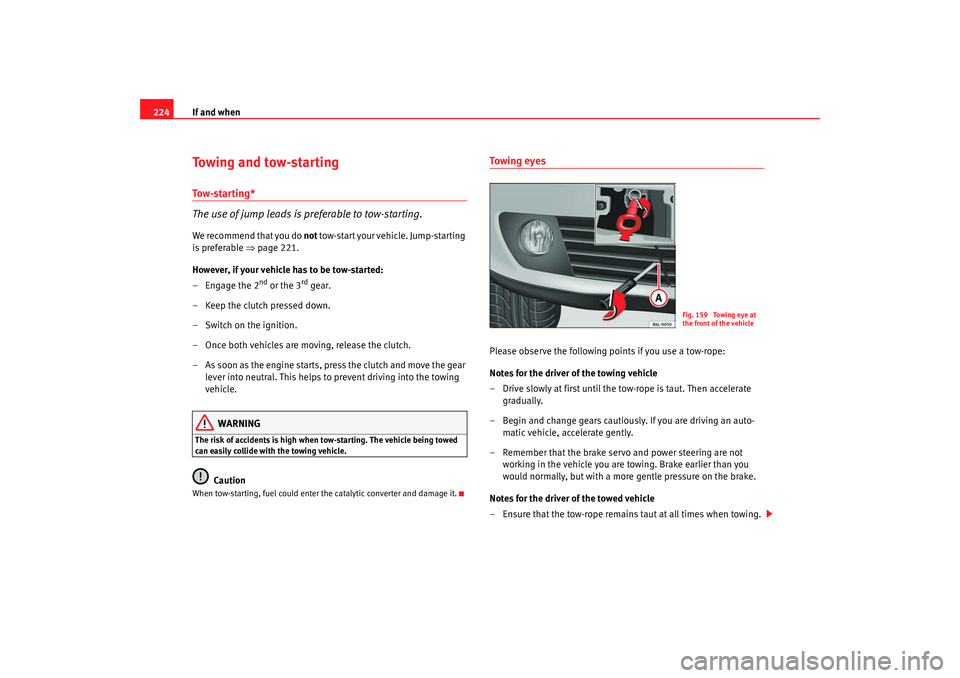
Fig. 159 Towing eye at
the front of the vehicle
COR_ING_0707 Seite 224 Mittwoch, 1. August 2007 6:25 18
Page 227 of 258
If and when225
Safety First
Operating instructions
Tips and Maintenance
Te c h n i c a l D a t a
Fitting the front towing eye
– First remove the right hand co ver from the lower part of the
bumper.
– Remove the bolt ⇒page 224, fig. 159 .
– Take the towing ring and the wheel spanner out of the vehicle tool kit.
– Turn the ring to the left with the box spanner until it is correctly screwed in.
– To remove the ring, turn to the right with the box spanner.Tow-rope or tow-bar
It is easier and safer to tow a vehicle with a tow-bar. You should only use a
tow-rope if you do not have a tow-bar.
A tow-rope should be slight ly elastic to reduce the loading on both vehicles.
It is advisable to use a tow-rope made of synthetic fibre or similarly elastic
material.
Attach the tow-rope or the tow-bar only to the towing eyes provided or a
towing bracket.
Driving style
Towing requires some experience, espec ially when using a tow-rope. Both
drivers should be famili ar with the technique required for towing. Inexperi-
enced drivers should not attempt to tow-start or tow away another vehicle.
Do not pull too hard with the towing vehi cle and take care to avoid jerking the
tow-rope. When towing on an unpaved road, there is always a risk of over-
loading and damaging the anchorage points.
The ignition of the vehicle being towed must be switched on to prevent the
steering wheel from locking and also to allow the use of the turn signals,
horn, windscreen wipers and washers. As the brake servo does not work if th
e engine is not running, you must apply
considerably more pressure to the brake pedal than you normally would.
As the power assisted steering does not work if the engine is not running, you
will need more strength to steer than you normally would.
Towing vehicles with an automatic gearbox
•
Put the selector lever into position “N”.
•
Do not drive faster than 50 km/h when towing a vehicle.
•
Do not tow further than 50 km.
•
If a breakdown vehicle is used, the vehicle must be towed with the front
wheels raised.Note
•
Observe legal requirements when towing or tow-starting.
•
Switch on the hazard warning lights of both vehicles. However, observe
any regulations to the contrary.
•
For technical reasons, vehicles with an automatic gearbox must not be
tow-started.
•
If damage to your vehicle means that there is no lubricant in the gearbox,
you must raise the drive wheels while the vehicle is being towed.
•
If the vehicle has to be towed more than 50 km, the front wheels must be
raised during towing, and towing should be carried out by a qualified person.
•
The steering wheel is locked when the vehicle has no electrical power. The
vehicle must then be towed with the front wheels raised. Towing should be
carried out by a qualified person.
•
The towing eye should always be kept in the vehicle. Please refer to the
notes on ⇒page 224, “Tow-starting*”.
AA
COR_ING_0707 Seite 225 Mittwoch, 1. August 2007 6:25 18
Page 232 of 258
General notes on the technical data
230WeightsKerb weight refers to the basic model with a fuel tank filled to 90% capacity
and without optional extras. The figure quoted includes 75 kg to allow for the
weight of the driver.
For special versions and optional equipment fittings or for the addition of
accessories, the weight of the vehicle will increase ⇒.
WARNING
•
Please note that the centre of gravity may shift when transporting
heavy objects; this may affect the vehi cle's handling and lead to an acci-
dent. Always adjust your speed and dr iving style to suit road conditions
and requirements.
•
Never exceed the gross axle weight rating or the gross vehicle weight
rating. If the allowed axle load or the allowed total weight is exceeded, the
driving characteristics of the vehicle may change, leading to accidents,
injuries and damage to the vehicle.
To w i n g a t r a i l e rTrailer weightsTrailer weights
The trailer weights and drawbar loads approved are selected in intensive
trials according to precisely defined criteria. The approved trailer weights are
valid for vehicles in the EU for maximum speeds of 80 km/h (in certain
circumstances up to 100 km/h). The figu res may be different in other coun-
tries. All data in the official vehicl e documents take precedence over these
data ⇒ . Drawbar load
The
maximum permitted weight exerted by the trailer drawbar on the ball joint
of the towing bracket must not exceed 75 kg.
In the interest of road safety, we recommend that you always tow
approaching the maximum drawbar load. The response of the trailer on the
road will be poor if th e drawbar load is too small.
If the maximum permissible drawbar load cannot be met (e.g. with small,
empty and light-weight single axle trailers or tandem axle trailers with an axle
base of less than 1 metre), at least 4% of the actual trailer weight is a legal
stipulation for a drawbar load.
WARNING
•
For safety reasons, you should not drive at speeds above 80 km/h when
towing a trailer. This also applies to countries where higher speeds are
permitted.
•
Never exceed the maximum trailer weights or the draw bar loading. If
the permissible axle load or the perm issible total weight is exceeded, the
driving characteristics of the vehicle may change, leading to accidents,
injuries and damage to the vehicle.
WheelsTyre pressure, snow chains, wheel boltsTyre pressures
The sticker with the tyre pressure values can be found on the inside of the
tank flap. The tyre pressure values given there are for cold tyres. The slightly
raised pressures of warm tyres must not be reduced ⇒.
COR_ING_0707 Seite 230 Mittwoch, 1. August 2007 6:25 18
Page 255 of 258

Index253
Switch
Hazard warning lights . . . . . . . . . . . . . . . . . . 91
Rear window heating . . . . . . . . . . . . . . . . . . . 90
Switches Electric windows . . . . . . . . . . . . . . . . . . . . . . 84
Sliding/tilting roof . . . . . . . . . . . . . . . . . . . . . 87
Switching off the engine . . . . . . . . . . . . . . . . . . 132TTailgate . . . . . . . . . . . . . . . . . . . . . . . . . . . . . . . . . 83
Tank fuel level . . . . . . . . . . . . . . . . . . . . . . . . . . . . . 54
reserve indicator . . . . . . . . . . . . . . . . . . . . . . 54
tank capacity . . . . . . . . . . . . . . . . . . . . . . . . . 54
TCS . . . . . . . . . . . . . . . . . . . . . . . . . . . . . . . . . . . 144
TCS (Traction control system) Warning lamp . . . . . . . . . . . . . . . . . . . . . . . . . 66
The danger of not using the seat belt . . . . . . . . 19
Tightening torque of wheel bolts . . . . . . . . . . . 231
Tools . . . . . . . . . . . . . . . . . . . . . . . . . . . . . . . . . . 196
Towing . . . . . . . . . . . . . . . . . . . . . . . . . . . . . . . . 224
Towing a trailer . . . . . . . . . . . . . . . . . . . . 154, 230
Towing bracket . . . . . . . . . . . . . . . . . . . . . . . . . . 155
Towing bracket, fitting . . . . . . . . . . . . . . . . . . . 170
Towing eye . . . . . . . . . . . . . . . . . . . . . . . . . . . . . 224
Tow-starting . . . . . . . . . . . . . . . . . . . . . . . . . . . . 224
Traction control system warning lamp . . . . . . . . . . . . . . . . . . . . . . . . . 66 Trailer turn signals
Indicator lamps . . . . . . . . . . . . . . . . . . . . . . . 67
Warning lamp . . . . . . . . . . . . . . . . . . . . . . . . . 93
Trailer weights . . . . . . . . . . . . . . . . . . . . . . . . . . 230
Trips, checklist . . . . . . . . . . . . . . . . . . . . . . . . . . . . 8
Turn signals . . . . . . . . . . . . . . . . . . . . . . . . . . . . . 92 Warning lamp . . . . . . . . . . . . . . . . . . . . . . 63, 93
Two-way radio . . . . . . . . . . . . . . . . . . . . . . . . . . 168
Type plate . . . . . . . . . . . . . . . . . . . . . . . . . . . . . . 228
Tyre Mobility-System (Tyre repair kit) . . . 197, 203
Tyre pressure . . . . . . . . . . . . . . . . . . . . . . . . . . . 191
Tyre pressures . . . . . . . . . . . . . . . . . . . . . . . . . . 230
Tyre repair kit . . . . . . . . . . . . . . . . . . . . . . 197, 203
Tyres and wheels Dimensions . . . . . . . . . . . . . . . . . . . . . . . . . 193
Tyres service life . . . . . . . . . . . . . . . . . . . . . . . . 192
Tyres tread depth . . . . . . . . . . . . . . . . . . . . . . . . 192
Tyres with directional tread pattern . . . . . . . . . 191
UUnderbody sealant . . . . . . . . . . . . . . . . . . . . . . 163
USB* connection . . . . . . . . . . . . . . . . . . . . . . . . 113VVehicle battery . . . . . . . . . . . . . . . . . . . . . . . . . . 188
Vehicle data . . . . . . . . . . . . . . . . . . . . . . . . . . . . 228
Vehicle identification data . . . . . . . . . . . . . . . . 228
Vehicle identification number . . . . . . . . . . . . . 228
Vehicle interior heating or cooling system . . . 120 Vehicle paint
Car care products . . . . . . . . . . . . . . . . . . . . 158
Vehicle tools Storage . . . . . . . . . . . . . . . . . . . . . . . . . . . . . 196
Vehicle wallet storage . . . . . . . . . . . . . . . . . . . . 108
Ventilation . . . . . . . . . . . . . . . . . . . . . . . . . . . . . 117
Ventilation slits . . . . . . . . . . . . . . . . . . . . . . . . . . 15
Volumetric sensor* Activation . . . . . . . . . . . . . . . . . . . . . . . . . . . . 81
Deactivation . . . . . . . . . . . . . . . . . . . . . . . . . . 81
WWarning lamp . . . . . . . . . . . . . . . . . . . . . . . . . . . 28
Warning lamps . . . . . . . . . . . . . . . . . . . . . . . . . . . 60
Warning triangles . . . . . . . . . . . . . . . . . . . . . . . 113
Washer fluid . . . . . . . . . . . . . . . . . . . . . . . . . . . . 185
Washing by hand . . . . . . . . . . . . . . . . . . . . . . . . 159
Washing the vehicle . . . . . . . . . . . . . . . . . . . . . 159
Washing with high pressure cleaners . . . . . . . 160
Water in the windscreen washer tank . . . . . . . 185
Wear indicators . . . . . . . . . . . . . . . . . . . . . . . . . 192
Wheel bolts . . . . . . . . . . . . . . . . . . . . . . . 200, 231Torque . . . . . . . . . . . . . . . . . . . . . . . . . . . . . 194
Wheel change . . . . . . . . . . . . . . . . . . . . . . . . . . 197
Wheel trims . . . . . . . . . . . . . . . . . . . . . . . . . . . . 199
Wheels . . . . . . . . . . . . . . . . . . . . . . . . . . . 190, 230
Why assume the correct sitting position? . . . . . 27
Why should head restraints be correctly adjusted? 12
COR_ING_0707 Seite 253 Mittwoch, 1. August 2007 6:25 18