lock Seat Cordoba 2008 Repair Manual
[x] Cancel search | Manufacturer: SEAT, Model Year: 2008, Model line: Cordoba, Model: Seat Cordoba 2008Pages: 258, PDF Size: 7.87 MB
Page 187 of 258
Checking and refilling levels185
Safety First
Operating instructions
Tips and Maintenance
Te c h n i c a l D a t a
Washer fluid and windscreen wiper bladesTopping up washer fluid
The water for cleaning the windscreen should always be
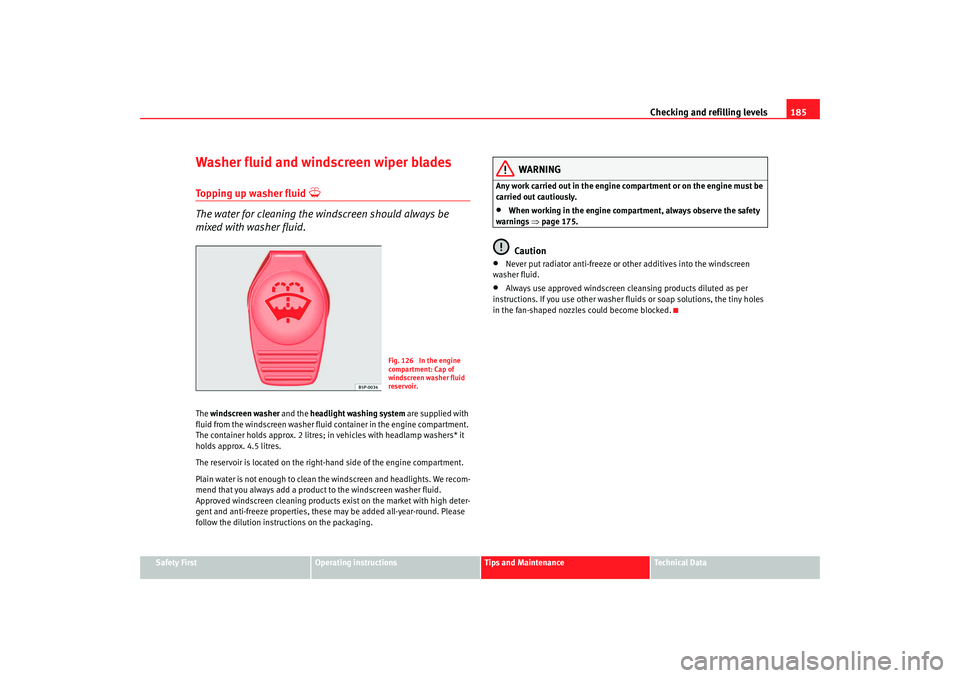
mixed with washer fluid.The windscreen washer and the headlight washing system are supplied with
fluid from the windscreen washer fluid container in the engine compartment.
The container holds approx. 2 litres; in vehicles with headlamp washers* it
holds approx. 4.5 litres.
The reservoir is located on the right-hand side of the engine compartment.
Plain water is not enough to clean the windscreen and headlights. We recom-
mend that you always add a product to the windscreen washer fluid.
Approved windscreen cleaning products exist on the market with high deter-
gent and anti-freeze properties, these may be added all-year-round. Please
follow the dilution instructions on the packaging.
WARNING
Any work carried out in the engine compartment or on the engine must be
carried out cautiously.•
When working in the engine compartm ent, always observe the safety
warnings ⇒page 175.Caution
•
Never put radiator anti-freeze or other additives into the windscreen
washer fluid.
•
Always use approved windscreen cleansing products diluted as per
instructions. If you use other washer fl uids or soap solutions, the tiny holes
in the fan-shaped nozzles could become blocked.
Fig. 126 In the engine
compartment: Cap of
windscreen washer fluid
reservoir.
COR_ING_0707 Seite 185 Mittwoch, 1. August 2007 6:25 18
Page 189 of 258
Checking and refilling levels187
Safety First
Operating instructions
Tips and Maintenance
Te c h n i c a l D a t a
Brake fluidChecking the brake fluid level
The brake fluid is checked at the intervals given in the service
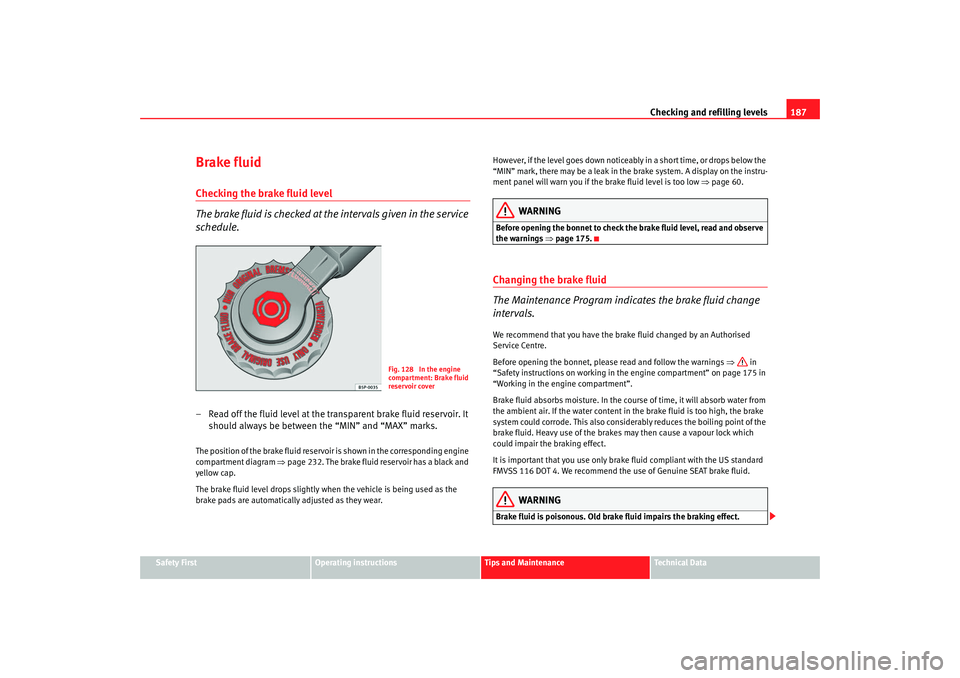
schedule.– Read off the fluid level at the transparent brake fluid reservoir. It
should always be between the “MIN” and “MAX” marks.The position of the brake fluid reservoir is shown in the corresponding engine
compartment diagram ⇒page 232. The brake fluid reservoir has a black and
yellow cap.
The brake fluid level drops slightly when the vehicle is being used as the
brake pads are automatically adjusted as they wear. However, if the level goes down noticeably in a short time, or drops below the
“MIN” mark, there may be a leak in the brake system. A display on the instru-
ment panel will warn you if the brake fluid level is too low
⇒page 60.
WARNING
Before opening the bonnet to check the brake fluid level, read and observe
the warnings ⇒ page 175.Changing the brake fluid
The Maintenance Program indicates the brake fluid change
intervals.We recommend that you have the brake fluid changed by an Authorised
Service Centre.
Before opening the bonnet, please read and follow the warnings ⇒ in
“Safety instructions on working in the engine compartment” on page 175 in
“Working in the engine compartment”.
Brake fluid absorbs moisture. In the course of time, it will absorb water from
the ambient air. If the water content in the brake fluid is too high, the brake
system could corrode. This also considerably reduces the boiling point of the
brake fluid. Heavy use of the brakes may then cause a vapour lock which
could impair the braking effect.
It is important that you use only brake fluid compliant with the US standard
FMVSS 116 DOT 4. We recommend the use of Genuine SEAT brake fluid.
WARNING
Brake fluid is poisonous. Old brake fluid impairs the braking effect.
Fig. 128 In the engine
compartment: Brake fluid
reservoir cover
COR_ING_0707 Seite 187 Mittwoch, 1. August 2007 6:25 18
Page 190 of 258
Checking and refilling levels
188•
Before opening the bonnet to check the brake fluid level, read and
observe the warnings ⇒ page 175.
•
Brake fluid should be stored in the closed original container in a safe
place out of reach of children. There is a toxic risk.
•
Complete the brake fluid change according to the Maintenance
Program. Heavy use of the brakes may cause a vapour lock if the brake fluid
is left in the system for too long. This would seriously affect the efficiency
of the brakes and the safety of the vehicle. This may cause an accident.Caution
Brake fluid could damage the paintwork. Wipe off any brake fluid from the
paintwork immediately.
For the sake of the environment
Brake fluid must be drained and disposed of in the proper manner observing
environmental regulations.
BatteryWarnings on handling the battery
WARNING
Always be aware of the danger of injury and chemical burns as well as the
risk of accident or fire when work ing on the battery and the electrical
system:•
Wear eye protection. Protect your eyes, skin and clothing from acid and
particles containing lead.
•
Battery acid is very corrosive and caustic. Wear protective gloves and
eye protection. Do not tilt the batter ies. This could spill acid through the
vents. Rinse battery acid from eyes immediately for several minutes with
clear water. Then seek medical care immediately. Neutralize any acid
splashes on the skin or clothing with a soapy solution, and rinse off with
plenty of water. If acid is swallowed by mistake, consult a doctor immedi-
ately.
•
Fires, sparks, naked lights and smoking are prohibited. When handling
cables and electrical equipment, avoid causing sparks and electrostatic
WARNING (continued)
Wear eye protection
Battery acid is very corrosive and caustic. Wear protec-
tive gloves and eye protection!
Fires, sparks, naked lights and smoking are prohibited!
A highly explosive mixture of gases is released when the
battery is under charge.
Keep children away from acid and batteries!
COR_ING_0707 Seite 188 Mittwoch, 1. August 2007 6:25 18
Page 191 of 258
Checking and refilling levels189
Safety First
Operating instructions
Tips and Maintenance
Te c h n i c a l D a t a
charge. Never short the battery terminals. High-energy sparks can cause
injury.
•
A highly explosive mixture of gases is released when the battery is
under charge. The batteries should be charged in a well-ventilated room
only.
•
Keep children away from acid and batteries.
•
Before working on the electrical system, you must switch off the
engine, the ignition and all consumers. The negative cable on the battery
must be disconnected. When a light bulb is changed, you need only switch
off the light.
•
Deactivate the anti-theft alarm by unlocking the vehicle before you
disconnect the battery! The alar m will otherwise be triggered.
•
When disconnecting the battery from the vehicle electrical system,
disconnect first the negative cable and then the positive cable.
•
Switch off all electrical consumers before reconnecting the battery.
Reconnect first the positive cable and then the negative cable. Never
reverse the polarity of the connections. This could cause an electrical fire.
•
Never charge a frozen battery, or one which has thawed. This could
result in explosions and chemical burns. Always replace a battery which
has frozen. A flat battery can freeze at temperatures around 0
°C.
•
Ensure that the vent hose is always connected to the battery.
•
Never use a defective battery. This may be fatally explosive. Replace a
damaged battery immediately.Caution
•
Never disconnect the battery if the ignition is switched on or if the engine
is running. This could damage the electrical system or electronic compo-
nents.
•
Do not expose the battery to direct sunlight over a long period of time, as
the intense ultraviolet radiation can damage the battery housing.
•
If the vehicle is left standing in cold conditions for a long period, protect
the battery from frost. If it “freezes” it will be damaged.
Checking the electrolyte level
The electrolyte level should be checked regularly in high-
mileage vehicles, in hot countries and in older batteries.– Open the bonnet and open the battery cover at the front ⇒ in
“Safety instructions on working in the engine compartment” on
page 175 ⇒ in “Warnings on handling the battery” on
page 188.
– Check the colour display in the "magic eye" on the top of the battery.
– If there are air bubbles in the window, tap the window gently until they disperse.The position of the battery is show n in the corresponding engine compart-
ment diagram ⇒page 232.
The round window (“magic eye”) on the top of the battery changes colour,
depending on the charge level and electrolyte level of the battery.
If the colour in the window is colourless or bright yellow, the electrolyte level
of the battery is too low. Have the battery checked by a qualified workshop.
The colours green and black are used by the workshops for diagnostic
purposes.
WARNING (continued)
COR_ING_0707 Seite 189 Mittwoch, 1. August 2007 6:25 18
Page 200 of 258
If and when
198
WARNING
Put the hazard warning lights on and pl ace the warning triangle in position.
This is for your own safety and also warns other road users.
Caution
If you have to change the tyre on a gradient, block the wheel opposite the
wheel being changed by placing a stone or similar object under it to prevent
the vehicle from rolling away.
Note
Please observe legal requirements when doing so.Changing a wheelChange the wheel as described below
– Remove the hub cap. Also refer to ⇒page 199.
–Slacken the wheel bolts.
– Raise the car with the jack in the corresponding zone.
– Ta k e o f f the wheel and then put on the spare wheel.
– Lower the vehicle.
– Tighten the wheel bolts firmly i n d ia go na l s e q u e n ce wi t h t h e b ox
spanner.
–Replace the hub cap.
After changing a wheel
After changing the wheel there are still tasks to complete.– Put the tools and jack back in the luggage compartment.
– Place the wheel with the defective tyre in the luggage compart- ment and secure it.
– Check the tyre pressure of the newly fitted tyre as soon as possible.
– Have the tightening torque of the wheel bolts checked as soon as possible with a torque wrench. The prescribed torque is 120 Nm.
Note•
If you notice that the wheel bolts are corroded and difficult to turn when
changing a wheel, they must be replaced before having the wheel bolt torque
checked.
•
In the interest of safety, drive at moderate speeds until the wheel bolt
torque has been checked.
COR_ING_0707 Seite 198 Mittwoch, 1. August 2007 6:25 18
Page 210 of 258

If and when
208
22 Main beam headlight, left 10
23 Number plate light/si de light indicator 5
24 Rear windscreen wiper 10
25 Injectors(fuel) 10
26 Brake light switch /ESP (Turn sensor) 10
27 Instrument panel/Diagnosis 5
28 Switchboard: glovebox light, boot light, interior light 10
29 Climatronic 5
30 Power supply central locking unit 5
31 Left front window control 25
32 Vacant
33 Self powered alarm horn 15
34 Engine control unit 15
35 Sunroof 20
36 Engine ventilator heating /blower 25
37 Headlight washer pump 20
38 Front and rear fog lights 15
39 Engine control unit (petrol) 15
40 Engine control unit diesel + SDI Fuel pump 30
41 Fuel gauge 15
42 Ignition transformer+ Engine control unit T70 15
43 Dipped headlight (right side) 15
44 Left rear window control 25
45 Front right window control 25
Number
Consumer Amperes
COR_ING_0707 Seite 208 Mittwoch, 1. August 2007 6:25 18
Page 211 of 258
If and when209
Safety First
Operating instructions
Tips and Maintenance
Te c h n i c a l D a t a
Fuses below steering wheel in relay holderPTC fuses46
Windscreen wiper unit 20
47 Heated rear window unit 20
48 Indicator unit 15
49 Cigarette lighter 15
50 Locking unit 15
51 Radio/CD/GPS/Telephone 20
52 Horn 20
53 Dipped headlight (left side) 15
54 Right rear window control 25a)The signal “S”is a system which includes the starter and steering lock and enables, after the ignition is switched off and with out removing the key from the steering and starter lock,
certain electrical components to be switched on, including for example, the radio, the courtesy light, etc. This function is de activated on removing the key from the steering and starter
lock.
Number Consumer Amperes
1 PTCs (Supplementary electrical heating using air) 40
2 PTCs (Supplementary electrical heating using air) 40
3 PTCs (Supplementary electrical heating using air) 40
Number
Consumer Amperes
COR_ING_0707 Seite 209 Mittwoch, 1. August 2007 6:25 18
Page 224 of 258
If and when
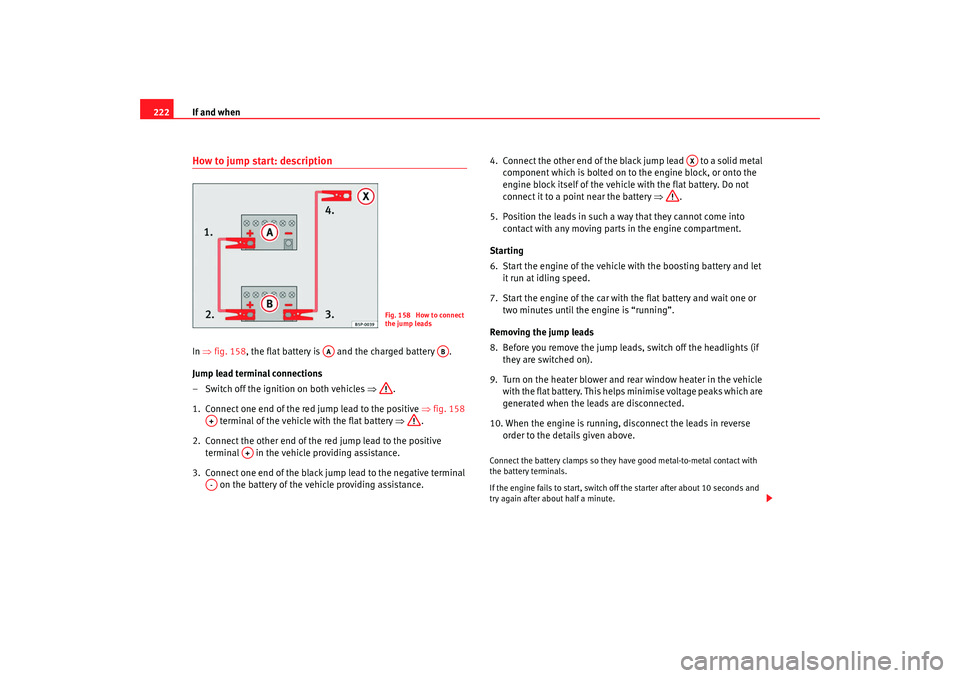
222How to jump start: descriptionIn ⇒ fig. 158, the flat battery is and the charged battery .
Jump lead terminal connections
– Switch off the ignition on both vehicles ⇒.
1. Connect one end of the red jump lead to the positive ⇒fig. 158
terminal of the vehicle with the flat battery ⇒.
2. Connect the other end of the red jump lead to the positive terminal in the vehicle providing assistance.
3. Connect one end of the black jump lead to the negative terminal on the battery of the vehicle providing assistance. 4. Connect the other end of the black jump lead to a solid metal
component which is bolted on to the engine block, or onto the
engine block itself of the vehicle with the flat battery. Do not
connect it to a point near the battery ⇒.
5. Position the leads in such a way that they cannot come into contact with any moving parts in the engine compartment.
Starting
6. Start the engine of the vehicle with the boosting battery and let it run at idling speed.
7. Start the engine of the car with the flat battery and wait one or two minutes until the engine is “running”.
Removing the jump leads
8. Before you remove the jump leads, switch off the headlights (if they are switched on).
9. Turn on the heater blower and rear window heater in the vehicle with the flat battery. This helps minimise voltage peaks which are
generated when the leads are disconnected.
10. When the engine is running, disconnect the leads in reverse order to the deta ils given above.
Connect the battery clamps so they have good metal-to-metal contact with
the battery terminals.
If the engine fails to start, switch off the starter after about 10 seconds and
try again after about half a minute.
Fig. 158 How to connect
the jump leads
AA
AB
A+
A+
A-
AX
COR_ING_0707 Seite 222 Mittwoch, 1. August 2007 6:25 18
Page 227 of 258
If and when225
Safety First
Operating instructions
Tips and Maintenance
Te c h n i c a l D a t a
Fitting the front towing eye
– First remove the right hand co ver from the lower part of the
bumper.
– Remove the bolt ⇒page 224, fig. 159 .
– Take the towing ring and the wheel spanner out of the vehicle tool kit.
– Turn the ring to the left with the box spanner until it is correctly screwed in.
– To remove the ring, turn to the right with the box spanner.Tow-rope or tow-bar
It is easier and safer to tow a vehicle with a tow-bar. You should only use a
tow-rope if you do not have a tow-bar.
A tow-rope should be slight ly elastic to reduce the loading on both vehicles.
It is advisable to use a tow-rope made of synthetic fibre or similarly elastic
material.
Attach the tow-rope or the tow-bar only to the towing eyes provided or a
towing bracket.
Driving style
Towing requires some experience, espec ially when using a tow-rope. Both
drivers should be famili ar with the technique required for towing. Inexperi-
enced drivers should not attempt to tow-start or tow away another vehicle.
Do not pull too hard with the towing vehi cle and take care to avoid jerking the
tow-rope. When towing on an unpaved road, there is always a risk of over-
loading and damaging the anchorage points.
The ignition of the vehicle being towed must be switched on to prevent the
steering wheel from locking and also to allow the use of the turn signals,
horn, windscreen wipers and washers. As the brake servo does not work if th
e engine is not running, you must apply
considerably more pressure to the brake pedal than you normally would.
As the power assisted steering does not work if the engine is not running, you
will need more strength to steer than you normally would.
Towing vehicles with an automatic gearbox
•
Put the selector lever into position “N”.
•
Do not drive faster than 50 km/h when towing a vehicle.
•
Do not tow further than 50 km.
•
If a breakdown vehicle is used, the vehicle must be towed with the front
wheels raised.Note
•
Observe legal requirements when towing or tow-starting.
•
Switch on the hazard warning lights of both vehicles. However, observe
any regulations to the contrary.
•
For technical reasons, vehicles with an automatic gearbox must not be
tow-started.
•
If damage to your vehicle means that there is no lubricant in the gearbox,
you must raise the drive wheels while the vehicle is being towed.
•
If the vehicle has to be towed more than 50 km, the front wheels must be
raised during towing, and towing should be carried out by a qualified person.
•
The steering wheel is locked when the vehicle has no electrical power. The
vehicle must then be towed with the front wheels raised. Towing should be
carried out by a qualified person.
•
The towing eye should always be kept in the vehicle. Please refer to the
notes on ⇒page 224, “Tow-starting*”.
AA
COR_ING_0707 Seite 225 Mittwoch, 1. August 2007 6:25 18
Page 249 of 258
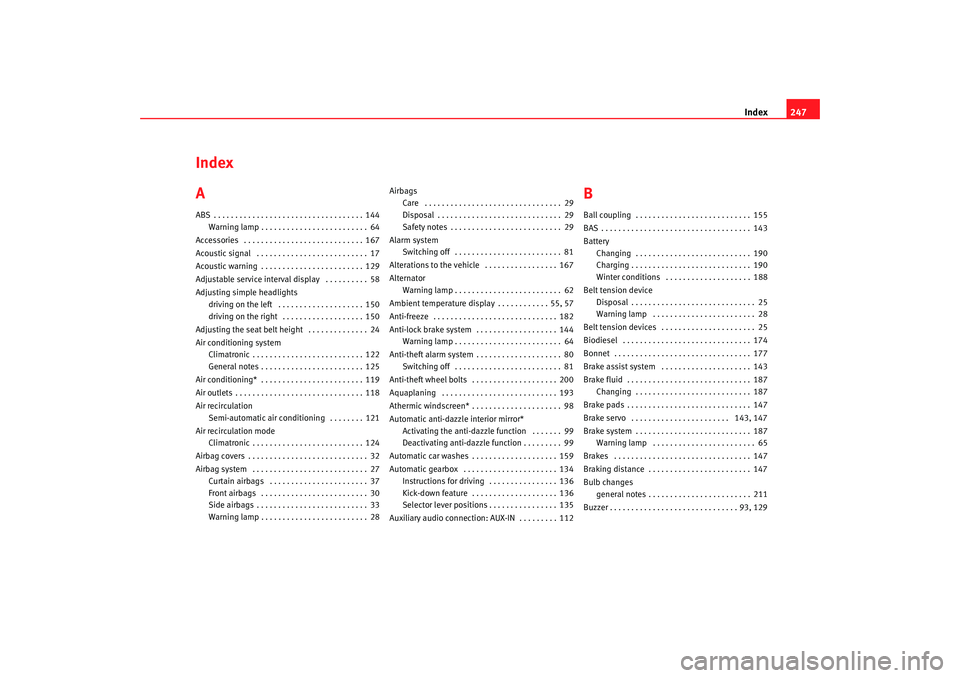
Index247
Index
AABS . . . . . . . . . . . . . . . . . . . . . . . . . . . . . . . . . . . 144
Warning lamp . . . . . . . . . . . . . . . . . . . . . . . . . 64
Accessories . . . . . . . . . . . . . . . . . . . . . . . . . . . . 167
Acoustic signal . . . . . . . . . . . . . . . . . . . . . . . . . . 17
Acoustic warning . . . . . . . . . . . . . . . . . . . . . . . . 129
Adjustable service interval display . . . . . . . . . . 58
Adjusting simp le headlights
driving on the left . . . . . . . . . . . . . . . . . . . . 150
driving on the right . . . . . . . . . . . . . . . . . . . 150
Adjusting the seat belt height . . . . . . . . . . . . . . 24
Air conditioning system Climatronic . . . . . . . . . . . . . . . . . . . . . . . . . . 122
General notes . . . . . . . . . . . . . . . . . . . . . . . . 125
Air conditioning* . . . . . . . . . . . . . . . . . . . . . . . . 119
Air outlets . . . . . . . . . . . . . . . . . . . . . . . . . . . . . . 118
Air recirculation Semi-automatic air conditi oning . . . . . . . . 121
Air recirculation mode Climatronic . . . . . . . . . . . . . . . . . . . . . . . . . . 124
Airbag covers . . . . . . . . . . . . . . . . . . . . . . . . . . . . 32
Airbag system . . . . . . . . . . . . . . . . . . . . . . . . . . . 27 Curtain airbags . . . . . . . . . . . . . . . . . . . . . . . 37
Front airbags . . . . . . . . . . . . . . . . . . . . . . . . . 30
Side airbags . . . . . . . . . . . . . . . . . . . . . . . . . . 33
Warning lamp . . . . . . . . . . . . . . . . . . . . . . . . . 28 Airbags
Care . . . . . . . . . . . . . . . . . . . . . . . . . . . . . . . . 29
Disposal . . . . . . . . . . . . . . . . . . . . . . . . . . . . . 29
Safety notes . . . . . . . . . . . . . . . . . . . . . . . . . . 29
Alarm system Switching off . . . . . . . . . . . . . . . . . . . . . . . . . 81
Alterations to the vehicle . . . . . . . . . . . . . . . . . 167
Alternator Warning lamp . . . . . . . . . . . . . . . . . . . . . . . . . 62
Ambient temperature display . . . . . . . . . . . . 55, 57
Anti-freeze . . . . . . . . . . . . . . . . . . . . . . . . . . . . . 182
Anti-lock brake system . . . . . . . . . . . . . . . . . . . 144 Warning lamp . . . . . . . . . . . . . . . . . . . . . . . . . 64
Anti-theft alarm system . . . . . . . . . . . . . . . . . . . . 80 Switching off . . . . . . . . . . . . . . . . . . . . . . . . . 81
Anti-theft wheel bolts . . . . . . . . . . . . . . . . . . . . 200
Aquaplaning . . . . . . . . . . . . . . . . . . . . . . . . . . . 193
Athermic windscreen* . . . . . . . . . . . . . . . . . . . . . 98
Automatic anti-dazzle interior mirror* Activating the anti-dazzle function . . . . . . . 99
Deactivating anti-dazzle function . . . . . . . . . 99
Automatic car washes . . . . . . . . . . . . . . . . . . . . 159
Automatic gearbox . . . . . . . . . . . . . . . . . . . . . . 134 Instructions for driving . . . . . . . . . . . . . . . . 136
Kick-down feature . . . . . . . . . . . . . . . . . . . . 136
Selector lever positions . . . . . . . . . . . . . . . . 135
Auxiliary audio connection: AUX-IN . . . . . . . . . 112
BBall coupling . . . . . . . . . . . . . . . . . . . . . . . . . . . 155
BAS . . . . . . . . . . . . . . . . . . . . . . . . . . . . . . . . . . . 143
Battery Changing . . . . . . . . . . . . . . . . . . . . . . . . . . . 190
Charging . . . . . . . . . . . . . . . . . . . . . . . . . . . . 190
Winter conditions . . . . . . . . . . . . . . . . . . . . 188
Belt tension device Disposal . . . . . . . . . . . . . . . . . . . . . . . . . . . . . 25
Warning lamp . . . . . . . . . . . . . . . . . . . . . . . . 28
Belt tension devices . . . . . . . . . . . . . . . . . . . . . . 25
Biodiesel . . . . . . . . . . . . . . . . . . . . . . . . . . . . . . 174
Bonnet . . . . . . . . . . . . . . . . . . . . . . . . . . . . . . . . 177
Brake assist system . . . . . . . . . . . . . . . . . . . . . 143
Brake fluid . . . . . . . . . . . . . . . . . . . . . . . . . . . . . 187 Changing . . . . . . . . . . . . . . . . . . . . . . . . . . . 187
Brake pads . . . . . . . . . . . . . . . . . . . . . . . . . . . . . 147
Brake servo . . . . . . . . . . . . . . . . . . . . . . . 143, 147
Brake system . . . . . . . . . . . . . . . . . . . . . . . . . . . 187 Warning lamp . . . . . . . . . . . . . . . . . . . . . . . . 65
Brakes . . . . . . . . . . . . . . . . . . . . . . . . . . . . . . . . 147
Braking distance . . . . . . . . . . . . . . . . . . . . . . . . 147
Bulb changes general notes . . . . . . . . . . . . . . . . . . . . . . . . 211
Buzzer . . . . . . . . . . . . . . . . . . . . . . . . . . . . . . 93, 129
COR_ING_0707 Seite 247 Mittwoch, 1. August 2007 6:25 18