brake fluid Seat Exeo 2008 User Guide
[x] Cancel search | Manufacturer: SEAT, Model Year: 2008, Model line: Exeo, Model: Seat Exeo 2008Pages: 303, PDF Size: 10.02 MB
Page 215 of 303
Checking and refilling levels213
Safety First
Operating instructions
Practical tips
Te c h n i c a l D a t a
WARNING
Never open the bonnet if you see steam or drips of coolant being released
from the engine compartment. Failure to comply could result in burns. Wait
until no steam or coolant can be seen before opening the bonnet.Work in the engine compartment
Extra caution is necessary when working on components in
the engine compartment.Always be aware of the danger of injury and scalding as well as the risk of
accident or even fire when working in the engine compartment (e.g. when
checking and refilling fluids). Therefor e, always observe the warnings listed
below and follow all general safety precautions. The engine compartment of
any motor vehicle is a potentially hazardous area ⇒
WARNING
•
Switch the engine off.
•
Remove the ignition key.
•
Apply handbrake firmly.
•
Place the gear lever into neutral.
•
Wait for the engine to cool down.
•
Children should not be allowed to approach the engine compartment
•
Never spill liquids involved in vehicle operations on the engine
compartment, as these may catch fire (e.g. anti-freeze containing liquid
coolant).
•
Take care not to cause short circuits in the electrical system, especially
when working on the battery.
•
Never touch the radiator fan while the engine is hot, as the fan could
start up suddenly.
•
Never open the expansion tank when the engine is hot. The cooling
system is under pressure.
•
Protect face, hands and arms from any hot steam or hot liquid coolant
released by covering the cap with a large, thick rag when opening the
expansion tank.
•
If any tests have to be performed with the engine running, there is an
extra safety risk from the rotating parts, such as the drive belts, alternator
and radiator fan, etc., and from the high-voltage ignition system.
•
Observe the following additional warnings if work on the fuel system or
the electrical system is necessary:
−Always disconnect the battery.
− Do not smoke.
− Never work near open flames
− Always keep an approved fire extinguisher immediately available.Caution
When topping up fluids, make sure the correct fluid is put into the correct
filler opening. This can otherwise cau se serious malfunctions or engine
damage.
For the sake of the environment
Inspect the ground underneath your vehicle regularly so that any leaks are
detected at an early stage. If you find spots of oil or other fluids, have your
vehicle inspected in the garage.
WARNING (continued)
Exeo_EN.book Seite 213 Freitag, 17. Oktober 2008 11:24 11
Page 224 of 303
Checking and refilling levels
222•
To prevent smearing on the windscreen, the wiper blades should be
cleaned regularly using a window cleaner solution. If the wiper blades are
very dirty (e.g. insects etc.), they should be cleaned using a sponge or
cloth. Failure to do so co uld result in an accident.
•
For safety reasons, the wiper blades should be changed once or twice a
year.Caution
•
Damaged or dirty windscreen wipers could scratch the windscreen.
•
Never use fuel, nail varnish remover, paint thinner or similar products to
clean the windows. This could damage the windscreen wiper blades.
•
Never move the windscreen wiper or windscreen wiper arm manually. This
could cause damage.
•
Do not pull the windscreen wipers forward unless they are in the service
position. Otherwise the bonnet could be damaged.Note
•
The wiper arms can be moved to the service position only when the
bonnet is properly closed.
Brake fluidChecking the brake fluid level
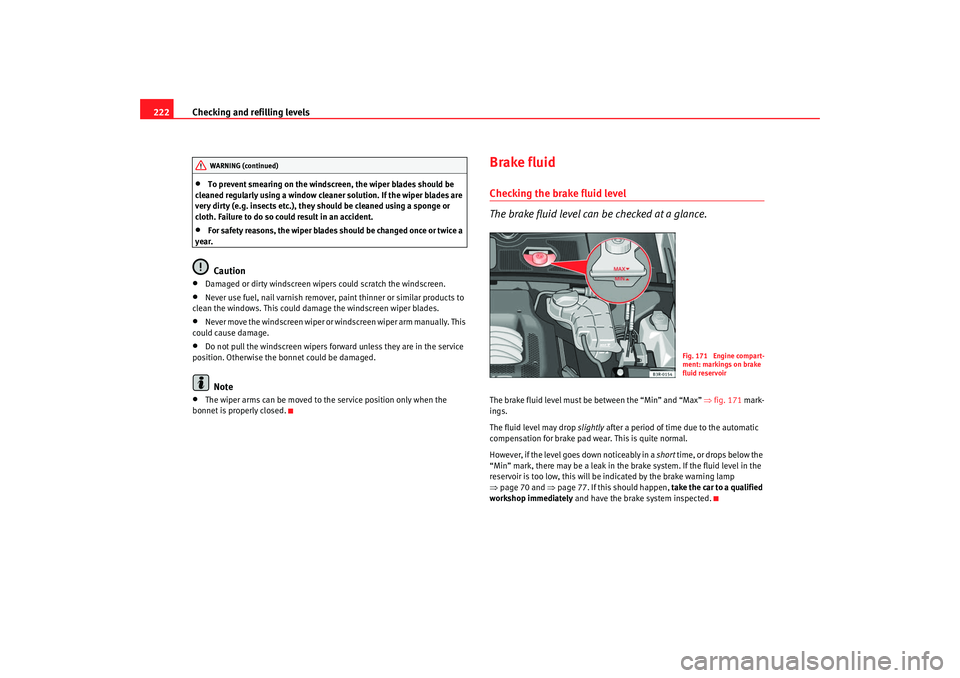
The brake fluid level can be checked at a glance.The brake fluid level must be between the “Min” and “Max” ⇒fig. 171 mark-
ings.
The fluid level may drop slightly after a period of time due to the automatic
compensation for brake pad wear. This is quite normal.
However, if the level goes down noticeably in a short time, or drops below the
“Min” mark, there may be a leak in the brake system. If the fluid level in the
reservoir is too low, this will be indicated by the brake warning lamp
⇒ page 70 and ⇒ page 77. If this should happen, take the car to a qualified
workshop immediately and have the brake system inspected.
WARNING (continued)
Fig. 171 Engine compart-
ment: markings on brake
fluid reservoir
Exeo_EN.book Seite 222 Freitag, 17. Oktober 2008 11:24 11
Page 225 of 303
Checking and refilling levels223
Safety First
Operating instructions
Practical tips
Te c h n i c a l D a t a
Topping up and changing the brake fluid
It is best to have the brake fluid changed by a professional.Brake fluid absorbs damp. Therefore, in the course of time it will absorb water
from the ambient air. If the water content in the brake fluid is too high, the
brake system could corrode. In addition, the boiling point of the brake fluid
will be considerably reduced. This could adversely affect the braking ability in
certain circumstances.
For this reason the brake fluid must be changed periodically.
Your vehicle's Service Schedule will tell you when the brake fluid has to be
renewed.
We recommend you have the brake fluid changed as part of a regular Inspec-
tion Service at your garage. They are familiar with the procedure and have the
necessary special tools and spare parts as well as the proper facilities for
disposing of the old fluid.
Use only the genuine brake fluid specified by the factory Specialist garages
know that the brake fluid -DOT 4- is factory approved. The brake fluid must be
new.
WARNING
•
Therefore, it must always be kept closed in its original container. Keep
out of the reach of children. Failure to comply could result in poisoning.
•
Heavy use of the brakes may cause a vapour lock if the brake fluid is left
in the system for too long. This would seriously affect the efficiency of the
brakes and the safety of the car, leading to the risk of accident.Caution
Please note that brake fluid will attack the paintwork on contact.
For the sake of the environment
If the fluid has to be drained out of the brake system, use an appropriate
container to catch the used brake fluid and dispose of it in the proper
manner.BatteryGeneral notes
All work on batteries requires specialist knowledge.The battery is virtually maintenance-free and is checked in the Inspection
Services.
We recommend that you replace a battery once it is older than 5 years.
Disconnecting the battery
If the battery is disconnected, some of the vehicle's functions will become
inoperative (e.g. electric windows). These functions will require resetting
after the battery is reconnected. For th is reason, the battery should only be
disconnected from the vehicle's electr ical system when absolutely necessary.
Long periods of non-use
The battery will gradually lose its charge because certain electrical equip-
ment continues to draw current even when the ignition is off. If you park the
vehicle for long periods of time in winter you should take the battery out of
the vehicle and keep it in a frost-proof room. Store the battery in a place
where it cannot “freeze up” and become damaged. At warm outside temper-
atures it is sufficient to disconnect the negative terminal of the battery. Even
when the battery is not connected you should charge it from time to time.
Exeo_EN.book Seite 223 Freitag, 17. Oktober 2008 11:24 11
Page 233 of 303

Wheels and tyres231
Safety First
Operating instructions
Practical tips
Te c h n i c a l D a t a
Wear indicators
The original tyres on your vehicle have 1.6 mm high “tread wear indicators”
⇒
page 230, fig. 173 , running across the tread. Depending on the make,
there will be six to eight of them evenly spaced around the tyre. Markings on
the tyre sidewall (for instance the letters “TWI” or other symbols) indicate the
positions of the tread wear indicators. The minimum tread depth required by
law is 1.6 mm (measured in the tread grooves next to the tread wear indica-
tors). Worn tyres must be replaced. Different figures may apply in export
countries ⇒.
Tyre pressure
Under-inflation or over-inflation will reduce the life of the tyres considerably
and also impair the car's handling. The inflation pressures are listed on a
sticker on the inside of the fuel tank flap.
Correct inflation pressures are very important, especially at high speeds. The
pressure should therefore be checked at least once a month and before
starting any long journey.
Tyre pressure monitoring (RKA+)*
Monitoring of the tyre pressures is based on the tyre pressures you have
stored. The tyre pressure monitoring syst em cannot function as intended if
you store tyre pressure settings for a normal load, but then drive with the
vehicle fully laden. The tyre pressure must be adapted to the actual load and
stored accordingly in the tyre pressure monitoring system ⇒page 229.
Driving style
Fast cornering, heavy acceleration and hard braking all increase tyre wear.
Changing wheels around
If the front tyres are worn considerably more than the rear ones it is advisable
to change them around as shown ⇒page 230, fig. 174 . All the tyres will then
last for about the same time. Wheel balance
The wheels on new vehicles are balanced. However, various factors encoun-
tered in normal driving can cause them to become unbalanced, which results
in steering vibration.
Unbalanced wheels should be rebalanced, as they otherwise cause excessive
wear on steering, suspension and tyres. A wheel must also be rebalanced
when a new tyre is fitted.
Incorrect wheel alignment
Incorrect wheel alignment causes excessive tyre wear, impairing the safety of
the vehicle. If tyres show excessive wear, you should have the wheel align-
ment checked by an Authorised Service Centre.
WARNING
There is a serious danger of accidents if a tyre bursts during driving!•
The tyres must be replaced at the latest when the tread is worn down to
the tread wear indicators. Failure to do so could result in an accident. Worn
tyres do not grip well at high speeds on wet roads. There is also a greater
risk of “aquaplaning”
•
At continuously high speeds, a tyre with insufficient pressure flexes
more. This causes it to overheat. This can cause tread separation and tyre
blow-out. Risk of accident. Always observe the recommended tyre pres-
sures.
•
If tyres show excessive wear, you should have the running gear checked
by an Authorised Service Centre.
•
Keep chemicals such as oil, fuel and brake fluid away from tyres.
•
Damaged wheels and tyres must be replaced immediately!For the sake of the environment
Under-inflated tyres will increase fuel consumption.
Exeo_EN.book Seite 231 Freitag, 17. Oktober 2008 11:24 11
Page 284 of 303
Technical Data
282Te c h n i c a l D a t aChecking fluid levelsFrom time to time, the levels of the different fluids in the
vehicle must be checked. Never fill with incorrect fluids,
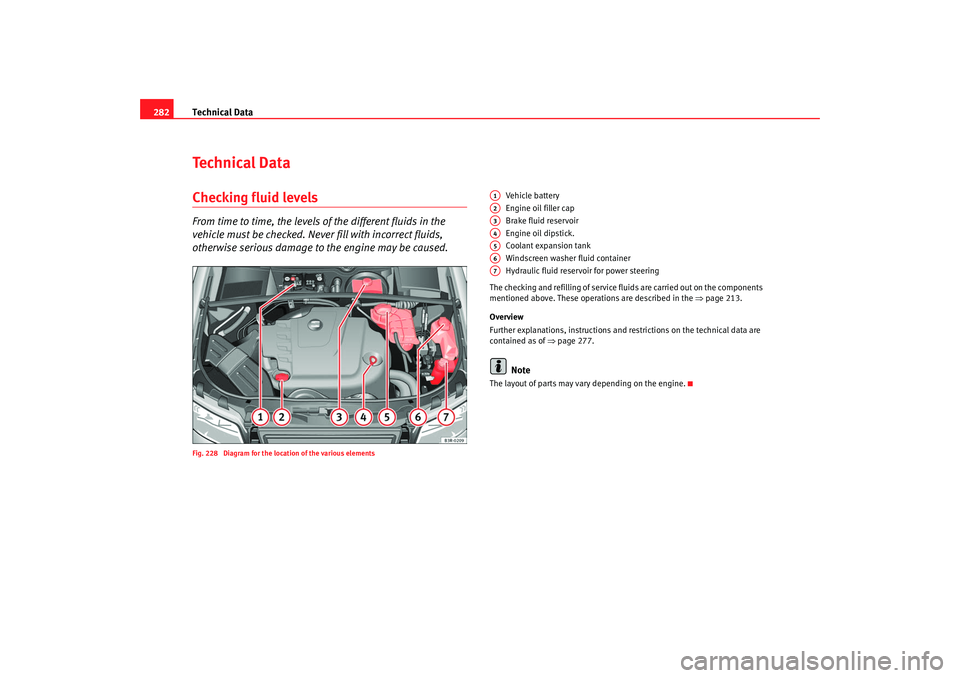
otherwise serious damage to the engine may be caused.Fig. 228 Diagram for the location of the various elements
Vehicle battery
Engine oil filler cap
Brake fluid reservoir
Engine oil dipstick.
Coolant expansion tank
Windscreen washer fluid container
Hydraulic fluid reservoir for power steering
The checking and refilling of service fluids are carried out on the components
mentioned above. These operat ions are described in the ⇒page 213.
Overview
Further explanations, instructions and restrictions on the technical data are
contained as of ⇒page 277.Note
The layout of parts may vary depending on the engine.A1A2A3A4A5A6A7
Exeo_EN.book Seite 282 Freitag, 17. Oktober 2008 11:24 11
Page 293 of 303

Index291
Index
AAccessories . . . . . . . . . . . . . . . . . . . . . . . . . . . . 206
Towing . . . . . . . . . . . . . . . . . . . . . . . . . . . . . 188
Air conditioner 2C-Climatronic . . . . . . . . . . . . . . . . . . . . . . . 152
Defrosting . . . . . . . . . . . . . . . . . . . . . . . . . . . 156
Solar-powered blower/solar roof . . . . . . . . 161
Air duct Fitting . . . . . . . . . . . . . . . . . . . . . . . . . 251, 258
Removing . . . . . . . . . . . . . . . . . . . . . . 250, 257
Air purity sensor . . . . . . . . . . . . . . . . . . . . . . . . . 157
Airbag Warning lamp . . . . . . . . . . . . . . . . . . . . . . . . . 66
Airbag covers . . . . . . . . . . . . . . . . . . . . . . . . . . . . 34
Airbag system . . . . . . . . . . . . . . . . . . . . . . . . . . . 28 Curtain airbags . . . . . . . . . . . . . . . . . . . . . . . 41
Front airbags . . . . . . . . . . . . . . . . . . . . . . . . . 32
Side airbags . . . . . . . . . . . . . . . . . . . . . . . . . . 38
Warning lamp . . . . . . . . . . . . . . . . . . . . . . . . . 29
Alternator Warning lamp . . . . . . . . . . . . . . . . . . . . . . . . . 69
Ambient temperature display . . . . . . . . . . . . . . . 72
Anti-freeze . . . . . . . . . . . . . . . . . . . . . . . . . . . . . 217
Anti-lock brake system How it works . . . . . . . . . . . . . . . . . . . . . . . . . 176
Anti-puncture tyres . . . . . . . . . . . . . . . . . . . . . . 232 Anti-theft alarm system . . . . . . . . . . . . . . . . . . . 104
Interior monitoring . . . . . . . . . . . . . . . . . . . 105
Aquaplaning . . . . . . . . . . . . . . . . . . . . . . . . . . . 231
Armrest Storage compartment in front armrest . . . . 138
Armrests Adjusting the front armrest . . . . . . . . . . . . . 138
Ashtray Front . . . . . . . . . . . . . . . . . . . . . . . . . . . . . . . 146
Rear . . . . . . . . . . . . . . . . . . . . . . . . . . . . . . . 147
Athermic windscreen . . . . . . . . . . . . . . . . . . . . . 207
Auto-check system . . . . . . . . . . . . . . . . . . . . . . . 75
Automatic car wash tunnel . . . . . . . . . . . . . . . . 198
Automatic gearbox Safety interlock for ignition key . . . . . . . . . 163
Automatic headlight control . . . . . . . . . . . . . . . 112
BBackground lighting . . . . . . . . . . . . . . . . . . . . . 121
Battery . . . . . . . . . . . . . . . . . . . . . . . . . . . . . . . . 223 Battery voltage . . . . . . . . . . . . . . . . . . . . . . . . 80
Charging . . . . . . . . . . . . . . . . . . . . . . . . . . . . 225
Disconnection . . . . . . . . . . . . . . . . . . . . . . . 223
Long periods of non-use . . . . . . . . . . . . . . . 223
Replacing . . . . . . . . . . . . . . . . . . . . . . 223, 224
Testing . . . . . . . . . . . . . . . . . . . . . . . . . . . . . 223
Winter operations . . . . . . . . . . . . . . . 223, 224 Belt tension device
Disposal . . . . . . . . . . . . . . . . . . . . . . . . . . . . . 27
Warning lamp . . . . . . . . . . . . . . . . . . . . . . . . 29
Belt tension devices . . . . . . . . . . . . . . . . . . . . . . 26
Bicycle rack Towing . . . . . . . . . . . . . . . . . . . . . . . . . . . . . 188
Biodiesel . . . . . . . . . . . . . . . . . . . . . . . . . . . . . . 210
Biodiesel fuel . . . . . . . . . . . . . . . . . . . . . . . . . . . 210
Bonnet . . . . . . . . . . . . . . . . . . . . . . . . . . . . . . . . 212 Closing . . . . . . . . . . . . . . . . . . . . . . . . . . . . . 214
Opening . . . . . . . . . . . . . . . . . . . . . . . . . . . . 212
Releasing . . . . . . . . . . . . . . . . . . . . . . . . . . . 212
Brake pads . . . . . . . . . . . . . . . . . . . . . . . . . . . . . 181
Brake servo . . . . . . . . . . . . . . . . . . . . . . . . . . . . 181
Brake system Brake servo . . . . . . . . . . . . . . . . . . . . . . . . . 178
Brakes . . . . . . . . . . . . . . . . . . . . . . . . . . . . . 178
Malfunction . . . . . . . . . . . . . . . . . . . . . . . . . . 77
Brakes . . . . . . . . . . . . . . . . . . . . . . . . . . . . . . . . 181 Brake assist system . . . . . . . . . . . . . . . . . . 176
Brake fluid . . . . . . . . . . . . . . . . . . . . . . . . . . 222
Worn brake pads . . . . . . . . . . . . . . . . . . . . . . 80
Braking distance . . . . . . . . . . . . . . . . . . . . . . . . 181
Bulb change general notes . . . . . . . . . . . . . . . . . . . . . . . . 249
CCar keys . . . . . . . . . . . . . . . . . . . . . . . . . . . . . . . . 93
Exeo_EN.book Seite 291 Freitag, 17. Oktober 2008 11:24 11
Page 300 of 303

Index
298Tools . . . . . . . . . . . . . . . . . . . . . . . . . . . . . . . . . . 236
Tow starting
Comments . . . . . . . . . . . . . . . . . . . . . . . . . . 274
Towing . . . . . . . . . . . . . . . . . . . . . . . . . . . . 186, 274 Accessories . . . . . . . . . . . . . . . . . . . . . . . . . 188
Notes on towing . . . . . . . . . . . . . . . . . 186, 187
Removable towing bracket . . . . . . . . . . . . . 189
Technical requirements . . . . . . . . . . . . . . . 186
Towing a trailer . . . . . . . . . . . . . . . . . . . . . . . . . 280
Towing bracket, fitting . . . . . . . . . . . . . . . . . . . 195
Towing eye . . . . . . . . . . . . . . . . . . . . . . . . . . . . . 274
Towing eyes . . . . . . . . . . . . . . . . . . . . . . . . . . . . 275
Tow-starting . . . . . . . . . . . . . . . . . . . . . . . . . . . . 274
Traction control system How the system works . . . . . . . . . . . . . . . . 178
Trailer weights . . . . . . . . . . . . . . . . . . . . . . . . . . 280
Trip recorder . . . . . . . . . . . . . . . . . . . . . . . . . . . . 63
Type plate . . . . . . . . . . . . . . . . . . . . . . . . . . . . . 278
Tyre Mobility System . . . . . . . . . . . . . . . . . . . . . 243
Tyre mobility system . . . . . . . . . . . . . . . . . . . . . 237
Tyre pressure . . . . . . . . . . . . . . . . . . . . 66, 89, 227 Loss . . . . . . . . . . . . . . . . . . . . . . . . . . . . . . . 229
Tyre pressure monitoring . . . . . . . . . . . . . . . . . 228
Tyre pressure monitoring system . . . . . . . . . . . . 88
Tyre pressures . . . . . . . . . . . . . . . . . . . . . . . . . . 280
Tyre repair kit Tyre Mobility System . . . . . . . . . . . . . . . . . . 243
Tyres and wheels Dimensions . . . . . . . . . . . . . . . . . . . . . . . . . 233
Tyres service life . . . . . . . . . . . . . . . . . . . . . . . . 230 Tyres tread depth . . . . . . . . . . . . . . . . . . . . . . . 231
Tyres with directional tread pattern . . . . . . . . . 227
UUnderbody maintenance . . . . . . . . . . . . . . . . . 202VVehicle data . . . . . . . . . . . . . . . . . . . . . . . . . . . . 278
Vehicle identification data . . . . . . . . . . . . . . . . 278
Vehicle identification number . . . . . . . . . . . . . 278
Vehicle Maintenance
Exterior . . . . . . . . . . . . . . . . . . . . . . . . . . . . . 198
Vehicle modifications . . . . . . . . . . . . . . . . . . . . 206
Vehicle paintwork Products for vehicle maintenance . . . . . . . 197
Waxing . . . . . . . . . . . . . . . . . . . . . . . . . . . . . 199
Vehicle washing . . . . . . . . . . . . . . . . . . . . . . . . 198
Ventilation slits . . . . . . . . . . . . . . . . . . . . . . . . . . 17WWarning lamp . . . . . . . . . . . . . . . . . . . . . . . . . . . 29 Alternator . . . . . . . . . . . . . . . . . . . . . . . . . . . . 69
Warning lamps Airbag . . . . . . . . . . . . . . . . . . . . . . . . . . . . . . 66
Anti-lock brake system . . . . . . . . . . . . . . . . . 67
Electronic differential lock . . . . . . . . . . . . . . 67
Electronic stabilisation programme . . . . . . . 68
Engine management (EPC) . . . . . . . . . . . . . . 69
Exhaust emission control system . . . . . . . . 66 Handbrake . . . . . . . . . . . . . . . . . . . . . . . . . . . 70
Red symbols in central display . . . . . . . . . . 76
Seat belt warning lamp . . . . . . . . . . . . . . . . . 68
Yellow symbols in central display . . . . . . . . 78
Warning lamps - overview . . . . . . . . . . . . . . . . . 65
Washer fluid level . . . . . . . . . . . . . . . . . . . . . . . . 80
Washing by hand . . . . . . . . . . . . . . . . . . . . . . . 198
Washing with high pressure cleaners . . . . . . . 199
Wear indicators . . . . . . . . . . . . . . . . . . . . . . . . . 231
Wheel bolts . . . . . . . . . . . . . . . . . . . . . . . . . . . . 281 Torque . . . . . . . . . . . . . . . . . . . . . . . . . . . . . 234
Wheels . . . . . . . . . . . . . . . . . . . . . . . . . . . . 227, 280 Changing a wheel . . . . . . . . . . . . . . . . . . . . 238
Why assume the correct sitting position? . . . . . 28
Why should head restraints be correctly adjusted? 13
Why wear seat belts? . . . . . . . . . . . . . . . . . . 19, 28
Why wear seatbelts? . . . . . . . . . . . . . . . . . . . . . . 18
Windows Defrosting . . . . . . . . . . . . . . . . . . . . . . . . . . 156
Windscreen washer system . . . . . . . . . . . . . . . 220
Windscreen wiper blades Cleaning . . . . . . . . . . . . . . . . . . . . . . . . . . . . 201
Windscreen wipers . . . . . . . . . . . . . . . . . . . . . . 125 Changing blades . . . . . . . . . . . . . . . . . . . . . 221
Rain sensor . . . . . . . . . . . . . . . . . . . . . . . . . 125
Washer jets . . . . . . . . . . . . . . . . . . . . . . . . . 125
Winter Battery . . . . . . . . . . . . . . . . . . . . . . . . . . . . . 223
Winter conditions Defrost function . . . . . . . . . . . . . . . . . . . . . 156
Exeo_EN.book Seite 298 Freitag, 17. Oktober 2008 11:24 11