height Seat Exeo 2008 User Guide
[x] Cancel search | Manufacturer: SEAT, Model Year: 2008, Model line: Exeo, Model: Seat Exeo 2008Pages: 303, PDF Size: 10.02 MB
Page 133 of 303
Seats and stowage131
Safety First
Operating instructions
Practical tips
Te c h n i c a l D a t a
•
Be careful when adjusting the seat he ight. Injuries can be caused if the
height is adjusted without due care and attention.
Adjusting the backrest angle– Lean forwards to take your weight off the backrest.
– Turn the adjuster wheel ⇒page 130, fig. 104 to set the angle
of the backrest as required.
WARNING
The front backrests must not be reclined for driving. Otherwise, safety
belts and the airbag system might no t protect as they should, with the
subsequent danger of injury.
WARNING (continued)
A4
Exeo_EN.book Seite 131 Freitag, 17. Oktober 2008 11:24 11
Page 135 of 303
Seats and stowage133
Safety First
Operating instructions
Practical tips
Te c h n i c a l D a t a
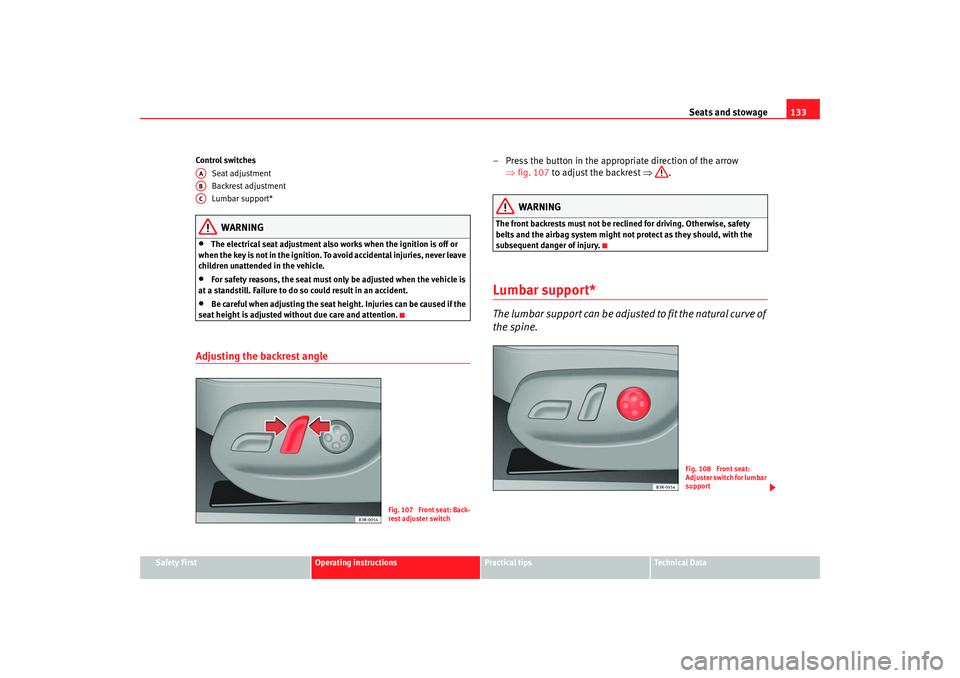
Control switches
Seat adjustment
Backrest adjustment
Lumbar support*
WARNING
•
The electrical seat adjustment also works when the ignition is off or
when the key is not in th e ignition. To avoid accidental injuries, never leave
children unattended in the vehicle.
•
For safety reasons, the seat must on ly be adjusted when the vehicle is
at a standstill. Failure to do so could result in an accident.
•
Be careful when adjusting the seat h eight. Injuries can be caused if the
seat height is adjusted with out due care and attention.
Adjusting the backrest angle
– Press the button in the appropriate direction of the arrow
⇒fig. 107 to adjust the backrest ⇒.
WARNING
The front backrests must not be reclin ed for driving. Otherwise, safety
belts and the airbag system might no t protect as they should, with the
subsequent danger of injury.Lumbar support*The lumbar support can be adjust ed to fit the natural curve of
the spine.
AAABAC
Fig. 107 Front seat: Back-
rest adjuster switch
Fig. 108 Front seat:
Adjuster switch for lumbar
support
Exeo_EN.book Seite 133 Freitag, 17. Oktober 2008 11:24 11
Page 136 of 303
Seats and stowage
134
Adjusting the contour of lumbar support
– Press the front part of the adjuster switch ⇒page 133, fig. 108
to increase the contour of the lumbar support.
– Press the rear part of the adjuster switch to decrease the contour of the lumbar support.
Adjusting the height of lumbar support
– Press the top part of the adjuster switch to move the lumbar support upwards.
– Press the bottom part of the adjuster switch to move the lumbar support down.The lumbar support provides effective su pport for the natural curvature of the
spine to give a more relaxed seating position, especially on long journeys.
Memory for driver’s seat*Description
The recall buttons in the driver's door can be used to store
and recall up to four different positions for the driver's seat
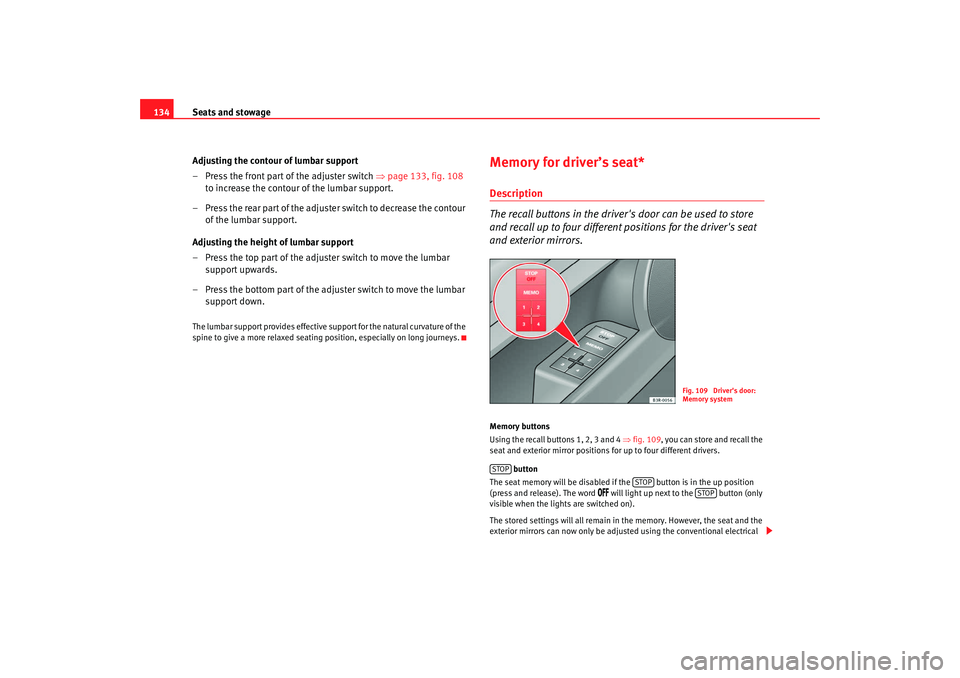
and exterior mirrors.Memory buttons
Using the recall buttons 1, 2, 3 and 4 ⇒fig. 109 , you can store and recall the
seat and exterior mirror positions for up to four different drivers.
button
The seat memory will be disabled if the button is in the up position
(press and release). The word
will light up next to the button (only
visible when the lights are switched on).
The stored settings will all remain in the memory. However, the seat and the
exterior mirrors can now only be adjust ed using the conventional electrical
Fig. 109 Driver's door:
Memory system
STOP
STOP
STOP
Exeo_EN.book Seite 134 Freitag, 17. Oktober 2008 11:24 11
Page 138 of 303
Seats and stowage
136Assigning remote control keys
The key must be assigned to a memory button so that the
p o s i t i o ns st o red i n t h e m e m o r y ca n al s o b e recall ed u s i ng t h e
remote control key.Assigning the remote control key to a memory button
– Using the memory button, recall the settings that are to be
programmed onto the key.
– Keeping the memory button pressed down, press the unlock button on the remote control key within 10 seconds.
– Wait for about 2 seconds before releasing the memory button.
Deleting assignment of the remote control key to the memory
button
– Press and hold the button and press the unlock button on the remote control key within 10 seconds.
– Wait for about 2 seconds befo re releasing the button.The previous settings are automatically cancelled when the keys are re-
assigned to different memory buttons.
Head restraintsFront head restraints
In combination with properly worn seat belts, the head
restraints offer effective protection, provided they are prop-
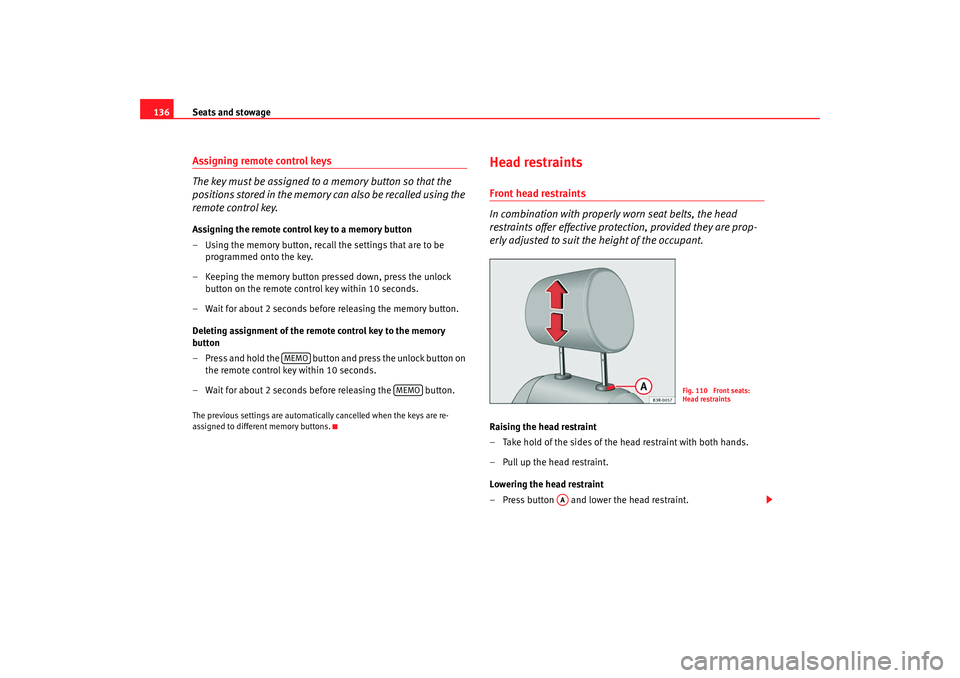
erly adjusted to suit the height of the occupant.Raising the head restraint
– Take hold of the sides of the head restraint with both hands.
–Pull up the head restraint.
Lowering the head restraint
– Press button and lower the head restraint.
MEMO
MEMO
Fig. 110 Front seats:
Head restraints
AA
Exeo_EN.book Seite 136 Freitag, 17. Oktober 2008 11:24 11
Page 139 of 303
Seats and stowage137
Safety First
Operating instructions
Practical tips
Te c h n i c a l D a t a
Removing the head restraints
– Pull up the head restraint as far as it will go.
– Press button and pull out the head restraint.
Fitting the head restraint
– Insert the head restraint in its guides until it clicks into place.
Press button and lower the head restraint.The height of the head restraints is ad justable. They should be set to suit the
height of the occupant. In combination with the seat belts, the head
restraints offer effective protection, provided they are properly adjusted.
For best protection, the top of the head restraint should be at least at eye level
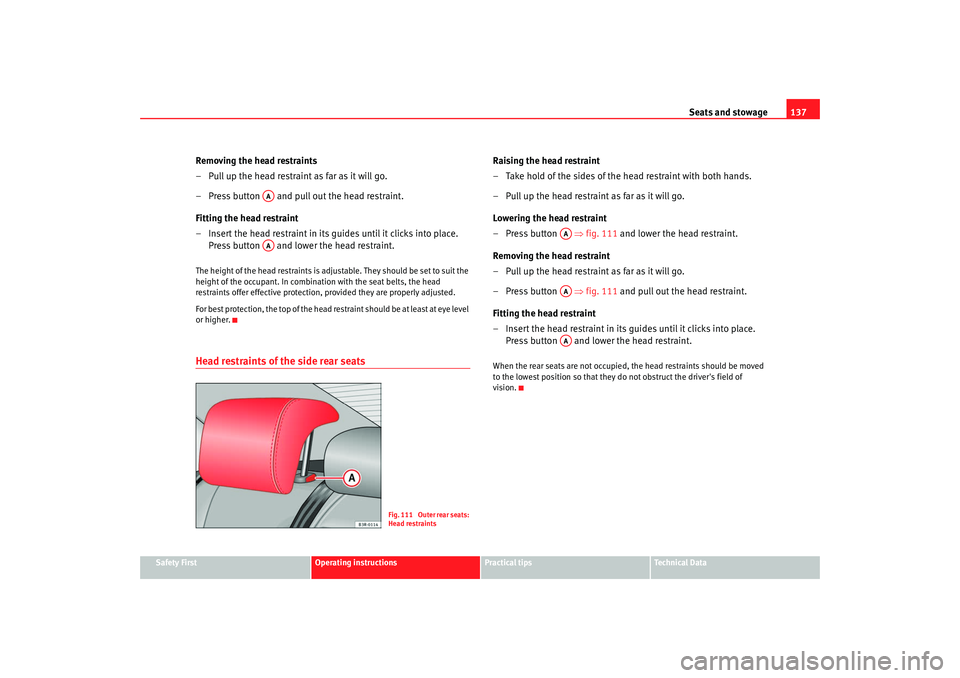
or higher.Head restraints of the side rear seats
Raising the head restraint
– Take hold of the sides of the head restraint with both hands.
– Pull up the head restraint as far as it will go.
Lowering the head restraint
– Press button ⇒ fig. 111 and lower the head restraint.
Removing the head restraint
– Pull up the head restraint as far as it will go.
– Press button ⇒ fig. 111 and pull out the head restraint.
Fitting the head restraint
– Insert the head restraint in its guides until it clicks into place. Press button and lower the head restraint.When the rear seats are not occupied, the head restraints should be moved
to the lowest position so that they do not obstruct the driver's field of
vision.
AAAA
Fig. 111 Outer rear seats:
Head restraints
AAAAAA
Exeo_EN.book Seite 137 Freitag, 17. Oktober 2008 11:24 11
Page 164 of 303
Driving
162DrivingAddressAdjusting the steering wheel position
The height and reach of the steering wheel can be adjusted as
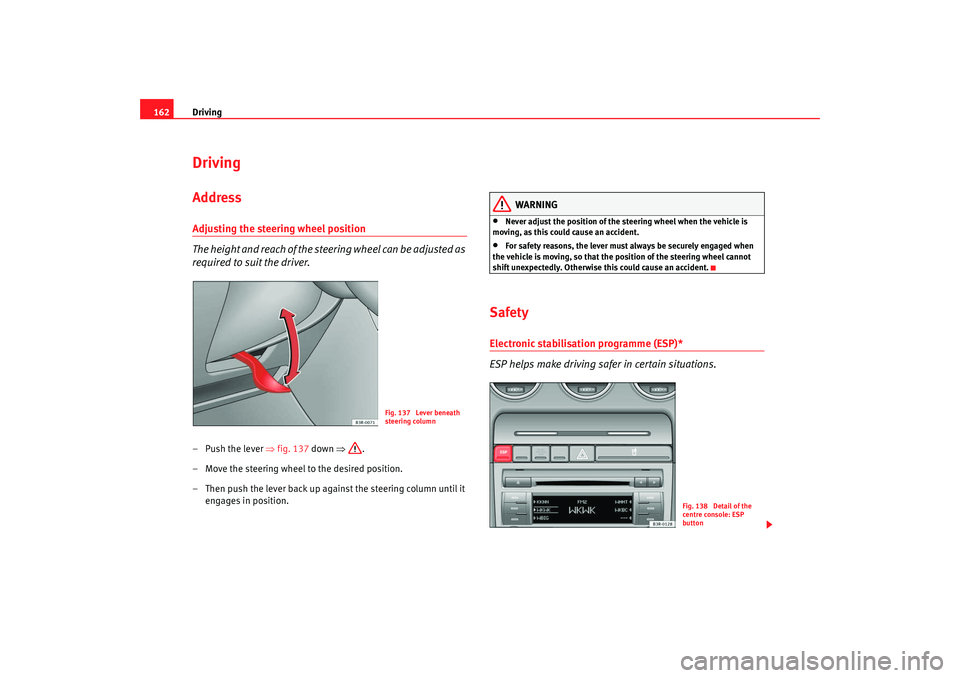
required to suit the driver.–Push the lever ⇒fig. 137 down ⇒.
– Move the steering wheel to the desired position.
– Then push the lever back up against the steering column until it engages in position.
WARNING
•
Never adjust the position of the steering wheel when the vehicle is
moving, as this could cause an accident.
•
For safety reasons, the lever must always be securely engaged when
the vehicle is moving, so that the position of the steering wheel cannot
shift unexpectedly. Otherwise this could cause an accident.
SafetyElectronic stabilisation programme (ESP)*
ESP helps make driving safer in certain situations.
Fig. 137 Lever beneath
steering column
Fig. 138 Detail of the
centre console: ESP
button
Exeo_EN.book Seite 162 Freitag, 17. Oktober 2008 11:24 11
Page 189 of 303
Trailer towing187
Safety First
Operating instructions
Practical tips
Te c h n i c a l D a t a
Where possible, operate the trailer with the maximum permitted
draw bar
weight on the ball joint of the towing bracket, but do not exceed the specified
limit.
Tyre pressure
Check the tyre pressures on your car, and adjust for “full load” conditions
(refer to the sticker listing the tyre pressures on the door pillar). It may also be
necessary to adjust the tyre pressures on the trailer according to the recom-
mendations of the trailer manufacturer.
Exterior mirrors
Check whether you can see enough of the road behind the trailer with the
standard mirrors. If this is not the case you should have additional mirrors
fitted. The two exterior mi rrors should be fitted on folding arms. Adjust the
mirrors to give sufficient rear vision.
Headlights
Before starting a journey, check the headlight beam settings with the trailer
hitched up. If necessary, alter the height of the headlight beams by means of
the headlight range control. See ⇒page 116.
Power supply
When you remove the ignition key, the power supply to the trailer is inter-
rupted.
Removable ball joint coupling
Vehicles with a factory-fitted towing bracket are equipped with a removable
ball joint coupling. This is stored in the spare wheel well in the luggage
compartment together with the necessary fitting instructions.
Note
If you frequently tow, we recommend you also have vehicle serviced between
services.
Notes on towing
Towing a trailer involves additi onal attention by the driver.Weight distribution
The weight distribution of a loaded trailer with an unladen vehicle is very
unfavourable. However, if this cannot be avoided, drive extra slowly to allow
for the unbalanced we ight distribution.
Speed
The stability of the car and trailer is reduced with increasing speed. Therefore,
it is advisable not to drive at the maximum permissible speed in an unfavour-
able road, weather or wind conditions. This especially applies when driving
downhill.
You should always reduce speed immediately if the trailer shows the slightest
sign of swaying. Never try to stop the “snaking” by increasing speed.
Anticipate hazards and brake in good time. If towing a trailer with an inertia
brake , first brake gently and then more severely. This will prevent brake
tapping by the trailer wheels when they lock. Select a low gear in due course
before going down a steep downhill. This enables you to use the engine
braking to slow down the vehicle.
Swaying and pitching can be reduced by stabiliser aids. We recommend
having stabiliser aids installed when towing trailers with a high trailer load.
They can be purchased and installed at a Dealer.
Reheating
When climbing long hills in hot weather wi th the engine running fast in low
gear, you should keep an eye on the coolant temperature gauge ⇒page 60.
Reduce speed immediately if the needle moves to the right end of the scale.
If the temperature warning light
in the instrument cluster should start
flashing, stop the car and let the engine cool down by running it at idling
speed for a few minutes.
Exeo_EN.book Seite 187 Freitag, 17. Oktober 2008 11:24 11
Page 235 of 303

Wheels and tyres233
Safety First
Operating instructions
Practical tips
Te c h n i c a l D a t a
•
Avoid driving over obstacles (for example kerbs) or potholes.
•
If one or more tyres is being driven in emergency conditions, the driving
quality of the vehicle is impaired and there is a risk of accident.Note
•
The anti-puncture tyres do not “deflate” on losing pressure because they
are supported on the reinforced sides. Therefore defects in the tyre can not be
detected with a visual inspection.
•
Snow chains must not be used on front tyres used in emergency
conditions.
New tyres and wheels
New tyres and wheels have to be run-in.The tyres and wheel rims are an essential part of the vehicle's design. The
tyres and rims approved by SEAT are specially matched to the characteristics
of the vehicle and make a major contribution to good road holding and safe
handling ⇒.
Tyres should be replaced at least in pairs and not individually (i.e. both front
tyres or both rear tyres together). A knowledge of tyre designations makes it
easier to choose the correct tyres. Radial tyres have the tyre designations
marked on the sidewall, for example: 195/65 R15 91T
This contains the following information:
195 Tyre width in mm
65 Height/width ratio in %
R Tyre construction: Radial 15 Rim diameter in inches
91 Load rating code
T Speed rating
The tyres could also have the following information:
•
A direction of rotation symbol
•
“Reinforced” denotes heavy-duty tyres.
The manufacturing date is also indicate d on the tyre sidewall (possibly only
on the inner side of the wheel).
“DOT ... 1103...” means, for example, that the tyre was produced in the 11th
week of 2003.
We recommend that work on tyres and wh eels is carried out by an Authorised
Service Centre. They are familiar with the procedure and have the necessary
special tools and spare parts as well as the proper facilities for disposing of
the old tyres.
Any Authorised Service Centre has full information on the technical require-
ments when installing or changing tyres, wheels or wheel trims.
WARNING
•
We recommend that you use only wh eels and tyres which have been
approved by SEAT for your model. Failure to do so could impair vehicle
handling. Risk of accident.
•
Avoid running the vehicle on tyres th at are more than six years old. If
you have no alternative, you should drive slowly and with extra care at all
times.
•
Never use old tyres or those with an unknown “history of use”.
•
If wheel trims are retrofitted, you must ensure that the flow of air to the
brakes is not restricted. This could cause them to overheat.
•
All four wheels must be fitted with radial tyres of the same type, size
(rolling circumference) and the same tread pattern.
WARNING (continued)
Exeo_EN.book Seite 233 Freitag, 17. Oktober 2008 11:24 11
Page 292 of 303

Technical Data
290Dimensions and capacities
Dimensions
Length, width 4,661 mm/ 1,772 mm
Height at kerb weight 1,430 mm
Front and rear projection 976 mm/ 1,043 mm
Wheelbase 2,642 mm
Turning circle 11.2 m
Track width
a)
a)This data will change depending on the type of wheel rim.
Front Rear
1,522 mm 1,523 mm
Capacities
Fuel tank 70 l. Reserve 10 l.
Windscreen washer fluid contai ner with headlight washer 4.8 l.
Tyre pressure
Summer-grade tyres:
The correct tyre pressure can be seen on the sticker on the inside of the tank flap.
Winter tyres:
The pressure of these tyres is the same as the summer tyre pressure plus 0.2 bar.
Exeo_EN.book Seite 290 Freitag, 17. Oktober 2008 11:24 11
Page 299 of 303

Index297
side airbags . . . . . . . . . . . . . . . . . . . . . . . . . . 40
Using child seats . . . . . . . . . . . . . . . . . . . . . . 46
Using seat belts . . . . . . . . . . . . . . . . . . . . . . . 21
Seals . . . . . . . . . . . . . . . . . . . . . . . . . . . . . . . . . . 201
Seat adjustment Lumbar support . . . . . . . . . . . . . . . . . . . . . . 133
Seat belt position Pregnant women . . . . . . . . . . . . . . . . . . . . . . 24
Seat belts . . . . . . . . . . . . . . . . . . . . . . . . . . . . 23
Seat belt release . . . . . . . . . . . . . . . . . . . . . . . . . 25
Seat belt warning lamp . . . . . . . . . . . . . . . . . . . . 18
Seat belts . . . . . . . . . . . . . . . . . . . . . . . . . . . . . . . 18 adjustment . . . . . . . . . . . . . . . . . . . . . . . . . . . 22
Height adjustment . . . . . . . . . . . . . . . . . . . . . 25
Incorrectly fastened . . . . . . . . . . . . . . . . . . . . 26
Not worn . . . . . . . . . . . . . . . . . . . . . . . . . . . . . 20
Safety notes . . . . . . . . . . . . . . . . . . . . . . . . . . 21
Warning lamp . . . . . . . . . . . . . . . . . . . . . . 18, 68
Seat belts cleaning . . . . . . . . . . . . . . . . . . . . . . 205
Seat belts protection . . . . . . . . . . . . . . . . . . . . . . 21
Seat heating . . . . . . . . . . . . . . . . . . . . . . . . . . . . 161
Seats . . . . . . . . . . . . . . . . . . . . . . . . . . . . . . . . . . . 18 Electric adjustment . . . . . . . . . . . . . . . . . . . 132
Electric backrest adjustment . . . . . . . . . . . 133
Manual adjustment . . . . . . . . . . . . . . . . . . . 130
Manual backrest angle adjustment . . . . . . 131
Moving the seat forwards and backwards . 130
Seat height adjustment . . . . . . . . . . . . . . . . 130
Self-directing headlights . . . . . . . . . . . . . . . . . . 118 faulty . . . . . . . . . . . . . . . . . . . . . . . . . . . . . . . . 80
Service indicator . . . . . . . . . . . . . . . . . . . . . . . . . 74 Servotronic . . . . . . . . . . . . . . . . . . . . . . . . . . . . . 180
Shoes . . . . . . . . . . . . . . . . . . . . . . . . . . . . . . . . . . 15
Side airbags . . . . . . . . . . . . . . . . . . . . . . . . . . . . . 38
Description . . . . . . . . . . . . . . . . . . . . . . . . . . . 38
Function . . . . . . . . . . . . . . . . . . . . . . . . . . . . . 39
Safety notes . . . . . . . . . . . . . . . . . . . . . . . . . . 40
Side lights . . . . . . . . . . . . . . . . . . . . . . . . . . . . . 112
Sitting position Driver . . . . . . . . . . . . . . . . . . . . . . . . . . . . . . . 10
Front passenger . . . . . . . . . . . . . . . . . . . . . . . 11
Incorrect sitting position . . . . . . . . . . . . . . . . 14
Passengers . . . . . . . . . . . . . . . . . . . . . . . . . . . 12
Sitting position, occupants . . . . . . . . . . . . . . . . . 10
Ski bag . . . . . . . . . . . . . . . . . . . . . . . . . . . . . . . . 143
Snow chains . . . . . . . . . . . . . . . . . . . . . . . 235, 281
Solar-powered blower/solar roof . . . . . . . . . . . 161
Spare keys . . . . . . . . . . . . . . . . . . . . . . . . . . . . . . 93
Spare parts . . . . . . . . . . . . . . . . . . . . . . . . . . . . . 206
Spare wheel Steel rim . . . . . . . . . . . . . . . . . . . . . . . . . . . . 237
Speed warning . . . . . . . . . . . . . . . . . . . . . . . . 80, 81
Speed warning function . . . . . . . . . . . . . . . . . . . 81
Speedometer . . . . . . . . . . . . . . . . . . . . . . . . . . . . 63
Steam jets . . . . . . . . . . . . . . . . . . . . . . . . . . . . . 199
Steering Locking . . . . . . . . . . . . . . . . . . . . . . . . . . . . . 163
Manual steering wheel adjustment . . . . . . 162
Steering wheel controls . . . . . . . . . . . . . . . . . . . 90
Stopping the engine . . . . . . . . . . . . . . . . . . . . . 165 Sun roof
Opening . . . . . . . . . . . . . . . . . . . . . . . . . . . . 109
Sun roof / deflector . . . . . . . . . . . . . . . . . . . . . . 108
Sun visors . . . . . . . . . . . . . . . . . . . . . . . . . . . . . 123
Sunroof . . . . . . . . . . . . . . . . . . . . . . . . . . . . . . . . 110 Automatic close function . . . . . . . . . . . . . . 110
Closing . . . . . . . . . . . . . . . . . . . . . . . . . . . . . 109
Manual operation . . . . . . . . . . . . . . . . . . . . 111
Override function . . . . . . . . . . . . . . . . . . . . . 110
Supplementary heating . . . . . . . . . . . . . . . . . . 161
Switches in the driver's door Electric windows . . . . . . . . . . . . . . . . . . . . . 106
Symbols Red symbols in central display . . . . . . . . . . . 76
Yellow symbols in central display . . . . . . . . 78
TTailgateCentral locking system . . . . . . . . . . . . . . . . 100
Light . . . . . . . . . . . . . . . . . . . . . . . . . . . . . . . 122
TCS Funcionamiento . . . . . . . . . . . . . . . . . . . . . . 178
Technical modification s . . . . . . . . . . . . . . . . . . 206
The danger of not using the seat belt . . . . . . . . 20
The environment Heated rear window . . . . . . . . . . . . . . . . . . 123
Leaks . . . . . . . . . . . . . . . . . . . . . . . . . . . . . . 213
Roof carriers . . . . . . . . . . . . . . . . . . . . . . . . . 145
Warming up the engine . . . . . . . . . . . . . . . . 164
Tightening torque of wheel bo lts . . . . . . . . . . . 281
Exeo_EN.book Seite 297 Freitag, 17. Oktober 2008 11:24 11