oil level Seat Exeo 2008 User Guide
[x] Cancel search | Manufacturer: SEAT, Model Year: 2008, Model line: Exeo, Model: Seat Exeo 2008Pages: 303, PDF Size: 10.02 MB
Page 218 of 303
Checking and refilling levels
216
Checking oil level
– Park the vehicle in a horizontal position.
– Briefly run the engine at idle speed until the service temperature is reached then stop.
– Wait two minutes.
– Pull out the dipstick. Wipe the dipstick with a clean cloth and insert it again, pushing it in as far as it will go.
– Then pull it out once more and check the oil level ⇒page 215,
fig. 165. If the oil level is too low, add more engine oil
⇒ page 216.
Oil level in area
–Do not top up oil.
Oil level in area
–Oil can be topped up. After topping up the oil level should be in
area .
Oil level in area
–Oil must be topped up. After topping up the oil level should be in
area .Depending on how you drive and the conditions in which the car is used, oil
consumption can be up to 0.5 l/1,000 km. Oil consumption is likely to be
higher for the first 5,000 km. Therefore, the engine oil level must be checked
at regular intervals, preferably when filling the tank and before a journey.
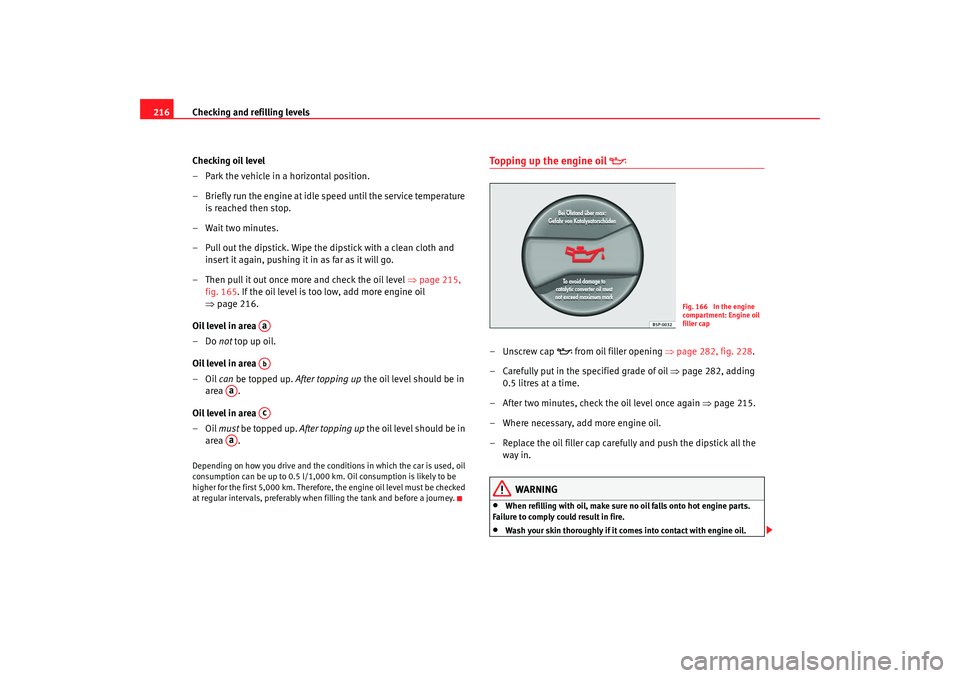
Topping up the engine oil
–Unscrew cap
from oil filler opening ⇒page 282, fig. 228 .
– Carefully put in the specified grade of oil ⇒page 282, adding
0.5 litres at a time.
– After two minutes, check the oil level once again ⇒page 215.
– Where necessary, add more engine oil.
– Replace the oil filler cap carefully and push the dipstick all the way in.
WARNING
•
When refilling with oil, make sure no oil falls onto hot engine parts.
Failure to comply could result in fire.
•
Wash your skin thoroughly if it comes into contact with engine oil.
AaAb
Aa
Ac
Aa
Fig. 166 In the engine
compartment: Engine oil
filler cap
Exeo_EN.book Seite 216 Freitag, 17. Oktober 2008 11:24 11
Page 219 of 303
Checking and refilling levels217
Safety First
Operating instructions
Practical tips
Te c h n i c a l D a t a
Caution
•
The oil level must never be above area . This could damage the cata-
lytic converter or the engine. Contact a specialist garage to drain the engine
oil if necessary.
•
No additives should be used with engine oil. Any damage caused by the
use of such additives would not be covered by the factory warranty.For the sake of the environment
•
Oil must not be disposed of into the drains or onto the ground.
•
Always observe legal requirements when disposing of empty oil
canisters.
Cooling systemLiquid coolant
The purpose of the liquid coolant is to carry heat away from
the engine. The correct amount of antifreeze is decisive in
preventing the cooling system from freezing in winter.The your vehicle's engine cooling system is filled for life at the factory, so no
coolant needs to be changed. The liquid coolant consists of a mixture of water
and anti-freeze G12++. This is a glycol-b ased antifreeze with anti-corrosion
additives.
Liquid coolant additive
The amount of antifreeze required depends on the temperatures to be
expected in the winter season. If the antifreeze concentration is too low the
coolant can freeze, resulting in failure of the cooling system and heater. The cooling system is filled at the fact
ory with the correct amount of anti-
freeze for the country concerned.
In most cases, the mixture consists of 60% water and 40% anti-freeze. This
mixture gives the required anti-freeze protection at temperatures down to
-25°C and particularly protects the metal parts of the cooling system against
corrosion. It also prevents scaling and significantly raises the boiling point of
the liquid coolant.
Countries with warm climate
The liquid coolant concentration must not be reduced by adding plain water,
even in the summer or in warm climates. The concentration of the anti-freeze
must always be at least 40%.
Countries with cold climate
If greater frost protection is required in very cold climates, the proportion of
the anti-freeze G12++ can be increased. A concentration of 60% offers anti-
freeze protection of temperatures down to approx. -40°C. However,the
concentration of anti-freeze must not exceed 60%, as the anti-freeze protec-
tion would then drop and the performance of the coolant system would suffer.
Vehicles for countries with cold clima tes (e.g. Sweden, Norway and Finland)
have factory-filled anti-freeze protection for temperatures down to -35°C. In
these countries, the concentration of anti-freeze should always be at least
50%.
Caution
•
It is advisable to have the cooling system checked before the winter
season to make sure that the antifreeze concentration is adequate for the
conditions to be expected. This applies particularly if you intend to take the
car into a colder climate zone. If necessary, have the antifreeze concentration
increased to 50 - 60% as required.
•
Use only anti-freeze G12++ , an additive meeting the “TL-VW 774G” spec-
ification. Other anti-freezes may give considerably inferior corrosion protec-
Aa
Exeo_EN.book Seite 217 Freitag, 17. Oktober 2008 11:24 11
Page 220 of 303
Checking and refilling levels
218tion. The damage caused by the use of these anti-freezes may lead to a loss
of liquid coolant, causing serious damage to the engine.•
The anti-freeze G12++ can be mixed on ly with anti-freeze additives G11,
G12 and G12+.
Checking the liquid coolant level
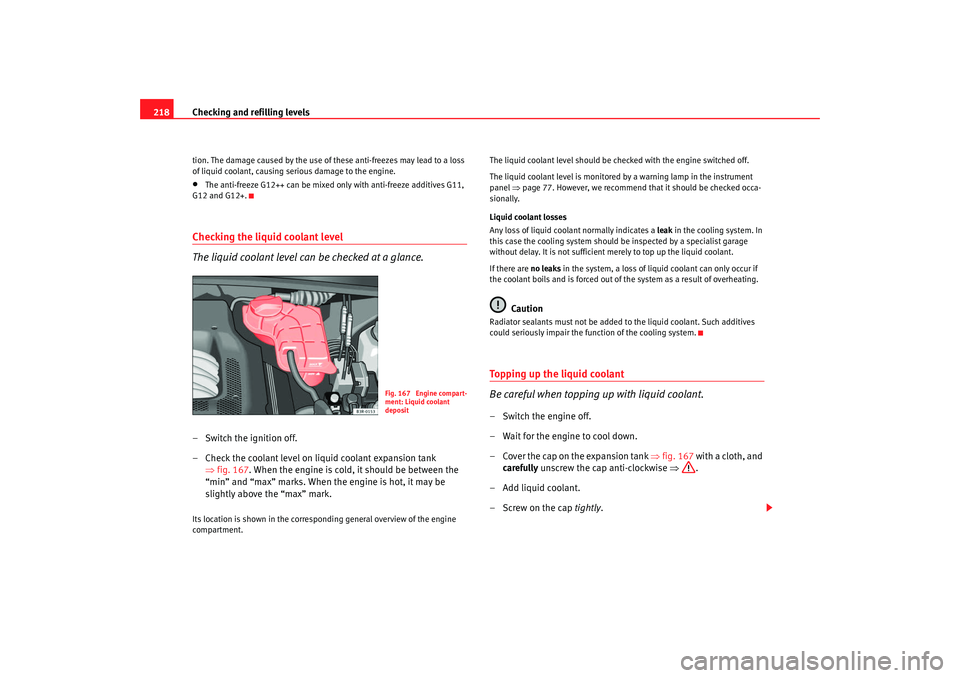
The liquid coolant level can be checked at a glance.– Switch the ignition off.
– Check the coolant level on liquid coolant expansion tank ⇒fig. 167. When the engine is cold, it should be between the
“min” and “max” marks. When the engine is hot, it may be
slightly above the “max” mark.Its location is shown in the correspon ding general overview of the engine
compartment. The liquid coolant level should be checked with the engine switched off.
The liquid coolant level is monitored
by a warning lamp in the instrument
panel ⇒ page 77. However, we recommend that it should be checked occa-
sionally.
Liquid coolant losses
Any loss of liquid coolant normally indicates a leak in the cooling system. In
this case the cooling system should be inspected by a specialist garage
without delay. It is not sufficient merely to top up the liquid coolant.
If there are no leaks in the system, a loss of liquid coolant can only occur if
the coolant boils and is forced out of the system as a result of overheating.
Caution
Radiator sealants must not be added to the liquid coolant. Such additives
could seriously impair the function of the cooling system.Topping up the liquid coolant
Be careful when topping up with liquid coolant.– Switch the engine off.
– Wait for the engine to cool down.
– Cover the cap on the expansion tank ⇒fig. 167 with a cloth, an d
carefully unscrew the cap anti-clockwise ⇒ .
– Add liquid coolant.
– Screw on the cap tightly.
Fig. 167 Engine compart-
ment: Liquid coolant
deposit
Exeo_EN.book Seite 218 Freitag, 17. Oktober 2008 11:24 11
Page 223 of 303
Checking and refilling levels221
Safety First
Operating instructions
Practical tips
Te c h n i c a l D a t a
Changing windscreen wiper blades
If the windscreen wiper blades are in perfect condition, you
will benefit from an improved visibility. Damaged wiper
blades should be replaced immediately.
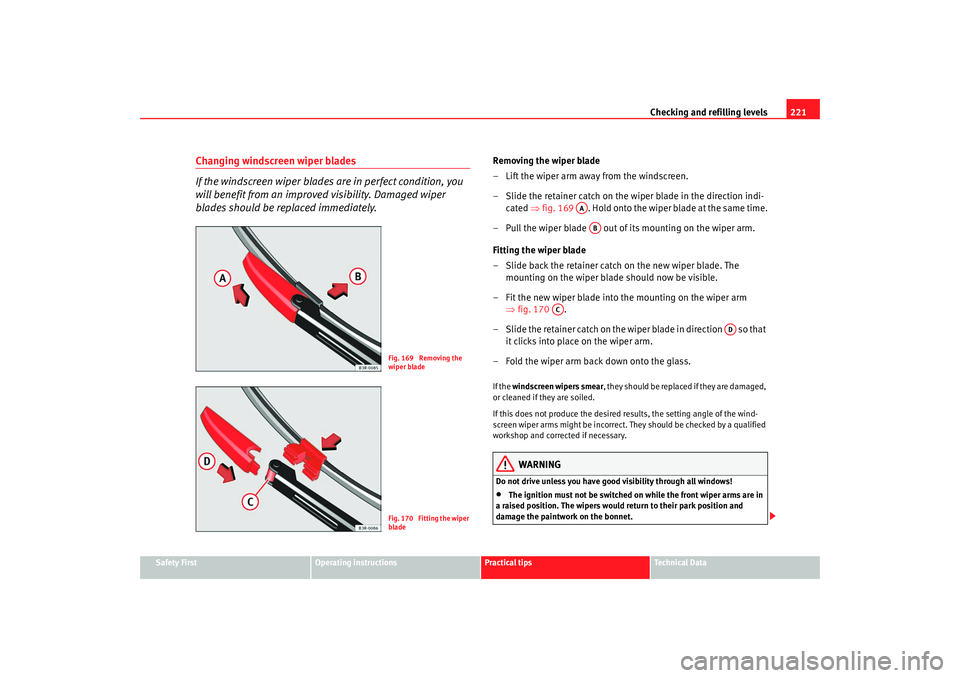
Removing the wiper blade
– Lift the wiper arm away from the windscreen.
– Slide the retainer catch on the wiper blade in the direction indi-
cated ⇒fig. 169 . Hold onto the wiper blade at the same time.
– Pull the wiper blade out of its mounting on the wiper arm.
Fitting the wiper blade
– Slide back the retainer catch on the new wiper blade. The mounting on the wiper blade should now be visible.
– Fit the new wiper blade into the mounting on the wiper arm
⇒ fig. 170 .
– Slide the retainer catch on the wiper blade in direction so that it clicks into place on the wiper arm.
– Fold the wiper arm back down onto the glass.If the windscreen wipers smear , they should be replaced if they are damaged,
or cleaned if they are soiled.
If this does not produce the desired results, the setting angle of the wind-
screen wiper arms might be incorrect. Th ey should be checked by a qualified
workshop and corrected if necessary.
WARNING
Do not drive unless you have good visibility through all windows!•
The ignition must not be switched on while the front wiper arms are in
a raised position. The wipers would return to their park position and
damage the paintwork on the bonnet.
Fig. 169 Removing the
wiper bladeFig. 170 Fitting the wiper
blade
AAAB
AC
AD
Exeo_EN.book Seite 221 Freitag, 17. Oktober 2008 11:24 11
Page 225 of 303
Checking and refilling levels223
Safety First
Operating instructions
Practical tips
Te c h n i c a l D a t a
Topping up and changing the brake fluid
It is best to have the brake fluid changed by a professional.Brake fluid absorbs damp. Therefore, in the course of time it will absorb water
from the ambient air. If the water content in the brake fluid is too high, the
brake system could corrode. In addition, the boiling point of the brake fluid
will be considerably reduced. This could adversely affect the braking ability in
certain circumstances.
For this reason the brake fluid must be changed periodically.
Your vehicle's Service Schedule will tell you when the brake fluid has to be
renewed.
We recommend you have the brake fluid changed as part of a regular Inspec-
tion Service at your garage. They are familiar with the procedure and have the
necessary special tools and spare parts as well as the proper facilities for
disposing of the old fluid.
Use only the genuine brake fluid specified by the factory Specialist garages
know that the brake fluid -DOT 4- is factory approved. The brake fluid must be
new.
WARNING
•
Therefore, it must always be kept closed in its original container. Keep
out of the reach of children. Failure to comply could result in poisoning.
•
Heavy use of the brakes may cause a vapour lock if the brake fluid is left
in the system for too long. This would seriously affect the efficiency of the
brakes and the safety of the car, leading to the risk of accident.Caution
Please note that brake fluid will attack the paintwork on contact.
For the sake of the environment
If the fluid has to be drained out of the brake system, use an appropriate
container to catch the used brake fluid and dispose of it in the proper
manner.BatteryGeneral notes
All work on batteries requires specialist knowledge.The battery is virtually maintenance-free and is checked in the Inspection
Services.
We recommend that you replace a battery once it is older than 5 years.
Disconnecting the battery
If the battery is disconnected, some of the vehicle's functions will become
inoperative (e.g. electric windows). These functions will require resetting
after the battery is reconnected. For th is reason, the battery should only be
disconnected from the vehicle's electr ical system when absolutely necessary.
Long periods of non-use
The battery will gradually lose its charge because certain electrical equip-
ment continues to draw current even when the ignition is off. If you park the
vehicle for long periods of time in winter you should take the battery out of
the vehicle and keep it in a frost-proof room. Store the battery in a place
where it cannot “freeze up” and become damaged. At warm outside temper-
atures it is sufficient to disconnect the negative terminal of the battery. Even
when the battery is not connected you should charge it from time to time.
Exeo_EN.book Seite 223 Freitag, 17. Oktober 2008 11:24 11
Page 284 of 303
Technical Data
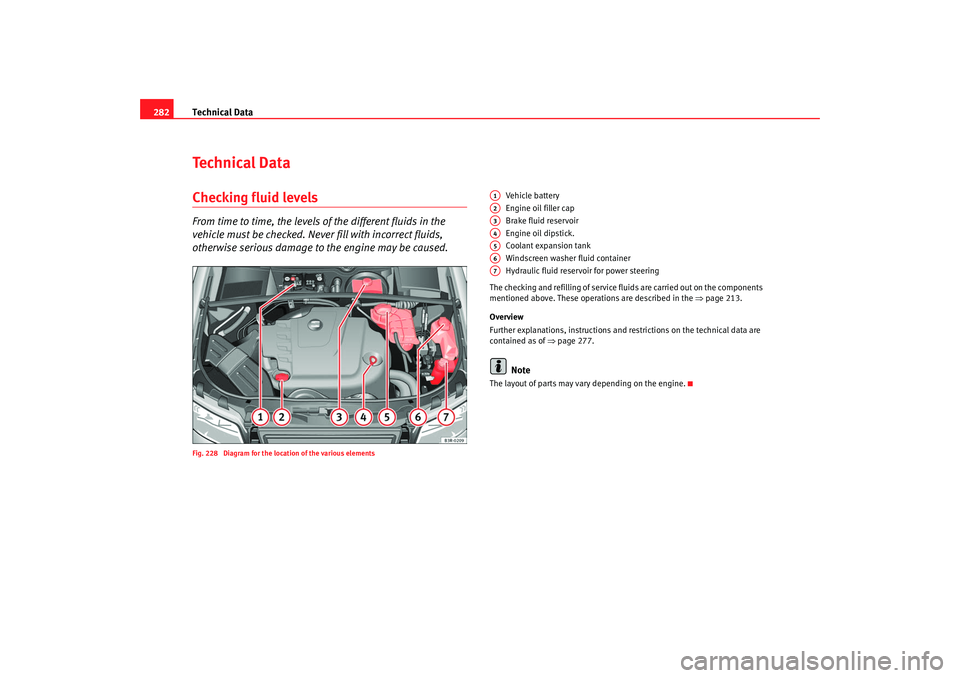
282Te c h n i c a l D a t aChecking fluid levelsFrom time to time, the levels of the different fluids in the
vehicle must be checked. Never fill with incorrect fluids,
otherwise serious damage to the engine may be caused.Fig. 228 Diagram for the location of the various elements
Vehicle battery
Engine oil filler cap
Brake fluid reservoir
Engine oil dipstick.
Coolant expansion tank
Windscreen washer fluid container
Hydraulic fluid reservoir for power steering
The checking and refilling of service fluids are carried out on the components
mentioned above. These operat ions are described in the ⇒page 213.
Overview
Further explanations, instructions and restrictions on the technical data are
contained as of ⇒page 277.Note
The layout of parts may vary depending on the engine.A1A2A3A4A5A6A7
Exeo_EN.book Seite 282 Freitag, 17. Oktober 2008 11:24 11
Page 295 of 303

Index293
Digital clock . . . . . . . . . . . . . . . . . . . . . . . . . . . . . 61
Dipped headlights . . . . . . . . . . . . . . . . . . . . . . . 112
DIS
Average fuel consumption . . . . . . . . . . . . . . 84
Average speed . . . . . . . . . . . . . . . . . . . . . . . . 84
Driving time . . . . . . . . . . . . . . . . . . . . . . . . . . 84
Instantaneous fuel consumption . . . . . . . . . 84
Disabling front passenger airbag Safety notes . . . . . . . . . . . . . . . . . . . . . . . . . . 45
Disabling the airbag Disabling front passenger airbag . . . . . . . . . 44
Disposal Airbags . . . . . . . . . . . . . . . . . . . . . . . . . . . . . . 30
Distance covered . . . . . . . . . . . . . . . . . . . . . . . . . 85
Distance display . . . . . . . . . . . . . . . . . . . . . . . . . 63
Door catch/ tailgate warning . . . . . . . . . . . . . . . 73
Door lock cylinders . . . . . . . . . . . . . . . . . . . . . . 201
Doors Childproof lock . . . . . . . . . . . . . . . . . . . . . . . 101
Locking the doors manually if the central lock-ing fails to work . . . . . . . . . . . . . . . . . . . . . 99
Driver information system . . . . . . . . . . . . . . . . . . 71 Ambient temperature display . . . . . . . . . . . . 72
Auto-check system . . . . . . . . . . . . . . . . . . . . 75
CD and radio display . . . . . . . . . . . . . . . . . . . 72
Door catch/ tailgate warning . . . . . . . . . . . . 73
Driver messages . . . . . . . . . . . . . . . . . . . . . . 75
Handbrake warning . . . . . . . . . . . . . . . . . . . . 76
Menu display . . . . . . . . . . . . . . . . . . . . . . . . . 86
On-board computer . . . . . . . . . . . . . . . . . . . . 84
Red symbols . . . . . . . . . . . . . . . . . . . . . . . . . . 76 Speed warning . . . . . . . . . . . . . . . . . . . . . . . . 81
Warning messages . . . . . . . . . . . . . . . . . . . . 75
Yellow symbols . . . . . . . . . . . . . . . . . . . . . . . 78
Driver messages . . . . . . . . . . . . . . . . . . . . . . . . . 75
Driver's seat Assigning the key to the seat . . . . . . . . . . . 136
Enabling stored settings . . . . . . . . . . . . . . . 135
Driver’s seat With memory . . . . . . . . . . . . . . . . . . . . . . . . 134
Driving Driving abroad . . . . . . . . . . . . . . . . . . . . . . . 185
Economically / With Respect for the Environment . . . . . . . . . . . . . . . . . . . . . . . 183
Driving abroad . . . . . . . . . . . . . . . . . . . . . . . . . . 185 Headlights . . . . . . . . . . . . . . . . . . . . . . . . . . 185
Driving safety . . . . . . . . . . . . . . . . . . . . . . . . . . . . . 9
EEconomical driving . . . . . . . . . . . . . . . . . . . . . . 183
Electric windows . . . . . . . . . . . . . . . . . . . . . . . . 106 Central locking system . . . . . . . . . . . . . . . . 107
Possible malfunctions . . . . . . . . . . . . . . . . . 108
Switch on font passenger's door . . . . . . . . 107
Switch on rear doors . . . . . . . . . . . . . . . . . . 107
Switches in the driver's door . . . . . . . . . . . 106
Electrical power point . . . . . . . . . . . . . . . 147, 148
Electronic differential lock How it works . . . . . . . . . . . . . . . . . . . . . . . . . 177
Electronic immobiliser . . . . . . . . . . . . . . . . . . . . . 95 Electronic stabilisation programme
Description . . . . . . . . . . . . . . . . . . . . . . . . . . 162
How the system works . . . . . . . . . . . . . . . . 175
Warning light . . . . . . . . . . . . . . . . . . . . . . . . 163
Emergencies Changing a wheel . . . . . . . . . . . . . . . . . . . . 238
Disconnecting the battery . . . . . . . . . . . . . . 223
Jack . . . . . . . . . . . . . . . . . . . . . . . . . . . 236, 241
Tools . . . . . . . . . . . . . . . . . . . . . . . . . . . . . . . 236
tyre mobility system . . . . . . . . . . . . . . . . . . 237
Engine Running in . . . . . . . . . . . . . . . . . . . . . . . . . . 181
Starting . . . . . . . . . . . . . . . . . . . . . . . . . . . . 164
Stop . . . . . . . . . . . . . . . . . . . . . . . . . . . . . . . 165
Engine compartment Safety instructions . . . . . . . . . . . . . . . . . . . 213
Engine oil . . . . . . . . . . . . . . . . . . . . . . . . . . . . . . 214 Checking oil level . . . . . . . . . . . . . . . . . . . . 215
Consumption . . . . . . . . . . . . . . . . . . . . . . . . 215
Oil pressure too low . . . . . . . . . . . . . . . . . . . 78
Oil properties . . . . . . . . . . . . . . . . . . . . . . . . 215
Topping up . . . . . . . . . . . . . . . . . . . . . . . . . . 216
Environment . . . . . . . . . . . . . . . . . . . . . . . . . . . . 183 Environmental friendliness . . . . . . . . . . . . . 184
Environmental tip Avoiding pollution . . . . . . . . . . . . . . . . . . . . 209
Environmentally friendly driving . . . . . . . . . . . . 183
Exhaust gas purification system . . . . . . . . . . . 182
Exterior mirrors . . . . . . . . . . . . . . . . . . . . . . . . . 200
Exeo_EN.book Seite 293 Freitag, 17. Oktober 2008 11:24 11
Page 297 of 303

Index295
Luggage compartment . . . . . . . . . . . . . . . . 122
Rear . . . . . . . . . . . . . . . . . . . . . . . . . . . . . . . . 122
Interior monitoring . . . . . . . . . . . . . . . . . . . . . . . 105
Intermittent wipe . . . . . . . . . . . . . . . . . . . . . . . . 125
ISOFIX . . . . . . . . . . . . . . . . . . . . . . . . . . . . . . . . . . 52
JJack . . . . . . . . . . . . . . . . . . . . . . . . . . . . . . 236, 241
Jump leads . . . . . . . . . . . . . . . . . . . . . . . . . . . . . 271
Jump-starting . . . . . . . . . . . . . . . . . . . . . . . . . . . 271KKey tab . . . . . . . . . . . . . . . . . . . . . . . . . . . . . . . . . 94
Keys . . . . . . . . . . . . . . . . . . . . . . . . . . . . . . . . . . . 93 Battery . . . . . . . . . . . . . . . . . . . . . . . . . . . . . . 95
Climate control settings . . . . . . . . . . . . . . . 160
Remote control key . . . . . . . . . . . . . . . . . . . 102
Settings for the driver's seat . . . . . . . . . . . . 136LLeather cleaning . . . . . . . . . . . . . . . . . . . . . . . . 204
Light sensor faulty . . . . . . . . . . . . . . . . . . . . . . . . 79
LightingInstruments . . . . . . . . . . . . . . . . . . . . . 62, 116
Lights . . . . . . . . . . . . . . . . . . . . . . . . . . . . . . . . . 112 Automatic headlight control . . . . . . . . . . . . 112
Cornering light . . . . . . . . . . . . . . . . . . . . . . . 118
Dipped headlights faulty . . . . . . . . . . . . . . . . 81
Dynamic headlight range control . . . . . . . . 117 Headlight flasher . . . . . . . . . . . . . . . . . . . . . 120
Parking light . . . . . . . . . . . . . . . . . . . . . . . . . 120
Rear lights faulty . . . . . . . . . . . . . . . . . . . . . . 81
Self-directing headlights . . . . . . . . . . . . . . 118
Switching on and off . . . . . . . . . . . . . . . . . . 112
Xenon lights . . . . . . . . . . . . . . . . . . . . . . . . . 117
Liquid coolant Anti-freeze . . . . . . . . . . . . . . . . . . . . . . . . . . 217
Checking the level . . . . . . . . . . . . . . . . . . . . 218
Liquid coolant additive . . . . . . . . . . . . . . . . 217
Topping up . . . . . . . . . . . . . . . . . . . . . . . . . . 218
Load compartment in the boot See Luggage compartment . . . . . . . . . . . . . . 16
Locking the doors manually if the central locking
fails to work
Locking the doors manually if the central lock- ing fails to work . . . . . . . . . . . . . . . . . . . . . 99
Locks . . . . . . . . . . . . . . . . . . . . . . . . . . . . . . . . . 201
Long periods of non-use Battery . . . . . . . . . . . . . . . . . . . . . . . . . . . . . 223
Luggage compartment . . . . . . . . . . . . . . . . 16, 139 Extending . . . . . . . . . . . . . . . . . . . . . . . . . . . 141
Fastening rings . . . . . . . . . . . . . . . . . . . . . . 140
Light . . . . . . . . . . . . . . . . . . . . . . . . . . . . . . . 122
Loading . . . . . . . . . . . . . . . . . . . . . . . . . . . . 139
Ski bag . . . . . . . . . . . . . . . . . . . . . . . . . . . . . 143
Stretch net . . . . . . . . . . . . . . . . . . . . . . . . . . 140
See also Luggage compartment . . . . . . . . . . 16
Luggage rack See Roof carrier . . . . . . . . . . . . . . . . . . . . . . 144
MMain beam headlights . . . . . . . . . . . . . . . . . . . 119
Maintenance
airbags . . . . . . . . . . . . . . . . . . . . . . . . . . . . . . 30
Maintenance and cleaning . . . . . . . . . . . . . . . . 197
Manual gearbox . . . . . . . . . . . . . . . . . . . . . . . . . 173
Manual operation Closing the sunroof manually . . . . . . . . . . . 111
Fuel tank flap . . . . . . . . . . . . . . . . . . . . . . . . 209
Mirrors Anti-dazzle interior rear -view mirror with auto-
matic adjustment . . . . . . . . . . . . . . . . . . . 127
Automatic exterior mirror adjustment . . . . 134
Enabling stored settings . . . . . . . . . . . . . . . 135
Heated exterior mirrors . . . . . . . . . . . . . . . . 128
Make-up mirrors . . . . . . . . . . . . . . . . . . . . . 123
Storing settings . . . . . . . . . . . . . . . . . . . . . . 135
Mobile telephones and radiotelephones . . . . 207NNumber of seats . . . . . . . . . . . . . . . . . . . . . . . . . 18OObservations . . . . . . . . . . . . . . . . . . . . . . . . . . . 185
Octane number . . . . . . . . . . . . . . . . . . . . . . . . . 210
Oil consumption . . . . . . . . . . . . . . . . . . . . . . . . 215
Oil dipstick . . . . . . . . . . . . . . . . . . . . . . . . . . . . . 215
Oil properties . . . . . . . . . . . . . . . . . . . . . . . . . . . 215
Exeo_EN.book Seite 295 Freitag, 17. Oktober 2008 11:24 11