steering wheel Seat Exeo 2008 Owner's Guide
[x] Cancel search | Manufacturer: SEAT, Model Year: 2008, Model line: Exeo, Model: Seat Exeo 2008Pages: 303, PDF Size: 10.02 MB
Page 166 of 303

Driving
164Switching on the ignition/pre-heating glow plugs
If the key is difficult to turn in the lock, move the steering wheel (to take the
load off the steering lock mechanism) until the key turns freely. In the case of
vehicles with a diesel engine, the key is turned to this position to preheat the
glow plugs.
Starting the engine
The engine is started in this position . Electrical components with a high
power consumption are switched off temporarily.
After the engine has started, the ignition key returns to position by itself.
The ignition key has to be turned back to position before re-starting the
engine. The starter inhibitor in the ignition lock prevents the starter motor
from engaging when the engine is running, as this could cause damage.
Switching off the ignition
Turn the ignition key to this position.
WARNING
•
Never remove the ignition key until the vehicle is stationary! Otherwise
the steering lock could engage suddenly, which could cause an accident.
•
Always take the key with you when leaving the vehicle, even if you only
intend to be gone for a short time. This is particularly important if there are
children in the car, as they might otherwise be able to start the engine or
use power-operated equipment (e.g. the electric windows), which could
lead to injuries.Note
•
If the battery has been disconnected and then reconnected, it will be
necessary to leave the key in position for about 5 seconds before starting
the engine.
Starting and stopping the engineStarting the engine
The engine can only be started with an original SEAT key.Vehicles with a petrol engine:
– Use the foot brake.
– Manual gearbox: Push the clutch pedal all the way down.
– Move the gear lever into the neutral position ⇒.
– Turn the ignition key to position without pressing the acceler- ator.
– Release the ignition key as soon as the engine starts (the starter motor must not be allowed to run on with the engine).
A1
A2
A1
A0
A0
A1
Fig. 140 Ignition key
positions
A2
Exeo_EN.book Seite 164 Freitag, 17. Oktober 2008 11:24 11
Page 169 of 303

Driving167
Safety First
Operating instructions
Practical tips
Te c h n i c a l D a t a
If you drive by mistake with the handbrake still applied, you will hear a
warning buzzer and the display will show the message:
Handbrake applied
The handbrake warning is enabled after driving for 3 seconds at a speed
above 5 km/h.
The handbrake warning lamp
lights up when the handbrake is applied
with the ignition on.
WARNING
Please note that the handbrake should be released all the way. If it is only
partially released, this will cause rear brakes overheating, which can
impair the function of the brake system and could lead to an accident.
Caution
After the vehicle has been stopped, always apply the hand brake and engage
a gear.Parking
The following points will ensure there is no risk of the car
rolling away accidentally after it is parked.– Use the foot brake to stop the vehicle.
– Apply handbrake firmly.
– Switch the engine off.
– Engage the first gear ⇒.
When parking on slopes:
Turn the steering wheel so that the, if the vehicle moves, it will do so towards
the curb.
WARNING
•
Do not leave anyone (especially chil dren) in the vehicle when it is
locked. Locked doors could delay assistance in an emergency, potentially
putting lives at risk.
•
Never leave children unsupervised in the vehicle. They could release
e.g. the handbrake or gear lever, moving the vehicle and causing an
accident.
Parking aidGeneral notesVarious systems are available to help you when parking or manoeuvring in
tight spaces, dependi ng on the equipment fitted on your vehicle.
The SEAT parking system gives an acoustic warning if there are any obstacles
behind your car ⇒ page 168.
When you are parking, SEAT parking system plus warns you acoustically and
optically about obstacles in front of and behind the vehicle ⇒ page 168.
Note
To ensure the acoustic parking aid works properly, the sensors must be kept
clean and free of snow and ice.
Exeo_EN.book Seite 167 Freitag, 17. Oktober 2008 11:24 11
Page 177 of 303
Intelligent technology175
Safety First
Operating instructions
Practical tips
Te c h n i c a l D a t a
Practical tipsIntelligent technologyElectronic stabilisation programme (ESP)General notes
The electronic stabilisation programme increases the
vehicle?s stability on the road.The ESP is designed to increase the degree of control in situations where the
car approaches the limits of adhesion, especially when accelerating and
cornering. It reduces the risk of skidding and improves stability in all road
conditions. The system is active across the entire speed range. The anti-lock brake system (ABS), the electronic differential lock (EDL) and
the traction control system (TCS) are all
integrated into the electronic stabili-
sation programme.
How it works
The ESP control unit processes data from the three integrated systems. It also
processes additional inputs provided by other high-precision sensors. These
register the vehicle's rotation about the vertical axis (yaw rate), lateral accel-
eration, brake pressure and steering wheel angle.
The system uses the steering wheel angle and road speed to calculate the
changes of direction desired by the driver, and constantly compares them
with the actual behaviour of the vehi cle. If the desired course is not being
maintained (for instance, if the car is starting to skid), then the ESP compen-
sates automatically by braking the appropriate wheel.
The forces acting on the braked wheel bring the car back to a stable condi-
tion. If the vehicle over swerves (tendency of the rear to leave the road), the
brakes will act on the front wheel facing the outside of the bend. If the vehicle
under swerves (tendency to leave the bend), the braking force is applied to
the rear wheel facing th e inside of the bend.
The ESP works in conjunction with the ABS ⇒page 176. If a malfunction
should occur in the ABS, the ESP will also be out of action.
Disabling
The ESP is enabled automatically when the engine is started and performs a
self-test routine.
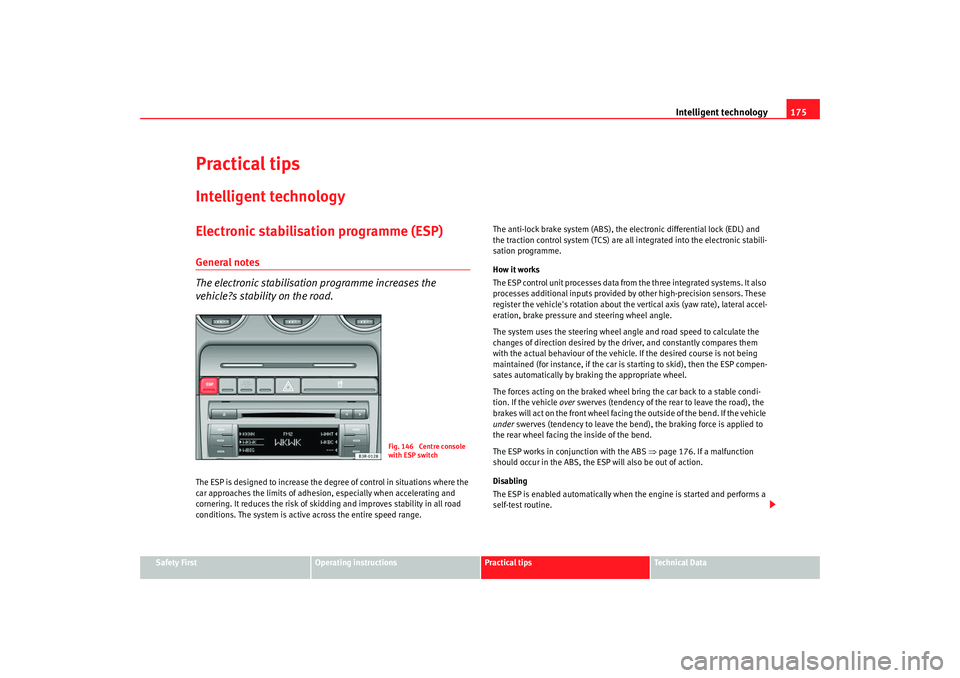
Fig. 146 Centre console
with ESP switch
Exeo_EN.book Seite 175 Freitag, 17. Oktober 2008 11:24 11
Page 181 of 303
Intelligent technology179
Safety First
Operating instructions
Practical tips
Te c h n i c a l D a t a
Corrosion
There may be a tendency for dirt to build up on the brake pads and corrosion
to form on the discs if the car is used
infrequently, or if you only drive low
mileages without using the brakes very much.
If the brakes are not used frequently, or if rust has formed on the disks, it is
advisable to clean off the pads and disks by braking firmly a few times from a
moderately high speed ⇒.
Faults in the brake system
If the brake pedal travel should ever increase suddenly, this may mean that
one of the two brake circuits has failed. Drive immediately to the nearest qual-
ified workshop and have the fault rectified. On the way to the dealer, be
prepared to use more pressure on the brake pedal, and allow for longer stop-
ping distances.
Low brake fluid level
Malfunctions can occur in the brake system if the brake fluid level is too low.
The brake fluid level is monitored electronically.
WARNING
When applying the brakes to clean off deposits on the pads and discs,
select a clear, dry road. Be sure not to inconvenience or endanger other
road users. Risk of accident.
Caution
•
Never let the brakes “drag” by leaving your foot on the pedal when you do
not really intend to brake. This overhe ats the brakes, resulting in longer stop-
ping distances and greater wear.
•
Before driving down a long, steep slope, it is advisable to reduce speed
and change into a lower gear. This makes use of engine braking and prolongs
the service life of the brakes. If you still have to use the brakes, it is better to
brake firmly at intervals than to apply the brakes continuously.
Note
If you wish to equip the car with accessories such as a front spoiler or wheel
covers, it is important that the flow of air to the front wheels is not obstructed,
otherwise the brakes can overheat.Brake servo
The brake servo assists the driver when brakingThe brake servo amplifies the pressure you apply to the brake pedal. The
brake servo works only when the engine is running.
WARNING
Ensure the vehicle does not move whil e in neutral, when the motor is
stopped. Failure to do so could result in an accident.
Note
If the brake servo is not working, e.g. because the vehicle has to be towed or
because it is broken, you will have to press the brake pedal considerably
harder to make up for the lack of servo assistance.Power steeringThe power steering assists the driver when turning the
steering wheel (with the engine running).The power steering assists the driver by reducing the force needed to turn the
steering wheel.
Exeo_EN.book Seite 179 Freitag, 17. Oktober 2008 11:24 11
Page 182 of 303
Intelligent technology
180The power steering does not work if the engine is off. In this case the steering
wheel is very hard to turn.
If the steering is held at its turning limit when the car is stationary, this will
place an excessive load on the power steering system. Turning the steering
wheel to its limit places a load on the sy stem, which causes noise. It will also
reduce the idling speed of the engine.
Caution
When the engine is running, do not tu rn the steering wheel to its limit for
more than 15 seconds. Otherwise, there is a risk of damaging the power
steering.
Note
•
If the power steering should fail at any time or the engine is switched off
(for instance when being towed), the ca r can still be steered. However, more
effort will be required to turn the steering wheel.
•
If the system is leaking or malfunctioning, please take the car to a quali-
fied workshop as soon as possible.
•
The power steering requires a special hydraulic fluid. The fluid reservoir is
located at the front of the engine compartment on the left ⇒page 282. The
correct fluid level in the reservoir is important for the power steering to func-
tion properly. The hydraulic fluid level is checked at the Inspection Service.
ServotronicThe servotronic system electronically adjusts the degree of
power assistanceIn cars equipped with servotronic power steering the degree of power assist-
ance ⇒page 179 is adjusted electronically according to road speed. If a fault should occur in the
servotronic system, the power steering will still
operate. The degree of power assistance will, however, no longer adapt to
different speeds. If the el ectronic regulating system is not working properly,
this is most noticeable when turning the steering wheel at low speeds (for
instance when parking) – more effort will be required than usual. The fault
should be corrected by a qualified workshop as soon as possible.
Exeo_EN.book Seite 180 Freitag, 17. Oktober 2008 11:24 11
Page 232 of 303

Wheels and tyres
230TMPS (Tyre Pressure Monitoring Syst em). Please contact the nearest
specialist garage as soon as possible.
The tyre pressure warning lamp
lights up if the tyre pressure on one or
more wheels is significantly lower than the tyre pressure setting which was
confirmed by the driver ⇒.
WARNING
•
If the tyre pressure warning lamp lights up
you must slow down
immediately and avoid any severe braking or steering manoeuvres. Stop
the vehicle as soon as possible and check the tyres and their pressure.
•
The driver is responsible for maintaining correct tyre pressures. There-
fore, the tyre pressure must be regularly checked.
•
Under certain conditions (e.g. drivin g at high speeds, on ice and snow
or on poor road surfaces) the tyre pressure warning lamp
may not light
up immediately or not at all.
•
Please ask your Dealer or specialist garage whether run-flat tyres can
be used on your vehicle. Fitting this type of tyre in an undue manner could
lead to your driving licence being taken away from you. Furthermore, it may
led to damage to the vehicle or, un der certain circumstances, may cause
accidents.
•
If you change normal tyres for run-flat tyres or vice versa, the control
unit must be reprogrammed by the Dealer or a specialist garage.Note
If you did not press the button for the tyre pressure monitoring system to
confirm a new tyre pressure setting after making changes to the tyre pres-
sures or changing one or more wheels, the warning lamp
may light up
although the tyre pressures are correct. In this case, stop the vehicle as soon
as possible and, after examining the tyres, press the button for the tyre pres-
sure monitoring system.
Tyre service life
The service life of tyres is dependent on tyre pressure, driving
style and fitting.
Fig. 173 Tyre tread wear
indicatorsFig. 174 Diagram for
changing wheels
Exeo_EN.book Seite 230 Freitag, 17. Oktober 2008 11:24 11
Page 233 of 303

Wheels and tyres231
Safety First
Operating instructions
Practical tips
Te c h n i c a l D a t a
Wear indicators
The original tyres on your vehicle have 1.6 mm high “tread wear indicators”
⇒
page 230, fig. 173 , running across the tread. Depending on the make,
there will be six to eight of them evenly spaced around the tyre. Markings on
the tyre sidewall (for instance the letters “TWI” or other symbols) indicate the
positions of the tread wear indicators. The minimum tread depth required by
law is 1.6 mm (measured in the tread grooves next to the tread wear indica-
tors). Worn tyres must be replaced. Different figures may apply in export
countries ⇒.
Tyre pressure
Under-inflation or over-inflation will reduce the life of the tyres considerably
and also impair the car's handling. The inflation pressures are listed on a
sticker on the inside of the fuel tank flap.
Correct inflation pressures are very important, especially at high speeds. The
pressure should therefore be checked at least once a month and before
starting any long journey.
Tyre pressure monitoring (RKA+)*
Monitoring of the tyre pressures is based on the tyre pressures you have
stored. The tyre pressure monitoring syst em cannot function as intended if
you store tyre pressure settings for a normal load, but then drive with the
vehicle fully laden. The tyre pressure must be adapted to the actual load and
stored accordingly in the tyre pressure monitoring system ⇒page 229.
Driving style
Fast cornering, heavy acceleration and hard braking all increase tyre wear.
Changing wheels around
If the front tyres are worn considerably more than the rear ones it is advisable
to change them around as shown ⇒page 230, fig. 174 . All the tyres will then
last for about the same time. Wheel balance
The wheels on new vehicles are balanced. However, various factors encoun-
tered in normal driving can cause them to become unbalanced, which results
in steering vibration.
Unbalanced wheels should be rebalanced, as they otherwise cause excessive
wear on steering, suspension and tyres. A wheel must also be rebalanced
when a new tyre is fitted.
Incorrect wheel alignment
Incorrect wheel alignment causes excessive tyre wear, impairing the safety of
the vehicle. If tyres show excessive wear, you should have the wheel align-
ment checked by an Authorised Service Centre.
WARNING
There is a serious danger of accidents if a tyre bursts during driving!•
The tyres must be replaced at the latest when the tread is worn down to
the tread wear indicators. Failure to do so could result in an accident. Worn
tyres do not grip well at high speeds on wet roads. There is also a greater
risk of “aquaplaning”
•
At continuously high speeds, a tyre with insufficient pressure flexes
more. This causes it to overheat. This can cause tread separation and tyre
blow-out. Risk of accident. Always observe the recommended tyre pres-
sures.
•
If tyres show excessive wear, you should have the running gear checked
by an Authorised Service Centre.
•
Keep chemicals such as oil, fuel and brake fluid away from tyres.
•
Damaged wheels and tyres must be replaced immediately!For the sake of the environment
Under-inflated tyres will increase fuel consumption.
Exeo_EN.book Seite 231 Freitag, 17. Oktober 2008 11:24 11
Page 277 of 303
If and when275
Safety First
Operating instructions
Practical tips
Te c h n i c a l D a t a
Do not pull too hard with the towing vehi
cle and take care to avoid jerking the
tow-rope. When towing on an unpaved road, there is always a risk of over-
loading and damaging the anchorage points.
The ignition of the vehicle being towed must be switched on to prevent the
steering wheel from locking and also to allow the use of the indicators, horn,
windscreen wipers and washers.
As the brake servo does not work if th e engine is not running, you must apply
considerably more pressure to the brake pedal than you normally would.
As the power assisted steering does not wo rk if the engine is not running, you
will need more strength to steer than you normally would.
Note
•
Observe legal requirements when towing or tow-starting.
•
Switch on the hazard warning lights of both vehicles. However, observe
any regulations to the contrary.
•
For technical reasons, vehicles with an automatic gearbox must not be
tow-started.
•
If damage to your vehicle means that there is no lubricant in the gearbox,
you must raise the drive wheels while the vehicle is being towed.
•
If the vehicle has to be towed more than 50 km, the front wheels must be
raised during towing, and towing should be carried out by a qualified person.
•
The steering wheel is locked when the vehicle has no electrical power. The
vehicle must then be towed with the front wheels raised. Towing should be
carried out by a qualified person.
•
The towing eye should always be kept in the vehicle. Please refer to the
notes ⇒page 274, “Tow-starting”.
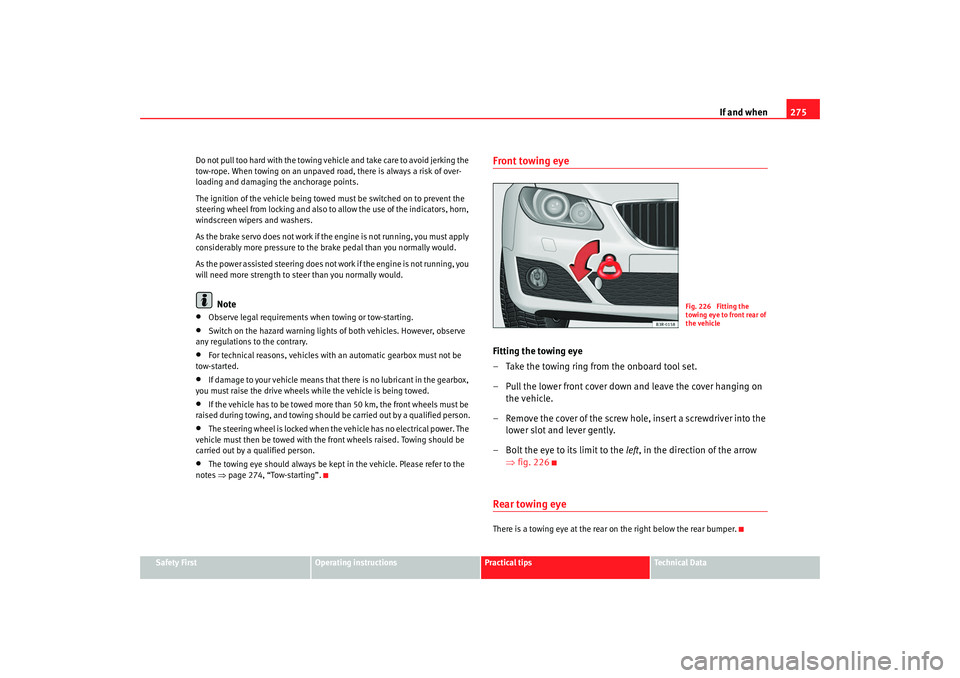
Front towing eyeFitting the towing eye
– Take the towing ring from the onboard tool set.
– Pull the lower front cover down and leave the cover hanging on
the vehicle.
– Remove the cover of the screw hole, insert a screwdriver into the lower slot and lever gently.
– Bolt the eye to its limit to the left, in the direction of the arrow
⇒ fig. 226Rear towing eyeThere is a towing eye at the rear on the right below the rear bumper.
Fig. 226 Fitting the
towing eye to front rear of
the vehicle
Exeo_EN.book Seite 275 Freitag, 17. Oktober 2008 11:24 11
Page 298 of 303

Index
296On-board computer . . . . . . . . . . . . . . . . . . . . . . . 84
Override function
Sunroof override function . . . . . . . . . . . . . . 110
Overview Cockpit . . . . . . . . . . . . . . . . . . . . . . . . . . . . . . 57PPaintworkPolishing . . . . . . . . . . . . . . . . . . . . . . . . . . . 200
Parking . . . . . . . . . . . . . . . . . . . . . . . . . . . . . . . . 167
Parking aid . . . . . . . . . . . . . . . . . . . . . . . . . . . . . 167 SEAT parking system . . . . . . . . . . . . . . . . . . 168
SEAT parking system plus . . . . . . . . . . . . . 168
Pedals . . . . . . . . . . . . . . . . . . . . . . . . . . . . . . . . . 15
Petrol . . . . . . . . . . . . . . . . . . . . . . . . . . . . . . . . . 210 Driving abroad . . . . . . . . . . . . . . . . . . . . . . . 185
Petrol additives . . . . . . . . . . . . . . . . . . . . . . . . . 210
Physical principles of a frontal collision . . . . . . 19
Plastic key tab . . . . . . . . . . . . . . . . . . . . . . . . . . . 94
Plastic parts . . . . . . . . . . . . . . . . . . . . . . . . . . . . 200
Plastic parts cleaning . . . . . . . . . . . . . . . . . . . . 203
Power steering . . . . . . . . . . . . . . . . . . . . . . . . . . 179
Products for vehicle maintenance . . . . . . . . . . 197QQuartz clock . . . . . . . . . . . . . . . . . . . . . . . . . . . . . 61
RRadiator fan . . . . . . . . . . . . . . . . . . . . . . . . . . . . 219
Radio display . . . . . . . . . . . . . . . . . . . . . . . . . . . . 72
Rain sensor . . . . . . . . . . . . . . . . . . . . . . . . . . . . 125
Rain sensor faulty . . . . . . . . . . . . . . . . . . . . . . . . 79
Reading lights Front . . . . . . . . . . . . . . . . . . . . . . . . . . . . . . . 120
Rear . . . . . . . . . . . . . . . . . . . . . . . . . . . . . . . 122
Rear drink holder . . . . . . . . . . . . . . . . . . . . . . . . 146
Rear fog light . . . . . . . . . . . . . . . . . . . . . . . . . . . 114
Rear side window sun blind . . . . . . . . . . . . . . . 124
Rear view mirror With manual anti-dazzle setting . . . . . . . . 127
Rear view mirrors Anti-dazzle setting . . . . . . . . . . . . . . . . . . . 127
Interior rear view mirror . . . . . . . . . . . . . . . 127
Rear window heating Heating element wires . . . . . . . . . . . . . . . . 201
Rear window sun blind . . . . . . . . . . . . . . . . . . . 124
Refuelling . . . . . . . . . . . . . . . . . . . . . . . . . . . . . . 208
Registration light . . . . . . . . . . . . . . . . . . . . . . . . 270
Remote control key Indicator light . . . . . . . . . . . . . . . . . . . . . . . . 94
Locking and unlocking . . . . . . . . . . . . . . . . 102
Locking and unlocking the vehicle . . . . . . 102
Replacing the battery . . . . . . . . . . . . . . . . . . 94
Remote control keys . . . . . . . . . . . . . . . . . . . . . . 93 Re-synchronising . . . . . . . . . . . . . . . . . . . . 103
Removing and fitting the wheel . . . . . . . . . . . . 242 Repairs
airbags . . . . . . . . . . . . . . . . . . . . . . . . . . . . . . 30
Replacement of parts . . . . . . . . . . . . . . . . . . . . 206
Replacing rear bulbs . . . . . . . . . . . . . . . . . . . . . 262
Rev counter . . . . . . . . . . . . . . . . . . . . . . . . . . . . . 61
Reverse gear Manual gearbox . . . . . . . . . . . . . . . . . . . . . 173
Roof carrier . . . . . . . . . . . . . . . . . . . . . . . . . . . . 144 Attachment points . . . . . . . . . . . . . . . . . . . 144
Roof load . . . . . . . . . . . . . . . . . . . . . . . . . . . 144
Rubber seals . . . . . . . . . . . . . . . . . . . . . . . . . . . 201
Running in Engine . . . . . . . . . . . . . . . . . . . . . . . . . . . . . 181
SSAFE . . . . . . . . . . . . . . . . . . . . . . . . . . . . . . . . . . . 95
Safe driving . . . . . . . . . . . . . . . . . . . . . . . . . . . . . . 7Aspects to take into account . . . . . . . . . . . . . 8
Before setting off . . . . . . . . . . . . . . . . . . . . . . 8
Driving safety . . . . . . . . . . . . . . . . . . . . . . . . . 8
Safety . . . . . . . . . . . . . . . . . . . . . . . . . . . . . . . . . . . 9
Safety equipment . . . . . . . . . . . . . . . . . . . . . . . . . 7
Safety instructions Engine compartment . . . . . . . . . . . . . . . . . 213
Safety notes Airbags . . . . . . . . . . . . . . . . . . . . . . . . . . . . . . 30
Belt tension devices . . . . . . . . . . . . . . . . . . . 27
Curtain airbags . . . . . . . . . . . . . . . . . . . . . . . 42
Disabling front passenger airbag . . . . . . . . 45
frontal airbags . . . . . . . . . . . . . . . . . . . . . . . . 35
Exeo_EN.book Seite 296 Freitag, 17. Oktober 2008 11:24 11
Page 299 of 303

Index297
side airbags . . . . . . . . . . . . . . . . . . . . . . . . . . 40
Using child seats . . . . . . . . . . . . . . . . . . . . . . 46
Using seat belts . . . . . . . . . . . . . . . . . . . . . . . 21
Seals . . . . . . . . . . . . . . . . . . . . . . . . . . . . . . . . . . 201
Seat adjustment Lumbar support . . . . . . . . . . . . . . . . . . . . . . 133
Seat belt position Pregnant women . . . . . . . . . . . . . . . . . . . . . . 24
Seat belts . . . . . . . . . . . . . . . . . . . . . . . . . . . . 23
Seat belt release . . . . . . . . . . . . . . . . . . . . . . . . . 25
Seat belt warning lamp . . . . . . . . . . . . . . . . . . . . 18
Seat belts . . . . . . . . . . . . . . . . . . . . . . . . . . . . . . . 18 adjustment . . . . . . . . . . . . . . . . . . . . . . . . . . . 22
Height adjustment . . . . . . . . . . . . . . . . . . . . . 25
Incorrectly fastened . . . . . . . . . . . . . . . . . . . . 26
Not worn . . . . . . . . . . . . . . . . . . . . . . . . . . . . . 20
Safety notes . . . . . . . . . . . . . . . . . . . . . . . . . . 21
Warning lamp . . . . . . . . . . . . . . . . . . . . . . 18, 68
Seat belts cleaning . . . . . . . . . . . . . . . . . . . . . . 205
Seat belts protection . . . . . . . . . . . . . . . . . . . . . . 21
Seat heating . . . . . . . . . . . . . . . . . . . . . . . . . . . . 161
Seats . . . . . . . . . . . . . . . . . . . . . . . . . . . . . . . . . . . 18 Electric adjustment . . . . . . . . . . . . . . . . . . . 132
Electric backrest adjustment . . . . . . . . . . . 133
Manual adjustment . . . . . . . . . . . . . . . . . . . 130
Manual backrest angle adjustment . . . . . . 131
Moving the seat forwards and backwards . 130
Seat height adjustment . . . . . . . . . . . . . . . . 130
Self-directing headlights . . . . . . . . . . . . . . . . . . 118 faulty . . . . . . . . . . . . . . . . . . . . . . . . . . . . . . . . 80
Service indicator . . . . . . . . . . . . . . . . . . . . . . . . . 74 Servotronic . . . . . . . . . . . . . . . . . . . . . . . . . . . . . 180
Shoes . . . . . . . . . . . . . . . . . . . . . . . . . . . . . . . . . . 15
Side airbags . . . . . . . . . . . . . . . . . . . . . . . . . . . . . 38
Description . . . . . . . . . . . . . . . . . . . . . . . . . . . 38
Function . . . . . . . . . . . . . . . . . . . . . . . . . . . . . 39
Safety notes . . . . . . . . . . . . . . . . . . . . . . . . . . 40
Side lights . . . . . . . . . . . . . . . . . . . . . . . . . . . . . 112
Sitting position Driver . . . . . . . . . . . . . . . . . . . . . . . . . . . . . . . 10
Front passenger . . . . . . . . . . . . . . . . . . . . . . . 11
Incorrect sitting position . . . . . . . . . . . . . . . . 14
Passengers . . . . . . . . . . . . . . . . . . . . . . . . . . . 12
Sitting position, occupants . . . . . . . . . . . . . . . . . 10
Ski bag . . . . . . . . . . . . . . . . . . . . . . . . . . . . . . . . 143
Snow chains . . . . . . . . . . . . . . . . . . . . . . . 235, 281
Solar-powered blower/solar roof . . . . . . . . . . . 161
Spare keys . . . . . . . . . . . . . . . . . . . . . . . . . . . . . . 93
Spare parts . . . . . . . . . . . . . . . . . . . . . . . . . . . . . 206
Spare wheel Steel rim . . . . . . . . . . . . . . . . . . . . . . . . . . . . 237
Speed warning . . . . . . . . . . . . . . . . . . . . . . . . 80, 81
Speed warning function . . . . . . . . . . . . . . . . . . . 81
Speedometer . . . . . . . . . . . . . . . . . . . . . . . . . . . . 63
Steam jets . . . . . . . . . . . . . . . . . . . . . . . . . . . . . 199
Steering Locking . . . . . . . . . . . . . . . . . . . . . . . . . . . . . 163
Manual steering wheel adjustment . . . . . . 162
Steering wheel controls . . . . . . . . . . . . . . . . . . . 90
Stopping the engine . . . . . . . . . . . . . . . . . . . . . 165 Sun roof
Opening . . . . . . . . . . . . . . . . . . . . . . . . . . . . 109
Sun roof / deflector . . . . . . . . . . . . . . . . . . . . . . 108
Sun visors . . . . . . . . . . . . . . . . . . . . . . . . . . . . . 123
Sunroof . . . . . . . . . . . . . . . . . . . . . . . . . . . . . . . . 110 Automatic close function . . . . . . . . . . . . . . 110
Closing . . . . . . . . . . . . . . . . . . . . . . . . . . . . . 109
Manual operation . . . . . . . . . . . . . . . . . . . . 111
Override function . . . . . . . . . . . . . . . . . . . . . 110
Supplementary heating . . . . . . . . . . . . . . . . . . 161
Switches in the driver's door Electric windows . . . . . . . . . . . . . . . . . . . . . 106
Symbols Red symbols in central display . . . . . . . . . . . 76
Yellow symbols in central display . . . . . . . . 78
TTailgateCentral locking system . . . . . . . . . . . . . . . . 100
Light . . . . . . . . . . . . . . . . . . . . . . . . . . . . . . . 122
TCS Funcionamiento . . . . . . . . . . . . . . . . . . . . . . 178
Technical modification s . . . . . . . . . . . . . . . . . . 206
The danger of not using the seat belt . . . . . . . . 20
The environment Heated rear window . . . . . . . . . . . . . . . . . . 123
Leaks . . . . . . . . . . . . . . . . . . . . . . . . . . . . . . 213
Roof carriers . . . . . . . . . . . . . . . . . . . . . . . . . 145
Warming up the engine . . . . . . . . . . . . . . . . 164
Tightening torque of wheel bo lts . . . . . . . . . . . 281
Exeo_EN.book Seite 297 Freitag, 17. Oktober 2008 11:24 11