check oil Seat Exeo 2008 Owner's manual
[x] Cancel search | Manufacturer: SEAT, Model Year: 2008, Model line: Exeo, Model: Seat Exeo 2008Pages: 303, PDF Size: 10.02 MB
Page 6 of 303
Contents
4Trailer towing
. . . . . . . . . . . . . . . . . . . . . . . . . . . . .
Trailer towing . . . . . . . . . . . . . . . . . . . . . . . . . . . .
Removable towing bracket . . . . . . . . . . . . . . . . .
Your vehicle maintenance and cleaning
. . . .
General notes . . . . . . . . . . . . . . . . . . . . . . . . . . .
Vehicle exterior maintenance . . . . . . . . . . . . . . .
Vehicle interior maintenance . . . . . . . . . . . . . . .
Accessories, parts replacement and
modifications
. . . . . . . . . . . . . . . . . . . . . . . . . . . .
Accessories and spare parts . . . . . . . . . . . . . . . .
Technical modifications . . . . . . . . . . . . . . . . . . .
Mobile telephones and radiotelephones . . . . .
Athermic windscreen* . . . . . . . . . . . . . . . . . . . . .
Checking and refilling levels
. . . . . . . . . . . . . .
Refuelling . . . . . . . . . . . . . . . . . . . . . . . . . . . . . . .
Releasing the tank flap manually . . . . . . . . . . . .
Petrol . . . . . . . . . . . . . . . . . . . . . . . . . . . . . . . . . .
Diesel . . . . . . . . . . . . . . . . . . . . . . . . . . . . . . . . . .
The bonnet . . . . . . . . . . . . . . . . . . . . . . . . . . . . . .
Engine oil . . . . . . . . . . . . . . . . . . . . . . . . . . . . . . .
Cooling system . . . . . . . . . . . . . . . . . . . . . . . . . .
Washer fluid and windscreen wiper blades . . . .
Brake fluid . . . . . . . . . . . . . . . . . . . . . . . . . . . . . .
Battery . . . . . . . . . . . . . . . . . . . . . . . . . . . . . . . . .
Wheels and tyres
. . . . . . . . . . . . . . . . . . . . . . . . .
Wheels . . . . . . . . . . . . . . . . . . . . . . . . . . . . . . . . .
If and when
. . . . . . . . . . . . . . . . . . . . . . . . . . . . . .
Tools, tyre repair kit and spare wheel . . . . . . . .
Changing a wheel . . . . . . . . . . . . . . . . . . . . . . . .
Tyre repair* (Tyre-Mobility-System) . . . . . . . . . .
Fuses . . . . . . . . . . . . . . . . . . . . . . . . . . . . . . . . . .
Bulbs . . . . . . . . . . . . . . . . . . . . . . . . . . . . . . . . . .
Changing bulbs Halogen headlights . . . . . . . . .
Changing bulbs. Bi-Xenon AFS headlights . . . .
Changing rear bulbs (in side panel) . . . . . . . . . .
Changing rear light bulbs (i n boot lid) . . . . . . . . Side indicators . . . . . . . . . . . . . . . . . . . . . . . . . .
Luggage compartment lights . . . . . . . . . . . . . . .
Registration light . . . . . . . . . . . . . . . . . . . . . . . . .
Sunroof light . . . . . . . . . . . . . . . . . . . . . . . . . . . .
Jump-starting . . . . . . . . . . . . . . . . . . . . . . . . . . . .
Towing and tow-starting . . . . . . . . . . . . . . . . . . .
Te c h n i c a l D a t a
. . . . . . . . . . . . . . . . . . . . . . .
General notes on the technical data
. . . . . . .
Outstanding information . . . . . . . . . . . . . . . . . .
Data on fuel consumption . . . . . . . . . . . . . . . . .
Towing a trailer . . . . . . . . . . . . . . . . . . . . . . . . . .
Wheels . . . . . . . . . . . . . . . . . . . . . . . . . . . . . . . . .
Techn ical Data
. . . . . . . . . . . . . . . . . . . . . . . . . . . .
Checking fluid levels . . . . . . . . . . . . . . . . . . . . . .
Petrol engine 1.6l 75 kW (102 HP) . . . . . . . . . . .
Petrol engine 1.8l 110 kW (150 HP) . . . . . . . . .
Petrol engine 2.0l 147 kW (200 HP) . . . . . . . . .
Diesel engine 2.0l 105 kW (143 hp) . . . . . . . . .
Diesel engine 2.0l 125 kW (170 hp) . . . . . . . . .
Dimensions and capacities . . . . . . . . . . . . . . . .
Index
. . . . . . . . . . . . . . . . . . . . . . . . . . . . . . . . . .
186
186
189
197
197
198
203
206
206
206
207
207
208
208
209
210
210
212
214
217
220
222
223
227
227
236
236
238
243
247
249
249
256
262
266 268
269
270
271
271
274
277
277
277
279
280
280
282
282
283
284
285
287
288
290
291
Exeo_EN.book Seite 4 Freitag, 17. Oktober 2008 11:24 11
Page 66 of 303
Cockpit
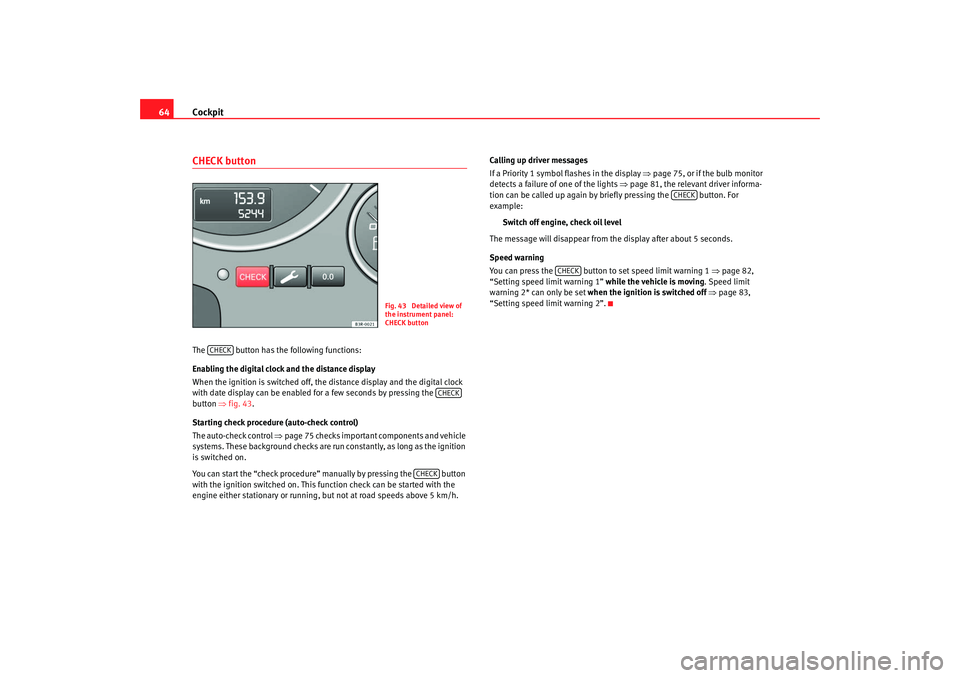
64CHECK buttonThe button has the following functions:
Enabling the digital clock and the distance display
When the ignition is switched off, the distance display and the digital clock
with date display can be enabled for a few seconds by pressing the
button ⇒ fig. 43.
Starting check procedure (auto-check control)
The auto-check control ⇒page 75 checks important components and vehicle
systems. These background checks are ru n constantly, as long as the ignition
is switched on.
You can start the “check procedure” manually by pressing the button
with the ignition switched on. This function check can be started with the
engine either stationary or running, but not at road speeds above 5 km/h. Calling up driver messages
If a Priority 1 symbol flashes in the display
⇒page 75, or if the bulb monitor
detects a failure of one of the lights ⇒page 81, the relevant driver informa-
tion can be called up again by briefly pressing the button. For
example:
Switch off engine, check oil level
The message will disappear from the display after about 5 seconds.
Speed warning
You can press the button to set speed limit warning 1 ⇒page 82,
“Setting speed limi t warning 1” while the vehicle is moving . Speed limit
warning 2* can only be set when the ignition is switched off ⇒page 83,
“Setting speed limi t warning 2”.
Fig. 43 Detailed view of
the instrument panel:
CHECK button
CHECK
CHECK
CHECK
CHECK
CHECK
Exeo_EN.book Seite 64 Freitag, 17. Oktober 2008 11:24 11
Page 77 of 303

Cockpit75
Safety First
Operating instructions
Practical tips
Te c h n i c a l D a t a
Auto-check systemIntroductionThe auto-check system checks important components and vehicle systems.
These background checks are run consta ntly, as long as the ignition is
switched on.
A message is displayed in the instrument panel if a fault should occur or if any
maintenance or repairs are urgently required. This is accompanied by an
audible warning signal. Depending on the pr iority of the fault, a red or yellow
warning symbol lights up in the display.
The red symbols indicate a danger, whereas the yellow ones represent a
warning . Additional messages to assist the driver may be shown with the red
or yellow symbols.
Driver messages
Additional messages to assist the driver are displayed
together with the warning symbols in the instrument panel.Driver messages and red symbols
If a red warning symbol appears in the display, you can press the
button ⇒fig. 52 to call up an additional driver message.
For example: in the event of an oil pressure malfunction, the oil pressure
symbol
will appear in the display. If you now press the button, the
following message will appear in the display:
Switch off engine, check oil level
The message will disappear from the display after about 5 seconds. If
required, the message can be called up again by briefly pressing the
button.
Fig. 52 Instrument panel:
CHECK button
CHECK
CHECK
CHECK
Exeo_EN.book Seite 75 Freitag, 17. Oktober 2008 11:24 11
Page 78 of 303

Cockpit
76Driver messages and yellow symbols
If a yellow warning symbol appears in the display, it will automatically be
accompanied by the corresponding driver message.
For example, the symbol
is displayed to indicate that the windscreen
washer fluid level is low. In addition, the following message will appear:
Top up washer fluid
The message will disappear after a few seconds. If required, the message can
be called up again by briefly pressing the button.
Note
•
The messages handbrake applied and When stationary apply footbrake
while selecting gear cannot be called up a second time. They will remain in
the display until the handbrake is released or until a gear is selected.
Handbrake warning– Release the handbrake.If you drive by mistake with the handbrake still applied, you will hear a
warning buzzer and the display will show the message:
Handbrake applied
The handbrake warning switches on after driving for 3 seconds at speeds
above 5 km/h.
Red symbols
A red symbol warns of a danger.–Stop the vehicle.
– Switch the engine off.
– Check the fault. Obtain professional assistance if necessary.
CHECK
BRAKE
Fault in brake system
⇒ page 77
COOLANT
Coolant level too low / coolant tem-
perature too high
⇒ page 77
OIL
PRESSURE
Engine oil pressure too low
⇒ page 78Fig. 53 Display: Coolant
level warning
Exeo_EN.book Seite 76 Freitag, 17. Oktober 2008 11:24 11
Page 80 of 303

Cockpit
78If the alternator warning lamp lights up as well ⇒page 69, it is possible that
the drive belt has broken.
Caution
Do not drive on if the symbol
has come on to indicate a fault in the cooling
system, otherwise there is a risk of engine damage.
Engine oil pressure too low
If the engine oil pressure is too low the fault must be rectified
immediately.If the
symbol flashes in the display, the oil pressure is too low.
The following message will appear in the display together with the
symbol:
Switch off engine, check oil level
–Stop the vehicle.
– Switch the engine off.
– Check the engine oil level ⇒page 215.
– Obtain professional assistance if necessary.
Engine oil level too low
If the engine oil level is too low, add more oil ⇒page 216.
Engine oil level correct
If the
symbol flashes and the engine oil level is correct, obtain profes-
sional assistance. Do not drive on. Do not continue to run the engine, even at
idle speed .
Note
The oil pressure warning lamp
is not an indicator for the oil level. The oil
level should therefore be checked regularl y, preferably every time you fill the
tank.
Yellow symbols
A yellow symbol indicates a warning.
Fuel level low
⇒ page 79
Diesel particulate filter* obstructed
⇒page 79
Light sensor/ rain sensor faulty
⇒page 79
F i g . 5 4 D i s p l a y : F u e l l e v e l
low
Exeo_EN.book Seite 78 Freitag, 17. Oktober 2008 11:24 11
Page 183 of 303
Driving and the environment181
Safety First
Operating instructions
Practical tips
Te c h n i c a l D a t a
Driving and the environmentRunning-inRunning in a new engine
The engine needs to be run-in over the first 1,500 km.Up to 1,000 kilometres
– Do not drive at speeds of more than 2/3 the maximum speed.
– Do not accelerate hard.
– Avoid high engine revolutions.
– Do not tow a trailer.
From 1000 to 1500 km
–Speeds can be gradually increased to the maximum road speed
or maximum permissible engine speed (rpm).During its first few hours of running, the internal fric tion in the engine is
greater than later on, when all the moving parts have bedded in.
For the sake of the environment
If the engine is run in gent ly, its life will be increased and its oil consumption,
reduced.
Braking effect and braking distance
The braking effect and braking distance are influenced by
driving situations and road conditions.The efficiency of the brakes depends directly on the brake pad wear. The rate
of wear of the brake pads depends to a great extent on the conditions under
which the vehicle is operated and the way the vehicle is driven. If you often
drive in town traffic, drive short distances or have a sporty driving style, we
recommend that you have the thickness of your brake pads checked by an
Authorised Service Centre more freque ntly than recommended in the Service
Schedule.
If you drive with wet brakes, for example, after crossing areas of water, in
heavy rainfall or even after washing the car, the effect of the brakes is less-
ened as the brake discs are wet or even frozen (in winter): The brakes should
be “dried” by pressing the pedal to restore full braking effect.
WARNING
Longer braking distances and faults in the brake system increase the risk
of accidents.•
New brake pads must be run in and do not have the correct friction
during the first 200 km. However, th e reduced braking capacity may be
compensated by pressing on the brake pedal a little harder. This also
applies when new brake pads are fitted.
•
If brakes are wet or frozen, or if you are driving on roads which have
been gritted with salt, braking po wer may set in later than normal.
•
On steep slopes, if brakes are excessively used, they will overheat.
Before driving down a long steep slope, it is advisable to reduce speed and
change down into a lower gear (or move the selector lever to a lower gear if
Exeo_EN.book Seite 181 Freitag, 17. Oktober 2008 11:24 11
Page 212 of 303

Checking and refilling levels
210PetrolPetrol types
The recommended fuel types are listed on a sticker inside the
fuel tank flap.Only unleaded petrol, corresponding to the standard DIN EN 228 , may be
used for vehicles with catalytic converters (EN = “European Standard”).
Fuel types are differentiated by the octane rating, e.g: 91, 95, 98 RON (RON
= “Regulation Octane Number, unit for determining the knock resistance of
petrol”). You may use petrol with a high er octane number than the one recom-
mended for your engine. However, this has no advantage in terms of fuel
consumption and engine power.
The correct fuel type for your vehicle is given in the technical table for the
engine. Section “Technical Data”
Caution
•
Petrol that follows EN 228 may be mixe d with small quantities of ethanol.
However, the so-called “bioethanol fuels” available at commercial establish-
ments, e.g. with reference E50 or E85, which contain a high percentage of
ethanol, may not be used, as they will damage the fuel system.
•
Even one tankful of leaded fuel woul d permanently impair the efficiency
of the catalytic converter.
•
High engine speed and full throttle can damage the engine when using
petrol with an octane rating lower than the correct grade for the engine.For the sake of the environment
Just one full tank of leaded fuel would seriously impair the efficiency of the
catalytic converter.
Petrol additives
Petrol additives improve the quality of the petrol.The quality of the petrol influences running behaviour, performance and
service life of the engine. For this re ason, you should use good quality petrol
containing additives. These additives will help to prevent corrosion, keep the
fuel system clean and prevent deposits from building up in the engine.
If good quality petrol with additives is not available or engine problems occur,
the required additives must be added during refuelling.DieselDiesel*Diesel fuel must correspond to DIN EN 590 (EN = “European standard”). It
must have a cetane number (CN) of at least 51. The cetane number indicates
the ignition quality of the diesel fuel.
Notes on refuelling ⇒page 208.Biodiesel*The biodiesel fuel must comply wi th the DIN EN 14.214 (FAME) Standard.•
Biodiesel is a methylester obtained from rapeseed oil.
•
DIN is the German abbreviation for “ Deutsches Institut für N ormung e.V.”,
the German standards institute.
•
EN means European Norm.
•
FAME is the English abbreviation for “F atty Acid Methyl Ester”.
Exeo_EN.book Seite 210 Freitag, 17. Oktober 2008 11:24 11
Page 215 of 303
Checking and refilling levels213
Safety First
Operating instructions
Practical tips
Te c h n i c a l D a t a
WARNING
Never open the bonnet if you see steam or drips of coolant being released
from the engine compartment. Failure to comply could result in burns. Wait
until no steam or coolant can be seen before opening the bonnet.Work in the engine compartment
Extra caution is necessary when working on components in
the engine compartment.Always be aware of the danger of injury and scalding as well as the risk of
accident or even fire when working in the engine compartment (e.g. when
checking and refilling fluids). Therefor e, always observe the warnings listed
below and follow all general safety precautions. The engine compartment of
any motor vehicle is a potentially hazardous area ⇒
WARNING
•
Switch the engine off.
•
Remove the ignition key.
•
Apply handbrake firmly.
•
Place the gear lever into neutral.
•
Wait for the engine to cool down.
•
Children should not be allowed to approach the engine compartment
•
Never spill liquids involved in vehicle operations on the engine
compartment, as these may catch fire (e.g. anti-freeze containing liquid
coolant).
•
Take care not to cause short circuits in the electrical system, especially
when working on the battery.
•
Never touch the radiator fan while the engine is hot, as the fan could
start up suddenly.
•
Never open the expansion tank when the engine is hot. The cooling
system is under pressure.
•
Protect face, hands and arms from any hot steam or hot liquid coolant
released by covering the cap with a large, thick rag when opening the
expansion tank.
•
If any tests have to be performed with the engine running, there is an
extra safety risk from the rotating parts, such as the drive belts, alternator
and radiator fan, etc., and from the high-voltage ignition system.
•
Observe the following additional warnings if work on the fuel system or
the electrical system is necessary:
−Always disconnect the battery.
− Do not smoke.
− Never work near open flames
− Always keep an approved fire extinguisher immediately available.Caution
When topping up fluids, make sure the correct fluid is put into the correct
filler opening. This can otherwise cau se serious malfunctions or engine
damage.
For the sake of the environment
Inspect the ground underneath your vehicle regularly so that any leaks are
detected at an early stage. If you find spots of oil or other fluids, have your
vehicle inspected in the garage.
WARNING (continued)
Exeo_EN.book Seite 213 Freitag, 17. Oktober 2008 11:24 11
Page 216 of 303

Checking and refilling levels
214
NoteOn right-hand drive vehicles some of the containers/ reservoirs mentioned
below are located on the other side of the engine compartment.Closing the bonnet– To close the bonnet, pull it down to overcome the spring pres- sure.
– Leave the bonnet secured in the locking part. Do not tighten
⇒ .
WARNING
•
For safety reasons the bonnet must always be completely closed when
the vehicle is moving. After closing it always check that it is properly
secured. The bonnet must be flus h with the adjacent body panels.
•
Should you notice that the bonnet is not safely secured when the
vehicle is moving, stop the vehicle immediately and close the bonnet.
Failure to do so could result in an accident.
Engine oilGeneral notesWe recommend you to entrust the oil change with your Technical Service or a
qualified workshop, according to the Maintenance Program. The correct oil specifications for your engine are listed in the
Technical data
section ⇒page 282.
Check that the specifications quoted (VW standards) appear on the container
either singly or in combination with other specifications.
Fixed service intervals*
You can use oils for service intervals - ⇒ page 282. In this case, your car must
be serviced after a fixed interval of 1 year / 15,000 km (10,000 miles) see
Service Schedule.
•
In exceptional circumstances, if the engine oil level is too low
⇒ page 215 and you cannot obtain the oi l specified for your vehicle, you can
put in a small quantity of oil conforming to the specification ACEA A2 or
ACEA A3 (petrol engines) or ACEA B3 or ACEA B4 (diesel engines) (up to 0.5l).
Vehicles with diesel particulate filter*
The Service Schedule states whether your vehicle is fitted with a diesel partic-
ulate filter.
•
Vehicles with a diesel particulate filter must only b e f ill e d wi th VW 507 00
engine oil.
•
Avoid mixing this oil with other engine oils.
•
Only in exceptional circumstances, if the engine oil level is too low
⇒ page 215 and you cannot obtain the oi l specified for your vehicle, can you
put in a small quantity of oil (once) conforming to the VW 506 00, VW 506 01,
VW 505 00, VW 505 01 or ACEA B3 / ACEA B4 specification. (up to 0.5l).
Exeo_EN.book Seite 214 Freitag, 17. Oktober 2008 11:24 11
Page 217 of 303
Checking and refilling levels215
Safety First
Operating instructions
Practical tips
Te c h n i c a l D a t a
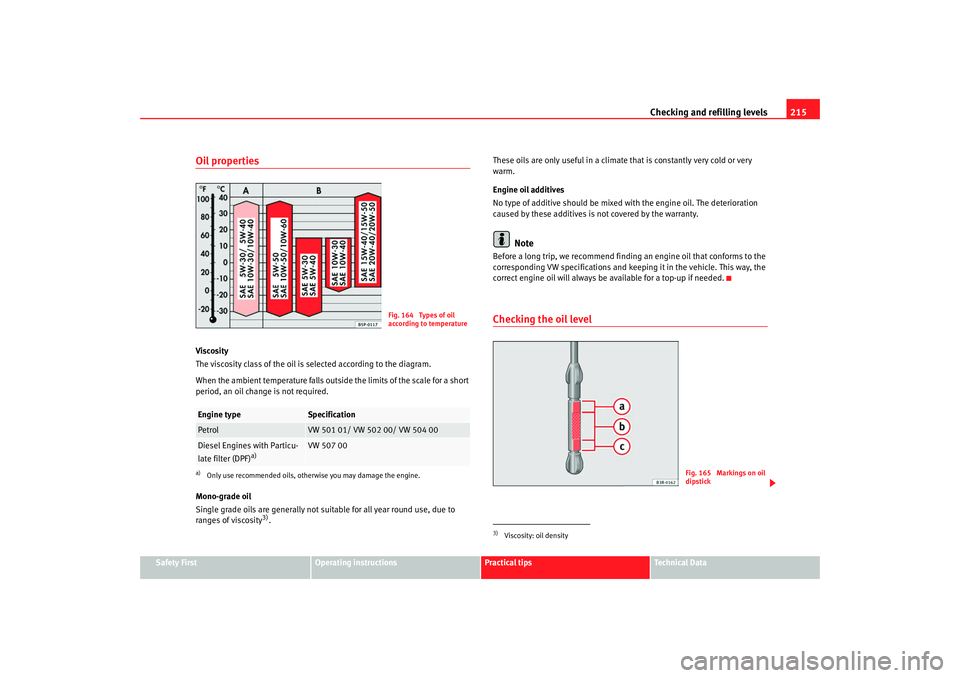
Oil propertiesViscosity
The viscosity class of the oil is selected according to the diagram.
When the ambient temperature falls outside the limits of the scale for a short
period, an oil change is not required.
Mono-grade oil
Single grade oils are generally not suitable for all year round use, due to
ranges of viscosity
3). These oils are only useful in a climate that is constantly very cold or very
warm.
Engine oil additives
No type of additive should be mixed with the engine oil. The deterioration
caused by these additives is not covered by the warranty.
Note
Before a long trip, we recommend findin
g an engine oil that conforms to the
corresponding VW specifications and keeping it in the vehicle. This way, the
correct engine oil will always be available for a top-up if needed.Checking the oil level
Engine type
Specification
Petrol
VW 501 01/ VW 502 00/ VW 504 00
Diesel Engines with Particu-
late filter (DPF)
a)
a)Only use recommended oils, otherwise you may damage the engine.
VW 507 00
Fig. 164 Types of oil
according to temperature
3)Viscosity: oil density
Fig. 165 Markings on oil
dipstick
Exeo_EN.book Seite 215 Freitag, 17. Oktober 2008 11:24 11