engine oil Seat Exeo 2008 Owner's manual
[x] Cancel search | Manufacturer: SEAT, Model Year: 2008, Model line: Exeo, Model: Seat Exeo 2008Pages: 303, PDF Size: 10.02 MB
Page 6 of 303
Contents
4Trailer towing
. . . . . . . . . . . . . . . . . . . . . . . . . . . . .
Trailer towing . . . . . . . . . . . . . . . . . . . . . . . . . . . .
Removable towing bracket . . . . . . . . . . . . . . . . .
Your vehicle maintenance and cleaning
. . . .
General notes . . . . . . . . . . . . . . . . . . . . . . . . . . .
Vehicle exterior maintenance . . . . . . . . . . . . . . .
Vehicle interior maintenance . . . . . . . . . . . . . . .
Accessories, parts replacement and
modifications
. . . . . . . . . . . . . . . . . . . . . . . . . . . .
Accessories and spare parts . . . . . . . . . . . . . . . .
Technical modifications . . . . . . . . . . . . . . . . . . .
Mobile telephones and radiotelephones . . . . .
Athermic windscreen* . . . . . . . . . . . . . . . . . . . . .
Checking and refilling levels
. . . . . . . . . . . . . .
Refuelling . . . . . . . . . . . . . . . . . . . . . . . . . . . . . . .
Releasing the tank flap manually . . . . . . . . . . . .
Petrol . . . . . . . . . . . . . . . . . . . . . . . . . . . . . . . . . .
Diesel . . . . . . . . . . . . . . . . . . . . . . . . . . . . . . . . . .
The bonnet . . . . . . . . . . . . . . . . . . . . . . . . . . . . . .
Engine oil . . . . . . . . . . . . . . . . . . . . . . . . . . . . . . .
Cooling system . . . . . . . . . . . . . . . . . . . . . . . . . .
Washer fluid and windscreen wiper blades . . . .
Brake fluid . . . . . . . . . . . . . . . . . . . . . . . . . . . . . .
Battery . . . . . . . . . . . . . . . . . . . . . . . . . . . . . . . . .
Wheels and tyres
. . . . . . . . . . . . . . . . . . . . . . . . .
Wheels . . . . . . . . . . . . . . . . . . . . . . . . . . . . . . . . .
If and when
. . . . . . . . . . . . . . . . . . . . . . . . . . . . . .
Tools, tyre repair kit and spare wheel . . . . . . . .
Changing a wheel . . . . . . . . . . . . . . . . . . . . . . . .
Tyre repair* (Tyre-Mobility-System) . . . . . . . . . .
Fuses . . . . . . . . . . . . . . . . . . . . . . . . . . . . . . . . . .
Bulbs . . . . . . . . . . . . . . . . . . . . . . . . . . . . . . . . . .
Changing bulbs Halogen headlights . . . . . . . . .
Changing bulbs. Bi-Xenon AFS headlights . . . .
Changing rear bulbs (in side panel) . . . . . . . . . .
Changing rear light bulbs (i n boot lid) . . . . . . . . Side indicators . . . . . . . . . . . . . . . . . . . . . . . . . .
Luggage compartment lights . . . . . . . . . . . . . . .
Registration light . . . . . . . . . . . . . . . . . . . . . . . . .
Sunroof light . . . . . . . . . . . . . . . . . . . . . . . . . . . .
Jump-starting . . . . . . . . . . . . . . . . . . . . . . . . . . . .
Towing and tow-starting . . . . . . . . . . . . . . . . . . .
Te c h n i c a l D a t a
. . . . . . . . . . . . . . . . . . . . . . .
General notes on the technical data
. . . . . . .
Outstanding information . . . . . . . . . . . . . . . . . .
Data on fuel consumption . . . . . . . . . . . . . . . . .
Towing a trailer . . . . . . . . . . . . . . . . . . . . . . . . . .
Wheels . . . . . . . . . . . . . . . . . . . . . . . . . . . . . . . . .
Techn ical Data
. . . . . . . . . . . . . . . . . . . . . . . . . . . .
Checking fluid levels . . . . . . . . . . . . . . . . . . . . . .
Petrol engine 1.6l 75 kW (102 HP) . . . . . . . . . . .
Petrol engine 1.8l 110 kW (150 HP) . . . . . . . . .
Petrol engine 2.0l 147 kW (200 HP) . . . . . . . . .
Diesel engine 2.0l 105 kW (143 hp) . . . . . . . . .
Diesel engine 2.0l 125 kW (170 hp) . . . . . . . . .
Dimensions and capacities . . . . . . . . . . . . . . . .
Index
. . . . . . . . . . . . . . . . . . . . . . . . . . . . . . . . . .
186
186
189
197
197
198
203
206
206
206
207
207
208
208
209
210
210
212
214
217
220
222
223
227
227
236
236
238
243
247
249
249
256
262
266 268
269
270
271
271
274
277
277
277
279
280
280
282
282
283
284
285
287
288
290
291
Exeo_EN.book Seite 4 Freitag, 17. Oktober 2008 11:24 11
Page 66 of 303
Cockpit
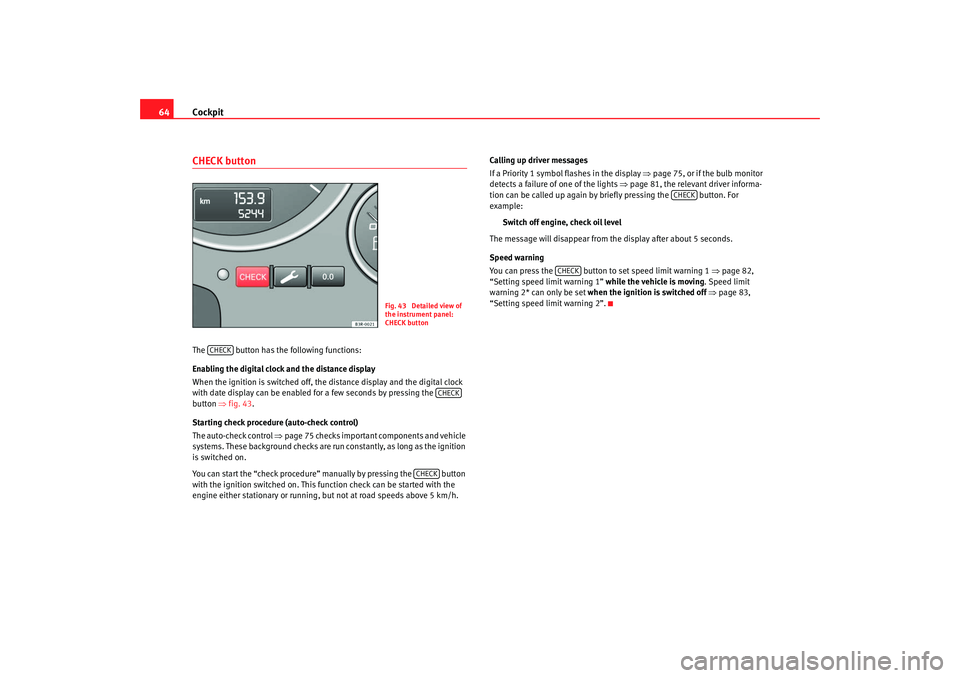
64CHECK buttonThe button has the following functions:
Enabling the digital clock and the distance display
When the ignition is switched off, the distance display and the digital clock
with date display can be enabled for a few seconds by pressing the
button ⇒ fig. 43.
Starting check procedure (auto-check control)
The auto-check control ⇒page 75 checks important components and vehicle
systems. These background checks are ru n constantly, as long as the ignition
is switched on.
You can start the “check procedure” manually by pressing the button
with the ignition switched on. This function check can be started with the
engine either stationary or running, but not at road speeds above 5 km/h. Calling up driver messages
If a Priority 1 symbol flashes in the display
⇒page 75, or if the bulb monitor
detects a failure of one of the lights ⇒page 81, the relevant driver informa-
tion can be called up again by briefly pressing the button. For
example:
Switch off engine, check oil level
The message will disappear from the display after about 5 seconds.
Speed warning
You can press the button to set speed limit warning 1 ⇒page 82,
“Setting speed limi t warning 1” while the vehicle is moving . Speed limit
warning 2* can only be set when the ignition is switched off ⇒page 83,
“Setting speed limi t warning 2”.
Fig. 43 Detailed view of
the instrument panel:
CHECK button
CHECK
CHECK
CHECK
CHECK
CHECK
Exeo_EN.book Seite 64 Freitag, 17. Oktober 2008 11:24 11
Page 77 of 303

Cockpit75
Safety First
Operating instructions
Practical tips
Te c h n i c a l D a t a
Auto-check systemIntroductionThe auto-check system checks important components and vehicle systems.
These background checks are run consta ntly, as long as the ignition is
switched on.
A message is displayed in the instrument panel if a fault should occur or if any
maintenance or repairs are urgently required. This is accompanied by an
audible warning signal. Depending on the pr iority of the fault, a red or yellow
warning symbol lights up in the display.
The red symbols indicate a danger, whereas the yellow ones represent a
warning . Additional messages to assist the driver may be shown with the red
or yellow symbols.
Driver messages
Additional messages to assist the driver are displayed
together with the warning symbols in the instrument panel.Driver messages and red symbols
If a red warning symbol appears in the display, you can press the
button ⇒fig. 52 to call up an additional driver message.
For example: in the event of an oil pressure malfunction, the oil pressure
symbol
will appear in the display. If you now press the button, the
following message will appear in the display:
Switch off engine, check oil level
The message will disappear from the display after about 5 seconds. If
required, the message can be called up again by briefly pressing the
button.
Fig. 52 Instrument panel:
CHECK button
CHECK
CHECK
CHECK
Exeo_EN.book Seite 75 Freitag, 17. Oktober 2008 11:24 11
Page 78 of 303

Cockpit
76Driver messages and yellow symbols
If a yellow warning symbol appears in the display, it will automatically be
accompanied by the corresponding driver message.
For example, the symbol
is displayed to indicate that the windscreen
washer fluid level is low. In addition, the following message will appear:
Top up washer fluid
The message will disappear after a few seconds. If required, the message can
be called up again by briefly pressing the button.
Note
•
The messages handbrake applied and When stationary apply footbrake
while selecting gear cannot be called up a second time. They will remain in
the display until the handbrake is released or until a gear is selected.
Handbrake warning– Release the handbrake.If you drive by mistake with the handbrake still applied, you will hear a
warning buzzer and the display will show the message:
Handbrake applied
The handbrake warning switches on after driving for 3 seconds at speeds
above 5 km/h.
Red symbols
A red symbol warns of a danger.–Stop the vehicle.
– Switch the engine off.
– Check the fault. Obtain professional assistance if necessary.
CHECK
BRAKE
Fault in brake system
⇒ page 77
COOLANT
Coolant level too low / coolant tem-
perature too high
⇒ page 77
OIL
PRESSURE
Engine oil pressure too low
⇒ page 78Fig. 53 Display: Coolant
level warning
Exeo_EN.book Seite 76 Freitag, 17. Oktober 2008 11:24 11
Page 80 of 303

Cockpit
78If the alternator warning lamp lights up as well ⇒page 69, it is possible that
the drive belt has broken.
Caution
Do not drive on if the symbol
has come on to indicate a fault in the cooling
system, otherwise there is a risk of engine damage.
Engine oil pressure too low
If the engine oil pressure is too low the fault must be rectified
immediately.If the
symbol flashes in the display, the oil pressure is too low.
The following message will appear in the display together with the
symbol:
Switch off engine, check oil level
–Stop the vehicle.
– Switch the engine off.
– Check the engine oil level ⇒page 215.
– Obtain professional assistance if necessary.
Engine oil level too low
If the engine oil level is too low, add more oil ⇒page 216.
Engine oil level correct
If the
symbol flashes and the engine oil level is correct, obtain profes-
sional assistance. Do not drive on. Do not continue to run the engine, even at
idle speed .
Note
The oil pressure warning lamp
is not an indicator for the oil level. The oil
level should therefore be checked regularl y, preferably every time you fill the
tank.
Yellow symbols
A yellow symbol indicates a warning.
Fuel level low
⇒ page 79
Diesel particulate filter* obstructed
⇒page 79
Light sensor/ rain sensor faulty
⇒page 79
F i g . 5 4 D i s p l a y : F u e l l e v e l
low
Exeo_EN.book Seite 78 Freitag, 17. Oktober 2008 11:24 11
Page 167 of 303

Driving165
Safety First
Operating instructions
Practical tips
Te c h n i c a l D a t a
Vehicles with a diesel engine:
–Use the foot brake.
– Manual gearbox: Push the clutch pedal all the way down.
– Move the gear lever into the neutral position ⇒.
– Turn the ignition key to position . The pre-heating indicator light
comes on while the glow plugs are preheating.
– When the indicator light
goes out, turn the ignition key to
position . Do not press the accelerator.
– Release the ignition key as soon as the engine starts (the starter motor must not be allowed to run on with the engine).
When starting a very cold engine, it may be a little noisy for the first few
seconds until oil pressure has built up in the hydraulic valve compensators.
This is quite normal, and no cause for concern.
If the engine fails to start straight-away, switch off the starter after about 10
seconds and try again after about half a minute.
Glow plug system*
To assist starting at low temperatures, diesel engines are equipped with a
glow plug preheating system. The pr eheating time depends on the coolant
temperature and the outside temperature. Start the engine as soon as the
glow plug indicator light
goes out.
When the engine is warm or at outside temperatures above +8°C, the glow
plug indicator light will only come on for about one second. This means that
the engine can be started immediately .
If the engine will not start...
•
⇒ page 271
•
⇒page 274
•
⇒page 208, “Refuelling”
WARNING
Never run the engine in confined spaces, as the exhaust gases are
poisonous.
Caution
Avoid high engine speeds, full throttle and extreme load conditions until the
engine has reached its normal operating temperature, otherwise this can
damage the engine.
For the sake of the environment
Do not warm up the engine by running the engine with the vehicle stationary.
Start immediately. This will help avoid unnecessary exhaust emissions.Stopping the engine– Turn the ignition key to position ⇒page 164, fig. 140 .
WARNING
•
Never switch the engine off until the vehicle is stationary.
•
The brake servo and the power steering system work only when the
engine is running. You need more stre ngth to steer and brake the vehicle
when the engine is switched off. Given that you will be unable to steer and
brake as usual, this could lead to a risk of accidents and injuries.
A1
A2
A0
Exeo_EN.book Seite 165 Freitag, 17. Oktober 2008 11:24 11
Page 181 of 303
Intelligent technology179
Safety First
Operating instructions
Practical tips
Te c h n i c a l D a t a
Corrosion
There may be a tendency for dirt to build up on the brake pads and corrosion
to form on the discs if the car is used
infrequently, or if you only drive low
mileages without using the brakes very much.
If the brakes are not used frequently, or if rust has formed on the disks, it is
advisable to clean off the pads and disks by braking firmly a few times from a
moderately high speed ⇒.
Faults in the brake system
If the brake pedal travel should ever increase suddenly, this may mean that
one of the two brake circuits has failed. Drive immediately to the nearest qual-
ified workshop and have the fault rectified. On the way to the dealer, be
prepared to use more pressure on the brake pedal, and allow for longer stop-
ping distances.
Low brake fluid level
Malfunctions can occur in the brake system if the brake fluid level is too low.
The brake fluid level is monitored electronically.
WARNING
When applying the brakes to clean off deposits on the pads and discs,
select a clear, dry road. Be sure not to inconvenience or endanger other
road users. Risk of accident.
Caution
•
Never let the brakes “drag” by leaving your foot on the pedal when you do
not really intend to brake. This overhe ats the brakes, resulting in longer stop-
ping distances and greater wear.
•
Before driving down a long, steep slope, it is advisable to reduce speed
and change into a lower gear. This makes use of engine braking and prolongs
the service life of the brakes. If you still have to use the brakes, it is better to
brake firmly at intervals than to apply the brakes continuously.
Note
If you wish to equip the car with accessories such as a front spoiler or wheel
covers, it is important that the flow of air to the front wheels is not obstructed,
otherwise the brakes can overheat.Brake servo
The brake servo assists the driver when brakingThe brake servo amplifies the pressure you apply to the brake pedal. The
brake servo works only when the engine is running.
WARNING
Ensure the vehicle does not move whil e in neutral, when the motor is
stopped. Failure to do so could result in an accident.
Note
If the brake servo is not working, e.g. because the vehicle has to be towed or
because it is broken, you will have to press the brake pedal considerably
harder to make up for the lack of servo assistance.Power steeringThe power steering assists the driver when turning the
steering wheel (with the engine running).The power steering assists the driver by reducing the force needed to turn the
steering wheel.
Exeo_EN.book Seite 179 Freitag, 17. Oktober 2008 11:24 11
Page 183 of 303
Driving and the environment181
Safety First
Operating instructions
Practical tips
Te c h n i c a l D a t a
Driving and the environmentRunning-inRunning in a new engine
The engine needs to be run-in over the first 1,500 km.Up to 1,000 kilometres
– Do not drive at speeds of more than 2/3 the maximum speed.
– Do not accelerate hard.
– Avoid high engine revolutions.
– Do not tow a trailer.
From 1000 to 1500 km
–Speeds can be gradually increased to the maximum road speed
or maximum permissible engine speed (rpm).During its first few hours of running, the internal fric tion in the engine is
greater than later on, when all the moving parts have bedded in.
For the sake of the environment
If the engine is run in gent ly, its life will be increased and its oil consumption,
reduced.
Braking effect and braking distance
The braking effect and braking distance are influenced by
driving situations and road conditions.The efficiency of the brakes depends directly on the brake pad wear. The rate
of wear of the brake pads depends to a great extent on the conditions under
which the vehicle is operated and the way the vehicle is driven. If you often
drive in town traffic, drive short distances or have a sporty driving style, we
recommend that you have the thickness of your brake pads checked by an
Authorised Service Centre more freque ntly than recommended in the Service
Schedule.
If you drive with wet brakes, for example, after crossing areas of water, in
heavy rainfall or even after washing the car, the effect of the brakes is less-
ened as the brake discs are wet or even frozen (in winter): The brakes should
be “dried” by pressing the pedal to restore full braking effect.
WARNING
Longer braking distances and faults in the brake system increase the risk
of accidents.•
New brake pads must be run in and do not have the correct friction
during the first 200 km. However, th e reduced braking capacity may be
compensated by pressing on the brake pedal a little harder. This also
applies when new brake pads are fitted.
•
If brakes are wet or frozen, or if you are driving on roads which have
been gritted with salt, braking po wer may set in later than normal.
•
On steep slopes, if brakes are excessively used, they will overheat.
Before driving down a long steep slope, it is advisable to reduce speed and
change down into a lower gear (or move the selector lever to a lower gear if
Exeo_EN.book Seite 181 Freitag, 17. Oktober 2008 11:24 11
Page 184 of 303
Driving and the environment
182your vehicle has automatic transmission). This makes use of engine
braking and relieves the brakes.•
Never let the brakes “slip” by applying light pressure. Continuous
braking will cause the brakes to overheat and the braking distance will
increase. Apply and then release the brakes alternately.
•
Never let the vehicle run with the engine switched off. The braking
distance is increased considerably when the brake servo is not active.
•
Very heavy use of the brakes may cause a vapour lock if the brake fluid
is left in the system for too long. This impairs the braking effect.
•
Non-standard or damaged front spoilers could restrict the airflow to the
brakes and cause them to overheat. Observe the relevant instructions
before purchasing accessories ⇒ page 206, “Technical modifications”.
•
If a brake circuit fails, the braking distance will be increased consider-
ably. Contact a qualified workshop immediately and avoid unnecessary
journeys.
Exhaust gas purification systemCatalytic converter*To conserve the useful life of the catalytic converter
– Always use unleaded petrol.
– Do not let the fuel get too low in the tank.
– For engine oil changes, do not replenish with too much engine oil ⇒page 215. – Never tow the vehicle to start it, use jump leads if necessary
⇒page 271.
If you notice misfiring, uneven running or loss of power when the vehicle is
moving, reduce speed immediately and have the vehicle inspected at the
nearest qualified workshop. In general, the exhaust warning lamp will light
up when any of the described symptoms occur ⇒page 66. If this happens,
unburnt fuel can enter the exhaust system and escape into the environment.
The catalytic converter can also be damaged by overheating.
WARNING
The catalytic converter reaches very high temperatures! Fire hazard!•
Never park where the catalytic convert er could come into contact with
dry grass or inflammable materials under the vehicle.
•
Do not apply additional underseal or anti-corrosion coatings to the
exhaust pipes, catalytic converter or the heat shields on the exhaust
system. These materials could catch fire when the vehicle is being driven.Caution
Never fully drain the fuel tank because the irregularity of the fuel supply may
cause ignition problems. This allows unburnt fuel to enter the exhaust
system, which could cause overheating and damage the catalytic converter.
For the sake of the environment
Even when the emission control system is working perfectly, there may be a
smell of sulphur from the exhaust under some conditions. This depends on
the sulphur content of the fuel used. Quite often the problem can be solved
by changing to another fuel brand.
WARNING (continued)
Exeo_EN.book Seite 182 Freitag, 17. Oktober 2008 11:24 11
Page 199 of 303
Your vehicle maintenance and cleaning197
Safety First
Operating instructions
Practical tips
Te c h n i c a l D a t a
Your vehicle maintenance and cleaningGeneral notesRegular washing and care help maintain the value of your
vehicle.Your vehicle maintenance
Regular care and washing help to maintain the value of the vehicle. This may
also be one of the requirements for acknowledging warranty claims in the
event of bodywork corr osion or paint defects.
The best way to protect your car against the harmful effects of the environ-
ment is through correct maintenance and frequent washing. The longer
substances such as insects remains, bird droppings, resinous tree sap, road
dirt, industrial deposits, tar, soot or road salt and other aggressive materials
remain on the vehicle, the more damage they do to the paintwork. High
temperatures (for instance in strong sunlight) further intensify the corrosive
effect.
After winter, a period when salt is put on the roads, it is important to have the
underside of the vehicle washed thoroughly.
Products for vehicle maintenance
Car care products are available in your Authorised Service Centre. Keep the
product instructions until you have used them up.
WARNING
•
Car care products can be toxic. For this, they must always be kept
closed in their original container. Keep them out of the reach of children.
Failure to comply could result in poisoning.
•
Always read and observe the instructions and warnings on the package
before using car care products. Improper use could damage your health or your vehicle. The use of certain products may produce noxious vapours;
they should be used in well ventilated areas.
•
Never use fuel, turpentine, engine oil, nail varnish remover or other
volatile fluids. These are toxic and highly flammable. Risk of fire and explo-
sion.
•
Before washing your vehicle, or carrying out any maintenance, switch
the engine off, apply your handbrake firmly and remove the key from the
ignition.Caution
Never attempt to remove dirt, mud or dust if the surface of the vehicle is dry.
Never use a dry cloth or sponge for clea ning purposes. This could damage the
paintwork or the windows of your vehicle. Soak dirt, mud or dust with plenty
of water.
For the sake of the environment
•
When purchasing products for your vehicle maintenance, select the ones
which are not harmful to the environment.
•
The leftovers of the car care products should not be disposed of with ordi-
nary household waste. Observe the disposal information on the package.WARNING (continued)
Exeo_EN.book Seite 197 Freitag, 17. Oktober 2008 11:24 11