air conditioning Seat Exeo 2009 User Guide
[x] Cancel search | Manufacturer: SEAT, Model Year: 2009, Model line: Exeo, Model: Seat Exeo 2009Pages: 310, PDF Size: 8.54 MB
Page 163 of 310
Heating, Ventilation and Air conditioning161
Safety First
Controls and equipment
Practical tips
Technical Data
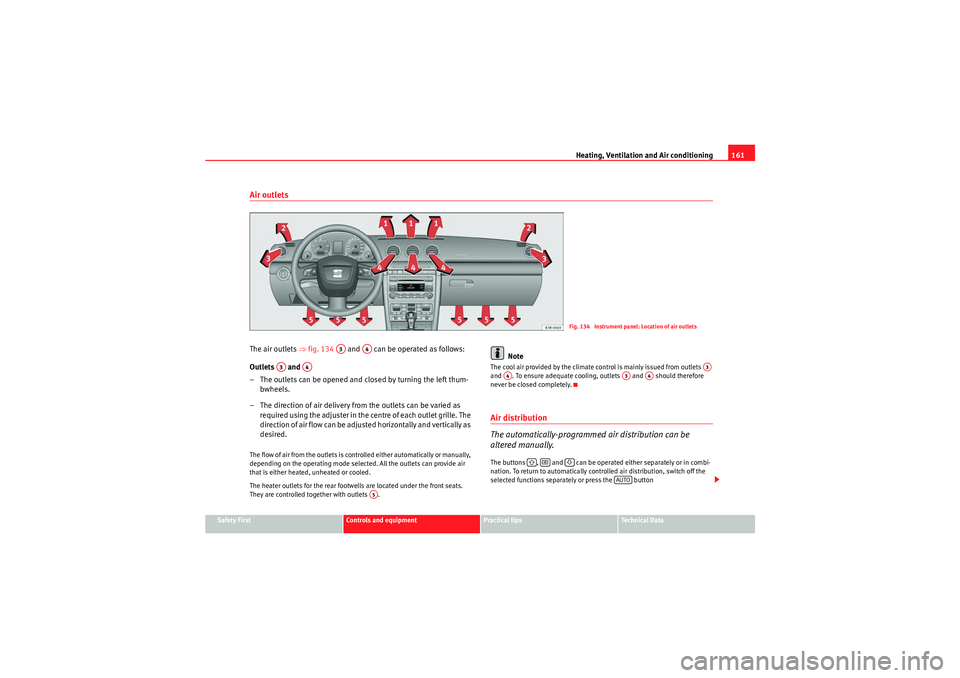
Air outletsThe air outlets ⇒fig. 134 and can be operated as follows:
Outlets and
– The outlets can be opened and closed by turning the left thum- bwheels.
– The direction of air delivery from the outlets can be varied as re quire d using the adjuster in the ce n tre o f ea ch o u t let g rille. The
direction of air flow can be adjusted horizontally and vertically as
desired.The flow of air from the outlets is controlled either automatically or manually,
depending on the operating mode selected. All the outlets can provide air
that is either heated, unheated or cooled.
The heater outlets for the rear footwells are located under the front seats.
They are controlled together with outlets .
Note
The cool air provided by the climate control is mainly issued from outlets
and . To ensure adequate cooling, outlets and should therefore
never be closed completely.Air distribution
The automatically-programmed air distribution can be
altered manually.The buttons , and can be operated either separately or in combi-
nation. To return to automatically controlled air distribution, switch off the
selected functions separately or press the button
Fig. 134 Instrument panel: Location of air outlets
A3
A4
A3
A4
A5
A3
A4
A3
A4
AUTO
Exeo_EN.book Seite 161 Freitag, 28. August 2009 10:14 10
Page 164 of 310
Heating, Ventilation and Air conditioning
162Each of the three buttons has a specific function. The numbers relate to the
air outlets ⇒page 161, fig. 134.
Air directed to windows
This setting directs all the air to outlets 1 and 2. Unlike in setting , the
volume of air delivery remains the same.
Air to the driver/front passenger
All the air comes from outlets 3 and 4 in the dash panel and from the rear of
the centre console.
Air to the footwells
Most of the air emerges from outlets 5 and the outlets under the front seats.
Some of the air will also be issued from outlets 3 and 4.
Note
In all of the above air distribution settings, a small amount of air will still
come from the other outlets.Economical use of the climate control
Economical use of the climate control will help save fuel.Engine power is reduced and fuel consumption increases when the
climate control is in cooling mode. To ensure that the system is only
switched on when it is really necessary, please note the following
points:
– Select ECON mode if you wish to save fuel.
– Select ECON mode if you decide to open the windows or sun roof* while driving. – If the vehicle has heated up after standing in the sun, open the
windows and doors for a short time to cool the vehicle.
For the sake of the environment
By saving fuel you also reduce the amount of pollutants emitted from your
vehicle.Key settings
When the ignition is switched on, the climate control settings
assigned to the key are selected automatically.The climate control settings selected are automatically stored and assigned
to the key in use. When the vehicle is started, the climate control automati-
cally selects the settings assigned to the key. Hence, every driver automati-
cally obtains his/her preferred settings without having to select them manu-
ally.
Note
Should another driver use the key and enter other settings, the previous
settings will be deleted.
Exeo_EN.book Seite 162 Freitag, 28. August 2009 10:14 10
Page 165 of 310
Heating, Ventilation and Air conditioning163
Safety First
Controls and equipment
Practical tips
Technical Data
Solar-powered blower/solar roof*
If the vehicle is parked in sufficiently strong sunlight, the
blower will operate in solar-powered mode when the ignition
is switched off.After the ignition is switched off, the blower is supplied with electrical power
from the solar roof. Please ensure that outlets 3 and 4 are open ⇒page 161,
fig. 134 to ensure the best possible ventilation.
The blower only works when the sun roof is closed or tilted open at the rear.
If the air recirculation mode is on when you switch off the engine, the climate
control will automatically switch to fresh air ventilation.Supplementary heating*Diesel vehicles are fitted with supplementary heating
2) to raise the tempera-
ture of the interior as quickly as possible. At outdoor temperatures below
+5°C and with the engine running, the supplementary heating will switch on
and off automatically depending on the temperature of the coolant.
In order to save fuel, the supplementary heating can be can be switched off
by briefly pressing the button on the climate control.
Seat heating*
The surface and backrest of the front seats can be electrically
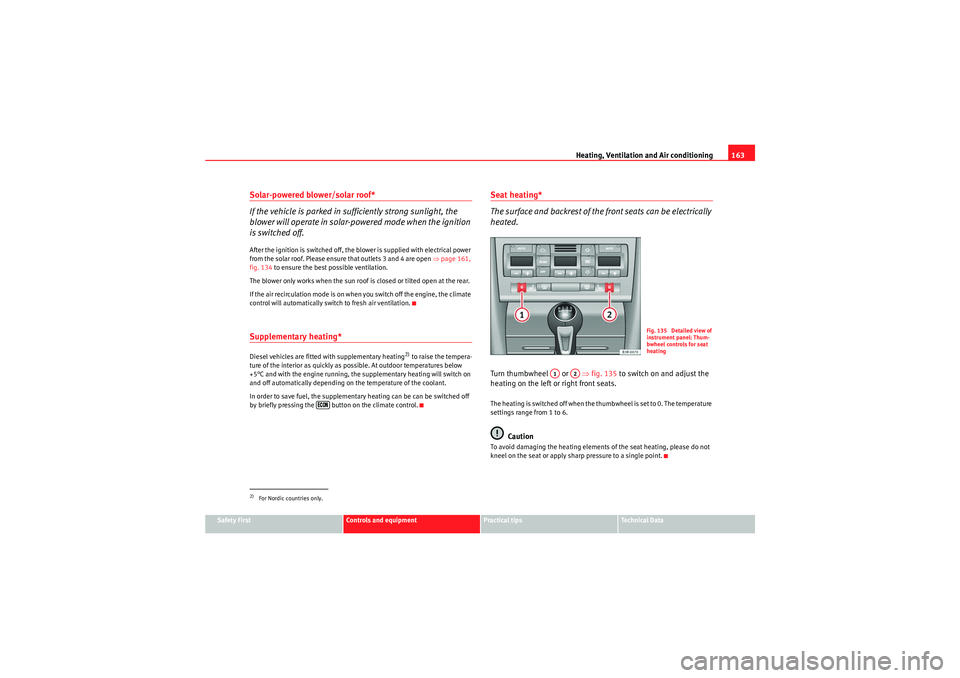
heated.Turn thumbwheel or ⇒fig. 135 to switch on and adjust the
heating on the left or right front seats.The heating is switched off when the thumbwheel is set to 0. The temperature
settings range from 1 to 6.
Caution
To avoid damaging the heating elements of the seat heating, please do not
kneel on the seat or apply sharp pressure to a single point.
2)For Nordic countries only.
Fig. 135 Detailed view of
instrument panel: Thum-
bwheel controls for seat
heating
A1
A2
Exeo_EN.book Seite 163 Freitag, 28. August 2009 10:14 10
Page 194 of 310
Driving and the environment
192Periodic maintenance
Periodic maintenance work guarantees that, before beginning a journey, you
will not consume more than the required amount of fuel. A well-serviced
engine gives you the benefit of improved fuel efficiency as well as maximum
reliability and an enhanced resale value.
A badly serviced engine can consume up to 10% more fuel than necessary.
Avoid short journeys
To reduce the consumption and emission of polluting gases, the engine and
the exhaust filtration systems should reach the optimum service tempera-
ture .
With the engine cold, fuel consumption is proportionally higher. The engine
does not warm up and fuel consumption does not regularise until having
driven some four kilometres. This is the reason why we recommend avoiding
short trips wherever possible.
Maintain the correct tyre pressures
Bear in mind that keeping the tyres at an adequate pressure saves fuel. If the
tyre pressures are just 1 bar too low, this can put the fuel consumption up by
as much as 5%. Due to the greater rolling resistance, under-inflation also
increases tyre wear and impairs handling.
The tyre pressures should always be checked when the tyres are cold.
Do not use winter tyres all year round: they will increase fuel consumption by
up to 10%.
Avoid unnecessary weight
Every kilo of extra weight will put up the fuel consumption, so it is worth
checking the luggage compartment occasionally to make sure that no unnec-
essary loads are being transported.
A roof carrier is often left in place for the sake of convenience, even when it is
no longer needed. At a speed of 100-120 km/h your car will use about 12%
more fuel as a result of the extra wind resistance caused by the roof carrier
even when it is not in use. Saving electrical energy
The engine activates the alternator, which produces electricity. With the need
for electricity, fuel consumption is also increased. Because of this, always
turn off electrical equipment when you do not need them. Examples of equip-
ment that use a lot of electricity are: the fan at high speeds, the rear window
heating or the seat heaters*.
Environmental friendlinessEnvironmental protection is a top priority in the design, choice of materials
and production of your new Seat.
Design measures for economical recycling•Joints and connections designed for ease of dismantling•Modular construction to facilitate dismantling•Increased use of single-grade materials•Plastic parts and elastomers are labelled in accordance with ISO 1043,
ISO 11469 and ISO 1629
Choice of materials•Nearly all materials used can be recycled•Similar types of plastics grouped together for easy recycling•Recycled materials used in manufacture•Reduction of volatile compounds in plastics•CFC-free refrigerant in air conditioning
Compliance with prohibited materials laws : cadmium, lead, mercury, chrome
VI.
Manufacturing methods•Use of recycled material for manufacturing plastic parts•Solvent-free cavity sealing
Exeo_EN.book Seite 192 Freitag, 28. August 2009 10:14 10