battery Seat Exeo 2009 User Guide
[x] Cancel search | Manufacturer: SEAT, Model Year: 2009, Model line: Exeo, Model: Seat Exeo 2009Pages: 310, PDF Size: 8.54 MB
Page 109 of 310
Unlocking and locking107
Safety First
Controls and equipment
Practical tips
Technical Data
•Doors•Tilt angle (tow-away protection)•Ignition•Radio (only with a factory-fitted SEAT radio)•Interior ⇒page 107
If any of the named areas are entered, the alarm will be triggered.
How is the alarm disabled?
The alarm can be switched off by unlocking the vehicle using the remote
control, or by switching on the ignition with the key, thus “disabling” the
alarm system. The alarm will also switch off when it comes to the end of its
cycle.
Indicators
The indicators flash briefly when the vehicle is locked to confirm that the
doors, the engine bonnet and the tailgate are properly closed and locked.
If the indicators do not flash, check the doors, the bonnet and the tailgate to
make sure they are properly closed. The indicators will also flash briefly if one
of the doors or the tailgate or engine bonnet are closed after the alarm system
has been enabled.
LED
When the vehicle is locked, the LED on the top of the driver's door trim will
flash rapidly for about 30 seconds and then continue flashing slowly. This is
to indicate that the anti-theft alarm system (including the interior monitor
and tow-away protection ) is operative. If the LED lights up continuously for
about 30 seconds when the vehicle is locked instead of flashing, this means
the alarm system is not working properly.Note
•To make sure that the alarm is fully operative when leaving the vehicle,
briefly check that all the doors and windows and the sun roof* are closed.
•The alarm is triggered immediately if one of the battery cables is discon-
nected while the alarm system is enabled.Interior monitoring*
The interior monitor triggers an alarm if it detects movement
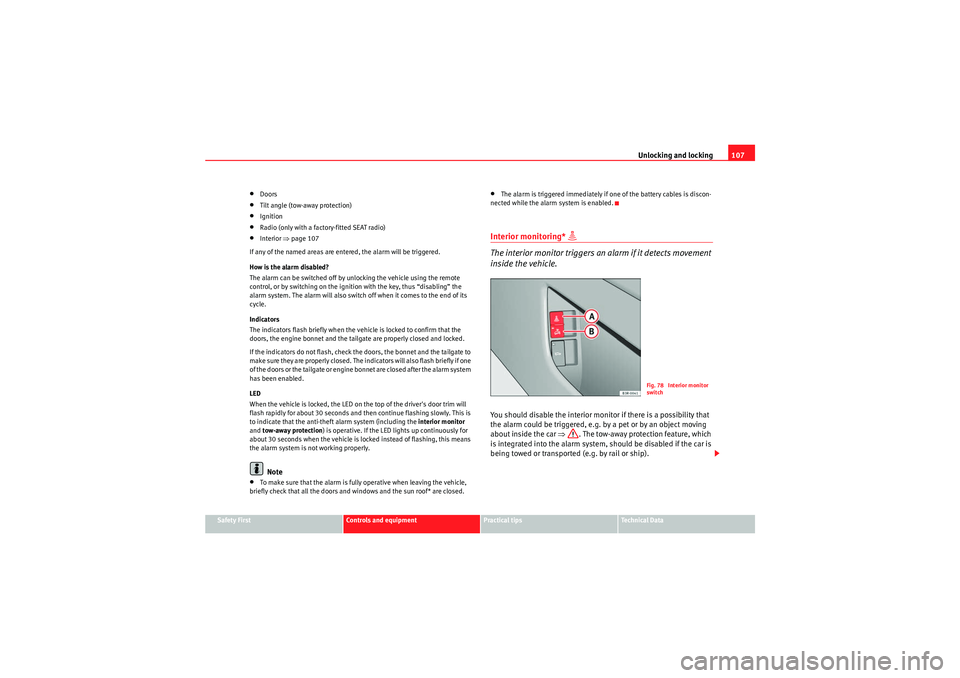
inside the vehicle.You should disable the interior monitor if there is a possibility that
the alarm could be triggered, e.g. by a pet or by an object moving
about inside the car ⇒ . The tow-away protection feature, which
is integrated into the alarm system, should be disabled if the car is
being towed or transported (e.g. by rail or ship).
Fig. 78 Interior monitor
switch
Exeo_EN.book Seite 107 Freitag, 28. August 2009 10:14 10
Page 112 of 310
Unlocking and locking
110
Opening the windows
– Press the switch as far as the first stop and hold it until the
window has moved to the desired position.
– Press the switch briefly to the second stop and the window will
automatically open all the way.
Closing the windows
– Pull the switch as far as the first stop and hold it until the window
has moved to the desired position.
– Pull the switch briefly to the second stop and the window will
automatically close all the way.
NoteThe windows will work for about ten minutes after the ignition has been
switched off. The window switches are only disabled when one of the front
doors is opened.Opening and closing the windows using the central locking function
The windows can be opened or closed simultaneously when
the vehicle is unlocked or locked.Opening the windows using the remote control
– Press and hold the unlock button on the remote control until the windows reach the desired position. Opening the windows using the ignition key
– unlock the driver's door with the key and hold the key in the
unlock position until all the windows are open.
Closing the windows using the remote control
– Press and hold the lock button until all windows are closed ⇒ .
Closing the windows using the ignition key
– Lock the driver's door with the key and hold the key in the lock position until all the windows are closed ⇒.
The windows will stop moving when you release the remote control button or
turn the key back to its initial position in the door lock.
WARNING
•Be careful when closing the windows to ensure nobody is hurt.•For safety reasons, you should only use the remote control open and
close functions within about 2 metres of the vehicle. To avoid injuries,
always keep an eye on the windows when pressing the button to close
them. The windows stop moving as soon as the button is released.
Possible malfunctionsAutomatic open and close function not working
The automatic open and close function will not work if the battery has been
temporarily disconnected. The function can be restored as follows:•Close the window as far as it will go by lifting and holding the window
switch.
Exeo_EN.book Seite 110 Freitag, 28. August 2009 10:14 10
Page 120 of 310
Lights and visibility
118Coming home and leaving home functions*
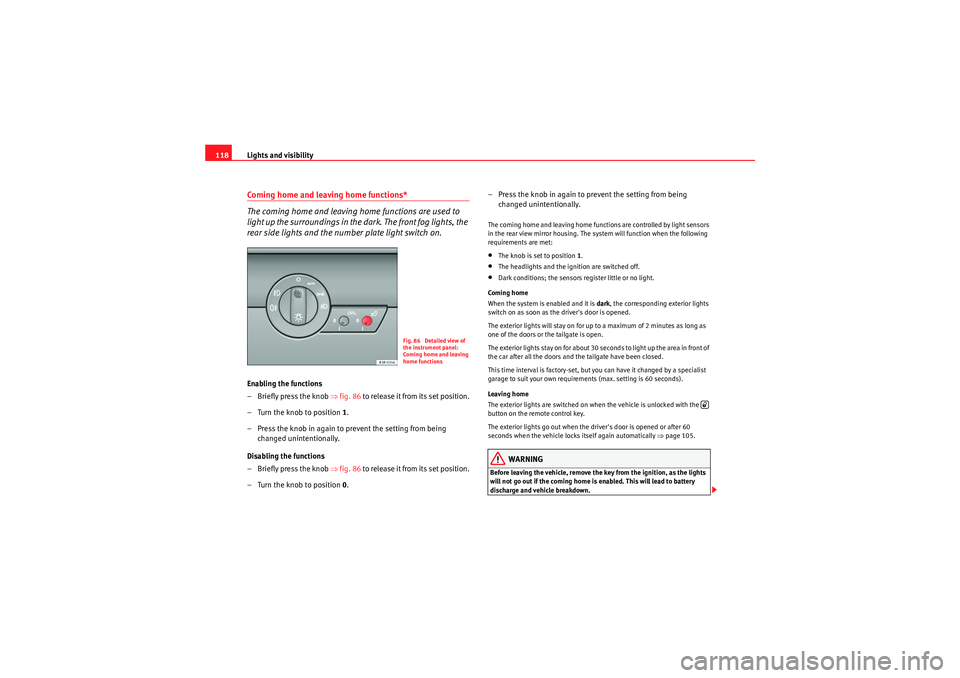
The coming home and leaving home functions are used to
light up the surroundings in the dark. The front fog lights, the
rear side lights and the number plate light switch on.Enabling the functions
– Briefly press the knob ⇒fig. 86 to release it from its set position.
– Turn the knob to position 1.
– Press the knob in again to prevent the setting from being changed unintentionally.
Disabling the functions
– Briefly press the knob ⇒fig. 86 to release it from its set position.
– Turn the knob to position 0. – Press the knob in again to prevent the setting from being
changed unintentionally.
The coming home and leaving home functions are controlled by light sensors
in the rear view mirror housing. The system will function when the following
requirements are met:•The knob is set to position 1.•The headlights and the ignition are switched off.•Dark conditions; the sensors register little or no light.
Coming home
When the system is enabled and it is dark, the corresponding exterior lights
switch on as soon as the driver's door is opened.
The exterior lights will stay on for up to a maximum of 2 minutes as long as
one of the doors or the tailgate is open.
The exterior lights stay on for about 30 seconds to light up the area in front of
the car after all the doors and the tailgate have been closed.
This time interval is factory-set, but you can have it changed by a specialist
garage to suit your own requirements (max. setting is 60 seconds).
Leaving home
The exterior lights are switched on when the vehicle is unlocked with the
button on the remote control key.
The exterior lights go out when the driver's door is opened or after 60
seconds when the vehicle locks itself again automatically ⇒page 105.WARNING
Before leaving the vehicle, remove the key from the ignition, as the lights
will not go out if the coming home is enabled. This will lead to battery
discharge and vehicle breakdown.
Fig. 86 Detailed view of
the instrument panel:
Coming home and leaving
home functions
Exeo_EN.book Seite 118 Freitag, 28. August 2009 10:14 10
Page 121 of 310
Lights and visibility119
Safety First
Controls and equipment
Practical tips
Technical Data
Note
•If you always wish to use the coming home and leaving home functions,
you can leave them permanently switched on. As the system is controlled via
a light sensor, it will only work in dark conditions.•Permanent use of the coming home and leaving home functions, particu-
larly on short journeys, will increase the load on the battery. To make sure the
battery is always sufficiently charged, occasionally drive longer distances.•If the fog lights have been switched on by the coming home and leaving
home functions, they will always be switched off when you switch on the igni-
tion.•Observe all relevant legal requirements when using the signalling and
lighting systems described here.Instrument lighting
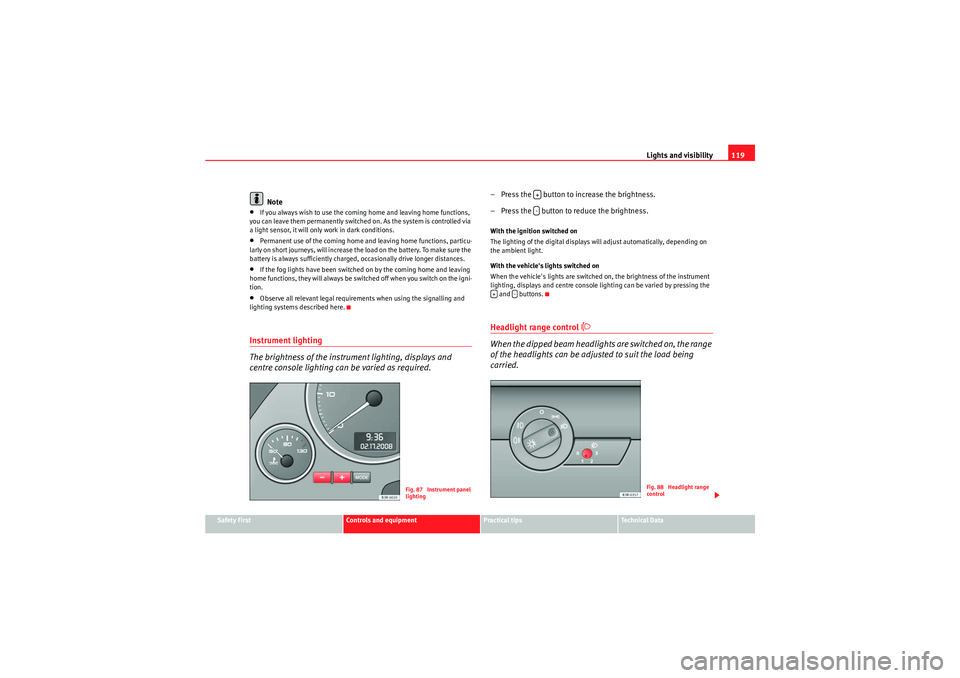
The brightness of the instrument lighting, displays and
centre console lighting can be varied as required.
– Press the button to increase the brightness.
– Press the button to reduce the brightness.With the ignition switched on
The lighting of the digital displays will adjust automatically, depending on
the ambient light.
With the vehicle's lights switched on
When the vehicle's lights are switched on, the brightness of the instrument
lighting, displays and centre console lighting can be varied by pressing the and buttons.Headlight range control
When the dipped beam headlights are switched on, the range
of the headlights can be adjusted to suit the load being
carried.
Fig. 87 Instrument panel
lighting
+-
+
-
Fig. 88 Headlight range
control
Exeo_EN.book Seite 119 Freitag, 28. August 2009 10:14 10
Page 126 of 310
Lights and visibility
124
Door light position
– Move switch to the centre position.
Interior light switched on
– Move switch to position I.
Interior light switched off
– Move switch to position O.
Front reading lights
– Press one of the switches to turn the left and right reading lights on and off.
Glove compartment light
– Open the glove compartment on the front passenger's side. The glove compartment light will come on automatically if the side
lights or headlights are switched on, and will go out again when
the glove compartment is closed.
Footwell* and door lighting
– This is switched on when the doors are opened and off when they are closed.If the switch is in the courtesy light position, the interior light comes on auto-
matically when the vehicle is unlocked or the doors are opened. The light also
comes on when the key is pulled out of the ignition. The light turns off about
30 seconds after closing the doors. The interior light is switched off immedi-
ately when the vehicle is locked or when the ignition is switched on.
If a door is left open, the light is switched off after about 10 minutes to
prevent the battery from running flat. The brightness of the lights is automatically adjusted by a dimmer when they
are switched on.
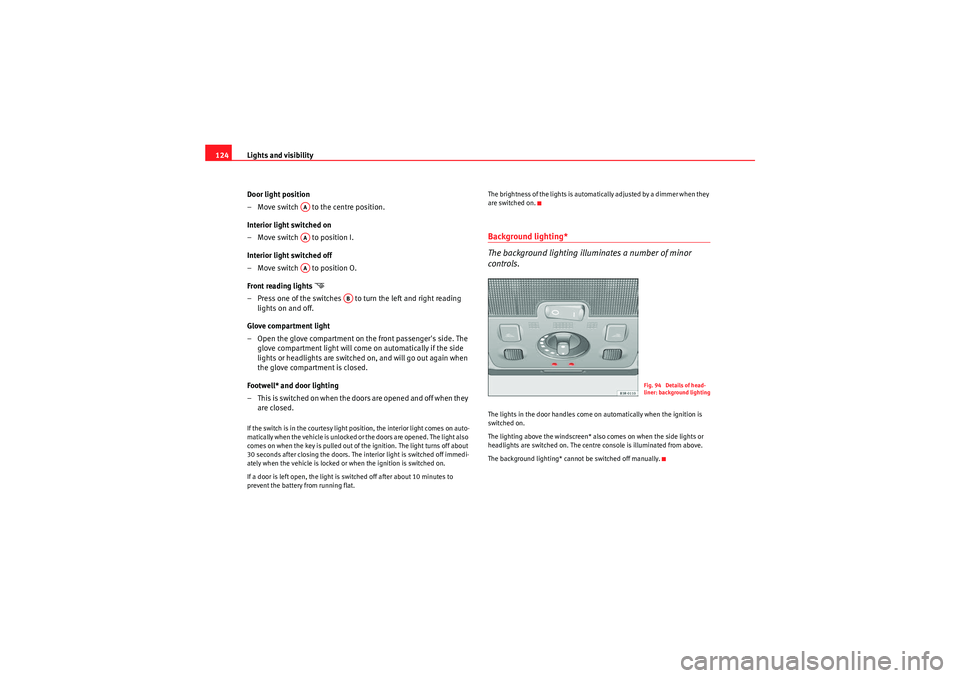
Background lighting*
The background lighting illuminates a number of minor
controls.The lights in the door handles come on automatically when the ignition is
switched on.
The lighting above the windscreen* also comes on when the side lights or
headlights are switched on. The centre console is illuminated from above.
The background lighting* cannot be switched off manually.
AAAAAA
AB
Fig. 94 Details of head-
liner: background lighting
Exeo_EN.book Seite 124 Freitag, 28. August 2009 10:14 10
Page 152 of 310
Seats and stowage
150
– Pull out the cigarette lighter immediately.
– Use the glowing heater element of the cigarette lighter to light your cigarette.
– Put the cigarette lighter back in its socket.
Operating the socket
– Take out the cigarette lighter.
– Insert the plug of the electrical appliance into the cigarette lighter socket.The cigarette lighter ⇒page 149, fig. 126 employs a standard 12-volt
socket, which can also be used as a power source for electrical appliances.
The appliances connected to the socket must not exceed a power rating of
100 W.
WARNING
•Be careful when using the electric cigarette lighter. Carelessness or
negligence when using the cigarette lighter can cause burns.•The lighter will only work when the ignition is switched on.•The electrical sockets and, therefore, any appliances connected to
them will only work when the ignition is switched on.Caution
Always use the correct type of plugs to avoid damaging the sockets.
Note
The use of electrical appliances with the engine switched off will cause a
battery discharge.
Electrical socket*
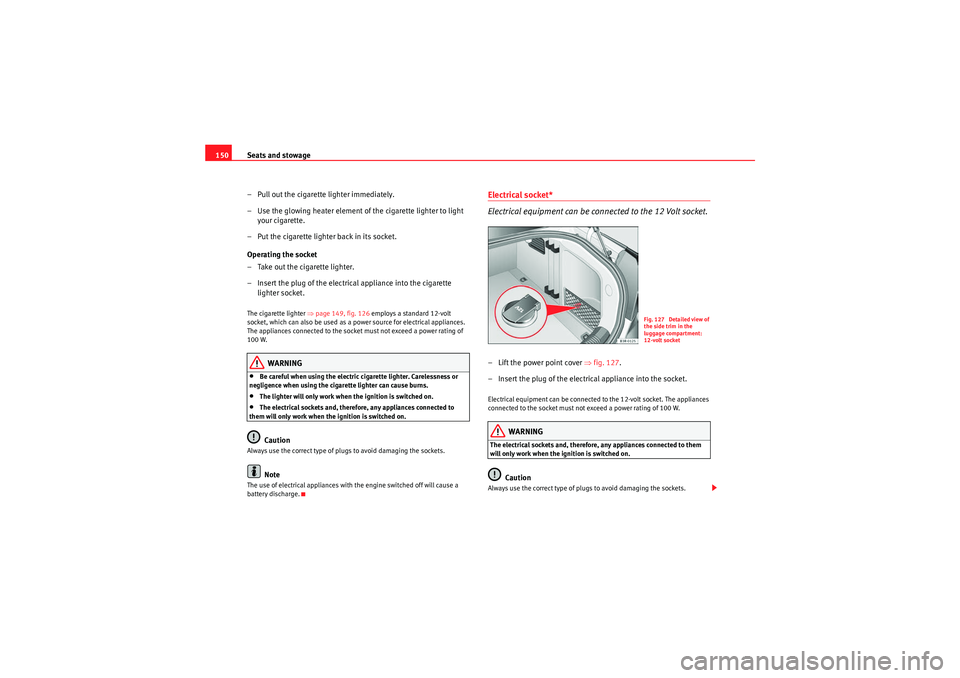
Electrical equipment can be connected to the 12 Volt socket.– Lift the power point cover ⇒fig. 127 .
– Insert the plug of the electrical appliance into the socket.Electrical equipment can be connected to the 12-volt socket. The appliances
connected to the socket must not exceed a power rating of 100 W.
WARNING
The electrical sockets and, therefore, any appliances connected to them
will only work when the ignition is switched on.
Caution
Always use the correct type of plugs to avoid damaging the sockets.
Fig. 127 Detailed view of
the side trim in the
luggage compartment:
12-volt socket
Exeo_EN.book Seite 150 Freitag, 28. August 2009 10:14 10
Page 153 of 310
Seats and stowage151
Safety First
Controls and equipment
Practical tips
Technical Data
Note
The use of electrical appliances with the engine switched off will cause a
battery discharge.CompartmentsOverview
There are several storage compartments at various points in
the vehicle.Your vehicle has the following storage compartments:
Some of the compartments listed are only provided in certain models / model
years or are optional extras.
Glove compartment
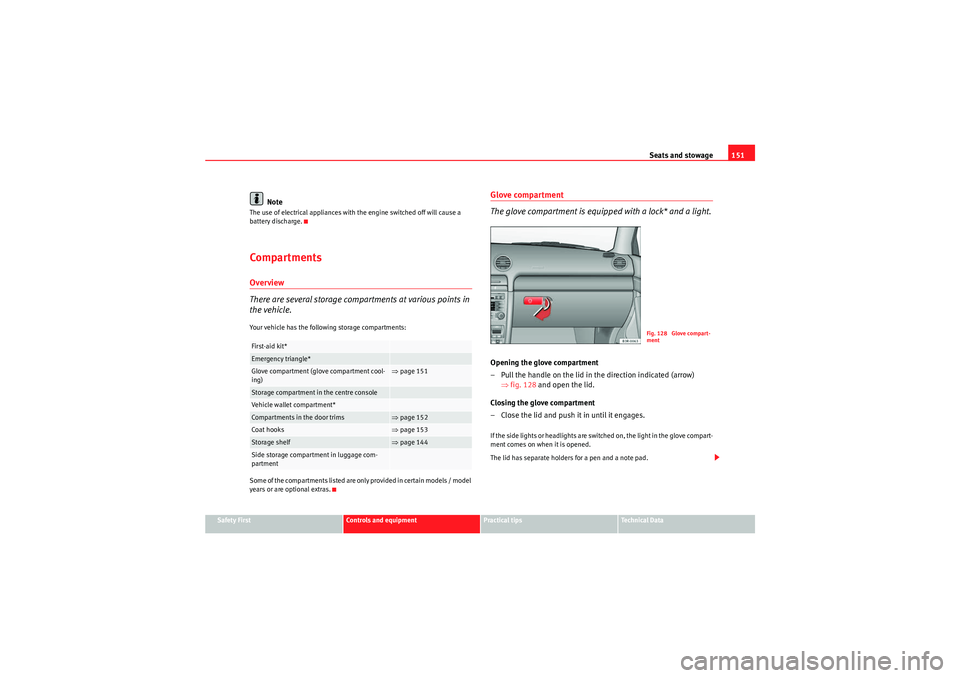
The glove compartment is equipped with a lock* and a light.Opening the glove compartment
– Pull the handle on the lid in the direction indicated (arrow)
⇒fig. 128 and open the lid.
Closing the glove compartment
– Close the lid and push it in until it engages.If the side lights or headlights are switched on, the light in the glove compart-
ment comes on when it is opened.
The lid has separate holders for a pen and a note pad.
First-aid kit*Emergency triangle*Glove compartment (glove compartment cool-
ing)
⇒ page 151
Storage compartment in the centre consoleVehicle wallet compartment*Compartments in the door trims
⇒page 152
Coat hooks
⇒page 153
Storage shelf
⇒page 144
Side storage compartment in luggage com-
partment
Fig. 128 Glove compart-
ment
Exeo_EN.book Seite 151 Freitag, 28. August 2009 10:14 10
Page 168 of 310
Driving
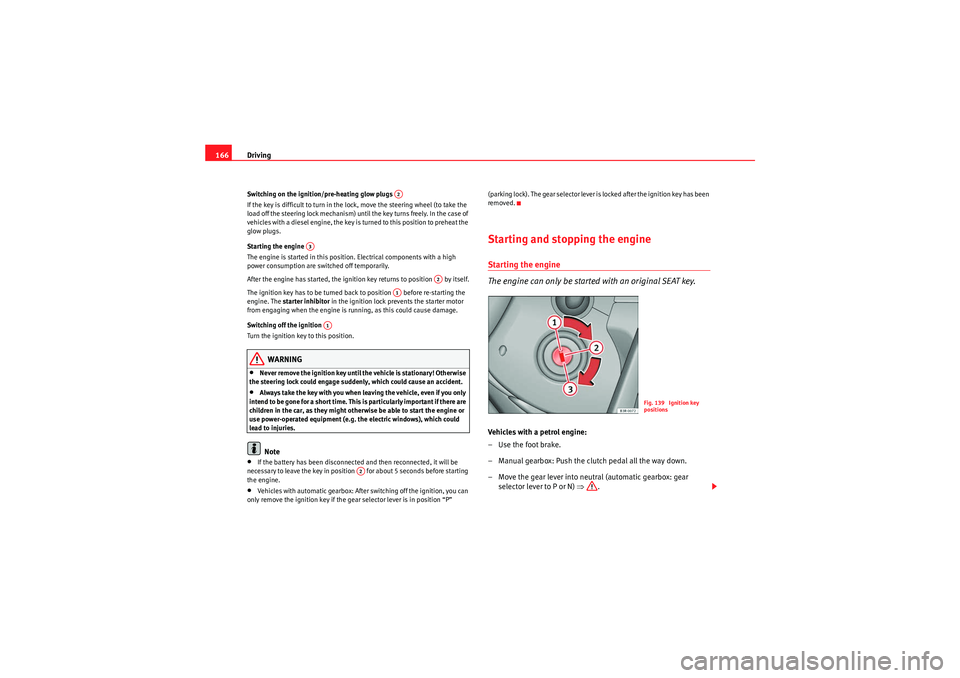
166Switching on the ignition/pre-heating glow plugs
If the key is difficult to turn in the lock, move the steering wheel (to take the
load off the steering lock mechanism) until the key turns freely. In the case of
vehicles with a diesel engine, the key is turned to this position to preheat the
glow plugs.
Starting the engine
The engine is started in this position. Electrical components with a high
power consumption are switched off temporarily.
After the engine has started, the ignition key returns to position by itself.
The ignition key has to be turned back to position before re-starting the
engine. The starter inhibitor in the ignition lock prevents the starter motor
from engaging when the engine is running, as this could cause damage.
Switching off the ignition
Turn the ignition key to this position.
WARNING
•Never remove the ignition key until the vehicle is stationary! Otherwise
the steering lock could engage suddenly, which could cause an accident.•Always take the key with you when leaving the vehicle, even if you only
intend to be gone for a short time. This is particularly important if there are
children in the car, as they might otherwise be able to start the engine or
use power-operated equipment (e.g. the electric windows), which could
lead to injuries.Note
•If the battery has been disconnected and then reconnected, it will be
necessary to leave the key in position for about 5 seconds before starting
the engine.•Vehicles with automatic gearbox: After switching off the ignition, you can
only remove the ignition key if the gear selector lever is in position “P” (parking lock). The gear selector lever is locked after the ignition key has been
removed.
Starting and stopping the engineStarting the engine
The engine can only be started with an original SEAT key.Vehicles with a petrol engine:
– Use the foot brake.
– Manual gearbox: Push the clutch pedal all the way down.
– Move the gear lever into neutral (automatic gearbox: gear
selector lever to P or N) ⇒.
A2
A3
A2
A1
A1
A2
Fig. 139 Ignition key
positions
Exeo_EN.book Seite 166 Freitag, 28. August 2009 10:14 10
Page 223 of 310
Checking and refilling levels221
Safety First
Controls and equipment
Practical tips
Technical Data
WARNING
Never open the bonnet if you see steam or drips of coolant being released
from t he engine com par t ment . Fail ure to com ply could resul t in burns . Wait
until no steam or coolant can be seen before opening the bonnet.Work in the engine compartment
Extra caution is necessary when working on components in
the engine compartment.Always be aware of the danger of injury and scalding as well as the risk of
accident or even fire when working in the engine compartment (e.g. when
checking and refilling fluids). Therefore, always observe the warnings listed
below and follow all general safety precautions. The engine compartment of
any motor vehicle is a potentially hazardous area ⇒
WARNING
•Switch the engine off.•Remove the ignition key.•Apply handbrake firmly.•If your vehicle is equipped with a manual gearbox, place the gearshift
lever in neutral. If you are driving an automatic vehicle, place the selector
lever in the position P.•Wait for the engine to cool down.•Children should not be allowed to approach the engine compartment•Never spill liquids involved in vehicle operations on the engine
compartment, as these may catch fire (e.g. anti-freeze containing liquid
coolant).
•Take care not to cause short circuits in the electrical system, especially
when working on the battery.•Never touch the radiator fan while the engine is hot, as the fan could
start up suddenly.•Never open the expansion tank when the engine is hot. The cooling
system is under pressure.•Protect face, hands and arms from any hot steam or hot liquid coolant
released by covering the cap with a large, thick rag when opening the
expansion tank.•If any tests have to be performed with the engine running, there is an
extra safety risk from the rotating parts, such as the drive belts, alternator
and radiator fan, etc., and from the high-voltage ignition system.•Observe the following additional warnings if work on the fuel system or
the electrical system is necessary:
−Always disconnect the battery.
− Do not smoke.
− Never work near open flames
− Always keep an approved fire extinguisher immediately available.Caution
When topping up fluids, make sure the correct fluid is put into the correct
filler opening. This can otherwise cause serious malfunctions or engine
damage.
For the sake of the environment
Inspect the ground underneath your vehicle regularly so that any leaks are
detected at an early stage. If you find spots of oil or other fluids, have your
vehicle inspected in the garage.
WARNING (continued)
Exeo_EN.book Seite 221 Freitag, 28. August 2009 10:14 10
Page 233 of 310
Checking and refilling levels231
Safety First
Controls and equipment
Practical tips
Technical Data
Topping up and changing the brake fluid
It is best to have the brake fluid changed by a professional.Brake fluid absorbs damp. Therefore, in the course of time it will absorb water
from the ambient air. If the water content in the brake fluid is too high, the
brake system could corrode. In addition, the boiling point of the brake fluid
will be considerably reduced. This could adversely affect the braking ability in
certain circumstances.
For this reason the brake fluid must be changed periodically.
Your vehicle's Service Schedule will tell you when the brake fluid has to be
renewed.
We recommend you have the brake fluid changed as part of a regular Inspec-
tion Service at your garage. They are familiar with the procedure and have the
necessary special tools and spare parts as well as the proper facilities for
disposing of the old fluid.
Use only the genuine brake fluid specified by the factory Specialist garages
know that the brake fluid -DOT 4- is factory approved. The brake fluid must be
new.
WARNING
•Therefore, it must always be kept closed in its original container. Keep
out of the reach of children. Failure to comply could result in poisoning.•Heavy use of the brakes may cause a vapour lock if the brake fluid is left
in the system for too long. This would seriously affect the efficiency of the
brakes and the safety of the car, leading to the risk of accident.Caution
Please note that brake fluid will attack the paintwork on contact.
For the sake of the environment
If the fluid has to be drained out of the brake system, use an appropriate
container to catch the used brake fluid and dispose of it in the proper
manner.BatteryGeneral notes
All work on batteries requires specialist knowledge.The battery is virtually maintenance-free and is checked in the Inspection
Services.
We recommend that you replace a battery once it is older than 5 years.
Disconnecting the battery
If the battery is disconnected, some of the vehicle's functions will become
inoperative (e.g. electric windows). These functions will require resetting
after the battery is reconnected. For this reason, the battery should only be
disconnected from the vehicle's electrical system when absolutely necessary.
Long periods of non-use
The battery will gradually lose its charge because certain electrical equip-
ment continues to draw current even when the ignition is off. If you park the
vehicle for long periods of time in winter you should take the battery out of
the vehicle and keep it in a frost-proof room. Store the battery in a place
where it cannot “freeze up” and become damaged. At warm outside temper-
atures it is sufficient to disconnect the negative terminal of the battery. Even
when the battery is not connected you should charge it from time to time.
Exeo_EN.book Seite 231 Freitag, 28. August 2009 10:14 10