brake light Seat Exeo 2009 User Guide
[x] Cancel search | Manufacturer: SEAT, Model Year: 2009, Model line: Exeo, Model: Seat Exeo 2009Pages: 310, PDF Size: 8.54 MB
Page 81 of 310
Cockpit79
Safety First
Controls and equipment
Practical tips
Technical Data
Note
The oil pressure warning lamp
is not an indicator for the oil level. The oil
level should therefore be checked regularly, preferably every time you fill the
tank.
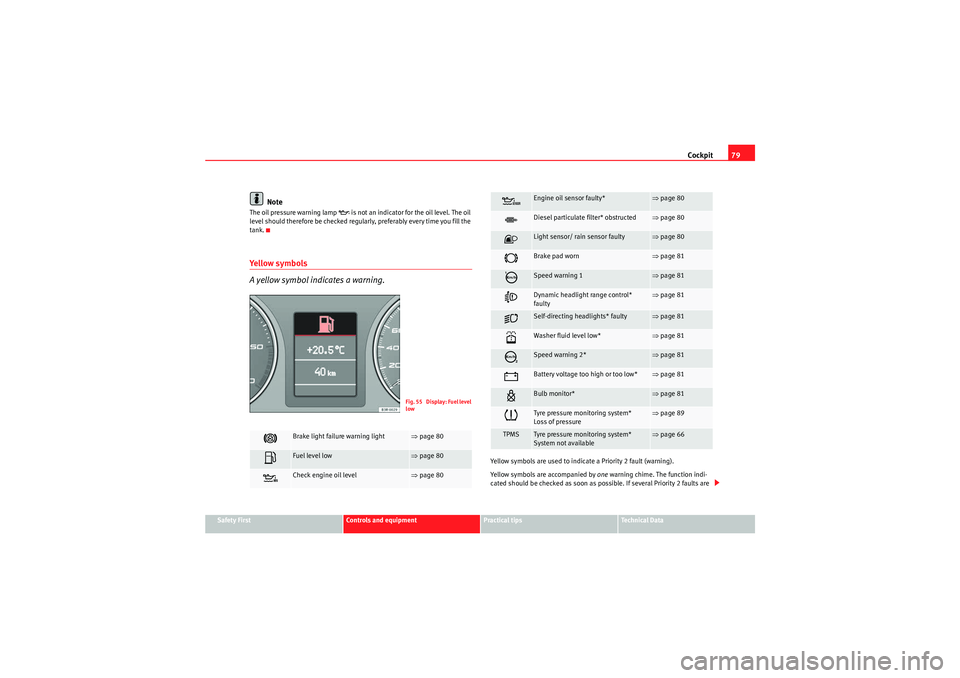
Ye ll o w s y m b o l s
A yellow symbol indicates a warning.
Yellow symbols are used to indicate a Priority 2 fault (warning).
Yellow symbols are accompanied by one warning chime. The function indi-
cated should be checked as soon as possible. If several Priority 2 faults are
Brake light failure warning light
⇒ page 80
Fuel level low
⇒page 80
Check engine oil level
⇒page 80F i g . 5 5 D i s p l a y : F u e l l e v e l
low
Engine oil sensor faulty*
⇒page 80
Diesel particulate filter* obstructed
⇒page 80
Light sensor/ rain sensor faulty
⇒page 80
Brake pad worn
⇒page 81
Speed warning 1
⇒page 81
Dynamic headlight range control*
faulty
⇒page 81
Self-directing headlights* faulty
⇒page 81
Washer fluid level low*
⇒page 81
Speed warning 2*
⇒page 81
Battery voltage too high or too low*
⇒page 81
Bulb monitor*
⇒page 81
Tyre pressure monitoring system*
Loss of pressure
⇒page 89
TPMS
Tyre pressure monitoring system*
System not available
⇒page 66
Exeo_EN.book Seite 79 Freitag, 28. August 2009 10:14 10
Page 82 of 310
Cockpit
80detected at the same time, the symbol s are displayed one after the other for
about 2 seconds at a time.Brake light failure
This warning light will appear on the upper part of the display if any of the
brake lights has failed. A text message in the central part of the display indi-
cates which brake light has failed (left or right).Fuel level low
When this symbol
comes on for the first time, there are about 8 to 10 litres
of fuel left in the tank. You should fill up as soon as possible ⇒page 216.
Check engine oil level
If the
symbol lights up, please check the engine oil level as soon as
possible ⇒page 224. Top up the oil at the next opportunity ⇒page 224.
Engine oil sensor defective*
If the
symbol lights up, take the vehicle to a qualified workshop and have
the oil level sensor checked. Until then it is advisable to check the oil level
every time you fill up with fuel ⇒page 224.
Diesel particulate filter obstructed
If the symbol
lights up, you may be able to contribute towards automatic
filter cleaning by driving in the right manner. To do this, drive about 15
minutes in 4th or 5th gear (automatic gearbox: S gear range) at a speed of 60
km/h, with the engine running at approximately 2000 rpm. The increase in
temperature will burn off any soot in the filter. When cleaning is successful,
the symbol switches off.
If the light on symbol
does not go off, take the vehicle to a specialist
garage to repair the fault.
For further information on the diesel particulate filter, see ⇒page 191.
WARNING
It is essential that you adjust your speed to suit the weather, road, terrain
and traffic conditions. The recommended driving speed must never lead to
the driver disregarding the traffic regulations.Light sensor/ rain sensor faulty
Automatic headlights / automatic wipers faulty
If the symbol appears, this means that the light sensor / rain sensor is not
working. For safety reasons, the dipped beam headlights will then be
switched on permanently when the light switch is set to the AUTO position.
However, you can still switch the lights on and off in the normal way with the
light switch. If the rain sensor is faulty, the functions operated via the wind-
screen wiper lever will still be available. You should have the light sensor /
rain sensor checked by a specialist garage as soon as possible.
Exeo_EN.book Seite 80 Freitag, 28. August 2009 10:14 10
Page 83 of 310
Cockpit81
Safety First
Controls and equipment
Practical tips
Technical Data
Worn brake pads
If the
symbol lights up, have the front brake pads (and, for safety's sake,
the rear pads as well) inspected by a specialist garage.
Speed warning 1
If the
symbol lights up, this means you are exceeding the speed that has
been pre-set with the speed warning function. You should reduce your speed
accordingly ⇒page 82.
Headlight range control faulty
This symbol
indicates a malfunction in the dynamic headlight range
control. Take the vehicle to a specialist garage to have the dynamic headlight
range control function repaired.
Self-directing headlights* faulty
Self-directing headlights faulty
This symbol
indicates that the self-directing headlight system is faulty.
Take the vehicle to a specialist garage to have the headlights or the self-
directing headlight control unit repaired.
Washer fluid level low
If the
symbol lights up, top up the fluid for the windscreen washer and
headlight washer system* ⇒page 228.
Speed warning 2
If the
symbol lights up, this means you are exceeding the speed that has
been pre-set. You should reduce your speed accordingly ⇒page 82.
Battery voltage too high or too low
If the
symbol lights up, take the vehicle to a specialist garage and have
the following items checked:
•Ribbed belt•Battery condition
I t is a l s o a d v isa b le t o ch e ck w h e t h e r t h e a l te r na t o r wa r n i n g la m p ha s co m e o n
⇒ page 69.Bulb monitor
The bulb monitor checks whether the lights on the vehicle are
working.If a defective bulb is detected, or if one of the lights has failed for any reason,
the bulb monitor symbol
will appear in the display together with an addi-
tional message (which goes out after 5 seconds). For instance, if the rear left
Exeo_EN.book Seite 81 Freitag, 28. August 2009 10:14 10
Page 146 of 310
Seats and stowage
144Extending the luggage compartment
The two sections of the backrest can be folded forwards either
together or separately to increase the capacity of the luggage
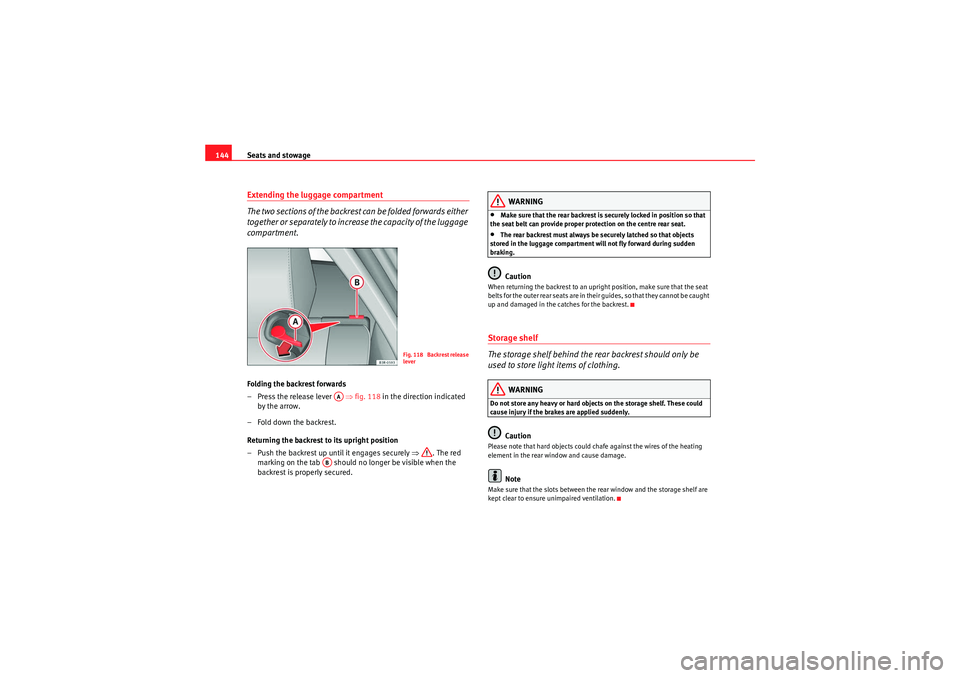
compartment.Folding the backrest forwards
– Press the release lever ⇒fig. 118 in the direction indicated
by the arrow.
– Fold down the backrest.
Returning the backrest to its upright position
– Push the backrest up until it engages securely ⇒ . The red
marking on the tab should no longer be visible when the
backrest is properly secured.
WARNING
•Make sure that the rear backrest is securely locked in position so that
the seat belt can provide proper protection on the centre rear seat.•The rear backrest must always be securely latched so that objects
stored in the luggage compartment will not fly forward during sudden
braking.Caution
When returning the backrest to an upright position, make sure that the seat
b e l t s f o r t h e o u t e r r e a r s e a t s a r e i n t h e i r g u i d e s , s o t ha t t h e y ca n n o t b e ca u g h t
up and damaged in the catches for the backrest.Storage shelf
The storage shelf behind the rear backrest should only be
used to store light items of clothing.
WARNING
Do not store any heavy or hard objects on the storage shelf. These could
cause injury if the brakes are applied suddenly.
Caution
Please note that hard objects could chafe against the wires of the heating
element in the rear window and cause damage.
Note
Make sure that the slots between the rear window and the storage shelf are
kept clear to ensure unimpaired ventilation.
Fig. 118 Backrest release
lever
AA
AB
Exeo_EN.book Seite 144 Freitag, 28. August 2009 10:14 10
Page 167 of 310
Driving165
Safety First
Controls and equipment
Practical tips
Technical Data
The Electronic Stabilisation Program (ESP) contains the electronic differential
lock (EDL) and the traction control system (TCS). The ESP function works
together with the ABS. If a fault in the ABS occurs, both warning lamps light
up, but if the ESP fails, only the ESP warning lamp lights up.
The ESP is started automatically when the engine is started.
The ESP switch deactivates both TCS and ESP functions. The ESP, in spite of
being deactivated, will always self-connect when necessary if brakes are
being used.
The TCS can be deactivated when in cases where wheel sliding is desirable.
For example:
•When driving with snow chains,•when driving in deep snow or on loose surfaces,•when rocking the vehicle backwards and forwards to free it from mud, for
example.
Next, the button should be pressed to reactivate the TCS.
When does the warning light switch on or flash ?•On switching the ignition on, it lights up for about two seconds to carry
out a function control.•The warning lamp will start flashing when the vehicle is moving if the ESP
or the TCS is activated.•It will light up continuously if there is a malfunction in the ESP.WARNING
•The electronic stabilisation programme (ESP) cannot defy the laws of
physics. This should be kept in mind, particularly on slippery and wet
roads and when towing a trailer.•Always adapt your driving style to suit the condition of the roads and
the traffic situation. Do not let the extra safety afforded by ESP tempt you
into taking any risks when driving, this can cause accidents.
•Please refer to the corresponding warning notes on ESP in ⇒page 183,
“Intelligent technology”.
Ignition lockIgnition key positions
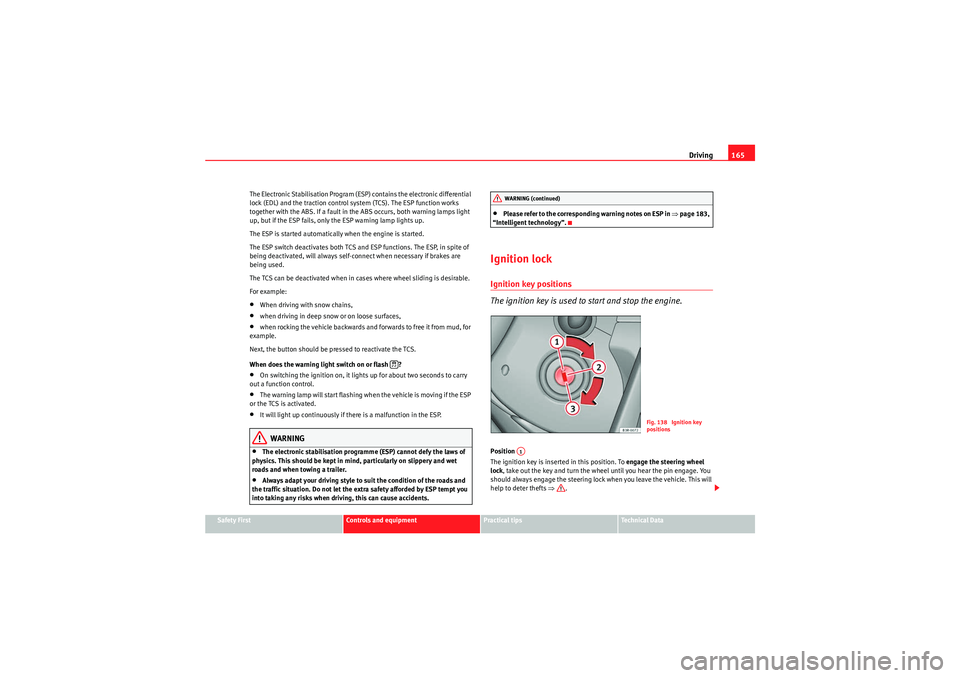
The ignition key is used to start and stop the engine.Position
The ignition key is inserted in this position. To engage the steering wheel
lock , take out the key and turn the wheel until you hear the pin engage. You
should always engage the steering lock when you leave the vehicle. This will
help to deter thefts ⇒.
WARNING (continued)
Fig. 138 Ignition key
positions
A1
Exeo_EN.book Seite 165 Freitag, 28. August 2009 10:14 10
Page 169 of 310
Driving167
Safety First
Controls and equipment
Practical tips
Technical Data
– Turn the ignition key to position without pressing the acceler-
ator.
– Release the ignition key as soon as the engine starts (the starter motor must not be allowed to run on with the engine).
Vehicles with a diesel engine:
– Use the foot brake.
– Manual gearbox: Push the clutch pedal all the way down.
– Move the gear lever into neutral (automatic gearbox: gear selector lever to P or N) ⇒.
– Turn the ignition key to position . The pre-heating indicator light
comes on while the glow plugs are preheating.
– When the indicator light
goes out, turn the ignition key to
position . Do not press the accelerator.
– Release the ignition key as soon as the engine starts (the starter motor must not be allowed to run on with the engine).
When starting a very cold engine, it may be a little noisy for the first few
seconds until oil pressure has built up in the hydraulic valve compensators.
This is quite normal, and no cause for concern.
If the engine fails to start straight-away, switch off the starter after about 10
seconds and try again after about half a minute.
Glow plug system*
To assist starting at low temperatures, diesel engines are equipped with a
glow plug preheating system. The preheating time depends on the coolant
temperature and the outside temperature. Start the engine as soon as the
glow plug indicator light
goes out. When the engine is warm or at outside temperatures above +8°C, the glow
plug indicator light will only come on for about one second. This means that
the engine can be started
immediately.
If the engine will not start...
•⇒ page 279•⇒page 282•⇒page 216, “Refuelling”WARNING
Never run the engine in confined spaces, as the exhaust gases are
poisonous.
Caution
Avoid high engine speeds, full throttle and extreme load conditions until the
engine has reached its normal operating temperature, otherwise this can
damage the engine.
For the sake of the environment
Do not warm up the engine by running the engine with the vehicle stationary.
Start immediately. This will help avoid unnecessary exhaust emissions.Stopping the engine– Turn the ignition key to position ⇒page 166, fig. 139 .
WARNING
•Never switch the engine off until the vehicle is stationary.
A3A2
A3
A1
Exeo_EN.book Seite 167 Freitag, 28. August 2009 10:14 10
Page 170 of 310
Driving
168•The brake servo and the power steering system work only when the
engine is running. You need more strength to steer and brake the vehicle
when the engine is switched off. Given that you will be unable to steer and
brake as usual, this could lead to a risk of accidents and injuries.Caution
If the engine has been running hard for a long time, there is a risk of heat
building up in the engine compartment after the engine has been switched
off; this could cause engine damage. Therefore, you should idle the engine
for approx. 2 minutes before you switch it off.
Note
After the engine is switched off the radiator fan may run on for up to 10
minutes, even if the ignition is switched off. It may also start running again
after some time if the coolant temperature rises due to a build-up of heat
under the bonnet, or if the engine is already warm and the engine compart-
ment is heated up further by direct sunlight.
HandbrakeHandbrake
The handbrake should be applied firmly to prevent the
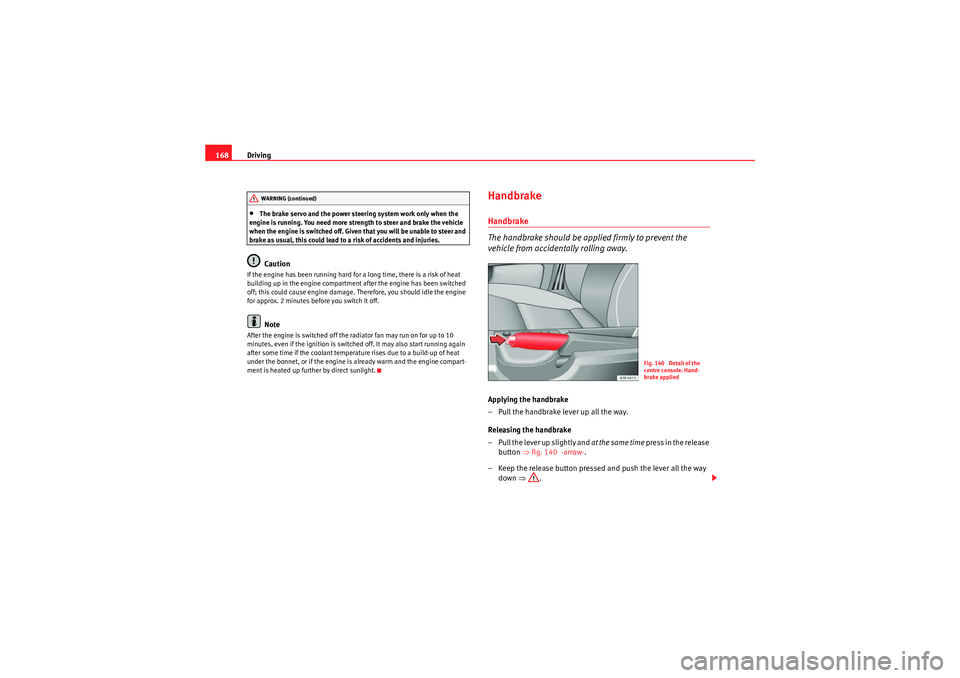
vehicle from accidentally rolling away.Applying the handbrake
– Pull the handbrake lever up all the way.
Releasing the handbrake
– Pull the lever up slightly and at the same time press in the release
button ⇒fig. 140 -arrow-.
– Keep the release button pressed and push the lever all the way down ⇒ .
WARNING (continued)
Fig. 140 Detail of the
centre console: Hand-
brake applied
Exeo_EN.book Seite 168 Freitag, 28. August 2009 10:14 10
Page 171 of 310
Driving169
Safety First
Controls and equipment
Practical tips
Technical Data
If you drive by mistake with the handbrake still applied, you will hear a
warning buzzer and the display will show the message:
Handbrake applied
The handbrake warning is enabled after driving for 3 seconds at a speed
above 5 km/h.
The handbrake warning lamp
lights up when the handbrake is applied
with the ignition on.
WARNING
Please note that the handbrake should be released all the way. If it is only
partially released, this will cause rear brakes overheating, which can
impair the function of the brake system and could lead to an accident.
Caution
Once the vehicle has come to a standstill, always apply the handbrake firmly
and then, on a manual gearbox, engage a gear, or select P on an automatic.Parking
The following points will ensure there is no risk of the car
rolling away accidentally after it is parked.– Use the foot brake to stop the vehicle.
– Apply handbrake firmly.
– Switch the engine off.
– On a manual gearbox engage 1st gear or on an automatic move the selector lever to P ⇒ .
When parking on slopes:
Turn the steering wheel so that the, if the vehicle moves, it will do so towards
the curb.
WARNING
•Do not leave anyone (especially children) in the vehicle when it is
locked. Locked doors could delay assistance in an emergency, potentially
putting lives at risk.•Never leave children unsupervised in the vehicle. They could release
e.g. the handbrake or gear lever, moving the vehicle and causing an
accident.
Parking aid acoustic systemGeneral notesVarious systems are available to help you when parking or manoeuvring in
tight spaces, depending on the equipment fitted on your vehicle.
The SEAT parking system gives an acoustic warning if there are any obstacles
behind your car ⇒ page 170.
When you are parking, SEAT parking system plus warns you acoustically and
optically about obstacles in front of and behind the vehicle ⇒page 170.
Note
To ensure the acoustic parking aid works properly, the sensors must be kept
clean and free of snow and ice.
Exeo_EN.book Seite 169 Freitag, 28. August 2009 10:14 10
Page 174 of 310
Driving
172SEAT parking system*
There is no distance warning.
SEAT parking system plus*
There is no rear distance warning. The system will still give a warning when
obstacles are detected while driving forwards.Fault messages*If you hear a long beep for a few seconds and the LED on the switch
* starts
flashing when you switch on the parking aid, a system fault has occurred.
Please have the fault corrected by a Dealer or specialist garage.
Note
If the fault is not corrected before you switch off the ignition, it will only be
indicated by the flashing LED on the switch
* the next time you switch on
the parking aid.
Cruise control (GRA)Introduction
The cruise control system allows you to maintain a constant
speed.Using this equipment, any speed over 30 km/h can be kept constant up to the
power output of the engine. This is subject to power output and braking
ability of the engine. This helps to reduce fatigue, especially on long jour-
neys. The indicator light
in the instrument panel lights up when the cruise
control system is operating.
WARNING
For safety reasons, the cruise control system should not be used in dense
traffic or poor road conditions (such as slippery surfaces, heavy rain, loose
grit or gravel), as this could cause an accident.
Caution
On vehicles with a manual gearbox: do not go into neutral if the device is
enabled without previously releasing the clutch, as the engine will increase
its revs and, under certain conditions, could break down.
Note
The cruise control cannot maintain a constant speed when travelling down
steep hills. The vehicle tends to accelerate under its own weight. Change
down to a lower gear in good time or use the foot brake to slow the vehicle.
Exeo_EN.book Seite 172 Freitag, 28. August 2009 10:14 10
Page 178 of 310
Driving
176If desired, you can also select the gears manually (tiptronic mode)
⇒ page 181.
Please note that on vehicles with a multitronic® gearbox, torque is trans-
mitted via a multi-plate clutch, and not via a torque converter as on conven-
tional automatics. This means that the car will not “creep” as much as
conventional automatics when the engine is idling if you stop temporarily
with the selector lever in position D, S or R.
Applies to vehicles with tiptronic gearbox
The vehicle is equipped with an electronically controlled 7-speed automatic
gearbox. The gearbox changes up and down automatically .
If desired, you can also select the gears manually (tiptronic mode)
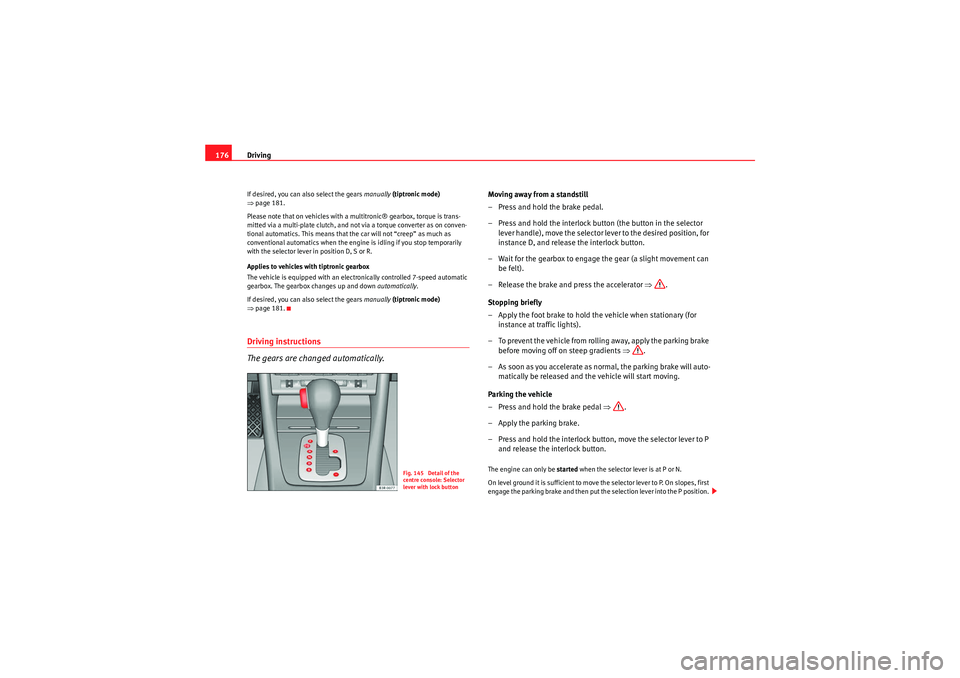
⇒ page 181.Driving instructions
The gears are changed automatically.
Moving away from a standstill
–Press and hold the brake pedal.
– Press and hold the interlock button (the button in the selector
lever handle), move the selector lever to the desired position, for
instance D, and release the interlock button.
– Wait for the gearbox to engage the gear (a slight movement can be felt).
– Release the brake and press the accelerator ⇒.
Stopping briefly
– Apply the foot brake to hold the vehicle when stationary (for instance at traffic lights).
– To prevent the vehicle from rolling away, apply the parking brake before moving off on steep gradients ⇒.
– As soon as you accelerate as normal, the parking brake will auto- matically be released and the vehicle will start moving.
Parking the vehicle
–Press and hold the brake pedal ⇒.
– Apply the parking brake.
– Press and hold the interlock button, move the selector lever to P and release the interlock button.The engine can only be started when the selector lever is at P or N.
On level ground it is sufficient to move the selector lever to P. On slopes, first
engage the parking brake and then put the selection lever into the P position.
Fig. 145 Detail of the
centre console: Selector
lever with lock button
Exeo_EN.book Seite 176 Freitag, 28. August 2009 10:14 10