child lock Seat Exeo 2009 User Guide
[x] Cancel search | Manufacturer: SEAT, Model Year: 2009, Model line: Exeo, Model: Seat Exeo 2009Pages: 310, PDF Size: 8.54 MB
Page 103 of 310
Unlocking and locking101
Safety First
Controls and equipment
Practical tips
Technical Data
•The doors and the tailgate cannot be opened from the outside (for secu-
rity reasons, e.g. when stopped at traffic lights).•You can open the doors individually from the inside by pulling the inside
door handle.•When the driver's door is open, it cannot be locked by pressing the central
locking switch and then closing the door. This helps to prevent you from
being locked out of the vehicle. The door has to be locked separately after it
has been closed.•In the event of an accident in which the airbags inflate, doors locked from
the inside will be automatically unlocked to facilitate access and assistance.WARNING
The central locking switch is still operative when the ignition is switched
off. This switch can be used to automatically lock all the doors and the tail-
gate. However, since this makes it difficult to enter the car from the
outside, you should never leave children unattended in the vehicle. Locked
doors could delay assistance in an emergency, potentially putting lives at
risk.
Note
The central locking switch inside the vehicle will not be operative if the anti-
theft mechanism has been enabled.
Security central locking*
The security central locking feature allows you to only unlock
the driver's door and the tank flap. All other doors and the
tailgate remain locked.Unlocking the driver's door and tank flap
–Turn the key once to the unlock position, or press the unlock
button on the remote control once.
Unlocking all the doors, the tailgate and the tank flap
simultaneously.
–Turn the key twice within five seconds, or press the unlock button
on the remote control twice within five seconds.The security system and the anti-theft alarm* are immediately disabled if you
unlock only the driver's door, without unlocking the other doors
⇒page 106.
Exeo_EN.book Seite 101 Freitag, 28. August 2009 10:14 10
Page 104 of 310
Unlocking and locking
102Locking the doors manually if the central locking fails to work
Should the central locking system fail to work at any time (for
instance if there is no electrical power supply), each door will
have to be locked separately.
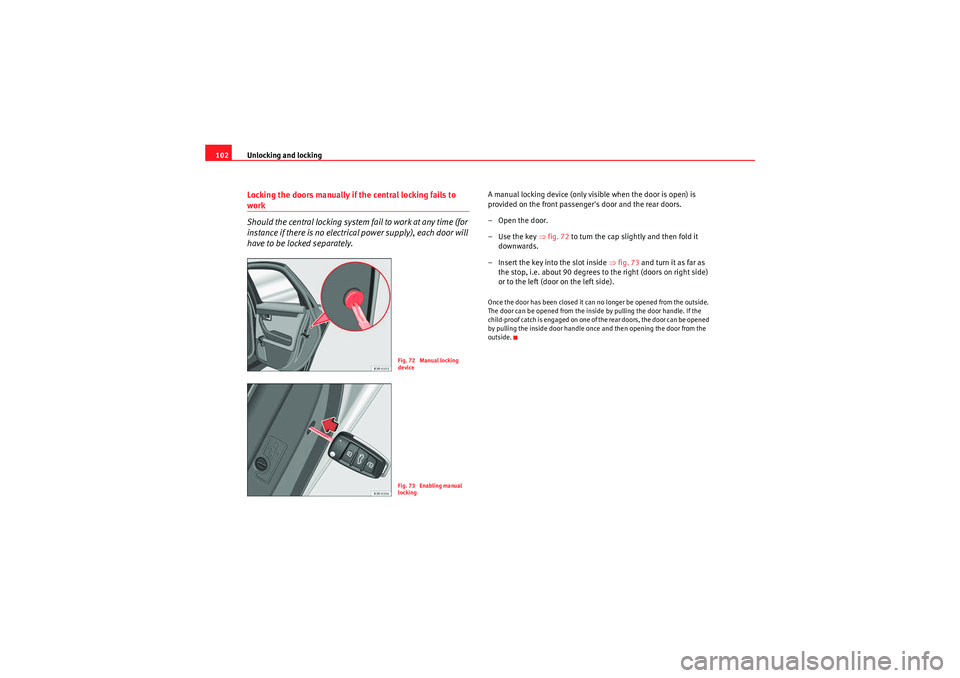
A manual locking device (only visible when the door is open) is
provided on the front passenger's door and the rear doors.
– Open the door.
–Use the key ⇒fig. 72 to turn the cap slightly and then fold it
downwards.
– Insert the key into the slot inside ⇒fig. 73 and turn it as far as
the stop, i.e. about 90 degrees to the right (doors on right side)
or to the left (door on the left side).Once the door has been closed it can no longer be opened from the outside.
The door can be opened from the inside by pulling the door handle. If the
child-proof catch is engaged on one of the rear doors, the door can be opened
by pulling the inside door handle once and then opening the door from the
outside.
Fig. 72 Manual locking
deviceFig. 73 Enabling manual
locking
Exeo_EN.book Seite 102 Freitag, 28. August 2009 10:14 10
Page 106 of 310
Unlocking and locking
104Childproof locksChildproof locks on rear doors
The childproof lock prevents the rear doors from being
opened from the inside.The rear doors are equipped with childproof locks. These can be
operated using the ignition key. The childproof locks are only visible
with the doors open.
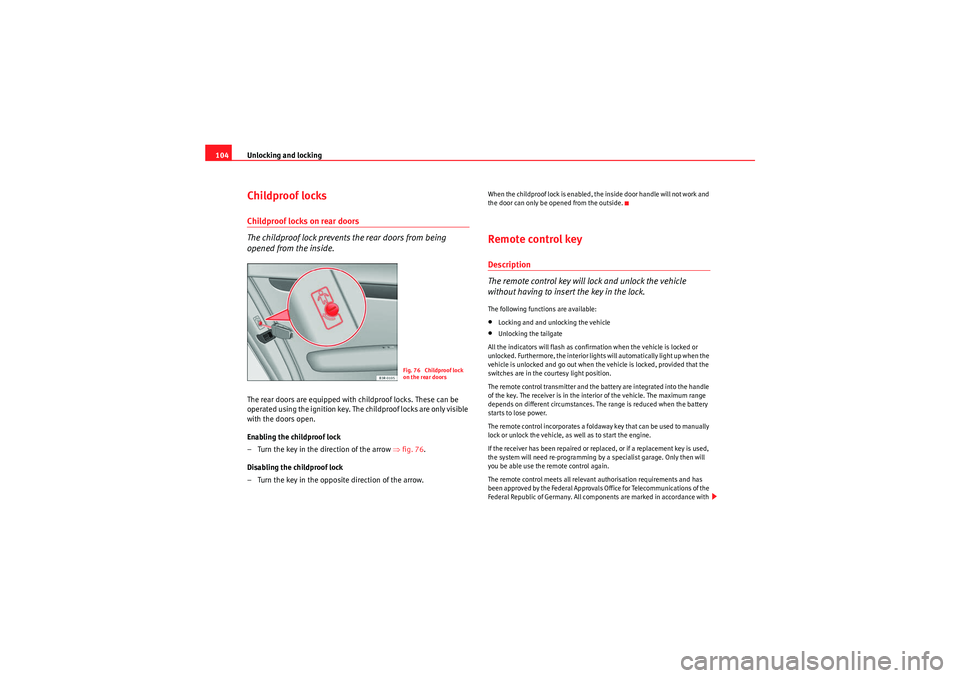
Enabling the childproof lock
– Turn the key in the direction of the arrow ⇒fig. 76 .
Disabling the childproof lock
– Turn the key in the opposite direction of the arrow.
W h en the ch ildp ro of lo ck is e na ble d , th e insid e d oo r ha nd le will no t wo rk and
the door can only be opened from the outside.Remote control keyDescription
The remote control key will lock and unlock the vehicle
without having to insert the key in the lock.The following functions are available:•Locking and and unlocking the vehicle•Unlocking the tailgate
All the indicators will flash as confirmation when the vehicle is locked or
unlocked. Furthermore, the interior lights will automatically light up when the
vehicle is unlocked and go out when the vehicle is locked, provided that the
switches are in the courtesy light position.
The remote control transmitter and the battery are integrated into the handle
of the key. The receiver is in the interior of the vehicle. The maximum range
depends on different circumstances. The range is reduced when the battery
starts to lose power.
The remote control incorporates a foldaway key that can be used to manually
lock or unlock the vehicle, as well as to start the engine.
If the receiver has been repaired or replaced, or if a replacement key is used,
the system will need re-programming by a specialist garage. Only then will
you be able use the remote control again.
The remote control meets all relevant authorisation requirements and has
been approved by the Federal Approvals Office for Telecommunications of the
Federal Republic of Germany. All components are marked in accordance with
Fig. 76 Childproof lock
on the rear doors
Exeo_EN.book Seite 104 Freitag, 28. August 2009 10:14 10
Page 107 of 310
Unlocking and locking105
Safety First
Controls and equipment
Practical tips
Technical Data
the current legal requirements. This certification forms the basis for official
approval for use in other countries.
Note
•The remote control is automatically disabled when the ignition is
switched on.•The function of the remote control may be impaired by interference from
other nearby radio signals (e.g. from a mobile phone or TV transmitter) if
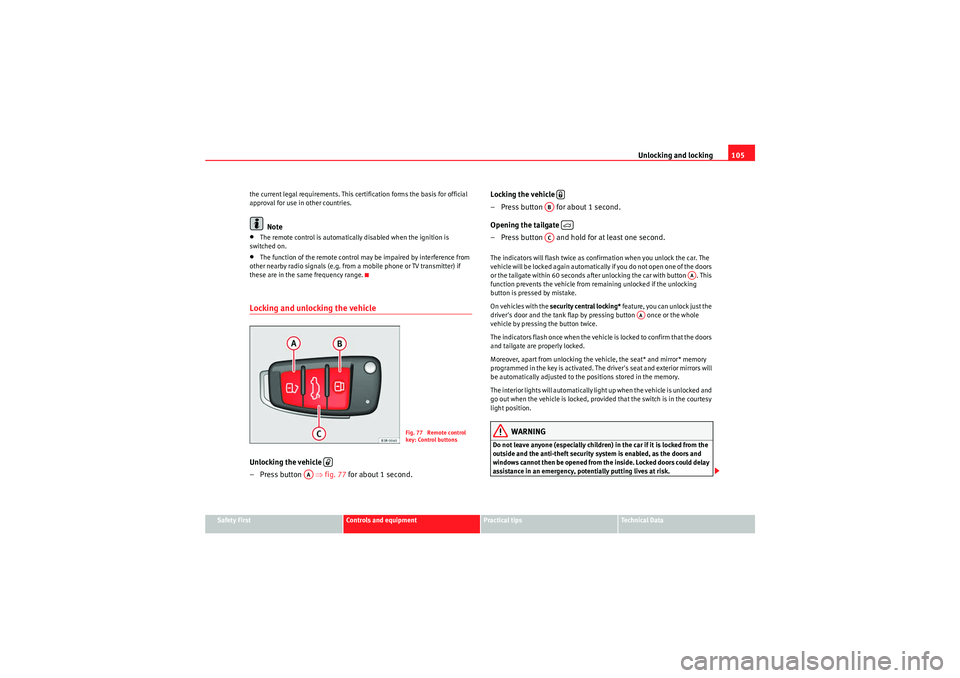
these are in the same frequency range.Locking and unlocking the vehicleUnlocking the vehicle
– Press button ⇒fig. 77 for about 1 second. Locking the vehicle
– Press button for about 1 second.
Opening the tailgate
– Press button and hold for at least one second.
The indicators will flash twice as confirmation when you unlock the car. The
vehicle will be locked again automatically if you do not open one of the doors
or the tailgate within 60 seconds after unlocking the car with button . This
function prevents the vehicle from remaining unlocked if the unlocking
button is pressed by mistake.
On vehicles with the
security central locking* feature, you can unlock just the
driver's door and the tank flap by pressing button once or the whole
vehicle by pressing the button twice.
The indicators flash once when the vehicle is locked to confirm that the doors
and tailgate are properly locked.
Moreover, apart from unlocking the vehicle, the seat* and mirror* memory
programmed in the key is activated. The driver's seat and exterior mirrors will
be automatically adjusted to the positions stored in the memory.
The interior lights will automatically light up when the vehicle is unlocked and
go out when the vehicle is locked, provided that the switch is in the courtesy
light position.
WARNING
Do not leave anyone (especially children) in the car if it is locked from the
outside and the anti-theft security system is enabled, as the doors and
windows cannot then be opened from the inside. Locked doors could delay
assistance in an emergency, potentially putting lives at risk.
Fig. 77 Remote control
key: Control buttons
AA
AB
AC
AA
AA
Exeo_EN.book Seite 105 Freitag, 28. August 2009 10:14 10
Page 110 of 310
Unlocking and locking
108
Disabling the interior monitor
– Open the door and pull out the switch (with the symbol
) to
one side of the storage compartment, in the driver's door
⇒ page 107, fig. 78.
– Then lock the vehicle.
Disabling the tow-away protection
– Open the door and pull out switch (with the symbol
) to one
side of the storage compartment, in the driver's door
⇒ page 107, fig. 78.
– Then lock the vehicle.
The LED on switch will light up when the interior monitor is disabled. The
LED on the top of the driver's door trim will also light up for about 3 seconds.
When the vehicle is locked, the LED on the top of the driver's door trim will
flash rapidly for about 3 seconds. After about 30 seconds it flashes more
slowly. The interior monitor is automatically enabled again the next time the
vehicle is locked.
The LED on switch will light up when the tow-away protection function is
disabled. The LED on the top of the driver's door trim will also light up for
about 3 seconds. When the vehicle is locked, the LED on the top of the
driver's door trim will flash rapidly for about 3 seconds. The tow-away protec-
tion is automatically enabled again the next time the vehicle is locked.
WARNING
Do not leave anyone (especially children) in the car if it is locked from the
outside and the anti-theft security system is enabled, as the doors and
windows cannot then be opened from the inside. Locked doors could delay
assistance in an emergency, potentially putting lives at risk.
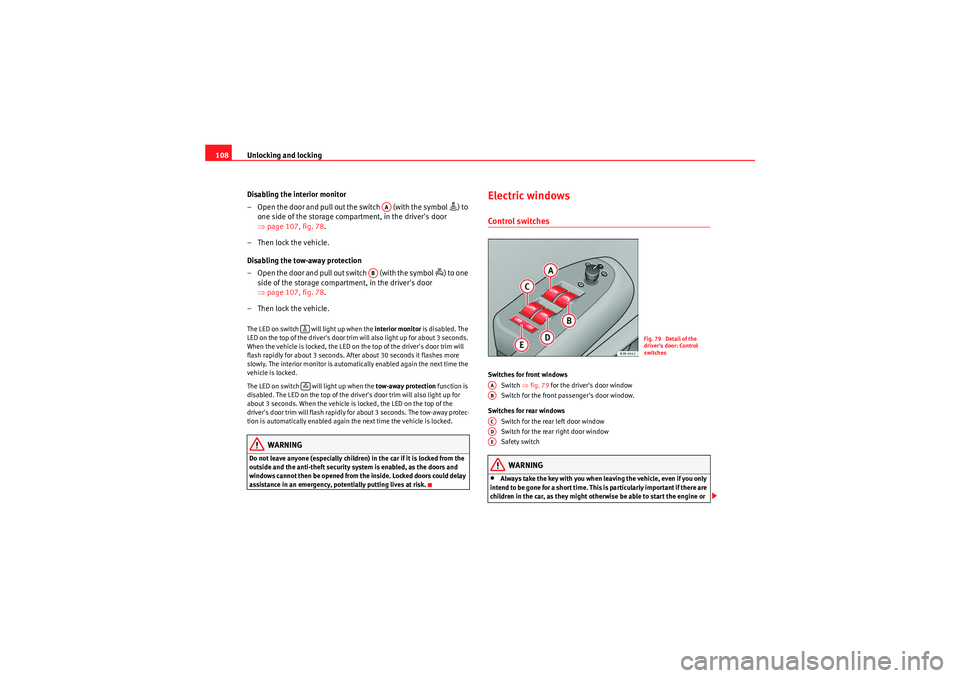
Electric windowsControl switchesSwitches for front windows
Switch ⇒fig. 79 for the driver's door window
Switch for the front passenger's door window.
Switches for rear windows Switch for the rear left door window
Switch for the rear right door window
Safety switch
WARNING
•Always take the key with you when leaving the vehicle, even if you only
intend to be gone for a short time. This is particularly important if there are
children in the car, as they might otherwise be able to start the engine or
AA
AB
Fig. 79 Detail of the
driver's door: Control
switches
AAABACADAE
Exeo_EN.book Seite 108 Freitag, 28. August 2009 10:14 10
Page 168 of 310
Driving
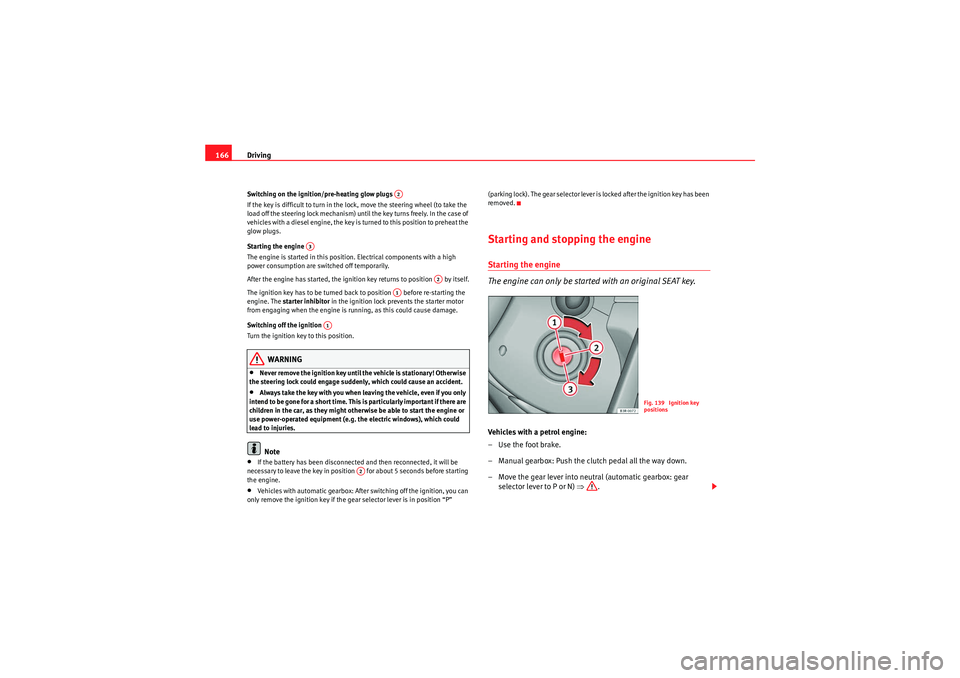
166Switching on the ignition/pre-heating glow plugs
If the key is difficult to turn in the lock, move the steering wheel (to take the
load off the steering lock mechanism) until the key turns freely. In the case of
vehicles with a diesel engine, the key is turned to this position to preheat the
glow plugs.
Starting the engine
The engine is started in this position. Electrical components with a high
power consumption are switched off temporarily.
After the engine has started, the ignition key returns to position by itself.
The ignition key has to be turned back to position before re-starting the
engine. The starter inhibitor in the ignition lock prevents the starter motor
from engaging when the engine is running, as this could cause damage.
Switching off the ignition
Turn the ignition key to this position.
WARNING
•Never remove the ignition key until the vehicle is stationary! Otherwise
the steering lock could engage suddenly, which could cause an accident.•Always take the key with you when leaving the vehicle, even if you only
intend to be gone for a short time. This is particularly important if there are
children in the car, as they might otherwise be able to start the engine or
use power-operated equipment (e.g. the electric windows), which could
lead to injuries.Note
•If the battery has been disconnected and then reconnected, it will be
necessary to leave the key in position for about 5 seconds before starting
the engine.•Vehicles with automatic gearbox: After switching off the ignition, you can
only remove the ignition key if the gear selector lever is in position “P” (parking lock). The gear selector lever is locked after the ignition key has been
removed.
Starting and stopping the engineStarting the engine
The engine can only be started with an original SEAT key.Vehicles with a petrol engine:
– Use the foot brake.
– Manual gearbox: Push the clutch pedal all the way down.
– Move the gear lever into neutral (automatic gearbox: gear
selector lever to P or N) ⇒.
A2
A3
A2
A1
A1
A2
Fig. 139 Ignition key
positions
Exeo_EN.book Seite 166 Freitag, 28. August 2009 10:14 10
Page 171 of 310
Driving169
Safety First
Controls and equipment
Practical tips
Technical Data
If you drive by mistake with the handbrake still applied, you will hear a
warning buzzer and the display will show the message:
Handbrake applied
The handbrake warning is enabled after driving for 3 seconds at a speed
above 5 km/h.
The handbrake warning lamp
lights up when the handbrake is applied
with the ignition on.
WARNING
Please note that the handbrake should be released all the way. If it is only
partially released, this will cause rear brakes overheating, which can
impair the function of the brake system and could lead to an accident.
Caution
Once the vehicle has come to a standstill, always apply the handbrake firmly
and then, on a manual gearbox, engage a gear, or select P on an automatic.Parking
The following points will ensure there is no risk of the car
rolling away accidentally after it is parked.– Use the foot brake to stop the vehicle.
– Apply handbrake firmly.
– Switch the engine off.
– On a manual gearbox engage 1st gear or on an automatic move the selector lever to P ⇒ .
When parking on slopes:
Turn the steering wheel so that the, if the vehicle moves, it will do so towards
the curb.
WARNING
•Do not leave anyone (especially children) in the vehicle when it is
locked. Locked doors could delay assistance in an emergency, potentially
putting lives at risk.•Never leave children unsupervised in the vehicle. They could release
e.g. the handbrake or gear lever, moving the vehicle and causing an
accident.
Parking aid acoustic systemGeneral notesVarious systems are available to help you when parking or manoeuvring in
tight spaces, depending on the equipment fitted on your vehicle.
The SEAT parking system gives an acoustic warning if there are any obstacles
behind your car ⇒ page 170.
When you are parking, SEAT parking system plus warns you acoustically and
optically about obstacles in front of and behind the vehicle ⇒page 170.
Note
To ensure the acoustic parking aid works properly, the sensors must be kept
clean and free of snow and ice.
Exeo_EN.book Seite 169 Freitag, 28. August 2009 10:14 10
Page 229 of 310
Checking and refilling levels227
Safety First
Controls and equipment
Practical tips
Technical Data
Liquid coolant losses
Any loss of liquid coolant normally indicates a
leak in the cooling system. In
this case the cooling system should be inspected by a specialist garage
without delay. It is not sufficient merely to top up the liquid coolant.
If there are no leaks in the system, a loss of liquid coolant can only occur if
the coolant boils and is forced out of the system as a result of overheating.
Caution
Radiator sealants must not be added to the liquid coolant. Such additives
could seriously impair the function of the cooling system.Topping up the liquid coolant
Be careful when topping up with liquid coolant.– Switch the engine off.
– Wait for the engine to cool down.
– Cover the cap on the expansion tank ⇒page 226, fig. 172 with a
cloth, and carefully unscrew the cap anti-clockwise ⇒.
– Add liquid coolant.
– Screw on the cap tightly.Make sure that the liquid coolant meets the required specifications
⇒page 225, “Liquid coolant”. Do not use a different type of anti-freeze if
anti-freeze G12++ is not available. In this case, use only water and bring the
anti-freeze concentration back up to the correct level as soon as possible.
Always top up with new liquid coolant. Do not fill above the “max” mark. Excess liquid coolant is forced out of the
system through the valve in the filler cap when the engine gets hot.
If a lot of liquid coolant has been lost, wait for the engine to
cool down before
putting in cold coolant. Failure to do so could result in serious engine
damage.
WARNING
•The cooling system is under pressure. Do not unscrew the cap on the
expansion tank when the engine is hot. Failure to comply could result in
burns.•The anti-freeze and liquid coolant can be a health hazard. Therefore,
the anti-freeze should be stored in the original container in a safe place out
of reach of children. Failure to comply could result in poisoning.For the sake of the environment
Drained off coolant should not be used again. Drain off the used coolant into
a suitable container and dispose of it in the proper manner (observe environ-
mental regulations).Radiator fan
The radiator fan can start running spontaneously.The auxiliary fan can continue to run for as long as 10 minutes after stopping
the engine – even after the ignition is switched off. It may also start running
suddenly ⇒ after some while if•stored heat raises the coolant temperature, or•the hot engine compartment is additionally heated up by the sun.
Exeo_EN.book Seite 227 Freitag, 28. August 2009 10:14 10
Page 233 of 310
Checking and refilling levels231
Safety First
Controls and equipment
Practical tips
Technical Data
Topping up and changing the brake fluid
It is best to have the brake fluid changed by a professional.Brake fluid absorbs damp. Therefore, in the course of time it will absorb water
from the ambient air. If the water content in the brake fluid is too high, the
brake system could corrode. In addition, the boiling point of the brake fluid
will be considerably reduced. This could adversely affect the braking ability in
certain circumstances.
For this reason the brake fluid must be changed periodically.
Your vehicle's Service Schedule will tell you when the brake fluid has to be
renewed.
We recommend you have the brake fluid changed as part of a regular Inspec-
tion Service at your garage. They are familiar with the procedure and have the
necessary special tools and spare parts as well as the proper facilities for
disposing of the old fluid.
Use only the genuine brake fluid specified by the factory Specialist garages
know that the brake fluid -DOT 4- is factory approved. The brake fluid must be
new.
WARNING
•Therefore, it must always be kept closed in its original container. Keep
out of the reach of children. Failure to comply could result in poisoning.•Heavy use of the brakes may cause a vapour lock if the brake fluid is left
in the system for too long. This would seriously affect the efficiency of the
brakes and the safety of the car, leading to the risk of accident.Caution
Please note that brake fluid will attack the paintwork on contact.
For the sake of the environment
If the fluid has to be drained out of the brake system, use an appropriate
container to catch the used brake fluid and dispose of it in the proper
manner.BatteryGeneral notes
All work on batteries requires specialist knowledge.The battery is virtually maintenance-free and is checked in the Inspection
Services.
We recommend that you replace a battery once it is older than 5 years.
Disconnecting the battery
If the battery is disconnected, some of the vehicle's functions will become
inoperative (e.g. electric windows). These functions will require resetting
after the battery is reconnected. For this reason, the battery should only be
disconnected from the vehicle's electrical system when absolutely necessary.
Long periods of non-use
The battery will gradually lose its charge because certain electrical equip-
ment continues to draw current even when the ignition is off. If you park the
vehicle for long periods of time in winter you should take the battery out of
the vehicle and keep it in a frost-proof room. Store the battery in a place
where it cannot “freeze up” and become damaged. At warm outside temper-
atures it is sufficient to disconnect the negative terminal of the battery. Even
when the battery is not connected you should charge it from time to time.
Exeo_EN.book Seite 231 Freitag, 28. August 2009 10:14 10
Page 235 of 310
Checking and refilling levels233
Safety First
Controls and equipment
Practical tips
Technical Data
•A highly explosive mixture of gases is released when the battery is
under charge. The batteries should be charged in a well-ventilated room
only.•Keep children away from acid and batteries.•Before working on the electrical system, you must switch off the
engine, the ignition and all consumers. The negative cable on the battery
must be disconnected. When a light bulb is changed, you need only switch
off the light.•Deactivate the anti-theft alarm by unlocking the vehicle before you
disconnect the battery! The alarm will otherwise be triggered.•When disconnecting the battery from the vehicle electrical system,
disconnect first the negative cable and then the positive cable.•Switch off all electrical consumers before reconnecting the battery.
Reconnect first the positive cable and then the negative cable. Never
reverse the polarity of the connections. This could cause an electrical fire.•Never charge a frozen battery, or one which has thawed. This could
result in explosions and chemical burns. Always replace a battery which
has frozen. A flat battery can freeze at temperatures around 0°.•Ensure that the vent hose is always connected to the battery.•Never use a defective battery. This may be fatally explosive. Replace a
damaged battery immediately.Caution
•Never disconnect the battery if the ignition is switched on or if the engine
is running. This could damage the electrical system or electronic compo-
nents.•Do not expose the battery to direct sunlight over a long period of time, as
the intense ultraviolet radiation can damage the battery housing.•If the vehicle is left standing in cold conditions for a long period, protect
the battery from frost. If it “freezes” it will be damaged.
Charging the battery
A fully-charged battery is important for reliable starting.–Note the warnings ⇒ in “Important safety warnings for
handling a car battery” on page 232 and ⇒.
– Switch off the ignition and all electrical equipment.
– Only if “fast-charging”: both battery cables must be discon- nected (first the “negative” cable, then the “positive” cable).
– Connect the charger cables to the battery terminals, noting the colour code (red is used for “positive”, black or brown for “nega-
tive”).
– Now connect the battery charger to the power point and switch on.
– After charging the battery: switch off the battery charger and disconnect the power point cable.
– Finally disconnect the charger cables from the battery.
– If necessary, reconnect both battery cables to the battery (first the “positive” cable, then the “negative” cable).When charging with a low current (for instance with a small battery charger)
the battery does not normally have to be disconnected. However, both
battery cables must be disconnected before “ fast-charging” the battery with
a high current. However, always follow the instructions given by the manufac-
turer of the battery charger.
The fast-charging procedure for a battery is dangerous ⇒ in “Important
safety warnings for handling a car battery” on page 232, as it requires a
WARNING (continued)
Exeo_EN.book Seite 233 Freitag, 28. August 2009 10:14 10