seat adjustment Seat Exeo 2009 User Guide
[x] Cancel search | Manufacturer: SEAT, Model Year: 2009, Model line: Exeo, Model: Seat Exeo 2009Pages: 310, PDF Size: 8.54 MB
Page 49 of 310
Child safety47
Safety First
Controls and equipment
Practical tips
Technical Data
“Deactivating airbags*”. If the passenger seat has a height adjustment
option, move it to the highest position.
•For those vehicles that do not include a key lock switch to turn the
airbag off, an Authorised Service Centre must be consulted.•All passengers, especially children, must assume the proper sitting
position and be properly belted in while travelling.•Never hold children or babies on your lap, this can result in potentially
fatal injuries to the child!•Never allow a child to be transported in a vehicle without being properly
secured, or to stand up or kneel on a seat while travelling. In an accident,
the child could be flung through the vehicle, causing possibly fatal injuries
to themselves and to the other passengers.•If children assume an improper sitting position when the car is moving,
they expose themselves to greater risk of injury in the event of sudden
braking manoeuvre or in an accident. This is particularly important if the
child is travelling on the front passenger seat and the airbag system is trig-
gered in an accident; as this could cause serious injury or even death.•A suitable child seat can protect your child!•Never leave an unsupervised child alone on a child seat or in the
vehicle.•Depending on weather conditions, it may become extremely hot or cold
inside the vehicle. This can be fatal.•Children who are less than 1.5 metres tall must not wear a normal seat
belt without a child restraint system, as this could cause injuries to the
abdominal and neck areas during a sudden braking manoeuvre or in an
accident.•Do not allow the belt webbing to become twisted or jammed, or to rub
on any sharp edges.•Incorrectly worn seat belts can cause injuries even in a minor collision
or in sudden braking manoeuvres.
•The seat belt provides maximum protection only when the belt web is
properly positioned ⇒page 22, “Seat belts”.•Only one child may occupy a child seat ⇒page 48, “Child seats”.
WARNING (continued)
WARNING (continued)
Exeo_EN.book Seite 47 Freitag, 28. August 2009 10:14 10
Page 53 of 310
Child safety51
Safety First
Controls and equipment
Practical tips
Technical Data
Securing child seatsWays to secure a child seat
A child seat can be secured differently on the rear seat and on
the front passenger seat.You can secure a child seat to the rear seat or front passenger seat in the
following ways:•Child seats in groups 0 to 3 can be secured with a seat belt.•Seats for children aged 0, 0+ and 1 with the “ISOFIX” system can be
secured without fastening seat belts, using the “ISOFIX” and/or Top Tether
securing rings ⇒page 52.
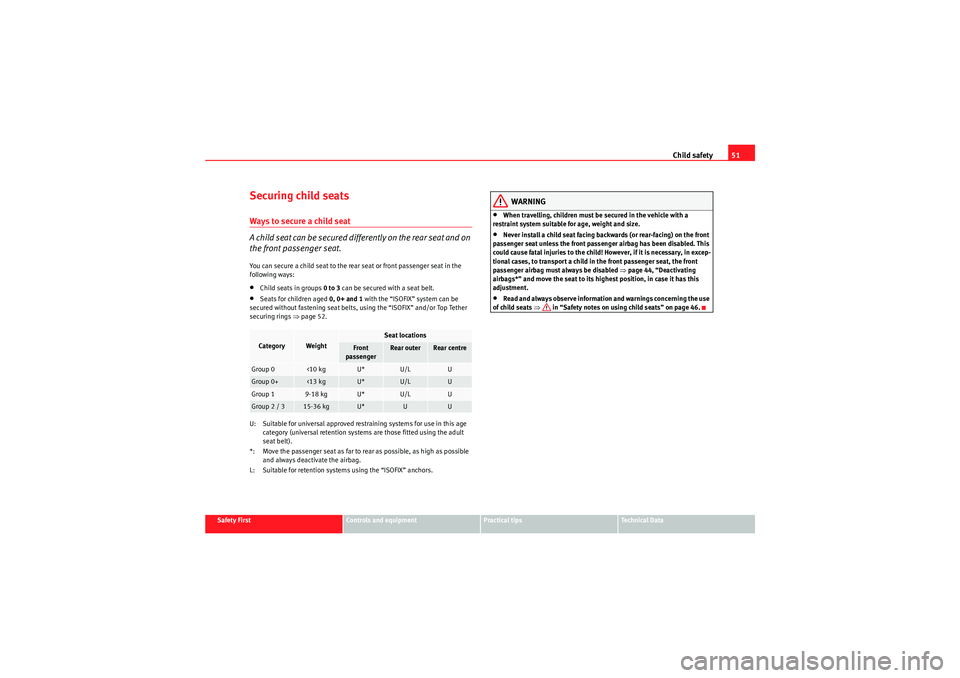
U: Suitable for universal approved restraining systems for use in this age category (universal retention systems are those fitted using the adult
seat belt).
*: Move the passenger seat as far to rear as possible, as high as possible and always deactivate the airbag.
L: Suitable for retention systems using the “ISOFIX” anchors.
WARNING
•When travelling, children must be secured in the vehicle with a
restraint system suitable for age, weight and size.•Never install a child seat facing backwards (or rear-facing) on the front
passenger seat unless the front passenger airbag has been disabled. This
could cause fatal injuries to the child! However, if it is necessary, in excep-
tional cases, to transport a child in the front passenger seat, the front
passenger airbag must always be disabled ⇒page 44, “Deactivating
airbags*” and move the seat to its highest position, in case it has this
adjustment.•Read and always observe information and warnings concerning the use
of child seats ⇒ in “Safety notes on using child seats” on page 46.
Category
Weight
Seat locations
Front
passenger
Rear outer
Rear centre
Group 0
<10 kg
U*
U/L
U
Group 0+
<13 kg
U*
U/L
U
Group 1
9-18 kg
U*
U/L
U
Group 2 / 3
15-36 kg
U*
U
U
Exeo_EN.book Seite 51 Freitag, 28. August 2009 10:14 10
Page 56 of 310
Child safety
54Fitting the Top Tether child restraint to the anchoring pointSecuring the Top Tether child restraint to the anchoring point
situated on the vehicle luggage compartment cover
– Pull out the fastening belt of the child restraint seat according to
the manufacturer's instructions.
– Lead the Top Tether fastening belt under the rear seat head restraint ⇒fig. 35 (lift the head restraint where necessary).
– Lift the luggage compartment cover anchorage cover -see detail- ⇒fig. 35 .
– Slide the belt so that the Top Tether belt of the child restraint seat is correctly secured to the luggage compartment cover
anchorage.
– Firmly tighten the Top Tether belt following the child restraint seat manufacturer's instructions. Releasing the retaining strap
– Release the retainer strap in line with the instructions given by
the child safety seat manufacturer.
– Push the lock and release it from the anchoring support.
WARNING
Read and bear in mind all the WARNINGS ⇒page 53.
Fig. 35 Retainer strap:
correct adjustment and
fitting
Exeo_EN.book Seite 54 Freitag, 28. August 2009 10:14 10
Page 134 of 310
Lights and visibility
132Heated mirrors
The mirrors are heated (depending on the outside temperature) when the rear
window heater ⇒ page 126 is switched on.
Memory for exterior mirrors*
On vehicles with memory function for the driver's seat, the setting of the exte-
rior mirrors is automatically stored together with the seat position
⇒ page 137.
Tilting function for exterior mirror on the passenger's side* (only if equipped
with memory for exterior mirrors)
When reverse gear is engaged, the mirror surface tilts slightly downwards,
provided the mirror control is switched to the exterior mirror on the
passenger's side (knob in position ⇒page 131, fig. 104 ) . T his p rovi de s a
better view of the kerb when parking.
The mirror returns to its original position as soon as reverse gear is disen-
gaged and the vehicle is driven forwards at a speed above 15 km/h, or when
the mirror control is turned to position or to the neutral position .
Caution
•Rear view convex or aspheric* mirrors increase the field of vision,
although objects appear smaller and further away in the mirrors. Therefore,
you should not rely on these mirrors for judging the distance of vehicles
behind.•If one of the mirror housings is knocked out of position (e.g. when
parking), the mirrors must first be fully retracted with the electric control. Do
not readjust the mirror housing by hand, as this will interfere with the mirror
adjuster function.Note
If the electrical adjustment ever fails to operate, the mirrors can be adjusted
by hand by lightly pressing the edge of the mirror glass.
ARAL
A0
Exeo_EN.book Seite 132 Freitag, 28. August 2009 10:14 10
Page 135 of 310

Seats and stowage133
Safety First
Controls and equipment
Practical tips
Technical Data
Seats and stowageManual adjustment of the front seatsSeat adjuster controls
There are several seat adjustment functions for your conven-
ienceS o m e o f t h e e q u i p m e n t l i s t e d i s o nl y f i t t e d o n ce r ta i n m o d e l s o r i s a n o p t i o n a l
extra.
Control switches
Moving the seat backwards or forwards
Raising/lowering the seat
Adjusting the backrest angle
Adjusting lumbar support
Moving the seats forwards and backwards– Lift the lever ⇒fig. 105 and move the seat to the desired
position.
– Then release the lever and move the seat further until the catch engages.
WARNING
The driver's seat must only be moved forwards and backwards when the
vehicle is at a standstill. Failure to do so could result in an accident.Adjusting the seat height*Raising the seat
–Pull the lever ⇒ fig. 105 up repeatedly until the seat is in the
desired position.
Lowering the seat
– Press the lever down repeatedly until the seat is in the desired position.
WARNING
•The height of the driver's seat mu st not be adjusted while driving.
Failure to do so could result in an accident.
Fig. 105 Adjuster
controls on driver's seat
A1A2A3A4
A1
A1
A2A2
Exeo_EN.book Seite 133 Freitag, 28. August 2009 10:14 10
Page 136 of 310

Seats and stowage
134•Be careful when adjusting the seat height. Injuries can be caused if the
height is adjusted without due care and attention.
Adjusting the backrest angle– Lean forwards to take your weight off the backrest.
– Turn the adjuster wheel ⇒ page 133, fig. 105 to set the angle
of the backrest as required.
WARNING
The front backrests must not be reclined for driving. Otherwise, safety
belts and the airbag system might not protect as they should, with the
subsequent danger of injury.Adjusting lumbar support*– Do not exert any pressure on the backrest and turn adjuster wheel ⇒page 133, fig. 105 to adjust lumbar support.As you make the adjustments, the curvature of the cushioned area of the
lumbar region becomes more or less acute. In this way, it adapts to the
natural curvature of the spine.
WARNING (continued)
A3
A4
Exeo_EN.book Seite 134 Freitag, 28. August 2009 10:14 10
Page 137 of 310
Seats and stowage135
Safety First
Controls and equipment
Practical tips
Technical Data
Electric adjustment of front seats*Adjusting the seat
The arrangement of the switches corresponds with the design
of the seats.
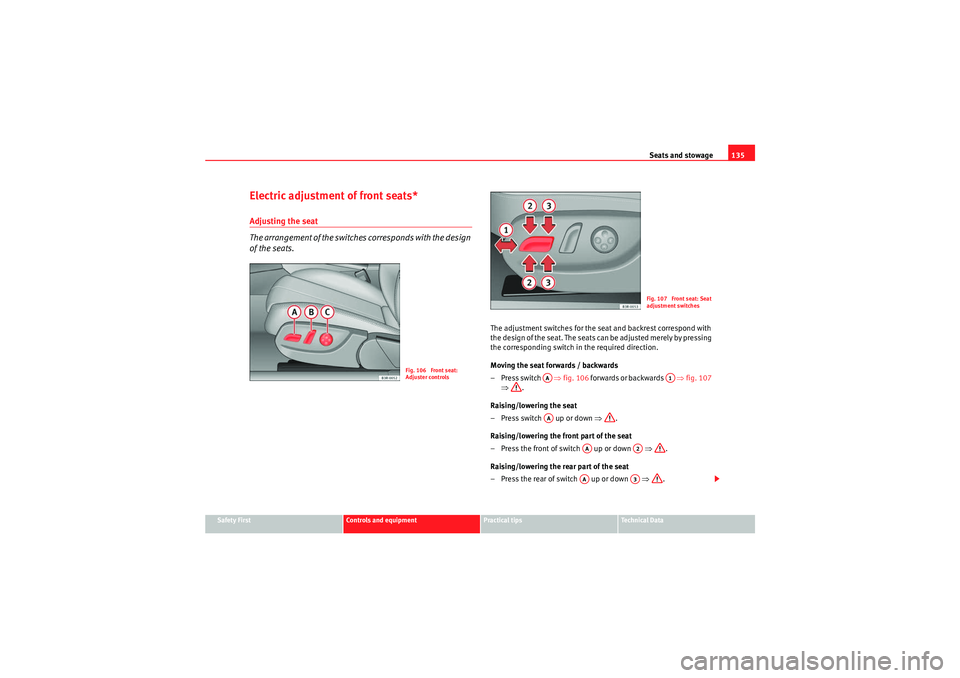
The adjustment switches for the seat and backrest correspond with
the design of the seat. The seats can be adjusted merely by pressing
the corresponding switch in the required direction.
Moving the seat forwards / backwards
–Press switch ⇒fig. 106 forwards or backwards ⇒fig. 107
⇒ .
Raising/lowering the seat
– Press switch up or down ⇒.
Raising/lowering the front part of the seat
– Press the front of switch up or down ⇒.
Raising/lowering the rear part of the seat
– Press the rear of switch up or down ⇒.
Fig. 106 Front seat:
Adjuster controls
Fig. 107 Front seat: Seat
adjustment switches
AA
A1
AA
AA
A2
AA
A3
Exeo_EN.book Seite 135 Freitag, 28. August 2009 10:14 10
Page 138 of 310

Seats and stowage
136Control switches
Seat adjustment
Backrest adjustment
Lumbar support*
WARNING
•The electrical seat adjustment also works when the ignition is off or
when the key is not in the ignition. To avoid accidental injuries, never leave
children unattended in the vehicle.•For safety reasons, the seat must only be adjusted when the vehicle is
at a standstill. Failure to do so could result in an accident.•Be careful when adjusting the seat height. Injuries can be caused if the
seat height is adjusted without due care and attention.
Adjusting the backrest angle
– Press the button in the appropriate direction of the arrow ⇒fig. 108 to adjust the backrest ⇒.
WARNING
The front backrests must not be reclined for driving. Otherwise, safety
belts and the airbag system might not protect as they should, with the
subsequent danger of injury.Lumbar support*The lumbar support can be adjusted to fit the natural curve of
the spine.
AAABAC
Fig. 108 Front seat: Back-
rest adjuster switch
Fig. 109 Front seat:
Adjuster switch for lumbar
support
Exeo_EN.book Seite 136 Freitag, 28. August 2009 10:14 10
Page 140 of 310
Seats and stowage
138adjustment. Use of the button is recommended to disable the memory
system when the vehicle is being driven temporarily by a different driver
whose settings do not need to be stored in the memory.
Note
You can also use the remote control to call up the stored settings
⇒ page 139.Storing settingsThe button must be in its down position (pressed in) before
you can store the desired settings.
– Adjust the driver's seat as required ⇒page 135.
– Adjust both exterior mirrors ⇒page 131.
– Press and hold the button. At the same time, press one of the memory buttons for at least a second.
– Release both buttons. The setting is now stored on the selected memory button.Any new setting selected automatically cancels the existing setting stored on
the memory button. It is best to begin with memory button No. 1 for the first
driver and then assign the other memory buttons to each subsequent driver.
The seat and mirror positions are stored when the car is locked with the
remote control and are assigned to the remote control key. The exterior
mirrors adjust automatically to the previous position when you unlock the
car; the driver's seat adjusts automatically when you open the driver's door. However, this does not delete the settings stored in memory buttons 1 to 4.
These settings can be enabled at any time.
Enabling settings
Stored settings can be recalled using either the memory
buttons or the remote control (remote control key).Using the memory buttons
– If the driver's door is open, press the desired memory button
briefly.
– If the driver's door is closed, press and hold down the appro- priate memory button until the seat and exterior mirrors reach
their programmed positions.
Using the remote control
– Unlock the vehicle using the remote control and open the driver's door within the next ten minutes.The seat adjustment will have to be called up using the memory buttons if the
driver's door is not opened within 10 minutes after unlocking the vehicle with
the remote control.
WARNING
•For safety reasons, the seat must only be adjusted when the vehicle is
at a standstill. Failure to do so could result in an accident.•In an emergency, the memory function can be stopped at any time by
pressing the STOP button or by br iefly pressing any of the memory
buttons.
STOP
STOP
MEMO
Exeo_EN.book Seite 138 Freitag, 28. August 2009 10:14 10
Page 304 of 310
Index
302Engine oil . . . . . . . . . . . . . . . . . . . . . . . . . . . . . . 222
Checking oil level . . . . . . . . . . . . . . . . . . . . 224
Consumption . . . . . . . . . . . . . . . . . . . . . . . . 224
Oil pressure too low . . . . . . . . . . . . . . . . . . . 78
Oil properties . . . . . . . . . . . . . . . . . . . . . . . . 223
Oil sensor defective . . . . . . . . . . . . . . . . . . . 80
Topping up . . . . . . . . . . . . . . . . . . . . . . . . . . 224
Environment . . . . . . . . . . . . . . . . . . . . . . . . . . . 191 Environmental friendliness . . . . . . . . . . . . 192
Environmental tip Avoiding pollution . . . . . . . . . . . . . . . . . . . . 217
Environmentally friendly driving . . . . . . . . . . . 191
Exhaust gas purification system . . . . . . . . . . . 190
Exterior mirrors . . . . . . . . . . . . . . . . . . . . . . . . . 208FFabric trim cleaning . . . . . . . . . . . . . . . . . . . . . 212
Fastening rings . . . . . . . . . . . . . . . . . . . . . . . . . . 17
Filling the tank Releasing the tank flap manually . . . . . . . 217
Floor mats . . . . . . . . . . . . . . . . . . . . . . . . . . . . . . 16
Fog lights . . . . . . . . . . . . . . . . . . . . . . . . . . . . . . 117
Front airbags . . . . . . . . . . . . . . . . . . . . . . . . . . . . 31 Description . . . . . . . . . . . . . . . . . . . . . . . . . . 31
Front drink holders . . . . . . . . . . . . . . . . . . . . . . 147
Front passenger airbag deactivation . . . . . . . . . 44
Frontal airbags Operation . . . . . . . . . . . . . . . . . . . . . . . . . . . . 32
safety notes . . . . . . . . . . . . . . . . . . . . . . . . . . 34 Fuel
Diesel . . . . . . . . . . . . . . . . . . . . . . . . . . . . . . 218
Fuel gauge . . . . . . . . . . . . . . . . . . . . . . . . . . . 63
Fuel level low . . . . . . . . . . . . . . . . . . . . . . . . . 80
Instantaneous fuel consumption . . . . . . . . . 85
Petrol . . . . . . . . . . . . . . . . . . . . . . . . . . . . . . 218
Fuel range . . . . . . . . . . . . . . . . . . . . . . . . . . . 73, 85
Fuel tank opening the fuel tank flap . . . . . . . . . . . . . 216
Fuel: save . . . . . . . . . . . . . . . . . . . . . . . . . . . . . . 191
Fuse Assignment . . . . . . . . . . . . . . . . . . . . . . . . . 256
Changing . . . . . . . . . . . . . . . . . . . . . . . . . . . 255
GGear display . . . . . . . . . . . . . . . . . . . . . . . . . . . . . 73
Gear shift pattern . . . . . . . . . . . . . . . . . . . . . . . 175
General overview of the engine compartment 289
Glove compartment . . . . . . . . . . . . . . . . . . . . . . 151Cool box . . . . . . . . . . . . . . . . . . . . . . . . . . . . 152
Light . . . . . . . . . . . . . . . . . . . . . . . . . . . . . . . 123
GRA . . . . . . . . . . . . . . . . . . . . . . . . . . . . . . . . . . . 172HHandbrake . . . . . . . . . . . . . . . . . . . . . . . . . . . . . 168
Hazard warning lights . . . . . . . . . . . . . . . . . . . . 121
Head restraint Rear seat . . . . . . . . . . . . . . . . . . . . . . . . . . . 141 Head restraints
Front seats . . . . . . . . . . . . . . . . . . . . . . . . . . 139
Rear seats . . . . . . . . . . . . . . . . . . . . . . . . . . 140
Removing and fitting . . . . . . . . . . . . . . . . . 140
head restraints, correct adjustment . . . . . . . . . 13 In-use and non-use positions . . . . . . . . . . . 14
Headlight range control . . . . . . . . . . . . . . . . . . 119 Dynamic . . . . . . . . . . . . . . . . . . . . . . . . . . . . 120
Faulty . . . . . . . . . . . . . . . . . . . . . . . . . . . . . . . 81
Headlights . . . . . . . . . . . . . . . . . . . . . . . . . . . . . 115 Adaptive headlights . . . . . . . . . . . . . . . . . . 121
Automatic headlight control . . . . . . . . . . . 116
Automatic headlight control photo sensors . . .116
Coming home function . . . . . . . . . . . . . . . . 118
Driving abroad . . . . . . . . . . . . . . . . . . . . . . . 193
Front fog lights . . . . . . . . . . . . . . . . . . . . . . 117
Headlight range control . . . . . . . . . . . . . . . 119
Headlight washer system . . . . . . . . . . . . . . 129
Leaving home function . . . . . . . . . . . . . . . . 118
Heated Seats . . . . . . . . . . . . . . . . . . . . . . . . . . . . . . 163
Heated rear window . . . . . . . . . . . . . . . . . . . . . 126
Heated seat . . . . . . . . . . . . . . . . . . . . . . . . . . . . 163
High pressure cleaners . . . . . . . . . . . . . . . . . . . 207
Horn . . . . . . . . . . . . . . . . . . . . . . . . . . . . . . . . . . . 57
IIdentification number . . . . . . . . . . . . . . . . . . . . 286
Exeo_EN.book Seite 302 Freitag, 28. August 2009 10:14 10