seats Seat Exeo 2009 Owner's Guide
[x] Cancel search | Manufacturer: SEAT, Model Year: 2009, Model line: Exeo, Model: Seat Exeo 2009Pages: 310, PDF Size: 8.54 MB
Page 49 of 310
Child safety47
Safety First
Controls and equipment
Practical tips
Technical Data
“Deactivating airbags*”. If the passenger seat has a height adjustment
option, move it to the highest position.
•For those vehicles that do not include a key lock switch to turn the
airbag off, an Authorised Service Centre must be consulted.•All passengers, especially children, must assume the proper sitting
position and be properly belted in while travelling.•Never hold children or babies on your lap, this can result in potentially
fatal injuries to the child!•Never allow a child to be transported in a vehicle without being properly
secured, or to stand up or kneel on a seat while travelling. In an accident,
the child could be flung through the vehicle, causing possibly fatal injuries
to themselves and to the other passengers.•If children assume an improper sitting position when the car is moving,
they expose themselves to greater risk of injury in the event of sudden
braking manoeuvre or in an accident. This is particularly important if the
child is travelling on the front passenger seat and the airbag system is trig-
gered in an accident; as this could cause serious injury or even death.•A suitable child seat can protect your child!•Never leave an unsupervised child alone on a child seat or in the
vehicle.•Depending on weather conditions, it may become extremely hot or cold
inside the vehicle. This can be fatal.•Children who are less than 1.5 metres tall must not wear a normal seat
belt without a child restraint system, as this could cause injuries to the
abdominal and neck areas during a sudden braking manoeuvre or in an
accident.•Do not allow the belt webbing to become twisted or jammed, or to rub
on any sharp edges.•Incorrectly worn seat belts can cause injuries even in a minor collision
or in sudden braking manoeuvres.
•The seat belt provides maximum protection only when the belt web is
properly positioned ⇒page 22, “Seat belts”.•Only one child may occupy a child seat ⇒page 48, “Child seats”.
WARNING (continued)
WARNING (continued)
Exeo_EN.book Seite 47 Freitag, 28. August 2009 10:14 10
Page 50 of 310
Child safety
48Child seatsCategorisation of child seats into groups
Use only child seats that are officially approved and suitable
for the child.Child seats are subject to the regulation ECE-R 44. ECE-R. It means that:
Economic Commission for Europe Regulation
The child seats are grouped into 5 categories:
Group 0 : Children up to 10 kg
Group 0+ : Children up to 13 kg
Group 1 : from 9 to 18 kg
Group 2 : from 15 to 25 kg
Group 3 : from 22 to 36 kg
Child seats that have been tested and approved under the ECE R 44 standard
bear the test mark on the seat (the letter E in a circle with the test number
below it).
Group 0 and 0+ child seats
A suitable child seat and a correctly adjusted seat belt can
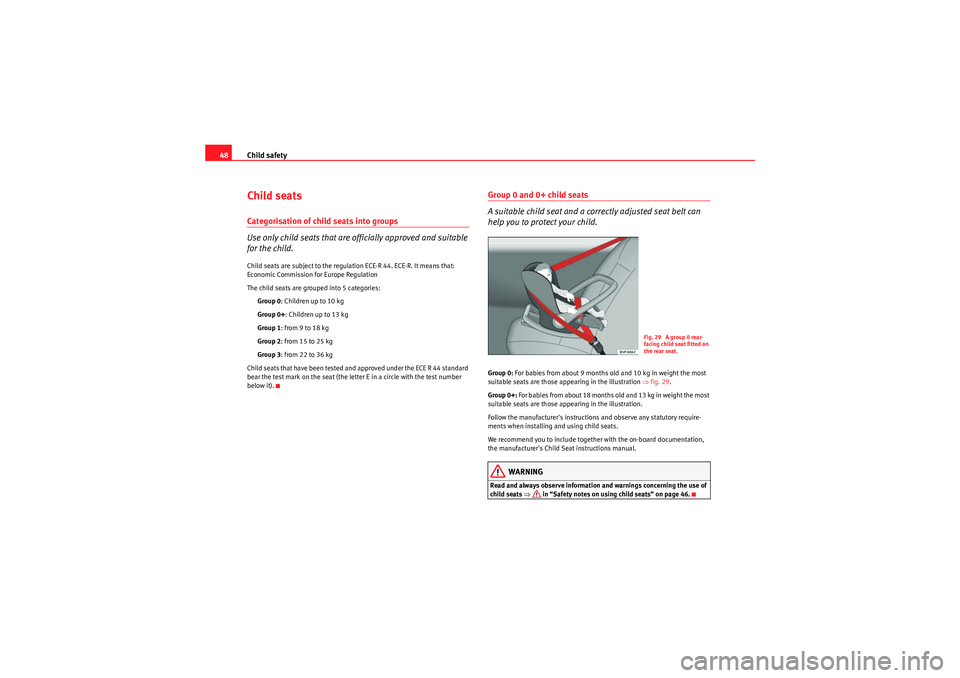
help you to protect your child.Group 0: For babies from about 9 months old and 10 kg in weight the most
suitable seats are those appearing in the illustration ⇒ fig. 29.
Group 0+: For babies from about 18 months old and 13 kg in weight the most
suitable seats are those appearing in the illustration.
Follow the manufacturer's instructions and observe any statutory require-
ments when installing and using child seats.
We recommend you to include together with the on-board documentation,
the manufacturer's Child Seat instructions manual.
WARNING
Read and always observe information and warnings concerning the use of
child seats ⇒ in “Safety notes on using child seats” on page 46.
Fig. 29 A group 0 rear-
facing child seat fitted on
the rear seat.
Exeo_EN.book Seite 48 Freitag, 28. August 2009 10:14 10
Page 51 of 310
Child safety49
Safety First
Controls and equipment
Practical tips
Technical Data
Group 1 child seats
A suitable child seat and a correctly adjusted seat belt can
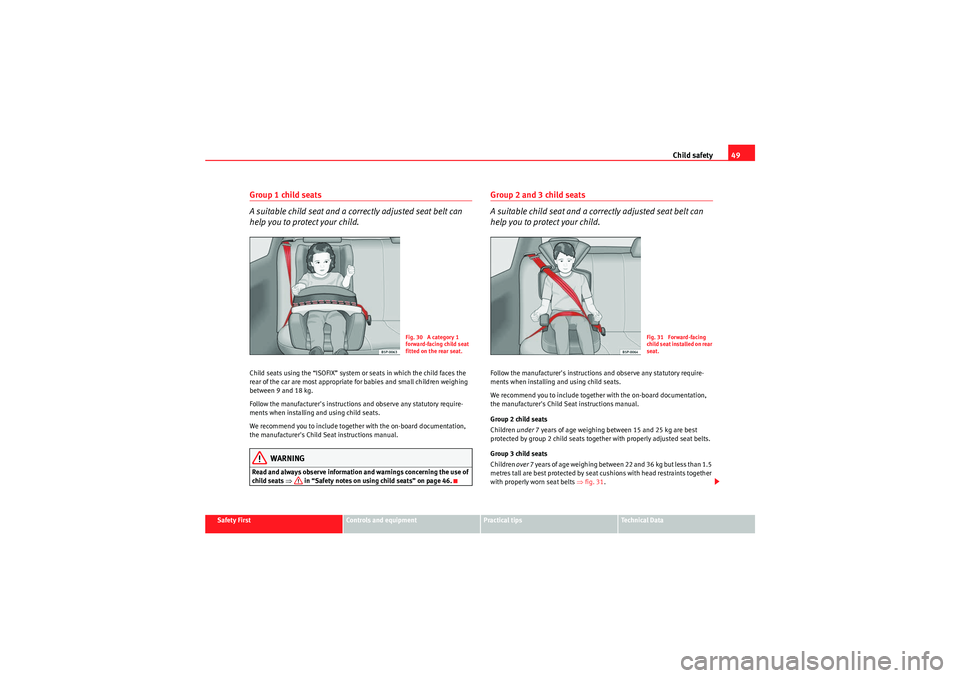
help you to protect your child.Child seats using the “ISOFIX” system or seats in which the child faces the
rear of the car are most appropriate for babies and small children weighing
between 9 and 18 kg.
Follow the manufacturer's instructions and observe any statutory require-
ments when installing and using child seats.
We recommend you to include together with the on-board documentation,
the manufacturer's Child Seat instructions manual.
WARNING
Read and always observe information and warnings concerning the use of
child seats ⇒ in “Safety notes on using child seats” on page 46.
Group 2 and 3 child seats
A suitable child seat and a correctly adjusted seat belt can
help you to protect your child.Follow the manufacturer's instructions and observe any statutory require-
ments when installing and using child seats.
We recommend you to include together with the on-board documentation,
the manufacturer's Child Seat instructions manual.
Group 2 child seats
Children under 7 years of age weighing between 15 and 25 kg are best
protected by group 2 child seats together with properly adjusted seat belts.
Group 3 child seats
Children over 7 years of age weighing between 22 and 36 kg but less than 1.5
metres tall are best protected by seat cushions with head restraints together
with properly worn seat belts ⇒fig. 31 .
Fig. 30 A category 1
forward-facing child seat
fitted on the rear seat.
Fig. 31 Forward-facing
child seat installed on rear
seat.
Exeo_EN.book Seite 49 Freitag, 28. August 2009 10:14 10
Page 52 of 310
Child safety
50
WARNING
•The shoulder part of the seat belt must lie approximately on the centre
of the shoulder, never across the neck or the arm. The seat belt must lie
close to the upper part of the body. The lap belt part must lie across the
pelvis, not across the stomach, and always fit closely. Pull the belt tight if
necessary to take up any slack ⇒page 22, “Seat belts”.•Read and always observe information and warnings concerning the use
of child seats ⇒ in “Safety notes on using child seats” on page 46.
Exeo_EN.book Seite 50 Freitag, 28. August 2009 10:14 10
Page 53 of 310
Child safety51
Safety First
Controls and equipment
Practical tips
Technical Data
Securing child seatsWays to secure a child seat
A child seat can be secured differently on the rear seat and on
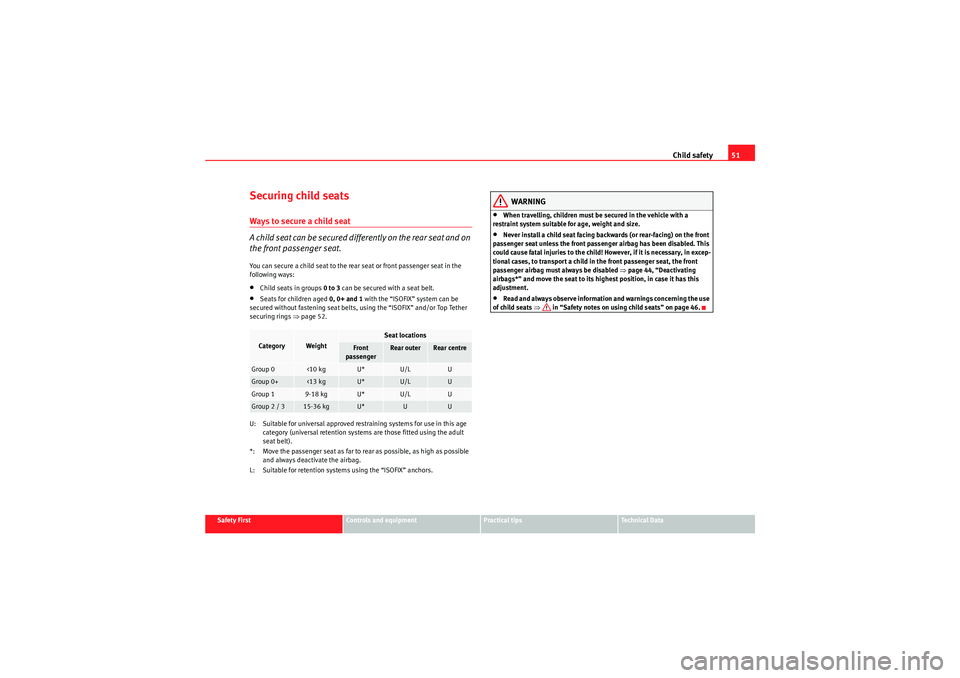
the front passenger seat.You can secure a child seat to the rear seat or front passenger seat in the
following ways:•Child seats in groups 0 to 3 can be secured with a seat belt.•Seats for children aged 0, 0+ and 1 with the “ISOFIX” system can be
secured without fastening seat belts, using the “ISOFIX” and/or Top Tether
securing rings ⇒page 52.
U: Suitable for universal approved restraining systems for use in this age category (universal retention systems are those fitted using the adult
seat belt).
*: Move the passenger seat as far to rear as possible, as high as possible and always deactivate the airbag.
L: Suitable for retention systems using the “ISOFIX” anchors.
WARNING
•When travelling, children must be secured in the vehicle with a
restraint system suitable for age, weight and size.•Never install a child seat facing backwards (or rear-facing) on the front
passenger seat unless the front passenger airbag has been disabled. This
could cause fatal injuries to the child! However, if it is necessary, in excep-
tional cases, to transport a child in the front passenger seat, the front
passenger airbag must always be disabled ⇒page 44, “Deactivating
airbags*” and move the seat to its highest position, in case it has this
adjustment.•Read and always observe information and warnings concerning the use
of child seats ⇒ in “Safety notes on using child seats” on page 46.
Category
Weight
Seat locations
Front
passenger
Rear outer
Rear centre
Group 0
<10 kg
U*
U/L
U
Group 0+
<13 kg
U*
U/L
U
Group 1
9-18 kg
U*
U/L
U
Group 2 / 3
15-36 kg
U*
U
U
Exeo_EN.book Seite 51 Freitag, 28. August 2009 10:14 10
Page 54 of 310
Child safety
52Child seat mounting using the “ISOFIX” and/or Top Tether system
The child retention systems can be installed quickly and
safely on the rear seat using the “ISOFIX” and/or Top Tether
systems (fitted on the rear tray).
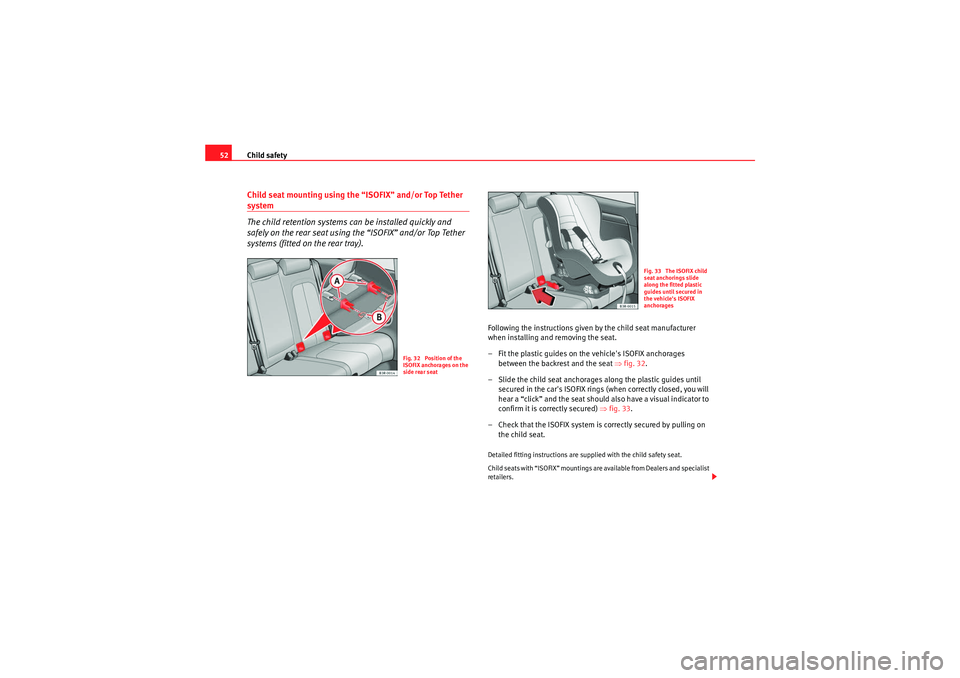
Following the instructions given by the child seat manufacturer
when installing and removing the seat.
– Fit the plastic guides on the vehicle's ISOFIX anchorages
between the backrest and the seat ⇒fig. 32 .
– Slide the child seat anchorages along the plastic guides until secured in the car's ISOFIX rings (when correctly closed, you will
hear a “click” and the seat should also have a visual indicator to
confirm it is correctly secured) ⇒fig. 33 .
– Check that the ISOFIX system is correctly secured by pulling on the child seat.Detailed fitting instructions are supplied with the child safety seat.
Child seats with “ISOFIX” mountings are available from Dealers and specialist
retailers.
Fig. 32 Position of the
ISOFIX anchorages on the
side rear seat
Fig. 33 The ISOFIX child
seat anchorings slide
along the fitted plastic
guides until secured in
the vehicle's ISOFIX
anchorages
Exeo_EN.book Seite 52 Freitag, 28. August 2009 10:14 10
Page 55 of 310
Child safety53
Safety First
Controls and equipment
Practical tips
Technical Data
WARNING
The retainers employed for this child safety seat are specially designed for
the “ISOFIX” system. Never secure other child seats, seat belts or other
items into the retainers. If you do, you increase the risk of sustaining
severe or fatal injuries.To p Te t h e r r e t a i n e r s t r a p s
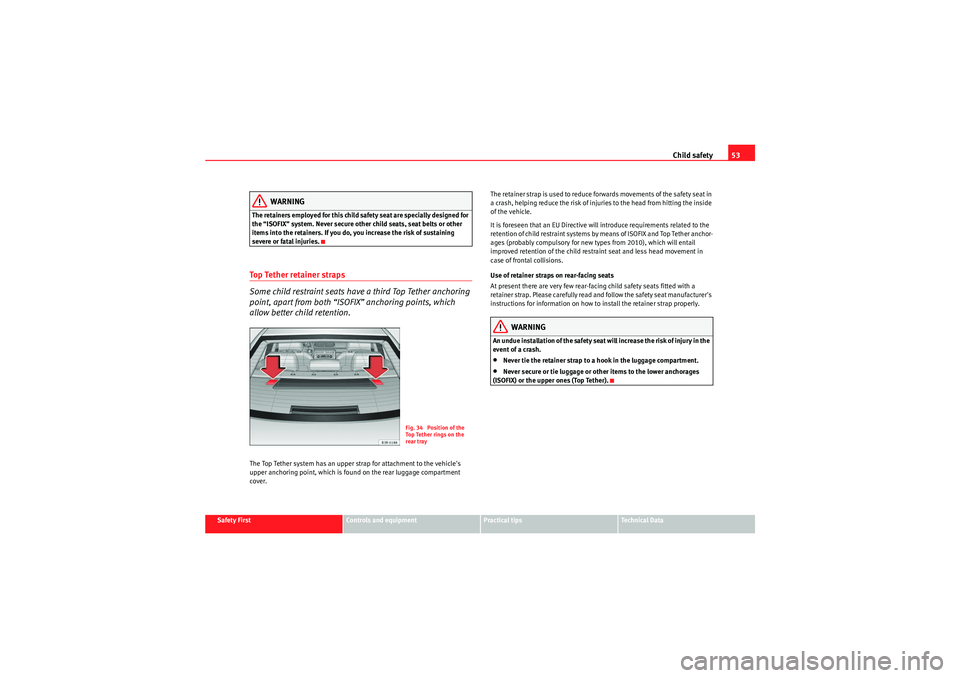
Some child restraint seats have a third Top Tether anchoring
point, apart from both “ISOFIX” anchoring points, which
allow better child retention.The Top Tether system has an upper strap for attachment to the vehicle's
upper anchoring point, which is found on the rear luggage compartment
cover. The retainer strap is used to reduce forwards movements of the safety seat in
a crash, helping reduce the risk of injuries to the head from hitting the inside
of the vehicle.
It is foreseen that an EU Directive will introduce requirements related to the
retention of child restraint systems by means of ISOFIX and Top Tether anchor-
ages (probably compulsory for new types from 2010), which will entail
improved retention of the child restraint seat and less head movement in
case of frontal collisions.
Use of retainer straps on rear-facing seats
At present there are very few rear-facing child safety seats fitted with a
retainer strap. Please carefully read and follow the safety seat manufacturer's
instructions for information on how to install the retainer strap properly.
WARNING
An undue installation of the safety seat will increase the risk of injury in the
event of a crash.•Never tie the retainer strap to a hook in the luggage compartment.•Never secure or tie luggage or other items to the lower anchorages
(ISOFIX) or the upper ones (Top Tether).
Fig. 34 Position of the
Top Tether rings on the
rear tray
Exeo_EN.book Seite 53 Freitag, 28. August 2009 10:14 10
Page 135 of 310

Seats and stowage133
Safety First
Controls and equipment
Practical tips
Technical Data
Seats and stowageManual adjustment of the front seatsSeat adjuster controls
There are several seat adjustment functions for your conven-
ienceS o m e o f t h e e q u i p m e n t l i s t e d i s o nl y f i t t e d o n ce r ta i n m o d e l s o r i s a n o p t i o n a l
extra.
Control switches
Moving the seat backwards or forwards
Raising/lowering the seat
Adjusting the backrest angle
Adjusting lumbar support
Moving the seats forwards and backwards– Lift the lever ⇒fig. 105 and move the seat to the desired
position.
– Then release the lever and move the seat further until the catch engages.
WARNING
The driver's seat must only be moved forwards and backwards when the
vehicle is at a standstill. Failure to do so could result in an accident.Adjusting the seat height*Raising the seat
–Pull the lever ⇒ fig. 105 up repeatedly until the seat is in the
desired position.
Lowering the seat
– Press the lever down repeatedly until the seat is in the desired position.
WARNING
•The height of the driver's seat mu st not be adjusted while driving.
Failure to do so could result in an accident.
Fig. 105 Adjuster
controls on driver's seat
A1A2A3A4
A1
A1
A2A2
Exeo_EN.book Seite 133 Freitag, 28. August 2009 10:14 10
Page 136 of 310

Seats and stowage
134•Be careful when adjusting the seat height. Injuries can be caused if the
height is adjusted without due care and attention.
Adjusting the backrest angle– Lean forwards to take your weight off the backrest.
– Turn the adjuster wheel ⇒ page 133, fig. 105 to set the angle
of the backrest as required.
WARNING
The front backrests must not be reclined for driving. Otherwise, safety
belts and the airbag system might not protect as they should, with the
subsequent danger of injury.Adjusting lumbar support*– Do not exert any pressure on the backrest and turn adjuster wheel ⇒page 133, fig. 105 to adjust lumbar support.As you make the adjustments, the curvature of the cushioned area of the
lumbar region becomes more or less acute. In this way, it adapts to the
natural curvature of the spine.
WARNING (continued)
A3
A4
Exeo_EN.book Seite 134 Freitag, 28. August 2009 10:14 10
Page 137 of 310
Seats and stowage135
Safety First
Controls and equipment
Practical tips
Technical Data
Electric adjustment of front seats*Adjusting the seat
The arrangement of the switches corresponds with the design
of the seats.
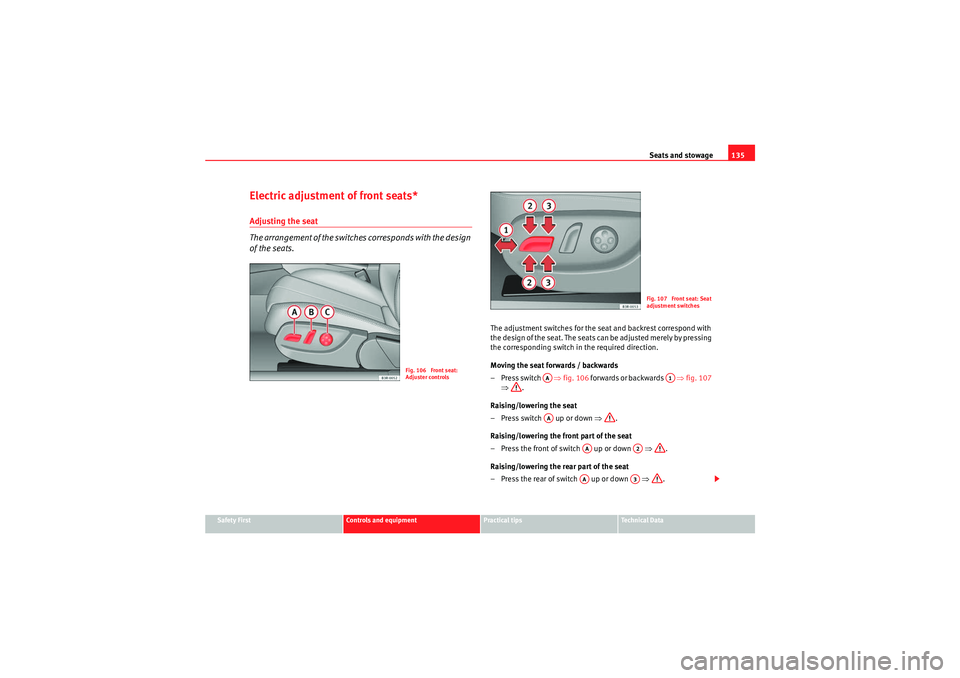
The adjustment switches for the seat and backrest correspond with
the design of the seat. The seats can be adjusted merely by pressing
the corresponding switch in the required direction.
Moving the seat forwards / backwards
–Press switch ⇒fig. 106 forwards or backwards ⇒fig. 107
⇒ .
Raising/lowering the seat
– Press switch up or down ⇒.
Raising/lowering the front part of the seat
– Press the front of switch up or down ⇒.
Raising/lowering the rear part of the seat
– Press the rear of switch up or down ⇒.
Fig. 106 Front seat:
Adjuster controls
Fig. 107 Front seat: Seat
adjustment switches
AA
A1
AA
AA
A2
AA
A3
Exeo_EN.book Seite 135 Freitag, 28. August 2009 10:14 10