belt Seat Exeo 2009 Owner's Guide
[x] Cancel search | Manufacturer: SEAT, Model Year: 2009, Model line: Exeo, Model: Seat Exeo 2009Pages: 310, PDF Size: 8.54 MB
Page 43 of 310
Airbag system41
Safety First
Controls and equipment
Practical tips
Technical Data
Curtain airbagsDescription of curtain airbags
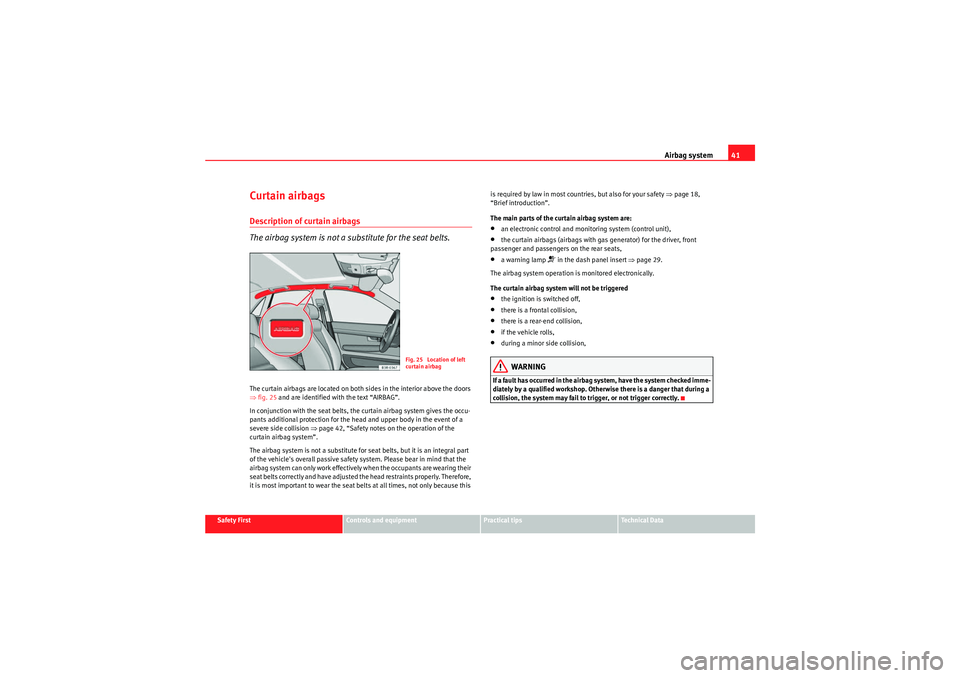
The airbag system is not a substitute for the seat belts.The curtain airbags are located on both sides in the interior above the doors
⇒fig. 25 and are identified with the text “AIRBAG”.
In conjunction with the seat belts, the curtain airbag system gives the occu-
pants additional protection for the head and upper body in the event of a
severe side collision ⇒ page 42, “Safety notes on the operation of the
curtain airbag system”.
The airbag system is not a substitute for seat belts, but it is an integral part
of the vehicle's overall passive safety system. Please bear in mind that the
airbag system can only work effectively when the occupants are wearing their
seat belts correctly and have adjusted the head restraints properly. Therefore,
it is most important to wear the seat belts at all times, not only because this is required by law in most countries, but also for your safety
⇒page 18,
“Brief introduction”.
The main parts of the curtain airbag system are:
•an electronic control and monitoring system (control unit),•the curtain airbags (airbags with ga s generator) for the driver, front
passenger and passengers on the rear seats,•a warning lamp
in the dash panel insert ⇒page 29.
The airbag system operation is monitored electronically.
The curtain airbag system will not be triggered
•the ignition is switched off,•there is a frontal collision,•there is a rear-end collision,•if the vehicle rolls,•during a minor side collision,WARNING
If a fault has occurred in the airbag system, have the system checked imme-
diately by a qualified workshop. Otherwise there is a danger that during a
collision, the system may fail to trigger, or not trigger correctly.
Fig. 25 Location of left
curtain airbag
Exeo_EN.book Seite 41 Freitag, 28. August 2009 10:14 10
Page 44 of 310
Airbag system
42Function of curtain airbags
Fully inflated airbags reduce the risk of head or chest injury in
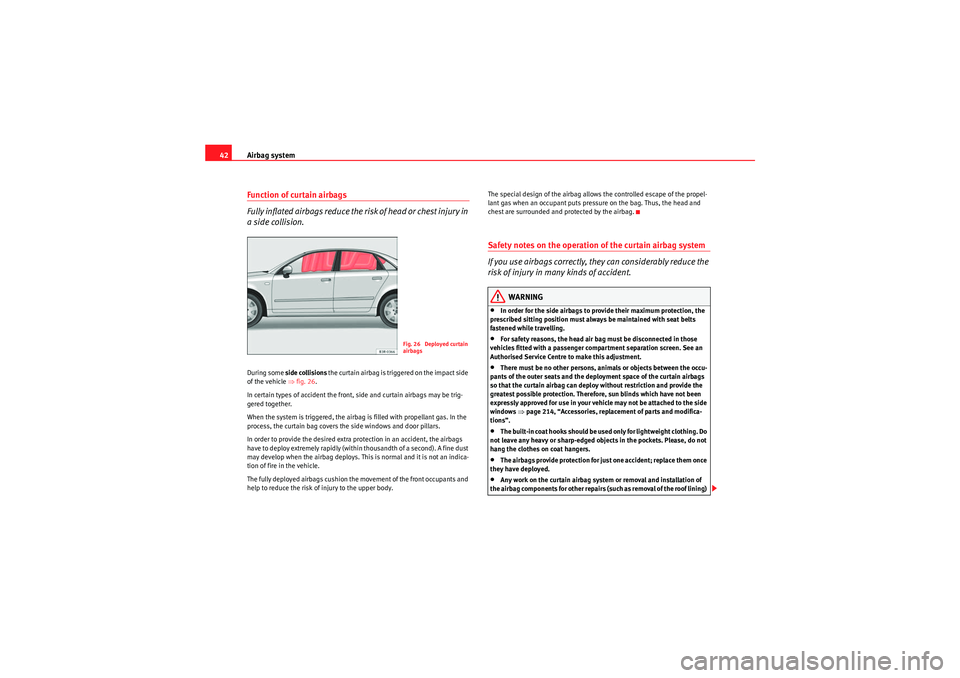
a side collision.During some side collisions the curtain airbag is triggered on the impact side
of the vehicle ⇒fig. 26 .
In certain types of accident the front, side and curtain airbags may be trig-
gered together.
When the system is triggered, the airbag is filled with propellant gas. In the
process, the curtain bag covers the side windows and door pillars.
In order to provide the desired extra protection in an accident, the airbags
have to deploy extremely rapidly (within thousandth of a second). A fine dust
may develop when the airbag deploys. This is normal and it is not an indica-
tion of fire in the vehicle.
The fully deployed airbags cushion the movement of the front occupants and
help to reduce the risk of injury to the upper body. The special design of the airbag allows the controlled escape of the propel-
lant gas when an occupant puts pressure on the bag. Thus, the head and
chest are surrounded and protected by the airbag.
Safety notes on the operation of the curtain airbag system
If you use airbags correctly, they can considerably reduce the
risk of injury in many kinds of accident.
WARNING
•In order for the side airbags to provide their maximum protection, the
prescribed sitting position must always be maintained with seat belts
fastened while travelling.•For safety reasons, the head air bag must be disconnected in those
vehicles fitted with a passenger compartment separation screen. See an
Authorised Service Centre to make this adjustment.•There must be no other persons, animals or objects between the occu-
pants of the outer seats and the deployment space of the curtain airbags
so that the curtain airbag can deploy without restriction and provide the
greatest possible protection. Therefore, sun blinds which have not been
expressly approved for use in your vehicle may not be attached to the side
windows ⇒page 214, “Accessories, replacement of parts and modifica-
tions”.•The built-in coat hooks should be us ed only for lightweight clothing. Do
not leave any heavy or sharp-edged objects in the pockets. Please, do not
hang the clothes on coat hangers.•The airbags provide protection for just one accident; replace them once
they have deployed.•Any work on the curtain airbag system or removal and installation of
the airbag components for other repairs (such as removal of the roof lining)
Fig. 26 Deployed curtain
airbags
Exeo_EN.book Seite 42 Freitag, 28. August 2009 10:14 10
Page 48 of 310
Child safety
46Child safetyBrief introductionIntroduction
Statistics show that children are generally safer on the rear
seat than on the front passenger seat.We recommend that children under 12 years of age are transported on the
rear seats. Children travelling on the rear seat must use a child restraint
system or the seat belts provided, depending on their age, height and
weight. It is advisable that children always travel in the rear seats, the rear
central position being the safest seat, since the risk of injuries in a side colli-
sion is diminished.
The physical laws involved and the forces acting in a collision apply also to
children ⇒page 19, “Why wear seat belts?”. But unlike adults, children do
not have muscle and bone structures fully developed. This means that chil-
dren are subject to a greater risk of injury.
To reduce this risk, children must always use special child restraint systems
when travelling in the vehicle.
We recommend the use of child safety products from the SEAT Genuine Acces-
sories Program, which includes systems for all ages made by “Peke”
1).
These systems have been especially designed and approved, complying with
the ECE-R44. regulation.
Follow the manufacturer's instructions and observe any statutory require-
ments when installing and using child seats. Always read and note
⇒ page 46, “Safety notes on using child seats”. We recommend you to include together with the on-board documentation,
the manufacturer's Child Seat instructions manual.
Safety notes on using child seats
Proper use of child seats substantially reduces the risk of
injury in an accident!As the driver, you are responsible for any children you transport in
your vehicle.
– Protect your children by properly using appropriate child seats
⇒page 48.
– Always ensure that the belt webbing is properly positioned according to the instructions provided by the manufacturer of the
child seat.
– When travelling, do not allow children to distract you from traffic.
– Take breaks regularly during long trips. Take a break at least
every two hours.
WARNING
•Never install a child seat facing backwards (or rear-facing) on the front
passenger seat unless the front passenger airbag has been disabled. This
could lead to a risk of potentially fatal injuries to the child! However, if it is
necessary, in exceptional cases, to transport a child in the front passenger
seat, the front passenger airbag must always be disabled ⇒page 44,
1)Not for all countries
Exeo_EN.book Seite 46 Freitag, 28. August 2009 10:14 10
Page 49 of 310
Child safety47
Safety First
Controls and equipment
Practical tips
Technical Data
“Deactivating airbags*”. If the passenger seat has a height adjustment
option, move it to the highest position.
•For those vehicles that do not include a key lock switch to turn the
airbag off, an Authorised Service Centre must be consulted.•All passengers, especially children, must assume the proper sitting
position and be properly belted in while travelling.•Never hold children or babies on your lap, this can result in potentially
fatal injuries to the child!•Never allow a child to be transported in a vehicle without being properly
secured, or to stand up or kneel on a seat while travelling. In an accident,
the child could be flung through the vehicle, causing possibly fatal injuries
to themselves and to the other passengers.•If children assume an improper sitting position when the car is moving,
they expose themselves to greater risk of injury in the event of sudden
braking manoeuvre or in an accident. This is particularly important if the
child is travelling on the front passenger seat and the airbag system is trig-
gered in an accident; as this could cause serious injury or even death.•A suitable child seat can protect your child!•Never leave an unsupervised child alone on a child seat or in the
vehicle.•Depending on weather conditions, it may become extremely hot or cold
inside the vehicle. This can be fatal.•Children who are less than 1.5 metres tall must not wear a normal seat
belt without a child restraint system, as this could cause injuries to the
abdominal and neck areas during a sudden braking manoeuvre or in an
accident.•Do not allow the belt webbing to become twisted or jammed, or to rub
on any sharp edges.•Incorrectly worn seat belts can cause injuries even in a minor collision
or in sudden braking manoeuvres.
•The seat belt provides maximum protection only when the belt web is
properly positioned ⇒page 22, “Seat belts”.•Only one child may occupy a child seat ⇒page 48, “Child seats”.
WARNING (continued)
WARNING (continued)
Exeo_EN.book Seite 47 Freitag, 28. August 2009 10:14 10
Page 50 of 310
Child safety
48Child seatsCategorisation of child seats into groups
Use only child seats that are officially approved and suitable
for the child.Child seats are subject to the regulation ECE-R 44. ECE-R. It means that:
Economic Commission for Europe Regulation
The child seats are grouped into 5 categories:
Group 0 : Children up to 10 kg
Group 0+ : Children up to 13 kg
Group 1 : from 9 to 18 kg
Group 2 : from 15 to 25 kg
Group 3 : from 22 to 36 kg
Child seats that have been tested and approved under the ECE R 44 standard
bear the test mark on the seat (the letter E in a circle with the test number
below it).
Group 0 and 0+ child seats
A suitable child seat and a correctly adjusted seat belt can
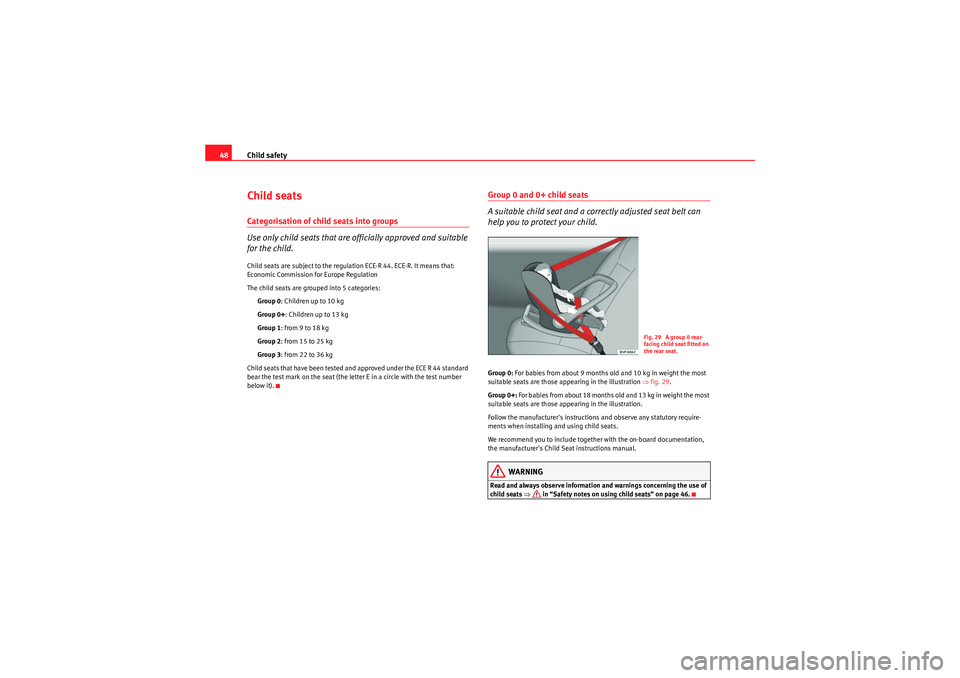
help you to protect your child.Group 0: For babies from about 9 months old and 10 kg in weight the most
suitable seats are those appearing in the illustration ⇒ fig. 29.
Group 0+: For babies from about 18 months old and 13 kg in weight the most
suitable seats are those appearing in the illustration.
Follow the manufacturer's instructions and observe any statutory require-
ments when installing and using child seats.
We recommend you to include together with the on-board documentation,
the manufacturer's Child Seat instructions manual.
WARNING
Read and always observe information and warnings concerning the use of
child seats ⇒ in “Safety notes on using child seats” on page 46.
Fig. 29 A group 0 rear-
facing child seat fitted on
the rear seat.
Exeo_EN.book Seite 48 Freitag, 28. August 2009 10:14 10
Page 51 of 310
Child safety49
Safety First
Controls and equipment
Practical tips
Technical Data
Group 1 child seats
A suitable child seat and a correctly adjusted seat belt can
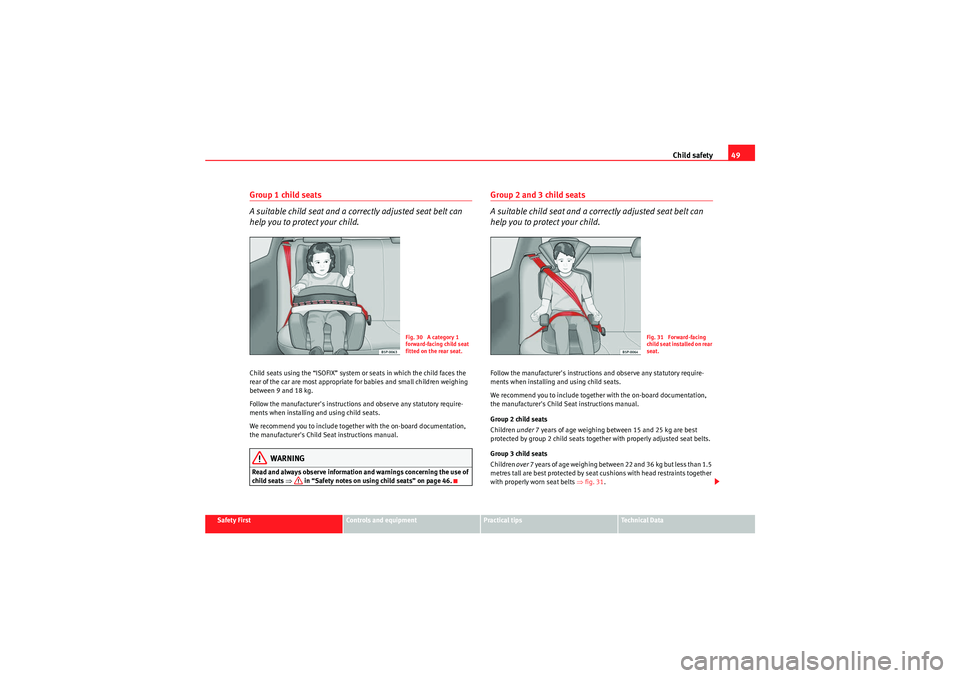
help you to protect your child.Child seats using the “ISOFIX” system or seats in which the child faces the
rear of the car are most appropriate for babies and small children weighing
between 9 and 18 kg.
Follow the manufacturer's instructions and observe any statutory require-
ments when installing and using child seats.
We recommend you to include together with the on-board documentation,
the manufacturer's Child Seat instructions manual.
WARNING
Read and always observe information and warnings concerning the use of
child seats ⇒ in “Safety notes on using child seats” on page 46.
Group 2 and 3 child seats
A suitable child seat and a correctly adjusted seat belt can
help you to protect your child.Follow the manufacturer's instructions and observe any statutory require-
ments when installing and using child seats.
We recommend you to include together with the on-board documentation,
the manufacturer's Child Seat instructions manual.
Group 2 child seats
Children under 7 years of age weighing between 15 and 25 kg are best
protected by group 2 child seats together with properly adjusted seat belts.
Group 3 child seats
Children over 7 years of age weighing between 22 and 36 kg but less than 1.5
metres tall are best protected by seat cushions with head restraints together
with properly worn seat belts ⇒fig. 31 .
Fig. 30 A category 1
forward-facing child seat
fitted on the rear seat.
Fig. 31 Forward-facing
child seat installed on rear
seat.
Exeo_EN.book Seite 49 Freitag, 28. August 2009 10:14 10
Page 52 of 310
Child safety
50
WARNING
•The shoulder part of the seat belt must lie approximately on the centre
of the shoulder, never across the neck or the arm. The seat belt must lie
close to the upper part of the body. The lap belt part must lie across the
pelvis, not across the stomach, and always fit closely. Pull the belt tight if
necessary to take up any slack ⇒page 22, “Seat belts”.•Read and always observe information and warnings concerning the use
of child seats ⇒ in “Safety notes on using child seats” on page 46.
Exeo_EN.book Seite 50 Freitag, 28. August 2009 10:14 10
Page 53 of 310
Child safety51
Safety First
Controls and equipment
Practical tips
Technical Data
Securing child seatsWays to secure a child seat
A child seat can be secured differently on the rear seat and on
the front passenger seat.You can secure a child seat to the rear seat or front passenger seat in the
following ways:•Child seats in groups 0 to 3 can be secured with a seat belt.•Seats for children aged 0, 0+ and 1 with the “ISOFIX” system can be
secured without fastening seat belts, using the “ISOFIX” and/or Top Tether
securing rings ⇒page 52.
U: Suitable for universal approved restraining systems for use in this age category (universal retention systems are those fitted using the adult
seat belt).
*: Move the passenger seat as far to rear as possible, as high as possible and always deactivate the airbag.
L: Suitable for retention systems using the “ISOFIX” anchors.
WARNING
•When travelling, children must be secured in the vehicle with a
restraint system suitable for age, weight and size.•Never install a child seat facing backwards (or rear-facing) on the front
passenger seat unless the front passenger airbag has been disabled. This
could cause fatal injuries to the child! However, if it is necessary, in excep-
tional cases, to transport a child in the front passenger seat, the front
passenger airbag must always be disabled ⇒page 44, “Deactivating
airbags*” and move the seat to its highest position, in case it has this
adjustment.•Read and always observe information and warnings concerning the use
of child seats ⇒ in “Safety notes on using child seats” on page 46.
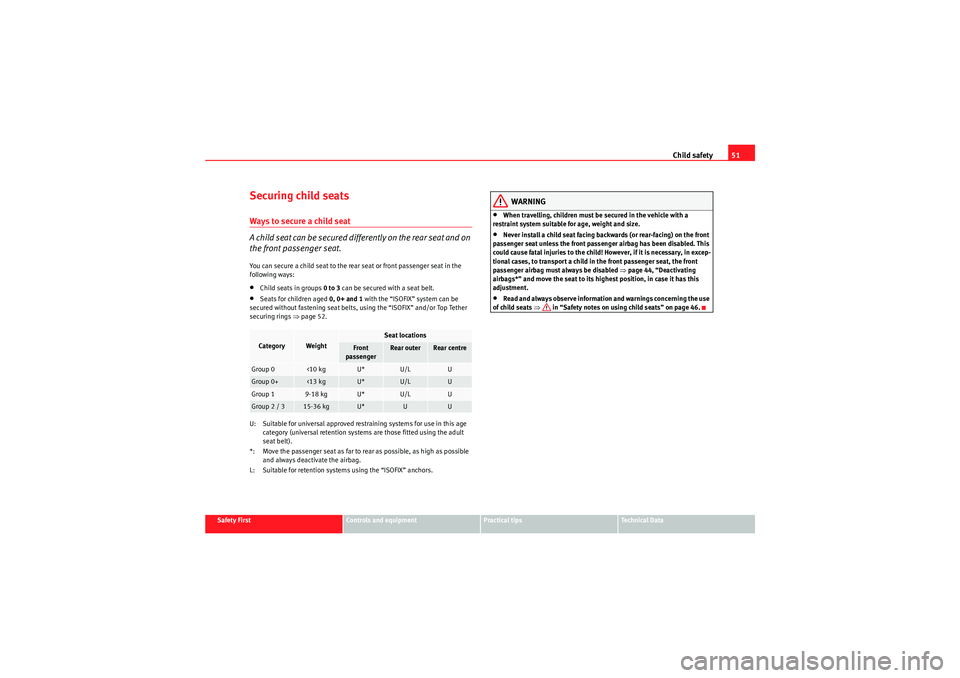
Category
Weight
Seat locations
Front
passenger
Rear outer
Rear centre
Group 0
<10 kg
U*
U/L
U
Group 0+
<13 kg
U*
U/L
U
Group 1
9-18 kg
U*
U/L
U
Group 2 / 3
15-36 kg
U*
U
U
Exeo_EN.book Seite 51 Freitag, 28. August 2009 10:14 10
Page 55 of 310
Child safety53
Safety First
Controls and equipment
Practical tips
Technical Data
WARNING
The retainers employed for this child safety seat are specially designed for
the “ISOFIX” system. Never secure other child seats, seat belts or other
items into the retainers. If you do, you increase the risk of sustaining
severe or fatal injuries.To p Te t h e r r e t a i n e r s t r a p s
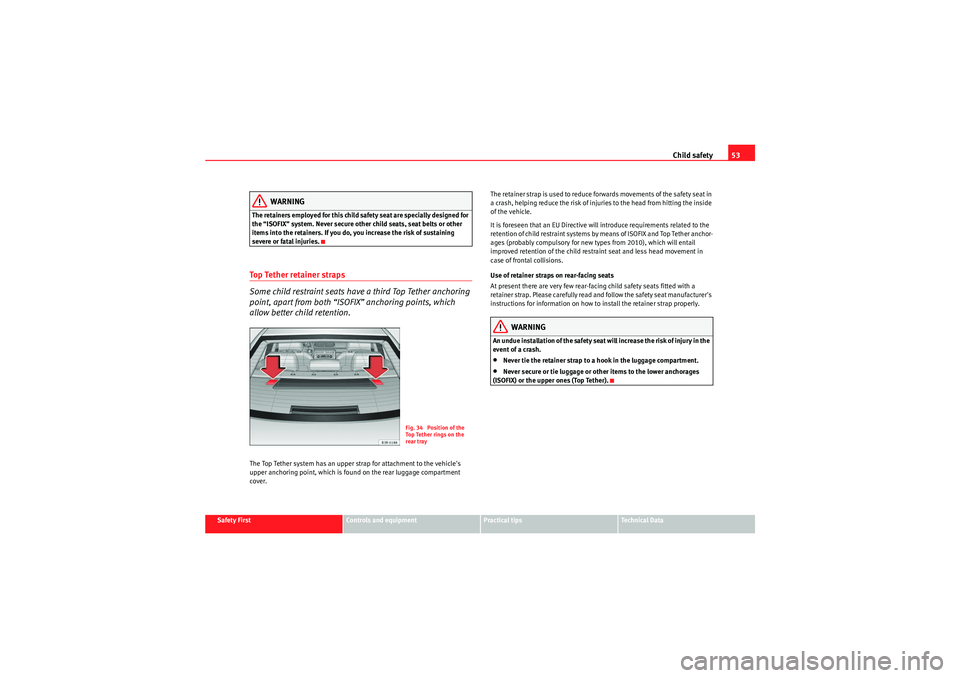
Some child restraint seats have a third Top Tether anchoring
point, apart from both “ISOFIX” anchoring points, which
allow better child retention.The Top Tether system has an upper strap for attachment to the vehicle's
upper anchoring point, which is found on the rear luggage compartment
cover. The retainer strap is used to reduce forwards movements of the safety seat in
a crash, helping reduce the risk of injuries to the head from hitting the inside
of the vehicle.
It is foreseen that an EU Directive will introduce requirements related to the
retention of child restraint systems by means of ISOFIX and Top Tether anchor-
ages (probably compulsory for new types from 2010), which will entail
improved retention of the child restraint seat and less head movement in
case of frontal collisions.
Use of retainer straps on rear-facing seats
At present there are very few rear-facing child safety seats fitted with a
retainer strap. Please carefully read and follow the safety seat manufacturer's
instructions for information on how to install the retainer strap properly.
WARNING
An undue installation of the safety seat will increase the risk of injury in the
event of a crash.•Never tie the retainer strap to a hook in the luggage compartment.•Never secure or tie luggage or other items to the lower anchorages
(ISOFIX) or the upper ones (Top Tether).
Fig. 34 Position of the
Top Tether rings on the
rear tray
Exeo_EN.book Seite 53 Freitag, 28. August 2009 10:14 10
Page 56 of 310
Child safety
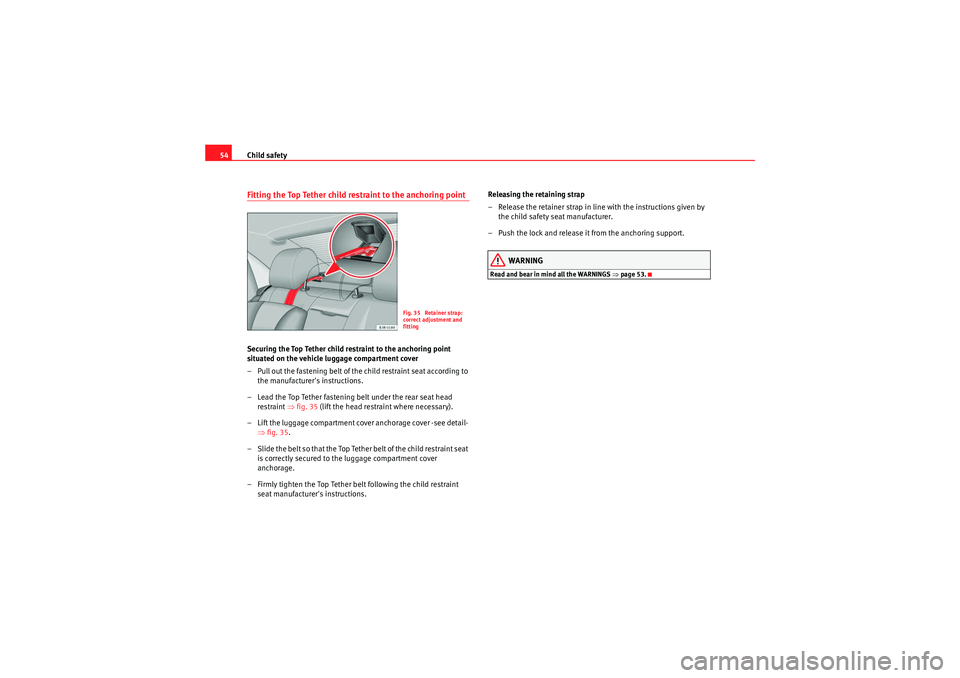
54Fitting the Top Tether child restraint to the anchoring pointSecuring the Top Tether child restraint to the anchoring point
situated on the vehicle luggage compartment cover
– Pull out the fastening belt of the child restraint seat according to
the manufacturer's instructions.
– Lead the Top Tether fastening belt under the rear seat head restraint ⇒fig. 35 (lift the head restraint where necessary).
– Lift the luggage compartment cover anchorage cover -see detail- ⇒fig. 35 .
– Slide the belt so that the Top Tether belt of the child restraint seat is correctly secured to the luggage compartment cover
anchorage.
– Firmly tighten the Top Tether belt following the child restraint seat manufacturer's instructions. Releasing the retaining strap
– Release the retainer strap in line with the instructions given by
the child safety seat manufacturer.
– Push the lock and release it from the anchoring support.
WARNING
Read and bear in mind all the WARNINGS ⇒page 53.
Fig. 35 Retainer strap:
correct adjustment and
fitting
Exeo_EN.book Seite 54 Freitag, 28. August 2009 10:14 10