warning lights Seat Exeo 2009 Service Manual
[x] Cancel search | Manufacturer: SEAT, Model Year: 2009, Model line: Exeo, Model: Seat Exeo 2009Pages: 310, PDF Size: 8.54 MB
Page 193 of 310
Driving and the environment191
Safety First
Controls and equipment
Practical tips
Technical Data
Diesel engine particulate filter*
The diesel engine particulate filter eliminates soot produced
by burning diesel.The diesel engine dust filter eliminates most of the soot from the exhaust gas
system. Under normal driving conditions, the filter cleans itself. If the driving
conditions do not allow the filter to clean itself (for example, multiple short
trips) the filter will be obstructed by dust and pollen and the indicator
for
the diesel engine particulate filter indicator will light up. See section on
Warning Lights.
WARNING
•The diesel engine particulate filter may reach extremely high tempera-
tures; it should not enter into contact with flammable materials under-
neath the vehicle. Failure to comply could result in fire.Caution
•The vehicle is not designed for refuelling with mixtures of FAME fuel
(biodiesel) over 7% in accordance with DIN 51628. The diesel particle filter
will be damaged if this mixture percentage is exceeded.Economical and environmentally friendly
drivingEconomical and environmen tally friendly drivingFuel consumption, environmental pollution and wear to the engine, brakes
and tyres depends in large part on your driving style. By adopting an econom- ical driving style and anticipating the traffic situation ahead, you can easily
reduce fuel consumption by 10-15%. Some tips on how to help you reduce
pollution while saving money are listed below.
As you drive try to anticipate the traffic situation
A vehicle uses most fuel when accelerating. When you anticipate the situa-
tion, you have to brake less often and, thus, accelerate less. If it is possible,
let the vehicle roll with a gear engaged
, for example, if you see a red light
ahead. The braking effect achieved in this way helps to reduce the wear of
brakes and tyres; emissions and fuel consumption are reduced to zero
(disconnection due to inertia).
Change gear early to save energy
An effective way of saving fuel is to change up quickly through the gears.
Running the engine at high rpm in the lower gears uses an unnecessary
amount of fuel.
Manual gearbox: Change from first to second gear as quickly as possible. We
recommend that, whenever possible, you change to a higher gear upon
reaching 2,000 rpm.
Avoid driving at high speed
We advise you not to drive at the top speed permitted by the vehicle. Fuel
consumption, exhaust emissions and noise levels all increase very rapidly at
higher speeds. Driving at moderate speeds will help to save fuel.
Avoid idling
It is worthwhile switching off the engine when waiting in a traffic jam, at level
crossings or at traffic lights with a long red phase. The fuel saved after only
30 - 40 seconds is greater than the amount of fuel needed to restart the
engine.
The engine takes a very long time to warm up when it is running at idling
speed. Mechanical wear and pollutant emissions are also especially high
during this initial warm-up phase. It is therefore best to drive off immediately
after starting the engine. Avoid running the engine at high speed.
Exeo_EN.book Seite 191 Freitag, 28. August 2009 10:14 10
Page 197 of 310
Trailer towing195
Safety First
Controls and equipment
Practical tips
Technical Data
Where possible, operate the trailer with the maximum permitted
draw bar
weight on the ball joint of the towing bracket, but do not exceed the specified
limit.
Tyre pressure
Check the tyre pressures on your car, and adjust for “full load” conditions
(refer to the sticker listing the tyre pressures on the door pillar). It may also be
necessary to adjust the tyre pressures on the trailer according to the recom-
mendations of the trailer manufacturer.
Exterior mirrors
Check whether you can see enough of the road behind the trailer with the
standard mirrors. If this is not the case you should have additional mirrors
fitted. The two exterior mirrors should be fitted on folding arms. Adjust the
mirrors to give sufficient rear vision.
Headlights
Before starting a journey, check the headlight beam settings with the trailer
hitched up. If necessary, alter the height of the headlight beams by means of
the headlight range control. See ⇒page 119.
Power supply
When you remove the ignition key, the power supply to the trailer is inter-
rupted.
Removable ball joint coupling
Vehicles with a factory-fitted towing bracket are equipped with a removable
ball joint coupling. This is stored in the spare wheel well in the luggage
compartment together with the necessary fitting instructions.
Note
If you frequently tow, we recommend you also have vehicle ser viced between
services.
Notes on towing
Towing a trailer involves additional attention by the driver.Weight distribution
The weight distribution of a loaded trailer with an unladen vehicle is very
unfavourable. However, if this cannot be avoided, drive extra slowly to allow
for the unbalanced weight distribution.
Speed
The stability of the car and trailer is reduced with increasing speed. Therefore,
it is advisable not to drive at the maximum permissible speed in an unfavour-
able road, weather or wind conditions. This especially applies when driving
downhill.
You should always reduce speed immediately if the trailer shows the slightest
sign of swaying . Never try to stop the “snaking” by increasing speed.
Anticipate hazards and brake in good time. If towing a trailer with an inertia
brake , first brake gently and then more severely. This will prevent brake
tapping by the trailer wheels when they lock. Select a low gear in due course
before going down a steep downhill. This enables you to use the engine
braking to slow down the vehicle.
Swaying and pitching can be reduced by stabiliser aids. We recommend
having stabiliser aids installed when towing trailers with a high trailer load.
They can be purchased and installed at a Dealer.
Reheating
When climbing long hills in hot weather with the engine running fast in low
gear, you should keep an eye on the coolant temperature gauge ⇒page 60.
Reduce speed immediately if the needle moves to the right end of the scale.
If the temperature warning light
in the instrument cluster should start
flashing, stop the car and let the engine cool down by running it at idling
speed for a few minutes.
Exeo_EN.book Seite 195 Freitag, 28. August 2009 10:14 10
Page 234 of 310
Checking and refilling levels
232Winter operations
The battery is drained more in cold weather, which means that the starting
power is reduced. For this reason, have the battery checked and charged if
necessary before the start of winter.
Replacing the battery
A replacement battery must have the same capacity, voltage and current
rating. It must also have the same di mensions as the original, factory-fitted
battery and have sealed caps. The SEAT batteries which have been specially
developed fulfil the maintenance, performance and safety specifications for
your vehicle.
We recommend you use maintenance-free batteries.
WARNING
•All work on batteries requires specialist knowledge. If work is required
on the battery, this should be performed by a Technical Service or
specialist garage. Danger of caustic burns and explosion!•The battery must not be opened. Never try to change the battery's
liquid level. Explosive gas is released from the battery that could lead to an
explosion.Caution
•The battery holder and clamps must always be correctly secured.•Before starting any work on the battery, always observe the warnings
listed under ⇒.For the sake of the environment
Batteries contain toxic substances including sulphuric acid and lead.
Therefore, they must be disposed in line with environmental regulations and
must not be disposed of with ordinary household waste. Make sure discon-
nected batteries cannot tip over. Sulphuric acid could be spilt!
Important safety warnings for handling a car batteryThe battery is located at the back of the engine compartment ⇒page 289.
WARNING
Always be aware of the danger of injury and chemical burns as well as the
risk of accident or fire when working on the battery and the electrical
system:•Wear eye protection. Protect your eyes, skin and clothing from acid and
particles containing lead.•Battery acid is very corrosive and caustic. Wear protective gloves and
eye protection. Do not tilt the batteries. This could spill acid through the
vents. Rinse battery acid from eyes immediately for several minutes with
clear water. Then seek medical care immediately. Neutralize any acid
splashes on the skin or clothing with a soapy solution, and rinse off with
plenty of water. If acid is swallowed by mistake, consult a doctor immedi-
ately.•Fires, sparks, naked lights and smoking are prohibited. When handling
cables and electrical equipment, av oid causing sparks and electrostatic
charge. Never short the battery terminals. High-energy sparks can cause
injury.
Wear eye protection
Battery acid is very corrosive and caustic. Wear protective
gloves and eye protection!
Fires, sparks, naked lights and smoking are prohibited!
A highly explosive mixture of gases is released when the bat-
tery is under charge.
Keep children away from acid and batteries!
Exeo_EN.book Seite 232 Freitag, 28. August 2009 10:14 10
Page 240 of 310
Wheels and tyres
238display TMPS (Tyre Pressure Monitoring System). Please contact the nearest
specialist garage as soon as possible.
The tyre pressure warning lamp
lights up if the tyre pressure on one or
more wheels is significantly lower than the tyre pressure setting which was
confirmed by the driver ⇒ .
WARNING
•If the tyre pressure warning lamp lights up
you must slow down
immediately and avoid any severe braking or steering manoeuvres. Stop
the vehicle as soon as possible and check the tyres and their pressure.
•The driver is responsible for maintaining correct tyre pressures. There-
fore, the tyre pressure must be regularly checked.•Under certain conditions (e.g. driving at high speeds, on ice and snow
or on poor road surfaces) the tyre pressure warning lamp
may not light
up immediately or not at all.
•Please ask your Dealer or specialist garage whether run-flat tyres can
be used on your vehicle. Fitting this type of tyre in an undue manner could
lead to your driving licence being taken away from you. Furthermore, it may
led to damage to the vehicle or, under certain circumstances, may cause
accidents.•If you change normal tyres for run-flat tyres or vice versa, the control
unit must be reprogrammed by the Dealer or a specialist garage.Note
If you did not press the button for the tyre pressure monitoring system to
confirm a new tyre pressure setting after making changes to the tyre pres-
sures or changing one or more wheels, the warning lamp
may light up
although the tyre pressures are correct. In this case, stop the vehicle as soon
as possible and, after examining the tyres, press the button for the tyre pres-
sure monitoring system.
Tyre ser vice life
The service life of tyres is dependent on tyre pressure, driving
style and fitting.
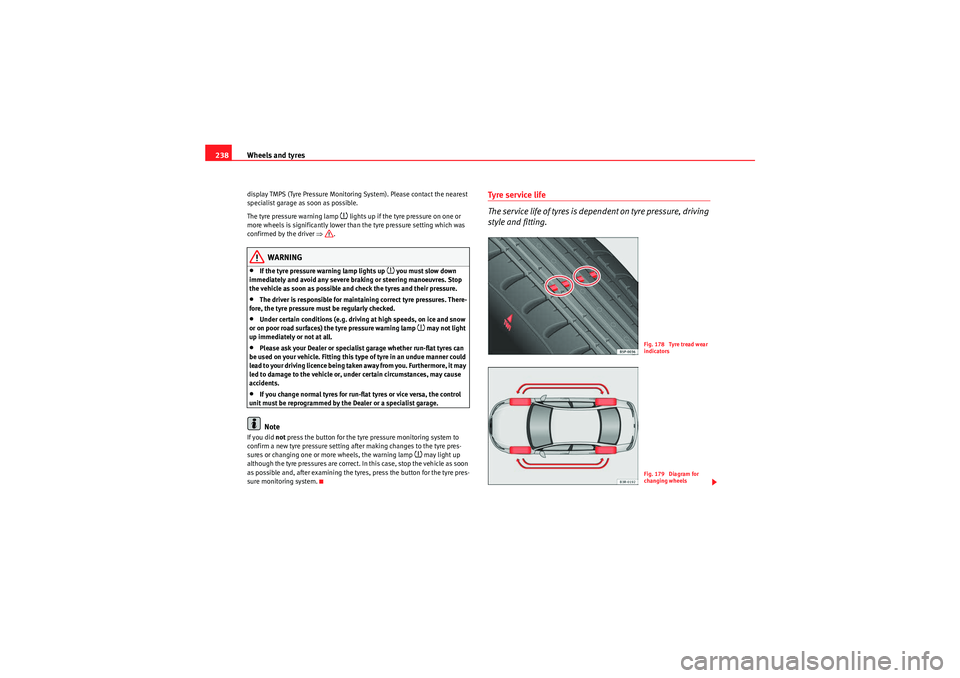
Fig. 178 Tyre tread wear
indicatorsFig. 179 Diagram for
changing wheels
Exeo_EN.book Seite 238 Freitag, 28. August 2009 10:14 10
Page 248 of 310

If and when
246Your vehicle can be equipped with a steel spare wheel at the factory. The
spare wheel does not usually meet the same performance standards as the
wheels fitted on the vehicle because of the wheel/tyre dimensions, rubber
composition, tread pattern, etc. Therefore, note the following restrictions:•The spare steel rim wheel is designed only for your vehicle model. Do not
attempt to mount the wheel on any vehicle but your own.•Your vehicle will have different driving characteristics when the spare
steel rim wheel is mounted ⇒.•The spare wheel is only intended for temporary use after having a flat tyre.
Replace the spare wheel with a normal wheel that has the proper tyre dimen-
sions as soon as possible.•If the size of the spare steel rim wheel is different to that of the other
wheels, it is unlikely that snow chains suitable for the other wheels will fit it.WARNING
•After mounting the spare steel rim wheel, the tyre pressure must be
checked and corrected as soon as possible. The inflating pressure must
adapt to the vehicle load (consult the table containing the inflation pres-
sures). Otherwise there is danger of causing an accident. Use the highest
tyre pressure as indicated in the table.•Do not drive faster than 80 km/h, as higher speeds can cause an acci-
dent.•Avoid heavy acceleration, hard braking and fast cornering, as this could
cause an accident.
Changing a wheelPreparation work
What you must do before changing a wheel.– If you have a flat tyre or puncture, park the car as far away from the flow of traffic as possible. Choose a location that is as level
as possible.
– All passengers should leave the vehicle. They should wait in a
safe place (e.g. behind the roadside crash barrier).
–Apply the handbrake firmly.
–Engage 1st gear.
– When towing a trailer: Unhitch the trailer from your vehicle.
–Take the tools and the spare wheel ⇒ page 244 out of the
luggage compartment.
WARNING
If you have a puncture in heavy traffic, switch on the hazard warning lights
and place the warning triangle in a visible location. This is for your own
safety and also warns other road users.
Caution
If you have to change the tyre on a gradient, block the wheel opposite the
wheel being changed by placing a stone or similar object under it to prevent
the vehicle from rolling away.
Exeo_EN.book Seite 246 Freitag, 28. August 2009 10:14 10
Page 256 of 310
If and when
254
– If the tyre pressure remains lowe r than the value specified above
drive the vehicle approx. 10 metres forwards or backwards, so
that the sealant can spread evenly in the tyre. If the pressure is
still lower than the specification the tyre is too badly damaged
and cannot be repaired using the tyre sealant.
Final check
– After about 10 minutes, stop to check the tyre pressure.
– If tyre pressure is less than 1.3 bar, the tyre is too badly damaged. Do not drive on! You should obtain professional
assistance.
WARNING
•If you have a puncture in heavy traffic, switch on the hazard warning
lights and place the warning triangle in a visible location. This is for your
own safety and also warns other road users.•Make su re your pass engers wait in a safe place ( for instance beh ind the
roadside crash barrier).•Please observe the manufacturers' safety notes on the compressor and
the instructions supplied with the tyre sealant can.•If it was not possible to build up a tyre pressure of 2.0 bar within 6
minutes this means that the tyre is too badly damaged. Do not drive on!•Seek professional assistance if the repair of a tyre puncture is not
possible with the sealing compound.•If tyre pressure is less than 1.3 bar after driving about 10 minutes, the
tyre is too badly damaged. Do not drive on! Obtain technical assistance.Caution
Take special care if you have to repair a tyre on a slope.
Note
•Do not use the compressor for longer than 6 minutes. Otherwise, it might
overheat. When the compressor has cooled down, you can use it again.•If tyre sealant should leak out, leave it to dry and then pull it off like foil.•After carrying out a tyre repair remember to buy a new tyre sealant can at
a qualified workshop. This will ensure that the Tyre Mobility System is opera-
tive again.•Please observe legal requirements when doing so.
Exeo_EN.book Seite 254 Freitag, 28. August 2009 10:14 10
Page 259 of 310
If and when257
Safety First
Controls and equipment
Practical tips
Technical Data
Some of the electrical items listed in the table are only fitted on certain
models or are optional extras.
The electric windows and electric seat adjusters are protected by circuit
breakers
. These reset automatically after a few seconds when the overload
(caused for example by frozen windows) has been corrected.
Note
Please note that the above list contains all data at the time of going to press,
so it is subject to modifications. If discrepancies should occur, please refer to
the sticker on the inside of the fuse cover for the correct information for your
model.BulbsGeneral notesYou can change the following bulbs for exterior lights yourself:•Main headlights: all (except for xenon headlights)•Rear lights: All bulbs•Side indicator bulb
The following bulbs can only be changed by a qualified workshop:
•Main headlights: Xenon* bulb ⇒page 264•Front fog lights: Bulb
As a rule, you require a certain degree of practical skill to change defective
bulbs. This applies in particular to those bulbs which are only accessible from
the engine compartment.
If in doubt, we recommend that you have defective bulbs changed by a qual-
ified workshop or qualified mechanic.
If you do decide to change bulbs in the engine compartment yourself, be
aware of the safety risks involved ⇒page 221 ⇒ in “Types of bulbs”.Changing bulbs Halogen headlightsTypes of bulbsYou must only replace a bulb with a bulb of the same type. The name can be
found on the base of the bulb.
WARNING
•Take particular care when working on components in the engine
compartment if the engine is warm - risk of burns!
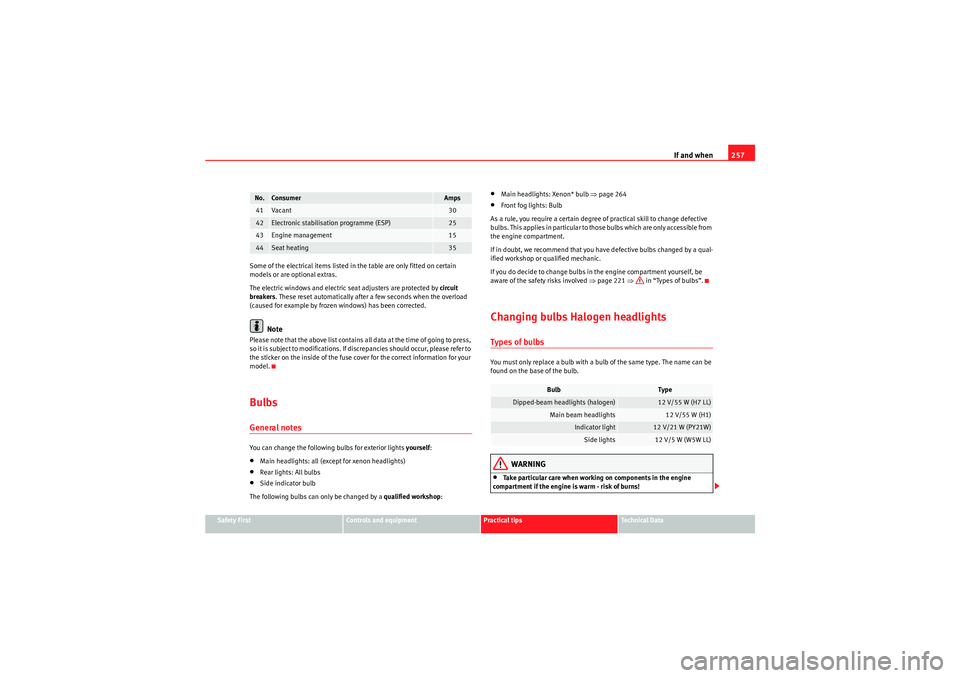
41
Va can t
30
42
Electronic stabilisation programme (ESP)
25
43
Engine management
15
44
Seat heating
35
No.
Consumer
Amps
Bulb
Type
Dipped-beam headlights (halogen)
12 V/55 W (H7 LL)
Main beam headlights
12 V/55 W (H1)
Indicator light
12 V/21 W (PY21W)
Side lights
12 V/5 W (W5W LL)
Exeo_EN.book Seite 257 Freitag, 28. August 2009 10:14 10
Page 260 of 310
If and when
258•Bulbs are highly sensitive to pressure. The glass can break when you
touch the bulb, causing injury.•The high voltage element of gas discharge lamps* (xenon light) must
be handled correctly. Otherwise, there is a risk of death.•When changing bulbs, please take care not to injure yourself on sharp
parts in the headlight housing.Caution
•Remove the ignition key before working on the electric system. If not, a
short circuit could occur.•Switch off the lights or parking lights before you change a bulb.For the sake of the environment
Please ask your specialist retailer how to dispose of used bulbs in the proper
manner.
Note
•Depending on weather conditions (cold or wet), the front lights, the fog
lights, the rear lights and the indicators may be temporarily misted. This does
not affect the useful life of the lighting system. By switching on the lights, the
area through which the beam of light is projected will quickly be demisted.
However, the edges may continue to be misted.•Please check at regular intervals that all lighting (especially the exterior
lighting) on your vehicle is functioning properly. This is not only in the interest
of your own safety, but also in that of all other road users.•Before changing a bulb, make sure you have the correct new bulb.•Do not touch the glass part of the bulb with your bare hands, use a cloth
or paper towel instead. Otherwise, the fingerprints left on the glass will vaporise as a result of the heat generated by the bulb, be deposited on the
reflector and impair its surface.
Removing the air duct
The air duct has to be removed to gain access to the bulbs for
the right-side headlight.–Unscrew bolts ⇒
fig. 192.
– Detach air duct from guide and take it out.
WARNING (continued)
Fig. 192 Air duct on right
side of vehicle
AA
AB
Exeo_EN.book Seite 258 Freitag, 28. August 2009 10:14 10
Page 267 of 310
If and when265
Safety First
Controls and equipment
Practical tips
Technical Data
WARNING
•Take particular care when working on components in the engine
compartment if the engine is warm - risk of burns!•Bulbs are highly sensitive to pressure. The glass can break when you
touch the bulb, causing injury.•The high voltage element of gas discharge lamps* (xenon light) must
be handled correctly. Otherwise, there is a risk of death.•When changing bulbs, please take care not to injure yourself on sharp
parts in the headlight housing.Caution
•Remove the ignition key before working on the electric system. If not, a
short circuit could occur.•Switch off the lights or parking lights before you change a bulb.For the sake of the environment
Please ask your specialist retailer how to dispose of used bulbs in the proper
manner.
Note
•Depending on weather conditions (cold or wet), the front lights, the fog
lights, the rear lights and the indicators may be temporarily misted. This does not affect the useful life of the lighting system. By switching on the lights, the
area through which the beam of light is projected will quickly be demisted.
However, the edges may continue to be misted.
•Please check at regular intervals that all lighting (especially the exterior
lighting) on your vehicle is functioning pr operly. This is not only in the interest
of your own safety, but also in that of all other road users.•Before changing a bulb, make sure you have the correct new bulb.•Do not touch the glass part of the bulb with your bare hands, use a cloth
or paper towel instead. Otherwise, the fingerprints left on the glass will
vaporise as a result of the heat generated by the bulb, be deposited on the
reflector and impair its surface.Removing the air duct
The air duct has to be removed to gain access to the bulbs for
the right-side headlight.
Bulb
Type
Xenon bulbs
12 V/35 W (D1S)
DRL (day light)
12 V/21 W (P21W SLL)
Indicator light
12 V/21 W (PY21W)
Side lights
12 V/5 W (W5W blue LL)
Fig. 204 Air duct on right
side of vehicle
Exeo_EN.book Seite 265 Freitag, 28. August 2009 10:14 10
Page 271 of 310
If and when269
Safety First
Controls and equipment
Practical tips
Technical Data
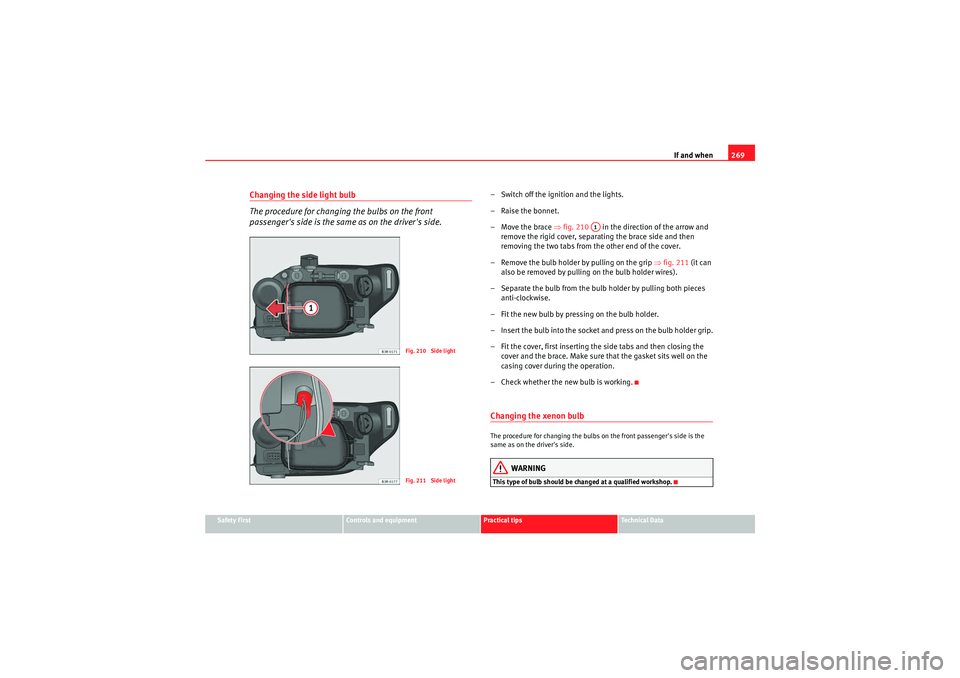
Changing the side light bulb
The procedure for changing the bulbs on the front
passenger's side is the same as on the driver's side.
– Switch off the ignition and the lights.
– Raise the bonnet.
– Move the brace ⇒fig. 210 in the direction of the arrow and
remove the rigid cover, separating the brace side and then
removing the two tabs from the other end of the cover.
– Remove the bulb holder by pulling on the grip ⇒fig. 211 (it can
also be removed by pulling on the bulb holder wires).
– Separate the bulb from the bulb holder by pulling both pieces anti-clockwise.
– Fit the new bulb by pressing on the bulb holder.
– Insert the bulb into the socket and press on the bulb holder grip.
– Fit the cover, first inserting the side tabs and then closing the cover and the brace. Make sure that the gasket sits well on the
casing cover during the operation.
– Check whether the new bulb is working.Changing the xenon bulbThe procedure for changing the bulbs on the front passenger's side is the
same as on the driver's side.
WARNING
This type of bulb should be changed at a qualified workshop.
Fig. 210 Side lightFig. 211 Side light
A1
Exeo_EN.book Seite 269 Freitag, 28. August 2009 10:14 10