child restraint Seat Exeo 2009 Owner's manual
[x] Cancel search | Manufacturer: SEAT, Model Year: 2009, Model line: Exeo, Model: Seat Exeo 2009Pages: 310, PDF Size: 8.54 MB
Page 5 of 310
Contents3
ContentsManual structure
. . . . . . . . . . . . . . . . . . . .
Content
. . . . . . . . . . . . . . . . . . . . . . . . . . . . . . . .
Safety First
. . . . . . . . . . . . . . . . . . . . . . . . . . .
Safe driving
. . . . . . . . . . . . . . . . . . . . . . . . . . . . . .
Brief introduction . . . . . . . . . . . . . . . . . . . . . . . .
Proper sitting position for occupants . . . . . . . . .
Pedal area . . . . . . . . . . . . . . . . . . . . . . . . . . . . . .
Stowing luggage . . . . . . . . . . . . . . . . . . . . . . . . .
Seat belts
. . . . . . . . . . . . . . . . . . . . . . . . . . . . . . . .
Brief introduction . . . . . . . . . . . . . . . . . . . . . . . .
Why wear seat belts? . . . . . . . . . . . . . . . . . . . . . .
Seat belts . . . . . . . . . . . . . . . . . . . . . . . . . . . . . . .
Belt tension devices . . . . . . . . . . . . . . . . . . . . . .
Airbag system
. . . . . . . . . . . . . . . . . . . . . . . . . . . .
Brief introduction . . . . . . . . . . . . . . . . . . . . . . . .
Front airbags . . . . . . . . . . . . . . . . . . . . . . . . . . . .
Knee airbag . . . . . . . . . . . . . . . . . . . . . . . . . . . . .
Side airbags* . . . . . . . . . . . . . . . . . . . . . . . . . . . .
Curtain airbags . . . . . . . . . . . . . . . . . . . . . . . . . .
Deactivating airbags* . . . . . . . . . . . . . . . . . . . . .
Child safety
. . . . . . . . . . . . . . . . . . . . . . . . . . . . . .
Brief introduction . . . . . . . . . . . . . . . . . . . . . . . .
Child seats . . . . . . . . . . . . . . . . . . . . . . . . . . . . . .
Securing child seats . . . . . . . . . . . . . . . . . . . . . .
Controls and equipment
. . . . . . . . . . .
Cockpit
. . . . . . . . . . . . . . . . . . . . . . . . . . . . . . . . . . .
Overview . . . . . . . . . . . . . . . . . . . . . . . . . . . . . . .
Instruments . . . . . . . . . . . . . . . . . . . . . . . . . . . . .
Warning and indicator lamps . . . . . . . . . . . . . . .
Driver information system . . . . . . . . . . . . . . . . . .
Auto-check system . . . . . . . . . . . . . . . . . . . . . . .
Speed warning . . . . . . . . . . . . . . . . . . . . . . . .
On-board computer . . . . . . . . . . . . . . . . . . . . . . .
Menu display . . . . . . . . . . . . . . . . . . . . . . . . . . . .
Tyre pressure monitoring . . . . . . . . . . . . . . . . . .
Steering wheel controls
. . . . . . . . . . . . . . . . . . .
The multi-function steering wheel . . . . . . . . . . .
Unlocking and locking
. . . . . . . . . . . . . . . . . . . .
Remote control keys . . . . . . . . . . . . . . . . . . . . . .
Central locking . . . . . . . . . . . . . . . . . . . . . . . . . . .
Tailgate . . . . . . . . . . . . . . . . . . . . . . . . . . . . . . . . .
Childproof locks . . . . . . . . . . . . . . . . . . . . . . . . . .
Remote control key . . . . . . . . . . . . . . . . . . . . . . .
Anti-theft alarm system* . . . . . . . . . . . . . . . . . . .
Electric windows . . . . . . . . . . . . . . . . . . . . . . . . .
Sun roof / deflector* . . . . . . . . . . . . . . . . . . . . . .
Lights and visibility
. . . . . . . . . . . . . . . . . . . . . . .
Lights . . . . . . . . . . . . . . . . . . . . . . . . . . . . . . . . . .
Interior lights . . . . . . . . . . . . . . . . . . . . . . . . . . . .
Visibility . . . . . . . . . . . . . . . . . . . . . . . . . . . . . . . .
Windscreen wipers . . . . . . . . . . . . . . . . . . . . . . .
Rear-view mirrors . . . . . . . . . . . . . . . . . . . . . . . . .
Seats and stowage
. . . . . . . . . . . . . . . . . . . . . . .
Manual adjustment of the front seats . . . . . . . .
Electric adjustment of front seats* . . . . . . . . . . .
Lumbar support* . . . . . . . . . . . . . . . . . . . . . . . . . Memory for driver's seat* . . . . . . . . . . . . . . . . . .
Head restraints . . . . . . . . . . . . . . . . . . . . . . . . . .
Armrests . . . . . . . . . . . . . . . . . . . . . . . . . . . . . . . .
Luggage compartment . . . . . . . . . . . . . . . . . . . .
Roof carrier . . . . . . . . . . . . . . . . . . . . . . . . . . . . . .
Drink holders . . . . . . . . . . . . . . . . . . . . . . . . . . . .
Ashtray*, cigarette lighter* and power points . .
Compartments . . . . . . . . . . . . . . . . . . . . . . . . . . .
Heating, Ventilation and Air conditioning
. .
2C-Climatronic . . . . . . . . . . . . . . . . . . . . . . . . . . .
Driving
. . . . . . . . . . . . . . . . . . . . . . . . . . . . . . . . . . .
Address . . . . . . . . . . . . . . . . . . . . . . . . . . . . . . . .
Safety . . . . . . . . . . . . . . . . . . . . . . . . . . . . . . . . . .
Ignition lock . . . . . . . . . . . . . . . . . . . . . . . . . . . . .
Starting and stopping the engine . . . . . . . . . . .
Handbrake . . . . . . . . . . . . . . . . . . . . . . . . . . . . . .
Parking aid acoustic system . . . . . . . . . . . . . . . .
Cruise control (GRA) . . . . . . . . . . . . . . . . . . . . . .
Manual gearbox . . . . . . . . . . . . . . . . . . . . . . . . . .
Automatic gearbox* . . . . . . . . . . . . . . . . . . . . . .
Practical tips
. . . . . . . . . . . . . . . . . . . . . . . . .
Intelligent technology
. . . . . . . . . . . . . . . . . . . . .
Electronic stabilisation programme (ESP) . . . . .
Brakes . . . . . . . . . . . . . . . . . . . . . . . . . . . . . . . . .
Power steering . . . . . . . . . . . . . . . . . . . . . . . . . . .
Servotronic . . . . . . . . . . . . . . . . . . . . . . . . . . . . . .
Driving and the environment
. . . . . . . . . . . . . .
Running-in . . . . . . . . . . . . . . . . . . . . . . . . . . . . . .
Exhaust gas purification system . . . . . . . . . . . . .
5
6
7
7
7
10
15
16
18
18
19
22
26
28
28
31
34
37
41
44
46
46
48
51 57
57
57
59
65
71
75
82
85
87
89
91
91
96
96
98
103
104
104
106
108
111
115
115
123
126
128
130
133
133
135
136 137
139
141
142
146
147
148
151
154
154
164
164
164
165
166
168
169
172
175
175
183
183
183
186
188
188
189
189
190
Exeo_EN.book Seite 3 Freitag, 28. August 2009 10:14 10
Page 9 of 310
Safe driving7
Safety First
Controls and equipment
Practical tips
Technical Data
Safety FirstSafe drivingBrief introductionDear SEAT Driver
Safety first!This chapter contains important in formation, tips, suggestions and
warnings that you should read and consider for both your own safety
and for your passengers safety.
WARNING
•This manual contains important information concerning the driver's
and passengers' handling of the vehicle. The other booklets in the on
board manual also contain further information that you should be aware of
for your own safety and for the safety of your passengers.•Ensure that the onboard documentation is kept in the vehicle at all
times. This is especially important when lending or selling the vehicle to
another person.
Safety equipment
The safety equipment listed here are part of the vehicle's
passenger restraint system. They work together to help
reduce the risk of injury in a wide variety of accident situa-
tions.Your safety and the safety of your passengers should not be left to chance. In
the event of an accident, the safety features incorporated in your vehicle are
capable of reducing the risk of injury. These are just a few of the safety
features in your SEAT:•Three-point seat belts optimised for all seats,•Belt force limiters for the seats,•belt tension devices for the front seat belts,•front airbags,•side airbags in the front and rear seat backrests*,•head-protection airbags*,•knee airbag for left guide only.•“ISOFIX” mountings* for “ISOFIX” child safety seats on the outer rear
seats,•height-adjustable head restraints,•adjustable steering column,
These individual safety features are harmonised to provide you and your
passengers with the best possible protection in accident situations.
Exeo_EN.book Seite 7 Freitag, 28. August 2009 10:14 10
Page 10 of 310
Safe driving
8However, they can only be effective if you and your passengers sit in the
correct position and adjust and use the safety equipment properly.
Therefore, this chapter explains why these safety features are so important,
how they can protect you, what you need to remember when using them and
how you and your passengers can gain the most benefit from them. There are
also a number of important safety warnings that you and your passengers
should always observe in order to minimise the risk of injury.
Safety is everyone's responsibility!Before setting off
The driver is responsible for the safety of the passengers and
the safe operation of the vehicle at all times.For your own safety and the safety of your passengers, always note
the following points before setting off:
– Make sure that all lights and indicators are working properly.
– Check tyre pressure.
– Make sure that all windows are clean and give good visibility to
the outside.
– Secure all luggage and other items carefully ⇒page 16.
– Make sure that no objects can interfere with the pedals.
– Adjust the front seat, head restraint and mirrors correctly.
– Make sure that the head rest raints for all passengers are
adjusted to the correct position. – Make sure that children are protected with suitable safety seats
and properly worn seat belts ⇒page 46.
– Sit in a correct position. Inform your passengers as to how they
should sit ⇒page 10.
– Fasten your seat belt correctly. Make sure that your passengers
do the same ⇒page 18.
What affects safe driving?
Safety on the road is directly related to how you drive, and can
also be affected by the passengers in the vehicle.The driver is responsible for the safety of the vehicle and all its occu-
pants. If your ability to drive is impaired in any way, you endanger
yourself and other road users ⇒. Therefore:
– Do not let yourself be distracted by passengers or by using a mobile phone, etc.
– Never drive when your driving ability is impaired (by medication, alcohol, drugs, etc.).
– Obey all traffic regulations and speed limits and always maintain a safe distance to the vehicle in front.
– Always adjust your speed to suit the road, traffic and weather conditions.
– Take frequent breaks on long trips. Do not drive for more than two hours without a stop.
Exeo_EN.book Seite 8 Freitag, 28. August 2009 10:14 10
Page 14 of 310
Safe driving
12•If your physical constitution pr events you from maintaining the
minimum distance of 25 cm, contact a qualified workshop. The workshop
will help you decide if special specific modifications are necessary.•Al ways kee p you r feet in t he footw ell w hen t he vehicle is moving; never
rest them on the instrument panel, out the window or on the seat. An incor-
rect sitting position exposes you to an increased risk of injury in case of a
sudden braking or an accident. If the airbag is triggered, you could sustain
severe injuries due to an incorrect sitting position.•To reduce the risk of injury to the front passenger in events such sudden
braking manoeuvres or an accident, never travel with the backrest tilted far
back! The airbag system and seat belts can only provide optimal protection
when the backrest is in an upright position and the front passenger is
wearing his or her seat belt properly. The further the backrests are tilted to
the rear, the greater the risk of injury due to incorrect positioning of the
belt web or to the incorrect sitting position!•Adjust the head restraint properly in order to achieve maximum
protection.
Correct sitting position for passengers in the rear seats
Passengers in the rear seats must sit up straight, keep their
feet in the foot well s and wear their seat belts properly.To reduce the risk of injury in the event of a sudden braking
manoeuvre or an accident, passengers on the rear bench seat must
consider the following:
– Adjust the headrest to the correct position ⇒page 14.
– Keep both feet in the foot well in front of the rear seat. –Fasten your safety belt securely
⇒page 18.
– Use an appropriate child restrain t system when you take children
in the vehicle ⇒page 46.
WARNING
•If the passengers on the rear seat are not sitting properly, they could
sustain severe injuries.•Adjust the head restraint properly in order to achieve maximum protec-
tion.•Seat belts can only provide optimal protection when backrests are in an
upright position and the passengers are wearing their seat belts properly.
If passengers on the rear seat are not sitting in an upright position, the risk
of injury due to incorrect positioning of the belt web increases.
WARNING (continued)
Exeo_EN.book Seite 12 Freitag, 28. August 2009 10:14 10
Page 16 of 310
Safe driving
14Correct adjustment of rear seat head restraints
Properly adjusted head restraints are an important part of the
occupant protection and can reduce the risk of injuries in
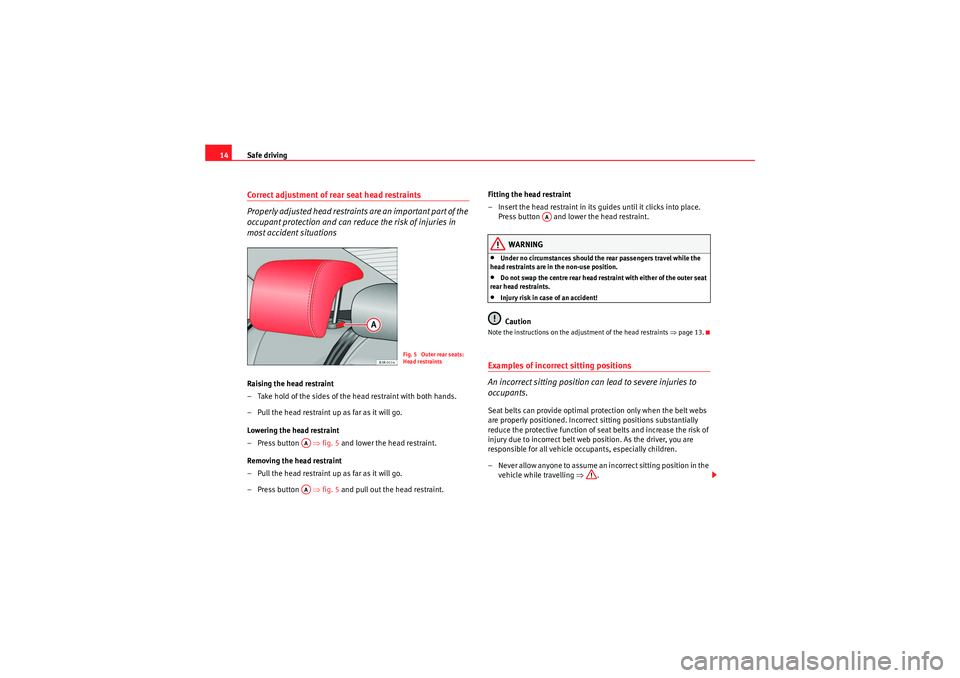
most accident situationsRaising the head restraint
– Take hold of the sides of the head restraint with both hands.
– Pull the head restraint up as far as it will go.
Lowering the head restraint
–Press button ⇒fig. 5 and lower the head restraint.
Removing the head restraint
– Pull the head restraint up as far as it will go.
–Press button ⇒fig. 5 and pull out the head restraint. Fitting the head restraint
– Insert the head restraint in its guides until it clicks into place.
Press button and lower the head restraint.
WARNING
•Under no circumstances should the rear passengers travel while the
head restraints are in the non-use position.•Do not swap the centre rear head restraint with either of the outer seat
rear head restraints.•Injury risk in case of an accident!Caution
Note the instructions on the adjustment of the head restraints ⇒page 13.Examples of incorrect sitting positions
An incorrect sitting position can lead to severe injuries to
occupants.Seat belts can provide optimal protection only when the belt webs
are properly positioned. Incorrect sitting positions substantially
reduce the protective function of se at belts and increase the risk of
injury due to incorrect belt web position. As the driver, you are
responsible for all vehicle occupants, especially children.
– Never allow anyone to assume an incorrect sitting position in the vehicle while travelling ⇒.
Fig. 5 Outer rear seats:
Head restraints
AAAA
AA
Exeo_EN.book Seite 14 Freitag, 28. August 2009 10:14 10
Page 20 of 310
Seat belts
18Seat beltsBrief introductionBefore driving: remember your seat belt!
Wearing a seat belt properly can save your life!In this chapter you will learn the importance of wearing seat belts,
how they work and how to properly fasten, adjust and wear them.
– Read and consider all the informat ion as well as the warnings in
this chapter.
WARNING
•If seat belts are worn incorrectly or not at all, the risk of severe injuries
increases.•Properly worn seat belts can reduce severe injuries in case of sudden
braking manoeuvres or accidents. For safety reasons, you and your passen-
gers must always wear the seat belts properly while the vehicle is moving.•P r e g n a n t w o m e n o r p e o p l e w i t h p h y s i ca l d i s a b i l i t i e s m u s t a l s o u s e s e a t
belts. Like all other passengers, these people can also sustain severe inju-
ries if they are not wearing their seat belts properly.
Number of seatsYour vehicle has five seats, two in the front and three in the rear. Each seat is
equipped with a three-point seat belt.
WARNING
•More people than available seats must never be transported in your
vehicle.•Every passenger in the vehicle must properly fasten and wear the seat
belt belonging to h is or her s eat . Child ren m ust be protecte d with an appro-
priate child restraint system.
Seat belt warning lamp*
The warning lamp acts as a reminder to the driver to fasten
the seat belt.Before starting the vehicle:
–Fasten your safety belt securely.
– Instruct your passengers to fasten their seat belts properly before driving off.
– Protect children by using a child seat according to the child's height and weight.After switching on the ignition, the warning light
will remain lit until the
driver and front passenger (where applicable) have fastened their seat belts.
When the vehicle has reached a certain speed, you will also hear a warning
signal and the warning light will flash.
Exeo_EN.book Seite 18 Freitag, 28. August 2009 10:14 10
Page 26 of 310
Seat belts
24The following features are available to adjust the seat belt in the shoulder
region:•belt height adjustment for the front seats.•front seat height adjustment*.WARNING
•An incorrectly worn seat belt web can cause severe injuries in the event
of an accident.•The shoulder part of the seat belt must lie on the centre of the shoulder,
never across the neck. The seat belt must lie flat and snugly on the torso
⇒ page 23, fig. 12 .•The lap par t of the seat belt must lie across the pelvis, never across the
stomach. The seat belt must lie flat and snugly on the pelvis ⇒page 23,
fig. 13. Pull the belt tight if necessary to take up any slack.•Read and observe the warnings ⇒page 21.
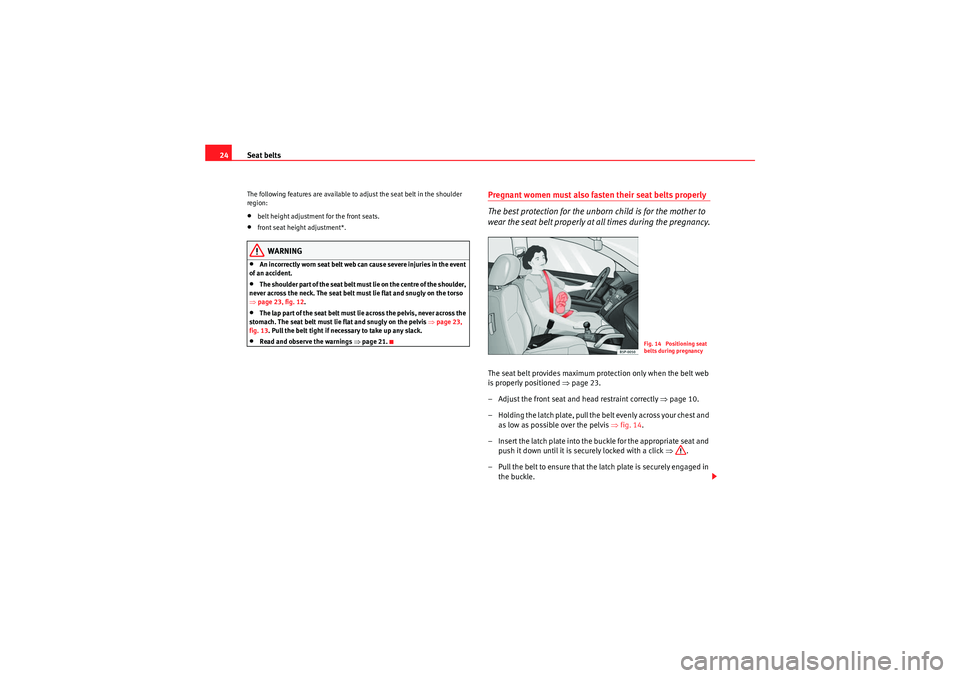
Pregnant women must also fasten their seat belts properly
The best protection for the unborn child is for the mother to
wear the seat belt properly at all times during the pregnancy.The seat belt provides maximum protection only when the belt web
is properly positioned ⇒page 23.
– Adjust the front seat and head restraint correctly ⇒page 10.
– Holding the latch plate, pull the belt evenly across your chest and as low as possible over the pelvis ⇒fig. 14 .
– Insert the latch plate into the buckle for the appropriate seat and push it down until it is securely locked with a click ⇒.
– Pull the belt to ensure that the latch plate is securely engaged in the buckle.
Fig. 14 Positioning seat
belts during pregnancy
Exeo_EN.book Seite 24 Freitag, 28. August 2009 10:14 10
Page 30 of 310
Airbag system
28Airbag systemBrief introductionWhy wear a seat belt and assume the correct sitting position?
For the inflating airbags to achieve the best protection, the
seat belt must always be worn properly and the correct sitting
position must be assumed.For your own safety and the safety of the passengers, please ensure
the following before driving:
– Always wear the seat belt properly ⇒page 18.
– Adjust the driver's seat and the steering wheel correctly ⇒page 10.
– Adjust the front passenger seat correctly ⇒page 11.
– Adjust the head restraint correctly ⇒page 13.
– Use the correct child restraint system to protect children in your vehicle ⇒page 46.The airbag is deployed at high speed in fractions of a second. If you have an
incorrect seating position at the time the airbag is deployed, it could cause
you critical injuries. Therefore, it is essential that all passengers in the vehicle
assume a correct sitting position while travelling.
A sharp braking before an accident may cause a passenger not wearing a seat
belt to be thrown forward into the area of the deploying airbag. In this case, the inflating airbag may inflict critical or fatal injuries on the occupant. This
also applies to children.
Always maintain the greatest possible distance between yourself and the
front airbag. This way, the front airbags can completely deploy when trig-
gered, providing their maximum protection.
The most important factors that will trigger an airbag are: the type of acci-
dent, the angle of collision and the speed of the vehicle.
Whether the airbags are triggered depends primarily on the vehicle deceler-
ation rate resulting from the collision and detected by the control unit. If the
vehicle deceleration occurring during the collision and measured by the
control unit remains below the specified reference values, the front, side
and/or curtain airbag will not be triggered. Take into account that the visible
damage in a vehicle involved in an accident, for whatever reason, is not an
indication as to why the airbags had been triggered.
WARNING
•Wearing the seat belt incorrectly or assuming an incorrect sitting posi-
tion can lead to critical or fatal injuries.•All occupants, including children, who are not properly belted can
sustain cr it ical or fatal inju ries if t he airbag is triggered. You s hould al ways
transport all children up to 12 years of age on the rear seat. Never transport
children in the vehicle if they are not restrained or the restraint system is
not appropriate for their age, size or weight.•I f yo u are n o t w ea r i ng a s ea t b e l t , i f yo u l e an fo r w a rd o r t o t h e s id e w h il e
travelling or assume an incorrect sitting position, there is a substantially
increased risk of injury. This increased risk of injury will be further
increased if you are struck by an inflating airbag.•To reduce the risk of injury from an inflating airbag, always wear the
seat belt properly ⇒page 18.
Exeo_EN.book Seite 28 Freitag, 28. August 2009 10:14 10
Page 36 of 310
Airbag system
34Safety notes on the frontal airbag system
If you use airbags correctly, they can considerably reduce the
risk of injury in many kinds of accident.
WARNING
•It is important for the driver and front passenger to keep a distance of
at least 25 cm from the steering wheel or dash panel. If the minimum
distance is not observed then the airbags do not correctly protect the
vehicle occupants; risk of fatal injuries! In addition, the front seats and
head restraints must always be positioned correctly for the height of the
occupant.•I f yo u are n o t w ea r i ng a s ea t b e l t , i f yo u l e an fo r w a rd o r t o t h e s id e w h il e
travelling or assume an incorrect sitting position, there is a substantially
increased risk of injury. This increased risk of injury will be further
increased if you are struck by an inflating airbag.•Never let a child travel on the front seat without an appropriate restraint
system. If the airbag is triggered in an accident, children can sustain
serious or fatal injuries from the airbag as it inflates ⇒page 46, “Child
safety”.•The deployment space between the front passengers and the airbags
must not in any case be occupied by other passenger, pets and objects.•The airbags provide protection for just one accident; replace them once
they have deployed.•It is also important not to attach any objects such as cup holders or
telephone mountings to the surfaces covering the airbag units.•Do not attempt to modify components of the airbag system in any
way.
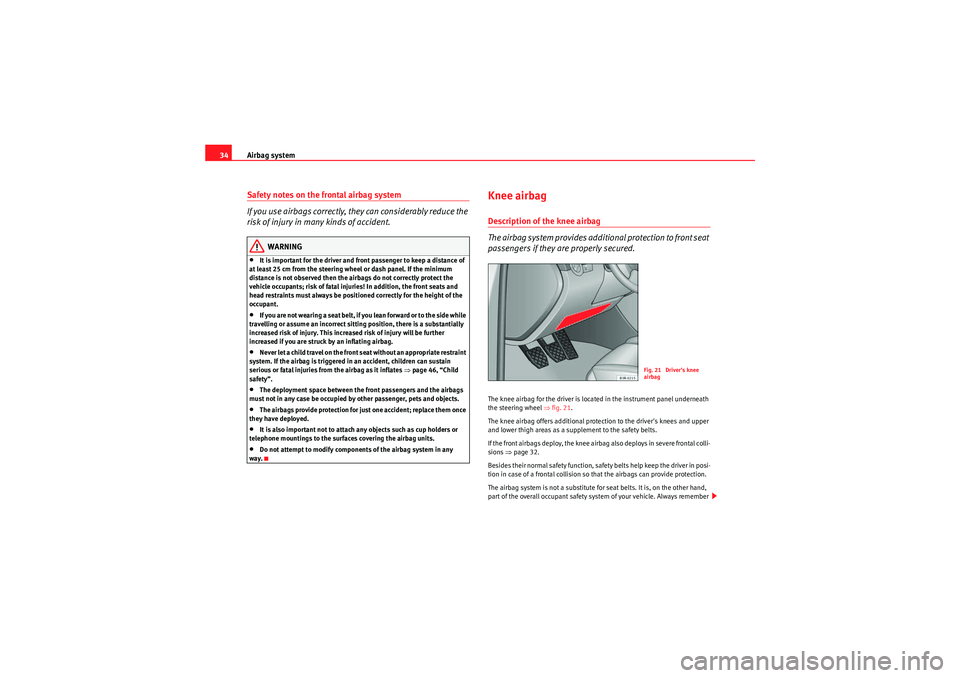
Knee airbagDescription of the knee airbag
The airbag system provides additional protection to front seat
passengers if they are properly secured.The knee airbag for the driver is located in the instrument panel underneath
the steering wheel ⇒fig. 21.
The knee airbag offers additional protection to the driver's knees and upper
and lower thigh areas as a supplement to the safety belts.
If the front airbags deploy, the knee airbag also deploys in severe frontal colli-
sions ⇒page 32.
Besides their normal safety function, safety belts help keep the driver in posi-
tion in case of a frontal collision so that the airbags can provide protection.
The airbag system is not a substitute for seat belts. It is, on the other hand,
part of the overall occupant safety system of your vehicle. Always remember
Fig. 21 Driver's knee
airbag
Exeo_EN.book Seite 34 Freitag, 28. August 2009 10:14 10
Page 38 of 310

Airbag system
36If the front airbag deploys, the knee airbag also deploys in severe frontal colli-
sions.
When the system is deployed, the airbag starts to fill with a propellant gas,
and inflates between the lower part of the instrument panel and the driver
⇒ page 35, fig. 22.
Although they are not a soft pillow, they can “cushion” the impact and in this
way they can help to reduce the risk of injury to the lower extremities.
All this takes place instantaneously, so fast that many people do not even
realize that the airbags have deployed. The airbags also inflate with a great
deal of force and it is important for occupant safety that nothing should be in
their way when they deploy.
Fully inflated airbags in combination with properly worn safety belts slow
down and limit the occupant's forward movement and help to reduce risk.Important safety notes on the knee airbag system
Airbags are only supplemental restraints.A l wa ys w ea r sa f e t y b e l t s co r r e c t l y a n d d r i v e i n a p r o p e r s e a t e d p o s i t i o n . T h e r e
is a lot that you and your passengers must know and do to help the safety
belts and airbags to provide supplementary protection.
WARNING
An inflating knee airbag can cause serious injury. Wearing safety belts
incorrectly and improper seating positions increase the risk of serious
personal injury and death whenever a vehicle is being used.•The airbag system cannot protect you properly if you are seated too
close to any of the airbag locations. When adjusting their seating posi-
tions, it is important for drivers to keep their upper bodies and knees to the
following minimum safe distances: −
25 cm between the chest and the steering wheel/instrument panel.
− 10 cm between the knees and the lower part of the instrument panel.
•The risk of personal injury increases if you lean forward or to the side,
or if the seat is improperly positioned and you are not wearing your safety
belt. The risk increases even more should the airbag deploy.•Always make sure that the knee airbag can inflate without interference.
Objects between yourself and the airbag can increase the risk of injury in
an accident by interfering with the way the airbag deploys or by being
thrust into you as the airbag deploys.
−No objects of any kind should be carried in the footwell area in front
of the driver's seat. Bulky objects (shopping bags, for example) can
hinder or prevent proper deployment of the airbag. Small objects can
be thrown through the vehicle if the airbag deploys and injure you or
your passengers.•Make sure there are no cracks, deep scratches or other damage in the
area of the instrument panel where the knee airbag is located.•If children are incorrectly seated, their risk of injury increases in the
case of an accident ⇒page 46.WARNING (continued)
Exeo_EN.book Seite 36 Freitag, 28. August 2009 10:14 10