handbrake Seat Exeo 2010 User Guide
[x] Cancel search | Manufacturer: SEAT, Model Year: 2010, Model line: Exeo, Model: Seat Exeo 2010Pages: 319, PDF Size: 9.64 MB
Page 217 of 319
Vehicle maintenance and cleaning215
Safety First
Operating Instructions
Practical Tips
Technical Specifications
Cleaning the engine compartment
Take special care when cleaning the engine compartment.Anti-corrosion treatment
The engine compartment and the surface of the power unit are given anti-
corrosion treatment at the factory.
Good corrosion protection is particularly important in winter when the vehicle
is frequently driven on salted roads. To prevent the salt corroding the vehicle,
the entire engine compartment should be thoroughly cleaned before and
after winter.
Yo u r A u t h o r i s e d S e r v i ce Ce n t re has got the necessary equipment to provide
the correct cleaning and preserving products. For this reason, we recommend
having this work performed by them.
The anti-corrosion protection is usually removed if the engine compartment
is cleaned with grease removing solutions, or if you have the engine cleaned.
On commissioning this work, ensure that all surfaces, seams, joints and
components in the engine compartment are given anti-corrosion treatment.
WARNING
•When working in the engine compartment, always observe the safety
warnings ⇒page 224.•Before opening the bonnet, switch the engine off, apply the handbrake
firmly and always remove the key from the ignition.•Allow the engine to cool before you clean the engine compartment.•Do not clean the vehicle underbody, wheel arches or wheel trims
without protecting your hands and arms. You may cut yourself on sharp-
edged metal parts. Failure to comply could result in injury.•Moisture, ice and salt on the brakes may affect braking efficiency. Risk
of accident. Directly after washing, avoid sudden and sharp braking.
•Never touch the radiator fan. It is temperature-controlled and could
start automatically, even when the key is removed from the ignition!For the sake of the environment
Fuel, grease and oil deposits could be removed when the engine is washed.
The polluted water must be cleaned in an oil separator. For this reason,
engine washing should be carried out only by a qualified workshop or a petrol
station.Vehicle interior maintenancePlastic parts and dash panel cleaning– Use a clean, damp cloth to clean plastic parts and the dash panel.
– If this does not provide satisfactory results, use a special solvent-free plastic cleaning product.
WARNING
Never clean the dash panel and the airbag module surface with cleaners
containing solvents. Solvents cause the surface to become porous. If the
airbag triggered, plastic parts could become detached and cause injuries.
Caution
Cleaning products which contain solvents will damage the material.
WARNING (continued)
exeo_EN.book Seite 215 Montag, 30. August 2010 4:45 16
Page 226 of 319

Checking and refilling levels
224
WARNING
Never open the bonnet if you see steam or drips of coolant being released
from th e eng ine compar t ment . Fail ure to comp ly could resul t in bur ns. Wait
until no steam or coolant can be seen before opening the bonnet.Work in the engine compartment
Extra caution is necessary when working on components in
the engine compartment.Always be aware of the danger of injury and scalding as well as the risk of
accident or even fire when working in the engine compartment (e.g. when
checking and refilling fluids). Always observe the warnings listed below and
follow all general safety precautions. The engine compartment of the vehicle
is a potentially hazardous area ⇒
WARNING
•Switch the engine off.•Remove the ignition key.•Apply the handbrake firmly.•If your vehicle is equipped with a manual gearbox, place the gear lever
in neutral. If you are driving an automatic vehicle, place the selector lever
in position P.•Wait for the engine to cool down.•Children should not be allowed to approach the engine compartment.•Never spill liquids used for vehicle operation on the engine compart-
ment, as these may catch fire (e.g. coolant).•Take care not to cause short circuits in the electrical system, especially
when working on the battery.
•Never touch the radiator fan while the engine is hot, as the fan could
start up suddenly.•Never open the expansion tank when the engine is hot. The cooling
system is under pressure.•Protect face, hands and arms from any hot steam or hot coolant fluid
released by covering the cap with a large, thick rag when opening the
expansion tank.•If any tests have to be performed with the engine running, there is an
added safety risk from the rotating parts (e.g. drive belts, alternator, radi-
ator fan, etc.) and from the high-voltage ignition system.•Observe the following additional warnings if work on the fuel system or
the electrical system is necessary:
−Always disconnect the battery.
− Do not smoke.
− Never work near open flames.
− Always keep an approved fire extinguisher immediately available.Caution
When topping up fluids, make sure the correct fluid is put into the correct
filler opening. This can otherwise cause serious malfunctions or engine
damage.
For the sake of the environment
Inspect the ground underneath your vehicle regularly so that any leaks are
detected at an early stage. If you find spots of oil or other fluids, have your
vehicle inspected at the workshop.
WARNING (continued)
exeo_EN.book Seite 224 Montag, 30. August 2010 4:45 16
Page 251 of 319
If and when249
Safety First
Operating Instructions
Practical Tips
Technical Specifications
Your vehicle can be factory-equipped with a spare steel wheel. The spare
wheel does
not usually meet the same performance standards as the wheels
fitted on the vehicle because of the wheel/tyre dimensions, rubber composi-
tion, tread pattern, etc. Therefore, note the following restrictions:
•The spare steel wheel is designed only for your vehicle model. Do not
attempt to mount the wheel on any vehicle but your own.•Your vehicle will have different driving characteristics when the spare
steel rim wheel is mounted ⇒.•The spare wheel is only intended for temporary use after having a flat tyre.
Replace the spare wheel with a normal wheel that has the proper tyre dimen-
sions as soon as possible.•If the size of the spare steel rim wheel is different to that of the other
wheels, it is unlikely that snow chains suitable for the other wheels will fit it.WARNING
•After mounting the spare steel rim wheel, the tyre pressure must be
checked and corrected as soon as possible. The tyre pressure must corre-
spond to the vehicle load (consult th e table containing the inflation pres-
sures). Otherwise there is danger of causing an accident. Use the highest
tyre pressure as indicated in the table.•Do not drive faster than 80 km/h, as higher speeds can cause an acci-
dent.•Avoid heavy acceleration, hard braking and fast cornering, as this could
cause an accident.
Changing a wheelPreparation work
What you must do before changing a wheel.– If you have a flat tyre or puncture, park the vehicle as far away from the flow of traffic as possible. Choose a location that is as
level as possible.
–All passengers should leave the vehicle. They should wait in a
safe place (e.g. behind the roadside crash barrier).
–Apply the handbrake firmly.
– Engage 1st gear .
– When towing a trailer: Unhitch the trailer from your vehicle.
– Take the tools and the spare wheel ⇒ page 247 out of the
luggage compartment.
WARNING
If you have a puncture in heavy traffic, switch on the hazard warning lights
and place the warning triangle in a visible location. This is for your own
safety and also warns other road users.
Caution
If you have to change the tyre on a gradient, block the wheel opposite the
wheel being changed by placing a stone or similar object under it to prevent
the vehicle from rolling away.
exeo_EN.book Seite 249 Montag, 30. August 2010 4:45 16
Page 258 of 319
If and when
256Repairing a tyrePreparations
– If you have a flat tyre or puncture, park the vehicle as far away
from the flow of traffic as possible.
–Apply the handbrake firmly to prevent the vehicle from moving
accidentally on slopes.
–Engage 1st gear.
– Check whether a repair is possible using the Tyre Mobility System ⇒page 254.
– Ensure that all passengers leave the vehicle and move away from
the danger area ⇒.
–Take the tyre sealant can and the compressor out of the luggage
compartment. – Stick the “max. 80 km/h” adhesive, which is included with the
tyre sealant can, onto the instrument panel where the driver will
see it.
Filling the tyre
– Shake the tyre sealant can well.
– Screw the enclosed filling hose onto the sealant can as far as it will go. This will automatically pierce the foil sealing the can.
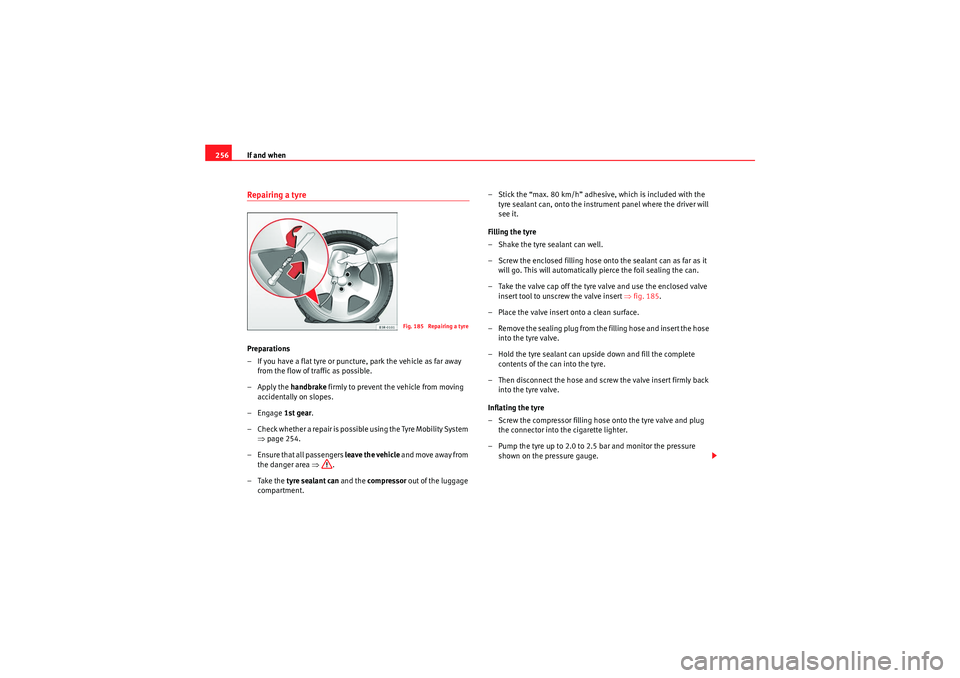
– Take the valve cap off the tyre valve and use the enclosed valve insert tool to unscrew the valve insert ⇒fig. 185 .
– Place the valve insert onto a clean surface.
– Remove the sealing plug from the filling hose and insert the hose into the tyre valve.
– Hold the tyre sealant can upside down and fill the complete contents of the can into the tyre.
– Then disconnect the hose and screw the valve insert firmly back into the tyre valve.
Inflating the tyre
– Screw the compressor filling hose onto the tyre valve and plug the connector into the cigarette lighter.
– Pump the tyre up to 2.0 to 2.5 bar and monitor the pressure shown on the pressure gauge.
Fig. 185 Repairing a tyre
exeo_EN.book Seite 256 Montag, 30. August 2010 4:45 16
Page 311 of 319
Index309
Cruise control system . . . . . . . . . . . . . . . . . . . . 174
Adjust the stored speed . . . . . . . . . . . . . . . 175
Deactivating . . . . . . . . . . . . . . . . . . . . . . . . . 176
Deactivating temporarily . . . . . . . . . . . . . . . 176
Setting the speed . . . . . . . . . . . . . . . . . . . . 175
Curtain airbags . . . . . . . . . . . . . . . . . . . . . . . . . . 41 Description . . . . . . . . . . . . . . . . . . . . . . . . . . . 41
Operation . . . . . . . . . . . . . . . . . . . . . . . . . . . . 42
Safety notes . . . . . . . . . . . . . . . . . . . . . . . . . . 42DDanger of fitting a child seat on the front passenger seat . . . . . . . . . . . . . . . . . . . . . . . . . . . . . . . 29
Dash panel cleaning . . . . . . . . . . . . . . . . . . . . . 215
Data entry control . . . . . . . . . . . . . . . . . . . . . . . . 88
Date display . . . . . . . . . . . . . . . . . . . . . . . . . . . . . 61
Daytime running lights . . . . . . . . . . . . . . . . . . . 120
Deactivating front passenger airbag Safety notes . . . . . . . . . . . . . . . . . . . . . . . . . . 45
Deactivating the airbag Front passenger airbag . . . . . . . . . . . . . . . . . 44
Diesel . . . . . . . . . . . . . . . . . . . . . . . . . . . . . . . . . 222
Diesel engine Winter driving . . . . . . . . . . . . . . . . . . . . . . . . 222
Diesel engine particulate filter . . . . . . . . . . . . . 194
Diesel particulate filter . . . . . . . . . . . . . . . . . . . . 80 Engine oil . . . . . . . . . . . . . . . . . . . . . . . . . . . 225
Digital clock . . . . . . . . . . . . . . . . . . . . . . . . . . . . . 61
Dipped beam headlights . . . . . . . . . . . . . . . . . 115 DIS
Average fuel consumption . . . . . . . . . . . . . . 85
Average speed . . . . . . . . . . . . . . . . . . . . . . . . 85
Driving time . . . . . . . . . . . . . . . . . . . . . . . . . . 85
Instantaneous fuel consumption . . . . . . . . . 85
Disposal Airbags . . . . . . . . . . . . . . . . . . . . . . . . . . . . . . 30
Seat belt tensioners . . . . . . . . . . . . . . . . . . . 27
Distance covered . . . . . . . . . . . . . . . . . . . . . . . . . 86
Distance to empty . . . . . . . . . . . . . . . . . . . . . 73, 85
Door and tailgate warning . . . . . . . . . . . . . . . . . 74
Door lock cylinders . . . . . . . . . . . . . . . . . . . . . . 213
Doors Childproof lock . . . . . . . . . . . . . . . . . . . . . . 104
Locking the doors manually if the central lock-ing fails to work . . . . . . . . . . . . . . . . . . . . 102
Driver See Correct sitting position . . . . . . . . . . . . . . 10
Driver information system . . . . . . . . . . . . . . . . . . 71 Auto-check system . . . . . . . . . . . . . . . . . . . . 75
CD, radio and telephone display . . . . . . . . . 72
Door and tailgate warning . . . . . . . . . . . . . . 74
Driver messages . . . . . . . . . . . . . . . . . . . . . . 76
Handbrake warning . . . . . . . . . . . . . . . . . . . . 76
Menu display . . . . . . . . . . . . . . . . . . . . . . . . . 87
Onboard computer . . . . . . . . . . . . . . . . . . . . 85
Outside temperature display . . . . . . . . . . . . 72
Red symbols . . . . . . . . . . . . . . . . . . . . . . . . . . 77
Speed warning . . . . . . . . . . . . . . . . . . . . . . . . 82
Warning messages . . . . . . . . . . . . . . . . . . . . 76
Yellow symbols . . . . . . . . . . . . . . . . . . . . . . . 79 Driver messages . . . . . . . . . . . . . . . . . . . . . . . . . 76
Driver seat
Activating stored settings . . . . . . . . . . . . . . 139
With memory . . . . . . . . . . . . . . . . . . . . . . . . 138
driver seat Assigning the key to the seat . . . . . . . . . . . 140
Driving Driving abroad . . . . . . . . . . . . . . . . . . . . . . . 196
Economically / Environmentally friendly . . 194
Driving abroad . . . . . . . . . . . . . . . . . . . . . . . . . . 196 Headlights . . . . . . . . . . . . . . . . . . . . . . . . . . 197
Driving safety . . . . . . . . . . . . . . . . . . . . . . . . . . . . . 9
DRP See Dynamic gear control programme . . . . 182
Dynamic gear control programme . . . . . . . . . . 182
EEconomical driving . . . . . . . . . . . . . . . . . . . . . . 194
Electric windows . . . . . . . . . . . . . . . . . . . . . . . . 108 Central locking system . . . . . . . . . . . . . . . . 110
Possible malfunctions . . . . . . . . . . . . . . . . . 110
Rear doors . . . . . . . . . . . . . . . . . . . . . . . . . . 109
Switch on front passenger’s door . . . . . . . 109
Switches in the driver door . . . . . . . . . . . . . 109
Electronic differential lock How it works . . . . . . . . . . . . . . . . . . . . . . . . 187
Electronic immobiliser . . . . . . . . . . . . . . . . . . . . 98
exeo_EN.book Seite 309 Montag, 30. August 2010 4:45 16
Page 312 of 319
Index
310Electronic Stability Programme
Description . . . . . . . . . . . . . . . . . . . . . . . . . 166
How the system works . . . . . . . . . . . . . . . . 185
Warning lamp . . . . . . . . . . . . . . . . . . . . . . . 167
Emergencies Changing a wheel . . . . . . . . . . . . . . . . . . . . 249
Disconnecting the battery . . . . . . . . . . . . . 234
Jack . . . . . . . . . . . . . . . . . . . . . . . . . . . . 247, 252
Sunroof emergency activation . . . . . . . . . . 113
Tools . . . . . . . . . . . . . . . . . . . . . . . . . . . . . . . 247
Tyre mobility system . . . . . . . . . . . . . . . . . . 248
Engine Running in . . . . . . . . . . . . . . . . . . . . . . . . . . 192
Starting . . . . . . . . . . . . . . . . . . . . . . . . . . . . 168
Stop . . . . . . . . . . . . . . . . . . . . . . . . . . . . . . . 169
Engine compartment Safety instructions . . . . . . . . . . . . . . . . . . . 224
Engine oil . . . . . . . . . . . . . . . . . . . . . . . . . . . . . . 225 Checking oil level . . . . . . . . . . . . . . . . . . . . 226
Consumption . . . . . . . . . . . . . . . . . . . . . . . . 226
Oil pressure too low . . . . . . . . . . . . . . . . . . . 78
Oil properties . . . . . . . . . . . . . . . . . . . . . . . . 226
Oil sensor defective . . . . . . . . . . . . . . . . . . . 80
Topping up . . . . . . . . . . . . . . . . . . . . . . . . . . 227
Engine speed governing . . . . . . . . . . . . . . . . . . . 80
Environment . . . . . . . . . . . . . . . . . . . . . . . . . . . 194 Environmental friendliness . . . . . . . . . . . . 196
Roof racks . . . . . . . . . . . . . . . . . . . . . . . . . . 147
Environmental tip Avoiding pollution . . . . . . . . . . . . . . . . . . . . 221
Environmentally friendly driving . . . . . . . . . . . 194 ESP
See Electronic Stability Programme . . . . . . 166
Exhaust gas purification system . . . . . . . . . . . 193
Exterior mirrors . . . . . . . . . . . . . . . . . . . . . . . . . 212
FFabric trim cleaning . . . . . . . . . . . . . . . . . . . . . 216
Floor mats . . . . . . . . . . . . . . . . . . . . . . . . . . . . . . 16
Fog lights . . . . . . . . . . . . . . . . . . . . . . . . . . . . . . 117
Front airbags . . . . . . . . . . . . . . . . . . . . . . . . . . . . 32 Description . . . . . . . . . . . . . . . . . . . . . . . . . . 32
Operation . . . . . . . . . . . . . . . . . . . . . . . . . . . . 33
Safety notes . . . . . . . . . . . . . . . . . . . . . . . . . . 35
Front drink holder . . . . . . . . . . . . . . . . . . . . . . . 147
Front passenger airbag deactivation . . . . . . . . . 44
Fuel Diesel . . . . . . . . . . . . . . . . . . . . . . . . . . . . . . 222
Fuel gauge . . . . . . . . . . . . . . . . . . . . . . . . . . . 63
Fuel level low . . . . . . . . . . . . . . . . . . . . . . . . . 80
Instantaneous fuel consumption . . . . . . . . . 85
Petrol . . . . . . . . . . . . . . . . . . . . . . . . . . . . . . 221
Fuel tank opening the fuel tank flap . . . . . . . . . . . . . 220
Fuel: save . . . . . . . . . . . . . . . . . . . . . . . . . . . . . . 194
Fuse Assignment . . . . . . . . . . . . . . . . . . . . . . . . . 259
Changing . . . . . . . . . . . . . . . . . . . . . . . . . . . 258
GGear display . . . . . . . . . . . . . . . . . . . . . . . . . . . . 73
Gear shift pattern . . . . . . . . . . . . . . . . . . . . . . . 177
General overview of the engine compartment 295
Glove compartment . . . . . . . . . . . . . . . . . . . . . 153Light . . . . . . . . . . . . . . . . . . . . . . . . . . . . . . . 123
GRA . . . . . . . . . . . . . . . . . . . . . . . . . . . . . . . . . . 174HHandbrake . . . . . . . . . . . . . . . . . . . . . . . . . . . . . 170
Hazard warning lights . . . . . . . . . . . . . . . . . . . . 121
Head restraint Rear seat . . . . . . . . . . . . . . . . . . . . . . . . . . . 142
Head restraints Front seats . . . . . . . . . . . . . . . . . . . . . . . . . . 140
Rear seats . . . . . . . . . . . . . . . . . . . . . . . . . . 141
Removing and fitting . . . . . . . . . . . . . . . . . 141
Headlight range control . . . . . . . . . . . . . . . . . . 119 Dynamic . . . . . . . . . . . . . . . . . . . . . . . . . . . . 120
Faulty . . . . . . . . . . . . . . . . . . . . . . . . . . . . . . . 81
Headlights Adaptive headlights . . . . . . . . . . . . . . . . . . 121
Automatic headlight control . . . . . . . . . . . 116
Automatic headlight control photosensors 116
Coming home function . . . . . . . . . . . . . . . . 118
Driving abroad . . . . . . . . . . . . . . . . . . . . . . . 197
Front fog lights . . . . . . . . . . . . . . . . . . . . . . 117
Headlight range control . . . . . . . . . . . . . . . 119
exeo_EN.book Seite 310 Montag, 30. August 2010 4:45 16
Page 317 of 319

Index315
Electronic Stability Programme . . . . . . . . . . 68
Engine management (EPC) . . . . . . . . . . . . . . 69
Exhaust emission control system . . . . . . . . . 66
Handbrake . . . . . . . . . . . . . . . . . . . . . . . . . . . 70
Red symbols in central display . . . . . . . . . . . 77
Seat belt warning lamp . . . . . . . . . . . . . . . . . 68
Yellow symbols in central display . . . . . . . . 79
Warning lamps - overview . . . . . . . . . . . . . . . . . . 65
Washer fluid level . . . . . . . . . . . . . . . . . . . . . . . . 81
Washing by hand . . . . . . . . . . . . . . . . . . . . . . . . 210
Washing with high pressure cleaners . . . . . . . 211
Wear indicators . . . . . . . . . . . . . . . . . . . . . . . . . 242
Wearing suitable shoes . . . . . . . . . . . . . . . . . . . . 15
Wheel bolts . . . . . . . . . . . . . . . . . . . . . . . . . . . . 294 Tightening torque . . . . . . . . . . . . . . . . . . . . 245
Wheels . . . . . . . . . . . . . . . . . . . . . . . . . . . 238, 294 Changing a wheel . . . . . . . . . . . . . . . . . . . . 249
Why assume the correct sitting position? . . . . . 28
Why should head restraints be correctly adjusted? 13
Why wear seat belts? . . . . . . . . . . . . . . . 18, 19, 28
Windows Defrosting . . . . . . . . . . . . . . . . . . . . . . . . . . . 160
Windscreen washer system . . . . . . . . . . . . . . . 231
Windscreen wiper blades Cleaning . . . . . . . . . . . . . . . . . . . . . . . . . . . . 213
Windscreen wipers . . . . . . . . . . . . . . . . . . . . . . 129 Changing blades . . . . . . . . . . . . . . . . . . . . . 232
Rain sensor . . . . . . . . . . . . . . . . . . . . . . . . . 129
Washer jets . . . . . . . . . . . . . . . . . . . . . . . . . 129 Winter
Battery . . . . . . . . . . . . . . . . . . . . . . . . . . . . . 234
Winter conditions Defrost function . . . . . . . . . . . . . . . . . . . . . . 160
Winter driving Diesel engine . . . . . . . . . . . . . . . . . . . . . . . . 222
Winter operation Battery . . . . . . . . . . . . . . . . . . . . . . . . . . . . . 235
Winter tyres . . . . . . . . . . . . . . . . . . . . . . . . . . . . 245
Wiper and washer system . . . . . . . . . . . . . . . . . 129
Wooden trim cleaning . . . . . . . . . . . . . . . . . . . . 216
exeo_EN.book Seite 315 Montag, 30. August 2010 4:45 16