air condition Seat Exeo 2010 Owner's Guide
[x] Cancel search | Manufacturer: SEAT, Model Year: 2010, Model line: Exeo, Model: Seat Exeo 2010Pages: 319, PDF Size: 9.64 MB
Page 166 of 319

Air conditioning
164Each of the three buttons has a specific function. The numbers relate to the
air outlets ⇒page 163, fig. 132.
Air directed to windows
This setting directs all the air to outlets 1 and 2. Unlike in setting , the
volume of air delivery remains the same.
Air to the driver/front passenger
All the air comes from outlets 3 and 4 in the dash panel and from the rear of
the centre console.
Air to the footwells
Most of the air emerges from outlets 5 and the outlets under the front seats.
Some of the air will also be issued from outlets 3 and 4.
Note
In all of the above air distribution settings, a small amount of air will still
come from the other outlets.Economical use of the air conditioner
Economical use of the air conditioner will help save fuel.Engine power is reduced and fuel consumption increases when the
air conditioner is in co oling mode. To ensure that the system is only
switched on when it is really necessary, please note the following
points:
– Select ECON mode if you wish to save fuel.
– S e le c t ECO N m o d e i f yo u d e ci d e t o o p e n t h e w i n d o w s o r su n r o o f * while driving. – If the vehicle has heated up after standing in the sun, open the
windows and doors for a short time to cool the vehicle.
For the sake of the environment
By saving fuel you also reduce the amount of pollutants emitted from your
vehicle.Key settings
When the ignition is switched on, the air conditioner settings
assigned to the key are selected automatically.The air conditioner settings selected are automatically stored and assigned
to the key in use. When the vehicle is started, the air conditioner automati-
cally selects the settings assigned to the key. Hence, every driver automati-
cally obtains his/her preferred settings without having to select them manu-
ally.
Note
Should another driver use the key and enter other settings, the previous
settings will be deleted.
<
exeo_EN.book Seite 164 Montag, 30. August 2010 4:45 16
Page 167 of 319

Air conditioning165
Safety First
Operating Instructions
Practical Tips
Technical Specifications
Solar-powered blower/sunroof*
If the vehicle is parked in sufficiently strong sunlight, the
blower will operate in solar-powered mode when the ignition
is switched off.After the ignition is switched off, the blower is supplied with electrical power
from the sunroof. Please ensure that outlets 3 and 4 are open ⇒page 163,
fig. 132 to ensure the best possible ventilation.
The blower only works when the sunroof is closed or tilted open at the rear.
If the air recirculation mode is on when you switch off the engine, the air
conditioner will automatically switch to fresh air ventilation.Auxiliary heater*Diesel vehicles are fitted with an auxiliary heater
2) to raise the temperature of
the interior as quickly as possible. At outdoor temperatures below +5°C and
with the engine running, the auxiliary heater will switch on and off automati-
cally depending on the temperature of the coolant.
In order to save fuel, the auxiliary heater can be can be switched off by briefly
pressing the button on the air conditioner.
Seat heating*
The surface and backrest of the front seats can be electrically
heated.Turn thumbwheel or ⇒fig. 133 to switch on and adjust the
heating on the left or right front seats.The heating is switched off when the thumbwheel is set to 0. The temperature
settings range from 1 to 6.
Caution
To avoid damaging the heating elements of the seat heating, please do not
kneel on the seat or apply sharp pressure to a single point.
2)For Nordic countries only.
%#/.
Fig. 133 Detailed view of
the dash panel: Thum-
bwheel controls for seat
heating
A1
A2
exeo_EN.book Seite 165 Montag, 30. August 2010 4:45 16
Page 189 of 319
Intelligent technology187
Safety First
Operating Instructions
Practical Tips
Technical Specifications
Brake assist system
The brake assist system helps the driver to achieve optimum
braking effect.The brake assist system helps to increase braking power and thus to achieve
a shorter stopping distance. If the driver presses the brake pedal very quickly,
the brake assist system automatically boosts the braking force to the
maximum level, up to the point where the anti-lock brake function (ABS) inter-
venes to stop the wheels from locking. You should then keep the brake pedal
pressed until the vehicle has braked to the required speed. The brake assist
system switches itself off as soon as you release the brake pedal.
The brake assist system will not be operative if there is a malfunction in the
ABS or the ESP.
WARNING
Please remember that the accident risk always increases if you drive too
fast, especially in corners or on a slippery road, or if you follow too close
behind the vehicle in front of you. An increased accident risk cannot be
compensated even by the brake assist system. Risk of accident.Electronic differential lock (EDL)
The electronic differential lock prevents the loss of traction
caused if one wheel starts spinning.General notes
The electronic differential lock (EDL) helps the vehicle to start moving, accel-
erate and climb a gradient in slippery conditions where this may otherwise be
difficult or even impossible. How it works
The EDL works automatically, without the driver’s involvement. With the aid
of the ABS sensors, the system monitors the rotational speed of the drive
wheels
⇒page 186. If a considerable difference in revs is detected (approx.
100 rpm) in the speed of the drive wheels, e.g. when only one part of the
surface supporting the wheels is slippery, the system applies the brake to
slow down the skidding wheel so that more of the power is directed to the
other wheels. The systems works up to a speed of approx. 80 km/h. The
system will make noise while it is working.
Starting the vehicle
If one wheel has less grip and starts spinning (for instance, if one of the drive
wheels is on ice), keep pressing the accelerator gradually until the vehicle
starts moving.
Overheating of the brakes
To prevent the brake disk of the braked wheel from overheating, the EDL cuts
out automatically if subjected to excessive loads. In this case, the vehicle will
continue to run and will have the same running properties as those of another
without EDL.
The EDL will switch on again automatically when the brake has cooled down.
WARNING
•When accelerating on a uniformly slippery surface (for instance all four
wheels on ice or snow), press the accelerator gradually and carefully.
Despite EDL, the drive wheels may otherwise start to spin. This could
impair the vehicle’s stability. Risk of accident.•Even with EDL, you should always adjust your speed to suit the road and
traffic conditions. Do not let the extra safety features tempt you into taking
any risks when driving. Failure to do so could result in an accident.
exeo_EN.book Seite 187 Montag, 30. August 2010 4:45 16
Page 191 of 319

Intelligent technology189
Safety First
Operating Instructions
Practical Tips
Technical Specifications
BrakesGeneral notesNew brake pads
New brake pads do not provide optimal performance during the first 200 km;
first they must be “run in”. However, the reduced braking capacity may be
compensated by pressing on the brake pedal a little harder. Avoid over-
loading the brakes during run-in.
Wear
The rate of wear on the brake pads depends a great deal on how you drive and
the conditions in which the vehicle is operated. Negative factors are, for
instance, city traffic, frequent short trips or hard driving with abrupt starts
and stops.
Wet roads or road salt
In certain conditions, such as in heavy rain, or after washing the vehicle or
driving through water, the full braking effect can be delayed by moisture (or
in winter by ice) on the discs and brake pads. In this case the brakes should
be dried by pressing the brake pedal several times.
When the speed is over 80 km/h and the windscreen wipers are on, the brake
system moves the pads towards the brake discs for a few seconds. This
occurs - without the driver knowing - at regular intervals and allows a faster
response from the brakes when driving on wet roads.
The effectiveness of the brakes can also be temporarily reduced if the vehicle
is driven for some distance without using the brakes when there is a lot of salt
on the road in winter. In this case, the layer of salt on the brake discs and pads
has to wear off before braking. Corrosion
There may be a tendency for corrosion to form on the discs and dirt to build
up on the brake pads if the vehicle is used infrequently or the brakes are not
used very often.
If the brakes are not used frequently, or if rust has formed on the disks, it is
advisable to clean off the pads and disks by braking firmly a few times at a
moderately high speed
⇒.
Faults in the brake system
If the brake pedal travel should ever increase suddenly, this may mean that
one of the two brake circuits has failed. Drive immediately to the nearest
specialised workshop and have the fault repaired. Drive there slowly and
remember that you will have to apply more pressure on the brake pedal and
allow for longer stopping distances.
Low brake fluid level
Malfunctions can occur in the brake system if the brake fluid level is too low.
The brake fluid level is monitored electronically.
WARNING
When applying the brakes to clean off deposits on the pads and discs,
select a clear, dry road. Be sure not to inconvenience or endanger other
road users. Risk of accident.
Caution
•Never let the brakes “drag” by leaving your foot on the pedal when it is
not necessary to brake. This overheats the brakes, resulting in longer stop-
ping distances and greater wear.•Before driving down a long, steep gradient, it is advisable to reduce speed
and change to a lower gear (or move the gear lever to a lower gear position if
your vehicle has automatic transmission). This makes use of engine braking
exeo_EN.book Seite 189 Montag, 30. August 2010 4:45 16
Page 195 of 319
Driving and the environment193
Safety First
Operating Instructions
Practical Tips
Technical Specifications
change down into a lower gear or range (depending on the type of trans-
mission). This makes use of engine braking and relieves the brakes.
•Never let the brakes “drag” by applying light pressure. Continuous
braking will cause the brakes to overheat and the braking distance will
increase. Apply and then release the brakes alternately.•Never let the vehicle run with the engine switched off. The braking
distance is increased considerably when the brake servo is not active.•If the brake fluid loses its viscosity and is subjected to heavy use,
vapour bubbles can form in the brake system. This reduces the efficiency of
the brakes.•Non-standard or damaged front spoilers could restrict the airflow to the
brakes and cause them to overheat. Before purchasing accessories please
observe the relevant instructions ⇒page 218, “Technical modifications”.•If a brake circuit fails, the braking distance will be increased consider-
ably. Contact a qualified workshop immediately and avoid unnecessary
journeys.
Exhaust gas purification systemCatalytic converter*To maintain the useful life of the catalytic converter
– Use only unleaded petrol with petrol engines, as lead damages the catalytic converter.
– Do not let the fuel get too low in the tank. – For engine oil changes, do not replenish with too much engine oil
⇒page 226.
– Never tow the vehicle to start it, use jump leads if necessary ⇒page 284.
If you notice misfiring, uneven running or loss of power when the vehicle is
moving, reduce speed immediately and have the vehicle inspected at the
nearest qualified workshop. In general, the exhaust gas warning lamp will
light up when any of the described symptoms occur ⇒page 66. If this
happens, unburnt fuel can enter the exhaust system and escape into the envi-
ronment. The catalytic converter can also be damaged by overheating.
WARNING
The catalytic converter reaches very high temperatures! There is a risk of
fire.•Never park where the catalytic converter could come into contact with
dry grass or flammable materials under the vehicle.•Do not apply additional underseal or anti-corrosion coatings to the
exhaust pipes, catalytic converter or the heat shields on the exhaust
system. These materials could catch fire when the vehicle is being driven.Caution
Never run the fuel tank completely dry because the irregularity of the fuel
supply may cause ignition problems. This allows unburnt fuel to enter the
exhaust system, which could cause overheating and damage the catalytic
converter.
For the sake of the environment
Even when the emission control system is working perfectly, there may be a
smell of sulphur from the exhaust gas under some conditions. This depends
WARNING (continued)
exeo_EN.book Seite 193 Montag, 30. August 2010 4:45 16
Page 198 of 319
Driving and the environment
196•Do not drive with your foot resting on the clutch pedal, as the pressure can
make the plate spin, more fuel will be used and it can burn the clutch plate
lining, causing a serious fault.•Do not hold the vehicle on a hill with the clutch, use the foot brake or hand
brake, using the latter to start. The fuel consumption will be lower and you will
prevent the clutch plate from being damaged.•On descents, use the engine brake, changing to the gear that is more suit-
able for the slope. The fuel consumption will be lower and the brakes will not
suffer.Environmental friendlinessEnvironmental protection is a top priority in the design, choice of materials
and production of your new Seat.
Design measures for economical recycling•Joints and connections designed for easy dismantling•Modular construction to facilitate dismantling•Increased use of single-grade materials•Plastic parts and elastomers are rated in accordance with ISO 1043, ISO
11469 and ISO 1629
Choice of materials•Nearly all materials used can be recycled•Similar types of plastics grouped together for easy recycling•Recycled materials used in manufacture•Reduction of volatile compounds in plastics•CFC-free refrigerant in air conditioner
Compliance with prohibited materials regulation : cadmium, lead, mercury,
chrome VI. Manufacturing methods
•Use of recycled material for manufacturing plastic parts•Solvent-free cavity sealing•Solvent-free wax for protecting the vehicles in transit•Solvent-free adhesives•No CFCs used in production•Surplus materials used extensively for energy conversion and building
materials•Overall water consumption reduced•Heat recovery systems•The use of water-soluble paintsDriving abroadObservationsTo drive abroad, the following must be taken into consideration:•For vehicles fitted with a catalytic converter ensure that unleaded petrol is
available for the journey. See the chapter “Refuelling”. Automobile organisa-
tions will have information about service station networks selling unleaded
fuel.•In some countries, it is possible that your vehicle model is not sold, and
therefore spare parts are not available or the Authorised Services can only
carry out limited repairs.
SEAT importers and distributors will gladly provide information about the
technical preparations that you vehicle requires and also about necessary
maintenance and repair possibilities.
exeo_EN.book Seite 196 Montag, 30. August 2010 4:45 16
Page 219 of 319
Vehicle maintenance and cleaning217
Safety First
Operating Instructions
Practical Tips
Technical Specifications
Seat belt cleaning
– Pull the dirty seat belt right out and unroll it.
– Clean dirty seat belts with a gentle soap solution.
– Allow it to dry.
– Do not roll the seat belt up until it is dry.If large stains form on the belts, it will not retract correctly into the automatic
belt retractor.
WARNING
•Do not use chemical cleaning agents on the seat belts, as this can
impair the strength of the webbing. Ensure that belts do not come into
contact with corrosive fluids.•Check the condition of the seat belts at regular intervals. If you notice
that the belt webbing, fittings, retractor mechanism or buckle of any of the
belts is damaged, the belt must be replaced by a specialist workshop.•Do not attempt to repair a damaged seat belt yourself. The seat belts
must not be removed or modified in any way.Caution
After cleaning, allow seat belts to dr y completely before rolling them up.
Otherwise, the belt retractors could become damaged.
exeo_EN.book Seite 217 Montag, 30. August 2010 4:45 16
Page 245 of 319
Wheels and tyres243
Safety First
Operating Instructions
Practical Tips
Technical Specifications
Run-flat tyres*
Run-flat tyres allow you to cont inue driving even with a punc-
tured tyre, in the majority of cases.In vehicles that are factory-fitted with run-flat tyres
3) the loss of tyre
pressure is indicated on the instrument panel.
Driving with run-flat tyres (emergency running)
– Leave the ESP/TCS (Electronic Stability Programme) switched on, or switch on ⇒page 68.
– Continue driving carefully and slowly (80 km/h maximum).
– Avoid sudden manoeuvres and sharp turns.
– Avoid driving over obstacles (for example kerbs) or potholes.
– Look out for the ESP/TCS intervening often, smoke coming from the tyres or the smell of rubber, the vehicle vibrating or a clat-
tering noise. If any of these occur, stop the vehicle.
The run-flat tyres have a tag on the side of the tyre, with the description:
“DSST”, “Eufonia”, “RFT”, “ROF”, “RSC”, “SSR” or “ZP”.
The sides of this type of tyre are reinforced. When the tyres lose air they are
supported on the sides (emergency driving).
The loss of pressure in the tyre is shown on the instrument panel. You can
then drive a maximum of 80 km and if the circumstances are favourable (for
example, low load), even more.
The damaged tyre should be changed as soon as possible. The rim should be
checked in a specialist workshop to detect possible damage and replace it if necessary. We recommend you contact Technical Service. If more than one
tyre is being used under emergency conditions, this reduces the distance
which can be travelled.
Starting driving in emergency conditions
When loss in tyre pressure is displayed on the instrument panel, this means
that at least one tyre is being driven in emergency conditions
⇒.
End of emergency operation
Do not drive on if:
•smoke is coming from one of the tyres,•there is a smell of rubber,•the vehicle vibrates,•there is a rattling noise.
When is it no longer possible to continue driving even using run-flat tyres?•If the Electronic Stability Programme (ESP) is out of operation.•If the tyre pressure monitoring system* does not work.•If one of the tyres has been severely damaged in an accident, etc. If a tyre
has been badly damaged there is a risk that parts of the tread can be thrown
off and cause damage to the fuel lines, brake pipes or fuel filler.•It is also advisable to stop driving if severe vibrations occur, or if the wheel
starts overheating and gives off smoke.WARNING
When driving in emergency conditions, the driving quality of the vehicle is
considerably impaired.•The maximum permitted speed of 80 km/h is subject to road and
weather conditions. Please observe legal requirements when doing so.•Avoid sharp turns and rapid manoeuvres, and brake earlier than usual.•Avoid driving over obstacles (for example kerbs) or potholes.
3)Depending upon version and country.
exeo_EN.book Seite 243 Montag, 30. August 2010 4:45 16
Page 246 of 319
Wheels and tyres
244•If one or more tyres are being driven in emergency conditions, the
driving quality of the vehicle is impaired and there is a risk of accident.Note
•The run-flat tyres do not “deflate” on losing pressure because they are
supported on the reinforced sides. Therefore defects in the tyre cannot be
detected with a visual inspection.•Snow chains must not be used on front tyres used in emergency
conditions.New tyres and wheels
New tyres and wheels have to be run in.The tyres and wheel rims are an essential part of the vehicle’s design. The
tyres and rims approved by SEAT are specially matched to the characteristics
of the vehicle and make a major contribution to good road holding and safe
handling ⇒.
Tyres should be replaced at least in pairs and not individually (i.e. both front
tyres or both rear tyres together). A knowledge of tyre designations makes it
easier to choose the correct tyres. Radial tyres have the tyre designations
marked on the sidewall, for example:
195/65 R15 91T
This contains the following information:
195 Tyre width in mm
65 Height/width ratio in %
RTyre construction: Radial
15 Rim diameter in inches 91 Load rating code
TSpeed rating
The tyres could also have the following information:
•A direction of rotation symbol•“Reinforced” denotes heavy-duty tyres.
The manufacturing date is also indicated on the tyre sidewall (possibly only
on the inner side of the wheel).
“DOT ... 1103...” means, for example, that the tyre was produced in the 11th
week of 2003.
We recommend that work on tyres and wheels be carried out by an Authorised
Service Centre. They are familiar with the procedure and have the necessary
special tools and spare parts as well as the proper facilities for disposing of
the old tyres.
Any Authorised Service Centre has full information on the technical require-
ments when installing or changing tyres, wheels or wheel trims.WARNING
•We recommend that you use only wheels and tyres which have been
approved by SEAT for your model. Failure to do so could impair vehicle
handling. Risk of accident.•Avoid running the vehicle on tyres that are more than six years old. If
you have no alternative, you should drive slowly and with extra care at all
times.•Never use old tyres or those with an unknown history of use.•If wheel trims are retrofitted, you must ensure that the flow of air to the
brakes is not restricted. This could cause them to overheat.•All four wheels must be fitted with radial tyres of the same type, size
(rolling circumference) and the same tread pattern.
WARNING (continued)
exeo_EN.book Seite 244 Montag, 30. August 2010 4:45 16
Page 261 of 319
If and when259
Safety First
Operating Instructions
Practical Tips
Technical Specifications
Fuse assignment
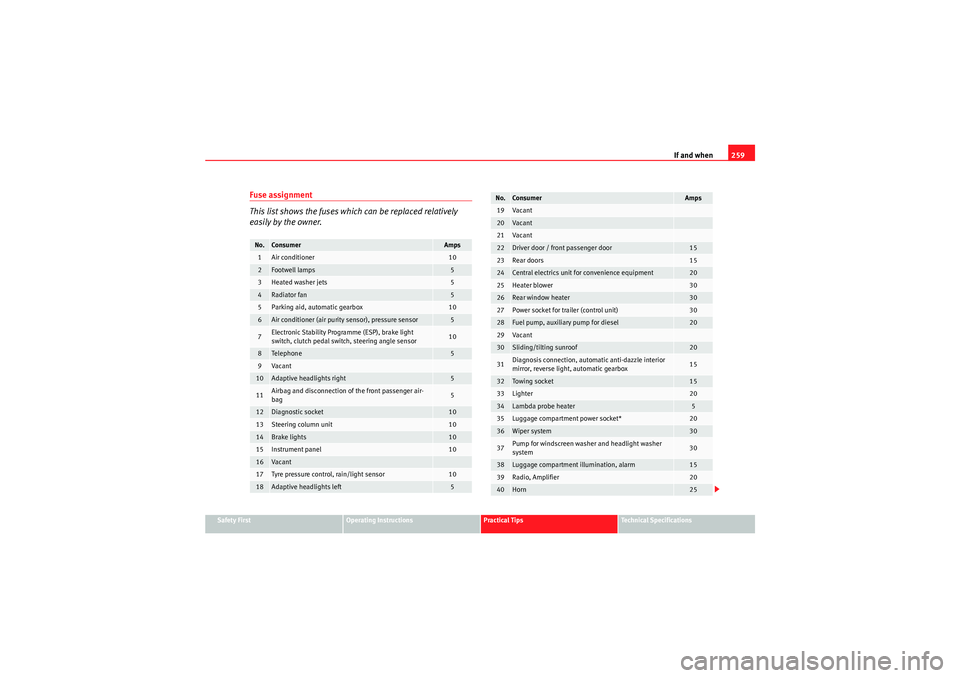
This list shows the fuses which can be replaced relatively
easily by the owner.No.
Consumer
Amps
1
Air conditioner
10
2
Footwell lamps
5
3
Heated washer jets
5
4
Radiator fan
5
5
Parking aid, automatic gearbox
10
6
Air conditioner (air purity sensor), pressure sensor
5
7
Electronic Stability Programme (ESP), brake light
switch, clutch pedal switch, steering angle sensor
10
8
Te le p hon e
5
9
Va can t
10
Adaptive headlights right
5
11
Airbag and disconnection of the front passenger air-
bag
5
12
Diagnostic socket
10
13
Steering column unit
10
14
Brake lights
10
15
Instrument panel
10
16
Va can t
17
Tyre pressure control, rain/light sensor
10
18
Adaptive headlights left
5
19
Va can t
20
Va can t
21
Va can t
22
Driver door / front passenger door
15
23
Rear doors
15
24
Central electrics unit for convenience equipment
20
25
Heater blower
30
26
Rear window heater
30
27
Power socket for trailer (control unit)
30
28
Fuel pump, auxiliary pump for diesel
20
29
Va can t
30
Sliding/tilting sunroof
20
31
Diagnosis connection, automatic anti-dazzle interior
mirror, reverse light, automatic gearbox
15
32
Towi ng s ocke t
15
33
Lighter
20
34
Lambda probe heater
5
35
Luggage compartment power socket*
20
36
Wiper system
30
37
Pump for windscreen washer and headlight washer
system
30
38
Luggage compartment illumination, alarm
15
39
Radio, Amplifier
20
40
Horn
25
No.
Consumer
Amps
exeo_EN.book Seite 259 Montag, 30. August 2010 4:45 16