battery Seat Exeo 2010 Owner's Guide
[x] Cancel search | Manufacturer: SEAT, Model Year: 2010, Model line: Exeo, Model: Seat Exeo 2010Pages: 319, PDF Size: 9.64 MB
Page 237 of 319
Checking and refilling levels235
Safety First
Operating Instructions
Practical Tips
Technical Specifications
Winter operation
The battery is drained more in cold weather, which means that the starting
power is reduced. For this reason, have the battery checked and charged if
necessary before the start of winter.
Replacing the battery
A replacement battery
must have the same capacity, voltage and current
rating. It must also have the same dimensions as the original, factory-fitted
battery and have sealed caps. The SEAT batteries which have been specially
developed fulfil the maintenance, performance and safety specifications for
your vehicle.
We recommend you use maintenance-free batteries.
WARNING
•All work on batteries requires specialist knowledge. If work is required
on the battery, this should be performed by a Technical Service or qualified
workshop. Danger of caustic burns and explosion!•The battery must not be opened. Never try to change the battery’s
liquid level. Explosive gas is released from the battery that could cause an
explosion.Caution
•The battery holder and clamps must always be correctly secured.•Before starting any work on the battery, always observe the warnings
listed under ⇒.For the sake of the environment
¡ Batteries contain toxic substances including sulphuric acid and lead.
Therefore, they must be disposed of in line with environmental regulations
and must not be disposed of with ordinary household waste. Make sure
disconnected batteries cannot tip over. Sulphuric acid could be spilt!
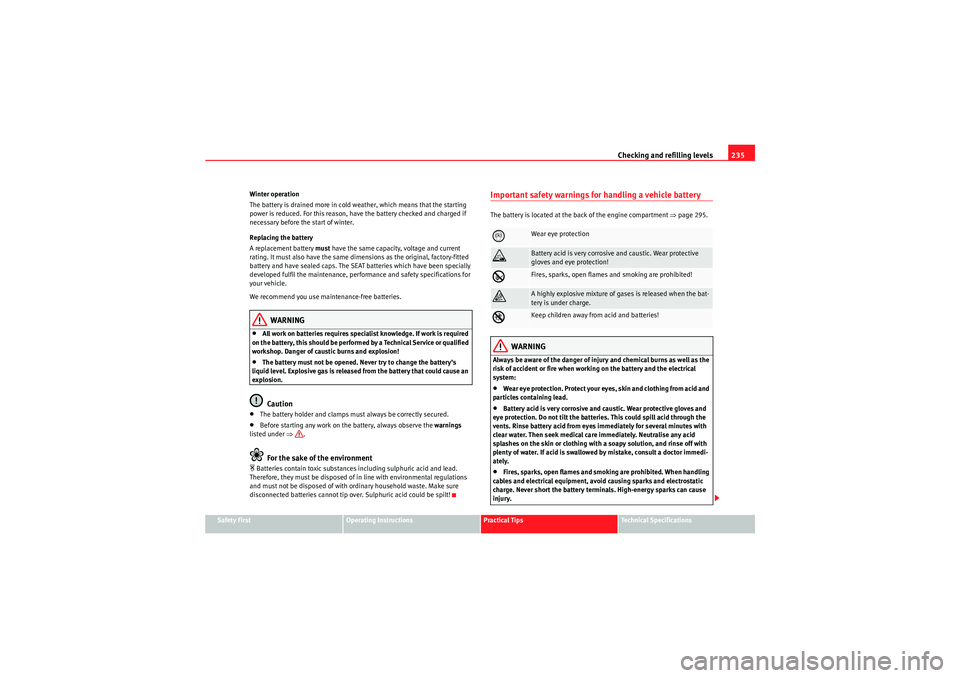
Important safety warnings for handling a vehicle batteryThe battery is located at the back of the engine compartment ⇒ page 295.
WARNING
Always be aware of the danger of injury and chemical burns as well as the
risk of accident or fire when working on the battery and the electrical
system:•Wear eye protection. Protect your eyes, skin and clothing from acid and
particles containing lead.•Battery acid is very corrosive and caustic. Wear protective gloves and
eye protection. Do not tilt the batteries. This could spill acid through the
vents. Rinse battery acid from eyes immediately for several minutes with
clear water. Then seek medical care immediately. Neutralise any acid
splashes on the skin or clothing with a soapy solution, and rinse off with
plenty of water. If acid is swallowed by mistake, consult a doctor immedi-
ately.•Fires, sparks, open flames and smoking are prohibited. When handling
cables and electrical equipment, avoid causing sparks and electrostatic
charge. Never short the battery terminals. High-energy sparks can cause
injury.
Wear eye protection
Battery acid is very corrosive and caustic. Wear protective
gloves and eye protection!
Ž
Fires, sparks, open flames and smoking are prohibited!
Ÿ
A highly explosive mixture of gases is released when the bat-
tery is under charge.
Keep children away from acid and batteries!
exeo_EN.book Seite 235 Montag, 30. August 2010 4:45 16
Page 238 of 319
Checking and refilling levels
236•A highly explosive mixture of gases is released when the battery is
under charge. The batteries should be charged in a well-ventilated room
only.•Keep children away from acid and batteries.•Before working on the electrical system, you must switch off the
engine, the ignition and all consumers. The negative cable on the battery
must be disconnected. When a light bulb is changed, you need only switch
off the light.•Deactivate the anti-theft alarm by unlocking the vehicle before you
disconnect the battery! The alarm will otherwise be triggered.•When disconnecting the battery from the vehicle electrical system,
disconnect first the negative cable and then the positive cable.•Switch off all electrical consumers before reconnecting the battery.
Reconnect first the positive cable and then the negative cable. Never
reverse the polarity of the connections. This could cause an electrical fire.•Never charge a frozen battery, or one which has thawed. This could
result in explosions and chemical burns. Always replace a battery which
has frozen. A flat battery can freeze at temperatures around 0°C.•Ensure that the vent hose is always connected to the battery.•Never use a defective battery. This could cause an explosion. Replace a
damaged battery immediately.Caution
•Never disconnect the battery if the ignition is switched on or if the engine
is running. This could damage the electrical system or electronic compo-
nents.•Do not expose the battery to direct sunlight over a long period of time, as
the intense ultraviolet radiation can damage the battery housing.•If the vehicle is left standing in cold conditions for a long period, protect
the battery from frost. If it freezes it will be damaged.
Charging the battery
A fully-charged battery is important for reliable starting.– Note the warnings ⇒ in “Important safety warnings for
handling a vehicle battery” on page 235 and ⇒.
– Switch off the ignition and all electrical equipment.
– Only if fast-charging: both battery cables must be disconnected (first the negative cable, then the positive cable).
– Connect the charger cables to the battery terminals, noting the colour code (red = positive; black or brown = negative).
– Now connect the battery charger to the power socket and switch on.
– After charging the battery: switch off the battery charger and disconnect the power point cable.
– Finally disconnect the charger cables from the battery.
– If necessary, reconnect both battery cables to the battery (first the positive cable, then the negative cable).When charging with a low current (for instance with a small battery charger)
the battery does not normally have to be disconnected. However, both
battery cables must be disconnected before fast-charging the battery with a
high current. However, always follow the instructions given by the manufac-
turer of the battery charger.
The fast-charging procedure for a battery is dangerous ⇒ in “Important
safety warnings for handling a vehicle battery” on page 235, as it requires a
special charger and the corresponding level of knowledge. We therefore
recommend that this work should only be performed by a qualified workshop.
WARNING (continued)
exeo_EN.book Seite 236 Montag, 30. August 2010 4:45 16
Page 239 of 319
Checking and refilling levels237
Safety First
Operating Instructions
Practical Tips
Technical Specifications
A flat battery can
freeze at temperatures of around 0°C. The battery must be
defrosted before charging ⇒. It is advisable to replace the battery if it has
frozen, because the ice can crack the battery casing and allow the battery
acid to escape.
The battery caps should not be opened while the battery is being charged.
WARNING
Never charge a frozen battery. Failure to comply could result in an
explosion.
exeo_EN.book Seite 237 Montag, 30. August 2010 4:45 16
Page 286 of 319
If and when
284Sun visor light– Remove the bulb carefully, using the screwdriver on its flat side
⇒fig. 228 . – Use a screwdriver to remo
ve the protective cover.
– Remove the bulb, moving it in the direction of the arrow and outwards ⇒fig. 229 .
Jump-startingJump leads
The jump lead must have a sufficient wire cross section.If the engine fails to start because of a discharged battery, the battery can be
connected to the battery of another vehicle to start the engine.
Jump leads
Jump leads must comply with standard DIN 72553 (see manufacturer’s docu-
mentation). The wire cross section must be at least 25 mm
2 for petrol engines
and at least 35 mm
2 for diesel engines.
Note
•The vehicles must not touch each other, otherwise electricity could flow as
soon as the positive terminals are connected.•The discharged battery must be properly connected to the vehicle elec-
trical system.
Fig. 228 Removing sun
visor lightFig. 229 Removing sun
visor light
exeo_EN.book Seite 284 Montag, 30. August 2010 4:45 16
Page 287 of 319
If and when285
Safety First
Operating Instructions
Practical Tips
Technical Specifications
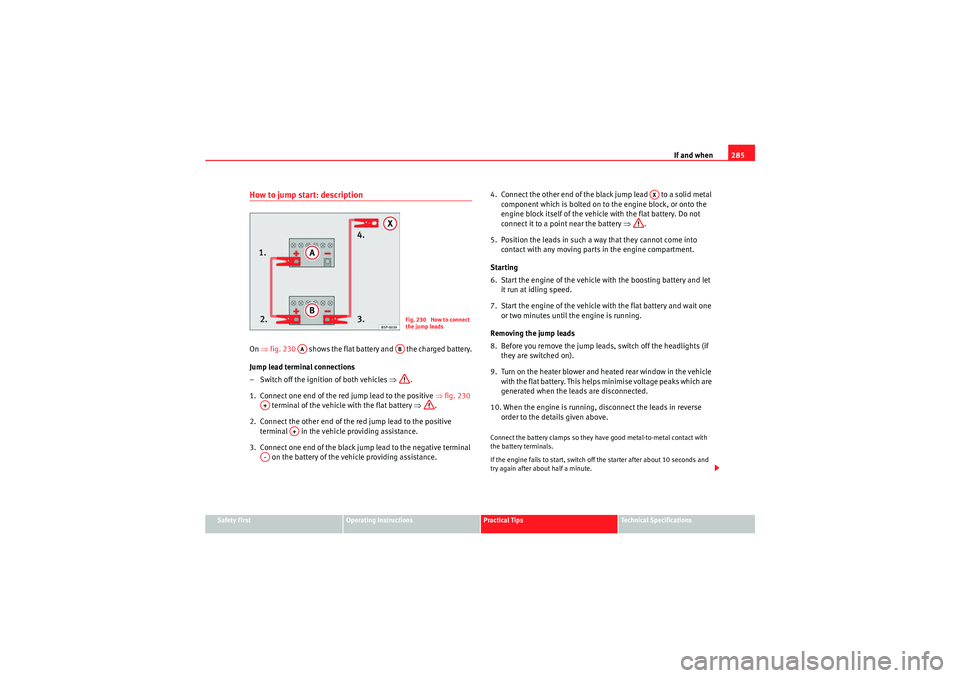
How to jump start: descriptionOn ⇒fig. 230 shows the flat battery and the charged battery.
Jump lead terminal connections
– Switch off the ignition of both vehicles ⇒.
1. Connect one end of the red jump lead to the positive ⇒fig. 230
terminal of the vehicle with the flat battery ⇒.
2. Connect the other end of the red jump lead to the positive terminal in the vehicle providing assistance.
3. Connect one end of the black jump lead to the negative terminal on the battery of the vehicle providing assistance. 4. Connect the other end of the black jump lead to a solid metal
component which is bolted on to the engine block, or onto the
engine block itself of the vehicle with the flat battery. Do not
connect it to a point near the battery ⇒.
5. Position the leads in such a way that they cannot come into contact with any moving parts in the engine compartment.
Starting
6. Start the engine of the vehicle with the boosting battery and let it run at idling speed.
7. Start the engine of the vehicle with the flat battery and wait one or two minutes until the engine is running.
Removing the jump leads
8. Before you remove the jump leads, switch off the headlights (if they are switched on).
9. Turn on the heater blower and heated rear window in the vehicle with the flat battery. This helps minimise voltage peaks which are
generated when the leads are disconnected.
10. When the engine is running, disconnect the leads in reverse order to the details given above.
Connect the battery clamps so they have good metal-to-metal contact with
the battery terminals.
If the engine fails to start, switch off the starter after about 10 seconds and
try again after about half a minute.
Fig. 230 How to connect
the jump leads
AA
AB
A+
A+
A-
AX
exeo_EN.book Seite 285 Montag, 30. August 2010 4:45 16
Page 288 of 319
If and when
286
WARNING
•Please note the safety warnings referring to working in the engine
compartment ⇒page 224.•The battery providing assistance must have the same voltage as the flat
battery (12V) and approximately the same capacity (see imprint on
battery). Failure to comply could result in an explosion.•Never use jump leads when one of the batteries is frozen. Danger of
explosion! Even after the battery has thawed, battery acid could leak and
cause chemical burns. If a battery freezes, it should be replaced.•Keep sparks, flames and lighted cigarettes away from batteries, danger
of explosion. Failure to comply could result in an explosion.•Observe the instructions provided by the manufacturer of the jump
leads.•Do not connect the negative cable from the other vehicle directly to the
negative terminal of the flat battery. The gas emitted from the battery could
be ignited by sparks. Danger of explosion.•Do not attach the negative cable from the other vehicle to parts of the
fuel system or to the brake line.•The non-insulated parts of the battery clamps must not be allowed to
touch. The jump lead attached to the positive battery terminal must not
touch metal parts of the vehicle, this can cause a short circuit.•Position the leads in such a way that they cannot come into contact
with any moving parts in the engine compartment.•Do not bend over the batteries. This could result in chemical burns.Note
The vehicles must not touch each other, otherwise electricity could flow as
soon as the positive terminals are connected.
exeo_EN.book Seite 286 Montag, 30. August 2010 4:45 16
Page 297 of 319
Technical Specifications295
Safety First
Operating Instructions
Practical Tips
Technical Specifications
Technical SpecificationsChecking fluid levelsFrom time to time, the levels of the different fluids in the
vehicle must be checked. Never fill with incorrect fluids,
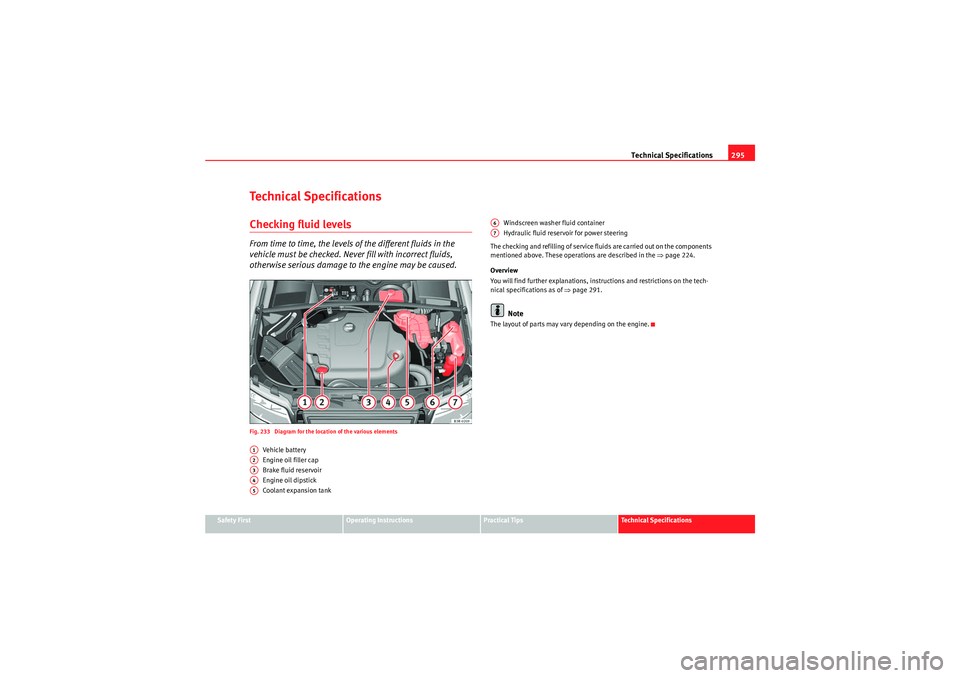
otherwise serious damage to the engine may be caused.Fig. 233 Diagram for the location of the various elements
Vehicle battery
Engine oil filler cap
Brake fluid reservoir
Engine oil dipstick
Coolant expansion tank Windscreen washer fluid container
Hydraulic fluid reservoir for power steering
The checking and refilling of service fluids are carried out on the components
mentioned above. These operations are described in the ⇒page 224.
Overview
You will find further explanations, instructions and restrictions on the tech-
nical specifications as of ⇒page 291.
Note
The layout of parts may vary depending on the engine.
A1A2A3A4A5
A6A7
exeo_EN.book Seite 295 Montag, 30. August 2010 4:45 16
Page 309 of 319
Index307
Index230 V socket . . . . . . . . . . . . . . . . . . . . . . . . . . . 151AAccessories . . . . . . . . . . . . . . . . . . . . . . . . . . . . 218
Towing . . . . . . . . . . . . . . . . . . . . . . . . . . . . . 200
Adaptive headlights . . . . . . . . . . . . . . . . . . . . . 121 Faulty . . . . . . . . . . . . . . . . . . . . . . . . . . . . . . . 81
Air conditioner 2C-Climatronic . . . . . . . . . . . . . . . . . . . . . . . 156
Air distribution . . . . . . . . . . . . . . . . . . . . . . . 163
Air outlets . . . . . . . . . . . . . . . . . . . . . . . . . . . 163
Air purity sensor . . . . . . . . . . . . . . . . . . . . . . 161
Air recirculation . . . . . . . . . . . . . . . . . . . . . . 160
Air recirculation (automatic) . . . . . . . . . . . . 161
Automatic mode . . . . . . . . . . . . . . . . . . . . . 159
Blower . . . . . . . . . . . . . . . . . . . . . . . . . . . . . . 162
Controls . . . . . . . . . . . . . . . . . . . . . . . . . . . . 158
Defrosting . . . . . . . . . . . . . . . . . . . . . . . . . . . 160
ECON Mode (economy) . . . . . . . . . . . . . . . . 160
Economical use . . . . . . . . . . . . . . . . . . . . . . 164
Key settings . . . . . . . . . . . . . . . . . . . . . . . . . 164
Solar-powered blower/sunroof . . . . . . . . . . 165
Temperature selection . . . . . . . . . . . . . . . . . 159
Air duct Fitting . . . . . . . . . . . . . . . . . . . . . . . . . 262, 269
Removing . . . . . . . . . . . . . . . . . . . . . . 261, 268 Air purity sensor . . . . . . . . . . . . . . . . . . . . . . . . . 161
Airbag
Warning lamp . . . . . . . . . . . . . . . . . . . . . . . . . 66
Airbag covers . . . . . . . . . . . . . . . . . . . . . . . . . . . . 34
Airbag system . . . . . . . . . . . . . . . . . . . . . . . . . . . 28 Curtain airbags . . . . . . . . . . . . . . . . . . . . . . . 41
Front airbags . . . . . . . . . . . . . . . . . . . . . . . . . 32
Side airbags . . . . . . . . . . . . . . . . . . . . . . . . . . 38
Warning lamp . . . . . . . . . . . . . . . . . . . . . . . . . 29
Alternator Warning lamp . . . . . . . . . . . . . . . . . . . . . . . . . 69
Ambient lighting . . . . . . . . . . . . . . . . . . . . . . . . 124
Antifreeze . . . . . . . . . . . . . . . . . . . . . . . . . . . . . . 228
Anti-lock brake system How it works . . . . . . . . . . . . . . . . . . . . . . . . . 186
Anti-theft alarm system . . . . . . . . . . . . . . . . . . . 106 Interior monitoring . . . . . . . . . . . . . . . . . . . 107
Aquaplaning . . . . . . . . . . . . . . . . . . . . . . . . . . . 242
Armrest Storage compartment in front armrest . . . . 142
Armrests Adjusting the front armrest . . . . . . . . . . . . . 142
Ashtray Front . . . . . . . . . . . . . . . . . . . . . . . . . . . . . . . 148
Rear . . . . . . . . . . . . . . . . . . . . . . . . . . . . . . . 149
Athermic windscreen . . . . . . . . . . . . . . . . . . . . . 219
Auto-check system . . . . . . . . . . . . . . . . . . . . . . . 75
Automatic car wash tunnel . . . . . . . . . . . . . . . . 210 Automatic gearbox
Dynamic gear control programme . . . . . . . 182
Kick-down feature . . . . . . . . . . . . . . . . . . . . 181
multitronic® . . . . . . . . . . . . . . . . . . . . . . . . 177
Paddle levers (tiptronic mode) . . . . . . . . . . 184
Safety interlock for ignition key . . . . . . . . . 167
Selector lever lock . . . . . . . . . . . . . . . . . . . . 181
Selector lever positions . . . . . . . . . . . . . . . 179
Steering wheel with paddle levers . . . . . . . 184
tiptronic . . . . . . . . . . . . . . . . . . . . . . . 177, 183
Automatic headlight control . . . . . . . . . . . . . . . 115
Auxiliary heater . . . . . . . . . . . . . . . . . . . . . . . . . 165
BBattery . . . . . . . . . . . . . . . . . . . . . . . . . . . . . . . . 234 Battery voltage . . . . . . . . . . . . . . . . . . . . . . . . 81
Charging . . . . . . . . . . . . . . . . . . . . . . . . . . . . 236
Disconnection . . . . . . . . . . . . . . . . . . . . . . . 234
Long periods of non-use . . . . . . . . . . . . . . . 234
Replacing . . . . . . . . . . . . . . . . . . . . . . 234, 235
Testing . . . . . . . . . . . . . . . . . . . . . . . . . . . . . 234
Winter operation . . . . . . . . . . . . . . . . 234, 235
Bicycle rack Towing . . . . . . . . . . . . . . . . . . . . . . . . . . . . . 200
Biodiesel . . . . . . . . . . . . . . . . . . . . . . . . . . . . . . 222
Biodiesel fuel . . . . . . . . . . . . . . . . . . . . . . . . . . . 222
exeo_EN.book Seite 307 Montag, 30. August 2010 4:45 16
Page 312 of 319
Index
310Electronic Stability Programme
Description . . . . . . . . . . . . . . . . . . . . . . . . . 166
How the system works . . . . . . . . . . . . . . . . 185
Warning lamp . . . . . . . . . . . . . . . . . . . . . . . 167
Emergencies Changing a wheel . . . . . . . . . . . . . . . . . . . . 249
Disconnecting the battery . . . . . . . . . . . . . 234
Jack . . . . . . . . . . . . . . . . . . . . . . . . . . . . 247, 252
Sunroof emergency activation . . . . . . . . . . 113
Tools . . . . . . . . . . . . . . . . . . . . . . . . . . . . . . . 247
Tyre mobility system . . . . . . . . . . . . . . . . . . 248
Engine Running in . . . . . . . . . . . . . . . . . . . . . . . . . . 192
Starting . . . . . . . . . . . . . . . . . . . . . . . . . . . . 168
Stop . . . . . . . . . . . . . . . . . . . . . . . . . . . . . . . 169
Engine compartment Safety instructions . . . . . . . . . . . . . . . . . . . 224
Engine oil . . . . . . . . . . . . . . . . . . . . . . . . . . . . . . 225 Checking oil level . . . . . . . . . . . . . . . . . . . . 226
Consumption . . . . . . . . . . . . . . . . . . . . . . . . 226
Oil pressure too low . . . . . . . . . . . . . . . . . . . 78
Oil properties . . . . . . . . . . . . . . . . . . . . . . . . 226
Oil sensor defective . . . . . . . . . . . . . . . . . . . 80
Topping up . . . . . . . . . . . . . . . . . . . . . . . . . . 227
Engine speed governing . . . . . . . . . . . . . . . . . . . 80
Environment . . . . . . . . . . . . . . . . . . . . . . . . . . . 194 Environmental friendliness . . . . . . . . . . . . 196
Roof racks . . . . . . . . . . . . . . . . . . . . . . . . . . 147
Environmental tip Avoiding pollution . . . . . . . . . . . . . . . . . . . . 221
Environmentally friendly driving . . . . . . . . . . . 194 ESP
See Electronic Stability Programme . . . . . . 166
Exhaust gas purification system . . . . . . . . . . . 193
Exterior mirrors . . . . . . . . . . . . . . . . . . . . . . . . . 212
FFabric trim cleaning . . . . . . . . . . . . . . . . . . . . . 216
Floor mats . . . . . . . . . . . . . . . . . . . . . . . . . . . . . . 16
Fog lights . . . . . . . . . . . . . . . . . . . . . . . . . . . . . . 117
Front airbags . . . . . . . . . . . . . . . . . . . . . . . . . . . . 32 Description . . . . . . . . . . . . . . . . . . . . . . . . . . 32
Operation . . . . . . . . . . . . . . . . . . . . . . . . . . . . 33
Safety notes . . . . . . . . . . . . . . . . . . . . . . . . . . 35
Front drink holder . . . . . . . . . . . . . . . . . . . . . . . 147
Front passenger airbag deactivation . . . . . . . . . 44
Fuel Diesel . . . . . . . . . . . . . . . . . . . . . . . . . . . . . . 222
Fuel gauge . . . . . . . . . . . . . . . . . . . . . . . . . . . 63
Fuel level low . . . . . . . . . . . . . . . . . . . . . . . . . 80
Instantaneous fuel consumption . . . . . . . . . 85
Petrol . . . . . . . . . . . . . . . . . . . . . . . . . . . . . . 221
Fuel tank opening the fuel tank flap . . . . . . . . . . . . . 220
Fuel: save . . . . . . . . . . . . . . . . . . . . . . . . . . . . . . 194
Fuse Assignment . . . . . . . . . . . . . . . . . . . . . . . . . 259
Changing . . . . . . . . . . . . . . . . . . . . . . . . . . . 258
GGear display . . . . . . . . . . . . . . . . . . . . . . . . . . . . 73
Gear shift pattern . . . . . . . . . . . . . . . . . . . . . . . 177
General overview of the engine compartment 295
Glove compartment . . . . . . . . . . . . . . . . . . . . . 153Light . . . . . . . . . . . . . . . . . . . . . . . . . . . . . . . 123
GRA . . . . . . . . . . . . . . . . . . . . . . . . . . . . . . . . . . 174HHandbrake . . . . . . . . . . . . . . . . . . . . . . . . . . . . . 170
Hazard warning lights . . . . . . . . . . . . . . . . . . . . 121
Head restraint Rear seat . . . . . . . . . . . . . . . . . . . . . . . . . . . 142
Head restraints Front seats . . . . . . . . . . . . . . . . . . . . . . . . . . 140
Rear seats . . . . . . . . . . . . . . . . . . . . . . . . . . 141
Removing and fitting . . . . . . . . . . . . . . . . . 141
Headlight range control . . . . . . . . . . . . . . . . . . 119 Dynamic . . . . . . . . . . . . . . . . . . . . . . . . . . . . 120
Faulty . . . . . . . . . . . . . . . . . . . . . . . . . . . . . . . 81
Headlights Adaptive headlights . . . . . . . . . . . . . . . . . . 121
Automatic headlight control . . . . . . . . . . . 116
Automatic headlight control photosensors 116
Coming home function . . . . . . . . . . . . . . . . 118
Driving abroad . . . . . . . . . . . . . . . . . . . . . . . 197
Front fog lights . . . . . . . . . . . . . . . . . . . . . . 117
Headlight range control . . . . . . . . . . . . . . . 119
exeo_EN.book Seite 310 Montag, 30. August 2010 4:45 16
Page 313 of 319
Index311
Headlight washer system . . . . . . . . . . . . . . 130
Leaving home function . . . . . . . . . . . . . . . . 118
Heated Seats . . . . . . . . . . . . . . . . . . . . . . . . . . . . . . . 165
Heated rear window . . . . . . . . . . . . . . . . . . . . . . 126 Heating element wires . . . . . . . . . . . . . . . . 213
Heated seats . . . . . . . . . . . . . . . . . . . . . . . . . . . 165
High pressure cleaners . . . . . . . . . . . . . . . . . . . 211
Horn . . . . . . . . . . . . . . . . . . . . . . . . . . . . . . . . . . . 57IIdentification number . . . . . . . . . . . . . . . . . . . . 292
Identification plate . . . . . . . . . . . . . . . . . . . . . . 292
Ignition key Safety interlock . . . . . . . . . . . . . . . . . . . . . . 167
Ignition lock . . . . . . . . . . . . . . . . . . . . . . . . . . . . 167
Indicator lamps Cruise control system . . . . . . . . . . . . . . . . . . 67
Glow plug system . . . . . . . . . . . . . . . . . . . . . 70
Main beam headlights . . . . . . . . . . . . . . . . . 69
Indicator lamps - overview . . . . . . . . . . . . . . . . . 65
Instruments Lighting . . . . . . . . . . . . . . . . . . . . . . . . 62, 119
Interior lights Ambient lighting . . . . . . . . . . . . . . . . . . . . . 124
Front . . . . . . . . . . . . . . . . . . . . . . . . . . . . . . . 123
Luggage compartment . . . . . . . . . . . . . . . . 125
Rear . . . . . . . . . . . . . . . . . . . . . . . . . . . . . . . . 125
Interior mirror With manual anti-dazzle setting . . . . . . . . . 131 Interior monitoring . . . . . . . . . . . . . . . . . . . . . . 107
Intermittent wipe . . . . . . . . . . . . . . . . . . . . . . . . 129
ISOFIX . . . . . . . . . . . . . . . . . . . . . . . . . . . . . . . . . . 52
JJack . . . . . . . . . . . . . . . . . . . . . . . . . . . . . . 247, 252
Jump leads . . . . . . . . . . . . . . . . . . . . . . . . . . . . . 284
Jump-starting . . . . . . . . . . . . . . . . . . . . . . . . . . . 284KKeys . . . . . . . . . . . . . . . . . . . . . . . . . . . . . . . . . . . 96
Air conditioner settings . . . . . . . . . . . . . . . . 164
Battery . . . . . . . . . . . . . . . . . . . . . . . . . . . . . . 97
Remote control key . . . . . . . . . . . . . . . . . . . 104
Settings for the driver seat . . . . . . . . . . . . . 140
Kick-down feature . . . . . . . . . . . . . . . . . . . . . . . 181LLeather cleaning . . . . . . . . . . . . . . . . . . . . . . . . 216
Lighting . . . . . . . . . . . . . . . . . . . . . . . . . . . . . . . 115 Instruments . . . . . . . . . . . . . . . . . . . . . . 62, 119
Lights Adaptive headlights . . . . . . . . . . . . . . . . . . 121
Automatic headlight control . . . . . . . . . . . . 115
Cornering light . . . . . . . . . . . . . . . . . . . . . . . 121
Dipped beam headlights faulty . . . . . . . . . . 82
Dynamic headlight range control . . . . . . . . 120
Headlight flasher . . . . . . . . . . . . . . . . . . . . . 123
Parking light . . . . . . . . . . . . . . . . . . . . . . . . . 123 Reverse lights faulty . . . . . . . . . . . . . . . . . . . 82
Switching on and off . . . . . . . . . . . . . . . . . . 115
Xenon lights . . . . . . . . . . . . . . . . . . . . . . . . . 120
Load compartment in the luggage compartment See Loading the luggage compartment . . . . 16
Loading the luggage compartment . . . . . . . . . . 16
Locking the doors manually if the central locking fails to work
Locking the doors manually if the central lock- ing fails to work . . . . . . . . . . . . . . . . . . . . 102
Locks . . . . . . . . . . . . . . . . . . . . . . . . . . . . . . . . . 213
Long periods of non-use Battery . . . . . . . . . . . . . . . . . . . . . . . . . . . . . 234
Luggage compartment . . . . . . . . . . . . . . . . . . . 143 Extending . . . . . . . . . . . . . . . . . . . . . . . . . . . 144
Light . . . . . . . . . . . . . . . . . . . . . . . . . . . . . . . 125
Loading . . . . . . . . . . . . . . . . . . . . . . . . . . . . 143
Ski bag . . . . . . . . . . . . . . . . . . . . . . . . . . . . . 145
See also Loading the luggage compartment 16
Luggage rack See Roof rack . . . . . . . . . . . . . . . . . . . . . . . . 146
MMain beam headlights . . . . . . . . . . . . . . 115, 122
Maintenance
Airbags . . . . . . . . . . . . . . . . . . . . . . . . . . . . . . 30
Maintenance and cleaning . . . . . . . . . . . . . . . . 209
Manual gearbox . . . . . . . . . . . . . . . . . . . . . . . . . 177
Manual operation Closing the sunroof manually . . . . . . . . . . . 113
exeo_EN.book Seite 311 Montag, 30. August 2010 4:45 16