wheel Seat Exeo 2010 Repair Manual
[x] Cancel search | Manufacturer: SEAT, Model Year: 2010, Model line: Exeo, Model: Seat Exeo 2010Pages: 319, PDF Size: 9.64 MB
Page 252 of 319
If and when
250
NotePlease observe legal requirements when doing so.Changing a wheel
Change the wheel as described below.– Remove the wheel cover.
–Loosen the wheel bolts ⇒ page 251.
– Raise the vehicle with the jack ⇒page 252.
– Ta k e o f f the wheel with the flat tyre and then put on the spare
wheel ⇒page 253.
– Lower the vehicle.
– Tighten the wheel bolts firmly in diagonal sequence with the box
spanner ⇒page 251.
–Replace the cover.After changing a wheel
After changing the wheel, there are still tasks to complete.– Place the wheel with the defective tyre in the spare wheel well
and secure it.
– Put the tools and jack back in the luggage compartment. –The
inflation pressure of the newly fitted spare tyre must be
checked as soon as possible.
–Have the tightening torque of the wheel bolts checked as soon
as possible with a torque wrench. It must be 120 Nm (always
when cold)
–Have the flat tyre replaced as quickly as possible.
Note
•If you notice that the wheel bolts are rusty and difficult to turn when
changing a wheel, they must be replaced before having the tightening torque
checked.•For your safety, drive at moderate speeds until the wheel bolt tightening
torque has been checked.
exeo_EN.book Seite 250 Montag, 30. August 2010 4:45 16
Page 253 of 319
If and when251
Safety First
Operating Instructions
Practical Tips
Technical Specifications
Loosening and tightening the wheel bolts
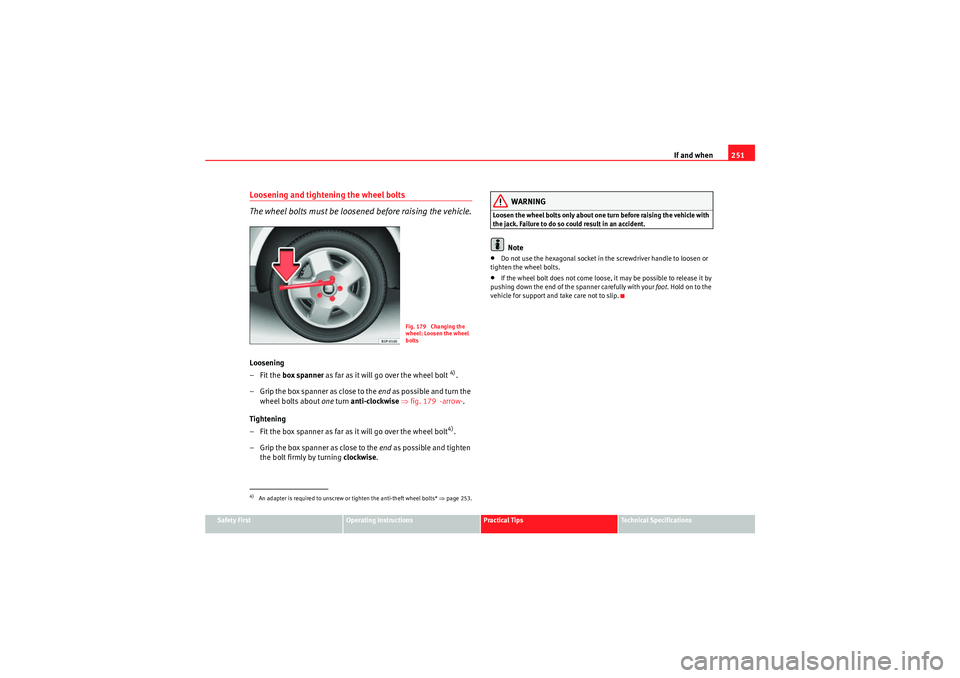
The wheel bolts must be loosened before raising the vehicle.Loosening
–Fit the box spanner as far as it will go over the wheel bolt
4).
– Grip the box spanner as close to the end as possible and turn the
wheel bolts about one turn anti-clockwise ⇒ fig. 179 -arrow- .
Tightening
– Fit the box spanner as far as it will go over the wheel bolt4).
– Grip the box spanner as close to the end as possible and tighten
the bolt firmly by turning clockwise.
WARNING
Loosen the wheel bolts only about one turn before raising the vehicle with
the jack. Failure to do so could result in an accident.
Note
•Do not use the hexagonal socket in the screwdriver handle to loosen or
tighten the wheel bolts.•If the wheel bolt does not come loose, it may be possible to release it by
pushing down the end of the spanner carefully with your foot. Hold on to the
vehicle for support and take care not to slip.
4)An adapter is required to unscrew or tighten the anti-theft wheel bolts* ⇒page 253.
Fig. 179 Changing the
wheel: Loosen the wheel
bolts
exeo_EN.book Seite 251 Montag, 30. August 2010 4:45 16
Page 254 of 319
If and when
252Raising the vehicle
In order to remove the wheel, the vehicle must be raised with
a jack.
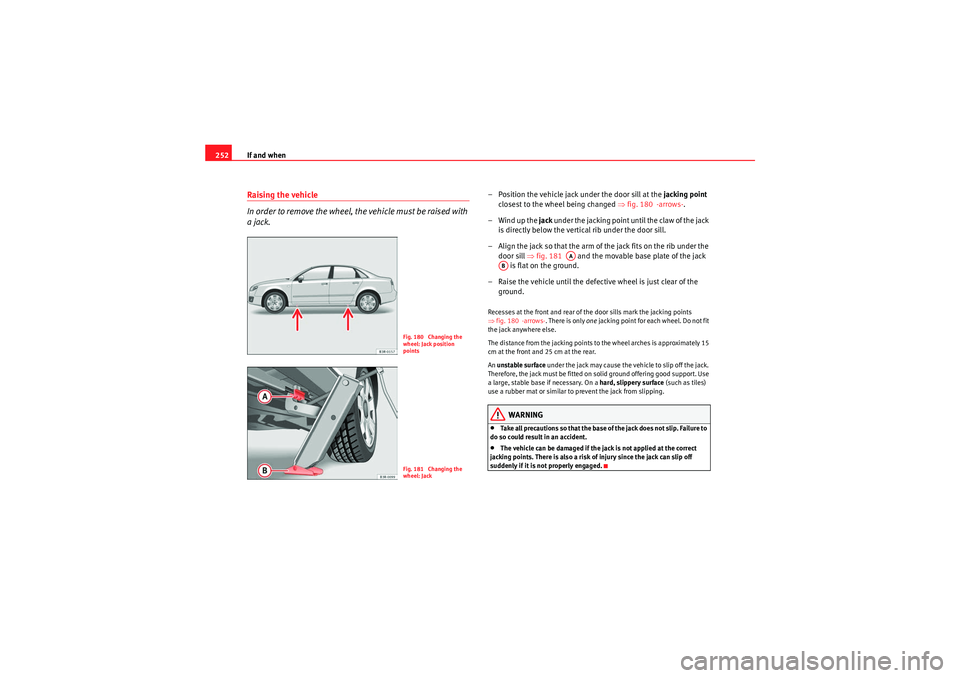
– Position the vehicle jack under the door sill at the jacking point
closest to the wheel being changed ⇒fig. 180 -arrows- .
–Wind up the jack under the jacking point until the claw of the jack
is directly below the vertical rib under the door sill.
– Align the jack so that the arm of the jack fits on the rib under the door sill ⇒ fig. 181 and the movable base plate of the jack
is flat on the ground.
– Raise the vehicle until the defective wheel is just clear of the ground.Recesses at the front and rear of the door sills mark the jacking points
⇒fig. 180 -arrows- . There is only one jacking point for each wheel. Do not fit
the jack anywhere else.
The distance from the jacking points to the wheel arches is approximately 15
cm at the front and 25 cm at the rear.
An unstable surface under the jack may cause the vehicle to slip off the jack.
Therefore, the jack must be fitted on solid ground offering good support. Use
a large, stable base if necessary. On a hard, slippery surface (such as tiles)
use a rubber mat or similar to prevent the jack from slipping.
WARNING
•Take all precautions so that the base of the jack does not slip. Failure to
do so could result in an accident.•The vehicle can be damaged if the jack is not applied at the correct
jacking points. There is also a risk of injury since the jack can slip off
suddenly if it is not properly engaged.
Fig. 180 Changing the
wheel: Jack position
pointsFig. 181 Changing the
wheel: Jack
AA
AB
exeo_EN.book Seite 252 Montag, 30. August 2010 4:45 16
Page 255 of 319
If and when253
Safety First
Operating Instructions
Practical Tips
Technical Specifications
Removing and fitting the wheel
For removal and fitting the wheel, the following tasks must be
completed.After loosening the wheel bolts and raising the vehicle with the jack,
change the wheel as described below:
Removing a wheel
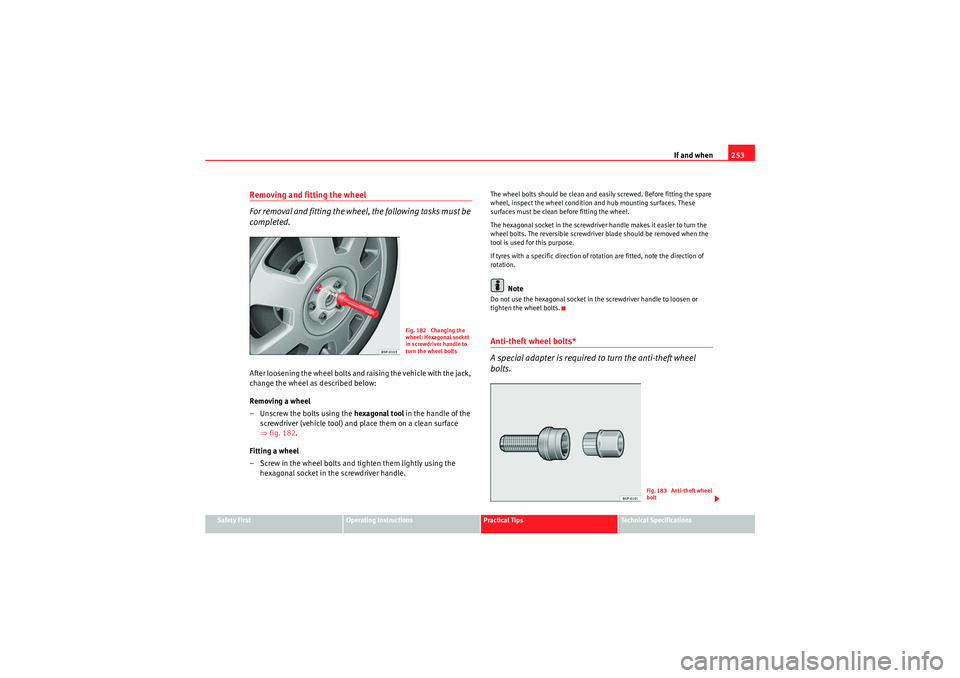
– Unscrew the bolts using the hexagonal tool in the handle of the
screwdriver (vehicle tool) and place them on a clean surface
⇒ fig. 182 .
Fitting a wheel
– Screw in the wheel bolts and tighten them lightly using the hexagonal socket in the screwdriver handle.
The wheel bolts should be clean and easily screwed. Before fitting the spare
wheel, inspect the wheel condition and hub mounting surfaces. These
surfaces must be clean before fitting the wheel.
The hexagonal socket in the screwdriver handle makes it easier to turn the
wheel bolts. The reversible screwdriver blade should be removed when the
tool is used for this purpose.
If tyres with a specific direction of rotation are fitted, note the direction of
rotation.
Note
Do not use the hexagonal socket in the screwdriver handle to loosen or
tighten the wheel bolts.Anti-theft wheel bolts*
A special adapter is required to turn the anti-theft wheel
bolts.
Fig. 182 Changing the
wheel: Hexagonal socket
in screwdriver handle to
turn the wheel bolts
Fig. 183 Anti-theft wheel
bolt
exeo_EN.book Seite 253 Montag, 30. August 2010 4:45 16
Page 256 of 319

If and when
254
– Insert the adapter onto the wheel bolt and push it on as far as it will go ⇒page 253, fig. 183 .
– Fit the box spanner as far as it will go over the adapter.
– Loosen or tighten the wheel bolt as appropriate.Code
The code number of the anti-theft wheel bolt is stamped onto the front part of
the adaptor.
The code number should be noted and kept in a safe place, as it is only by
using the code number that a duplicate adaptor can be obtained from an
Authorised Service Centre.Tyres with directional tread pattern
Tyres with directional tread pattern must be fitted so that they
rotate in the correct direction.A directional tread pattern can be identified by arrows on the sidewall that
point in the direction of rotation. Always note the direction of rotation indi-
cated when fitting the wheel. This is important so that these tyres can give
maximum grip and avoid excessive noise, tread wear and aquaplaning.
If, in an emergency, you have to fit the spare wheel so it rotates in the wrong
direction, you must drive extremely carefully. The tyre will not give optimum
performance. This is particularly important when driving on wet roads.
To benefit from the advantages of tyres with this type of tread pattern, the
defective tyre should be replaced as soon as possible so that all tyres again
rotate in the correct direction.
Tyre repairs* (Tyre Mobility System)General information and safety notes
Repaired tyres are only suitable for temporary use over a
short period.Your vehicle is equipped with a tyre repair kit: the Tyre Mobilit y System.
In the event of a puncture you will find the TMS, which consists of a sealing
compound and a compressor, located under the floor panel in the luggage
compartment.
The Tyre Mobil it y Syste m will reliably seal tyres damaged by foreign bodies,
provided that the cuts or punctures are no larger than approx. 4 mm in diam-
eter.
It is not necessary to remove the foreign body from the tyre.
Fig. 184 The Tyre
Mobility System is not
suitable for repairing this
type of damage to tyres.
exeo_EN.book Seite 254 Montag, 30. August 2010 4:45 16
Page 257 of 319
If and when255
Safety First
Operating Instructions
Practical Tips
Technical Specifications
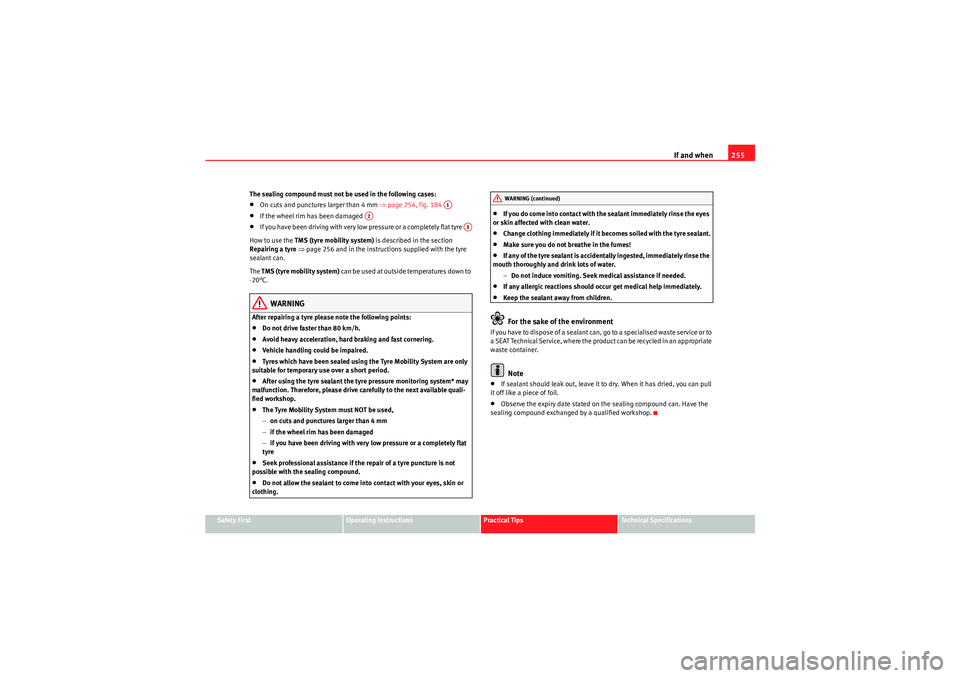
The sealing compound must not be used in the following cases:
•On cuts and punctures larger than 4 mm
⇒page 254, fig. 184 •If the wheel rim has been damaged •If you have been driving with ver y low pressure or a com pletely flat tyre
How to use the TMS (tyre mobility system) is described in the section
Repairing a tyre ⇒ page 256 and in the instructions supplied with the tyre
sealant can.
The TMS (tyre mobility system) can be used at outside temperatures down to
-20°C.WARNING
After repairing a tyre please note the following points:•Do not drive faster than 80 km/h.•Avoid heavy acceleration, hard braking and fast cornering.•Vehicle handling could be impaired.•Tyres which have been sealed using the Tyre Mobility System are only
suitable for temporary use over a short period.•After using the tyre sealant the tyre pressure monitoring system* may
malfunction. Therefore, please drive carefully to the next available quali-
fied workshop.•The Tyre Mobility System must NOT be used,
− on cuts and punctures larger than 4 mm
− if the wheel rim has been damaged
− if you have been driving with very low pressure or a completely flat
tyre•Seek professional assistance if the repair of a tyre puncture is not
possible with the sealing compound.•Do not allow the sealant to come into contact with your eyes, skin or
clothing.
•If you do come into contact with the sealant immediately rinse the eyes
or skin affected with clean water.•Change clothing immediately if it becomes soiled with the tyre sealant.•Make sure you do not breathe in the fumes!•If any of the tyre sealant is accidentally ingested, immediately rinse the
mouth thoroughly and drink lots of water.
−Do not induce vomiting. Seek medical assistance if needed.•If any allergic reactions should occur get medical help immediately.•Keep the sealant away from children.For the sake of the environment
If you have to dispose of a sealant can, go to a specialised waste service or to
a SEAT Technical Service, where the product can be recycled in an appropriate
waste container.
Note
•If sealant should leak out, leave it to dry. When it has dried, you can pull
it off like a piece of foil.•Observe the expiry date stated on the sealing compound can. Have the
sealing compound exchanged by a qualified workshop.
A1
A2
A3
WARNING (continued)
exeo_EN.book Seite 255 Montag, 30. August 2010 4:45 16
Page 290 of 319
If and when
288Do not pull too hard with the towing vehicle and take care to avoid jerking the
tow-rope. When towing on an unpaved road, there is always a risk of over-
loading and damaging the anchorage points.
The ignition of the vehicle being towed must be switched on to prevent the
steering wheel from locking and also to allow the use of the turn signals,
horn, windscreen wipers and washers.
As the brake servo does not work if the engine is not running, you must apply
considerably more pressure to the brake pedal than you normally would.
As the power assisted steering does not work if the engine is not running, you
will need more strength to steer than you normally would.
Towing vehicles with an automatic gearbox•Put the selector lever into position “N”.•Do not drive faster than 50 km/h when towing a vehicle.•Do not tow further than 50 km.•If a breakdown vehicle is used, the vehicle must be towed with the front
wheels raised.Note
•Observe legal requirements when towing or tow-starting.•Switch on the hazard warning lights of both vehicles. However, observe
any regulations to the contrary.•For technical reasons, vehicles with an automatic gearbox must not be
tow-started.•If damage to your vehicle means that there is no lubricant in the gearbox,
you must raise the drive wheels while the vehicle is being towed.•If the vehicle has to be towed more than 50 km, the front wheels should
be raised during towing, and towing should be carried out by a qualified
person.
•The steering wheel is locked when the vehicle has no electrical power. The
vehicle must then be towed with the front wheels raised. Towing should be
carried out by a qualified person.•The towing eye should always be kept in the vehicle. Please refer to the
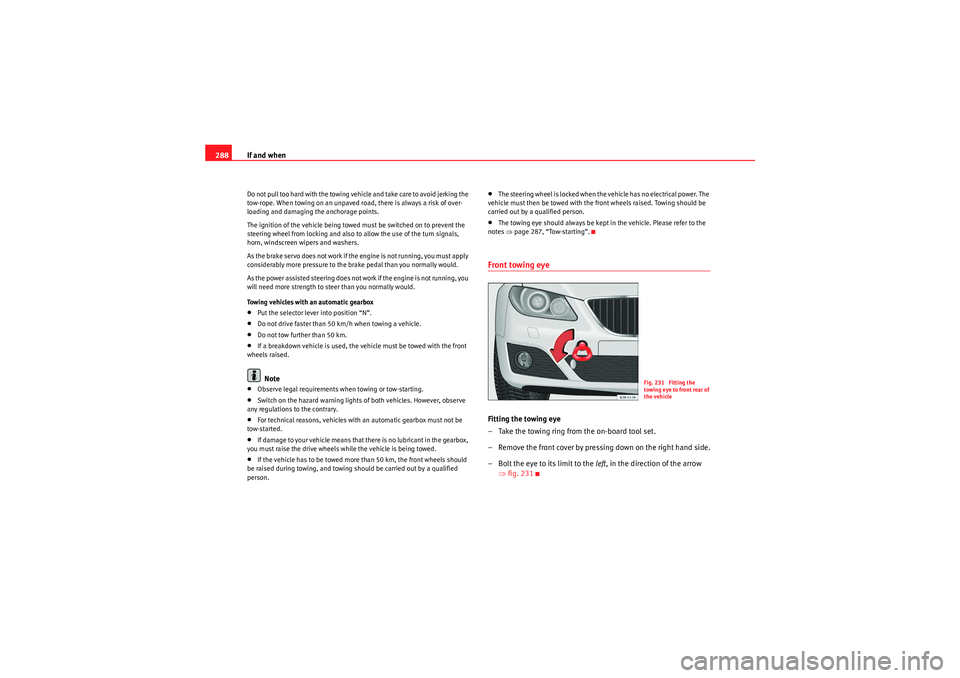
notes ⇒page 287, “Tow-starting”.Front towing eyeFitting the towing eye
– Take the towing ring from the on-board tool set.
– Remove the front cover by pressing down on the right hand side.
– Bolt the eye to its limit to the left, in the direction of the arrow
⇒ fig. 231
Fig. 231 Fitting the
towing eye to front rear of
the vehicle
exeo_EN.book Seite 288 Montag, 30. August 2010 4:45 16
Page 294 of 319
Description of specifications
292Vehicle identification data
The most important information is given on the identification
plate and the vehicle data sticker.Vehicles for certain export countries do not have an identification plate.
Identification plate
The identification plate is located on the left rib inside the engine compart-
ment.
Vehicle identification number
The vehicle identification number (chassis number) can be read from outside
the vehicle through a viewer in the windscreen. This is located on the left-
hand side of the vehicle in the lower area of the windscreen. It is also located
on the right hand side of the engine compartment. Vehicle data
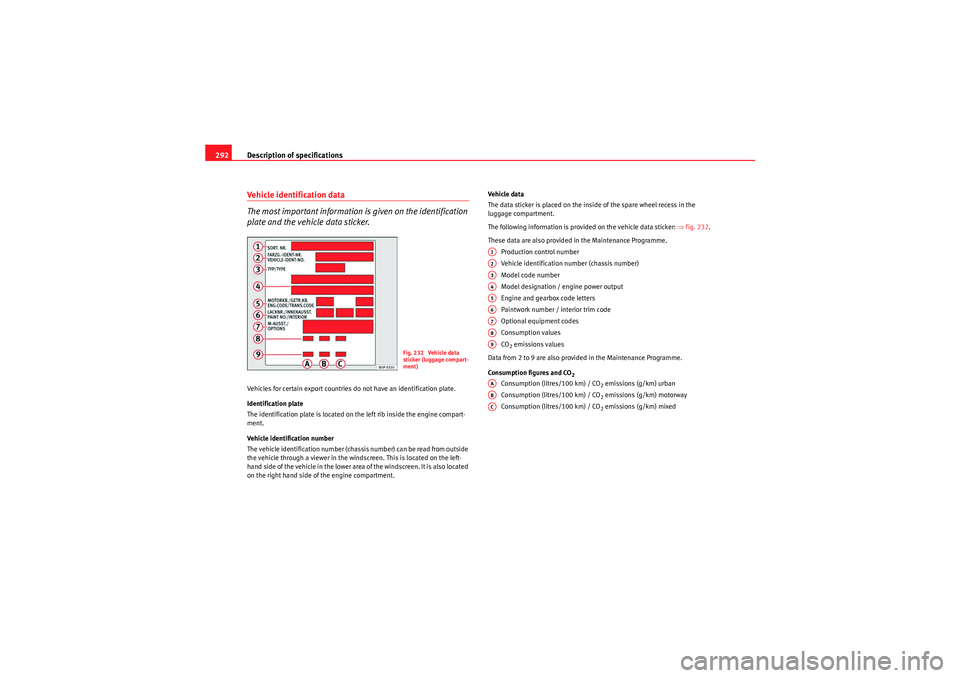
The data sticker is placed on the inside of the spare wheel recess in the
luggage compartment.
The following information is provided on the vehicle data sticker:
⇒fig. 232 .
These data are also provided in the Maintenance Programme. Production control number
Vehicle identification number (chassis number)
Model code number
Model designation / engine power output
Engine and gearbox code letters
Paintwork number / interior trim code
Optional equipment codes
Consumption values
CO
2 emissions values
Data from 2 to 9 are also provided in the Maintenance Programme.
Consumption figures and CO
2
Consumption (litres/100 km) / CO
2 emissions (g/km) urban
Consumption (litres/100 km) / CO2 emissions (g/km) motorway
Consumption (litres/100 km) / CO2 emissions (g/km) mixed
Fig. 232 Vehicle data
sticker (luggage compart-
ment)
A1A2A3A4A5A6A7A8A9AAABAC
exeo_EN.book Seite 292 Montag, 30. August 2010 4:45 16
Page 296 of 319

Description of specifications
294If the maximum permissible drawbar load cannot be met (e.g. with small,
empty and light-weight single axle trailers or tandem axle trailers with a
wheelbase of less than 1 metre), at least 4% of the actual trailer weight is a
legal stipulation for a drawbar load.
WARNING
•For safet y reas ons , d o not excee d the 8 0 k m/h limit . Th is is als o valid in
countries where higher speeds are permitted.•Never exceed the maximum trailer weights or the drawbar load. If the
permissible axle load or the permissible total weight is exceeded, the
driving characteristics of the vehicle may change, leading to accidents,
injuries and damage to the vehicle.
WheelsTyre pressure, snow chains, wheel boltsTyre pressures
The sticker with the tyre pressure values can be found on the inside of the
tank flap. The tyre pressure values given there are for cold tyres. The slightly
raised pressures of warm tyres must not be reduced. ⇒
Snow chains
Snow chains may be fitted only to the front wheels.
Consult the chapter “wheels” of this manual.
Wheel bolts
After the wheels have been changed, the tightening torque of the wheel bolts
s ho uld b e che cke d as s o on as p ossible wit h a to rqu e w re nch ⇒. The tight-
ening torque for steel and alloy wheels is 120 Nm.
WARNING
•Check the tyre pressure at least once per month. Checking the tyre
pressure is very important. If the tyre pressure is too high or too low, there
is an increased danger of accidents, particularly at high speeds.•If the torque of the wheel bolts is too low, they could loosen while the
vehicle is in motion. Risk of accident! If the tightening torque is too high,
the wheel bolts and threads can be damaged.Note
We recommend that you ask your Authorised Service Centre for information
about appropriate wheel, tyre and snow chain size.
exeo_EN.book Seite 294 Montag, 30. August 2010 4:45 16
Page 307 of 319
Technical Specifications305
Safety First
Operating Instructions
Practical Tips
Technical Specifications
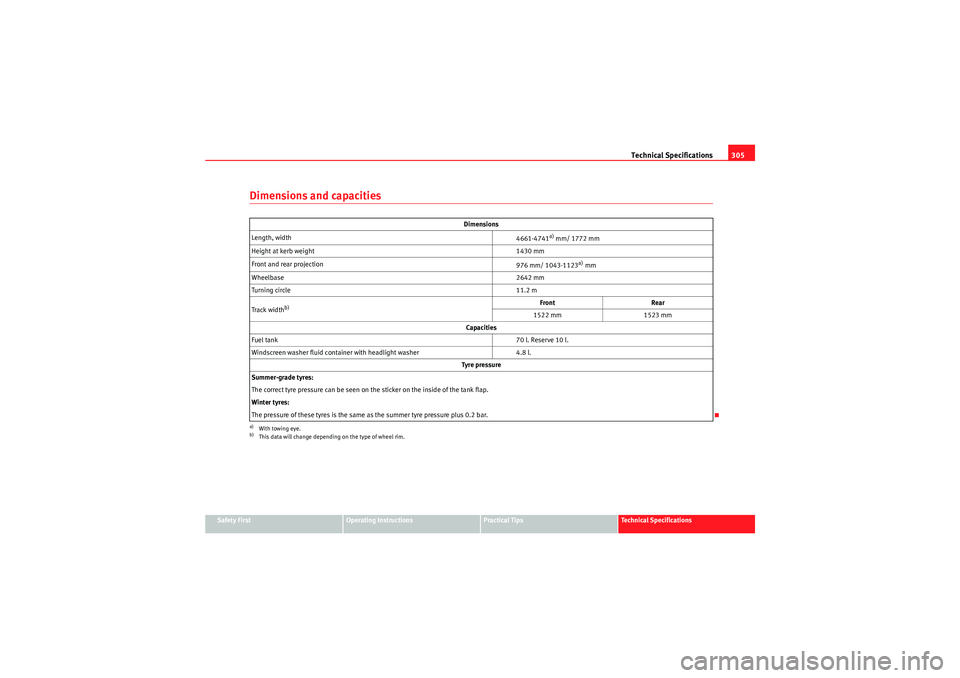
Dimensions and capacities
Dimensions
Length, width 4661-4741
a) mm/ 1772 mm
a)With towing eye.Height at kerb weight1430 mm
Front and rear projection 976 mm/ 1043-1123
a) mm
Wheelbase 2642 mm
Turning circle 11.2 m
Track width
b)
b)This data will change depending on the type of wheel rim.
Front Rear
1522 mm 1523 mm
Capacities
Fuel tank 70 l. Reserve 10 l.
Windscreen washer fluid container with headlight washer 4.8 l.
Tyre pressure
Summer-grade tyres:
The correct tyre pressure can be seen on the sticker on the inside of the tank flap.
Winter tyres:
The pressure of these tyres is the same as the summer tyre pressure plus 0.2 bar.
exeo_EN.book Seite 305 Montag, 30. August 2010 4:45 16