seat adjustment Seat Exeo 2011 User Guide
[x] Cancel search | Manufacturer: SEAT, Model Year: 2011, Model line: Exeo, Model: Seat Exeo 2011Pages: 313, PDF Size: 5.02 MB
Page 49 of 313
47
Child safety
WARNING
● Never install a child seat facing backwards on the front passenger
seat unless the front passenger airbag has been disabled. This could
lead to a risk of potentially fatal injuries to the child! However, if it is nec-
essary, in exceptional cases, to transport a child in the front passenger
seat, the front passenger airbag must always be disabled ⇒ page 44, De-
activating airbags. If the passenger seat has a height adjustment option,
move it to the highest position.
● For those vehicles that do not include a key lock switch to disconnect
the airbag, the vehicle must be taken to a Technical Service.
● All passengers, especially children, must assume the proper sitting
position and be properly belted in while travelling.
● Never hold children or babies on your lap, this can result in potential-
ly fatal injuries to the child!
● Never allow a child to be transported in a vehicle without being prop-
erly secured, or to stand up or kneel on a seat while travelling. In an acci-
dent, the child could be flung through the vehicle, causing possibly fatal
injuries to themselves and to the other passengers.
● If children assume an improper sitting position when the vehicle is
moving, they expose themselves to greater risk of injury in the event of a
sudden braking manoeuvre or in an accident. This is particularly impor-
tant if the child is travelling on the front passenger seat and the airbag
system is triggered in an accident; as this could cause serious injury or
even death.
● A suitable child seat can protect your child!
● Never leave an unsupervised child alone on a child seat or in the vehi-
cle.
● Depending on weather conditions, it may become extremely hot or
cold inside the vehicle. This can be fatal.WARNING (Continued)
● Children who are less than 1.5 metres tall must not wear a normal
seat belt without a child seat, as this could cause injuries to the abdomi-
nal and neck areas during a sudden braking manoeuvre or in an accident.
● Do not allow the seat belt to become twisted or jammed, or to rub on
any sharp edges.
● Incorrectly worn seat belts can cause injuries even in a minor colli-
sion or in sudden braking manoeuvres.
● The seat belt provides maximum protection only when the seat belt is
properly positioned ⇒ page 23, Seat belts.
● Only one child may occupy a child seat ⇒ page 48, Child seats.
Safety FirstOperating InstructionsPractical TipsTechnical Specifications
Page 56 of 313
54Child safety
Fitting the Top Tether child restraint to the anchoring point
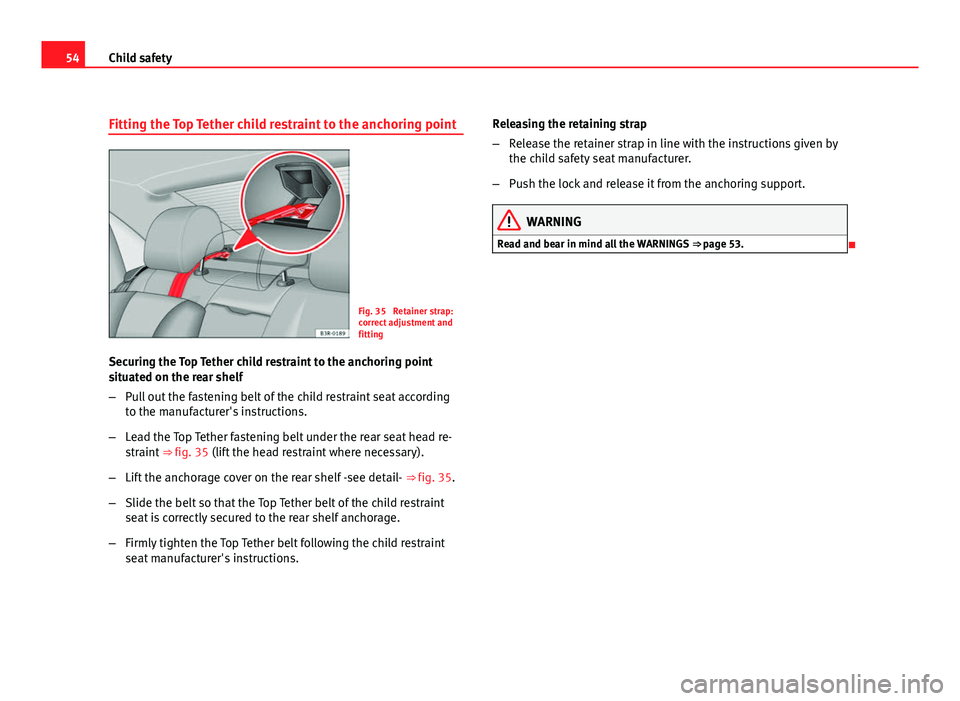
Fig. 35 Retainer strap:
correct adjustment and
fitting
Securing the Top Tether child restraint to the anchoring point
situated on the rear shelf
– Pull out the fastening belt of the child restraint seat according
to the manufacturer's instructions.
– Lead the Top Tether fastening belt under the rear seat head re-
straint ⇒ fig. 35 (lift the head restraint where necessary).
– Lift the anchorage cover on the rear shelf -see detail- ⇒ fig. 35.
– Slide the belt so that the Top Tether belt of the child restraint
seat is correctly secured to the rear shelf anchorage.
– Firmly tighten the Top Tether belt following the child restraint
seat manufacturer's instructions. Releasing the retaining strap
–
Release the retainer strap in line with the instructions given by
the child safety seat manufacturer.
– Push the lock and release it from the anchoring support.
WARNING
Read and bear in mind all the WARNINGS ⇒ page 53.
Page 134 of 313
132Lights and visibility
Retracting both exterior mirrors
–Turn the knob to position A
.
It is advisable to fold the exterior mirrors, for example when parking or when
driving through narrow spaces.
Heated mirrors
The mirrors are heated (depending on the outside temperature) when the
heated rear window is switched on ⇒ page 126.
The exterior mirror heating is not activated in temperatures above approxi-
mately 20 °C.
Memory for exterior mirrors*
In vehicles with memory function for the driver seat, the setting of the exte-
rior mirrors is automatically stored together with the seat position
⇒ page 137.
Tilting function for exterior mirror on the passenger side* (only if equipped
with memory for exterior mirrors)
When reverse gear is engaged, the mirror surface tilts slightly downwards,
provided the mirror control is switched to the exterior mirror on the passen-
ger side (knob in position R
⇒ fig. 104). This provides a better view of the
kerb when parking.
The mirror returns to its original position as soon as reverse gear is disen-
gaged and the vehicle is driven forwards at a speed above 15 km/h, or
when the mirror control is turned to position L
or to the neutral position
0.
CAUTION
● Rear view convex or aspheric* mirrors increase the field of vision, al-
though objects appear smaller and further away in the mirrors. Therefore,
you should not rely on these mirrors for judging the distance of vehicles be-
hind.
● If one of the mirror housings is knocked out of position (e.g. when park-
ing), the mirrors must first be fully retracted with the electric control. Do not
readjust the mirror housing by hand, as this will interfere with the mirror ad-
juster function.
Note
If the electrical adjustment ever fails to operate, the mirrors can be adjusted
by hand by lightly pressing the edge of the mirror glass.
Page 135 of 313
133
Seats and storage compartments
Seats and storage compartments Manual adjustment of the front seats
Seat adjuster controls
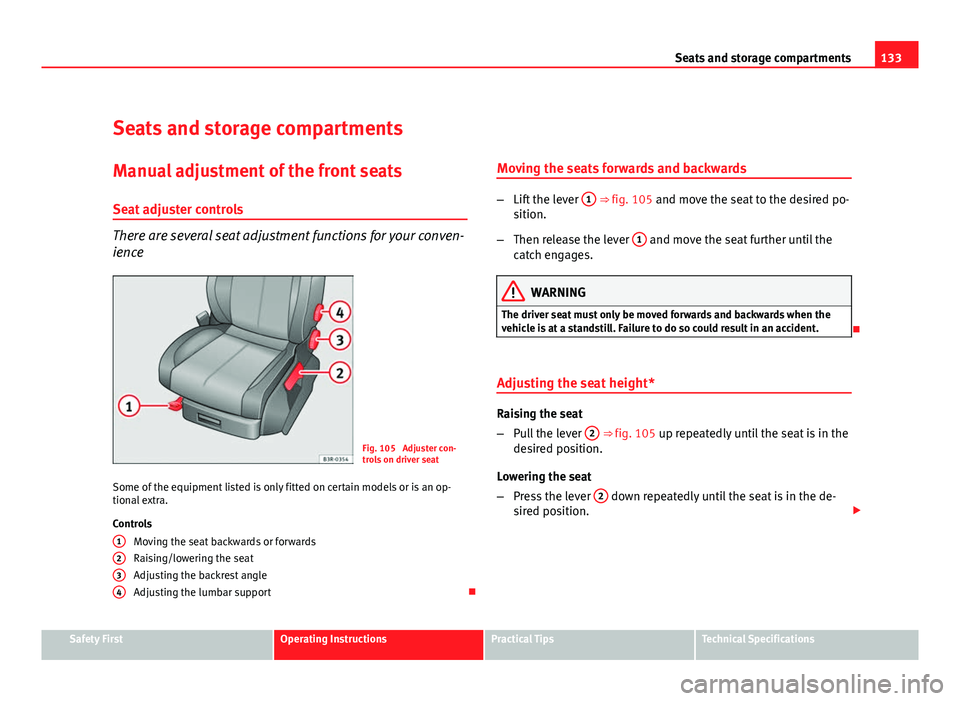
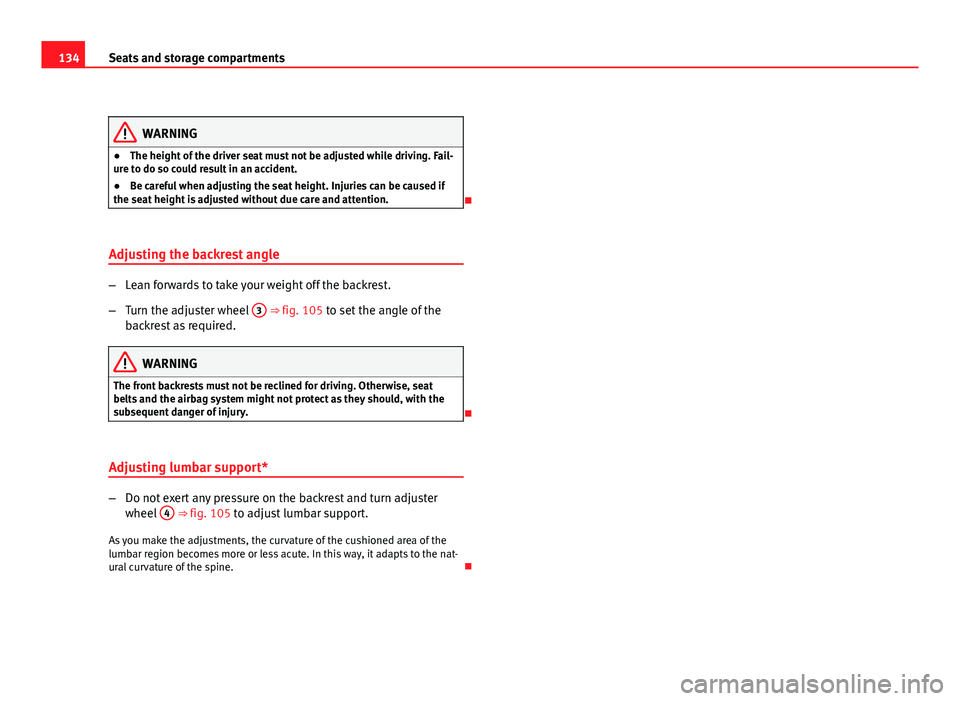
There are several seat adjustment functions for your conven-
ience
Fig. 105 Adjuster con-
trols on driver seat
Some of the equipment listed is only fitted on certain models or is an op-
tional extra.
Controls Moving the seat backwards or forwards
Raising/lowering the seat
Adjusting the backrest angle
Adjusting the lumbar support
1
234
Moving the seats forwards and backwards
–
Lift the lever 1 ⇒ fig. 105 and move the seat to the desired po-
sition.
– Then release the lever 1
and move the seat further until the
catch engages.
WARNING
The driver seat must only be moved forwards and backwards when the
vehicle is at a standstill. Failure to do so could result in an accident.
Adjusting the seat height*
Raising the seat
– Pull the lever 2
⇒ fig. 105 up repeatedly until the seat is in the
desired position.
Lowering the seat
– Press the lever 2
down repeatedly until the seat is in the de-
sired position.
Safety FirstOperating InstructionsPractical TipsTechnical Specifications
Page 136 of 313
134Seats and storage compartments
WARNING
● The height of the driver seat must not be adjusted while driving. Fail-
ure to do so could result in an accident.
● Be careful when adjusting the seat height. Injuries can be caused if
the seat height is adjusted without due care and attention.
Adjusting the backrest angle
– Lean forwards to take your weight off the backrest.
– Turn the adjuster wheel 3
⇒ fig. 105 to set the angle of the
backrest as required.
WARNING
The front backrests must not be reclined for driving. Otherwise, seat
belts and the airbag system might not protect as they should, with the
subsequent danger of injury.
Adjusting lumbar support*
– Do not exert any pressure on the backrest and turn adjuster
wheel 4 ⇒ fig. 105 to adjust lumbar support.
As you make the adjustments, the curvature of the cushioned area of the
lumbar region becomes more or less acute. In this way, it adapts to the nat-
ural curvature of the spine.
Page 137 of 313

135
Seats and storage compartments
Electric adjustment of front seats*
Adjusting the seat
The arrangement of the switches corresponds with the de-
sign of the seats.
Fig. 106 Front seat: Ad-
juster controls
Fig. 107 Front seat: Seat
adjustment switches
The adjustment switches for the seat and backrest correspond with
the layout, design and operation of the seat. The seats can be ad-
justed merely by pressing the corresponding switch in the required
direction.
Moving the seat forwards / backwards
– Press switch A
⇒ fig. 106 forwards or backwards 1 ⇒ fig. 107
⇒ .
Raising/lowering the seat
– Press switch A
up or down ⇒ .
Raising/lowering the front part of the seat
– Press the front of switch A
up or down 2 ⇒ .
Raising/lowering the rear part of the seat
– Press the rear of switch A
up or down 3 ⇒ .
Safety FirstOperating InstructionsPractical TipsTechnical Specifications
Page 138 of 313
136Seats and storage compartments
Controls
Seat adjustment
Backrest adjustment
Lumbar support*
WARNING
● The electrical seat adjustment also works when the ignition is off or
when the key is not in the ignition. To avoid accidental injuries, never
leave children unattended in the vehicle.
● For safety reasons, the seat must only be adjusted when the vehicle
is at a standstill. Failure to do so could result in an accident.
● Be careful when adjusting the seat height. Injuries can be caused if
the seat height is adjusted without due care and attention.
Adjusting the backrest angle
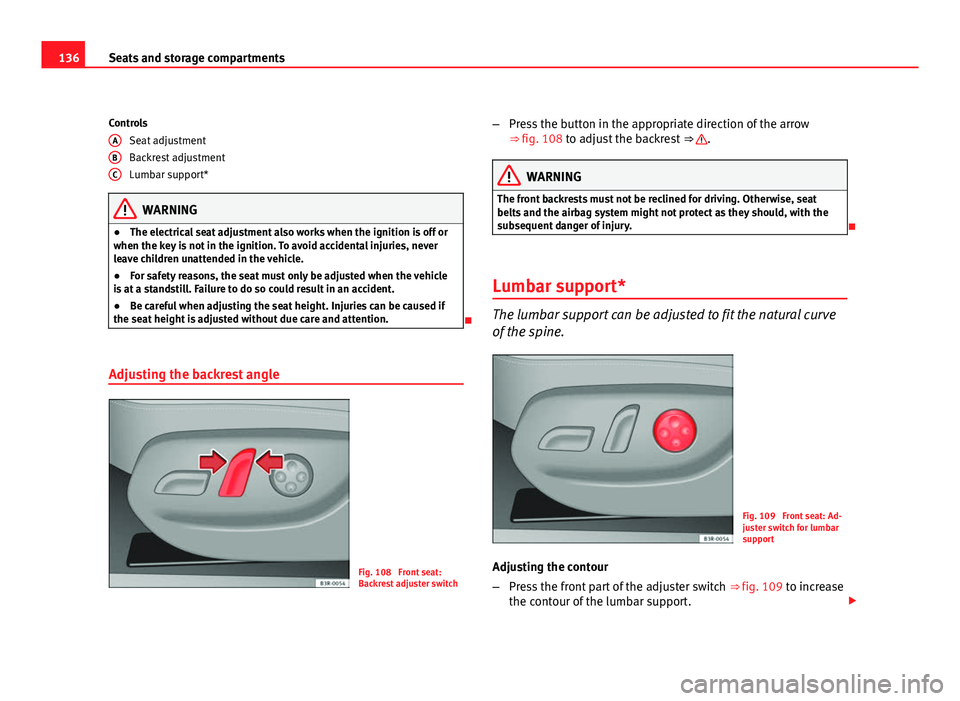
Fig. 108 Front seat:
Backrest adjuster switch
A
BC
–
Press the button in the appropriate direction of the arrow
⇒ fig. 108 to adjust the backrest ⇒ .
WARNING
The front backrests must not be reclined for driving. Otherwise, seat
belts and the airbag system might not protect as they should, with the
subsequent danger of injury.
Lumbar support*
The lumbar support can be adjusted to fit the natural curve
of the spine.
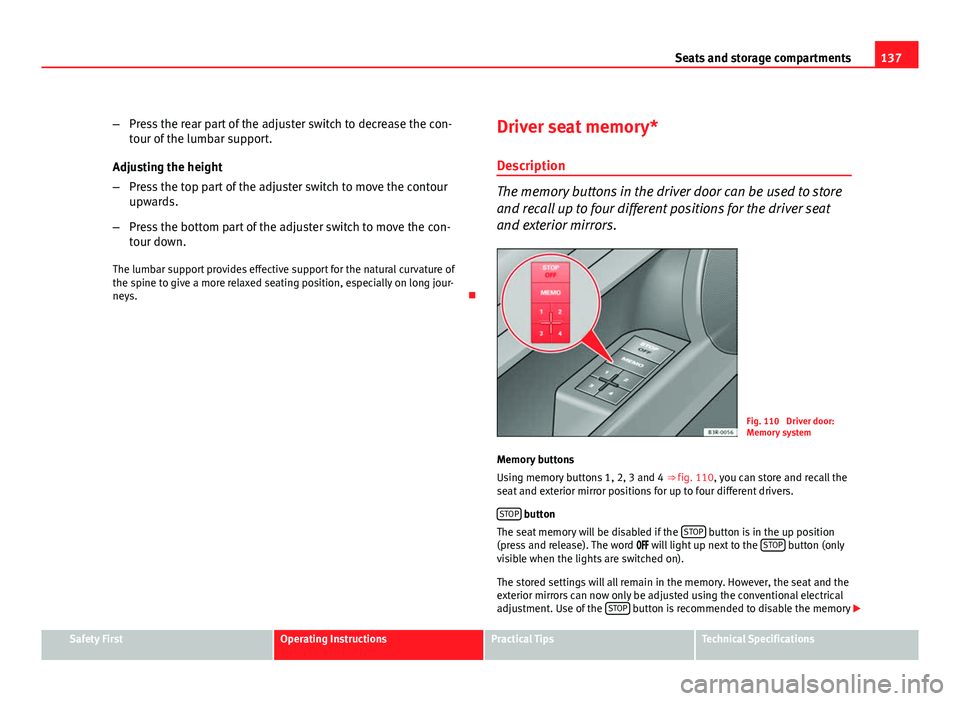
Fig. 109 Front seat: Ad-
juster switch for lumbar
support
Adjusting the contour
– Press the front part of the adjuster switch ⇒ fig. 109 to increase
the contour of the lumbar support.
Page 139 of 313
137
Seats and storage compartments
– Press the rear part of the adjuster switch to decrease the con-
tour of the lumbar support.
Adjusting the height
– Press the top part of the adjuster switch to move the contour
upwards.
– Press the bottom part of the adjuster switch to move the con-
tour down.
The lumbar support provides effective support for the natural curvature of
the spine to give a more relaxed seating position, especially on long jour-
neys. Driver seat memory*
Description
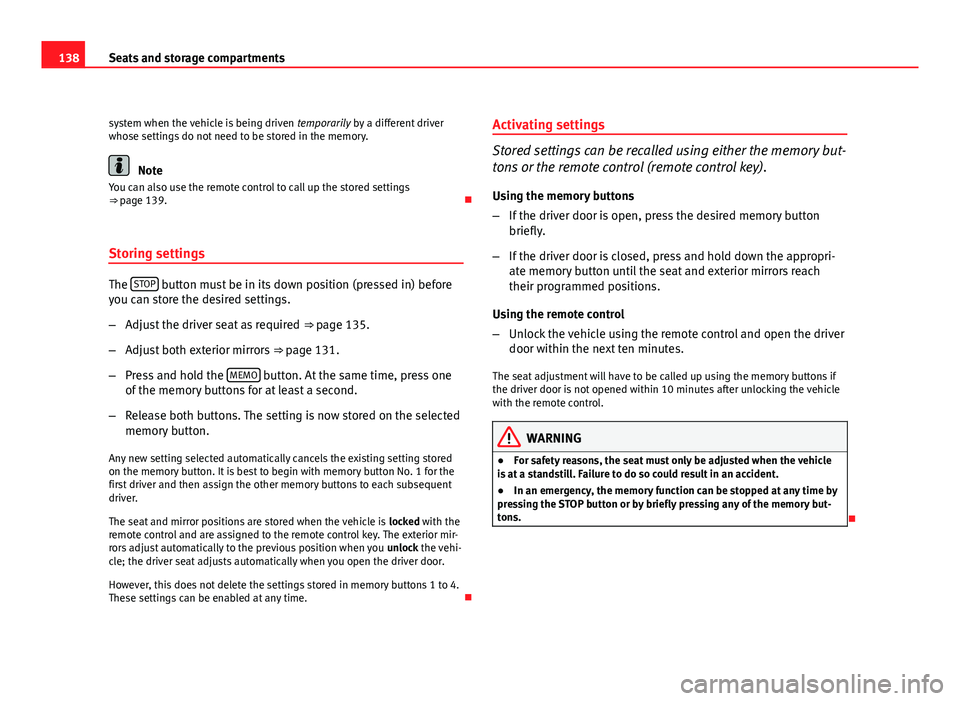
The memory buttons in the driver door can be used to store
and recall up to four different positions for the driver seat
and exterior mirrors.
Fig. 110 Driver door:
Memory system
Memory buttons
Using memory buttons 1, 2, 3 and 4 ⇒ fig. 110, you can store and recall the
seat and exterior mirror positions for up to four different drivers.
STOP
button
The seat memory will be disabled if the STOP button is in the up position
(press and release). The word will light up next to the STOP button (only
visible when the lights are switched on).
The stored settings will all remain in the memory. However, the seat and the
exterior mirrors can now only be adjusted using the conventional electrical
adjustment. Use of the STOP
button is recommended to disable the memory
Safety FirstOperating InstructionsPractical TipsTechnical Specifications
Page 140 of 313
138Seats and storage compartments
system when the vehicle is being driven temporarily by a different driver
whose settings do not need to be stored in the memory.
Note
You can also use the remote control to call up the stored settings
⇒ page 139.
Storing settings
The STOP button must be in its down position (pressed in) before
you can store the desired settings.
– Adjust the driver seat as required ⇒ page 135.
– Adjust both exterior mirrors ⇒ page 131.
– Press and hold the MEMO
button. At the same time, press one
of the memory buttons for at least a second.
– Release both buttons. The setting is now stored on the selected
memory button.
Any new setting selected automatically cancels the existing setting stored
on the memory button. It is best to begin with memory button No. 1 for the
first driver and then assign the other memory buttons to each subsequent
driver.
The seat and mirror positions are stored when the vehicle is locked with the
remote control and are assigned to the remote control key. The exterior mir-
rors adjust automatically to the previous position when you unlock the vehi-
cle; the driver seat adjusts automatically when you open the driver door.
However, this does not delete the settings stored in memory buttons 1 to 4.
These settings can be enabled at any time. Activating settings
Stored settings can be recalled using either the memory but-
tons or the remote control (remote control key).
Using the memory buttons
– If the driver door is open, press the desired memory button
briefly.
– If the driver door is closed, press and hold down the appropri-
ate memory button until the seat and exterior mirrors reach
their programmed positions.
Using the remote control
– Unlock the vehicle using the remote control and open the driver
door within the next ten minutes.
The seat adjustment will have to be called up using the memory buttons if
the driver door is not opened within 10 minutes after unlocking the vehicle
with the remote control.
WARNING
● For safety reasons, the seat must only be adjusted when the vehicle
is at a standstill. Failure to do so could result in an accident.
● In an emergency, the memory function can be stopped at any time by
pressing the STOP button or by briefly pressing any of the memory but-
tons.
Page 304 of 313

Bonnet . . . . . . . . . . . . . . . . . . . . . . . . . . . . . . . 220Closing . . . . . . . . . . . . . . . . . . . . . . . . . . . . 222
Opening . . . . . . . . . . . . . . . . . . . . . . . . . . . 221
Releasing . . . . . . . . . . . . . . . . . . . . . . . . . . 220
Brake light Failure control . . . . . . . . . . . . . . . . . . . . . . . . 80
Brake pads . . . . . . . . . . . . . . . . . . . . . . . . . . . . 191
Brakes . . . . . . . . . . . . . . . . . . . . . . . . . . . . . . . . 191 Brake assist system . . . . . . . . . . . . . . . . . . 186
Brake fluid . . . . . . . . . . . . . . . . . . . . . . . . . 230
Worn brake pads . . . . . . . . . . . . . . . . . . . . . 81
Brake servo . . . . . . . . . . . . . . . . . . . . . . . . . . . . 191
Brake system Brakes . . . . . . . . . . . . . . . . . . . . . . . . . . . . . 188
Brake servo . . . . . . . . . . . . . . . . . . . . . . . . . 188
Malfunction . . . . . . . . . . . . . . . . . . . . . . . . . 77
Braking distance . . . . . . . . . . . . . . . . . . . . . . . 191
Bulb change general notes . . . . . . . . . . . . . . . . . . . . . . . 258
C
Car care Exterior . . . . . . . . . . . . . . . . . . . . . . . . . . . . 207
Catalytic converter . . . . . . . . . . . . . . . . . . . . . . 192
CCS . . . . . . . . . . . . . . . . . . . . . . . . . . . . . . . . . . 173
Central locking . . . . . . . . . . . . . . . . . . . . . . . . . . 99 Manual locking . . . . . . . . . . . . . . . . . . . . . . 102
Sunroof: opening and closing . . . . . . . . . . 112
Central locking system Anti-theft security system . . . . . . . . . . . . . 100
Locking . . . . . . . . . . . . . . . . . . . . . . . . . . . . 100 Locking and unlocking the vehicle from in-
side . . . . . . . . . . . . . . . . . . . . . . . . . . . . . 101
Opening and closing the windows . . . . . . 110
Security central locking . . . . . . . . . . . . . . . 101
Switch on the driver door . . . . . . . . . . . . . . 101
Tailgate . . . . . . . . . . . . . . . . . . . . . . . . . . . . 103
Unlocking . . . . . . . . . . . . . . . . . . . . . . . . . . . 99
Cetane number . . . . . . . . . . . . . . . . . . . . . . . . . 219
Changing tail light bulbs . . . . . . . . . . . . . . . . . 269
Changing the main headlight bulb Main headlight . . . . . . . . . . . . . . . . . . . . . . 262
Changing the main headlight bulbs Dipped beam headlight . . . . . . . . . . . . . . . 263
Changing the tail lights Luggage compartment lights . . . . . . . . . . 278
Changing windscreen wiper blades . . . . . . . . 229
Chassis number . . . . . . . . . . . . . . . . . . . . . . . . 287
Childproof lock Rear doors . . . . . . . . . . . . . . . . . . . . . . . . . . 104
Child safety . . . . . . . . . . . . . . . . . . . . . . . . . . . . . 46
Child safety seat ISOFIX system . . . . . . . . . . . . . . . . . . . . . . . . 52
Child seat . . . . . . . . . . . . . . . . . . . . . . . . . . . . . . 48 Categorisation in groups . . . . . . . . . . . . . . . 48
Group 1 . . . . . . . . . . . . . . . . . . . . . . . . . . . . . 49
Group 2 . . . . . . . . . . . . . . . . . . . . . . . . . . . . . 49
Group 3 . . . . . . . . . . . . . . . . . . . . . . . . . . . . . 49
Groups 0 and 0+ . . . . . . . . . . . . . . . . . . . . . . 48
Safety notes . . . . . . . . . . . . . . . . . . . . . . . . . 46
Securing . . . . . . . . . . . . . . . . . . . . . . . . . . . . 51
Child seats on the front passenger seat . . . . . . . . . . . . . 29 Cigarette lighter . . . . . . . . . . . . . . . . . . . . . . . . 148
Cleaning alloy wheel rims . . . . . . . . . . . . . . . . 211
Cleaning chrome . . . . . . . . . . . . . . . . . . . . . . . 210
Cleaning engine compartment . . . . . . . . . . . . 212
Cleaning steel wheel rims . . . . . . . . . . . . . . . . 210
Cleaning windows . . . . . . . . . . . . . . . . . . . . . . 209
Clock, setting . . . . . . . . . . . . . . . . . . . . . . . . . . . 61
Cloth seat covers cleaning . . . . . . . . . . . . . . . . 213
Coat hooks . . . . . . . . . . . . . . . . . . . . . . . . . . . . 153
Cockpit . . . . . . . . . . . . . . . . . . . . . . . . . . . . . . . . 57
Overview . . . . . . . . . . . . . . . . . . . . . . . . . . . . 57
Compartments . . . . . . . . . . . . . . . . . . . . . . . . . 152 In the door trim . . . . . . . . . . . . . . . . . . . . . . 153
In the front seats . . . . . . . . . . . . . . . . . . . . 154
Coolant Checking the level . . . . . . . . . . . . . . . . . . . 226
Coolant fluid Antifreeze . . . . . . . . . . . . . . . . . . . . . . . . . . 225
Coolant fluid additive . . . . . . . . . . . . . . . . . 225
Topping up . . . . . . . . . . . . . . . . . . . . . . . . . 227
Cooling system Coolant temperature gauge . . . . . . . . . . . . . 60
Malfunction . . . . . . . . . . . . . . . . . . . . . . . . . 78
Correct adjustment of front seat head re- straints . . . . . . . . . . . . . . . . . . . . . . . . . . . . . . . 13
Correct adjustment of rear seat head restraints In-use and non-use positions . . . . . . . . . . . 14
Correct sitting position Front passenger . . . . . . . . . . . . . . . . . . . . . . 12
Incorrect sitting position . . . . . . . . . . . . . . . 14
302 Index