roof Seat Exeo 2011 Owner's Guide
[x] Cancel search | Manufacturer: SEAT, Model Year: 2011, Model line: Exeo, Model: Seat Exeo 2011Pages: 313, PDF Size: 5.02 MB
Page 210 of 313
208Vehicle maintenance and cleaning
CAUTION
● Never remove dirt, mud or dust if the vehicle surface is dry. Never use a
dry cloth or sponge for cleaning purposes. This could scratch the paintwork
or glass on your vehicle.
● Washing the vehicle in low temperatures: when washing the vehicle
with a hose, do not direct water into the lock cylinders or the gaps around
the doors, tailgate, or sunroof. Risk of freezing.
For the sake of the environment
To protect environment, the vehicle should be washed only in specially pro-
vided wash bays. This prevents toxic, oil-laden waste water entering the
sewerage system. In some places, washing vehicles outside wash bays is
prohibited.
Note
Do not wash the vehicle in direct sunlight.
Washing the vehicle with a high pressure cleaner
Be particularly careful when using a high pressure cleaner!
– Always observe the instructions for the high-pressure cleaner,
particularly those concerning the pressure and the spraying
distance.
– Increase the spraying distance for soft materials and painted
bumpers.
– Do not use a high pressure cleaner to remove ice or snow from
windows ⇒ page 209.
– Never use concentrated jet nozzles (“rotating jets”) ⇒
. –
After washing, avoid sudden and sharp braking. “Dry” the
brakes by braking several times ⇒ page 191.
WARNING
● Never wash tyres with a concentrated jet (“rotating nozzle”). Even at
large spraying distances and short cleaning times, visible and invisible
damage can occur to the tyres. This may cause an accident.
● Water, ice and salt on the brakes can reduce braking efficiency. Risk
of accident.
CAUTION
● Do not use water hotter than 60 °C. This could damage the vehicle.
● To avoid damage to the vehicle, keep a sufficient distance from sensitive
materials such as flexible hoses, plastic, soundproofing material, etc. This
is also important for bumpers painted in the colour of the bodywork. The
closer the nozzle is to the surface, the greater the wear on the material.
Vehicle paint maintenance
Regular waxing protects the paintwork. You need to apply wax to your vehicle if water does not form small drops
and run off the paintwork when it is clean.
Good quality hard wax products are available at your Authorised Service
Centre.
Regular wax applications help to protect the paintwork from environmental
contaminants ⇒ page 206. It is also effective in protecting against minor
scratches.
Even if a wax solution is used regularly in the vehicle washing tunnel, it is
advisable to protect the paint with a hard wax coating at least twice a year.
Page 258 of 313

256If and when
Fuses
Changing fuses
If a fuse has blown, it must be replaced.
Fig. 185 Left side of
dash panel: Fuse box cov-
er
Fig. 186 Schematic
drawing of fuse box at
the left-hand end of dash
panel: Fuses (without
fuse cover) –
Switch off the ignition and its failed electrical component.
– Remove the fuse cover using a screwdriver ⇒ fig. 185.
– Identify the fuse corresponding to the damaged electric con-
sumer ⇒ page 257, Fuse assignment.
– Take the plastic clip from inside the fuse cover, fit it onto the
blown fuse, and pull the fuse out.
– Replace the blown fuse (which will have a melted metal strip)
with a new fuse of the same amp rating.
– Fit the fuse cover back on.
The individual electrical circuits are protected by fuses. The fuses are loca-
ted behind a cover at the left-hand end of the dash panel.
Two spare fuses and a sticker identifying the fuses are provided on the in-
side of the fuse cover. There is also a crank handle for operating the sun-
roof* by hand (if the electrical system fails).
CAUTION
Never “repair” damaged fuses and never replace them with fuses with a
higher rating. Failure to comply could result in fire. It could also cause dam-
age to other parts of the electrical system.
Note
If a newly replaced fuse blows again after a short time, the electrical system
must be checked by a qualified workshop as soon as possible.
Page 259 of 313
257
If and when
Fuse assignment
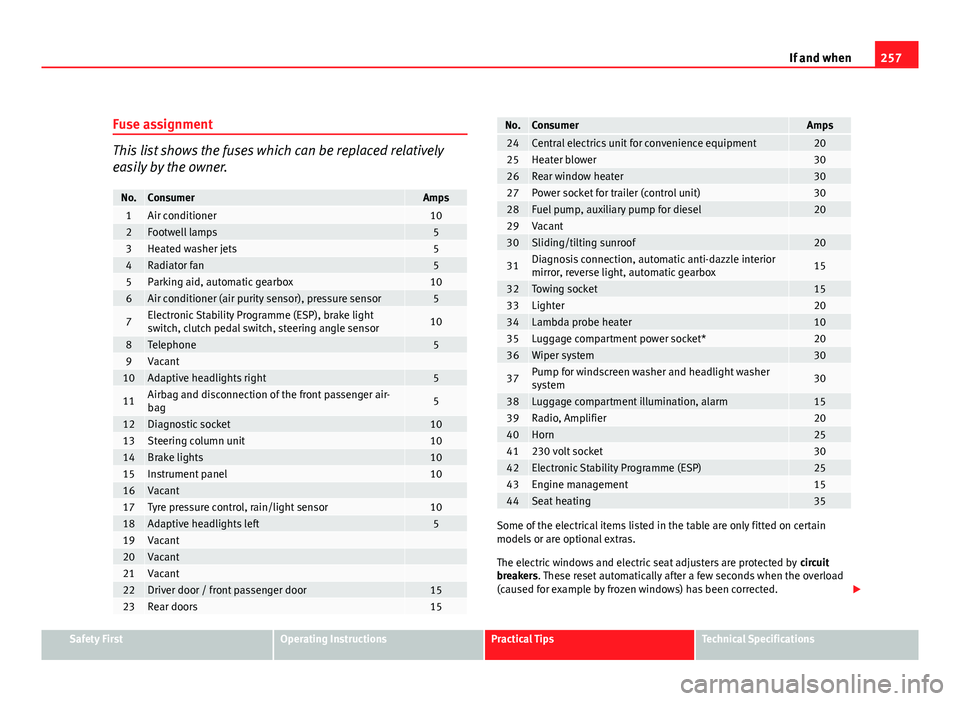
This list shows the fuses which can be replaced relatively
easily by the owner.
No.ConsumerAmps1Air conditioner102Footwell lamps53Heated washer jets54Radiator fan55Parking aid, automatic gearbox106Air conditioner (air purity sensor), pressure sensor5
7Electronic Stability Programme (ESP), brake light
switch, clutch pedal switch, steering angle sensor10
8Telephone59Vacant 10Adaptive headlights right5
11Airbag and disconnection of the front passenger air-
bag5
12Diagnostic socket1013Steering column unit1014Brake lights1015Instrument panel1016Vacant 17Tyre pressure control, rain/light sensor1018Adaptive headlights left519Vacant 20Vacant 21Vacant 22Driver door / front passenger door1523Rear doors15
No.ConsumerAmps24Central electrics unit for convenience equipment2025Heater blower3026Rear window heater3027Power socket for trailer (control unit)3028Fuel pump, auxiliary pump for diesel2029Vacant 30Sliding/tilting sunroof20
31Diagnosis connection, automatic anti-dazzle interior
mirror, reverse light, automatic gearbox15
32Towing socket1533Lighter2034Lambda probe heater1035Luggage compartment power socket*2036Wiper system30
37Pump for windscreen washer and headlight washer
system30
38Luggage compartment illumination, alarm1539Radio, Amplifier2040Horn2541230 volt socket3042Electronic Stability Programme (ESP)2543Engine management1544Seat heating35
Some of the electrical items listed in the table are only fitted on certain
models or are optional extras.
The electric windows and electric seat adjusters are protected by circuit
breakers. These reset automatically after a few seconds when the overload
(caused for example by frozen windows) has been corrected.
Safety FirstOperating InstructionsPractical TipsTechnical Specifications
Page 293 of 313

291
Technical specifications
Petrol engine 1.8 88 kW (120 PS)
Engine specifications Power output in kW (PS) rpm 88 (120) / 3650-6200
Maximum torque in Nm at rpm 230 / 1500-3650
No. of cylinders/capacity in cm3
4 / 1798
Fuel Super 95 RON a)
/ Super 91 RON b)
a)
Research Octane Number = Anti-detonation rating of the petrol.
b) Slight power loss.
Performance Maximum speed in km/h 202
Acceleration from 0-80 km/h in sec. 7
Acceleration from 0-100 km/h in sec. 10.6
Weights
Gross vehicle weight in kg 1980
Weight in running order (with driver) in kg 1495
Gross front axle weight in kg 1075
Gross rear axle weight in kg 1030
Permitted roof load in kg 75
Trailer weight
Trailer without brakes in kg 740
Trailer with brakes, gradients up to 8% in kg 1500
Trailer with brakes, gradients up to 12% in kg 1300
Engine oil capacity
Approximate engine oil capacity with oil filter change 4.6 litres
Safety FirstOperating InstructionsPractical TipsTechnical Specifications
Page 294 of 313

292Technical specifications
Petrol engine 1.8 118 kW (160 PS)
Engine specifications
Power output in kW (PS) rpm 118 (160) / 4500-6200
Maximum torque in Nm at rpm 250 / 1500-4500
No. of cylinders/capacity in cm3
4 / 1798
Fuel Super 95 RON a)
/ Super 91 RON b)
a)
Research Octane Number = Anti-detonation rating of the petrol.
b) Slight power loss.
Performance Maximum speed in km/h 225
Acceleration from 0-80 km/h in sec. 5.9
Acceleration from 0-100 km/h in sec. 8.6
Weights
Gross vehicle weight in kg 1980
Weight in running order (with driver) in kg 1495
Gross front axle weight in kg 1075
Gross rear axle weight in kg 1030
Permitted roof load in kg 75
Trailer weight
Trailer without brakes in kg 740
Trailer with brakes, gradients up to 8% in kg 1500
Trailer with brakes, gradients up to 12% in kg 1300
Engine oil capacity
Approximate engine oil capacity with oil filter change 4.6 litres
Page 295 of 313

293
Technical specifications
Petrol engine 2.0 147 kW (200 PS)
Engine specifications Power output in kW (PS) rpm 147 (200) / 5100-6000
Maximum torque in Nm at rpm 280 / 1800-5000
No. of cylinders/capacity in cm3
4 / 1984
Fuel Super 98 RON a)
/Super 95 RON b)
a)
Research Octane Number = Anti-detonation rating of the petrol.
b) Slight power loss.
Performance ManualAutomatic
Maximum speed in km/h 241 235
Acceleration from 0-80 km/h in sec. 5.4 5.3
Acceleration from 0-100 km/h in sec. 7.3 7.3
Weights
Manual Automatic
Gross vehicle weight in kg 1990 2015
Weight in running order (with driver) in kg 1505 1530
Gross front axle weight in kg 1090 1120
Gross rear axle weight in kg 1030 1030
Permitted roof load in kg 75 75
Trailer weight
ManualAutomatic
Trailer without brakes in kg 750 750
Trailer with brakes, gradients up to 8% in kg 1600 1700
Trailer with brakes, gradients up to 12% in kg 1400 1500
Safety FirstOperating InstructionsPractical TipsTechnical Specifications
Page 296 of 313

294Technical specifications
Engine oil capacity Approximate engine oil capacity with oil filter change 4.5 litres
Petrol engine 2.0 155 kW (211 PS)
Engine specifications Power output in kW (PS) rpm 155 (211) / 4600-6000
Maximum torque in Nm at rpm 320 / 1500-4600
No. of cylinders/capacity in cm3
4 / 1984
Fuel Super 95 RON a)
/ Super 91 RON b)
a)
Research Octane Number = Anti-detonation rating of the petrol.
b) Slight power loss.
Performance Maximum speed in km/h 244
Acceleration from 0-80 km/h in sec. 5.3
Acceleration from 0-100 km/h in sec. 7.1
Weights
Gross vehicle weight in kg 1990
Weight in running order (with driver) in kg 1505
Gross front axle weight in kg 1090
Gross rear axle weight in kg 1030
Permitted roof load in kg 75
Trailer weight
Trailer without brakes in kg 750
Trailer with brakes, gradients up to 8% in kg 1700
Trailer with brakes, gradients up to 12% in kg 1500
Page 297 of 313

295
Technical specifications
Engine oil capacity Approximate engine oil capacity with oil filter change 4.6 litres
Diesel engine 2.0 TDI CR 88 kW (120 PS)
Engine specifications Power output in kW (PS) rpm 88 (120) / 4000
Maximum torque in Nm at rpm 290 / 1750-2500
No. of cylinders/capacity in cm3
4 / 1968
Fuel Min. 51 CN a)
a)
Cetane Number (cetane index) = Measure of the combustion power of the diesel
Performance Maximum speed in km/h 204
Acceleration from 0-80 km/h in sec. 7.2
Acceleration from 0-100 km/h in sec. 10.5
Weights
Gross vehicle weight in kg 1990
Weight in running order (with driver) in kg 1505
Gross front axle weight in kg 1100
Gross rear axle weight in kg 1015
Permitted roof load in kg 75
Trailer weight
Trailer without brakes in kg 750
Trailer with brakes, gradients up to 8% in kg 1500
Trailer with brakes, gradients up to 12% in kg 1300
Safety FirstOperating InstructionsPractical TipsTechnical Specifications
Page 298 of 313

296Technical specifications
Engine oil capacity Approximate engine oil capacity with oil filter change 4.3 litres
Diesel engine 2.0 TDI CR 105 kW (143 PS)
Engine specifications Power output in kW (PS) rpm 105 (143) / 4200
Maximum torque in Nm at rpm 320 / 1750-2500
No. of cylinders/capacity in cm3
4 / 1968
Fuel Min. 51 CN a)
a)
Cetane Number (cetane index) = Measure of the combustion power of the diesel
Performance ManualAutomatic
Maximum speed in km/h 215 208
Acceleration from 0-80 km/h in sec. 6.3 6.3
Acceleration from 0-100 km/h in sec. 9.2 9.3
Weights
Manual Automatic
Gross vehicle weight in kg 1990 2030
Weight in running order (with driver) in kg 1505 1545
Gross front axle weight in kg 1100 1135
Gross rear axle weight in kg 1015 1030
Permitted roof load in kg 75 75
Page 299 of 313

297
Technical specifications
Trailer weight ManualAutomatic
Trailer without brakes in kg 750 750
Trailer with brakes, gradients up to 8% in kg 1800 1900
Trailer with brakes, gradients up to 12% in kg 1400 1700
Engine oil capacity
Approximate engine oil capacity with oil filter change 4.3 litres
Diesel engine 2.0 TDI CR 125 kW (170 PS)
Engine specifications Power output in kW (PS) rpm 125 (170) / 4200
Maximum torque in Nm at rpm 350 / 1750-2500
No. of cylinders/capacity in cm3
4 / 1968
Fuel Min. 51 CN a)
a)
Cetane Number (cetane index) = Measure of the combustion power of the diesel
Performance Maximum speed in km/h 229
Acceleration from 0-80 km/h in sec. 5.9
Acceleration from 0-100 km/h in sec. 8.4
Weights
Gross vehicle weight in kg 2015
Weight in running order (with driver) in kg 1530
Gross front axle weight in kg 1115
Gross rear axle weight in kg 1030
Permitted roof load in kg 75
Safety FirstOperating InstructionsPractical TipsTechnical Specifications