cooling Seat Exeo 2012 User Guide
[x] Cancel search | Manufacturer: SEAT, Model Year: 2012, Model line: Exeo, Model: Seat Exeo 2012Pages: 317, PDF Size: 5.29 MB
Page 201 of 317

199
Trailer towing
Trailer towing Trailer towing
Technical requirements
The towing bracket must meet certain technical require-
ments.
Your vehicle is intended mainly for transporting passengers and luggage.
However, if suitably equipped, it can also be used to tow a trailer or cara-
van.
If your vehicle has been factory-supplied with a towing bracket, all of the
necessary technical and legal aspects for trailing towing have been taking
into account during manufacturing.
Your vehicle is fitted with a 13-pole socket for the electrical connection be-
tween the trailer and the vehicle. If the trailer has a 7-pole connector you
can use an adapter cable. This can be purchased at a Technical Service.
If a towing bracket is to be fitted after the vehicle is purchased, this must be
done according to the instructions of the towing bracket manufacturer
⇒ page 207.
WARNING
If a towing bracket is retrofitted, the installation should be carried out by
a specialised workshop.
● Particularly in high outdoor temperatures, it is not possible to drive
up long steep gradients without a suitable cooling system. The engine
would heat up.
● Incorrect installation can result in a safety risk!
Notes on towing
There are a number of points which need to be checked be-
fore towing a trailer or caravan.
– Observe the maximum permitted trailer weights ⇒ page 296.
Trailer weight
Never exceed the maximum permitted trailer weight.
If you do not load the trailer up to the maximum permitted trailer weight,
you can then climb correspondingly steeper gradients.
The maximum trailer weights listed are only applicable for altitudes up to
1000 m above sea level. With increasing altitude the engine power and
therefore the vehicle's climbing ability are impaired because of the reduced
air density. The maximum trailer weight has to be reduced accordingly. The
weight of the vehicle and trailer must be reduced by about 10% for every
subsequent 1000 m (or part thereof). This figure refers to the combined
weight of the (loaded) vehicle and (loaded) trailer.
The figures for the drawbar load that appear on the identification plate of
the towing bracket are for certification purposes only. The correct figures for
your specific model, which may be lower than these figures for the towing
bracket, are given in the registration documents and on ⇒ page 289. Also
refer to ⇒ page 296.
Distributing the load
Distribute loads in the trailer so that heavy objects are as near to the axle as
possible. Loads carried in the trailer must be secured to prevent them mov-
ing.
Safety FirstOperating InstructionsPractical TipsTechnical Specifications
Page 210 of 317

208Trailer towing
The attachment points for the towing bracket A
are on the lower part of the
vehicle.
The distance between the centre of the ball coupling and the ground should
never be lower than the indicated value, even with a fully loaded vehicle
and including the maximum drawbar load.
Elevation values for securing the towing bracket:
65 mm (minimum)
403
629 mm
1112 mm (vehicle with max. load)
from 350 to 420 mm (vehicle with max. load)
1000 mm
Fitting a towing bracket
● Driving with a trailer involves an extra effort for the vehicle. Therefore,
before fitting a towing bracket, please contact a Technical Service to check
whether your cooling system needs modification.
● The legal requirements in your country must be observed (e.g. the fitting
of a separate warning lamp).
● Certain vehicle components, e.g. the rear bumper, must be removed and
reinstalled. The towing bracket securing bolts must be tightened using a
torque wrench, and a power socket must be connected to the vehicle's elec-
trical system. This requires specialised knowledge and tools.
● Figures in the illustration show the elevation value and the attachment
points which must be considered if you are retrofitting a towing bracket. B
CDEFG
WARNING
The towing brackets should be fitted at a specialised workshop.
● If the towing bracket is incorrectly installed, there is serious danger
of accident.
● For your own safety, please observe the instructions provided by the
manufacturer of the towing bracket.
CAUTION
● If the power socket is incorrectly installed, this could cause damage to
the vehicle's electrical system.
Note
For the Sport finish, fitting a trailer bracket is not recommended due to the
design of the bumpers.
Page 229 of 317
227
Checking and refilling levels
Opening the bonnet
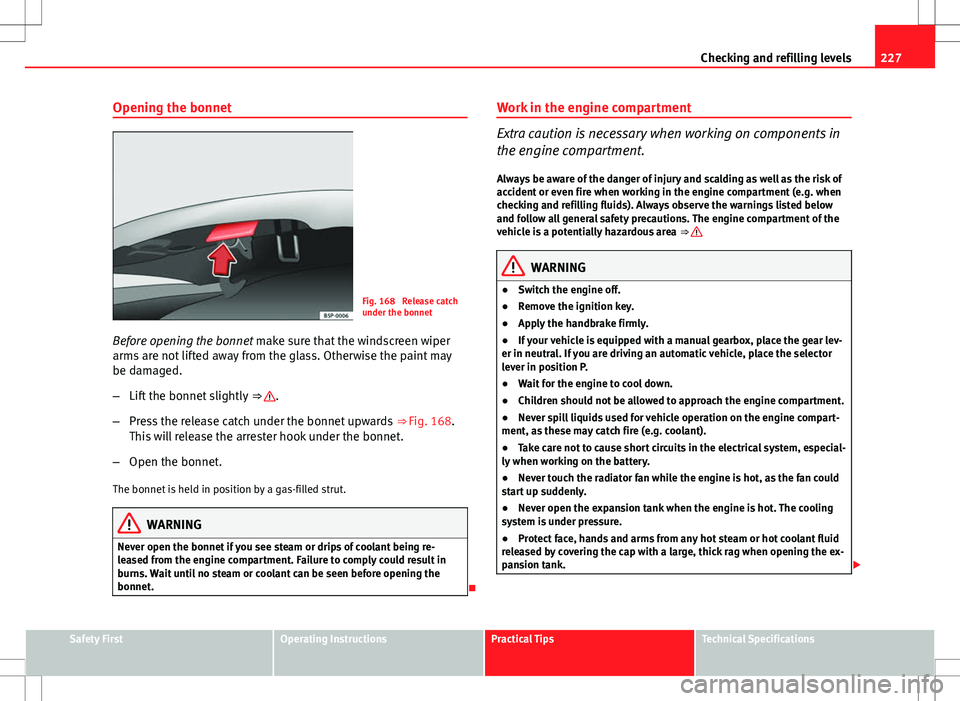
Fig. 168 Release catch
under the bonnet
Before opening the bonnet make sure that the windscreen wiper
arms are not lifted away from the glass. Otherwise the paint may
be damaged.
– Lift the bonnet slightly ⇒
.
– Press the release catch under the bonnet upwards ⇒ Fig. 168.
This will release the arrester hook under the bonnet.
– Open the bonnet.
The bonnet is held in position by a gas-filled strut.
WARNING
Never open the bonnet if you see steam or drips of coolant being re-
leased from the engine compartment. Failure to comply could result in
burns. Wait until no steam or coolant can be seen before opening the
bonnet.
Work in the engine compartment
Extra caution is necessary when working on components in
the engine compartment.
Always be aware of the danger of injury and scalding as well as the risk of
accident or even fire when working in the engine compartment (e.g. when
checking and refilling fluids). Always observe the warnings listed below
and follow all general safety precautions. The engine compartment of the
vehicle is a potentially hazardous area ⇒
WARNING
● Switch the engine off.
● Remove the ignition key.
● Apply the handbrake firmly.
● If your vehicle is equipped with a manual gearbox, place the gear lev-
er in neutral. If you are driving an automatic vehicle, place the selector
lever in position P.
● Wait for the engine to cool down.
● Children should not be allowed to approach the engine compartment.
● Never spill liquids used for vehicle operation on the engine compart-
ment, as these may catch fire (e.g. coolant).
● Take care not to cause short circuits in the electrical system, especial-
ly when working on the battery.
● Never touch the radiator fan while the engine is hot, as the fan could
start up suddenly.
● Never open the expansion tank when the engine is hot. The cooling
system is under pressure.
● Protect face, hands and arms from any hot steam or hot coolant fluid
released by covering the cap with a large, thick rag when opening the ex-
pansion tank.
Safety FirstOperating InstructionsPractical TipsTechnical Specifications
Page 233 of 317

231
Checking and refilling levels
Topping up the engine oil
Fig. 170 In the engine
compartment: Engine oil
filler cap
– Unscrew cap from oil filler opening ⇒ Fig. 233.
– Carefully put in the specified grade of oil ⇒ page 229, adding
0.5 litres at a time.
– After two minutes, check the oil level once again ⇒ page 230.
– Where necessary, add more engine oil.
– Replace the oil filler cap carefully and push the dipstick all the
way in.
WARNING
● When refilling with oil, make sure no oil falls onto hot engine parts.
Failure to comply could result in fire.
● Wash your skin thoroughly if it comes into contact with engine oil.
CAUTION
● The oil level must never be above area a. This could damage the cata-
lytic converter or the engine. Contact a specialised workshop to drain the
engine oil if necessary.
● No additives should be used with engine oil. Any damage caused by the
use of such additives would not be covered by the factory warranty.
For the sake of the environment
● Oil must not be disposed of in the drain or on the ground.
● Always observe legal requirements when disposing of empty oil canis-
ters.
Cooling system Engine coolant specifications
The engine cooling system is supplied from the factory with a specially trea-
ted mixture of water and, at least, 40 % of the additive G 13 (TLVW 774 J).
The engine coolant additive is recognisable by its purple colour. This mix-
ture of water and additive gives the necessary frost protection down to
-25 °C (-13 °F) and protects the light alloy parts of the cooling system
against corrosion. It also prevents scaling and considerably raises the boil-
ing point of the coolant.
To protect the engine cooling system, the percentage of additive must al-
ways be at least 40 %, even in warm climates where anti-freeze protection is
not required.
If greater frost protection is required in very cold climates, the proportion of
additive can be increased. However, the percentage of additive should not
exceed 60 %, as this would reduce the frost protection and, in turn, de-
crease the cooling capacity.
Safety FirstOperating InstructionsPractical TipsTechnical Specifications
Page 234 of 317

232Checking and refilling levels
When the coolant is topped up, use a mixture of distilled water and, at
least, 40 % of the G 13 or G 12 plus-plus (TL-VW 774 G) additive (both are
purple) to obtain an optimum anticorrosion protection ⇒
. The mixture of
G 13 with G 12 plus (TL-VW 774 F), G 12 (red) or G 11 (green-blue) engine
coolants will significantly reduce the anticorrosion protection and should,
therefore be avoided ⇒
.
WARNING
If there is not enough anti-freeze in the coolant system, the engine may
fail leading to serious damage.
● Please make sure that the percentage of additive is correct with re-
spect to the lowest expected ambient temperature in the zone in which
the vehicle is to be used.
● When the outside temperature is very low, the coolant could freeze
and the vehicle would be immobilised. In this case, the heating would
not work either and inadequately dressed passengers could die of cold.
CAUTION
The original additives should never be mixed with coolants which are not
approved by SEAT. Otherwise, you run the risk of causing severe damage to
the engine and the engine cooling system.
● If the fluid in the expansion tank is not purple but is, for example,
brown, this indicates that the G 13 additive has been mixed with an inade-
quate coolant. The coolant must be changed as soon as possible if this is
the case! This could result in serious faults and engine damage.
For the sake of the environment
Coolants and additives can contaminate the environment. If any fluids are
spilled, they should be collected and correctly disposed of, with respect to
the environment. Checking the coolant level
The coolant level can be checked visually.
Fig. 171 Engine com-
partment: Coolant fluid
deposit
– Switch the ignition off.
– Check the coolant level on coolant fluid expansion tank
⇒ Fig. 171. When the engine is cold, it should be between the
“min” and “max” marks. When the engine is hot, it may be
slightly above the “max” mark.
Its location is shown in the corresponding general overview of the engine
compartment.
The coolant level should be checked with the engine switched off.
The coolant level is monitored by a warning lamp on the instrument panel
display ⇒ page 79. However, we recommend that it should be checked oc-
casionally.
Page 235 of 317

233
Checking and refilling levels
Coolant fluid loss
Any loss of coolant fluid normally indicates a leak in the cooling system. In
this case the cooling system should be inspected by a specialised work-
shop without delay. It is not sufficient merely to top up the coolant fluid.
If there are no leaks in the system, a loss of coolant fluid can only occur if
the coolant boils and is forced out of the system as a result of overheating.
CAUTION
Radiator sealants must not be added to the coolant fluid. Such additives
could seriously impair the function of the cooling system.
Topping up the coolant fluid
Be careful when topping up with coolant fluid. – Switch the engine off.
– Wait for the engine to cool down.
– Cover the cap on the expansion tank ⇒ Fig. 171 with a cloth,
and carefully unscrew the cap anticlockwise ⇒
.
– Add coolant fluid.
– Screw on the cap tightly.
Make sure that the coolant fluid meets the required specifications
⇒ page 231. Do not use a different type of antifreeze if G12++ antifreeze is
not available. In this case, use only water and bring the antifreeze concen-
tration back up to the correct level as soon as possible.
Always top up with new coolant fluid. Do not fill above the “max” mark. Excess coolant fluid is forced out of the
system through the valve in the filler cap when the engine gets hot.
If a lot of coolant fluid has been lost, wait for the engine to
cool down before
putting in cold coolant. Failure to do so could result in serious engine dam-
age.
WARNING
● The cooling system is under pressure. Do not unscrew the cap on the
expansion tank when the engine is hot. Failure to comply could result in
burns.
● The antifreeze and coolant fluid can be a health hazard. Therefore,
the antifreeze should be stored in the original container in a safe place
out of reach of children. Failure to comply could result in poisoning.
For the sake of the environment
Drained off coolant should not be used again. Drain off the used coolant in-
to a suitable container and dispose of it in the proper manner (observe envi-
ronmental regulations).
Radiator fan
The radiator fan can start running spontaneously. The auxiliary fan can continue to run for as long as 10 minutes after stop-
ping the engine, even after the ignition is switched off. It may also start run-
ning suddenly ⇒
after some while if
● Stored heat raises the coolant temperature, or
● The hot engine compartment is additionally heated up by the sun.
Safety FirstOperating InstructionsPractical TipsTechnical Specifications
Page 308 of 317

Bonnet . . . . . . . . . . . . . . . . . . . . . . . . . . . . . . . 226Closing . . . . . . . . . . . . . . . . . . . . . . . . . . . . 228
Opening . . . . . . . . . . . . . . . . . . . . . . . . . . . 227
Releasing . . . . . . . . . . . . . . . . . . . . . . . . . . 226
Brake light Failure control . . . . . . . . . . . . . . . . . . . . . . . . 81
Brake pads . . . . . . . . . . . . . . . . . . . . . . . . . . . . 194
Brakes . . . . . . . . . . . . . . . . . . . . . . . . . . . . . . . . 194 Brake assist system . . . . . . . . . . . . . . . . . . 189
Brake fluid . . . . . . . . . . . . . . . . . . . . . . . . . 236
Worn brake pads . . . . . . . . . . . . . . . . . . . . . 82
Brake servo . . . . . . . . . . . . . . . . . . . . . . . . . . . . 194
Brake system Brakes . . . . . . . . . . . . . . . . . . . . . . . . . . . . . 192
Brake servo . . . . . . . . . . . . . . . . . . . . . . . . . 192
Malfunction . . . . . . . . . . . . . . . . . . . . . . . . . 78
Braking distance . . . . . . . . . . . . . . . . . . . . . . . 194
Bulb change general notes . . . . . . . . . . . . . . . . . . . . . . . 264
C
Car care Exterior . . . . . . . . . . . . . . . . . . . . . . . . . . . . 210
Catalytic converter . . . . . . . . . . . . . . . . . . . . . . 195
CCS . . . . . . . . . . . . . . . . . . . . . . . . . . . . . . . . . . 176
Central locking . . . . . . . . . . . . . . . . . . . . . . . . . . 99 Manual locking . . . . . . . . . . . . . . . . . . . . . . 103
Sunroof: opening and closing . . . . . . . . . . 113
Central locking system Anti-theft security system . . . . . . . . . . . . . 101
Locking . . . . . . . . . . . . . . . . . . . . . . . . . . . . 100 Locking and unlocking the vehicle from in-
side . . . . . . . . . . . . . . . . . . . . . . . . . . . . . 101
Opening and closing the windows . . . . . . 111
Rear lid . . . . . . . . . . . . . . . . . . . . . . . . . . . . 104
Security central locking . . . . . . . . . . . . . . . 102
Switch on the driver door . . . . . . . . . . . . . . 101
Unlocking . . . . . . . . . . . . . . . . . . . . . . . . . . 100
Cetane number . . . . . . . . . . . . . . . . . . . . . . . . . 225
Changing tail light bulbs . . . . . . . . . . . . . . . . . 275
Changing the main headlight bulb Main headlight . . . . . . . . . . . . . . . . . . . . . . 268
Changing the main headlight bulbs Dipped beam headlight . . . . . . . . . . . . . . . 269
Changing the tail lights Luggage compartment lights . . . . . . . . . . 284
Changing windscreen wiper blades . . . . . . . . 235
Chassis number . . . . . . . . . . . . . . . . . . . . . . . . 293
Checklist Seat upholstery . . . . . . . . . . . . . . . . . . . . . 216
Childproof lock Rear doors . . . . . . . . . . . . . . . . . . . . . . . . . . 105
Child safety . . . . . . . . . . . . . . . . . . . . . . . . . . . . . 46
Child safety seat ISOFIX system . . . . . . . . . . . . . . . . . . . . . . . . 52
Child seat . . . . . . . . . . . . . . . . . . . . . . . . . . . . . . 48 Categorisation in groups . . . . . . . . . . . . . . . 48
Group 1 . . . . . . . . . . . . . . . . . . . . . . . . . . . . . 49
Group 2 . . . . . . . . . . . . . . . . . . . . . . . . . . . . . 49
Group 3 . . . . . . . . . . . . . . . . . . . . . . . . . . . . . 49
Groups 0 and 0+ . . . . . . . . . . . . . . . . . . . . . . 48
Safety notes . . . . . . . . . . . . . . . . . . . . . . . . . 46
Securing . . . . . . . . . . . . . . . . . . . . . . . . . . . . 51 Child seats
on the front passenger seat . . . . . . . . . . . . . 29
Cigarette lighter . . . . . . . . . . . . . . . . . . . . . . . . 148
Cleaning alloy wheel rims . . . . . . . . . . . . . . . . 214
Cleaning chrome . . . . . . . . . . . . . . . . . . . . . . . 213
Cleaning engine compartment . . . . . . . . . . . . 215
Cleaning steel wheel rims . . . . . . . . . . . . . . . . 213
Cleaning windows . . . . . . . . . . . . . . . . . . . . . . 212
Clock, setting . . . . . . . . . . . . . . . . . . . . . . . . . . . 61
Coat hooks . . . . . . . . . . . . . . . . . . . . . . . . . . . . 153
Cockpit . . . . . . . . . . . . . . . . . . . . . . . . . . . . . . . . 57 Overview . . . . . . . . . . . . . . . . . . . . . . . . . . . . 57
Compartments . . . . . . . . . . . . . . . . . . . . . . . . . 152 In the door trim . . . . . . . . . . . . . . . . . . . . . . 153
In the front seats . . . . . . . . . . . . . . . . . . . . 154
Coolant Checking the level . . . . . . . . . . . . . . . . . . . 232
Coolant fluid Topping up . . . . . . . . . . . . . . . . . . . . . . . . . 233
Cooling system Coolant temperature gauge . . . . . . . . . . . . . 60
Malfunction . . . . . . . . . . . . . . . . . . . . . . . . . 79
Correct adjustment of front seat head re- straints . . . . . . . . . . . . . . . . . . . . . . . . . . . . . . . 13
Correct adjustment of rear seat head restraints In-use and non-use positions . . . . . . . . . . . 14
Correct sitting position Front passenger . . . . . . . . . . . . . . . . . . . . . . 12
Incorrect sitting position . . . . . . . . . . . . . . . 14
Cruise control system . . . . . . . . . . . . . . . . . . . . 176 Adjust the stored speed . . . . . . . . . . . . . . . 178
Deactivating . . . . . . . . . . . . . . . . . . . . . . . . 179
306 Index