height Seat Exeo 2012 User Guide
[x] Cancel search | Manufacturer: SEAT, Model Year: 2012, Model line: Exeo, Model: Seat Exeo 2012Pages: 317, PDF Size: 5.29 MB
Page 138 of 317
136Seats and storage compartments
Controls
Seat adjustment
Backrest adjustment
Lumbar support*
WARNING
● The electrical seat adjustment also works when the ignition is off or
when the key is not in the ignition. To avoid accidental injuries, never
leave children unattended in the vehicle.
● For safety reasons, the seat must only be adjusted when the vehicle
is at a standstill. Failure to do so could result in an accident.
● Be careful when adjusting the seat height. Injuries can be caused if
the seat height is adjusted without due care and attention.
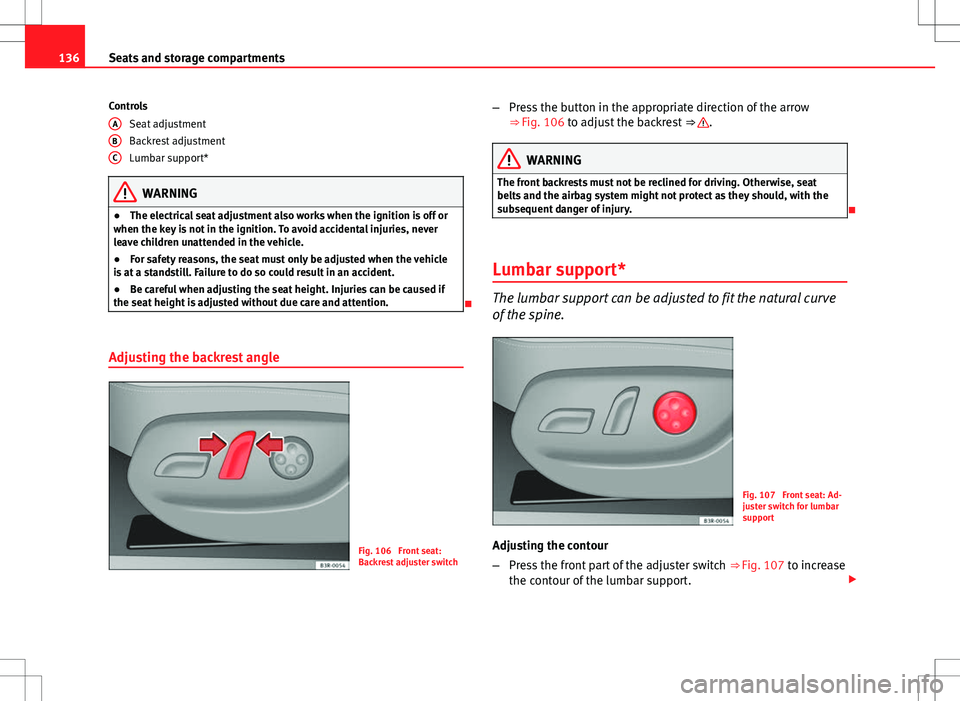
Adjusting the backrest angle
Fig. 106 Front seat:
Backrest adjuster switch
A
BC
–
Press the button in the appropriate direction of the arrow
⇒ Fig. 106 to adjust the backrest ⇒ .
WARNING
The front backrests must not be reclined for driving. Otherwise, seat
belts and the airbag system might not protect as they should, with the
subsequent danger of injury.
Lumbar support*
The lumbar support can be adjusted to fit the natural curve
of the spine.
Fig. 107 Front seat: Ad-
juster switch for lumbar
support
Adjusting the contour
– Press the front part of the adjuster switch ⇒
Fig. 107 to increase
the contour of the lumbar support.
Page 139 of 317
137
Seats and storage compartments
– Press the rear part of the adjuster switch to decrease the con-
tour of the lumbar support.
Adjusting the height
– Press the top part of the adjuster switch to move the contour
upwards.
– Press the bottom part of the adjuster switch to move the con-
tour down.
The lumbar support provides effective support for the natural curvature of
the spine to give a more relaxed seating position, especially on long jour-
neys. Driver seat memory*
Description
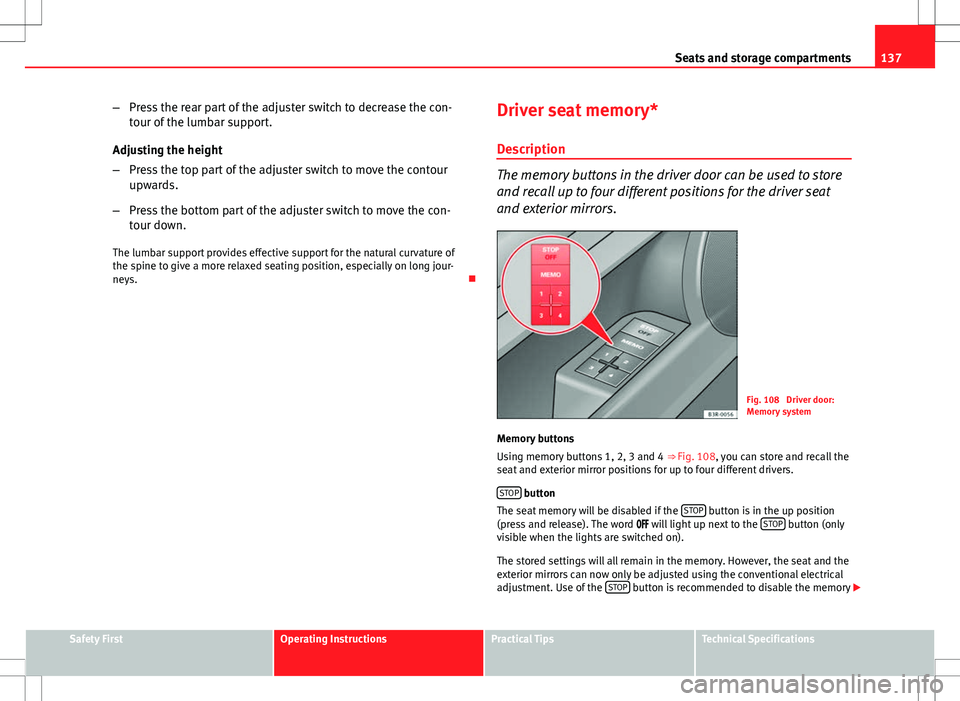
The memory buttons in the driver door can be used to store
and recall up to four different positions for the driver seat
and exterior mirrors.
Fig. 108 Driver door:
Memory system
Memory buttons
Using memory buttons 1, 2, 3 and 4 ⇒ Fig. 108, you can store and recall the
seat and exterior mirror positions for up to four different drivers.
STOP
button
The seat memory will be disabled if the STOP button is in the up position
(press and release). The word will light up next to the STOP button (only
visible when the lights are switched on).
The stored settings will all remain in the memory. However, the seat and the
exterior mirrors can now only be adjusted using the conventional electrical
adjustment. Use of the STOP
button is recommended to disable the memory
Safety FirstOperating InstructionsPractical TipsTechnical Specifications
Page 141 of 317
139
Seats and storage compartments
Assigning remote control keys
The key must be assigned to a memory button so that the
positions stored in the memory can also be recalled using
the remote control key. Assigning the remote control key to a memory button
– Using the memory button, recall the settings that are to be pro-
grammed onto the key.
– Keeping the memory button pressed down, press the unlock
button on the remote control key within 10 seconds.
– Wait for about 2 seconds before releasing the memory button.
Deleting assignment of the remote control key to the memory
button
– Press and hold the MEMO
button and press the unlock button
on the remote control key within 10 seconds.
– Wait for about 2 seconds before releasing the MEMO
button.
The previous settings are automatically cancelled when the keys are re-as-
signed to different memory buttons. Head restraints
Front head restraints
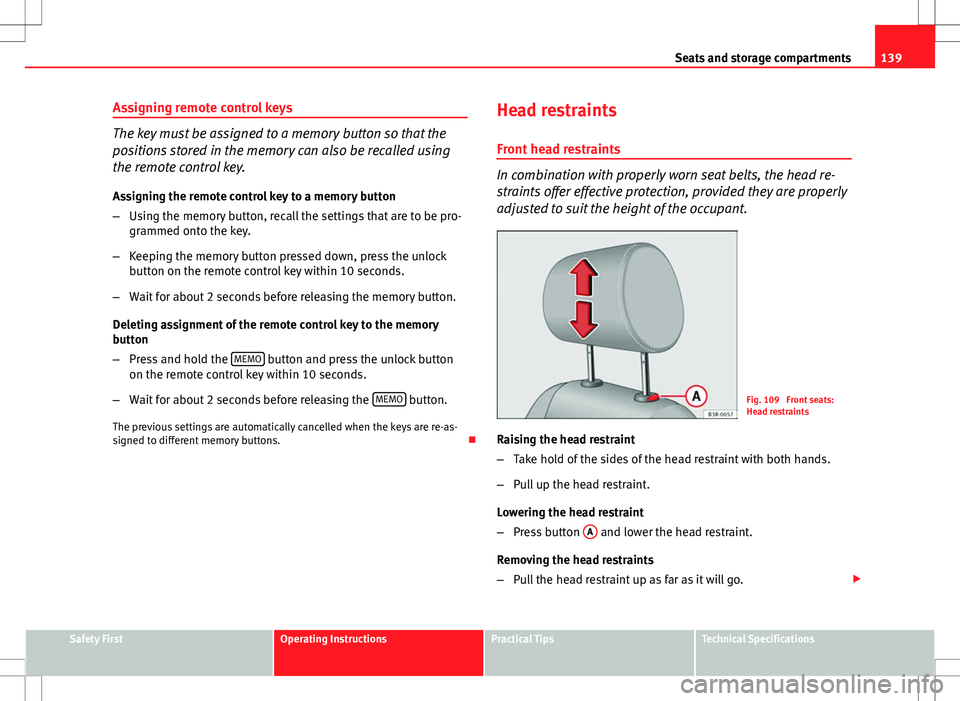
In combination with properly worn seat belts, the head re-
straints offer effective protection, provided they are properly
adjusted to suit the height of the occupant.
Fig. 109 Front seats:
Head restraints
Raising the head restraint
– Take hold of the sides of the head restraint with both hands.
– Pull up the head restraint.
Lowering the head restraint
– Press button A
and lower the head restraint.
Removing the head restraints
– Pull the head restraint up as far as it will go.
Safety FirstOperating InstructionsPractical TipsTechnical Specifications
Page 142 of 317
140Seats and storage compartments
–Press button A
and pull out the head restraint.
Fitting the head restraint
– Insert the head restraint in its guides until it clicks into place.
Press button A
and lower the head restraint.
The height of the head restraints is adjustable. They should be set to suit
the height of the occupant. In combination with the seat belts, the head re-
straints offer effective protection, provided they are properly adjusted.
For best protection, the top of the head restraint should be at least at eye
level or higher.
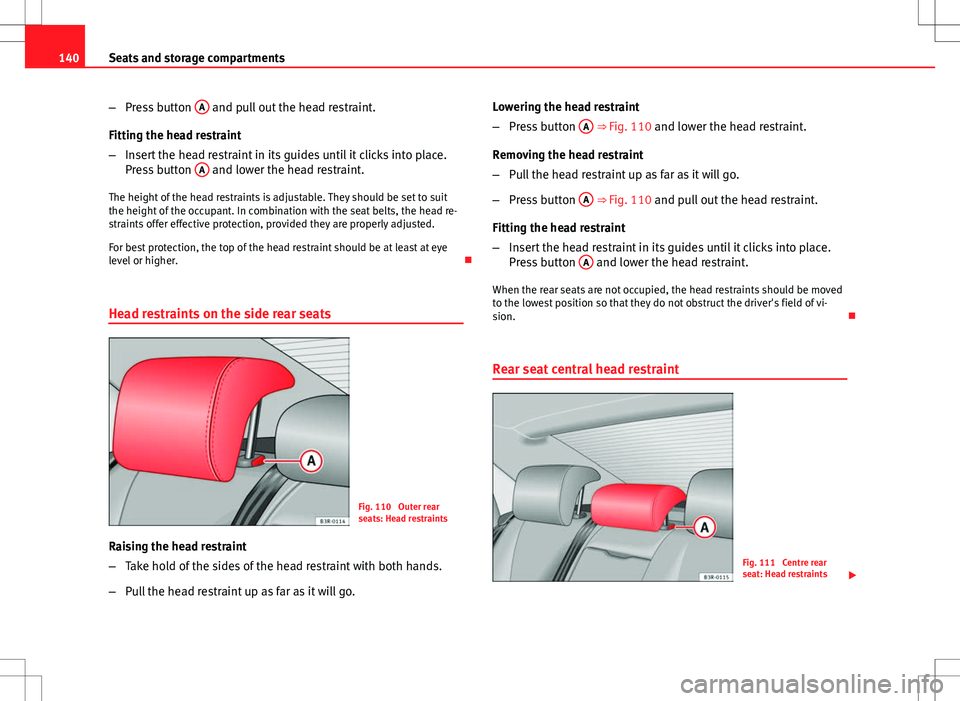
Head restraints on the side rear seats
Fig. 110 Outer rear
seats: Head restraints
Raising the head restraint
– Take hold of the sides of the head restraint with both hands.
– Pull the head restraint up as far as it will go. Lowering the head restraint
–
Press button A
⇒ Fig. 110 and lower the head restraint.
Removing the head restraint
– Pull the head restraint up as far as it will go.
– Press button A
⇒ Fig. 110 and pull out the head restraint.
Fitting the head restraint
– Insert the head restraint in its guides until it clicks into place.
Press button A
and lower the head restraint.
When the rear seats are not occupied, the head restraints should be moved
to the lowest position so that they do not obstruct the driver's field of vi-
sion.
Rear seat central head restraint
Fig. 111 Centre rear
seat: Head restraints
Page 167 of 317

165
Driving
Driving SteeringAdjusting the steering wheel position
The height and reach of the steering wheel can be freely ad-
justed to suit the driver
Fig. 132 Lever beneath
steering column
– Push the lever ⇒ Fig. 132 down ⇒
.
– Move the steering wheel to the desired position.
– Then push the lever back up against the steering column until it
engages in position.
WARNING
● Never adjust the position of the steering wheel when the vehicle is
moving, as this could cause an accident.
● For safety reasons, the lever must always be securely engaged when
the vehicle is moving, so that the position of the steering wheel cannot
shift unexpectedly. Otherwise this could cause an accident.
Safety Electronic Stability Control (ESC)
The ESC helps make driving safer in extreme driving condi-
tions.
Fig. 133 Detailed view of
the centre console: ESC
button
Safety FirstOperating InstructionsPractical TipsTechnical Specifications
Page 202 of 317

200Trailer towing
Where possible, operate the trailer with the maximum permitted drawbar
load on the ball joint of the towing bracket, but do not exceed the specified
limit.
Tyre pressure
Check the tyre pressures on your vehicle, and adjust for “full load” condi-
tions (refer to the sticker listing the tyre pressures on the door pillar). It may
also be necessary to adjust the tyre pressures on the trailer according to the
recommendations of the trailer manufacturer.
Exterior mirrors
Check whether you can see enough of the road behind the trailer with the
standard mirrors. If this is not the case you should have additional mirrors
fitted. The two exterior mirrors should be fitted on folding arms. Adjust the
mirrors to give sufficient rear vision.
Headlights
Before starting a journey, check the headlight beam settings with the trailer
hitched up. If necessary, alter the height of the headlight beams by means
of the headlight range control. See ⇒ page 119.
Power supply
When you remove the ignition key, the power supply to the trailer is inter-
rupted.
Removable ball joint coupling
Vehicles with a factory-fitted towing bracket are equipped with a removable
ball joint coupling. This is stored in the spare wheel well in the luggage
compartment together with the necessary fitting instructions.
Note
If you frequently tow, we recommend you also have the vehicle serviced be-
tween services. Notes on towing
Towing a trailer involves additional attention by the driver.
Weight distribution
The weight distribution of a loaded trailer with an unladen vehicle is very
unfavourable. However, if this cannot be avoided, drive extra slow to allow
for the unbalanced weight distribution.
Speed
The stability of the vehicle and trailer is reduced with increasing speed.
Therefore, it is advisable not to drive at the maximum permissible speed in
unfavourable road, weather or wind conditions. This especially applies
when driving downhill.
You should always reduce speed immediately if the trailer shows the slight-
est sign of swaying. Never try to stabilise the trailer by accelerating.
Anticipate hazards and brake in good time. If towing a trailer with an inertia
brake, first brake gently and then harder. This will prevent brake tapping by
the trailer wheels when they lock. Select a low gear in due course before go-
ing down a steep downhill. This enables you to use the engine braking to
slow down the vehicle.
Swaying and pitching can be reduced by stabiliser aids. We recommend
having stabiliser aids installed when towing trailers with a high trailer
weight. They can be purchased and installed at a Technical Service.
Reheating
When climbing long hills in hot weather with the engine running fast in low
gear, you should keep an eye on the coolant temperature gauge ⇒ page 60.
Reduce speed immediately if the needle moves to the right end of the scale.
If the temperature warning lamp in the instrument panel should start
flashing, stop the vehicle and let the engine cool down by running it at
idling speed for a few minutes.
Page 250 of 317

248Wheels and tyres
Tyre width in mm
Height/width ratio in %
Tyre construction: Radial
Rim diameter in inches
Load rating code
Speed rating
The tyres could also have the following information:
● A direction of rotation symbol
● “Reinforced” denotes heavy-duty tyres.
The manufacturing date is also indicated on the tyre sidewall (possibly only
on the inner side of the wheel).
“DOT ... 1103...” means, for example, that the tyre was produced in the 11th
week of 2003.
We recommend that work on tyres and wheels be carried out by a Technical
Service. They are familiar with the procedure and have the necessary spe-
cial tools and spare parts as well as the proper facilities for disposing of the
old tyres.
Any Technical Service has full information on the technical requirements
when installing or changing tyres, wheels or wheel trims.
WARNING
● We recommend that you use only wheels and tyres which have been
approved by SEAT for your model. Failure to do so could impair vehicle
handling. Risk of accident.
● Avoid running the vehicle on tyres that are more than 6 years old. If
you have no alternative, you should drive slowly and with extra care at all
times.
195
65
R
15
91
TWARNING (Continued)
● Never use old tyres or those with an unknown history of use.
● If wheel trims are retrofitted, you must ensure that the flow of air to
the brakes is not restricted. This could cause them to overheat.
● All four wheels must be fitted with radial tyres of the same type, size
(rolling circumference) and the same tread pattern.
For the sake of the environment
Old tyres must be disposed of according to the laws in the country con-
cerned.
Note
● For technical reasons, it is not generally possible to use the wheels from
other vehicles. This can also apply to wheels of the same model. The use of
wheels or tyres which have not been approved by SEAT for use with your
model may invalidate the vehicle's type approval for use on public roads.
● If the spare tyre is not the same as the tyres that are mounted on the
vehicle (e.g. winter tyres) you should only use the spare tyre for a short peri-
od of time and drive with extra care. Refit the normal road wheel as soon as
possible.
Wheel bolts
Wheel bolts must be tightened to the correct torque.
The design of wheel bolts is matched to the rims. If different wheel rims are
fitted, the correct wheel bolts with the right length and correctly shaped
bolt heads must be used. This ensures that wheels are fitted securely and
that the brake system functions correctly.
In certain circumstances, you should not use wheel bolts from a different
vehicle, even if it is the same model ⇒ page 221.
Page 306 of 317

304Technical specifications
Dimensions and capacities
Dimensions
Length, width 4661-4741a)
mm/ 1772 mm
Height at kerb weight 1430 mm
Front and rear projection 976 mm/ 1043-1123a)
mm
Wheelbase 2642 mm
Turning circle 11.2 m
Track width b) Front
Rear
1522 mm 1523 mm
Capacities
Fuel tank 70 l. Reserve 10 l.
Windscreen washer fluid container with headlight washer 4.8 l.
Tyre pressure
Summer-grade tyres:
The correct tyre pressure can be seen on the sticker on the inside of the tank flap.
Winter tyres:
The pressure of these tyres is the same as the summer tyre pressure plus 0.2 bar.
a) With towing eye.
b) This data will change depending on the type of wheel rim.
Page 313 of 317

SSAFE . . . . . . . . . . . . . . . . . . . . . . . . . . . . . . . . . . 99
Safe driving . . . . . . . . . . . . . . . . . . . . . . . . . . . . . 7 Aspects to take into account . . . . . . . . . . . . . 8
Before setting off . . . . . . . . . . . . . . . . . . . . . . 8
Driving safety . . . . . . . . . . . . . . . . . . . . . . . . . 8
Safety . . . . . . . . . . . . . . . . . . . . . . . . . . . . . . . . . . 9
Safety equipment . . . . . . . . . . . . . . . . . . . . . . . . . 7
Safety instructions Engine compartment . . . . . . . . . . . . . . . . . 227
Safety notes Airbags . . . . . . . . . . . . . . . . . . . . . . . . . . . . . 30
Curtain airbags . . . . . . . . . . . . . . . . . . . . . . . 42
Deactivating front passenger airbag . . . . . . 45
Front airbags . . . . . . . . . . . . . . . . . . . . . . . . 35
Seat belt tensioners . . . . . . . . . . . . . . . . . . . 27
Side airbags . . . . . . . . . . . . . . . . . . . . . . . . . 40
Using child seats . . . . . . . . . . . . . . . . . . . . . 46
Using seat belts . . . . . . . . . . . . . . . . . . . . . . 21
Seals . . . . . . . . . . . . . . . . . . . . . . . . . . . . . . . . . 213
Seat adjustment Lumbar support . . . . . . . . . . . . . . . . . . . . . 136
Seat belt cleaning . . . . . . . . . . . . . . . . . . . . . . 219
Seat belt position Pregnant women . . . . . . . . . . . . . . . . . . . . . 25
Seat belts . . . . . . . . . . . . . . . . . . . . . . . . . . . 24
Seat belt protection . . . . . . . . . . . . . . . . . . . . . . 21
Seat belt release . . . . . . . . . . . . . . . . . . . . . . . . 25
Seat belts . . . . . . . . . . . . . . . . . . . . . . . . . . . . . . 18 Adjustment . . . . . . . . . . . . . . . . . . . . . . . . . . 23
Height adjustment . . . . . . . . . . . . . . . . . . . . 26
Incorrectly fastened . . . . . . . . . . . . . . . . . . . 26 Not worn . . . . . . . . . . . . . . . . . . . . . . . . . . . . 20
Safety notes . . . . . . . . . . . . . . . . . . . . . . . . . 21
Warning lamp . . . . . . . . . . . . . . . . . . . . . 18, 68
Seat belt tensioner Warning lamp . . . . . . . . . . . . . . . . . . . . . . . . 30
Seat belt tensioners . . . . . . . . . . . . . . . . . . . . . . 27
Seat belt warning lamp . . . . . . . . . . . . . . . . . . . 18
Seat heating . . . . . . . . . . . . . . . . . . . . . . . . . . . 164
Seats Electric adjustment . . . . . . . . . . . . . . . . . . 135
Electric backrest adjustment . . . . . . . . . . . 136
Manual adjustment . . . . . . . . . . . . . . . . . . 133
Manual adjustment of lumbar support . . . 134
Manual backrest angle adjustment . . . . . 134
Moving the seat forwards and backwards 133
Seat height adjustment . . . . . . . . . . . . . . . 133
Seat upholstery Alcantara . . . . . . . . . . . . . . . . . . . . . . . . . . . 217
Checklist . . . . . . . . . . . . . . . . . . . . . . . . . . . 216
cleaning Alcantara . . . . . . . . . . . . . . . . . . . 217
Cleaning and maintenance of natural leath-er . . . . . . . . . . . . . . . . . . . . . . . . . . . . . . . 218
cleaning the trim fabric . . . . . . . . . . . . . . . 217
synthetic leather . . . . . . . . . . . . . . . . . . . . 219
Selector lever positions . . . . . . . . . . . . . . . . . . 182
Service indicator . . . . . . . . . . . . . . . . . . . . . . . . 75
Servotronic . . . . . . . . . . . . . . . . . . . . . . . . . . . . 193
Side airbags . . . . . . . . . . . . . . . . . . . . . . . . . . . . 38 Description . . . . . . . . . . . . . . . . . . . . . . . . . . 38
Operation . . . . . . . . . . . . . . . . . . . . . . . . . . . 39
Safety notes . . . . . . . . . . . . . . . . . . . . . . . . . 40
Side lights . . . . . . . . . . . . . . . . . . . . . . . . . . . . . 115Sitting position
Driver . . . . . . . . . . . . . . . . . . . . . . . . . . . . . . . 10
Front passenger . . . . . . . . . . . . . . . . . . . . . . 11
Sitting position, occupants . . . . . . . . . . . . . . . . 10
Ski bag . . . . . . . . . . . . . . . . . . . . . . . . . . . . . . . 144
Sliding/tilting sunroof . . . . . . . . . . . . . . . . . . . 112 Automatic close function . . . . . . . . . . . . . . 113
Closing . . . . . . . . . . . . . . . . . . . . . . . . . . . . 113
Emergency activation . . . . . . . . . . . . . . . . . 114
Opening . . . . . . . . . . . . . . . . . . . . . . . . . . . 112
Snow chains . . . . . . . . . . . . . . . . . . . . . . . 250, 295
Solar-powered blower/sunroof . . . . . . . . . . . . 163
Solar sunroof . . . . . . . . . . . . . . . . . . . . . . . . . . 113
Spare keys . . . . . . . . . . . . . . . . . . . . . . . . . . . . . 97
Spare parts . . . . . . . . . . . . . . . . . . . . . . . . . . . . 221
Spare wheel Steel rim . . . . . . . . . . . . . . . . . . . . . . . . . . . 252
Speedometer . . . . . . . . . . . . . . . . . . . . . . . . . . . 63
Speed warning . . . . . . . . . . . . . . . . . . . . . . . 82, 83
Speed warning function . . . . . . . . . . . . . . . . . . . 83
Start-Stop Activating and deactivating . . . . . . . . . . . . 170
Function . . . . . . . . . . . . . . . . . . . . . . . . . . . 169
Steam jets . . . . . . . . . . . . . . . . . . . . . . . . . . . . . 211
Steering Locking . . . . . . . . . . . . . . . . . . . . . . . . . . . . 166
Manual steering wheel adjustment . . . . . 165
Steering wheel controls . . . . . . . . . . . . . . . . . . . 92
Stopping the engine . . . . . . . . . . . . . . . . . . . . 168
Sun visors . . . . . . . . . . . . . . . . . . . . . . . . . . . . . 126
Switches on the driver door Electric windows . . . . . . . . . . . . . . . . . . . . . 110
311
Index