belt Seat Exeo 2012 Workshop Manual
[x] Cancel search | Manufacturer: SEAT, Model Year: 2012, Model line: Exeo, Model: Seat Exeo 2012Pages: 317, PDF Size: 5.29 MB
Page 146 of 317
144Seats and storage compartments
Ski bag*
You can use the ski bag to transport skis or other extra-long
objects safely inside the vehicle without soiling or damag-
ing the upholstery.
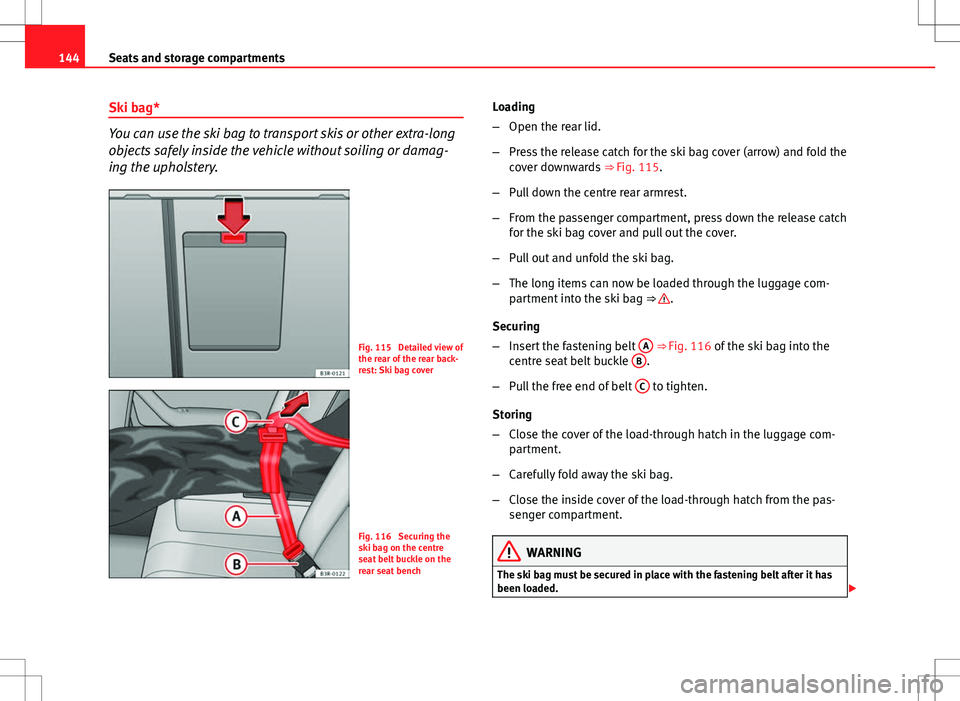
Fig. 115 Detailed view of
the rear of the rear back-
rest: Ski bag cover
Fig. 116 Securing the
ski bag on the centre
seat belt buckle on the
rear seat bench Loading
–
Open the rear lid.
– Press the release catch for the ski bag cover (arrow) and fold the
cover downwards ⇒ Fig. 115.
– Pull down the centre rear armrest.
– From the passenger compartment, press down the release catch
for the ski bag cover and pull out the cover.
– Pull out and unfold the ski bag.
– The long items can now be loaded through the luggage com-
partment into the ski bag ⇒
.
Securing
– Insert the fastening belt A
⇒ Fig. 116 of the ski bag into the
centre seat belt buckle B.
– Pull the free end of belt C
to tighten.
Storing
– Close the cover of the load-through hatch in the luggage com-
partment.
– Carefully fold away the ski bag.
– Close the inside cover of the load-through hatch from the pas-
senger compartment.
WARNING
The ski bag must be secured in place with the fastening belt after it has
been loaded.
Page 171 of 317

169
Driving
WARNING
● Never switch the engine off until the vehicle is stationary.
● The brake servo and the power steering system work only when the
engine is running. You need more strength to steer and brake the vehicle
when the engine is switched off. Given that you will be unable to steer
and brake as usual, this could lead to a risk of accidents and injuries.
CAUTION
If the engine has been running under high load for a long time, there is a
risk of heat building up in the engine compartment after the engine has
been switched off; this could cause engine damage. Therefore, you should
let the engine idle for approximately 2 minutes before you switch it off.
Note
After the engine is switched off the radiator fan may run on for up to 10 mi-
nutes, even if the ignition is switched off. It may also start running again af-
ter some time if the coolant temperature rises due to a build-up of heat un-
der the bonnet, or if the engine is already warm and the engine compart-
ment is heated up further by direct sunlight.
Start-Stop function* Description and operation
The Start-Stop function stops the engine when the vehicle is stop-
ped and starts it automatically when required.
– When the vehicle is stopped, put it in neutral and release the
clutch pedal. The engine will stop. –
When the clutch pedal is pressed, the engine starts again.
– The instrument panel screen displays information about the sta-
tus of the Start-Stop function ⇒ Fig. 137.
Start-Stop function conditions
● The driver seat belt must be buckled.
● The engine hood must be closed.
● The engine must be at operating temperature
● The steering wheel must not be turned more than 270°.
● The vehicle must not be on a steep gradient.
● The vehicle must not be in reverse.
● A trailer must not be connected.
● The temperature of the passenger compartment must be within the con-
venience limits ( ECON
button should not be selected).
● The windscreen de-mist function must be off.
● Otherwise it requires more than 50% of the airflow that the fan can sup-
ply.
● The temperature must not be set to HI or LO.
● The driver door must be closed.
● The diesel particulate filter must not be in regeneration mode, for diesel
engines.
● The battery charge must not be low for the next start.
● The battery temperature must be between -1 °C and 60 °C.
Start-Stop function interruption
In the following situations, the Start-Stop function will be interrupted and
the engine will automatically start:
● The vehicle starts moving.
● The brake pedal is pressed several times in a row.
● The battery has been discharged excessively.
Safety FirstOperating InstructionsPractical TipsTechnical Specifications
Page 172 of 317

170Driving
● The Start-Stop System is manually deactivated.
● The windscreen de-mist function is turned on.
● The temperature of the passenger compartment exceeds the comfort
limits (button ECON
should not be selected).
● If more than 50% of the airflow that the fan can supply is ordered.
● Temperature setting HI or LO is selected.
● The engine coolant temperature is insufficient.
● The alternator is faulty, for example the V-belt has ruptured.
● If any of the conditions described in the previous section are not fulfil-
led.
WARNING
Never allow the vehicle to move with the engine off for any reason. You
could lose control of your vehicle. This could cause an accident and seri-
ous injury.
● Power steering does not work when the engine is not running. That is
why it is much more difficult to turn the steering wheel.
● Disconnect the Start-Stop system when driving through water (ford-
ing streams, etc.).
Note
● For vehicles with the Start-Stop function and a manual gearbox, when
the engine is started, the clutch must be pressed.
● When the conditions for the Start-Stop function are not fulfilled, the in-
strument panel displays the Start-Stop indicator dimmed.
● If the steering wheel is turned more than 270°, Stop will not function;
however, the angle of steering wheel turn does not affect starting the vehi-
cle. Activating and deactivating the Start-Stop function
Fig. 136 The Start-Stop
function button.
Every time the ignition is switched on, the Start-Stop function is au-
tomatically switched on.
Manually deactivating the Start-Stop function
– Press the ⇒ Fig. 136 button located on the centre console.
When the Start-Stop function is deactivated, the pushbutton in-
dicator lights.
– If the Start-Stop function is operating then the engine starts im-
mediately.
Switching the Start-Stop function on manually
– Press the ⇒ Fig. 136 button located on the centre console.
The indicator on the button will go out.
Page 174 of 317
172Driving
Warnings
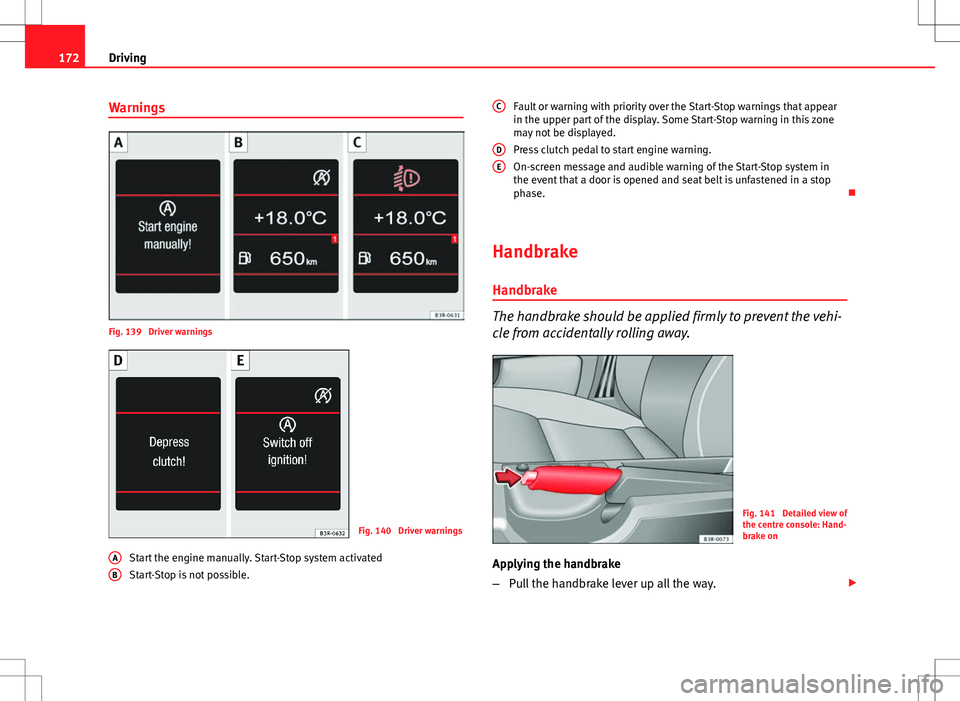
Fig. 139 Driver warnings
Fig. 140 Driver warnings
Start the engine manually. Start-Stop system activated
Start-Stop is not possible.
A
B
Fault or warning with priority over the Start-Stop warnings that appear
in the upper part of the display. Some Start-Stop warning in this zone
may not be displayed.
Press clutch pedal to start engine warning.
On-screen message and audible warning of the Start-Stop system in
the event that a door is opened and seat belt is unfastened in a stop
phase.
Handbrake Handbrake
The handbrake should be applied firmly to prevent the vehi-
cle from accidentally rolling away.
Fig. 141 Detailed view of
the centre console: Hand-
brake on
Applying the handbrake
– Pull the handbrake lever up all the way.
C
DE
Page 218 of 317

216Vehicle maintenance and cleaning
WARNING
Vehicle care products may be toxic and hazardous. Using unsuitable car-
care products or, using them in the wrong way, may cause accidents, se-
rious injury, burns or intoxication.
● Keep your car-care products in their original containers.
● Read the instructions.
● Never keep car-care products in empty food containers, bottles or
other similar containers, other people may confuse them.
● Keep all car-care products out of the reach of children.
● Some products may give off harmful vapours during use. Therefore,
they should be used outdoors in well-ventilated places.
● Never use fuel, turpentine, engine oil, nail-varnish remover or any
other volatile product for washing, maintenance or cleaning. These are
toxic and highly flammable.
WARNING
Unsuitable maintenance and cleaning of vehicle components may impair
proper operation of safety equipment and cause serious injury.
● Maintain and clean vehicle components according to the manufactur-
er's instructions.
● Only use approved or recommended cleaning products.
CAUTION
● Cleaning products which contain solvents have a corrosive effect and
may damage the material irreparably.
● Stains and dirt containing aggressive substances or solvents attack the
material and may damage it irreparably, even when they are cleaned quick-
ly. ●
Dirt and stains should not be allowed to dry and should be cleaned as
quickly as possible.
● In the case of stubborn stains, take the vehicle to a specialised work-
shop to avoid damage.
Treating your upholstery
Checklist
To treat and maintain your seat upholstery, keep the following in mind ⇒
:
Before entering the vehicle, close any velcro fasteners that might
snag on the upholstery or trim fabric. Any open velcro fasteners may
damage the trim or upholstery fabrics.
To prevent damage, avoid direct contact between sharp decorative
objects and the upholstery and trim fabrics. Decorative objects in-
clude zips, rivets and rhinestones on clothing and belts.
From time to time, clean the dust that gathers in the perforations,
folds and seams so that the surfaces of the seats are not damaged
by its abrasive effect.
Make sure clothes are colour-fast to avoid them running and staining
the upholstery. This is especially important if the upholstery is light
in colour.
CAUTION
If you ignore this checklist, which is important for maintaining your seat up-
holstery, the fabric may be damaged or stained.
● Consult the checklist and carry out the operations it describes.
Note
SEAT recommends you take the vehicle to a specialised workshop to treat
any stains on the upholstery caused by the discolouration of clothing.
Page 221 of 317

219
Vehicle maintenance and cleaning
Cleaning synthetic leather upholstery
Before cleaning the synthetic leather upholstery, bear in mind the following
recommendations ⇒ page 217, Cleaning the fabric on heated seats and
electrically adjustable seats or seats with airbag components
Only use water and neutral cleaning products to clean synthetic leather up-
holstery.
CAUTION
Do not use solvents, floor wax, shoe cream, stain removers or similar prod-
ucts on synthetic leather. These will stiffen the material, causing it to crack
prematurely.
Plastic parts and dash panel cleaning
– Use a clean, damp cloth to clean plastic parts and the dash
panel.
– If this does not provide satisfactory results, use a special sol-
vent-free plastic cleaning product.
WARNING
Never clean the dash panel and the airbag module surface with cleaners
containing solvents. Solvents cause the surface to become porous. If the
airbag triggered, plastic parts could become detached and cause inju-
ries.
CAUTION
Cleaning products which contain solvents will damage the material. Wooden trim cleaning*
–
Clean the wooden trim with a water-moistened clean cloth.
– If this does not provide satisfactory results, use a gentle soap
solution.
CAUTION
Cleaning products which contain solvents will damage the material.
Cleaning the radio and climate controls
To clean the radio and/or climate controls, use a soft damp cloth. For more
resistant dirt, a neutral soap solution may be used.
Seat belt cleaning
A dirty belt may not work properly.
Check all seat belts regularly and keep them clean.
Seat belt cleaning
– Pull the dirty seat belt right out and unroll it.
– Clean dirty seat belts with a gentle soap solution.
– Allow it to dry.
– Do not roll the seat belt up until it is dry.
Safety FirstOperating InstructionsPractical TipsTechnical Specifications
Page 222 of 317

220Vehicle maintenance and cleaning
If large stains form on the belts, it will not retract correctly into the automat-
ic belt retractor.
WARNING
● Do not use chemical cleaning agents on the seat belts, as this can im-
pair the strength of the webbing. Ensure that belts do not come into con-
tact with corrosive fluids.
● Check the condition of the seat belts at regular intervals. If you notice
that the belt webbing, fittings, retractor mechanism or buckle of any of
the belts is damaged, the belt must be replaced by a specialised work-
shop.
● Do not attempt to repair a damaged seat belt yourself. The seat belts
must not be removed or modified in any way.
CAUTION
After cleaning, allow seat belts to dry completely before rolling them up.
Otherwise, the belt retractors could become damaged.
Page 230 of 317

228Checking and refilling levels
WARNING (Continued)
● If any tests have to be performed with the engine running, there is an
added safety risk from the rotating parts (e.g. drive belts, alternator, ra-
diator fan, etc.) and from the high-voltage ignition system.
● Observe the following additional warnings if work on the fuel system
or the electrical system is necessary:
–Always disconnect the battery.
– Do not smoke.
– Never work near open flames.
– Always keep an approved fire extinguisher immediately available.
CAUTION
When topping up fluids, make sure the correct fluid is put into the correct
filler opening. This can otherwise cause serious malfunctions or engine
damage.
For the sake of the environment
Inspect the ground underneath your vehicle regularly so that any leaks are
detected at an early stage. If you find spots of oil or other fluids, have your
vehicle inspected at the workshop.
● When the external temperature and level of humidity are high or when
the engine stops, it is possible for water to drop from the air conditioning
system evaporator potentially forming a small puddle on the ground. This is
normal and does not indicate a leak.
Note
On right-hand drive vehicles some of the reservoirs mentioned below are lo-
cated on the other side of the engine compartment. Closing the bonnet
–
To close the bonnet, push it down until it overcomes the spring
pressure.
– Let the bonnet engage in the locking part. Do not force it ⇒
.
WARNING
● For safety reasons the bonnet must always be completely closed
when the vehicle is moving. After closing it always check that it is proper-
ly secured. The bonnet must be flush with the adjacent body panels.
● Should you notice that the bonnet is not safely secured when the ve-
hicle is moving, stop the vehicle immediately and close the bonnet. Fail-
ure to do so could result in an accident.
Engine oil General notes
The engine is factory-filled with a special multi-grade oil that can be used all
year round.
As the use of high quality oil is essential for the correct operation of the en-
gine and its long useful life, when topping up or replacement is necessary
use only those oils that conform to the requirements of the VW standards.
The specifications (VW standards) set out in the following page should ap-
pear on the container of the service oil; when the container displays the
specific standards for petrol and diesel engines together, it means that the
oil can be used for both types of engines.
Page 309 of 317

Deactivating temporarily . . . . . . . . . . . . . . 178
Setting the speed . . . . . . . . . . . . . . . . . . . . 177
Cruise speed . . . . . . . . . . . . . . . . . . . . . . . . . . . 176
Curtain airbags . . . . . . . . . . . . . . . . . . . . . . . . . . 41 Description . . . . . . . . . . . . . . . . . . . . . . . . . . 41
Operation . . . . . . . . . . . . . . . . . . . . . . . . . . . 42
Safety notes . . . . . . . . . . . . . . . . . . . . . . . . . 42
D Danger of fitting a child seat on the front pas- senger seat . . . . . . . . . . . . . . . . . . . . . . . . . . . 29
Dash panel cleaning . . . . . . . . . . . . . . . . . . . . 219
Data entry control . . . . . . . . . . . . . . . . . . . . . . . . 90
Date display . . . . . . . . . . . . . . . . . . . . . . . . . . . . 61
Daytime running lights . . . . . . . . . . . . . . . . . . 120
Deactivating front passenger airbag Safety notes . . . . . . . . . . . . . . . . . . . . . . . . . 45
Deactivating the airbag Front passenger airbag . . . . . . . . . . . . . . . . 44
Diesel . . . . . . . . . . . . . . . . . . . . . . . . . . . . . . . . 225
Diesel engine Winter driving . . . . . . . . . . . . . . . . . . . . . . . 226
Diesel engine particulate filter . . . . . . . . . . . . 196
Diesel particulate filter . . . . . . . . . . . . . . . . . . . 81 Engine oil . . . . . . . . . . . . . . . . . . . . . . . . . . 228
Digital clock . . . . . . . . . . . . . . . . . . . . . . . . . . . . 61
Dipped beam headlights . . . . . . . . . . . . . . . . . 115
DIS Average fuel consumption . . . . . . . . . . . . . . 86
Average speed . . . . . . . . . . . . . . . . . . . . . . . 86 Driving time . . . . . . . . . . . . . . . . . . . . . . . . . 86
Instantaneous fuel consumption . . . . . . . . 86
Disposal Airbags . . . . . . . . . . . . . . . . . . . . . . . . . . . . . 30
Seat belt tensioners . . . . . . . . . . . . . . . . . . . 27
Distance covered . . . . . . . . . . . . . . . . . . . . . . . . 87
Distance to empty . . . . . . . . . . . . . . . . . . . . 74, 86
Door and rear lid warning . . . . . . . . . . . . . . . . . 75
Door lock cylinders . . . . . . . . . . . . . . . . . . . . . . 213
Doors Childproof lock . . . . . . . . . . . . . . . . . . . . . . 105
Locking the doors manually if the centrallocking fails to work . . . . . . . . . . . . . . . . 103
Driver see Correct sitting position . . . . . . . 10, 11, 12
Driver information system . . . . . . . . . . . . . . . . . 72 Auto-check system . . . . . . . . . . . . . . . . . . . . 76
CD, radio and telephone display . . . . . . . . . 73
Door and rear lid warning . . . . . . . . . . . . . . 75
Driver messages . . . . . . . . . . . . . . . . . . . . . . 77
Handbrake warning . . . . . . . . . . . . . . . . . . . 77
Menu display . . . . . . . . . . . . . . . . . . . . . . . . 89
Onboard computer . . . . . . . . . . . . . . . . . . . . 86
Outside temperature display . . . . . . . . . . . . 73
Red symbols . . . . . . . . . . . . . . . . . . . . . . . . . 78
Speed warning . . . . . . . . . . . . . . . . . . . . . . . 83
Warning messages . . . . . . . . . . . . . . . . . . . . 77
Yellow symbols . . . . . . . . . . . . . . . . . . . . . . . 80
Driver messages . . . . . . . . . . . . . . . . . . . . . . . . . 77
driver seat Assigning the key to the seat . . . . . . . . . . 139 Driver seat
Activating stored settings . . . . . . . . . . . . . 138
With memory . . . . . . . . . . . . . . . . . . . . . . . 137
Driving Driving abroad . . . . . . . . . . . . . . . . . . . . . . 198
Economically / Environmentally friendly . 196
Driving abroad . . . . . . . . . . . . . . . . . . . . . . . . . 198 Headlights . . . . . . . . . . . . . . . . . . . . . . . . . 198
Driving safety . . . . . . . . . . . . . . . . . . . . . . . . . . . . 9
DRP see Dynamic gear control programme . . . 184
Dynamic gear control programme . . . . . . . . . . 184
E
Economical driving . . . . . . . . . . . . . . . . . . . . . . 196
Electric windows . . . . . . . . . . . . . . . . . . . . . . . . 109 Central locking system . . . . . . . . . . . . . . . . 111
Possible malfunctions . . . . . . . . . . . . . . . . 111
Rear doors . . . . . . . . . . . . . . . . . . . . . . . . . . 110
Switches on the driver door . . . . . . . . . . . . 110
Switch on front passenger's door . . . . . . . 110
Electronic differential lock How it works . . . . . . . . . . . . . . . . . . . . . . . . 190
Electronic immobiliser . . . . . . . . . . . . . . . . . . . . 99
Electronic Stability Control . . . . . . . . . . . . . . . . 69 description . . . . . . . . . . . . . . . . . . . . . . . . . 165
Operation . . . . . . . . . . . . . . . . . . . . . . . . . . 188
warning lamp . . . . . . . . . . . . . . . . . . . . . . . 166
307
Index
Page 313 of 317

SSAFE . . . . . . . . . . . . . . . . . . . . . . . . . . . . . . . . . . 99
Safe driving . . . . . . . . . . . . . . . . . . . . . . . . . . . . . 7 Aspects to take into account . . . . . . . . . . . . . 8
Before setting off . . . . . . . . . . . . . . . . . . . . . . 8
Driving safety . . . . . . . . . . . . . . . . . . . . . . . . . 8
Safety . . . . . . . . . . . . . . . . . . . . . . . . . . . . . . . . . . 9
Safety equipment . . . . . . . . . . . . . . . . . . . . . . . . . 7
Safety instructions Engine compartment . . . . . . . . . . . . . . . . . 227
Safety notes Airbags . . . . . . . . . . . . . . . . . . . . . . . . . . . . . 30
Curtain airbags . . . . . . . . . . . . . . . . . . . . . . . 42
Deactivating front passenger airbag . . . . . . 45
Front airbags . . . . . . . . . . . . . . . . . . . . . . . . 35
Seat belt tensioners . . . . . . . . . . . . . . . . . . . 27
Side airbags . . . . . . . . . . . . . . . . . . . . . . . . . 40
Using child seats . . . . . . . . . . . . . . . . . . . . . 46
Using seat belts . . . . . . . . . . . . . . . . . . . . . . 21
Seals . . . . . . . . . . . . . . . . . . . . . . . . . . . . . . . . . 213
Seat adjustment Lumbar support . . . . . . . . . . . . . . . . . . . . . 136
Seat belt cleaning . . . . . . . . . . . . . . . . . . . . . . 219
Seat belt position Pregnant women . . . . . . . . . . . . . . . . . . . . . 25
Seat belts . . . . . . . . . . . . . . . . . . . . . . . . . . . 24
Seat belt protection . . . . . . . . . . . . . . . . . . . . . . 21
Seat belt release . . . . . . . . . . . . . . . . . . . . . . . . 25
Seat belts . . . . . . . . . . . . . . . . . . . . . . . . . . . . . . 18 Adjustment . . . . . . . . . . . . . . . . . . . . . . . . . . 23
Height adjustment . . . . . . . . . . . . . . . . . . . . 26
Incorrectly fastened . . . . . . . . . . . . . . . . . . . 26 Not worn . . . . . . . . . . . . . . . . . . . . . . . . . . . . 20
Safety notes . . . . . . . . . . . . . . . . . . . . . . . . . 21
Warning lamp . . . . . . . . . . . . . . . . . . . . . 18, 68
Seat belt tensioner Warning lamp . . . . . . . . . . . . . . . . . . . . . . . . 30
Seat belt tensioners . . . . . . . . . . . . . . . . . . . . . . 27
Seat belt warning lamp . . . . . . . . . . . . . . . . . . . 18
Seat heating . . . . . . . . . . . . . . . . . . . . . . . . . . . 164
Seats Electric adjustment . . . . . . . . . . . . . . . . . . 135
Electric backrest adjustment . . . . . . . . . . . 136
Manual adjustment . . . . . . . . . . . . . . . . . . 133
Manual adjustment of lumbar support . . . 134
Manual backrest angle adjustment . . . . . 134
Moving the seat forwards and backwards 133
Seat height adjustment . . . . . . . . . . . . . . . 133
Seat upholstery Alcantara . . . . . . . . . . . . . . . . . . . . . . . . . . . 217
Checklist . . . . . . . . . . . . . . . . . . . . . . . . . . . 216
cleaning Alcantara . . . . . . . . . . . . . . . . . . . 217
Cleaning and maintenance of natural leath-er . . . . . . . . . . . . . . . . . . . . . . . . . . . . . . . 218
cleaning the trim fabric . . . . . . . . . . . . . . . 217
synthetic leather . . . . . . . . . . . . . . . . . . . . 219
Selector lever positions . . . . . . . . . . . . . . . . . . 182
Service indicator . . . . . . . . . . . . . . . . . . . . . . . . 75
Servotronic . . . . . . . . . . . . . . . . . . . . . . . . . . . . 193
Side airbags . . . . . . . . . . . . . . . . . . . . . . . . . . . . 38 Description . . . . . . . . . . . . . . . . . . . . . . . . . . 38
Operation . . . . . . . . . . . . . . . . . . . . . . . . . . . 39
Safety notes . . . . . . . . . . . . . . . . . . . . . . . . . 40
Side lights . . . . . . . . . . . . . . . . . . . . . . . . . . . . . 115Sitting position
Driver . . . . . . . . . . . . . . . . . . . . . . . . . . . . . . . 10
Front passenger . . . . . . . . . . . . . . . . . . . . . . 11
Sitting position, occupants . . . . . . . . . . . . . . . . 10
Ski bag . . . . . . . . . . . . . . . . . . . . . . . . . . . . . . . 144
Sliding/tilting sunroof . . . . . . . . . . . . . . . . . . . 112 Automatic close function . . . . . . . . . . . . . . 113
Closing . . . . . . . . . . . . . . . . . . . . . . . . . . . . 113
Emergency activation . . . . . . . . . . . . . . . . . 114
Opening . . . . . . . . . . . . . . . . . . . . . . . . . . . 112
Snow chains . . . . . . . . . . . . . . . . . . . . . . . 250, 295
Solar-powered blower/sunroof . . . . . . . . . . . . 163
Solar sunroof . . . . . . . . . . . . . . . . . . . . . . . . . . 113
Spare keys . . . . . . . . . . . . . . . . . . . . . . . . . . . . . 97
Spare parts . . . . . . . . . . . . . . . . . . . . . . . . . . . . 221
Spare wheel Steel rim . . . . . . . . . . . . . . . . . . . . . . . . . . . 252
Speedometer . . . . . . . . . . . . . . . . . . . . . . . . . . . 63
Speed warning . . . . . . . . . . . . . . . . . . . . . . . 82, 83
Speed warning function . . . . . . . . . . . . . . . . . . . 83
Start-Stop Activating and deactivating . . . . . . . . . . . . 170
Function . . . . . . . . . . . . . . . . . . . . . . . . . . . 169
Steam jets . . . . . . . . . . . . . . . . . . . . . . . . . . . . . 211
Steering Locking . . . . . . . . . . . . . . . . . . . . . . . . . . . . 166
Manual steering wheel adjustment . . . . . 165
Steering wheel controls . . . . . . . . . . . . . . . . . . . 92
Stopping the engine . . . . . . . . . . . . . . . . . . . . 168
Sun visors . . . . . . . . . . . . . . . . . . . . . . . . . . . . . 126
Switches on the driver door Electric windows . . . . . . . . . . . . . . . . . . . . . 110
311
Index