brakes Seat Exeo 2013 User Guide
[x] Cancel search | Manufacturer: SEAT, Model Year: 2013, Model line: Exeo, Model: Seat Exeo 2013Pages: 319, PDF Size: 4.81 MB
Page 199 of 319
197
Driving and the environment
Avoid idling
It is worthwhile switching off the engine when waiting in a traffic jam, at lev-
el crossings or at traffic lights with a long red phase. The fuel saved after
only 30 - 40 seconds is greater than the amount of fuel needed to restart
the engine.
The engine takes a long time to warm up when it is idling. Mechanical wear
and pollutant emissions are also especially high during this initial warm-up
phase. It is therefore best to drive off immediately after starting the engine.
Avoid running the engine at high speed.
Periodic maintenance
Periodic maintenance work guarantees that, before beginning a journey,
you will not consume more than the required amount of fuel. A well-serviced
engine gives you the benefit of improved fuel efficiency as well as maxi-
mum reliability and an enhanced resale value.
A badly serviced engine can consume up to 10% more fuel than necessary.
Avoid short journeys
To reduce the consumption and emission of polluting exhaust gases, the
engine and the exhaust gas filtration systems should reach the optimum
operating temperature.
With the engine cold, fuel consumption is proportionally higher. The engine
does not warm up and fuel consumption does not normalise until having
driven approximately four kilometres (2.5 miles). This is why we recommend
avoiding short trips whenever possible.
Maintain the correct tyre pressures
Bear in mind that keeping the tyres at an adequate pressure saves fuel. If
the tyre pressure is just one bar too low, fuel consumption can increase by
as much as 5%. Due to the greater rolling resistance, under-inflation also
increases tyre wear and impairs handling.
The tyre pressures should always be checked when the tyres are cold.Do not use
winter tyres all year round as they increase fuel consumption by
up to 10%.
Avoid unnecessary weight
Given that every kilo of extra weight will increase the fuel consumption, it is
advisable to always check the luggage compartment to make sure that no
unnecessary loads are being transported.
A roof rack is often left in place for the sake of convenience, even when it is
no longer needed. At a speed of 100-120 km/h (60-75 mph) your vehicle
will use about 12% more fuel as a result of the extra wind resistance caused
by the roof rack even when it is not in use.
Save electricity
The engine activates the alternator, which produces electricity. With the
need for electricity, fuel consumption is also increased. Because of this, al-
ways turn off electrical components when you do not need them. Examples
of components that use a lot of electricity are: the fan at high speeds, the
rear window heating or the seat heaters*.
Note
● If you vehicle has Start-Stop, it is not recommended to switch this func-
tion off.
● It is recommended to close the windows when driving at more than
60 km/h (40 mph)
● Do not drive with your foot resting on the clutch pedal, as the pressure
can make the plate spin, more fuel will be used and it can burn the clutch
plate lining, causing a serious fault.
● Do not hold the vehicle on a hill with the clutch, use the foot brake or
hand brake, using the latter to start. The fuel consumption will be lower and
you will prevent the clutch plate from being damaged.
● On descents, use the engine brake, changing to the gear that is more
suitable for the slope. The fuel consumption will be lower and the brakes
will not suffer.
Safety FirstOperating instructionsPractical TipsTechnical Specifications
Page 213 of 319
211
Vehicle maintenance and cleaning
Care of the vehicle exterior Automatic car wash tunnel
The vehicle can normally be washed without problem in an
automatic car wash.
The vehicle paintwork is so durable that the vehicle can normally be washed
without problems in an automatic car wash tunnel. However, the paintwork
wear depends to a large extent on the kind of the car wash tunnel, the
brushes used, its water filtering and the type of cleaning and preservative
products.
Before going through a vehicle wash, be sure to take the usual precautions
such as closing the windows and sunroof.
If the vehicle has special accessories such as spoilers or a roof rack or two-
way radio aerial, etc., it is advisable to consult the car wash tunnel operator.
After washing, the brakes could take some time to respond as the brake
discs and pads could be wet, or even frozen in winter. Dry the brakes by
braking several times.
WARNING
Water, ice and salt on the brake system can reduce braking effectiveness.
Risk of accident.
Washing by hand
Vehicle washing
– First soften the dirt and rinse it off with water. –
Clean your vehicle from top to bottom with a soft sponge, a
glove or a brush. Use very light pressure.
– Rinse the sponge or glove often with clean water.
– Special car shampoo should only be used for very stubborn dirt.
– Leave the wheels, sill panels etc. until last, using a different
sponge or glove.
– Rinse the vehicle thoroughly with water.
– Dry the vehicle surface gently with a chamois leather.
– In cold temperature, dry the rubber seals and their surfaces to
prevent them from freezing. Apply silicone spray to the rubber
seals.
After washing the vehicle
– After washing, avoid sudden and sharp braking. Dry the brakes
by braking several times ⇒ page 194, Braking capacity and
braking distance.
WARNING
● Wash your vehicle with the ignition switched off.
● Protect your hands and arms from cuts on sharp metal edges when
cleaning the underbody, the inside of the wheel housings etc. Risk of in-
jury.
● Water, ice and salt on the brake system can reduce braking effective-
ness. Risk of accident.
Safety FirstOperating instructionsPractical TipsTechnical Specifications
Page 214 of 319
212Vehicle maintenance and cleaning
CAUTION
● Never remove dirt, mud or dust if the vehicle surface is dry. Never use a
dry cloth or sponge for cleaning purposes. This could scratch the paintwork
or glass on your vehicle.
● Washing the vehicle in low temperatures: when washing the vehicle
with a hose, do not direct water into the lock cylinders or the gaps around
the doors, rear lid, or sunroof. Risk of freezing.
For the sake of the environment
To protect environment, the vehicle should be washed only in specially pro-
vided wash bays. This prevents toxic, oil-laden waste water entering the
sewerage system. In some places, washing vehicles outside wash bays is
prohibited.
Note
Do not wash the vehicle in direct sunlight.
Washing the vehicle with a high pressure cleaner
Be particularly careful when using a high pressure cleaner!
– Always observe the instructions for the high-pressure cleaner,
particularly those concerning the pressure and the spraying
distance.
– Increase the spraying distance for soft materials and painted
bumpers.
– Do not use a high pressure cleaner to remove ice or snow from
windows ⇒ page 213.
– Never use concentrated jet nozzles (“rotating jets”) ⇒
. –
After washing, avoid sudden and sharp braking. Dry the brakes
by braking several times ⇒ page 194, Braking capacity and
braking distance.
WARNING
● Never wash tyres with a concentrated jet (“rotating nozzle”). Even at
large spraying distances and short cleaning times, visible and invisible
damage can occur to the tyres. This may cause an accident.
● Water, ice and salt on the brake system can reduce braking effective-
ness. Risk of accident.
CAUTION
● Do not use water hotter than 60 °C. This could damage the car.
● To avoid damage to the vehicle, keep a sufficient distance from sensitive
materials such as flexible hoses, plastic, soundproofing material, etc. This
is also important for bumpers painted in the colour of the bodywork. The
closer the nozzle is to the surface, the greater the wear on the material.
Vehicle paint maintenance
Regular waxing protects the paintwork. You need to apply wax to your vehicle if water does not form small drops
and run off the paintwork when it is clean.
Good quality hard wax products are available at your Technical Service.
Regular wax applications help to protect the paintwork from environmental
contaminants ⇒ page 210. It is also effective in protecting against minor
scratches.
Page 217 of 319
215
Vehicle maintenance and cleaning
Steel wheel rims
– Clean steel wheel rims regularly using a separate sponge.
Use an industrial cleaner to remove brake dust. Any damage to the paint on
steel wheel rims should be repaired before starting to rust.
WARNING
● Never wash tyres with a cylindrical jet. Even at large spraying distan-
ces and short cleaning times, visible and invisible damage can occur to
the tyres. This may cause an accident.
● Water, ice and salt on the brake system can reduce braking effective-
ness. Risk of accident. Directly after washing, avoid sudden and sharp
braking. Dry the brakes by braking several times ⇒ page 194, Braking ca-
pacity and braking distance.
Alloy wheel rims
Every two weeks
– Wash salt and brake dust from alloy wheels.
– Use an acid free detergent to clean the wheel rims.
Every three months
– Apply a hard wax compound to the wheels.
Alloy wheels require regular attention to preserve their appearance. If road
salt and brake dust are not often removed, the aluminium finish will be im-
paired.
Always use an acid-free detergent for alloy wheel rims. Car polish or other abrasive agents should not be used for maintaining the
rims. If the protective coating is damaged, e.g. by flying stones, the dam-
aged area should be repaired immediately.
WARNING
● Never wash tyres with a cylindrical jet. Even at large spraying distan-
ces and short cleaning times, visible and invisible damage can occur to
the tyres. This may cause an accident.
● Water, ice and salt on the brake system can reduce braking effective-
ness. Risk of accident. Directly after washing, avoid sudden and sharp
braking. Dry the brakes by braking several times ⇒ page 194, Braking ca-
pacity and braking distance.
Underbody protection
The vehicle underbody is coated to protect it from chemical
and mechanical damage.
The protective coating can be damaged when driving. We recommend you
to check the protective coating under the body and on the running gear, and
reinstated if necessary, before and after the winter season.
We recommend you to go to your Technical Service to carry out repair work
and additional anti-corrosion work.
WARNING
Do not apply underseal or anti-corrosion coatings to the exhaust pipes,
catalytic converter or the heat shields on the exhaust system. The heat of
the exhaust system or the engine could cause them to ignite. Risk of fire.
Safety FirstOperating instructionsPractical TipsTechnical Specifications
Page 240 of 319
238Checking and refilling levels
Topping up and changing the brake fluid
It is best to have the brake fluid changed by a professional.
Brake fluid absorbs moisture. Therefore, in the course of time it will absorb
water from the air. If the water content in the brake fluid is too high, the
brake system could corrode. In addition, the boiling point of the brake fluid
will be considerably reduced. This could adversely affect the braking ability
in certain circumstances.
For this reason the brake fluid must be changed periodically.
Your vehicle's Service Plan will tell you when the brake fluid has to be re-
newed.
We recommend you have the brake fluid changed as part of a regular In-
spection Service at a Technical Service. They are familiar with the procedure
and have the necessary special tools and spare parts as well as the proper
facilities for disposing of the old fluid.
Be sure to always use the correct brake fluid. Only use brake fluid that ex-
pressly meets VW 501 14 standards.
You can buy VW 501 14 standard brake fluid in a SEAT dealership or SEAT
Official Service. If none is available, use only high quality brake fluid that
meets DIN ISO 4925 CLASS 4 standards, or USA Standards FMVSS 116 DOT
4.
Using any other kind of brake fluid or one that is not of a high quality may
affect operation of the brake system and reduce its effectiveness. Never use
a brake fluid if the container does not state that it complies with VW 501 14,
DIN ISO 4925 CLASS 4 standards, or USA standards FMVSS 116 DOT 4.WARNING
● Brake fluid must always be kept closed in its original container. Keep
out of the reach of children. Failure to comply could result in poisoning.
● If the brake fluid is left in the system for too long and the brakes are
subjected to heavy use, vapour bubbles may form in the brake system.
This would seriously affect the efficiency of the brakes and the safety of
the vehicle, leading to the risk of accident.
CAUTION
Please note that brake fluid will attack the paintwork on contact.
For the sake of the environment
The brake pads and brake fluid must be collected and disposed of accord-
ing the applicable regulations. The SEAT Technical Service network has the
necessary equipment and qualified personnel for collecting and disposing
of this waste material.
Vehicle battery General notes
All work on batteries requires specialist knowledge.
The battery is virtually maintenance-free and is checked in the Inspection
Services.
We recommend replacing the battery after 5 years.
Page 251 of 319
249
Wheels and tyres
195/65 R15 91T
This contains the following information: Tyre width in mm
Height/width ratio in %
Tyre construction: Radial
Rim diameter in inches
Load rating code
Speed rating
The tyres could also have the following information:
● A direction of rotation symbol
● “Reinforced” denotes heavy-duty tyres.
The manufacturing date is also indicated on the tyre sidewall (possibly only
on the inner side of the wheel).
“DOT... 1103...” means, for example, that the tyre was produced in the 11th
week of 2003.
We recommend that work on tyres and wheels be carried out by a Technical
Service. They are familiar with the procedure and have the necessary spe-
cial tools and spare parts as well as the proper facilities for disposing of the
old tyres.
Any Technical Service has full information on the technical requirements
when installing or changing tyres, wheels or wheel trims. 195
65
R
15
91
T
WARNING
● We recommend that you use only wheels and tyres which have been
approved by SEAT for your model. Failure to do so could impair vehicle
handling. Risk of accident.
● Avoid running the vehicle on tyres that are more than 6 years old. If
you have no alternative, you should drive slowly and with extra care at all
times.
● Never use old tyres or those with an unknown history of use.
● If wheel trims are retrofitted, you must ensure that the flow of air to
the brakes is not restricted. This could cause the brake system to over-
heat.
● All four wheels must be fitted with radial tyres of the same type, size
(rolling circumference) and the same tread pattern.
For the sake of the environment
Old tyres must be disposed of according to the laws in the country con-
cerned.
Note
● For technical reasons, it is not generally possible to use the wheels from
other vehicles. This can also apply to wheels of the same model. The use of
wheels or tyres which have not been approved by SEAT for use with your
model may invalidate the vehicle's type approval for use on public roads.
● If the spare tyre is not the same as the tyres that are mounted on the
vehicle (e.g. winter tyres) you should only use the spare tyre for a short peri-
od of time and drive with extra care. Refit the normal road wheel as soon as
possible.
Safety FirstOperating instructionsPractical TipsTechnical Specifications
Page 300 of 319
298Technical specifications
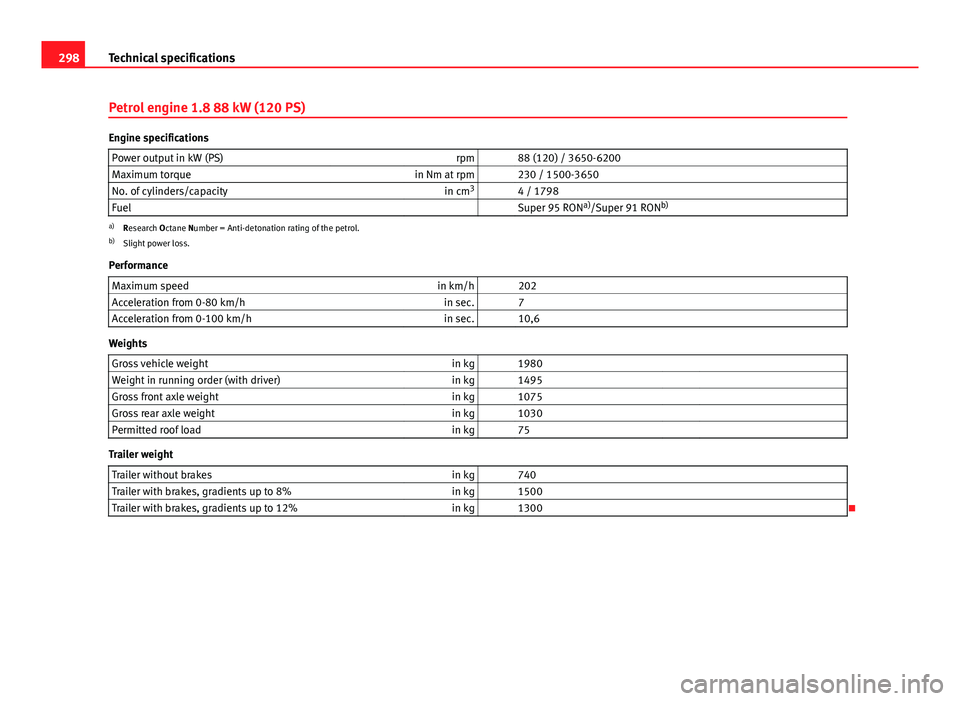
Petrol engine 1.8 88 kW (120 PS)
Engine specifications
Power output in kW (PS) rpm 88 (120) / 3650-6200
Maximum torque in Nm at rpm 230 / 1500-3650
No. of cylinders/capacity in cm3
4 / 1798
Fuel Super 95 RON a)
/Super 91 RON b)
a)
Research Octane Number = Anti-detonation rating of the petrol.
b) Slight power loss.
Performance Maximum speed in km/h 202
Acceleration from 0-80 km/h in sec. 7
Acceleration from 0-100 km/h in sec. 10,6
Weights
Gross vehicle weight in kg 1980
Weight in running order (with driver) in kg 1495
Gross front axle weight in kg 1075
Gross rear axle weight in kg 1030
Permitted roof load in kg 75
Trailer weight
Trailer without brakes in kg 740
Trailer with brakes, gradients up to 8% in kg 1500
Trailer with brakes, gradients up to 12% in kg 1300
Page 301 of 319
299
Technical specifications
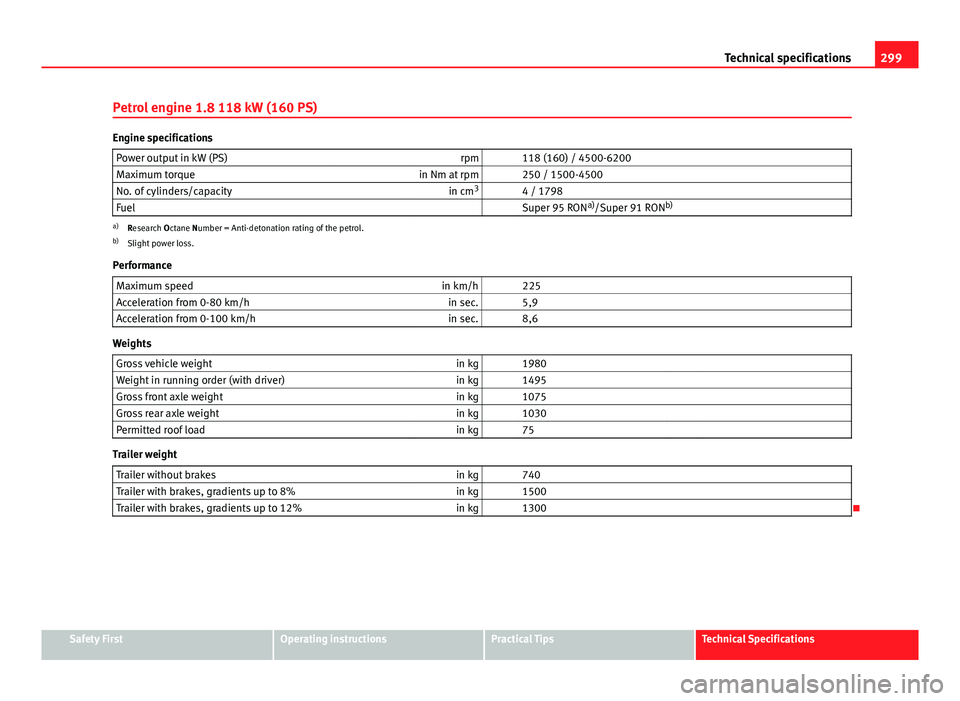
Petrol engine 1.8 118 kW (160 PS)
Engine specifications Power output in kW (PS) rpm 118 (160) / 4500-6200
Maximum torque in Nm at rpm 250 / 1500-4500
No. of cylinders/capacity in cm3
4 / 1798
Fuel Super 95 RON a)
/Super 91 RON b)
a)
Research Octane Number = Anti-detonation rating of the petrol.
b) Slight power loss.
Performance Maximum speed in km/h 225
Acceleration from 0-80 km/h in sec. 5,9
Acceleration from 0-100 km/h in sec. 8,6
Weights
Gross vehicle weight in kg 1980
Weight in running order (with driver) in kg 1495
Gross front axle weight in kg 1075
Gross rear axle weight in kg 1030
Permitted roof load in kg 75
Trailer weight
Trailer without brakes in kg 740
Trailer with brakes, gradients up to 8% in kg 1500
Trailer with brakes, gradients up to 12% in kg 1300
Safety FirstOperating instructionsPractical TipsTechnical Specifications
Page 302 of 319
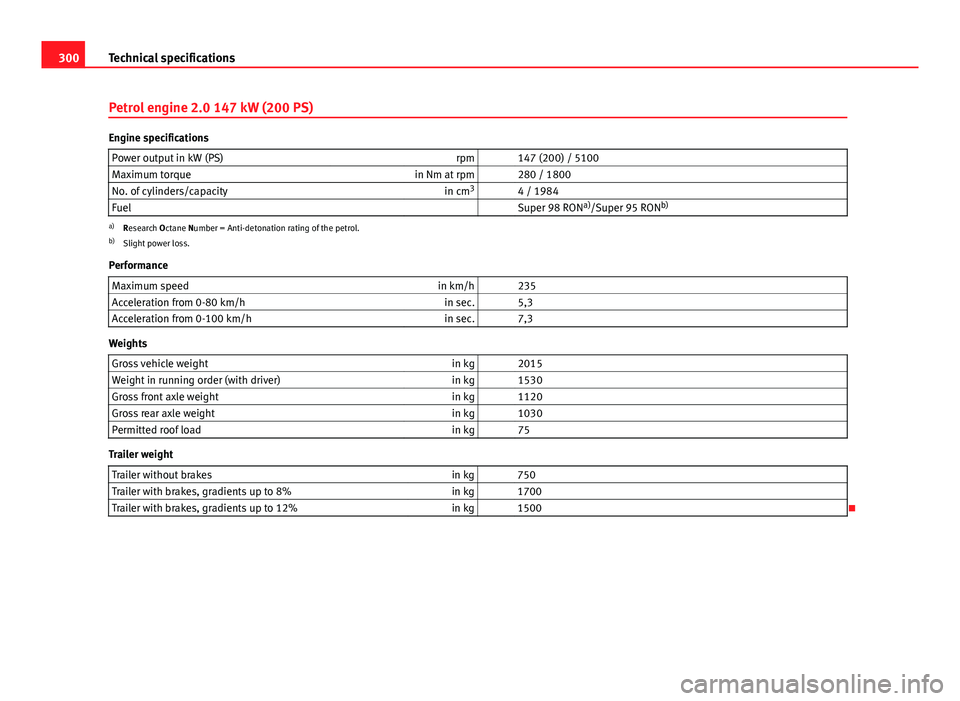
300Technical specifications
Petrol engine 2.0 147 kW (200 PS)
Engine specifications
Power output in kW (PS) rpm 147 (200) / 5100
Maximum torque in Nm at rpm 280 / 1800
No. of cylinders/capacity in cm3
4 / 1984
Fuel Super 98 RON a)
/Super 95 RON b)
a)
Research Octane Number = Anti-detonation rating of the petrol.
b) Slight power loss.
Performance Maximum speed in km/h 235
Acceleration from 0-80 km/h in sec. 5,3
Acceleration from 0-100 km/h in sec. 7,3
Weights
Gross vehicle weight in kg 2015
Weight in running order (with driver) in kg 1530
Gross front axle weight in kg 1120
Gross rear axle weight in kg 1030
Permitted roof load in kg 75
Trailer weight
Trailer without brakes in kg 750
Trailer with brakes, gradients up to 8% in kg 1700
Trailer with brakes, gradients up to 12% in kg 1500
Page 303 of 319
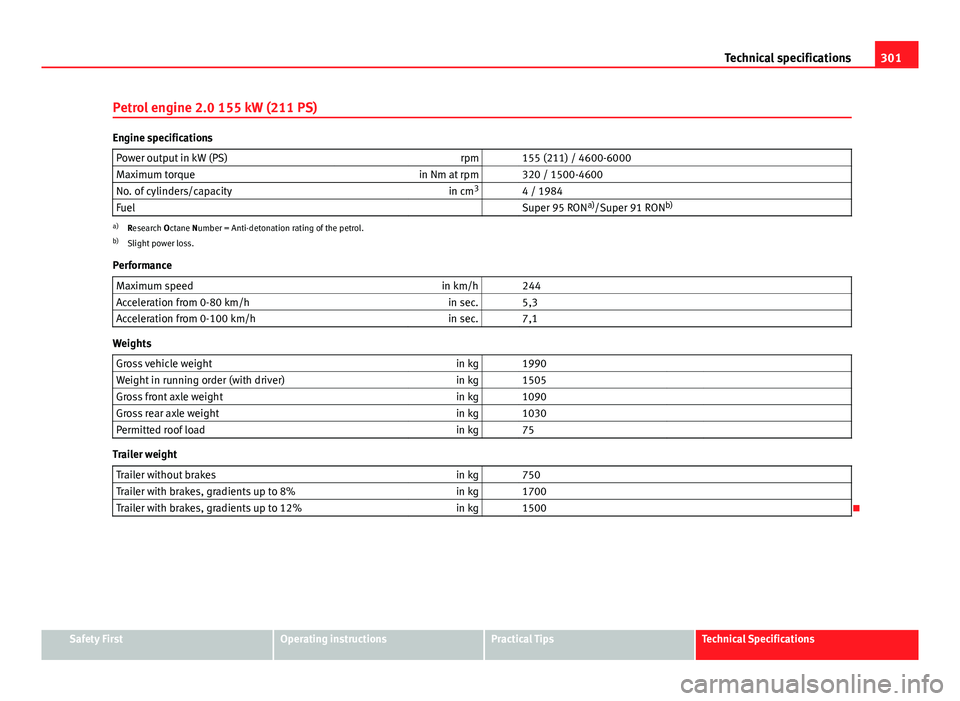
301
Technical specifications
Petrol engine 2.0 155 kW (211 PS)
Engine specifications Power output in kW (PS) rpm 155 (211) / 4600-6000
Maximum torque in Nm at rpm 320 / 1500-4600
No. of cylinders/capacity in cm3
4 / 1984
Fuel Super 95 RON a)
/Super 91 RON b)
a)
Research Octane Number = Anti-detonation rating of the petrol.
b) Slight power loss.
Performance Maximum speed in km/h 244
Acceleration from 0-80 km/h in sec. 5,3
Acceleration from 0-100 km/h in sec. 7,1
Weights
Gross vehicle weight in kg 1990
Weight in running order (with driver) in kg 1505
Gross front axle weight in kg 1090
Gross rear axle weight in kg 1030
Permitted roof load in kg 75
Trailer weight
Trailer without brakes in kg 750
Trailer with brakes, gradients up to 8% in kg 1700
Trailer with brakes, gradients up to 12% in kg 1500
Safety FirstOperating instructionsPractical TipsTechnical Specifications