trailer Seat Exeo 2013 Owner's Guide
[x] Cancel search | Manufacturer: SEAT, Model Year: 2013, Model line: Exeo, Model: Seat Exeo 2013Pages: 319, PDF Size: 4.81 MB
Page 210 of 319
208Trailer towing
WARNING
● To avoid injury, keep your hands away from the locking pin and the
release pin when releasing the locking mechanism.
● Make sure that the cover piece is properly engaged on the mounting
fixture on the vehicle. Otherwise the ball joint may fail to engage secure-
ly if dirt accumulates in the mounting fixture.
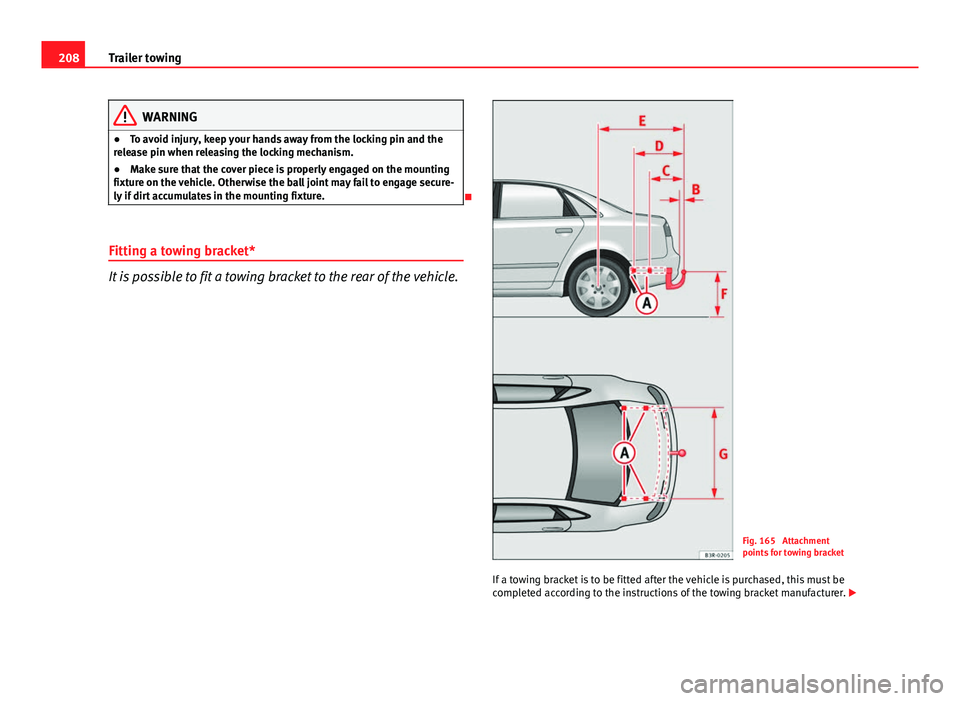
Fitting a towing bracket*
It is possible to fit a towing bracket to the rear of the vehicle.
Fig. 165 Attachment
points for towing bracket
If a towing bracket is to be fitted after the vehicle is purchased, this must be
completed according to the instructions of the towing bracket manufacturer.
Page 211 of 319
209
Trailer towing
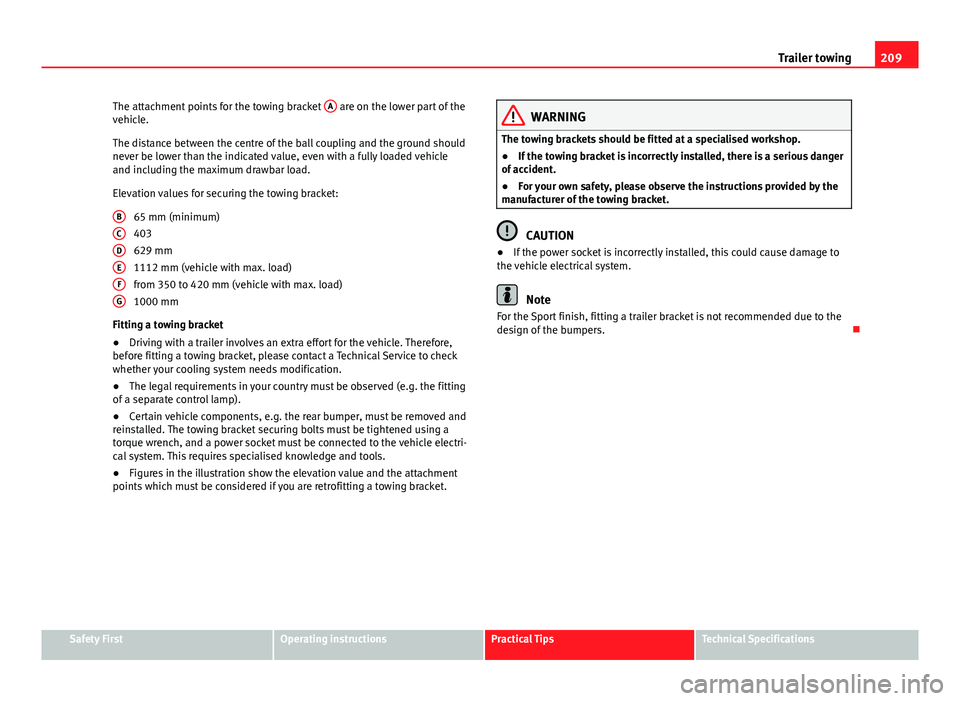
The attachment points for the towing bracket A
are on the lower part of the
vehicle.
The distance between the centre of the ball coupling and the ground should
never be lower than the indicated value, even with a fully loaded vehicle
and including the maximum drawbar load.
Elevation values for securing the towing bracket:
65 mm (minimum)
403
629 mm
1112 mm (vehicle with max. load)
from 350 to 420 mm (vehicle with max. load)
1000 mm
Fitting a towing bracket
● Driving with a trailer involves an extra effort for the vehicle. Therefore,
before fitting a towing bracket, please contact a Technical Service to check
whether your cooling system needs modification.
● The legal requirements in your country must be observed (e.g. the fitting
of a separate control lamp).
● Certain vehicle components, e.g. the rear bumper, must be removed and
reinstalled. The towing bracket securing bolts must be tightened using a
torque wrench, and a power socket must be connected to the vehicle electri-
cal system. This requires specialised knowledge and tools.
● Figures in the illustration show the elevation value and the attachment
points which must be considered if you are retrofitting a towing bracket. B
CDEFG
WARNING
The towing brackets should be fitted at a specialised workshop.
● If the towing bracket is incorrectly installed, there is a serious danger
of accident.
● For your own safety, please observe the instructions provided by the
manufacturer of the towing bracket.
CAUTION
● If the power socket is incorrectly installed, this could cause damage to
the vehicle electrical system.
Note
For the Sport finish, fitting a trailer bracket is not recommended due to the
design of the bumpers.
Safety FirstOperating instructionsPractical TipsTechnical Specifications
Page 256 of 319
254If and when
wheels fitted on the vehicle because of the wheel/tyre dimensions, rubber
composition, tread pattern, etc. Therefore, note the following restrictions:
● The spare steel wheel is designed only for your vehicle model. Do not
attempt to mount the wheel on any vehicle but your own.
● Your vehicle will have different driving characteristics when the spare
steel rim wheel is mounted ⇒
.
● The spare wheel is only intended for temporary use after having a flat
tyre. Replace the spare wheel with a normal wheel that has the proper tyre
dimensions as soon as possible.
● If the size of the spare steel rim wheel is different to that of the other
wheels, it is unlikely that snow chains suitable for the other wheels will fit it.
WARNING
● After mounting the spare steel rim wheel, the tyre pressure must be
checked and corrected as soon as possible. The tyre pressure must corre-
spond to the vehicle load (consult the table containing the inflation pres-
sures). Otherwise there is danger of causing an accident. Use the highest
tyre pressure as indicated in the table.
● Do not drive faster than 80 km/h, as higher speeds can cause an acci-
dent.
● Avoid heavy acceleration, hard braking and fast cornering, as this
could cause an accident.
Changing a wheel
Preparation work
What you must do before changing a wheel. – If you have a flat tyre or puncture, park the vehicle as far away
from the flow of traffic as possible. Choose a location that is as
level as possible.
– All occupants should leave the vehicle. They should wait in a
safe place (e.g. behind the roadside crash barrier).
– Apply the handbrake firmly.
– Engage first gear .
– When towing a trailer: Unhitch the trailer from your vehicle.
– Take the tools and the spare wheel ⇒ page 252 out of the lug-
gage compartment.
WARNING
If you have a puncture in heavy traffic, switch on the hazard warning
lights and place the warning triangle in a visible location. This is for your
own safety and also warns other road users.
CAUTION
If you have to change the tyre on a gradient, block the wheel opposite the
wheel being changed by placing a stone or similar object under it to prevent
the vehicle from rolling away.
Page 298 of 319

296Description of specifications
Towing a trailer
Trailer weights
Trailer weight
The trailer weights and drawbar loads approved are selected in intensive tri-
als according to precisely defined criteria. The approved trailer weights are
valid for vehicles in the EU for maximum speeds of 80 km/h (50 mph) (in
certain circumstances up to 100 km/h (60 mph). The figures may be differ-
ent in other countries. All data in the official vehicle documentation takes
precedence over these data at all times ⇒
.
Drawbar loads
The maximum permitted drawbar load on the ball joint of the towing bracket
must not exceed 75 kg.
In the interest of road safety, we recommend that you always tow approach-
ing the maximum drawbar load. The response of the trailer on the road will
be poor if the drawbar load is too small.
If the maximum permissible drawbar load cannot be met (e.g. with small,
empty and light-weight single axle trailers or tandem axle trailers with a
wheelbase of less than 1 metre), a minimum of 4% of the actual trailer
weight is legally required for the drawbar load.
WARNING
● For safety reasons, do not exceed the 80 km/h (50 mph) limit. This is
also valid in countries where higher speeds are permitted.
● Never exceed the maximum trailer weights or the drawbar load. If the
permissible axle load or the permissible total weight is exceeded, the
driving characteristics of the vehicle may change, leading to accidents,
injuries and damage to the vehicle.
Wheels
Tyre pressure, snow chains, wheel bolts
Tyre pressures
The sticker with the tyre pressure values can be found on the inside of the
fuel tank flap. The tyre pressure values given there are for cold tyres. The
slightly raised pressures of warm tyres must not be reduced. ⇒
Snow chains
Snow chains may be fitted only to the front wheels.
Consult the section “wheels” of this manual.
Wheel bolts
After the wheels have been changed, the tightening torque of the wheel
bolts should be checked as soon as possible with a torque wrench ⇒
.
The tightening torque for steel and alloy wheels is 120 Nm.
WARNING
● Check the tyre pressure at least once per month. Checking the tyre
pressure is very important. If the tyre pressure is too high or too low,
there is an increased danger of accidents, particularly at high speeds.
● If the tightening torque of the wheel bolts is too low, they could loos-
en while the vehicle is in motion. Risk of accident! If the tightening tor-
que is too high, the wheel bolts and threads can be damaged.
Note
We recommend that you ask your Technical Service for information about
appropriate wheel, tyre and snow chain size.
Page 300 of 319
298Technical specifications
Petrol engine 1.8 88 kW (120 PS)
Engine specifications
Power output in kW (PS) rpm 88 (120) / 3650-6200
Maximum torque in Nm at rpm 230 / 1500-3650
No. of cylinders/capacity in cm3
4 / 1798
Fuel Super 95 RON a)
/Super 91 RON b)
a)
Research Octane Number = Anti-detonation rating of the petrol.
b) Slight power loss.
Performance Maximum speed in km/h 202
Acceleration from 0-80 km/h in sec. 7
Acceleration from 0-100 km/h in sec. 10,6
Weights
Gross vehicle weight in kg 1980
Weight in running order (with driver) in kg 1495
Gross front axle weight in kg 1075
Gross rear axle weight in kg 1030
Permitted roof load in kg 75
Trailer weight
Trailer without brakes in kg 740
Trailer with brakes, gradients up to 8% in kg 1500
Trailer with brakes, gradients up to 12% in kg 1300
Page 301 of 319
299
Technical specifications
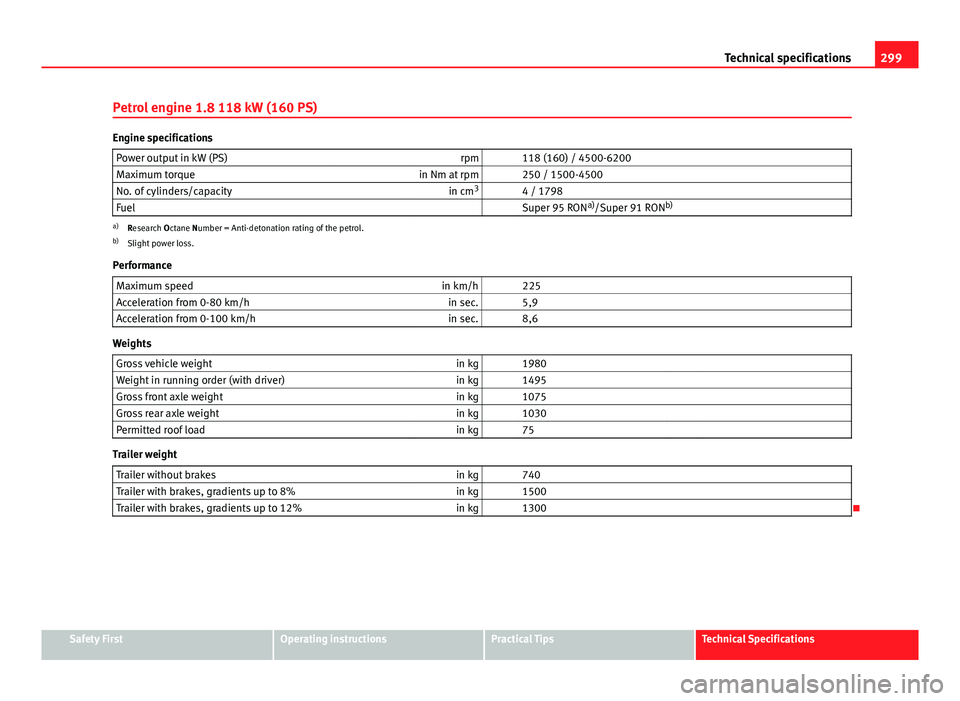
Petrol engine 1.8 118 kW (160 PS)
Engine specifications Power output in kW (PS) rpm 118 (160) / 4500-6200
Maximum torque in Nm at rpm 250 / 1500-4500
No. of cylinders/capacity in cm3
4 / 1798
Fuel Super 95 RON a)
/Super 91 RON b)
a)
Research Octane Number = Anti-detonation rating of the petrol.
b) Slight power loss.
Performance Maximum speed in km/h 225
Acceleration from 0-80 km/h in sec. 5,9
Acceleration from 0-100 km/h in sec. 8,6
Weights
Gross vehicle weight in kg 1980
Weight in running order (with driver) in kg 1495
Gross front axle weight in kg 1075
Gross rear axle weight in kg 1030
Permitted roof load in kg 75
Trailer weight
Trailer without brakes in kg 740
Trailer with brakes, gradients up to 8% in kg 1500
Trailer with brakes, gradients up to 12% in kg 1300
Safety FirstOperating instructionsPractical TipsTechnical Specifications
Page 302 of 319
300Technical specifications
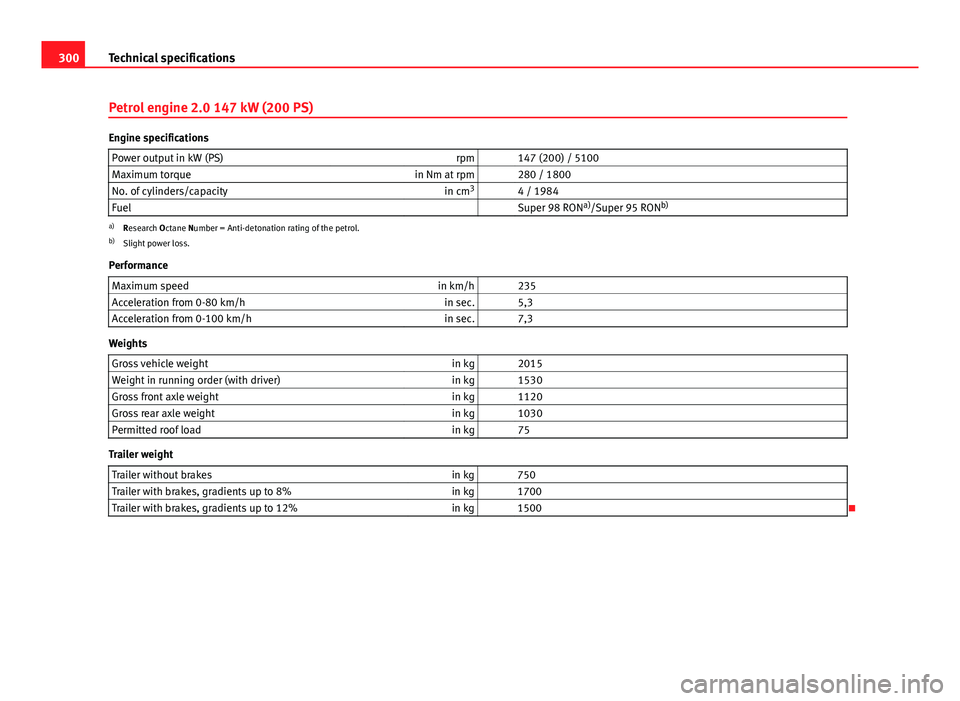
Petrol engine 2.0 147 kW (200 PS)
Engine specifications
Power output in kW (PS) rpm 147 (200) / 5100
Maximum torque in Nm at rpm 280 / 1800
No. of cylinders/capacity in cm3
4 / 1984
Fuel Super 98 RON a)
/Super 95 RON b)
a)
Research Octane Number = Anti-detonation rating of the petrol.
b) Slight power loss.
Performance Maximum speed in km/h 235
Acceleration from 0-80 km/h in sec. 5,3
Acceleration from 0-100 km/h in sec. 7,3
Weights
Gross vehicle weight in kg 2015
Weight in running order (with driver) in kg 1530
Gross front axle weight in kg 1120
Gross rear axle weight in kg 1030
Permitted roof load in kg 75
Trailer weight
Trailer without brakes in kg 750
Trailer with brakes, gradients up to 8% in kg 1700
Trailer with brakes, gradients up to 12% in kg 1500
Page 303 of 319
301
Technical specifications
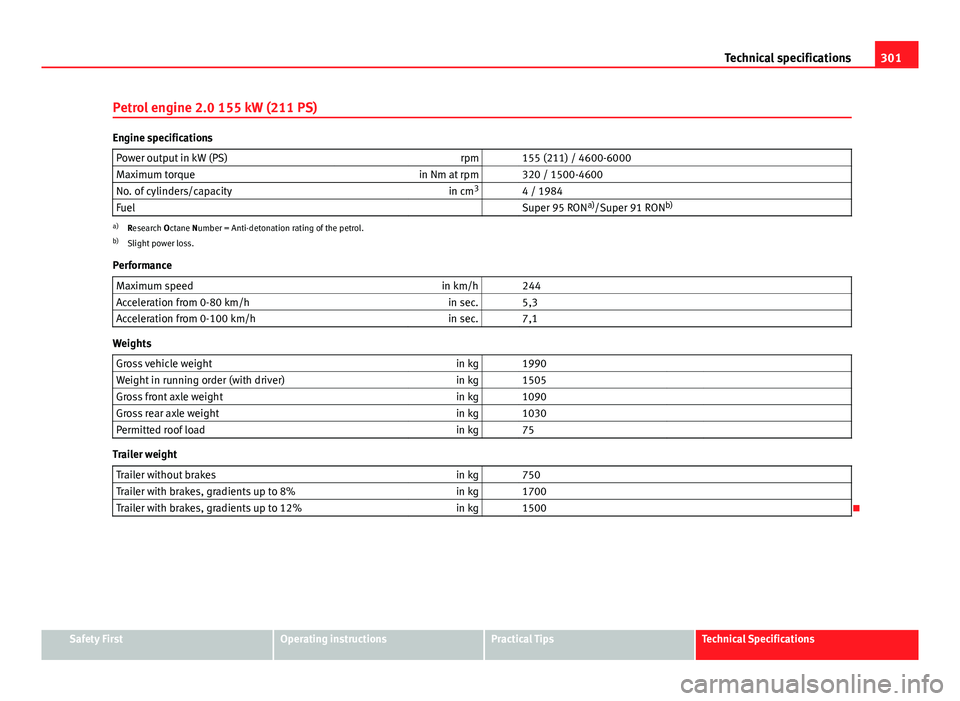
Petrol engine 2.0 155 kW (211 PS)
Engine specifications Power output in kW (PS) rpm 155 (211) / 4600-6000
Maximum torque in Nm at rpm 320 / 1500-4600
No. of cylinders/capacity in cm3
4 / 1984
Fuel Super 95 RON a)
/Super 91 RON b)
a)
Research Octane Number = Anti-detonation rating of the petrol.
b) Slight power loss.
Performance Maximum speed in km/h 244
Acceleration from 0-80 km/h in sec. 5,3
Acceleration from 0-100 km/h in sec. 7,1
Weights
Gross vehicle weight in kg 1990
Weight in running order (with driver) in kg 1505
Gross front axle weight in kg 1090
Gross rear axle weight in kg 1030
Permitted roof load in kg 75
Trailer weight
Trailer without brakes in kg 750
Trailer with brakes, gradients up to 8% in kg 1700
Trailer with brakes, gradients up to 12% in kg 1500
Safety FirstOperating instructionsPractical TipsTechnical Specifications
Page 304 of 319
302Technical specifications
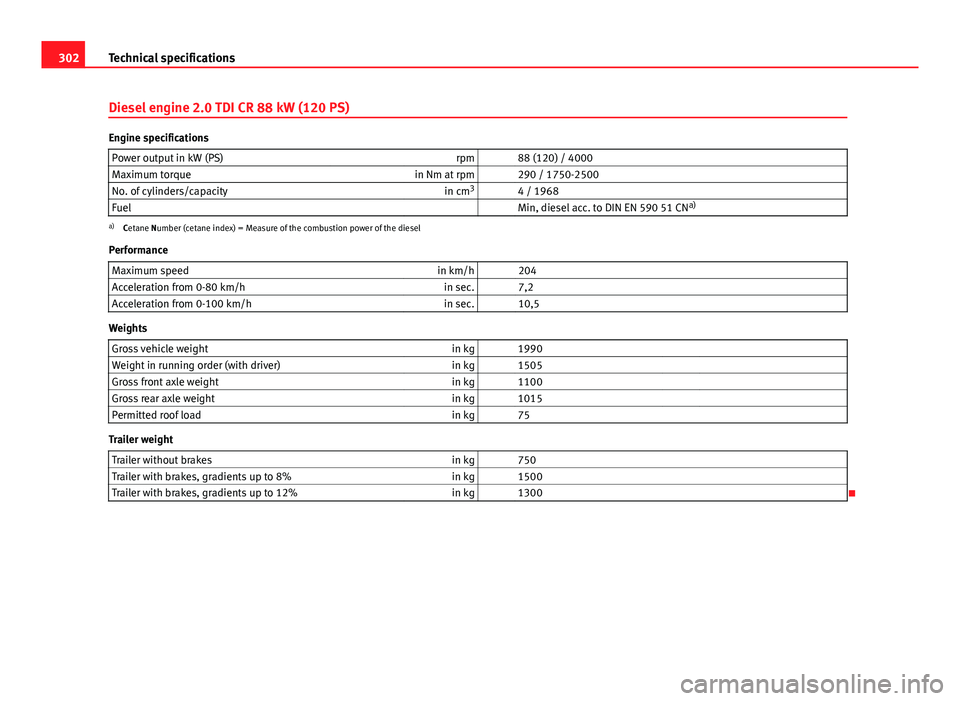
Diesel engine 2.0 TDI CR 88 kW (120 PS)
Engine specifications
Power output in kW (PS) rpm 88 (120) / 4000
Maximum torque in Nm at rpm 290 / 1750-2500
No. of cylinders/capacity in cm3
4 / 1968
Fuel Min, diesel acc. to DIN EN 590 51 CN a)
a)
Cetane Number (cetane index) = Measure of the combustion power of the diesel
Performance Maximum speed in km/h 204
Acceleration from 0-80 km/h in sec. 7,2
Acceleration from 0-100 km/h in sec. 10,5
Weights
Gross vehicle weight in kg 1990
Weight in running order (with driver) in kg 1505
Gross front axle weight in kg 1100
Gross rear axle weight in kg 1015
Permitted roof load in kg 75
Trailer weight
Trailer without brakes in kg 750
Trailer with brakes, gradients up to 8% in kg 1500
Trailer with brakes, gradients up to 12% in kg 1300
Page 305 of 319
303
Technical specifications
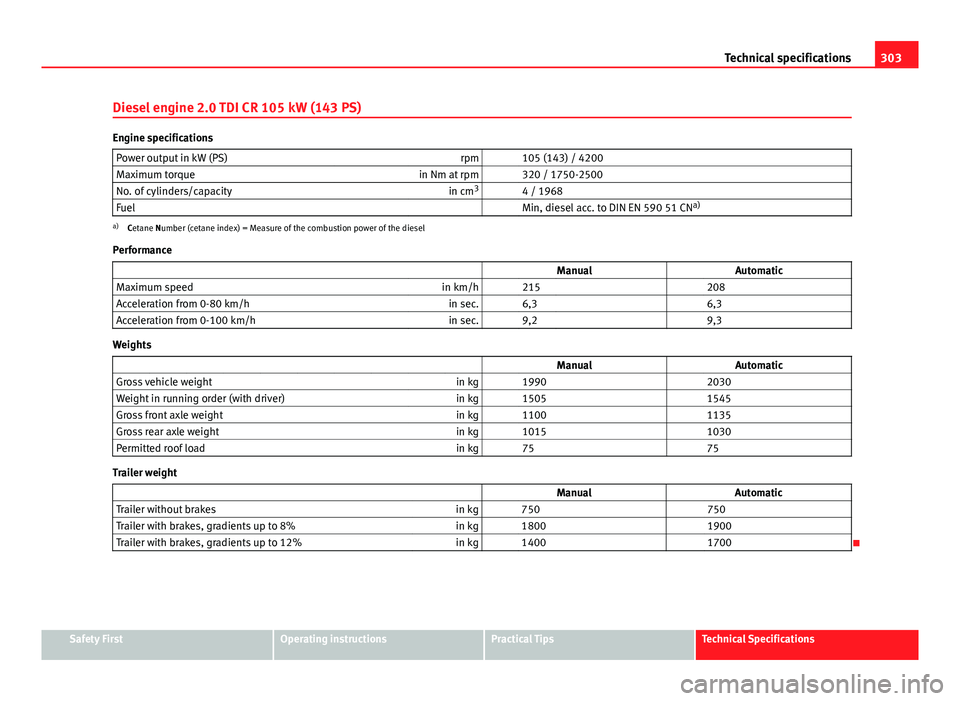
Diesel engine 2.0 TDI CR 105 kW (143 PS)
Engine specifications Power output in kW (PS) rpm 105 (143) / 4200
Maximum torque in Nm at rpm 320 / 1750-2500
No. of cylinders/capacity in cm3
4 / 1968
Fuel Min, diesel acc. to DIN EN 590 51 CN a)
a)
Cetane Number (cetane index) = Measure of the combustion power of the diesel
Performance ManualAutomatic
Maximum speed in km/h 215 208
Acceleration from 0-80 km/h in sec. 6,3 6,3
Acceleration from 0-100 km/h in sec. 9,2 9,3
Weights
Manual Automatic
Gross vehicle weight in kg 1990 2030
Weight in running order (with driver) in kg 1505 1545
Gross front axle weight in kg 1100 1135
Gross rear axle weight in kg 1015 1030
Permitted roof load in kg 75 75
Trailer weight
ManualAutomatic
Trailer without brakes in kg 750 750
Trailer with brakes, gradients up to 8% in kg 1800 1900
Trailer with brakes, gradients up to 12% in kg 1400 1700
Safety FirstOperating instructionsPractical TipsTechnical Specifications