ECU Seat Exeo 2013 Service Manual
[x] Cancel search | Manufacturer: SEAT, Model Year: 2013, Model line: Exeo, Model: Seat Exeo 2013Pages: 319, PDF Size: 4.81 MB
Page 241 of 319
239
Checking and refilling levels
Disconnecting the battery
If the battery is disconnected, some of the vehicle's functions will become
inoperative (e.g. electric windows). These functions will require resetting af-
ter the battery is reconnected. For this reason, the battery should only be
disconnected from the vehicle's electrical system when absolutely necessa-
ry.
Long periods of non-use
The battery will gradually lose its charge because certain electrical equip-
ment continues to draw current even when the ignition is off. If you park the
vehicle for long periods of time in winter you should take the battery out of
the vehicle and store it in a place protected from frost. This way it will not
freeze and become damaged. At warm outside temperatures it is sufficient
to disconnect the negative terminal of the battery. Even when the battery is
not connected you should charge it from time to time.
Winter operation
The battery is drained more in cold weather, which means that the starting
power is reduced. For this reason, have the battery checked and charged if
necessary before the start of winter.
Replacing the battery
A replacement battery must have the same capacity, voltage and current rat-
ing. It must also have the same dimensions as the original, factory-fitted
battery and have sealed caps. The SEAT batteries which have been specially
developed fulfil the maintenance, performance and safety specifications for
your vehicle.
We recommend you use maintenance-free batteries.
WARNING
● All work on batteries requires specialist knowledge. If work is re-
quired on the battery, this should be performed by a Technical Service or
specialised workshop. Danger of caustic burns and explosion!
● The battery must not be opened. Never try to change the battery's liq-
uid level. Explosive gas is released from the battery that could cause an
explosion.
CAUTION
● The battery holder and clamps must always be correctly secured.
● Before starting any work on the battery, always observe the warnings
listed under ⇒
.
For the sake of the environment
Batteries contain toxic substances including sulphuric acid and lead.
Therefore, they must be disposed of in line with environmental regulations
and must not be disposed of with ordinary household waste. Make sure dis-
connected batteries cannot tip over. Sulphuric acid could be spilt!
Important safety warnings for handling a vehicle battery
The battery is located at the back of the engine compartment ⇒ page 297.
Wear eye protection
Battery acid is extremely corrosive. Wear protective gloves
and eye protection!
Fires, sparks, open flames and smoking are prohibited!
Safety FirstOperating instructionsPractical TipsTechnical Specifications
Page 252 of 319
250Wheels and tyres
Wheel bolts
Wheel bolts must be tightened to the correct torque.
The design of wheel bolts is matched to the rims. If different wheel rims are
fitted, the correct wheel bolts with the right length and correctly shaped
bolt heads must be used. This ensures that wheels are fitted securely and
that the brake system functions correctly.
In certain circumstances, you should not use wheel bolts from a different
vehicle, even if it is the same model ⇒ page 222.
After the wheels have been changed, the tightening torque of the wheel
bolts should be checked as soon as possible with a torque wrench. ⇒
The tightening torque for steel and alloy wheels is 120 Nm.
WARNING
If the wheel bolts are not tightened correctly, the wheel could become
loose while driving. Risk of accident.
● The wheel bolts must be clean and turn easily. Never apply grease or
oil to them.
● Use only wheel bolts which belong to the wheel.
● If the tightening torque of the wheel bolts is too low, they could loos-
en whilst the vehicle is in motion. Risk of accident! If the tightening tor-
que is too high, the wheel bolts and threads can be damaged.
CAUTION
The prescribed tightening torque for wheel bolts for steel and alloy wheels
is 120 Nm. Winter tyres
Winter tyres will improve the vehicles handling on snow and
ice.
In winter conditions winter tyres will considerably improve the vehicle's han-
dling. The design of summer tyres (width, rubber compound, tread pattern)
gives less grip on ice and snow.
Winter tyres must be inflated to a pressure 0.2 bar higher than the pres-
sures specified for summer tyres (see sticker on fuel tank flap).
Winter tyres must be fitted on all four wheels.
Information on permitted winter tyre sizes can be found in the vehicle's reg-
istration documentation. Use only radial winter tyres. All tyre sizes listed in
the vehicle documentation also apply to winter tyres.
Winter tyres lose their effectiveness when the tread is worn down to a depth
of 4 mm.
The speed rating code ⇒ page 248, New tyres and wheels determines the
following speed limits for winter tyres: ⇒
max. 160 km/h (100 mph)
max. 180 km/h (110 mph)
max. 190 km/h (118 mph)
max. 210 km/h (130 mph)
In some countries, vehicles which can exceed the speed rating of the fitted
tyre must have an appropriate sticker in the driver's field of view. These
stickers are available from your Technical Service. The legal requirements of
each country must be followed.
Do not have winter tyres fitted for unnecessarily long periods. Vehicles with
summer tyres handle better when the roads are free of snow and ice.
Q
S
T
H
Page 255 of 319
253
If and when
Tyre mobility system
The tyre mobility system is stored under the floor panel in
the luggage compartment.
Fig. 181 Tyre Mobility
System under floor panel
in luggage compartment
– Take hold of the handle and fold back the floor panel in the lug-
gage compartment.
– Take out the tyre mobility system.
Your vehicle is equipped with a Tyre Mobility System in case of a puncture.
The tyre mobility system consists of a container with sealing compound and
a compressor to generate the required tyre pressure.
Instructions for using the sealant compound and the compressor are inclu-
ded with the sealant can. Spare steel rim wheel
The spare steel rim wheel is carried in the wheel well under
the floor panel in the luggage compartment. It is only inten-
ded for temporary use over short distances.
Fig. 182 Spare steel rim
wheel
Taking out the spare wheel
– Turn the plastic knob ⇒ Fig. 182 anticlockwise.
– Take out the spare wheel.
Securing the defective wheel in the spare wheel well
– Place wheel in spare wheel well in the luggage compartment.
– Secure the wheel by turning plastic knob clockwise.
– Replace the floor panel before closing the rear lid.
Your vehicle can be factory-equipped with a spare steel wheel. The spare
wheel does not usually meet the same performance standards as the
Safety FirstOperating instructionsPractical TipsTechnical Specifications
Page 257 of 319
255
If and when
Note
Please observe legal requirements when doing so.
Changing a wheel
Change the wheel as described below.
– Remove the wheel cover .
– Loosen the wheel bolts ⇒ page 256.
– Raise the vehicle with the jack ⇒ page 257.
– Take off the wheel with the flat tyre and then put on the spare
wheel ⇒ page 258.
– Lower the vehicle.
– Tighten the wheel bolts firmly in diagonal sequence with the
box spanner ⇒ page 256.
– Replace the cover.
After changing a wheel
After changing the wheel, there are still tasks to complete. – Place the wheel with the defective tyre in the spare wheel well
and secure it.
– Put the tools and jack back in the luggage compartment. –
The inflation pressure of the newly fitted spare tyre must be
checked as soon as possible.
– Have the tightening torque of the wheel bolts checked as soon
as possible with a torque wrench. It must be 120 Nm (always
when cold)
– Have the flat tyre replaced as quickly as possible.
Note
● If you notice that the wheel bolts are rusty and difficult to turn when
changing a wheel, they must be replaced before having the tightening tor-
que checked.
● For safety reasons, drive at moderate speeds until the wheel bolt tight-
ening torque has been checked.
Safety FirstOperating instructionsPractical TipsTechnical Specifications
Page 279 of 319
277
If and when
Removing tail light
To change the bulbs you must remove the tail light assem-
bly. Removing the light requires a certain degree of practical
skill.
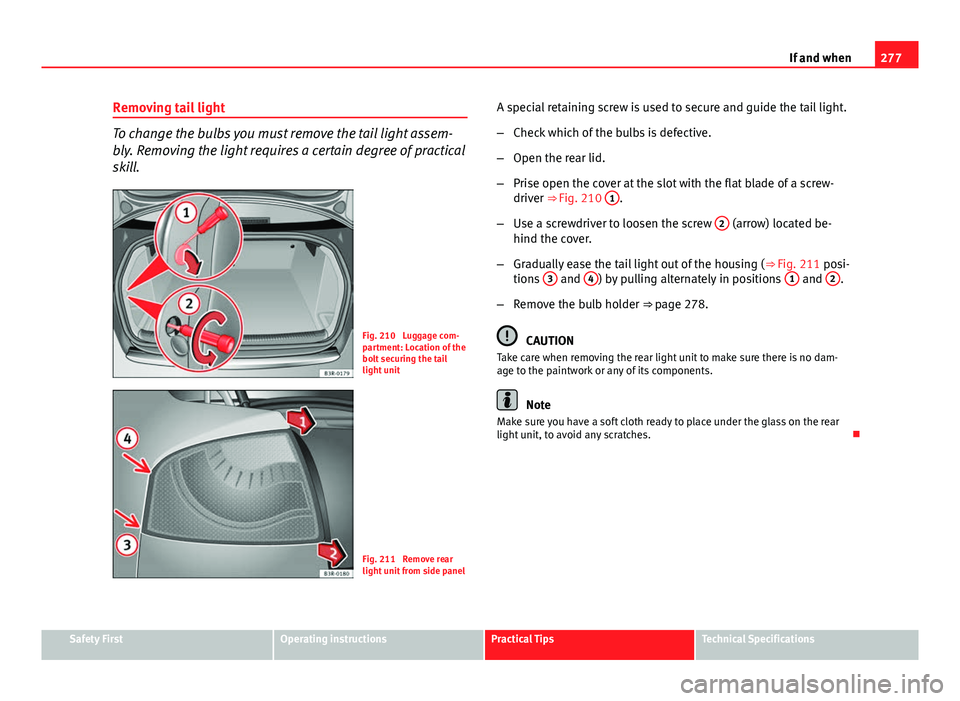
Fig. 210 Luggage com-
partment: Location of the
bolt securing the tail
light unit
Fig. 211 Remove rear
light unit from side panel A special retaining screw is used to secure and guide the tail light.
–
Check which of the bulbs is defective.
– Open the rear lid.
– Prise open the cover at the slot with the flat blade of a screw-
driver ⇒ Fig. 210 1
.
– Use a screwdriver to loosen the screw 2
(arrow) located be-
hind the cover.
– Gradually ease the tail light out of the housing ( ⇒ Fig. 211 posi-
tions 3
and 4) by pulling alternately in positions 1 and 2.
– Remove the bulb holder ⇒ page 278.
CAUTION
Take care when removing the rear light unit to make sure there is no dam-
age to the paintwork or any of its components.
Note
Make sure you have a soft cloth ready to place under the glass on the rear
light unit, to avoid any scratches.
Safety FirstOperating instructionsPractical TipsTechnical Specifications
Page 280 of 319
278If and when
Remove the bulb holder
When changing a bulb, you must first remove the bulb hold-
er.
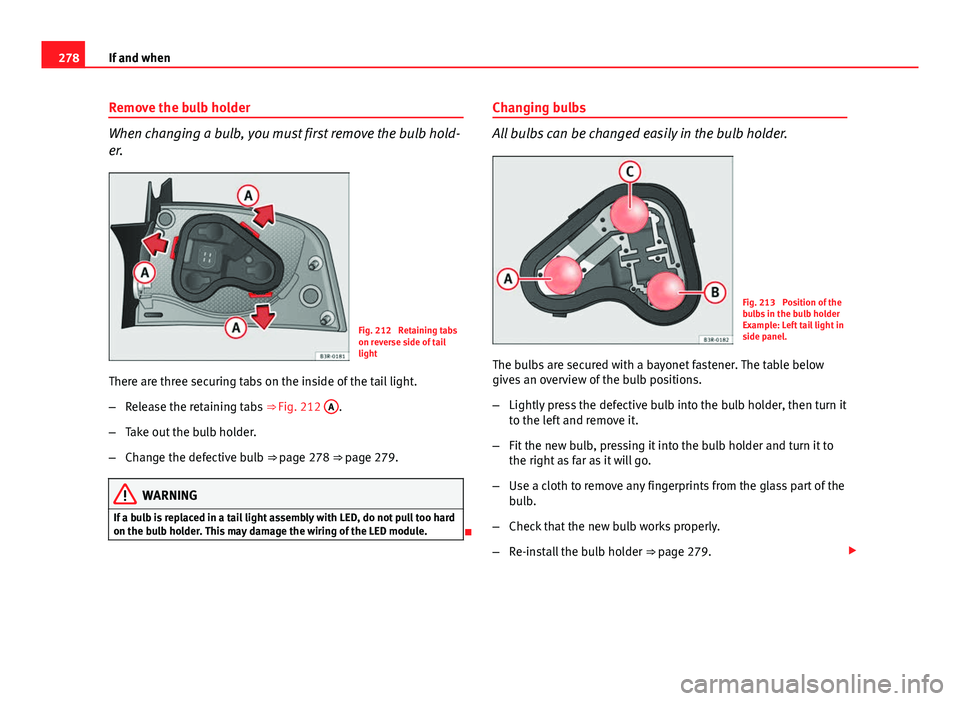
Fig. 212 Retaining tabs
on reverse side of tail
light
There are three securing tabs on the inside of the tail light.
– Release the retaining tabs ⇒ Fig. 212 A
.
– Take out the bulb holder.
– Change the defective bulb ⇒ page 278 ⇒ page 279.
WARNING
If a bulb is replaced in a tail light assembly with LED, do not pull too hard
on the bulb holder. This may damage the wiring of the LED module.
Changing bulbs
All bulbs can be changed easily in the bulb holder.
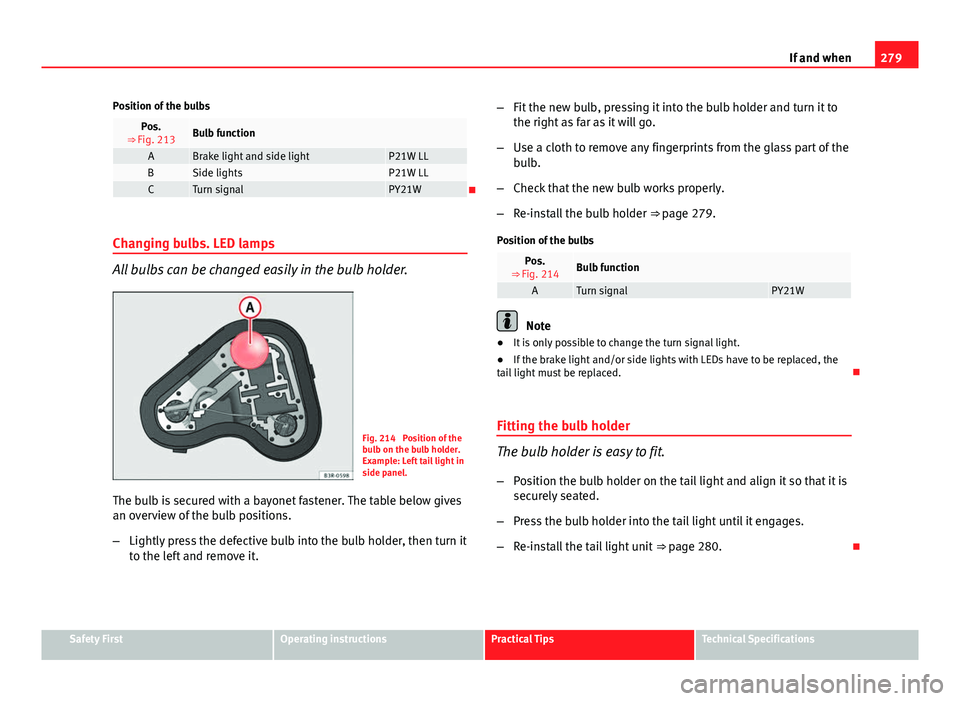
Fig. 213 Position of the
bulbs in the bulb holder
Example: Left tail light in
side panel.
The bulbs are secured with a bayonet fastener. The table below
gives an overview of the bulb positions.
– Lightly press the defective bulb into the bulb holder, then turn it
to the left and remove it.
– Fit the new bulb, pressing it into the bulb holder and turn it to
the right as far as it will go.
– Use a cloth to remove any fingerprints from the glass part of the
bulb.
– Check that the new bulb works properly.
– Re-install the bulb holder ⇒ page 279.
Page 281 of 319
279
If and when
Position of the bulbs
Pos.
⇒ Fig. 213Bulb function
ABrake light and side lightP21W LLBSide lightsP21W LLCTurn signalPY21W
Changing bulbs. LED lamps
All bulbs can be changed easily in the bulb holder.
Fig. 214 Position of the
bulb on the bulb holder.
Example: Left tail light in
side panel.
The bulb is secured with a bayonet fastener. The table below gives
an overview of the bulb positions.
– Lightly press the defective bulb into the bulb holder, then turn it
to the left and remove it. –
Fit the new bulb, pressing it into the bulb holder and turn it to
the right as far as it will go.
– Use a cloth to remove any fingerprints from the glass part of the
bulb.
– Check that the new bulb works properly.
– Re-install the bulb holder ⇒ page 279.
Position of the bulbs
Pos.
⇒ Fig. 214Bulb function
ATurn signalPY21W
Note
● It is only possible to change the turn signal light.
● If the brake light and/or side lights with LEDs have to be replaced, the
tail light must be replaced.
Fitting the bulb holder
The bulb holder is easy to fit. – Position the bulb holder on the tail light and align it so that it is
securely seated.
– Press the bulb holder into the tail light until it engages.
– Re-install the tail light unit ⇒ page 280.
Safety FirstOperating instructionsPractical TipsTechnical Specifications
Page 282 of 319
280If and when
Fitting the tail light unit
The tail light unit is easy to fit.
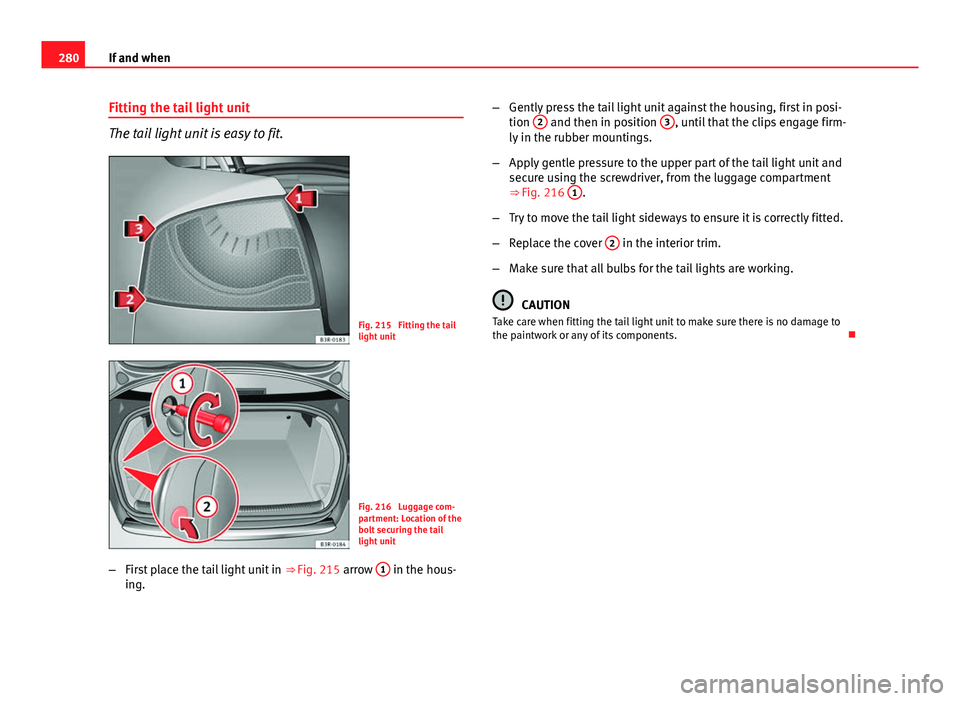
Fig. 215 Fitting the tail
light unit
Fig. 216 Luggage com-
partment: Location of the
bolt securing the tail
light unit
– First place the tail light unit in ⇒ Fig. 215 arrow 1
in the hous-
ing. –
Gently press the tail light unit against the housing, first in posi-
tion 2
and then in position 3, until that the clips engage firm-
ly in the rubber mountings.
– Apply gentle pressure to the upper part of the tail light unit and
secure using the screwdriver, from the luggage compartment
⇒ Fig. 216 1
.
– Try to move the tail light sideways to ensure it is correctly fitted.
– Replace the cover 2
in the interior trim.
– Make sure that all bulbs for the tail lights are working.
CAUTION
Take care when fitting the tail light unit to make sure there is no damage to
the paintwork or any of its components.
Page 285 of 319
283
If and when
The bulbs are secured with a bayonet fastener. The table below
gives an overview of the bulb positions.
– Lightly press the defective bulb into the bulb holder, then turn it
to the left and remove it.
– Fit the new bulb, pressing it into the bulb holder and turn it to
the right as far as it will go.
– Use a cloth to remove any fingerprints from the glass part of the
bulb.
– Check that the new bulb works properly.
– Re-install the bulb holder ⇒ page 284.
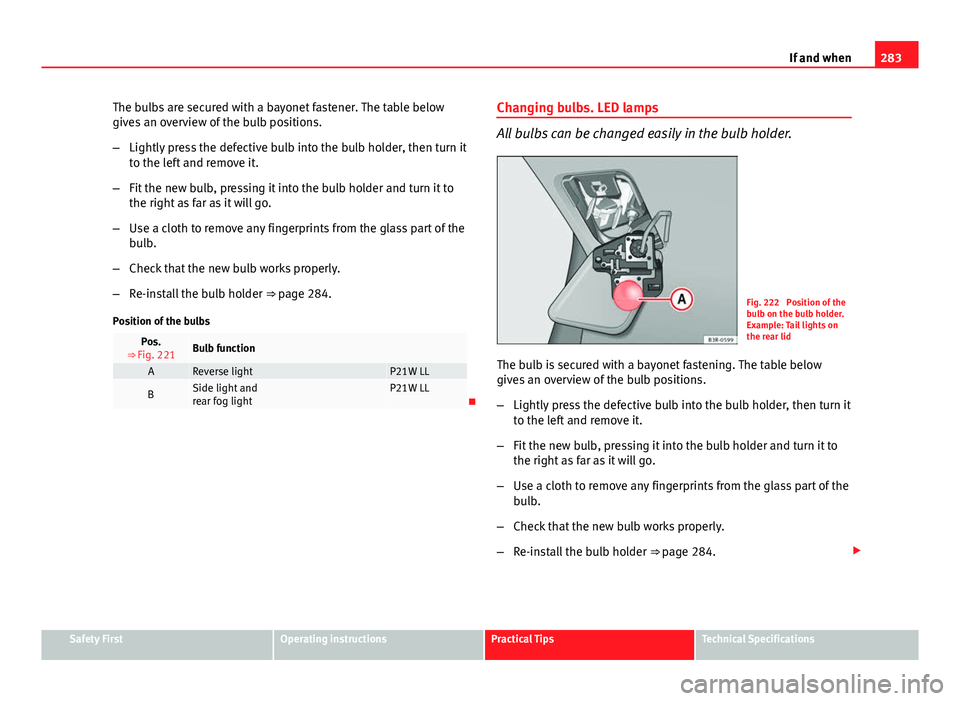
Position of the bulbs
Pos.
⇒ Fig. 221Bulb function
AReverse lightP21W LL
BSide light and
rear fog lightP21W LL Changing bulbs. LED lamps
All bulbs can be changed easily in the bulb holder.
Fig. 222 Position of the
bulb on the bulb holder.
Example: Tail lights on
the rear lid
The bulb is secured with a bayonet fastening. The table below
gives an overview of the bulb positions.
– Lightly press the defective bulb into the bulb holder, then turn it
to the left and remove it.
– Fit the new bulb, pressing it into the bulb holder and turn it to
the right as far as it will go.
– Use a cloth to remove any fingerprints from the glass part of the
bulb.
– Check that the new bulb works properly.
– Re-install the bulb holder ⇒ page 284.
Safety FirstOperating instructionsPractical TipsTechnical Specifications
Page 286 of 319
284If and when
Position of the bulbs
Pos.
⇒ Fig. 222Bulb function
AReverse lightP21W LL
Fitting the bulb holder
The bulb holder is easy to fit. – Check that the seal is seated correctly on the bulb holder.
– Position the bulb holder on the tail light and align it so that it is
securely seated.
– Press the bulb holder into the tail light until it engages.
– Fit the cover back in the interior trim so that it engages.
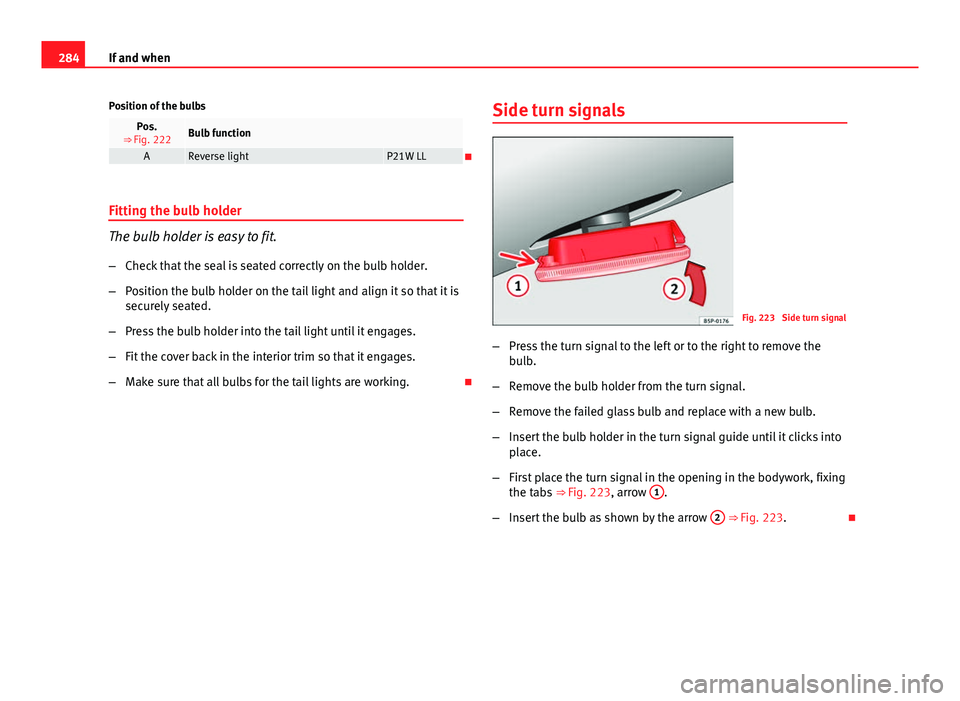
– Make sure that all bulbs for the tail lights are working. Side turn signals
Fig. 223 Side turn signal
– Press the turn signal to the left or to the right to remove the
bulb.
– Remove the bulb holder from the turn signal.
– Remove the failed glass bulb and replace with a new bulb.
– Insert the bulb holder in the turn signal guide until it clicks into
place.
– First place the turn signal in the opening in the bodywork, fixing
the tabs ⇒ Fig. 223, arrow 1
.
– Insert the bulb as shown by the arrow 2
⇒ Fig. 223.