warning Seat Exeo ST 2009 Owner's manual
[x] Cancel search | Manufacturer: SEAT, Model Year: 2009, Model line: Exeo ST, Model: Seat Exeo ST 2009Pages: 316, PDF Size: 8.83 MB
Page 256 of 316
If and when
254Changing a wheelPreparation work
What you must do before changing a wheel.– If you have a flat tyre or puncture, park the car as far away from
the flow of traffic as possible. Choose a location that is as level
as possible.
– All passengers should leave the vehicle. They should wait in a
safe place (e.g. behind the roadside crash barrier).
–Apply the handbrake firmly.
–Engage 1st gear.
– When towing a trailer: Unhitch the trailer from your vehicle.
–Take the tools and the spare wheel ⇒ page 251 out of the
luggage compartment.
WARNING
If you have a puncture in heavy traffic, switch on the hazard warning lights
and place the warning triangle in a visible location. This is for your own
safety and also warns other road users.
Caution
If you have to change the tyre on a gradient, block the wheel opposite the
wheel being changed by placing a stone or similar object under it to prevent
the vehicle from rolling away.
Note
Please observe legal requirements when doing so.Changing a wheel
Change the wheel as described below.– Remove the wheel cover.
–Loosen the wheel bolts ⇒ page 255.
– Raise the car with the jack ⇒page 256.
– Ta k e o f f the wheel with the flat tyre and then put on the spare
wheel ⇒page 257.
– Lower the vehicle.
– Tighten the wheel bolts firmly in diagonal sequence with the box
spanner ⇒page 255.
–Replace the cover .After changing a wheel
After changing the wheel, there are still tasks to complete.– Place the wheel with the defective tyre in the spare wheel well
and secure it.
– Put the tools and jack back in the luggage compartment.
ExeoST_EN.book Seite 254 Donnerstag, 3. September 2009 12:24 12
Page 258 of 316
If and when
256
WARNING
Loosen the wheel bolts only about one turn before raising the vehicle with
the jack. Failure to do so could result in an accident.
Note
•Do not use the hexagonal socket in the screwdriver handle to loosen or
tighten the wheel bolts.•If the wheel bolt does not come loose, it may be possible to release it by
pushing down the end of the spanner carefully with your foot. Hold on to the
vehicle for support and take care not to slip.Raising the vehicle
In order to remove the wheel, the vehicle must be raised with
a jack.
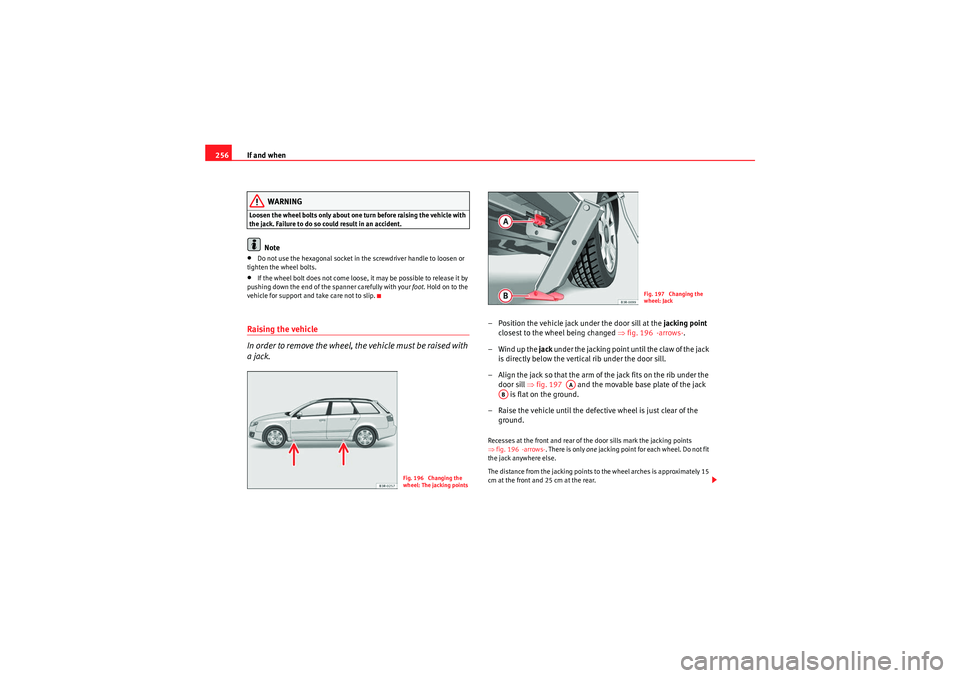
– Position the vehicle jack under the door sill at the jacking point
closest to the wheel being changed ⇒fig. 196 -arrows- .
–Wind up the jack under the jacking point until the claw of the jack
is directly below the vertical rib under the door sill.
– Align the jack so that the arm of the jack fits on the rib under the door sill ⇒ fig. 197 and the movable base plate of the jack
is flat on the ground.
– Raise the vehicle until the defective wheel is just clear of the ground.Recesses at the front and rear of the door sills mark the jacking points
⇒fig. 196 -arrows- . There is only one jacking point for each wheel. Do not fit
the jack anywhere else.
The distance from the jacking points to the wheel arches is approximately 15
cm at the front and 25 cm at the rear.
Fig. 196 Changing the
wheel: The jacking points
Fig. 197 Changing the
wheel: Jack
AA
AB
ExeoST_EN.book Seite 256 Donnerstag, 3. September 2009 12:24 12
Page 259 of 316
If and when257
Safety First
Controls and equipment
Practical tips
Technical Data
An
unstable surface under the jack may cause the vehicle to slip off the jack.
Therefore, the jack must be fitted on solid ground offering good support. Use
a large, stable base if necessary. On a hard, slippery surface (such as tiles)
use a rubber mat or similar to prevent the jack from slipping.
WARNING
•Take all precautions so that the base of the jack does not slip. Failure to
do so could result in an accident.•The vehicle can be damaged if the jack is not applied at the correct
jacking points. There is also a risk of injury since the jack can slip off
suddenly if it is not properly engaged.
Removing and fitting the wheel
For removal and fitting the wheel, the following tasks must be
completed.
After loosening the wheel bolts and raising the vehicle with the jack,
change the wheel as described below:
Removing a wheel
– Unscrew the bolts using the hexagonal tool in the handle of the
screwdriver (vehicle tool) and place them on a clean surface
⇒ fig. 198 .
Fitting a wheel
– Screw in the wheel bolts and tighten them lightly using the hexagonal socket in the screwdriver handle.The wheel bolts should be clean and easily screwed. Before fitting the spare
wheel, inspect the wheel condition and hub mounting surfaces. These
surfaces must be clean before fitting the wheel.
The hexagonal socket in the screwdriver handle makes it easier to turn the
wheel bolts. The reversible screwdriver blade should be removed when the
tool is used for this purpose.
If tyres with a specific direction of rotation are fitted, note the direction of
rotation.
Note
Do not use the hexagonal socket in the screwdriver handle to loosen or
tighten the wheel bolts.
Fig. 198 Changing the
wheel: Hexagonal socket
in screwdriver handle to
turn the wheel bolts
ExeoST_EN.book Seite 257 Donnerstag, 3. September 2009 12:24 12
Page 261 of 316
If and when259
Safety First
Controls and equipment
Practical tips
Technical Data
Tyre repair* (Tyre-Mobility-System)General information and safety notes
Repaired tyres are only suitable for temporary use over a
short period.Your vehicle is equipped with a tyre repair kit: the Ty re Mo bil it y Syste m.
In the event of a puncture you will find the TMS, which consists of a sealing
compound and a compressor, located under the floor panel in the luggage
compartment.
The Ty re Mo bil i t y Syste m will reliably seal tyres damaged by foreign bodies,
provided that the cuts or punctures are no larger than approx. 4 mm in diam-
eter.
It is not necessary to remove the foreign body from the tyre. The sealing compound must not be used in the following cases:
•On cuts and punctures larger than 4 mm
⇒fig. 200 •if the wheel rim has been damaged •i f yo u ha ve b e en d r iving wit h v e r y low pre ssu re o r a com ple te ly fla t tyre
How to use the TMS (tyre mobility system) is described in the section
Repairing a tyre ⇒ page 260 and in the instructions supplied with the tyre
sealant can.
The TMS (tyre mobility system) can be used at outside temperatures down to
-20°C.WARNING
After repairing a tyre please note the following points:•Do not drive faster than 80 km/h.•Avoid heavy acceleration, hard braking and fast cornering.•Vehicle handling could be impaired.•Tyres which have been sealed using the Tyre Mobility System are only
suitable for temporary use over a short period.•After using the tyre sealant the tyre pressure monitoring system* may
malfunction. Therefore, please drive carefully to the next available quali-
fied workshop.•The Tyre Mobility System must NOT be used,
− on cuts and punctures larger than 4 mm
− if the wheel rim has been damaged
− if you have been driving with very low pressure or a completely flat
tyre•Seek professional assistance if the repair of a tyre puncture is not
possible with the sealing compound.•Do not allow the sealant to come into contact with your eyes, skin or
clothing.
Fig. 200 The Tyre
Mobility System is not
suitable for repairing this
type of damage to tyres.
A1
A2
A3
ExeoST_EN.book Seite 259 Donnerstag, 3. September 2009 12:24 12
Page 262 of 316
If and when
260•If you do come into contact with the sealant immediately rinse the eyes
or skin affected with clean water.•Change clothing immediately if it becomes soiled with the tyre sealant.•Make sure you do not breathe in the fumes!•If any of the tyre sealant is accidentally ingested, immediately rinse the
mouth thoroughly and drink lots of water.
−Do not induce vomiting. Seek medical assistance if needed.•If any allergic reactions should occur get medical help immediately.•Keep the sealant away from children.For the sake of the environment
Used bottles of sealing compound can be returned to the Technical Service
for disposal.
Note
•If sealant should leak out, leave it to dry. When it has dried, you can pull
it off like a piece of foil.•Observe the expiry date stated on the sealing compound can. Have the
sealing compound exchanged by a qualified workshop.
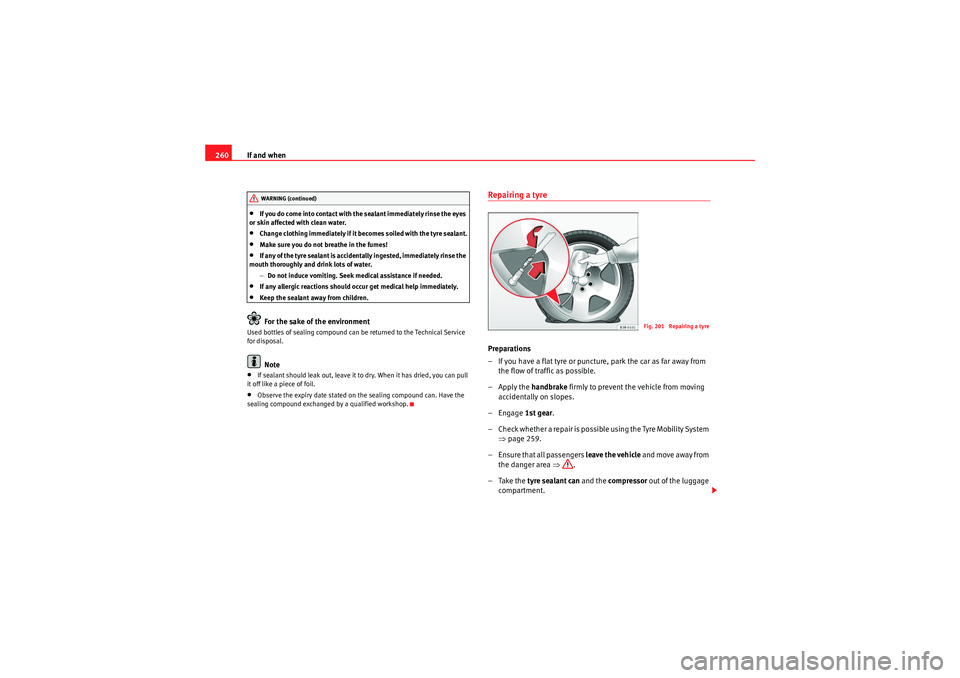
Repairing a tyrePreparations
– If you have a flat tyre or puncture, park the car as far away from the flow of traffic as possible.
–Apply the handbrake firmly to prevent the vehicle from moving
accidentally on slopes.
–Engage 1st gear.
– Check whether a repair is possible using the Tyre Mobility System ⇒page 259.
– Ensure that all passengers leave the vehicle and move away from
the danger area ⇒.
–Take the tyre sealant can and the compressor out of the luggage
compartment.
WARNING (continued)
Fig. 201 Repairing a tyre
ExeoST_EN.book Seite 260 Donnerstag, 3. September 2009 12:24 12
Page 263 of 316
If and when261
Safety First
Controls and equipment
Practical tips
Technical Data
– Stick the “max. 80 km/h” adhesive, which is included with the
tyre sealant can, onto the instrument panel where the driver will
see it.
Filling the tyre
– Shake the tyre sealant can well.
– Screw the enclosed filling hose onto the sealant can as far as it will go. This will automatically pierce the foil sealing the can.
– Take the valve cap off the tyre valve and use the enclosed valve insert tool to unscrew the valve insert ⇒page 260, fig. 201 .
– Place the valve insert onto a clean surface.
– Remove the sealing plug from the filling hose and insert the hose into the tyre valve.
– Hold the tyre sealant can upside down and fill the complete contents of the can into the tyre.
– Then disconnect the hose and screw the valve insert firmly back into the tyre valve.
Inflating the tyre
– Screw the compressor filling hose onto the tyre valve and plug the connector into the cigarette lighter.
– Pump the tyre up to 2.0 to 2.5 bar and monitor the pressure shown on the pressure gauge. – If the tyre pressure remains lower than the value specified above
drive the vehicle approx. 10 metres forwards or backwards, so
that the sealant can spread evenly in the tyre. If the pressure is
still lower than the specification the tyre is too badly damaged
and cannot be repaired using the tyre sealant.
Final check
– After about 10 minutes, stop to check the tyre pressure.
– If tyre pressure is less than 1.3 bar, the tyre is too badly damaged. Do not drive on! You should obtain professional
assistance.
WARNING
•If you have a puncture in heavy traffic, switch on the hazard warning
lights and place the warning triangle in a visible location. This is for your
own safety and also warns other road users.•Make sure your pass engers wait in a safe place ( for instance behind t he
roadside crash barrier).•Please observe the manufacturers' safety notes on the compressor and
the instructions supplied with the tyre sealant can.•If it was not possible to build up a tyre pressure of 2.0 bar within 6
minutes this means that the tyre is too badly damaged. Do not drive on!•Seek professional assistance if the repair of a tyre puncture is not
possible with the sealing compound.•If tyre pressure is less than 1.3 bar after driving about 10 minutes, the
tyre is too badly damaged. Do not drive on! Obtain technical assistance.Caution
Take special care if you have to repair a tyre on a slope.
ExeoST_EN.book Seite 261 Donnerstag, 3. September 2009 12:24 12
Page 267 of 316
If and when265
Safety First
Controls and equipment
Practical tips
Technical Data
WARNING
•Take particular care when working on components in the engine
compartment if the engine is warm - risk of burns!•Bulbs are highly sensitive to pressure. The glass can break when you
touch the bulb, causing injury.•The high voltage element of gas discharge lamps* (xenon light) must
be handled correctly. Otherwise, there is a risk of death.•When changing bulbs, please take care not to injure yourself on sharp
parts in the headlight housing.Caution
•Remove the ignition key before working on the electric system. If not, a
short circuit could occur.•Switch off the lights or parking lights before you change a bulb.For the sake of the environment
Please ask your specialist retailer how to dispose of used bulbs in the proper
manner.
Note
•Depending on weather conditions (cold or wet), the front lights, the fog
lights, the rear lights and the indicators may be temporarily misted. This does not affect the useful life of the lighting system. By switching on the lights, the
area through which the beam of light is projected will quickly be demisted.
However, the edges may continue to be misted.
•Please check at regular intervals that all lighting (especially the exterior
lighting) on your vehicle is functioning pr operly. This is not only in the interest
of your own safety, but also in that of all other road users.•Before changing a bulb, make sure you have the correct new bulb.•Do not touch the glass part of the bulb with your bare hands, use a cloth
or paper towel instead. Otherwise, the fingerprints left on the glass will
vaporise as a result of the heat generated by the bulb, be deposited on the
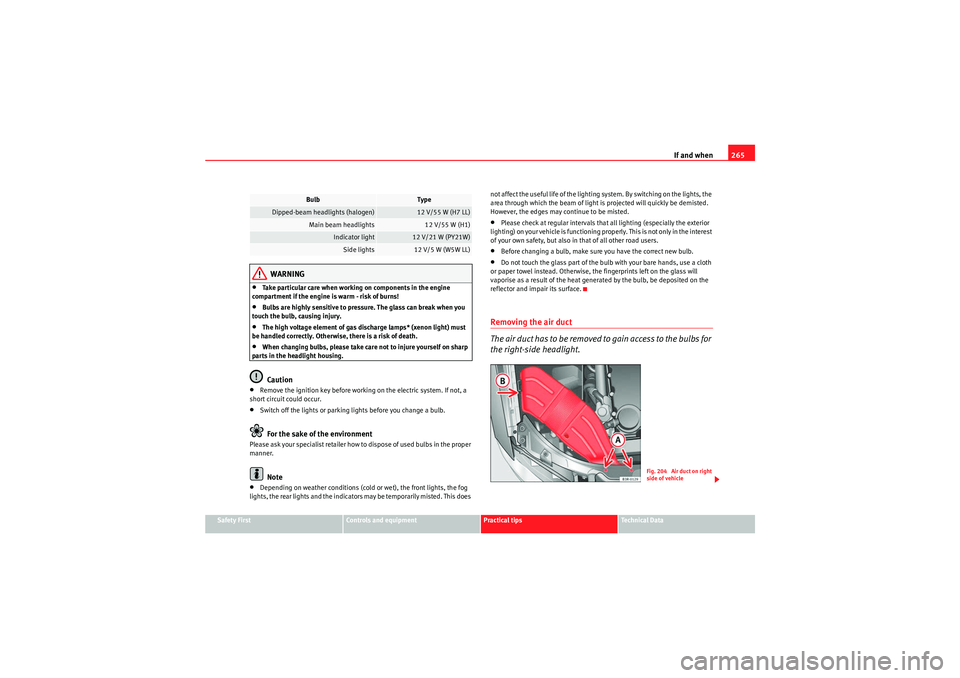
reflector and impair its surface.Removing the air duct
The air duct has to be removed to gain access to the bulbs for
the right-side headlight.
Bulb
Type
Dipped-beam headlights (halogen)
12 V/55 W (H7 LL)
Main beam headlights
12 V/55 W (H1)
Indicator light
12 V/21 W (PY21W)
Side lights
12 V/5 W (W5W LL)
Fig. 204 Air duct on right
side of vehicle
ExeoST_EN.book Seite 265 Donnerstag, 3. September 2009 12:24 12
Page 274 of 316
If and when
272
WARNING
•Take particular care when working on components in the engine
compartment if the engine is warm - risk of burns!•Bulbs are highly sensitive to pressure. The glass can break when you
touch the bulb, causing injury.•The high voltage element of gas discharge lamps* (xenon light) must
be handled correctly. Otherwise, there is a risk of death.•When changing bulbs, please take care not to injure yourself on sharp
parts in the headlight housing.Caution
•Remove the ignition key before working on the electric system. If not, a
short circuit could occur.•Switch off the lights or parking lights before you change a bulb.For the sake of the environment
Please ask your specialist retailer how to dispose of used bulbs in the proper
manner.
Note
•Depending on weather conditions (cold or wet), the front lights, the fog
lights, the rear lights and the indicators may be temporarily misted. This does not affect the useful life of the lighting system. By switching on the lights, the
area through which the beam of light is projected will quickly be demisted.
However, the edges may continue to be misted.
•Please check at regular intervals that all lighting (especially the exterior
lighting) on your vehicle is functioning properly. This is not only in the interest
of your own safety, but also in that of all other road users.•Before changing a bulb, make sure you have the correct new bulb.•Do not touch the glass part of the bulb with your bare hands, use a cloth
or paper towel instead. Otherwise, the fingerprints left on the glass will
vaporise as a result of the heat generated by the bulb, be deposited on the
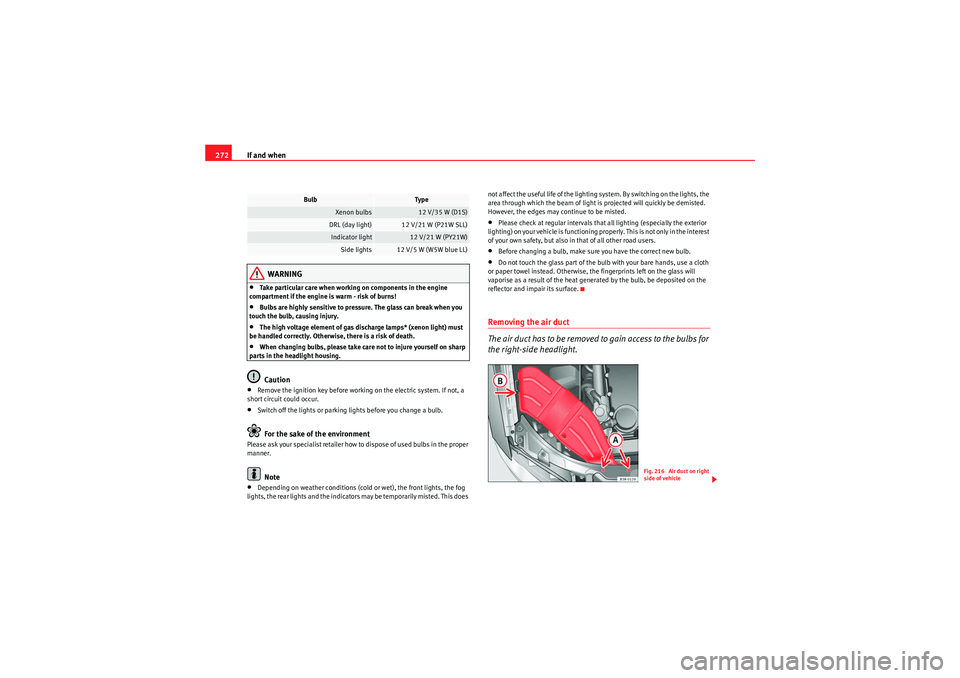
reflector and impair its surface.Removing the air duct
The air duct has to be removed to gain access to the bulbs for
the right-side headlight.
Bulb
Type
Xenon bulbs
12 V/35 W (D1S)
DRL (day light)
12 V/21 W (P21W SLL)
Indicator light
12 V/21 W (PY21W)
Side lights
12 V/5 W (W5W blue LL)
Fig. 216 Air duct on right
side of vehicle
ExeoST_EN.book Seite 272 Donnerstag, 3. September 2009 12:24 12
Page 278 of 316
If and when
276Changing the side light bulb
The procedure for changing the bulbs on the front
passenger's side is the same as on the driver's side.
– Switch off the ignition and the lights.
– Raise the bonnet.
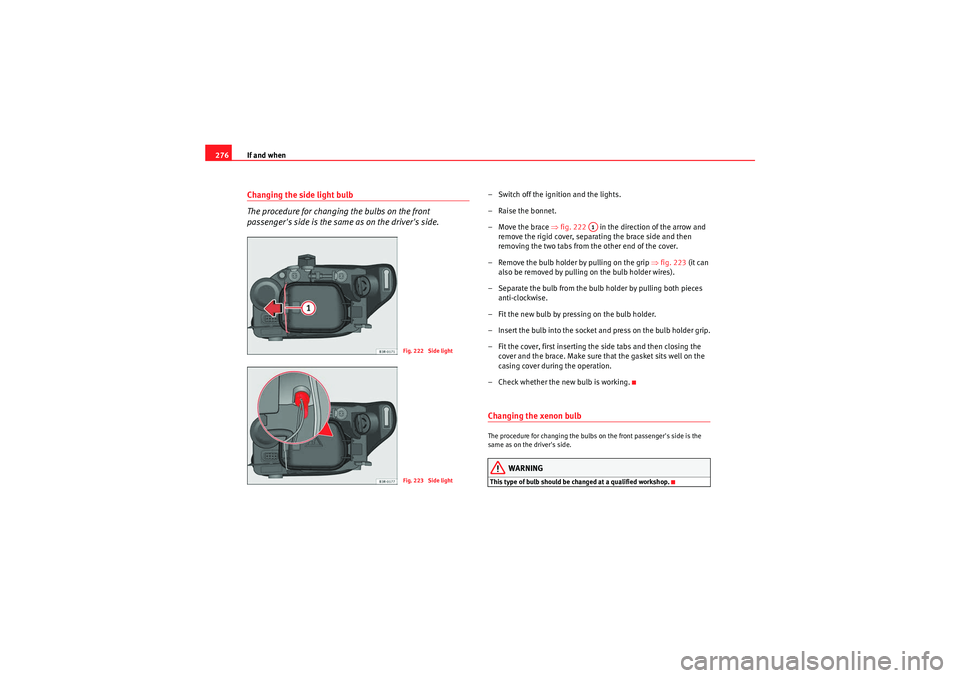
– Move the brace ⇒ fig. 222 in the direction of the arrow and
remove the rigid cover, separating the brace side and then
removing the two tabs from the other end of the cover.
– Remove the bulb holder by pulling on the grip ⇒fig. 223 (it can
also be removed by pulling on the bulb holder wires).
– Separate the bulb from the bulb holder by pulling both pieces anti-clockwise.
– Fit the new bulb by pressing on the bulb holder.
– Insert the bulb into the socket and press on the bulb holder grip.
– Fit the cover, first inserting the side tabs and then closing the cover and the brace. Make sure that the gasket sits well on the
casing cover during the operation.
– Check whether the new bulb is working.Changing the xenon bulbThe procedure for changing the bulbs on the front passenger's side is the
same as on the driver's side.
WARNING
This type of bulb should be changed at a qualified workshop.
Fig. 222 Side lightFig. 223 Side light
A1
ExeoST_EN.book Seite 276 Donnerstag, 3. September 2009 12:24 12
Page 289 of 316
If and when287
Safety First
Controls and equipment
Practical tips
Technical Data
WARNING
•Please note the safety warnings referring to working in the engine
compartment ⇒page 227.•The battery providing assistance must have the same voltage as the flat
battery (12V) and approximately the same capacity (see imprint on
battery). Failure to comply could result in an explosion.•Never use jump leads when one of the batteries is frozen. Danger of
explosion! Even after the battery has thawed, battery acid could leak and
cause chemical burns. If a battery freezes, it should be replaced.•Keep sparks, flames and lighted cigarettes away from batteries, danger
of explosion. Failure to comply could result in an explosion.•Observe the instructions provided by the manufacturer of the jump
leads.•Do not connect the negative cable from the other vehicle directly to the
negative terminal of the flat battery. The gas emitted from the battery could
be ignited by sparks. Danger of explosion.•Do not attach the negative cable from the other vehicle to parts of the
fuel system or to the brake line.•The non-insulated parts of the battery clamps must not be allowed to
touch. The jump lead attached to the positive battery terminal must not
touch metal parts of the vehicle, this can cause a short circuit.•Position the leads in such a way that they cannot come into contact
with any moving parts in the engine compartment.•Do not bend over the batteries. This could result in chemical burns.Note
The vehicles must not touch each other, otherwise electricity could flow as
soon as the positive terminals are connected.
ExeoST_EN.book Seite 287 Donnerstag, 3. September 2009 12:24 12