fuel consumption Seat Exeo ST 2009 User Guide
[x] Cancel search | Manufacturer: SEAT, Model Year: 2009, Model line: Exeo ST, Model: Seat Exeo ST 2009Pages: 316, PDF Size: 8.83 MB
Page 201 of 316
Driving and the environment199
Safety First
Controls and equipment
Practical tips
Technical Data
•Solvent-free wax for protecting the vehicles in transit•Solvent-free adhesives•No CFCs used in production•Surplus materials used extensively for energy conversion and building
materials•Overall water consumption reduced•Heat recovery systems•The use of water-soluble paintsDriving abroadObservationsTo drive abroad, the following must be taken into consideration:•Fo r v eh icles f it te d wit h a ca ta lyt ic co nv er ter e nsur e that unleade d pe tr ol is
available for the journey. See the chapter “Refuelling”. Automobile organisa-
tions will have information about service station networks selling unleaded
fuel.•In some countries, it is possible that a vehicle model is sold under condi-
tions where some spare parts are not available or that the Authorised Service
Centre may only carry out limited repairs.
SEAT importers and distributors will gladly provide information about the
technical preparation of your vehicle and also about necessary maintenance
and repair possibilities.
Adhesive strips for headlightsIf you have to drive a right-hand drive vehicle in a left-hand drive country, or
vice versa, the asymmetric dipped beam headlights will dazzle oncoming
traffic.
To prevent dazzling, you must apply stickers to certain parts of the headlight
lenses. Further information is available in your Authorised Service Centre.
In vehicles with self-directing headlights, the rotation system must previ-
ously be disconnected. To do this, please go to a specialist workshop.
ExeoST_EN.book Seite 199 Donnerstag, 3. September 2009 12:24 12
Page 226 of 316
Checking and refilling levels
224PetrolPetrol types
The recommended fuel types are listed on a sticker inside the
fuel tank flap.Only unleaded petrol, corresponding to the standard DIN EN 228 , may be
used for vehicles with catalytic converters (EN = “European Standard”).
Fuel types are differentiated by the octane rating, e.g: 91, 95, 98 RON (RON
= “Regulation Octane Number, unit for determining the knock resistance of
petrol”). You may use petrol with a higher octane number than the one recom-
mended for your engine. However, this has no advantage in terms of fuel
consumption and engine power.
The correct fuel type for your vehicle is given in the technical table for the
engine. Section “Technical Data”
Caution
•Petrol that follows EN 228 may be mixed with small quantities of ethanol.
However, the so-called “bioethanol fuels” available at commercial establish-
ments, e.g. with reference E50 or E85, which contain a high percentage of
ethanol, may not be used, as they will damage the fuel system.•Even one tankful of leaded fuel would permanently impair the efficiency
of the catalytic converter.•High engine speed and full throttle can damage the engine when using
petrol with an octane rating lower than the correct grade for the engine.For the sake of the environment
Just one full tank of leaded fuel would seriously impair the efficiency of the
catalytic converter.
Petrol additives
Petrol additives improve the quality of the petrol.The quality of the petrol influences running behaviour, performance and
service life of the engine. For this reason, you should use good quality petrol
containing additives. These additives will help to prevent corrosion, keep the
fuel system clean and prevent deposits from building up in the engine.
If good quality petrol with additives is not available or engine problems occur,
the required additives must be added during refuelling.DieselDiesel*Diesel fuel must correspond to DIN EN 590 (EN = “European standard”). It
must have a cetane number (CN) of at least 51. The cetane number indicates
the ignition quality of the diesel fuel.
Notes on refuelling ⇒page 222.Biodiesel*The biodiesel fuel must comply with the DIN EN 14.214 (FAME) Standard.•Biodiesel is a methyl ester obtained from rapeseed oil.•DIN is the German abbreviation for “ Deutsches Institut für N ormung e.V.”,
the German standards institute.•EN means European Norm.•FAME is the English abbreviation for “ Fatty Acid Methyl Ester”.
ExeoST_EN.book Seite 224 Donnerstag, 3. September 2009 12:24 12
Page 227 of 316
Checking and refilling levels225
Safety First
Controls and equipment
Practical tips
Technical Data
Your Authorised Service Centre can also be consulted to know if the vehicle
has been prepared for biodiesel use.
Things to note about RME fuel (biodiesel)
•The performance of a vehicle using biodiesel maybe somewhat reduced.•Fuel consumption of a vehicle using biodiesel may be slightly higher.•RME fuel is resistant to the cold down to approx. -10°C.•At temperatures below -10°C, we recommend using winter diesel fuel.•Your vehicle is designed to be refuelled with up to a maximum of 7%
blended biodiesel, in accordance with the DIN 51628 standard.Caution
•RME fuel can damage the fuel system in vehicles which are not suitably
adjusted.•If you refuel with biodiesel, please be sure that it conforms to the
DIN E 14.214 standard.•If you use biodiesel that does not meet the required standard, the fuel
filter could become clogged.Note
•In case of low exterior temperatures and a fuel biodiesel percentage of
higher than 50%, an increase in gas emission may occur during operation of
the independent heating.•The fuel filter may become clogged when fuel is changed to biodiesel. For
this reason, we recommend you that, when having run 300 or 400 km after a
fuel change, the fuel filter change must also be done. Also note the instruc-
tions in the Inspection and Maintenance plan.•If the vehicle is to remain parked for more than about two weeks, we
recommend filling the fuel tank with biodiesel and driving about 50 km in
order to avoid damage to the injection system.
Winter driving
Diesel can thicken in winter.Winter-grade diesel
When using summer-grade diesel fuel, difficulties may be experienced at
sub-zero temperatures because the fuel thickens due to wax separation.
Therefore, winter-grade diesel fuel is available in some countries during the
cold months. It can be used at temperatures as low as -22°C.
In countries with different climatic conditions the diesel fuel generally sold
has different temperature characteristics. Check with an Authorised Service
Centre or filling stations in the country concerned regarding the type of diesel
fuels available.
Filter pre-heater
Your vehicle is fitted with a fuel filter pre-heater, making it well equipped for
operation in winter. This ensures that the fuel system remains operational to
approx. -24°C, provided you use winter-grade diesel which is safe to -15°C.
However, if the fuel has waxed to such an extent that the engine will not start
at temperatures of under -24°C, simply place the vehicle in a warm place for
a while.
Caution
Do not mix fuel additives (“thinners”, or similar additives) with diesel fuel.
ExeoST_EN.book Seite 225 Donnerstag, 3. September 2009 12:24 12
Page 245 of 316

Wheels and tyres243
Safety First
Controls and equipment
Practical tips
Technical Data
2. The tyre pressures should only be checked when the tyres are
cold. The slightly raised pressures of warm tyres must not be
reduced.
3. Adjust the tyre pressure to the load you are carrying.Tyre pressure
The correct tyre pressure is especially important at high speeds. The pressure
should therefore be checked at least once a month and before starting a
journey.
The sticker with the tyre pressure values can be found on the inside of the
tank flap. The tyre pressure values given are for cold tyres. Do not reduce the
slightly raised pressures of warm tyres ⇒.
WARNING
•Check the tyre pressure at least once per month. Checking tyre pressure
value is very important. If the tyre pressure is too high or too low, there is
an increased danger of accidents - particularly at high speeds.•A tyre can easily burst if the pressure is too low, causing an accident!•At continuously high speeds, a tyre with insufficient pressure flexes
more. In this way it becomes too hot, and this can cause tread separation
and tyre blow-out. Always observe the recommended tyre pressures.•If the tyre pressure is too low or too high, the tyres will wear prema-
turely and the vehicle will not handle well. Risk of accident!For the sake of the environment
Under-inflated tyres will increase fuel consumption.
Tyre pressure monitoring*
The tyre pressure monitoring system constantly checks the
pressure of the tyres.The system warns the driver in the event of a loss of pressure by means of
symbols and messages in the instrument cluster display.
Note that tyre pressure also depends on tyre temperature. Tyre pressure
increases about 0.1 bar for each 10°C in tyre temperature increase. The tyre
heats up while the vehicle is being driven and the tyre pressure will rise
accordingly. For this reason, you should only adjust the tyre pressures when
they are cold (i.e. approximately at ambient temperature).
To ensure that the tyre pressure monitoring system works reliably, you should
check and, if necessary, adjust the tyre pressures at regular intervals and
store the correct pressures (reference values) in the system.
A tyre pr essure i nfor ma ti on lab e l is a tta che d to t he insi de o f the fu el ta nk f lap.
WARNING
•Never adjust tyre pressure when the tyres are hot. This may damage or
even burst the tyres. Risk of accident!•An insufficiently inflated tyre flexes a lot more at high speeds and
causes significant heating of the tyre. Under these conditions, the tyre
bead may be released or the tyre may burst. Risk of accident!For the sake of the environment
Under-inflated tyres lead to increased fuel consumption and tyre wear.
ExeoST_EN.book Seite 243 Donnerstag, 3. September 2009 12:24 12
Page 248 of 316
Wheels and tyres
246Wear indicators
The original tyres on your vehicle have 1.6 mm high “tread wear indicators”
⇒ page 245, fig. 189 , running across the tread. Depending on the make,
there will be six to eight of them evenly spaced around the tyre. Markings on
the tyre sidewall (for instance the letters “TWI” or other symbols) indicate the
positions of the tread wear indicators. The minimum tread depth required by
law is 1.6 mm (measured in the tread grooves next to the tread wear indica-
tors). Worn tyres must be replaced. Different figures may apply in export
countries ⇒.
Tyre pressure
Under-inflation or over-inflation will reduce the life of the tyres considerably
and also impair the car's handling. The inflation pressures are listed on a
sticker on the inside of the fuel tank flap.
Correct inflation pressures are very important, especially at high speeds. The
pressure should therefore be checked at least once a month and before
starting any long journey.
Tyre pressure monitoring (RKA+)*
Monitoring of the tyre pressures is based on the tyre pressures you have
stored. The tyre pressure monitoring system cannot function as intended if
you store tyre pressure settings for a normal load, but then drive with the
vehicle fully laden. The tyre pressure must be adapted to the actual load and
stored accordingly in the tyre pressure monitoring system ⇒ page 244.
Driving style
Fast cornering, heavy acceleration and hard braking all increase tyre wear.
Changing wheels around
If the front tyres are worn considerably more than the rear ones it is advisable
to change them around as shown ⇒page 245, fig. 190. All the tyres will then
last for about the same time. Wheel balance
The wheels on new vehicles are balanced. However, various factors encoun-
tered in normal driving can cause them to become unbalanced, which results
in steering vibration.
Unbalanced wheels should be rebalanced, as they otherwise cause excessive
wear on steering, suspension and tyres. A wheel must also be rebalanced
when a new tyre is fitted.
Incorrect wheel alignment
Incorrect wheel alignment causes excessive tyre wear, impairing the safety of
the vehicle. If tyres show excessive wear, you should have the wheel align-
ment checked by an Authorised Service Centre.
WARNING
There is a serious danger of accidents if a tyre bursts during driving!•The tyres must be replaced at the latest when the tread is worn down to
the tread wear indicators. Failure to do so could result in an accident. Worn
tyres do not grip well at high speeds on wet roads. There is also a greater
risk of “aquaplaning” •At continuously high speeds, a tyre with insufficient pressure flexes
more. This causes it to overheat. This can cause tread separation and tyre
blow-out. Risk of accident. Always observe the recommended tyre pres-
sures.•I f t y r e s s h o w e x ce s s i v e w e a r, y o u s h o u l d h a v e t h e r u n n i n g g e a r ch e cke d
by an Authorised Service Centre.•Keep chemicals such as oil, fuel and brake fluid away from tyres.•Damaged wheels and tyres must be replaced immediately!For the sake of the environment
Under-inflated tyres will increase fuel consumption.
ExeoST_EN.book Seite 246 Donnerstag, 3. September 2009 12:24 12
Page 252 of 316
Wheels and tyres
250Winter tyres lose their effectiveness when the tread is worn down to a depth
of 4 mm.
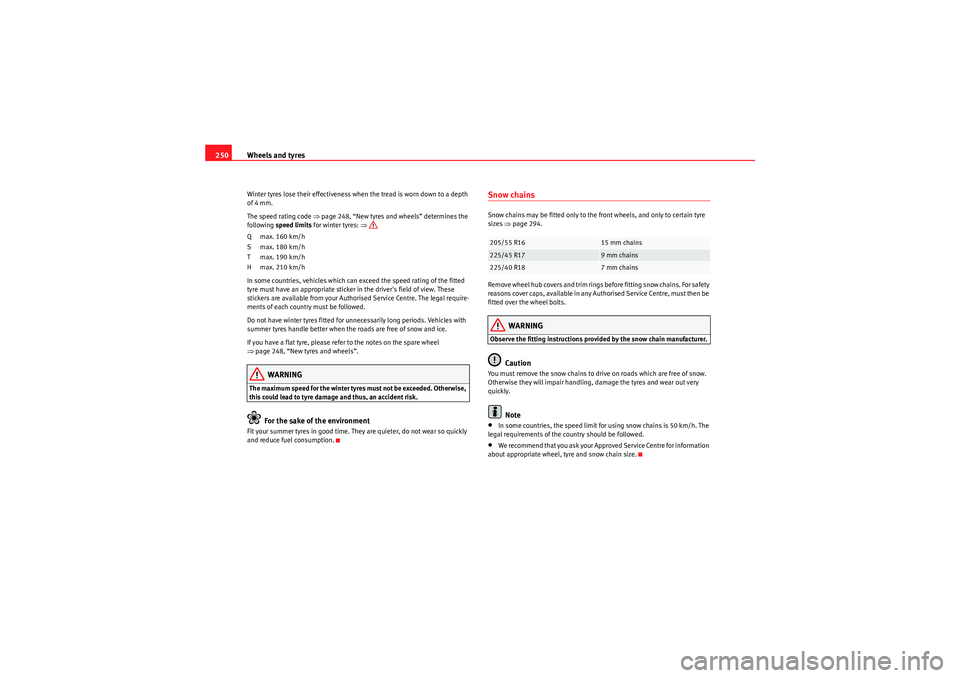
The speed rating code ⇒page 248, “New tyres and wheels” determines the
following speed limits for winter tyres: ⇒
Q max. 160 km/h
S max. 180 km/h
T max. 190 km/h
H max. 210 km/h
In some countries, vehicles which can exceed the speed rating of the fitted
tyre must have an appropriate sticker in the driver's field of view. These
stickers are available from your Authorised Service Centre. The legal require-
ments of each country must be followed.
Do not have winter tyres fitted for unnecessarily long periods. Vehicles with
summer tyres handle better when the roads are free of snow and ice.
If you have a flat tyre, please refer to the notes on the spare wheel
⇒ page 248, “New tyres and wheels”.
WARNING
The maximum speed for the winter tyres must not be exceeded. Otherwise,
this could lead to tyre damage and thus, an accident risk.
For the sake of the environment
Fit your summer tyres in good time. They are quieter, do not wear so quickly
and reduce fuel consumption.
Snow chainsSnow chains may be fitted only to the front wheels, and only to certain tyre
sizes ⇒page 294.
Remove wheel hub covers and trim rings before fitting snow chains. For safety
reasons cover caps, available in any Authorised Service Centre, must then be
fitted over the wheel bolts.
WARNING
Observe the fitting instructions provided by the snow chain manufacturer.
Caution
You must remove the snow chains to drive on roads which are free of snow.
Otherwise they will impair handling, damage the tyres and wear out very
quickly.
Note
•In some countries, the speed limit for using snow chains is 50 km/h. The
legal requirements of the country should be followed.•We recommend that you ask your Approved Service Centre for information
about appropriate wheel, tyre and snow chain size.205/55 R16
15 mm chains
225/45 R17
9 mm chains
225/40 R18
7 mm chains
ExeoST_EN.book Seite 250 Donnerstag, 3. September 2009 12:24 12
Page 293 of 316
General notes on the technical data291
Safety First
Controls and equipment
Practical tips
Technical Data
Te ch n i c a l D a t aGeneral notes on the technical dataOutstanding informationImportant considerations
All data in the official vehicle documents take precedence
over this data.All data provided in this manual are valid for the standard model in Spain. The
vehicle data card included in the Maintenance Programme or the vehicle
registration documents shows which engine is installed in the vehicle.
The figures may be different depending on if additional equipment is fitted,
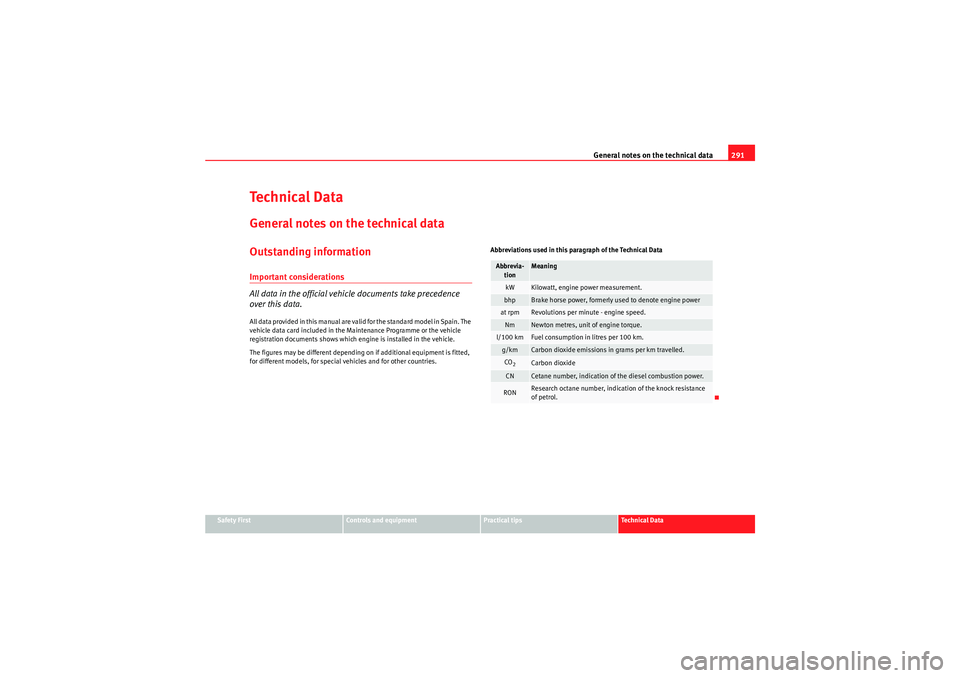
for different models, for special vehicles and for other countries. Abbreviations used in this paragraph of the Technical Data
Abbrevia-
tion
Meaning
kW
Kilowatt, engine power measurement.
bhp
Brake horse power, formerly used to denote engine power
at rpm
Revolutions per minute - engine speed.
Nm
Newton metres, unit of engine torque.
l/100 km
Fuel consumption in litres per 100 km.
g/km
Carbon dioxide emissions in grams per km travelled.
CO2
Carbon dioxide
CN
Cetane number, indication of the diesel combustion power.
RON
Research octane number, indication of the knock resistance
of petrol.
ExeoST_EN.book Seite 291 Donnerstag, 3. September 2009 12:24 12
Page 295 of 316
General notes on the technical data293
Safety First
Controls and equipment
Practical tips
Technical Data
Data on fuel consumptionFuel consumption
The consumption and emission details shown on the vehicle
data sticker differ from one vehicle to another.The fuel consumption and CO
2 emissions of the vehicle can be found on the
vehicle data sticker.
The fuel consumption and emissions figures given are based on the vehicle
weight category, which is determined according to the engine/gearbox
combination and the equipment fitted.
The consumption and emission figures are calculated in accordance with the
EC test requirements 1999/100/EC. These test requirements specify a real-
istic test method based on normal everyday driving.
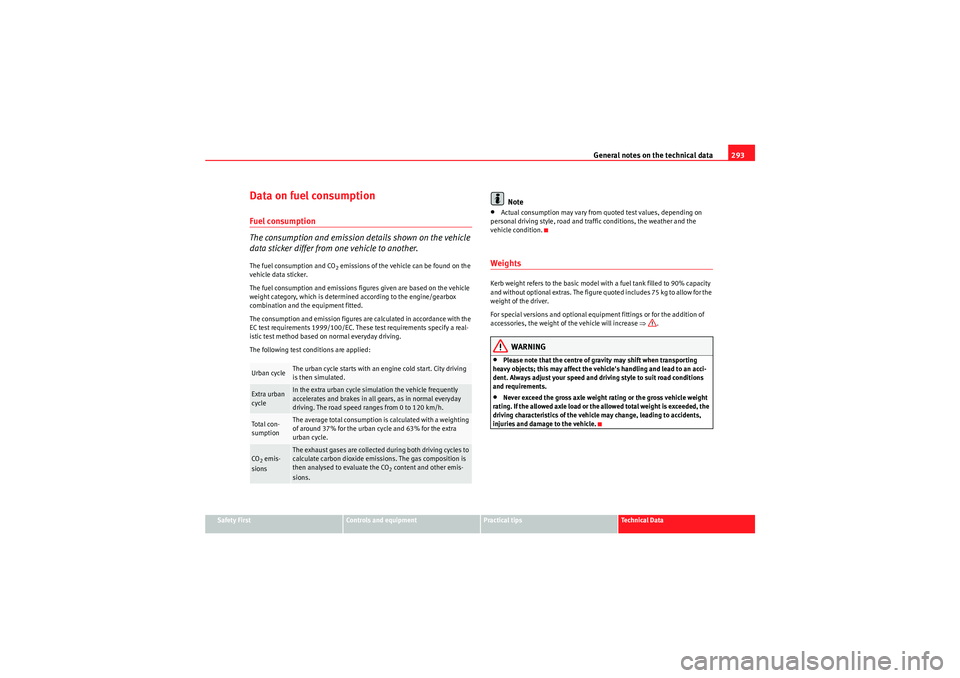
The following test conditions are applied:
Note
•Actual consumption may vary from quoted test values, depending on
personal driving style, road and traffic conditions, the weather and the
vehicle condition.WeightsKerb weight refers to the basic model with a fuel tank filled to 90% capacity
and without optional extras. The figure quoted includes 75 kg to allow for the
weight of the driver.
For special versions and optional equipment fittings or for the addition of
accessories, the weight of the vehicle will increase ⇒.
WARNING
•Please note that the centre of gravity may shift when transporting
heavy objects; this may affect the vehicle's handling and lead to an acci-
dent. Always adjust your speed and driving style to suit road conditions
and requirements.•Never exceed the gross axle weight rating or the gross vehicle weight
rating. If the allowed axle load or the allowed total weight is exceeded, the
driving characteristics of the vehicle may change, leading to accidents,
injuries and damage to the vehicle.
Urban cycle
The urban cycle starts with an engine cold start. City driving
is then simulated.
Extra urban
cycle
In the extra urban cycle simulation the vehicle frequently
accelerates and brakes in all gears, as in normal everyday
driving. The road speed ranges from 0 to 120 km/h.
To ta l co n-
sumption
The average total consumption is calculated with a weighting
of around 37% for the urban cycle and 63% for the extra
urban cycle.
CO2 emis-
sions
The exhaust gases are collected during both driving cycles to
calculate carbon dioxide emissions. The gas composition is
then analysed to evaluate the CO
2 content and other emis-
sions.
ExeoST_EN.book Seite 293 Donnerstag, 3. September 2009 12:24 12
Page 309 of 316

Index307
DDanger of fitting a child seat on the front passenger
seat . . . . . . . . . . . . . . . . . . . . . . . . . . . . . . . 29
Dash panel cleaning . . . . . . . . . . . . . . . . . . . . . 217
Data entry control . . . . . . . . . . . . . . . . . . . . . . . . 88
Date display . . . . . . . . . . . . . . . . . . . . . . . . . . . . . 61
Daytime running lights . . . . . . . . . . . . . . . . . . . 121
Diesel . . . . . . . . . . . . . . . . . . . . . . . . . . . . . . . . . 224
Diesel engine Winter driving . . . . . . . . . . . . . . . . . . . . . . . . 225
Diesel engine particulate filter . . . . . . . . . . . . . 197
Diesel particulate filter . . . . . . . . . . . . . . . . . . . . 80 Engine oil . . . . . . . . . . . . . . . . . . . . . . . . . . . 228
Digital clock . . . . . . . . . . . . . . . . . . . . . . . . . . . . . 61
Dipped headlights . . . . . . . . . . . . . . . . . . . . . . . 116
DIS Average fuel consumption . . . . . . . . . . . . . . 85
Average speed . . . . . . . . . . . . . . . . . . . . . . . . 85
Driving time . . . . . . . . . . . . . . . . . . . . . . . . . . 85
Instantaneous fuel consumption . . . . . . . . . 85
Disabling front passenger airbag Safety notes . . . . . . . . . . . . . . . . . . . . . . . . . . 45
Disabling the airbag Disabling front passenger airbag . . . . . . . . . 44
Disposal Airbags . . . . . . . . . . . . . . . . . . . . . . . . . . . . . . 30
Distance covered . . . . . . . . . . . . . . . . . . . . . . . . . 86
Distance display . . . . . . . . . . . . . . . . . . . . . . . . . 63
Door catch/ tailgate warning . . . . . . . . . . . . . . . 74 Door lock cylinders . . . . . . . . . . . . . . . . . . . . . . 215
Doors
Childproof lock . . . . . . . . . . . . . . . . . . . . . . 104
Locking the doors manually if the central lock-ing fails to work . . . . . . . . . . . . . . . . . . . . 102
Driver information system . . . . . . . . . . . . . . . . . . 71 Ambient temperature display . . . . . . . . . . . . 72
Auto-check system . . . . . . . . . . . . . . . . . . . . 75
CD and radio display . . . . . . . . . . . . . . . . . . . 72
Door catch/ tailgate warning . . . . . . . . . . . . 74
Driver messages . . . . . . . . . . . . . . . . . . . . . . 76
Handbrake warning . . . . . . . . . . . . . . . . . . . . 76
Menu display . . . . . . . . . . . . . . . . . . . . . . . . . 87
On-board computer . . . . . . . . . . . . . . . . . . . . 85
Red symbols . . . . . . . . . . . . . . . . . . . . . . . . . . 77
Speed warning . . . . . . . . . . . . . . . . . . . . . . . . 82
Warning messages . . . . . . . . . . . . . . . . . . . . 76
Yellow symbols . . . . . . . . . . . . . . . . . . . . . . . 79
Driver messages . . . . . . . . . . . . . . . . . . . . . . . . . 76
Driver's seat Assigning the key to the seat . . . . . . . . . . . 140
Enabling stored settings . . . . . . . . . . . . . . . 139
With memory . . . . . . . . . . . . . . . . . . . . . . . . 138
Driving Driving abroad . . . . . . . . . . . . . . . . . . . . . . . 199
Economically / With Respect for the Environment . . . . . . . . . . . . . . . . . . . . . . . 197
Driving abroad . . . . . . . . . . . . . . . . . . . . . . . . . . 199 Headlights . . . . . . . . . . . . . . . . . . . . . . . . . . 199
Driving safety . . . . . . . . . . . . . . . . . . . . . . . . . . . . . 9
Dynamic gear control program . . . . . . . . . . . . . 186
EEconomical driving . . . . . . . . . . . . . . . . . . . . . . 197
Electric windows . . . . . . . . . . . . . . . . . . . . . . . . 109 Central locking system . . . . . . . . . . . . . . . . 111
Possible malfunctions . . . . . . . . . . . . . . . . . 111
Switch on font passenger's door . . . . . . . . 110
Switch on rear doors . . . . . . . . . . . . . . . . . . 110
Switches in the driver's door . . . . . . . . . . . 110
Electrical power point . . . . . . . . . . . . . . . . . . . . 155
Electronic differential lock How it works . . . . . . . . . . . . . . . . . . . . . . . . 191
Electronic immobiliser . . . . . . . . . . . . . . . . . . . . 98
Electronic stabilisation programme Description . . . . . . . . . . . . . . . . . . . . . . . . . . 170
How the system works . . . . . . . . . . . . . . . . 189
Warning light . . . . . . . . . . . . . . . . . . . . . . . . 171
Emergencies Changing a wheel . . . . . . . . . . . . . . . . . . . . 254
Disconnecting the battery . . . . . . . . . . . . . . 238
Jack . . . . . . . . . . . . . . . . . . . . . . . . . . . 251, 256
Tools . . . . . . . . . . . . . . . . . . . . . . . . . . . . . . . 251
tyre mobility system . . . . . . . . . . . . . . . . . . 252
Engine Running in . . . . . . . . . . . . . . . . . . . . . . . . . . 195
Starting . . . . . . . . . . . . . . . . . . . . . . . . . . . . 172
Stop . . . . . . . . . . . . . . . . . . . . . . . . . . . . . . . 173
Engine compartment Safety instructions . . . . . . . . . . . . . . . . . . . 227
ExeoST_EN.book Seite 307 Donnerstag, 3. September 2009 12:24 12
Page 310 of 316
Index
308Engine oil . . . . . . . . . . . . . . . . . . . . . . . . . . . . . . 228
Checking oil level . . . . . . . . . . . . . . . . . . . . 230
Consumption . . . . . . . . . . . . . . . . . . . . . . . . 230
Oil pressure too low . . . . . . . . . . . . . . . . . . . 78
Oil properties . . . . . . . . . . . . . . . . . . . . . . . . 229
Oil sensor defective . . . . . . . . . . . . . . . . . . . 80
Topping up . . . . . . . . . . . . . . . . . . . . . . . . . . 230
Environment . . . . . . . . . . . . . . . . . . . . . . . . . . . 197 Environmental friendliness . . . . . . . . . . . . 198
Environmental tip Avoiding pollution . . . . . . . . . . . . . . . . . . . . 223
Environmentally friendly driving . . . . . . . . . . . 197
Exhaust gas purification system . . . . . . . . . . . 196
Exterior mirrors . . . . . . . . . . . . . . . . . . . . . . . . . 214FFabric trim cleaning . . . . . . . . . . . . . . . . . . . . . 218
Fastening rings . . . . . . . . . . . . . . . . . . . . . . . . . . 17
Filling the tank Releasing the tank flap manually . . . . . . . 223
Floor mats . . . . . . . . . . . . . . . . . . . . . . . . . . . . . . 16
Fog lights . . . . . . . . . . . . . . . . . . . . . . . . . . . . . . 118
Front airbags . . . . . . . . . . . . . . . . . . . . . . . . . . . . 31 Description . . . . . . . . . . . . . . . . . . . . . . . . . . 31
Front drink holders . . . . . . . . . . . . . . . . . . . . . . 153
Front passenger airbag deactivation . . . . . . . . . 44
Frontal airbags Operation . . . . . . . . . . . . . . . . . . . . . . . . . . . . 32
safety notes . . . . . . . . . . . . . . . . . . . . . . . . . . 34 Fuel
Diesel . . . . . . . . . . . . . . . . . . . . . . . . . . . . . . 224
Fuel gauge . . . . . . . . . . . . . . . . . . . . . . . . . . . 63
Fuel level low . . . . . . . . . . . . . . . . . . . . . . . . . 80
Instantaneous fuel consumption . . . . . . . . . 85
Petrol . . . . . . . . . . . . . . . . . . . . . . . . . . . . . . 224
Fuel range . . . . . . . . . . . . . . . . . . . . . . . . . . . 73, 85
Fuel tank opening the fuel tank flap . . . . . . . . . . . . . 222
Fuel: save . . . . . . . . . . . . . . . . . . . . . . . . . . . . . . 197
Fuse Assignment . . . . . . . . . . . . . . . . . . . . . . . . . 263
Changing . . . . . . . . . . . . . . . . . . . . . . . . . . . 262
GGear display . . . . . . . . . . . . . . . . . . . . . . . . . . . . . 73
Gear shift pattern . . . . . . . . . . . . . . . . . . . . . . . 181
General overview of the engine compartment 295
Glove compartment . . . . . . . . . . . . . . . . . . . . . . 157Cool box . . . . . . . . . . . . . . . . . . . . . . . . . . . . 157
Light . . . . . . . . . . . . . . . . . . . . . . . . . . . . . . . 124
GRA . . . . . . . . . . . . . . . . . . . . . . . . . . . . . . . . . . . 178HHandbrake . . . . . . . . . . . . . . . . . . . . . . . . . . . . . 174
Hazard warning lights . . . . . . . . . . . . . . . . . . . . 122
Head restraint Rear seat . . . . . . . . . . . . . . . . . . . . . . . . . . . 142 Head restraints
Front seats . . . . . . . . . . . . . . . . . . . . . . . . . . 140
Rear seats . . . . . . . . . . . . . . . . . . . . . . . . . . 141
Removing and fitting . . . . . . . . . . . . . . . . . 141
head restraints, correct adjustment . . . . . . . . . 13 In-use and non-use positions . . . . . . . . . . . 14
Headlight range control . . . . . . . . . . . . . . . . . . 120 Dynamic . . . . . . . . . . . . . . . . . . . . . . . . . . . . 121
Faulty . . . . . . . . . . . . . . . . . . . . . . . . . . . . . . . 81
Headlights . . . . . . . . . . . . . . . . . . . . . . . . . . . . . 116 Adaptive headlights . . . . . . . . . . . . . . . . . . 122
Automatic headlight control . . . . . . . . . . . 117
Automatic headlight control photo sensors . . .117
Coming home function . . . . . . . . . . . . . . . . 119
Driving abroad . . . . . . . . . . . . . . . . . . . . . . . 199
Front fog lights . . . . . . . . . . . . . . . . . . . . . . 118
Headlight range control . . . . . . . . . . . . . . . 120
Headlight washer system . . . . . . . . . . . . . . 131
Leaving home function . . . . . . . . . . . . . . . . 119
Heated Seats . . . . . . . . . . . . . . . . . . . . . . . . . . . . . . 169
Heated rear window . . . . . . . . . . . . . . . . . . . . . 127
Heated seat . . . . . . . . . . . . . . . . . . . . . . . . . . . . 169
High pressure cleaners . . . . . . . . . . . . . . . . . . . 213
Horn . . . . . . . . . . . . . . . . . . . . . . . . . . . . . . . . . . . 57
IIdentification number . . . . . . . . . . . . . . . . . . . . 292
ExeoST_EN.book Seite 308 Donnerstag, 3. September 2009 12:24 12