engine Seat Exeo ST 2009 Owner's Guide
[x] Cancel search | Manufacturer: SEAT, Model Year: 2009, Model line: Exeo ST, Model: Seat Exeo ST 2009Pages: 316, PDF Size: 8.83 MB
Page 107 of 316
Unlocking and locking105
Safety First
Controls and equipment
Practical tips
Technical Data
The rear doors are equipped with childproof locks. These can be
operated using the ignition key. The childproof locks are only visible
with the doors open.
Enabling the childproof lock
– Turn the key in the direction of the arrow ⇒page 104, fig. 77.
Disabling the childproof lock
– Turn the key in the opposite direction of the arrow.W he n th e ch ild pro o f l ock is e na ble d , t he insi de d o or ha nd le will no t wo r k an d
the door can only be opened from the outside.Remote control keyDescription
The remote control key will lock and unlock the vehicle
without having to insert the key in the lock.The following functions are available:•Locking and and unlocking the vehicle•Unlocking the tailgate
All the indicators will flash as confirmation when the vehicle is locked or
unlocked. Furthermore, the interior lights will automatically light up when the
vehicle is unlocked and go out when the vehicle is locked, provided that the
switches are in the courtesy light position.
The remote control transmitter and the battery are integrated into the handle
of the key. The receiver is in the interior of the vehicle. The maximum range depends on different circumstances. The range is reduced when the battery
starts to lose power.
The remote control incorporates a foldaway key that can be used to manually
lock or unlock the vehicle, as well as to start the engine.
If the receiver has been repaired or replaced, or if a replacement key is used,
the system will need re-programming by a specialist garage. Only then will
you be able use the remote control again.
The remote control meets all relevant authorisation requirements and has
b e e n a p p r o v e d b y t h e Fe d e r a l A p p r ov a l s O f f i ce f o r Te le co m m un i ca t i o n s o f t h e
Federal Republic of Germany. All components are marked in accordance with
the current legal requirements. This certification forms the basis for official
approval for use in other countries.
Note
•The remote control is automatically disabled when the ignition is
switched on.•The function of the remote control may be impaired by interference from
other nearby radio signals (e.g. from a mobile phone or TV transmitter) if
these are in the same frequency range.
ExeoST_EN.book Seite 105 Donnerstag, 3. September 2009 12:24 12
Page 109 of 316
Unlocking and locking107
Safety First
Controls and equipment
Practical tips
Technical Data
Re-synchronising
Should the remote control fail to lock or unlock the vehicle,
the system must be re-synchronised.– If the vehicle is locked, use the key to unlock the driver's door.
– Press the unlock button on the remote control.
– Insert the key into the ignition and switch on the ignition.
– Switch off the ignition and remove the key.
– Press the unlock or the lock button .Anti-theft alarm system*Description
The system triggers an alarm if anyone attempts to break into
the vehicle.The anti-theft alarm helps to prevent the vehicle being broken into or stolen.
If the system senses interference with the vehicle, it triggers an audible and
visible alarm.
How is the system enabled?
The anti-theft alarm system is enabled automatically when the vehicle is
locked with the remote control or by turning the key in the driver's door (if the
door is closed). The system is enabled about 30 seconds after the vehicle is
locked. How is the system disabled?
The anti-theft alarm is only disabled when the vehicle is unlocked using the
remote control. The vehicle will lock again automatically if none of the doors
is opened within 60 seconds after pressing the remote control button.
If the vehicle is unlocked by turning the key in the driver's door, all the other
doors, the tailgate and the tank flap will remain locked.
If the vehicle has been unlocked with the key in the driver's door, the key must
be inserted in the ignition lock and the ignition switched on within 15
seconds of opening the door in order to disable the alarm. The alarm will be
triggered
if the ignition is not switched on within 15 seconds.
When does the system trigger the alarm?
The following parts of the car are monitored when the vehicle is locked:
•Engine compartment (bonnet)•Luggage compartment•Doors•Tilt angle (tow-away protection)•Ignition•Radio (only with a factory-fitted SEAT radio)•Interior ⇒page 108
If any of the named areas are entered, the alarm will be triggered.
How is the alarm disabled?
The alarm can be switched off by unlocking the vehicle using the remote
control, or by switching on the ignition with the key, thus “disabling” the
alarm system. The alarm will also switch off when it comes to the end of its
cycle.
Indicators
The indicators flash briefly when the vehicle is locked to confirm that the
doors, the engine bonnet and the tailgate are properly closed and locked.
ExeoST_EN.book Seite 107 Donnerstag, 3. September 2009 12:24 12
Page 110 of 316

Unlocking and locking
108If the indicators do not flash, check the doors, the bonnet and the tailgate to
ma ke su re t he y ar e pr op e rly close d . T h e in di cato rs will a lso flash br i ef ly i f o ne
of the doors or the tailgate or engine bonnet are closed after the alarm system
has been enabled.
LED
When the vehicle is locked, the LED on the top of the driver's door trim will
flash rapidly for about 30 seconds and then continue flashing slowly. This is
to indicate that the anti-theft alarm system (including the interior monitor
and tow-away protection ) is operative. If the LED lights up continuously for
about 30 seconds when the vehicle is locked instead of flashing, this means
the alarm system is not working properly.
Note
•To make sure that the alarm is fully operative when leaving the vehicle,
briefly check that all the doors and windows and the sun roof* are closed.•The alarm is triggered immediately if one of the battery cables is discon-
nected while the alarm system is enabled.
Interior monitoring*
The interior monitor triggers an alarm if it detects movement
inside the vehicle.You should disable the interior monitor if there is a possibility that
the alarm could be triggered, e.g. by a pet or by an object moving
about inside the car ⇒ . The tow-away protection feature, which
is integrated into the alarm system, should be disabled if the car is
being towed or transported (e.g. by rail or ship).
Disabling the interior monitor
– Open the door and pull out the switch (with the symbol
) to
one side of the storage compartment, in the driver's door
⇒ fig. 79 .
– Then lock the vehicle.
Fig. 79 Interior monitor
switch
AA
ExeoST_EN.book Seite 108 Donnerstag, 3. September 2009 12:24 12
Page 111 of 316
Unlocking and locking109
Safety First
Controls and equipment
Practical tips
Technical Data
Disabling the tow-away protection
– Open the door and pull out switch (with the symbol
) to one
side of the storage compartment, in the driver's door
⇒ page 108, fig. 79 .
–Then lock the vehicle.
The LED on switch will light up when the interior monitor is disabled. The
LED on the top of the driver's door trim will also light up for about 3 seconds.
When the vehicle is locked, the LED on the top of the driver's door trim will
flash rapidly for about 3 seconds. The interior monitor is automatically
enabled again the next time the vehicle is locked.
The LED on switch will light up when the tow-away protection function is
disabled. The LED on the top of the driver's door trim will also light up for
about 3 seconds. When the vehicle is locked, the LED on the top of the
driver's door trim will flash rapidly for about 3 seconds. The tow-away protec-
tion is automatically enabled again the next time the vehicle is locked.
WARNING
Do not leave anyone (especially children) in the car if it is locked from the
outside and the anti-theft security system is enabled, as the doors and
windows cannot then be opened from the inside. Locked doors could delay
assistance in an emergency, potentially putting lives at risk.
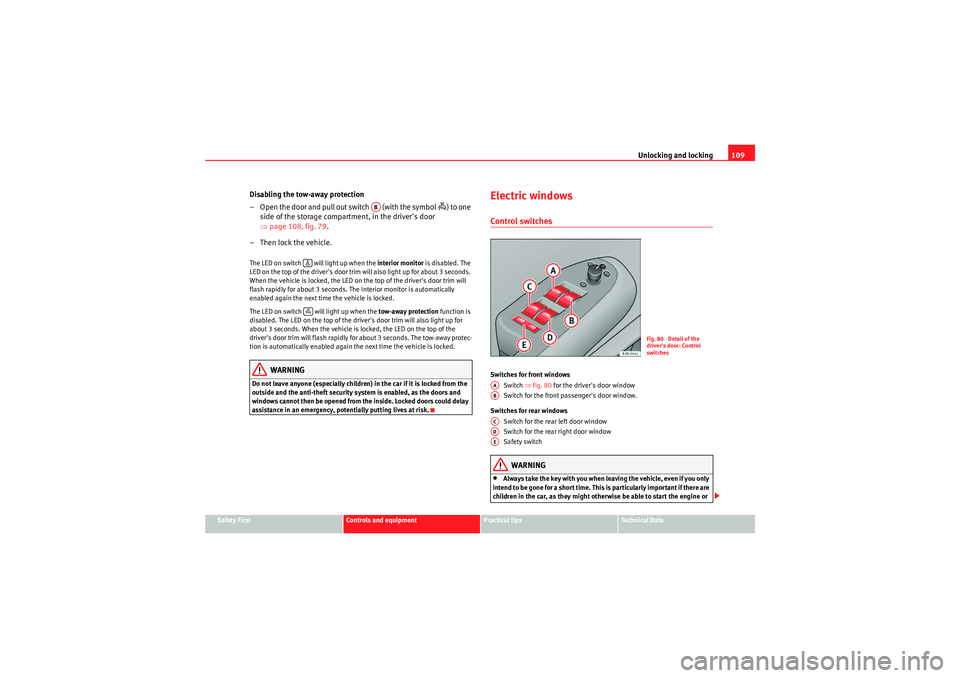
Electric windowsControl switchesSwitches for front windows
Switch ⇒fig. 80 for the driver's door window
Switch for the front passenger's door window.
Switches for rear windows Switch for the rear left door window
Switch for the rear right door window
Safety switch
WARNING
•Always take the key with you when leaving the vehicle, even if you only
intend to be gone for a short time. This is particularly important if there are
children in the car, as they might otherwise be able to start the engine or
AB
Fig. 80 Detail of the
driver's door: Control
switches
AAABACADAE
ExeoST_EN.book Seite 109 Donnerstag, 3. September 2009 12:24 12
Page 157 of 316
Seats and stowage155
Safety First
Controls and equipment
Practical tips
Technical Data
Fitting the ashtray casing
– Open the lid on the ashtray and press the casing into the
mounting as far as it will go.
WARNING
Never put waste paper in the ashtray, as this could cause a fire.Cigarette lighter*
The 12-volt socket for the cigarette lighter can also be used as
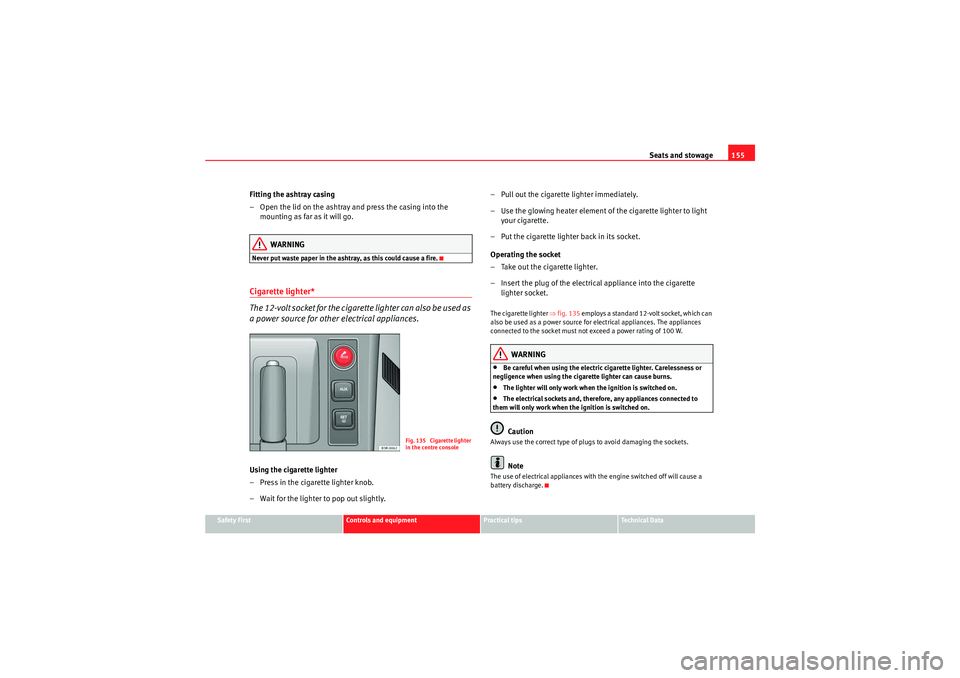
a power source for other electrical appliances.Using the cigarette lighter
–Press in the ciga rette lighter knob.
– Wait for the lighter to pop out slightly. – Pull out the cigarette lighter immediately.
– Use the glowing heater element of the cigarette lighter to light
your cigarette.
– Put the cigarette lighter back in its socket.
Operating the socket
– Take out the cigarette lighter.
– Insert the plug of the electrical appliance into the cigarette lighter socket.
The cigarette lighter ⇒fig. 135 employs a standard 12-volt socket, which can
also be used as a power source for electrical appliances. The appliances
connected to the socket must not exceed a power rating of 100 W.
WARNING
•Be careful when using the electric cigarette lighter. Carelessness or
negligence when using the cigarette lighter can cause burns.•The lighter will only work when the ignition is switched on.•The electrical sockets and, therefore, any appliances connected to
them will only work when the ignition is switched on.Caution
Always use the correct type of plugs to avoid damaging the sockets.
Note
The use of electrical appliances with the engine switched off will cause a
battery discharge.
Fig. 135 Cigarette lighter
in the centre console
ExeoST_EN.book Seite 155 Donnerstag, 3. September 2009 12:24 12
Page 158 of 316
Seats and stowage
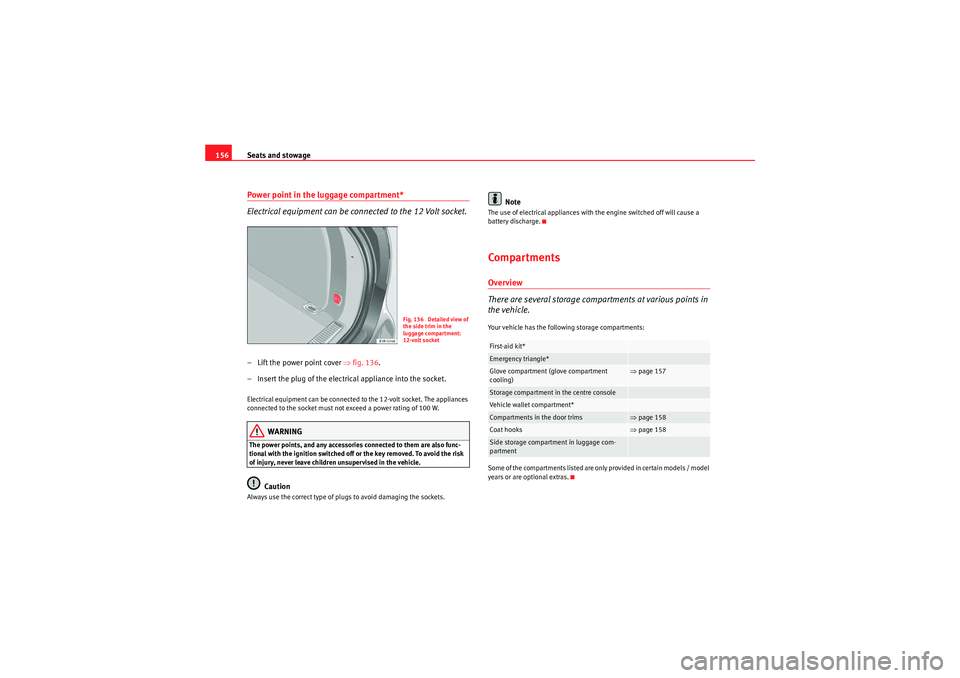
156Power point in the luggage compartment*
Electrical equipment can be connected to the 12 Volt socket.– Lift the power point cover ⇒fig. 136 .
– Insert the plug of the electrical appliance into the socket.Electrical equipment can be connected to the 12-volt socket. The appliances
connected to the socket must not exceed a power rating of 100 W.
WARNING
The power points, and any accessories connected to them are also func-
tional with the ignition switched off or the key removed. To avoid the risk
of injury, never leave children unsupervised in the vehicle.
Caution
Always use the correct type of plugs to avoid damaging the sockets.
Note
The use of electrical appliances with the engine switched off will cause a
battery discharge.CompartmentsOverview
There are several storage compartments at various points in
the vehicle.Your vehicle has the following storage compartments:
Some of the compartments listed are only provided in certain models / model
years or are optional extras.
Fig. 136 Detailed view of
the side trim in the
luggage compartment:
12-volt socket
First-aid kit*Emergency triangle*Glove compartment (glove compartment
cooling)
⇒ page 157
Storage compartment in the centre consoleVehicle wallet compartment*Compartments in the door trims
⇒page 158
Coat hooks
⇒page 158
Side storage compartment in luggage com-
partment
ExeoST_EN.book Seite 156 Donnerstag, 3. September 2009 12:24 12
Page 162 of 316
Heating, Ventilation and Air conditioning
160Heating, Ventilation and Air conditioning2C-ClimatronicDescription
The climate control is designed to automatically keep the
passenger compartment at the temperature you find most
comfortable at all times of the year.Recommended settings:
– Set the temperature to 22°C (71°F).
–Press the ⇒page 162, fig. 141 button.The following setting quickly provides a comfortable temperature inside the
vehicle. We therefore recommend you do not modify the setting unless you
find this temperature uncomfortable or where circumstances require as such.
The climate control provides heating and ventilation and also cools and
dehumidifies the air inside the vehicle.
The climate control is fully automatic and will constantly maintain the temper-
ature which has been set. To achieve this, the temperature of the air supplied
to the interior, the blower speed (volume of air delivery) and the air distribu-
tion are regulated automatically. The system also takes solar radiation into
account and, therefore, no subsequent manual readjustments are required.
Therefore, automatic mode ⇒ page 163 should be used for the comfort of all
the passengers in virtually all conditions throughout the year.
Please note the following points:
The humidity of the air is automatically reduced when the system cools the
interior of the vehicle. This helps to prevent condensation on the windows. If the humidity and temperature outside the vehicle are high,
condensation
can drip off the evaporator in the air cooling system and form a pool under-
neath the vehicle. This is normal and does not indicate a leak.
If the outside temperature is low, the blower normally only switches to a
higher speed once the coolant has warmed up sufficiently (this does not
apply to the defrost setting).
In order to achieve maximum engine power, the air conditioning compressor
is tem po ra r ily s witche d o ff whe n pulli ng away f ro m s tan dstill wit h full th rot tle.
The compressor also switches off if the coolant temperature is excessively
high to ensure adequate engine cooling under extreme loads.
Pollution filter
The pollution filter (a combined particle filter and activated charcoal filter)
serves as a barrier against impurities in the outside air, including dust and
pollen.
For the climate control to work with maximum efficiency, the pollution filter
element must be replaced at the intervals specified in the Service Schedule.
If the vehicle is driven in areas with a high level of air pollution and the filter
is no longer fully effective, it may be necessary to change the filter element
more frequently.
Caution
•If you suspect that the climate control system is damaged, switch over to
ECON mode to prevent further damage and have the system checked by a
specialist garage.•Repairs to the climate control require specialist knowledge and special
tools. For this reason, please contact a specialist garage if the system is not
working properly.
AUTO
ExeoST_EN.book Seite 160 Donnerstag, 3. September 2009 12:24 12
Page 167 of 316

Heating, Ventilation and Air conditioning165
Safety First
Controls and equipment
Practical tips
Technical Data
due to a defect in one of the climate control components. If a malfunction
should occur, please contact a specialist garage.
Air recirculation: automatic activation*
If the outside air is polluted by diesel and petrol emissions,
an air purity sensor in the vehicle will automatically switch on
the air recirculation.Enabling air recirculation mode
– Press the button
⇒fig. 142 .
Disabling air recirculation mode
– Press the button again or
– Press the button or – Press button .
The automatic air recirculation mode should normally be left switched on at
all times.
The system is ready to operate approx. 30 seconds after the engine ignition
key has been turned. During this initial period, fresh air is fed into the car.
If the
air purity sensor in the air conditioning system detects a certain
concentration of fumes in the outside air, the control unit will either pass the
incoming air through the pollution filter or automatically switch on the air
recirculation. If there is a high concentration of pollution in the outside air,
the climate control automatically switches to air recirculation and the supply
of air from the outside is cut off. As soon as the level of pollution decreases,
air is fed into the vehicle from the outside again.
The automatic air recirculation operates for a maximum period of 12 minutes.
If the windows mist up when the automatic air recirculation is on, press the button immediately.
The automatic air recirculation switches itself off under certain circumstances
(for instance if or is selected). In “ECON” and at temperature of below
approx. 8°C below zero, the automatic air recirculation mode is limited to 12
seconds.Switching the temperature displa y from °C to °F and vice versa
The temperature display can be switched from °C (degrees
Celsius) to °F (degrees Fahrenheit) and vice versa.– Press and hold the button for recirculation mode and briefly
press the plus button of the left-hand temperature selector
⇒ page 162, fig. 141 .
Fig. 142 Button for auto-
matic air recirculation
AUTO
ExeoST_EN.book Seite 165 Donnerstag, 3. September 2009 12:24 12
Page 170 of 316
Heating, Ventilation and Air conditioning
168Each of the three buttons has a specific function. The numbers relate to the
air outlets ⇒page 167, fig. 143.
Air directed to windows
This setting directs all the air to outlets 1 and 2. Unlike in setting , the
volume of air delivery remains the same.
Air to the driver/front passenger
All the air comes from outlets 3 and 4 in the dash panel and from the rear of
the centre console.
Air to the footwells
Most of the air emerges from outlets 5 and the outlets under the front seats.
Some of the air will also be issued from outlets 3 and 4.
Note
In all of the above air distribution settings, a small amount of air will still
come from the other outlets.Economical use of the climate control
Economical use of the climate control will help save fuel.Engine power is reduced and fuel consumption increases when the
climate control is in cooling mode. To ensure that the system is only
switched on when it is really necessary, please note the following
points:
– Select ECON mode if you wish to save fuel.
– Select ECON mode if you decide to open the windows or sun roof* while driving. – If the vehicle has heated up after standing in the sun, open the
windows and doors for a short time to cool the vehicle.
For the sake of the environment
By saving fuel you also reduce the amount of pollutants emitted from your
vehicle.Key settings
When the ignition is switched on, the climate control settings
assigned to the key are selected automatically.The climate control settings selected are automatically stored and assigned
to the key in use. When the vehicle is started, the climate control automati-
cally selects the settings assigned to the key. Hence, every driver automati-
cally obtains his/her preferred settings without having to select them manu-
ally.
Note
Should another driver use the key and enter other settings, the previous
settings will be deleted.
ExeoST_EN.book Seite 168 Donnerstag, 3. September 2009 12:24 12
Page 171 of 316
Heating, Ventilation and Air conditioning169
Safety First
Controls and equipment
Practical tips
Technical Data
Solar-powered blower/solar roof*
If the vehicle is parked in sufficiently strong sunlight, the
blower will operate in solar-powered mode when the ignition
is switched off.After the ignition is switched off, the blower is supplied with electrical power
from the solar roof. Please ensure that outlets 3 and 4 are open ⇒page 167,
fig. 143 to ensure the best possible ventilation.
The blower only works when the sun roof is closed or tilted open at the rear.
If the air recirculation mode is on when you switch off the engine, the climate
control will automatically switch to fresh air ventilation.Supplementary heating*Diesel vehicles are fitted with supplementary heating
2) to raise the tempera-
ture of the interior as quickly as possible. At outdoor temperatures below
+5°C and with the engine running, the supplementary heating will switch on
and off automatically depending on the temperature of the coolant.
In order to save fuel, the supplementary heating can be can be switched off
by briefly pressing the button on the climate control.
Seat heating*
The surface and backrest of the front seats can be electrically
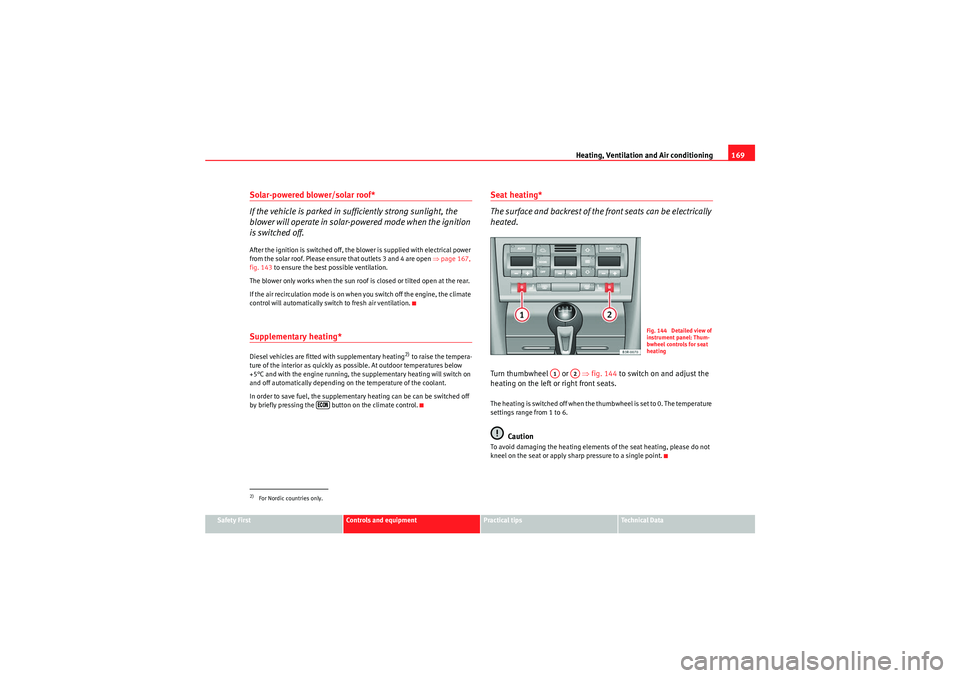
heated.Turn thumbwheel or ⇒fig. 144 to switch on and adjust the
heating on the left or right front seats.The heating is switched off when the thumbwheel is set to 0. The temperature
settings range from 1 to 6.
Caution
To avoid damaging the heating elements of the seat heating, please do not
kneel on the seat or apply sharp pressure to a single point.
2)For Nordic countries only.
Fig. 144 Detailed view of
instrument panel: Thum-
bwheel controls for seat
heating
A1
A2
ExeoST_EN.book Seite 169 Donnerstag, 3. September 2009 12:24 12