towing Seat Exeo ST 2009 Owner's Guide
[x] Cancel search | Manufacturer: SEAT, Model Year: 2009, Model line: Exeo ST, Model: Seat Exeo ST 2009Pages: 316, PDF Size: 8.83 MB
Page 211 of 316
Trailer towing209
Safety First
Controls and equipment
Practical tips
Technical Data
Fitting a towing bracket*
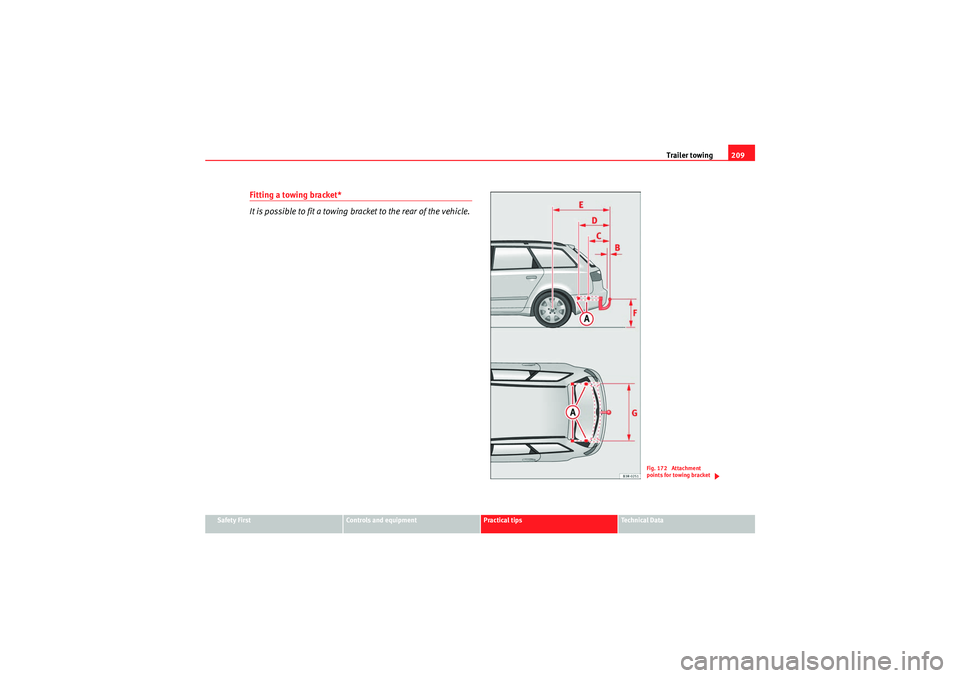
It is possible to fit a towing bracket to the rear of the vehicle.
Fig. 172 Attachment
points for towing bracket
ExeoST_EN.book Seite 209 Donnerstag, 3. September 2009 12:24 12
Page 212 of 316
Trailer towing
210If a towing bracket is to be fitted after the vehicle is purchased, this must be
completed according to the instructions of the towing bracket manufacturer.
The attachment points for the towing bracket are on the lower part of the
vehicle.
The distance between the centre of the ball coupling and the ground should
never be lower than the indicated value, even with a fully loaded vehicle and
including the maximum resting weight.
Elevation values for securing the towing bracket:
65 mm (minimum)
403
629 mm
1112 mm (vehicle with max. load)
from 350 to 420 mm (fully loaded vehicle)
1,000 mm
Fitting a towing bracket•Driving with a trailer involves an extra effort for the vehicle. Therefore,
before fitting a towing bracket, please contact an Authorised Service Centre
to check whether your cooling system needs modification.•Submit to the legal requirements in your country (e.g. the fitting of a sepa-
rate warning lamp).•Certain vehicle components, e.g. the rear bumper, must be removed and
reinstalled. The towing bracket securing bolts must be tightened using a
torque wrench, and an electrical socket must be connected to the vehicle's
electrical system. The above-mentioned require specialized knowledge and
tools.•Figures in the illustration show the elevation value and the attachment
points which must be considered if you are retrofitting a towing bracket.WARNING
Towing brackets should be fitted by specialists.
•If the towing bracket is incorrectly installed, there is serious danger of
accident.•For your own safety, please observe the instructions provided by the
manufacturer of the towing bracket.Caution
•If the electrical socket is incorrectly installed, this could cause damage to
the vehicle's electrical system.Note
For the Sport finish, fitting a trailer bracket is not recommended due to the
design of the bumpers.
AA
ABACADAEAFAG
WARNING (continued)
ExeoST_EN.book Seite 210 Donnerstag, 3. September 2009 12:24 12
Page 256 of 316
If and when
254Changing a wheelPreparation work
What you must do before changing a wheel.– If you have a flat tyre or puncture, park the car as far away from
the flow of traffic as possible. Choose a location that is as level
as possible.
– All passengers should leave the vehicle. They should wait in a
safe place (e.g. behind the roadside crash barrier).
–Apply the handbrake firmly.
–Engage 1st gear.
– When towing a trailer: Unhitch the trailer from your vehicle.
–Take the tools and the spare wheel ⇒ page 251 out of the
luggage compartment.
WARNING
If you have a puncture in heavy traffic, switch on the hazard warning lights
and place the warning triangle in a visible location. This is for your own
safety and also warns other road users.
Caution
If you have to change the tyre on a gradient, block the wheel opposite the
wheel being changed by placing a stone or similar object under it to prevent
the vehicle from rolling away.
Note
Please observe legal requirements when doing so.Changing a wheel
Change the wheel as described below.– Remove the wheel cover.
–Loosen the wheel bolts ⇒ page 255.
– Raise the car with the jack ⇒page 256.
– Ta k e o f f the wheel with the flat tyre and then put on the spare
wheel ⇒page 257.
– Lower the vehicle.
– Tighten the wheel bolts firmly in diagonal sequence with the box
spanner ⇒page 255.
–Replace the cover .After changing a wheel
After changing the wheel, there are still tasks to complete.– Place the wheel with the defective tyre in the spare wheel well
and secure it.
– Put the tools and jack back in the luggage compartment.
ExeoST_EN.book Seite 254 Donnerstag, 3. September 2009 12:24 12
Page 290 of 316
If and when
288Towing and tow-startingTo w - s t a r t i n g
The use of jump leads is preferable to tow-starting.We recommend that you do not tow-start your vehicle. Jump-starting
is preferable ⇒ page 285.
However, if your vehicle has to be tow-started:
– Engage the 2
nd or the 3
rd gear.
– Keep the clutch pressed down.
– Switch the ignition on.
– Once both vehicles are moving, release the clutch.
– As soon as the engine starts, press the clutch and move the gear lever into neutral. This helps to prevent driving into the towing
vehicle.
WARNING
The risk of accidents is high when tow-starting. The vehicle being towed
can easily collide with the towing vehicle.
Caution
When tow-starting, fuel could enter the catalytic converter and damage it.
CommentsPlease observe the following points if you use a tow-rope:
Notes for the driver of the towing vehicle
– Drive slowly at first until the tow-rope is taut. Then accelerate gradually.
– Begin and change gears cautiously. If you are driving an auto- matic vehicle, accelerate gently.
– Remember that the brake servo and power steering are not working in the vehicle you are towing. Brake earlier than you
would normally, but with a more gentle pressure on the brake.
Notes for the driver of the towed vehicle
– Ensure that the tow-rope remains taut at all times when towing.Tow-rope or tow-bar
It is easier and safer to tow a vehicle with a tow-bar. You should only use a
tow-rope if you do not have a tow-bar.
A tow-rope should be slightly elastic to reduce the loading on both vehicles.
It is advisable to use a tow-rope made of synthetic fibre or similarly elastic
material.
Attach the tow-rope or the tow-bar only to the towing eyes provided or a
towing bracket.
Driving style
Towing requires some experience, especially when using a tow-rope. Both
drivers should be familiar with the technique required for towing. Inexperi-
enced drivers should not attempt to tow-start or tow away another vehicle.
ExeoST_EN.book Seite 288 Donnerstag, 3. September 2009 12:24 12
Page 291 of 316
If and when289
Safety First
Controls and equipment
Practical tips
Technical Data
Do not pull too hard with the towing vehicle and take care to avoid jerking the
tow-rope. When towing on an unpaved road, there is always a risk of over-
loading and damaging the anchorage points.
The ignition of the vehicle being towed must be switched on to prevent the
steering wheel from locking and also to allow the use of the indicators, horn,
windscreen wipers and washers.
As the brake servo does not work if the engine is not running, you must apply
considerably more pressure to the brake pedal than you normally would.
As the power assisted steering does not work if the engine is not running, you
will need more strength to steer than you normally would.
Towing vehicles with an automatic gearbox
•Put the selector lever into position “N”.•Do not drive faster than 50 km/h when towing a vehicle.•Do not tow further than 50 km.•If a breakdown vehicle is used, the vehicle must be towed with the front
wheels raised.Note
•Observe legal requirements when towing or tow-starting.•Switch on the hazard warning lights of both vehicles. However, observe
any regulations to the contrary.•For technical reasons, vehicles with an automatic gearbox must not be
tow-started.•If damage to your vehicle means that there is no lubricant in the gearbox,
you must raise the drive wheels while the vehicle is being towed.•If the vehicle has to be towed more than 50 km, the front wheels must be
raised during towing, and towing should be carried out by a qualified person.•The steering wheel is locked when the vehicle has no electrical power. The
vehicle must then be towed with the front wheels raised. Towing should be
carried out by a qualified person.
•The towing eye should always be kept in the vehicle. Please refer to the
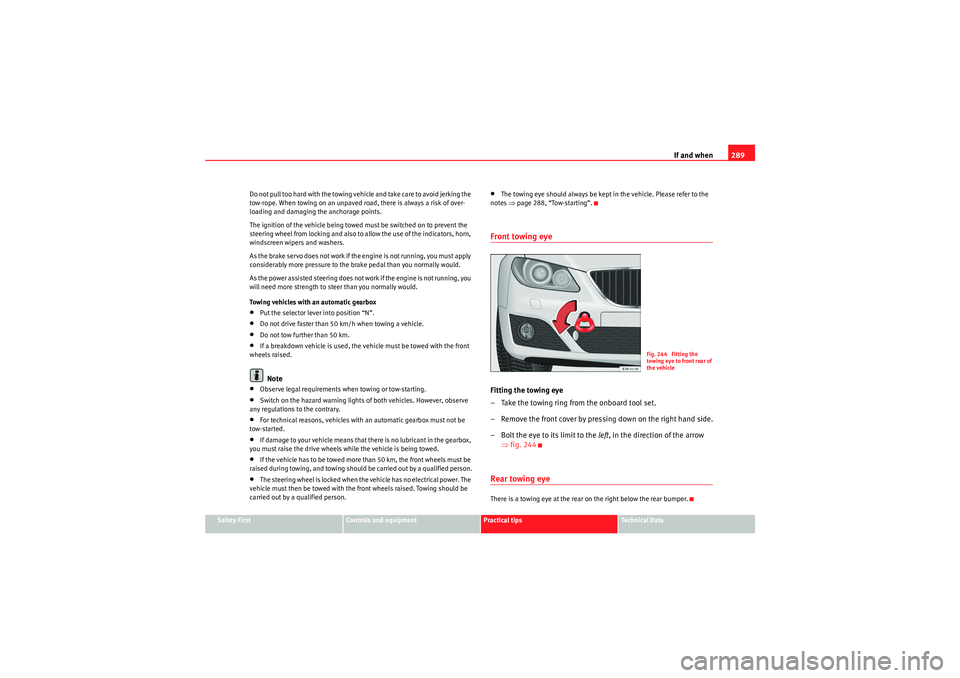
notes ⇒page 288, “Tow-starting”.Front towing eyeFitting the towing eye
– Take the towing ring from the onboard tool set.
– Remove the front cover by pressing down on the right hand side.
– Bolt the eye to its limit to the left, in the direction of the arrow
⇒ fig. 244Rear towing eyeThere is a towing eye at the rear on the right below the rear bumper.
Fig. 244 Fitting the
towing eye to front rear of
the vehicle
ExeoST_EN.book Seite 289 Donnerstag, 3. September 2009 12:24 12
Page 296 of 316
General notes on the technical data
294Towing a trailerTrailer weightsTrailer weights
The trailer weights and drawbar loads approved are selected in intensive
trials according to precisely defined criteria. The approved trailer weights are
valid for vehicles in the EU for maximum speeds of 80 km/h (in certain
circumstances up to 100 km/h). The figures may be different in other coun-
tries. All data in the official vehicle documents take precedence over these
data ⇒ .
Drawbar load
The maximum permitted weight exerted by the trailer drawbar on the ball joint
of the towing bracket must not exceed 75 kg.
In the interest of road safety, we recommend that you always tow
approaching the maximum drawbar load. The response of the trailer on the
road will be poor if the drawbar load is too small.
If the maximum permissible drawbar load cannot be met (e.g. with small,
empty and light-weight single axle trailers o r ta n d e m a x l e t r a i l e r s wi t h a n a x le
base of less than 1 metre), at least 4% of the actual trailer weight is a legal
stipulation for a drawbar load.
WARNING
•For safet y reas ons , d o not excee d the 8 0 k m/h limit . Th is is als o valid in
countries where higher speeds are permitted.•Never exceed the maximum trailer weights or the draw bar loading. If
the permissible axle load or the permissible total weight is exceeded, the
driving characteristics of the vehicle may change, leading to accidents,
injuries and damage to the vehicle.
WheelsTyre pressure, snow chains, wheel boltsTyre pressures
The sticker with the tyre pressure values can be found on the inside of the
tank flap. The tyre pressure values given there are for cold tyres. The slightly
raised pressures of warm tyres must not be reduced. ⇒
Snow chains
Snow chains may be fitted only to the front wheels.
Consult the chapter “wheels” of this manual.
Wheel bolts
After the wheels have been changed, the tightening torque of the wheel bolts
s ho uld b e che cke d as s o on as p ossible wit h a to rqu e w re nch ⇒ . The tight-
ening torque for steel and alloy wheels is 120 Nm.
WARNING
•Check the tyre pressure at least once per month. Checking tyre pressure
value is very important. If the tyre pressure is too high or too low, there is
an increased danger of accidents, particularly at high speeds.•If the torque of the wheel bolts is too low, they could loosen while the
vehicle is in motion. Risk of accident! If the tightening torque is too high,
the wheel bolts and threads can be damaged.Note
We recommend that you ask your Authorised Service Centre for information
about appropriate wheel, tyre and snow chain size.
ExeoST_EN.book Seite 294 Donnerstag, 3. September 2009 12:24 12
Page 307 of 316
Index305
Index
AAccessories . . . . . . . . . . . . . . . . . . . . . . . . . . . . 220
Towing . . . . . . . . . . . . . . . . . . . . . . . . . . . . . 202
Adaptive headlights . . . . . . . . . . . . . . . . . . . . . 122
Air conditioner 2C-Climatronic . . . . . . . . . . . . . . . . . . . . . . . 160
Defrosting . . . . . . . . . . . . . . . . . . . . . . . . . . . 164
Solar-powered blower/solar roof . . . . . . . . 169
Air duct Fitting . . . . . . . . . . . . . . . . . . . . . . . . . 266, 273
Removing . . . . . . . . . . . . . . . . . . . . . . 265, 272
Air purity sensor . . . . . . . . . . . . . . . . . . . . . . . . . 165
Airbag Warning lamp . . . . . . . . . . . . . . . . . . . . . . . . . 66
Airbag covers . . . . . . . . . . . . . . . . . . . . . . . . . . . . 33
Airbag system . . . . . . . . . . . . . . . . . . . . . . . . . . . 28 Curtain airbags . . . . . . . . . . . . . . . . . . . . . . . 41
Front airbags . . . . . . . . . . . . . . . . . . . . . . . . . 31
Side airbags . . . . . . . . . . . . . . . . . . . . . . . . . . 37
Warning lamp . . . . . . . . . . . . . . . . . . . . . . . . . 29
Alternator Warning lamp . . . . . . . . . . . . . . . . . . . . . . . . . 69
Ambient temperature display . . . . . . . . . . . . . . . 72
Anti-freeze . . . . . . . . . . . . . . . . . . . . . . . . . . . . . 231
Anti-lock brake system How it works . . . . . . . . . . . . . . . . . . . . . . . . . 190
Anti-puncture tyres . . . . . . . . . . . . . . . . . . . . . . 247 Anti-theft alarm system . . . . . . . . . . . . . . . . . . . 107
Interior monitoring . . . . . . . . . . . . . . . . . . . 108
Aquaplaning . . . . . . . . . . . . . . . . . . . . . . . . . . . 246
Armrest Storage compartment in front armrest . . . . 142
Armrests Adjusting the front armrest . . . . . . . . . . . . . 142
Ashtray Front . . . . . . . . . . . . . . . . . . . . . . . . . . . . . . . 154
Rear . . . . . . . . . . . . . . . . . . . . . . . . . . . . . . . 154
Athermic windscreen . . . . . . . . . . . . . . . . . . . . . 221
Auto-check system . . . . . . . . . . . . . . . . . . . . . . . 75
Automatic car wash tunnel . . . . . . . . . . . . . . . . 212
Automatic gearbox Dynamic gear control program . . . . . . . . . . 186
Kick-down feature . . . . . . . . . . . . . . . . . . . . 185
multitronic® . . . . . . . . . . . . . . . . . . . . . . . . 181
Paddle levers (tiptronic mode) . . . . . . . . . . 188
Safety interlock for ignition key . . . . . . . . . 171
Selector lever lock . . . . . . . . . . . . . . . . . . . . 185
Selector lever positions . . . . . . . . . . . . . . . . 183
Steering wheel with paddle levers . . . . . . . 188
tiptronic . . . . . . . . . . . . . . . . . . . . . . . 181, 187
Automatic headlight control . . . . . . . . . . . . . . . 116
BBackground lighting . . . . . . . . . . . . . . . . . . . . . 125 Battery . . . . . . . . . . . . . . . . . . . . . . . . . . . . . . . . 238
Battery voltage . . . . . . . . . . . . . . . . . . . . . . . . 81
Charging . . . . . . . . . . . . . . . . . . . . . . . . . . . . 240
Disconnection . . . . . . . . . . . . . . . . . . . . . . . 238
Long periods of non-use . . . . . . . . . . . . . . . 238
Replacing . . . . . . . . . . . . . . . . . . . . . . 238, 239
Testing . . . . . . . . . . . . . . . . . . . . . . . . . . . . . 238
Winter operations . . . . . . . . . . . . . . . 238, 239
Belt tension device Disposal . . . . . . . . . . . . . . . . . . . . . . . . . . . . . 27
Warning lamp . . . . . . . . . . . . . . . . . . . . . . . . 29
Belt tension devices . . . . . . . . . . . . . . . . . . . . . . 26
Bicycle rack Towing . . . . . . . . . . . . . . . . . . . . . . . . . . . . . 202
Biodiesel . . . . . . . . . . . . . . . . . . . . . . . . . . . . . . 224
Biodiesel fuel . . . . . . . . . . . . . . . . . . . . . . . . . . . 224
Bonnet . . . . . . . . . . . . . . . . . . . . . . . . . . . . . . . . 226 Closing . . . . . . . . . . . . . . . . . . . . . . . . . . . . . 228
Opening . . . . . . . . . . . . . . . . . . . . . . . . . . . . 226
Releasing . . . . . . . . . . . . . . . . . . . . . . . . . . . 226
Brake light Failure control . . . . . . . . . . . . . . . . . . . . . . . . 80
Brake pads . . . . . . . . . . . . . . . . . . . . . . . . . . . . . 195
Brake servo . . . . . . . . . . . . . . . . . . . . . . . . . . . . 195
Brake system Brake servo . . . . . . . . . . . . . . . . . . . . . . . . . 192
Brakes . . . . . . . . . . . . . . . . . . . . . . . . . . . . . 192
Malfunction . . . . . . . . . . . . . . . . . . . . . . . . . . 77
ExeoST_EN.book Seite 305 Donnerstag, 3. September 2009 12:24 12
Page 314 of 316
Index
312Spare wheel
Steel rim . . . . . . . . . . . . . . . . . . . . . . . . . . . . 253
Speed warning . . . . . . . . . . . . . . . . . . . . . . . 81, 82
Speed warning function . . . . . . . . . . . . . . . . . . . 82
Speedometer . . . . . . . . . . . . . . . . . . . . . . . . . . . . 63
Steam jets . . . . . . . . . . . . . . . . . . . . . . . . . . . . . 213
Steering Locking . . . . . . . . . . . . . . . . . . . . . . . . . . . . 171
Manual steering wheel adjustment . . . . . . 170
Steering wheel controls . . . . . . . . . . . . . . . . . . . 91
Stopping the engine . . . . . . . . . . . . . . . . . . . . . 173
Sun roof Opening . . . . . . . . . . . . . . . . . . . . . . . . . . . . 112
Sun roof / deflector . . . . . . . . . . . . . . . . . . . . . . 112
Sun visors . . . . . . . . . . . . . . . . . . . . . . . . . . . . . 127
Sunroof . . . . . . . . . . . . . . . . . . . . . . . . . . . . . . . 113 Automatic close function . . . . . . . . . . . . . . 113
Closing . . . . . . . . . . . . . . . . . . . . . . . . . . . . . 113
Manual operation . . . . . . . . . . . . . . . . . . . . 114
Override function . . . . . . . . . . . . . . . . . . . . 114
Supplementary heating . . . . . . . . . . . . . . . . . . 169
Switches in the driver's door Electric windows . . . . . . . . . . . . . . . . . . . . . 110
Symbols Red symbols in central display . . . . . . . . . . 77
Yellow symbols in central display . . . . . . . . 79
TTailgateCentral locking system . . . . . . . . . . . . . . . . 103
Light . . . . . . . . . . . . . . . . . . . . . . . . . . . . . . . 126
TCS How the system works . . . . . . . . . . . . . . . . 192
Technical modifications . . . . . . . . . . . . . . . . . . 220
The danger of not using the seat belt . . . . . . . . 20
The environment Heated rear window . . . . . . . . . . . . . . . . . . 127
Leaks . . . . . . . . . . . . . . . . . . . . . . . . . . . . . . 227
Roof carriers . . . . . . . . . . . . . . . . . . . . . . . . 152
Warming up the engine . . . . . . . . . . . . . . . 172
Tightening torque of wheel bolts . . . . . . . . . . . 294
tiptronic . . . . . . . . . . . . . . . . . . . . . . . . . . . 181, 187
Tools . . . . . . . . . . . . . . . . . . . . . . . . . . . . . . . . . . 251
Tow starting Comments . . . . . . . . . . . . . . . . . . . . . . . . . . 288
Towing . . . . . . . . . . . . . . . . . . . . . . . . . . . . 200, 288 Accessories . . . . . . . . . . . . . . . . . . . . . . . . . 202
Notes on towing . . . . . . . . . . . . . . . . . 200, 201
Removable towing bracket . . . . . . . . . . . . . 203
Technical requirements . . . . . . . . . . . . . . . 200
Towing a trailer . . . . . . . . . . . . . . . . . . . . . . . . . 294
Towing bracket, fitting . . . . . . . . . . . . . . . . . . . 209
Towing eye . . . . . . . . . . . . . . . . . . . . . . . . . . . . . 288
Towing eyes . . . . . . . . . . . . . . . . . . . . . . . . . . . . 289
Tow-starting . . . . . . . . . . . . . . . . . . . . . . . . . . . . 288
Traction control system How the system works . . . . . . . . . . . . . . . . 192 Trailer weights . . . . . . . . . . . . . . . . . . . . . . . . . . 294
Trip recorder . . . . . . . . . . . . . . . . . . . . . . . . . . . . 63
Type plate . . . . . . . . . . . . . . . . . . . . . . . . . . . . . 292
Tyre Mobility System . . . . . . . . . . . . . . . . . . . . . 259
Tyre mobility system . . . . . . . . . . . . . . . . . . . . . 252
Tyre pressure . . . . . . . . . . . . . . . . . . . . . 66, 90, 242
Loss . . . . . . . . . . . . . . . . . . . . . . . . . . . . . . . 244
Tyre pressure monitoring . . . . . . . . . . . . . . . . . 243
Tyre pressure monitoring system . . . . . . . . . . . . 89
Tyre pressures . . . . . . . . . . . . . . . . . . . . . . . . . . 294
Tyre repair kit Tyre Mobility System . . . . . . . . . . . . . . . . . . 259
Tyres and wheels Dimensions . . . . . . . . . . . . . . . . . . . . . . . . . 248
Tyres service life . . . . . . . . . . . . . . . . . . . . . . . . 245
Tyres tread depth . . . . . . . . . . . . . . . . . . . . . . . 246
Tyres with directional tread pattern . . . . . . . . . 242
UUnderbody maintenance . . . . . . . . . . . . . . . . . 216VVehicle data . . . . . . . . . . . . . . . . . . . . . . . . . . . . 292
Vehicle identification data . . . . . . . . . . . . . . . . 292
Vehicle identification number . . . . . . . . . . . . . 292
Vehicle Maintenance Exterior . . . . . . . . . . . . . . . . . . . . . . . . . . . . . 212
Vehicle modifications . . . . . . . . . . . . . . . . . . . . 220
ExeoST_EN.book Seite 312 Donnerstag, 3. September 2009 12:24 12