ECU Seat Exeo ST 2009 Service Manual
[x] Cancel search | Manufacturer: SEAT, Model Year: 2009, Model line: Exeo ST, Model: Seat Exeo ST 2009Pages: 316, PDF Size: 8.83 MB
Page 212 of 316
Trailer towing
210If a towing bracket is to be fitted after the vehicle is purchased, this must be
completed according to the instructions of the towing bracket manufacturer.
The attachment points for the towing bracket are on the lower part of the
vehicle.
The distance between the centre of the ball coupling and the ground should
never be lower than the indicated value, even with a fully loaded vehicle and
including the maximum resting weight.
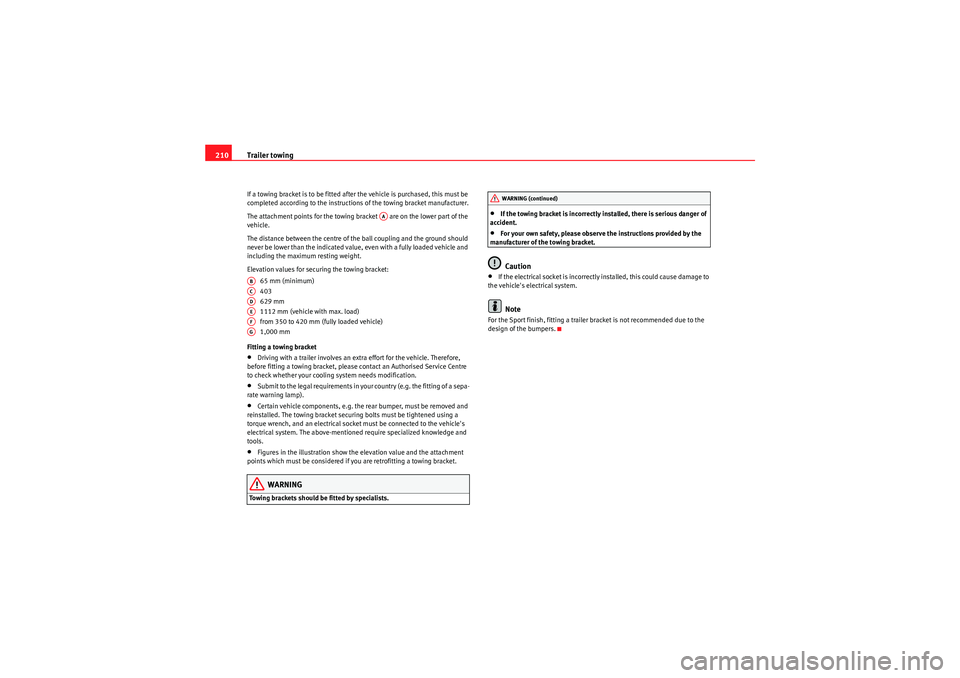
Elevation values for securing the towing bracket:
65 mm (minimum)
403
629 mm
1112 mm (vehicle with max. load)
from 350 to 420 mm (fully loaded vehicle)
1,000 mm
Fitting a towing bracket•Driving with a trailer involves an extra effort for the vehicle. Therefore,
before fitting a towing bracket, please contact an Authorised Service Centre
to check whether your cooling system needs modification.•Submit to the legal requirements in your country (e.g. the fitting of a sepa-
rate warning lamp).•Certain vehicle components, e.g. the rear bumper, must be removed and
reinstalled. The towing bracket securing bolts must be tightened using a
torque wrench, and an electrical socket must be connected to the vehicle's
electrical system. The above-mentioned require specialized knowledge and
tools.•Figures in the illustration show the elevation value and the attachment
points which must be considered if you are retrofitting a towing bracket.WARNING
Towing brackets should be fitted by specialists.
•If the towing bracket is incorrectly installed, there is serious danger of
accident.•For your own safety, please observe the instructions provided by the
manufacturer of the towing bracket.Caution
•If the electrical socket is incorrectly installed, this could cause damage to
the vehicle's electrical system.Note
For the Sport finish, fitting a trailer bracket is not recommended due to the
design of the bumpers.
AA
ABACADAEAFAG
WARNING (continued)
ExeoST_EN.book Seite 210 Donnerstag, 3. September 2009 12:24 12
Page 230 of 316
Checking and refilling levels
228
NoteOn right-hand drive vehicles some of the containers/ reservoirs mentioned
below are located on the other side of the engine compartment.Closing the bonnet– To close the bonnet, pull it down to overcome the spring pres- sure.
– Leave the bonnet secured in the locking part. Do not tighten
⇒ .
WARNING
•For safety reasons the bonnet must always be completely closed when
the vehicle is moving. After closing it always check that it is properly
secured. The bonnet must be flush with the adjacent body panels.•Should you notice that the bonnet is not safely secured when the
vehicle is moving, stop the vehicle immediately and close the bonnet.
Failure to do so could result in an accident.
Engine oilGeneral notesWe recommend that the oil change should be performed by an Authorised
Service Centre or a qualified workshop, according to the Maintenance
Program. The correct oil specifications for your engine are listed in the
⇒page 229,
“Oil properties”.
Check that the specifications quoted (VW standards) appear on the container
either singly or in combination with other specifications.
Flexible maintenance intervals (Extended Service Intervals*)
Special lubricating oils have been de ve lop
ed in the framework of the SEAT
Booklet “Extended Se rvice Intervals” Maintenance Programme
⇒ page 229.
This typ
e of oil must be used if you intend to take advantage of the prolonga-
tion of the maintenance intervals in the framework of the “Extended Service
Intervals” program.
•Do not mix the LongLife oil with oil intended for fixed service intervals, as
the requirements for the extended service intervals are then no longer guar-
anteed.•Only in exceptional circumstances, if the engine oil level is too low
⇒ page 230 and LongLife oil is not available, it is permitted to top up (once)
with oil for fixed service intervals ⇒ page 229 (up to a maximum of 0.5
litres).
Fixed service intervals*
If “Extended Service Intervals” are not applied to your vehicle, you can use
oils for fixed service intervals ⇒ page 229. In this case, your vehicle must be
serviced after a fixed interval of 1 year / 15,000 km (10,000 miles) (see the
Maintenance Program).•In exceptional circumstances, if the engine oil level is too low
⇒ page 230 and you cannot obtain the oil specified for your vehicle, you can
put in a small quantity of oil conforming to the specification ACEA A2 or
ACEA A3 (petrol engines) or ACEA B3 or ACEA B4 (diesel engines) (up to 0.5l).
Vehicles with diesel particulate filter*
The Maintenance Program states whether your vehicle is fitted with a diesel
particulate filter.
ExeoST_EN.book Seite 228 Donnerstag, 3. September 2009 12:24 12
⇒
Page 241 of 316
Checking and refilling levels239
Safety First
Controls and equipment
Practical tips
Technical Data
Winter operations
The battery is drained more in cold weather, which means that the starting
power is reduced. For this reason, have the battery checked and charged if
necessary before the start of winter.
Replacing the battery
A replacement battery
must have the same capacity, voltage and current
rating. It must also have the same dimensions as the original, factory-fitted
battery and have sealed caps. The SEAT batteries which have been specially
developed fulfil the maintenance, performance and safety specifications for
your vehicle.
We recommend you use maintenance-free batteries.
WARNING
•All work on batteries requires specialist knowledge. If work is required
on the battery, this should be performed by a Technical Service or
specialist garage. Danger of caustic burns and explosion!•The battery must not be opened. Never try to change the battery's
liquid level. Explosive gas is released from the battery that could lead to an
explosion.Caution
•The battery holder and clamps must always be correctly secured.•Before starting any work on the battery, always observe the warnings
listed under ⇒.For the sake of the environment
Batteries contain toxic substances including sulphuric acid and lead.
Therefore, they must be disposed in line with environmental regulations and
must not be disposed of with ordinary household waste. Make sure discon-
nected batteries cannot tip over. Sulphuric acid could be spilt!
Important safety warnings for handling a car batteryThe battery is located at the back of the engine compartment ⇒ page 295.
WARNING
Always be aware of the danger of injury and chemical burns as well as the
risk of accident or fire when working on the battery and the electrical
system:•Wear eye protection. Protect your eyes, skin and clothing from acid and
particles containing lead.•Battery acid is very corrosive and caustic. Wear protective gloves and
eye protection. Do not tilt the batteries. This could spill acid through the
vents. Rinse battery acid from eyes immediately for several minutes with
clear water. Then seek medical care immediately. Neutralize any acid
splashes on the skin or clothing with a soapy solution, and rinse off with
plenty of water. If acid is swallowed by mistake, consult a doctor immedi-
ately.•Fires, sparks, naked lights and smoking are prohibited. When handling
cables and electrical equipment, avoid causing sparks and electrostatic
charge. Never short the battery terminals. High-energy sparks can cause
injury.
Wear eye protection
Battery acid is very corrosive and caustic. Wear protective
gloves and eye protection!
Fires, sparks, naked lights and smoking are prohibited!
A highly explosive mixture of gases is released when the batter y
is under charge.
Keep children away from acid and batteries!
ExeoST_EN.book Seite 239 Donnerstag, 3. September 2009 12:24 12
Page 251 of 316
Wheels and tyres249
Safety First
Controls and equipment
Practical tips
Technical Data
For the sake of the environment
Old tyres must be disposed of according to the laws in the country concerned.
Note
•For technical reasons, it is not generally possible to use the wheels from
other vehicles. This can also apply to wheels of the same model. The use of
wheels or tyres which have not been approved by SEAT for use with your
model may invalidate the vehicle's type approval for use on public roads.•If the spare tyre is not the same as the tyres that are mounted on the
vehicle - for example with winter tyres - you should only use the spare tyre for
a short period of time and drive with extra care. Refit the normal road wheel
as soon as possible.Wheel bolts
Wheel bolts must be tightened to the correct torque.The design of wheel bolts is matched to the rims. If different wheel rims are
fitted, the correct wheel bolts with the right length and correctly shaped bolt
heads must be used. This ensures that wheels are fitted securely and that the
brake system functions correctly.
In certain circumstances, you may not use wheel bolts from a different car -
even if it is the same model ⇒page 220.
After the wheels have been changed, the tightening torque of the wheel bolts
s ho uld b e ch ecke d as so on as possi ble wi th a to rq ue wre nch ⇒ . The tight-
ening torque for steel and alloy wheels is 120 Nm.
WARNING
If the wheel bolts are not tightened correctly, the wheel could become
loose while driving. Risk of accident.•The wheel bolts must be clean and turn easily. Never apply grease or oil
to them.•Use only wheel bolts which belong to the wheel.•If the torque of the wheel bolts is too low, they could loosen whilst the
vehicle is in motion. Risk of accident! If the tightening torque is too high,
the wheel bolts and threads can be damaged.Caution
The prescribed torque for wheel bolts for steel and alloy wheels is 120 Nm.Winter tyres
Winter tyres will improve the vehicles handling on snow and
ice.In winter conditions winter tyres will considerably improve the vehicles
handling. The design of summer tyre s (width, rubber compound, tread
pattern) gives less grip on ice and snow.
Winter tyres must be inflated to a pressure 0.2 bar higher than the pressures
specified for summer tyres (see sticker on tank flap).
Winter tyres must be fitted on all four wheels.
Information on permitted winter tyre sizes can be found in the vehicle's regis-
tration documents. Use only radial winter tyres. All tyre sizes listed in the
vehicle documentation also apply to winter tyres.
ExeoST_EN.book Seite 249 Donnerstag, 3. September 2009 12:24 12
Page 254 of 316
If and when
252•A hook for removing wheel covers* or hub caps•Box spanner for wheel bolts•A screwdriver with reversible blade•Towi ng e ye•An adapter for the anti-theft wheel bolts*
Before replacing the jack in the storage bin, wind down the arm of the jack as
far as it will go.
Some of the tools listed are only provided in certain models or are optional
extras.WARNING
•Do not use the hexagonal socket in the screwdriver handle to tighten
the wheel bolts, as with this it is not possible to tighten the bolts to the
required torque. Risk of accident.•The jack supplied by the factory is only designed for changing wheels
on this model. On no account attempt to use it for lifting heavier vehicles
or other loads. Risk of injury.•Never start the engine when the vehicle is raised. Failure to do so could
result in an accident.•If work is to be carried out underneath the vehicle, this must be secured
by suitable stands. Otherwise, there is a risk of injury.
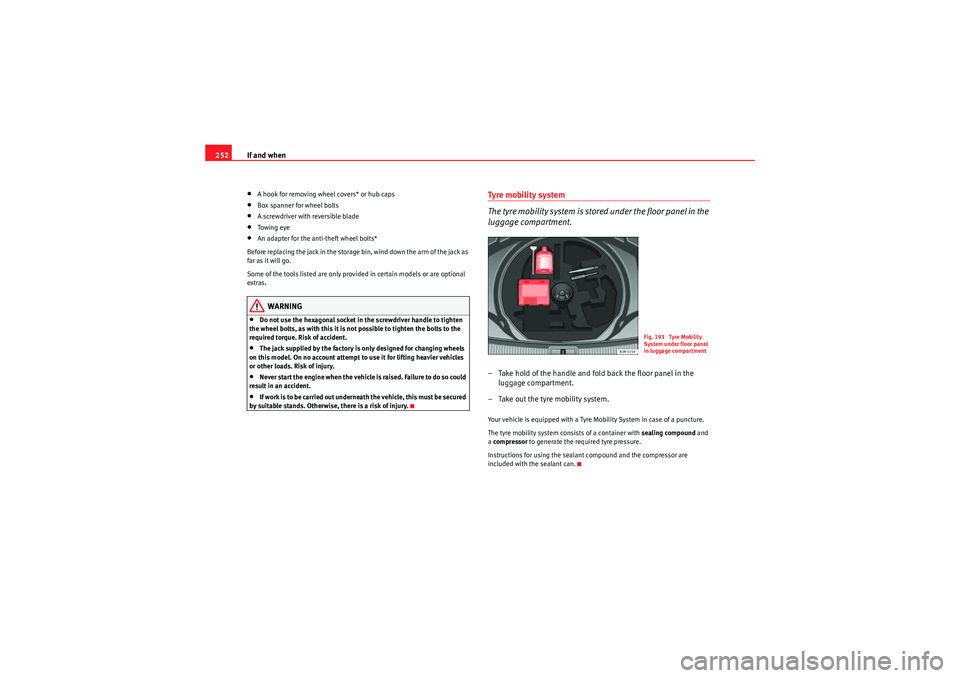
Tyre mobility system
The tyre mobility system is stor ed under the floor panel in the
luggage compartment.– Take hold of the handle and fold back the floor panel in the
luggage compartment.
– Take out the tyre mobility system.Your vehicle is equipped with a Tyre Mobility System in case of a puncture.
The tyre mobility system consists of a container with sealing compound and
a compressor to generate the required tyre pressure.
Instructions for using the sealant compound and the compressor are
included with the sealant can.
Fig. 193 Tyre Mobility
System under floor panel
in luggage compartment
ExeoST_EN.book Seite 252 Donnerstag, 3. September 2009 12:24 12
Page 255 of 316

If and when253
Safety First
Controls and equipment
Practical tips
Technical Data
Spare steel rim wheel
The spare steel rim wheel is carried in the wheel well under
the floor panel in the luggage compartment. It is only
intended for temporary use over short distances.Taking out the spare wheel
–Turn the plastic knob ⇒ fig. 194 anti-clockwise.
– Take out the spare wheel.
Securing the defective wheel in the spare wheel well
– Place wheel in spare wheel well in the luggage compartment.
– Secure wheel by turning plastic knob clockwise.
– Replace the floor panel before closing the boot lid.
Your vehicle can be equipped with a steel spare wheel at the factory. The
spare wheel does not usually meet the same performance standards as the
wheels fitted on the vehicle because of the wheel/tyre dimensions, rubber
composition, tread pattern, etc. Therefore, note the following restrictions:•The spare steel rim wheel is designed only for your vehicle model. Do not
attempt to mount the wheel on any vehicle but your own.•Your vehicle will have different driving characteristics when the spare
steel rim wheel is mounted ⇒.•The spare wheel is only intended for temporary use after having a flat tyre.
Replace the spare wheel with a normal wheel that has the proper tyre dimen-
sions as soon as possible.•If the size of the spare steel rim wheel is different to that of the other
wheels, it is unlikely that snow chains suitable for the other wheels will fit it.WARNING
•After mounting the spare steel rim wheel, the tyre pressure must be
checked and corrected as soon as possible. The inflating pressure must
adapt to the vehicle load (consult the table containing the inflation pres-
sures). Otherwise there is danger of causing an accident. Use the highest
tyre pressure as indicated in the table.•Do not drive faster than 80 km/h, as higher speeds can cause an acci-
dent.•Avoid heavy acceleration, hard braking and fast cornering, as this could
cause an accident.
Fig. 194 Spare steel rim
wheel
ExeoST_EN.book Seite 253 Donnerstag, 3. September 2009 12:24 12
Page 256 of 316
If and when
254Changing a wheelPreparation work
What you must do before changing a wheel.– If you have a flat tyre or puncture, park the car as far away from
the flow of traffic as possible. Choose a location that is as level
as possible.
– All passengers should leave the vehicle. They should wait in a
safe place (e.g. behind the roadside crash barrier).
–Apply the handbrake firmly.
–Engage 1st gear.
– When towing a trailer: Unhitch the trailer from your vehicle.
–Take the tools and the spare wheel ⇒ page 251 out of the
luggage compartment.
WARNING
If you have a puncture in heavy traffic, switch on the hazard warning lights
and place the warning triangle in a visible location. This is for your own
safety and also warns other road users.
Caution
If you have to change the tyre on a gradient, block the wheel opposite the
wheel being changed by placing a stone or similar object under it to prevent
the vehicle from rolling away.
Note
Please observe legal requirements when doing so.Changing a wheel
Change the wheel as described below.– Remove the wheel cover.
–Loosen the wheel bolts ⇒ page 255.
– Raise the car with the jack ⇒page 256.
– Ta k e o f f the wheel with the flat tyre and then put on the spare
wheel ⇒page 257.
– Lower the vehicle.
– Tighten the wheel bolts firmly in diagonal sequence with the box
spanner ⇒page 255.
–Replace the cover .After changing a wheel
After changing the wheel, there are still tasks to complete.– Place the wheel with the defective tyre in the spare wheel well
and secure it.
– Put the tools and jack back in the luggage compartment.
ExeoST_EN.book Seite 254 Donnerstag, 3. September 2009 12:24 12
Page 279 of 316
If and when277
Safety First
Controls and equipment
Practical tips
Technical Data
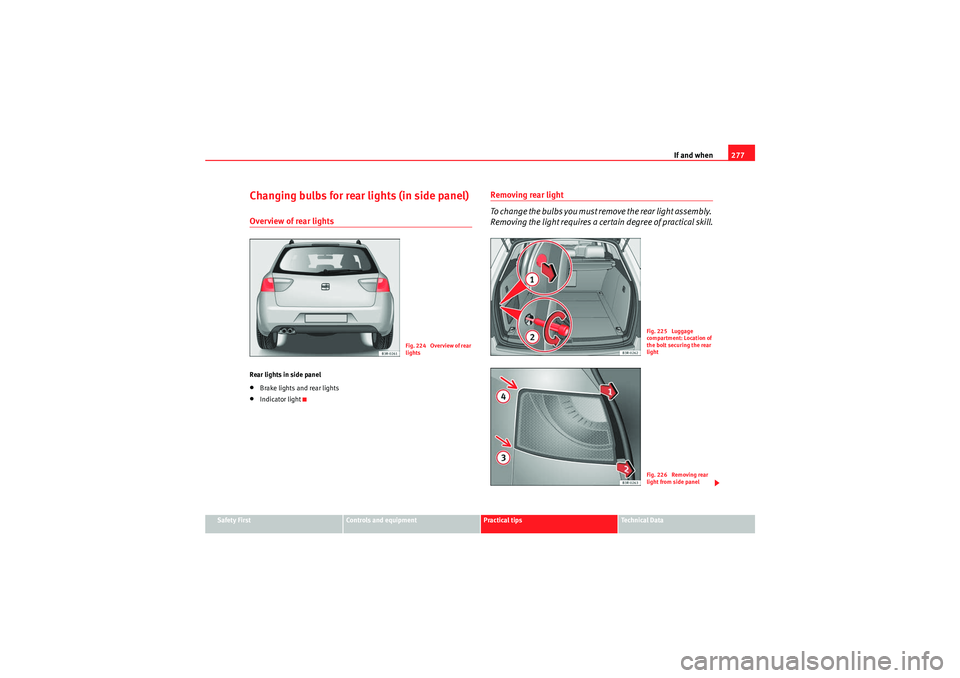
Changing bulbs for rear lights (in side panel)Overview of rear lightsRear lights in side panel•Brake lights and rear lights•Indicator light
Removing rear light
To change the bulbs you must remove the rear light assembly.
Removing the light requires a certain degree of practical skill.
F ig. 224 O ver vie w of rear
lights
Fig. 225 Luggage
compartment: Location of
the bolt securing the rear
lightFig. 226 Removing rear
light from side panel
ExeoST_EN.book Seite 277 Donnerstag, 3. September 2009 12:24 12
Page 280 of 316
If and when
278
A special retaining screw is used to secure and guide the rear light.
– Check which of the bulbs is defective.
–Open the tailgate.
– Take the screwdriver out of the vehicle's tool kit ⇒ page 251.
– Use the flat-blade side of th e reversible screwdriver insert.
– Prise off the cover with a screwdriver in the slot ⇒page 277,
fig. 225 and remove the cover (with the retaining clips) from
the opening.
– Carefully loosen the screw located behind the cover with the screwdriver, turning it anti-clockwise (arrows) .
– Gradually ease the rear light out of the housing ( ⇒page 277,
fig. 226 positions and ) by pulling alternately in positions
and .
– Remove the bulb holder ⇒page 278.
CautionWhen removing or installing the rear light, take care not to cause any
damage.•Removing the rear light in particular can lead to the paintwork or rear light
becoming damaged. This is another reason why we recommend having the
bulbs changed by a qualified workshop.Note
Make sure you have a soft cloth ready to place under the glass on the rear
light, to avoid any scratches.
Removing the bulb holder
When changing a bulb, you must first remove the bulb holder.There are four securing tabs on the inside of the rear light unit.
– Release the retaining tabs ⇒fig. 227.
– Lift the bulb carrier off in the direction of the arrow .
– Change the defective bulb ⇒page 279.
A1
A2
A3
A4
A1
A2
Fig. 227 Retaining tabs
on reverse side of rear
light
AA
AB
ExeoST_EN.book Seite 278 Donnerstag, 3. September 2009 12:24 12
Page 281 of 316
If and when279
Safety First
Controls and equipment
Practical tips
Technical Data
Changing bulbs
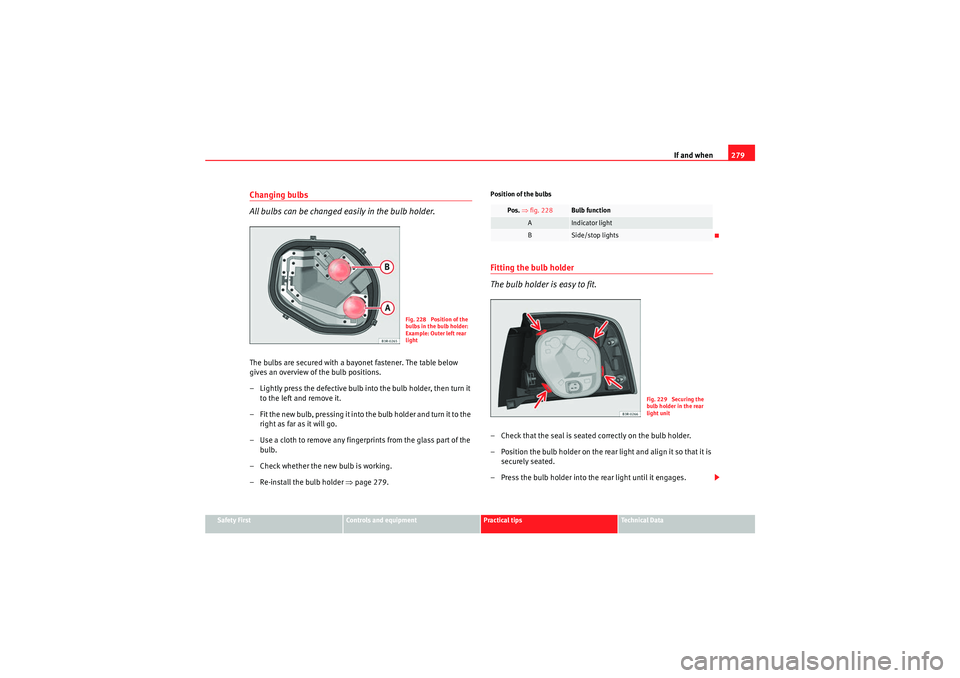
All bulbs can be changed easily in the bulb holder.The bulbs are secured with a bayonet fastener. The table below
gives an overview of the bulb positions.
– Lightly press the defective bulb into the bulb holder, then turn it
to the left and remove it.
– Fit the new bulb, pressing it into the bulb holder and turn it to the
right as far as it will go.
– Use a cloth to remove any fingerp rints from the glass part of the
bulb.
– Check whether the new bulb is working.
– Re-install the bulb holder ⇒page 279.
Position of the bulbsFitting the bulb holder
The bulb holder is easy to fit.– Check that the seal is seated correctly on the bulb holder.
– Position the bulb holder on the rear light and align it so that it is
securely seated.
– Press the bulb holder into the rear light until it engages.
Fig. 228 Position of the
bulbs in the bulb holder:
Example: Outer left rear
light
Pos. ⇒ fig. 228
Bulb function
A
Indicator light
B
Side/stop lights
Fig. 229 Securing the
bulb holder in the rear
light unit
ExeoST_EN.book Seite 279 Donnerstag, 3. September 2009 12:24 12