brake sensor Seat Exeo ST 2009 Owner's manual
[x] Cancel search | Manufacturer: SEAT, Model Year: 2009, Model line: Exeo ST, Model: Seat Exeo ST 2009Pages: 316, PDF Size: 8.83 MB
Page 81 of 316
Cockpit79
Safety First
Controls and equipment
Practical tips
Technical Data
Note
The oil pressure warning lamp
is not an indicator for the oil level. The oil
level should therefore be checked regularly, preferably every time you fill the
tank.
Ye ll o w s y m b o l s
A yellow symbol indicates a warning.
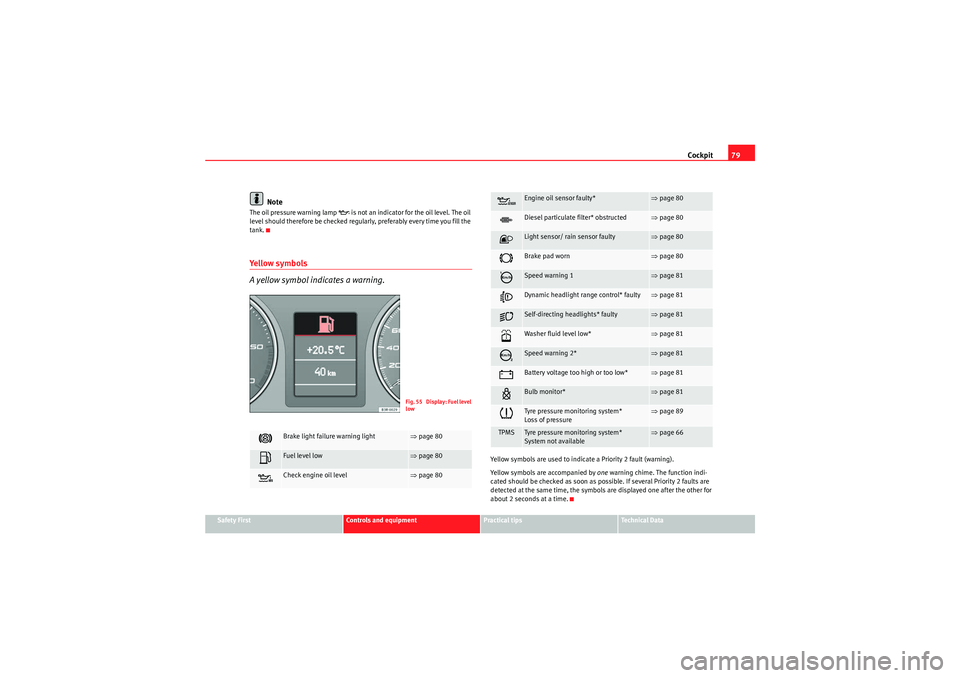
Yellow symbols are used to indicate a Priority 2 fault (warning).
Yellow symbols are accompanied by one warning chime. The function indi-
cated should be checked as soon as possible. If several Priority 2 faults are
detected at the same time, the symbols are displayed one after the other for
about 2 seconds at a time.
Brake light failure warning light
⇒ page 80
Fuel level low
⇒page 80
Check engine oil level
⇒page 80F i g . 5 5 D i s p l a y : F u e l l e v e l
low
Engine oil sensor faulty*
⇒page 80
Diesel particulate filter* obstructed
⇒page 80
Light sensor/ rain sensor faulty
⇒page 80
Brake pad worn
⇒page 80
Speed warning 1
⇒page 81
Dynamic headlight range control* faulty
⇒page 81
Self-directing headlights* faulty
⇒page 81
Washer fluid level low*
⇒page 81
Speed warning 2*
⇒page 81
Battery voltage too high or too low*
⇒page 81
Bulb monitor*
⇒page 81
Tyre pressure monitoring system*
Loss of pressure
⇒page 89
TPMS
Tyre pressure monitoring system*
System not available
⇒page 66
ExeoST_EN.book Seite 79 Donnerstag, 3. September 2009 12:24 12
Page 82 of 316

Cockpit
80Brake light failure
This warning light will appear on the upper part of the display if any of the
brake lights has failed. A text message in the central part of the display indi-
cates which brake light has failed (left or right).Fuel level low
When this symbol
comes on for the first time, there are about 8 to 10 litres
of fuel left in the tank. You should fill up as soon as possible ⇒page 222.
Check engine oil level
If the
symbol lights up, please check the engine oil level as soon as
possible ⇒page 230. Top up the oil at the next opportunity ⇒page 230.
Engine oil sensor defective*
If the
symbol lights up, take the vehicle to a qualified workshop and have
the oil level sensor checked. Until then it is advisable to check the oil level
every time you fill up with fuel ⇒page 230.
Diesel particulate filter obstructed
If the symbol
lights up, you may be able to contribute towards automatic
filter cleaning by driving in the right manner. To do this, drive about 15
minutes in 4th or 5th gear (automatic gearbox: S gear range) at a speed of 60 km/h, with the engine running at approximately 2000 rpm. The increase in
temperature will burn off any soot in the filter. When cleaning is successful,
the symbol switches off.
If the light on symbol
does not go off, take the vehicle to a specialist
garage to repair the fault.
For further information on the diesel particulate filter, see ⇒page 197.
WARNING
It is essential that you adjust your speed to suit the weather, road, terrain
and traffic conditions. The recommended driving speed must never lead to
the driver disregarding the traffic regulations.Light sensor/ rain sensor faulty
Automatic headlights / automatic wipers faulty
If the symbol appears, this means that the light sensor / rain sensor is not
working. For safety reasons, the dipped beam headlights will then be
switched on permanently when the light switch is set to the AUTO position.
However, you can still switch the lights on and off in the normal way with the
light switch. If the rain sensor is faulty, the functions operated via the wind-
screen wiper lever will still be available. You should have the light sensor /
rain sensor checked by a specialist garage as soon as possible.
Worn brake pads
If the
symbol lights up, have the front brake pads (and, for safety's sake,
the rear pads as well) inspected by a specialist garage.
ExeoST_EN.book Seite 80 Donnerstag, 3. September 2009 12:24 12
Page 177 of 316

Driving175
Safety First
Controls and equipment
Practical tips
Technical Data
If you drive by mistake with the handbrake still applied, you will hear a
warning buzzer and the display will show the message:
Handbrake applied
The handbrake warning is enabled after driving for 3 seconds at a speed
above 5 km/h.
The handbrake warning lamp
lights up when the handbrake is applied
with the ignition on.
WARNING
Please note that the handbrake should be released all the way. If it is only
partially released, this will cause rear brakes overheating, which can
impair the function of the brake system and could lead to an accident.
Caution
Once the vehicle has come to a standstill, always apply the handbrake firmly
and then, on a manual gearbox, engage a gear, or select P on an automatic.Parking
The following points will ensure there is no risk of the car
rolling away accidentally after it is parked.– Use the foot brake to stop the vehicle.
– Apply handbrake firmly.
– Switch the engine off.
– On a manual gearbox engage 1st gear or on an automatic move the selector lever to P ⇒ .
When parking on slopes:
Turn the steering wheel so that the, if the vehicle moves, it will do so towards
the curb.
WARNING
•Do not leave anyone (especially children) in the vehicle when it is
locked. Locked doors could delay assistance in an emergency, potentially
putting lives at risk.•Never leave children unsupervised in the vehicle. They could release
e.g. the handbrake or gear lever, moving the vehicle and causing an
accident.
Parking aid acoustic systemGeneral notesVarious systems are available to help you when parking or manoeuvring in
tight spaces, depending on the equipment fitted on your vehicle.
The SEAT parking system gives an acoustic warning if there are any obstacles
behind your car ⇒ page 176.
When you are parking, SEAT parking system plus warns you acoustically and
optically about obstacles in front of and behind the vehicle ⇒page 176.
Note
To ensure the acoustic parking aid works properly, the sensors must be kept
clean and free of snow and ice.
ExeoST_EN.book Seite 175 Donnerstag, 3. September 2009 12:24 12
Page 191 of 316
Intelligent technology189
Safety First
Controls and equipment
Practical tips
Technical Data
Practical tipsIntelligent technologyElectronic stabilisation programme (ESP)General notes
The electronic stabilisation programme increases the
vehicle's stability on the road.The ESP is designed to increase the degree of control in situations where the
car approaches the limits of adhesion, especially when accelerating and
cornering. It reduces the risk of skidding and improves stability in all road
conditions. The system is active across the entire speed range. The anti-lock brake system (ABS), the electronic differential lock (EDL) and
the traction control system (TCS) are all integrated into the electronic stabili-
sation programme.
How it works
The ESP control unit processes data from the three integrated systems. It also
processes additional inputs provided by other high-precision sensors. These
register the vehicle's rotation about the vertical axis (yaw rate), lateral accel-
eration, brake pressure and steering wheel angle.
The system uses the steering wheel angle and road speed to calculate the
changes of direction desired by the driver, and constantly compares them
with the actual behaviour of the vehicle. If the desired course is not being
maintained (for instance, if the car is starting to skid), then the ESP compen-
sates automatically by braking the appropriate wheel.
The forces acting on the braked wheel bring the car back to a stable condi-
tion. If the vehicle
over swerves (tendency of the rear to leave the road), the
brakes will act on the front wheel facing the outside of the bend. If the vehicle
under swerves (tendency to leave the bend), the braking force is applied to
the rear wheel facing the inside of the bend.
The ESP works in conjunction with the ABS ⇒page 190. If a malfunction
should occur in the ABS, the ESP will also be out of action.
Disabling
The ESP is enabled automatically when the engine is started and performs a
self-test routine.
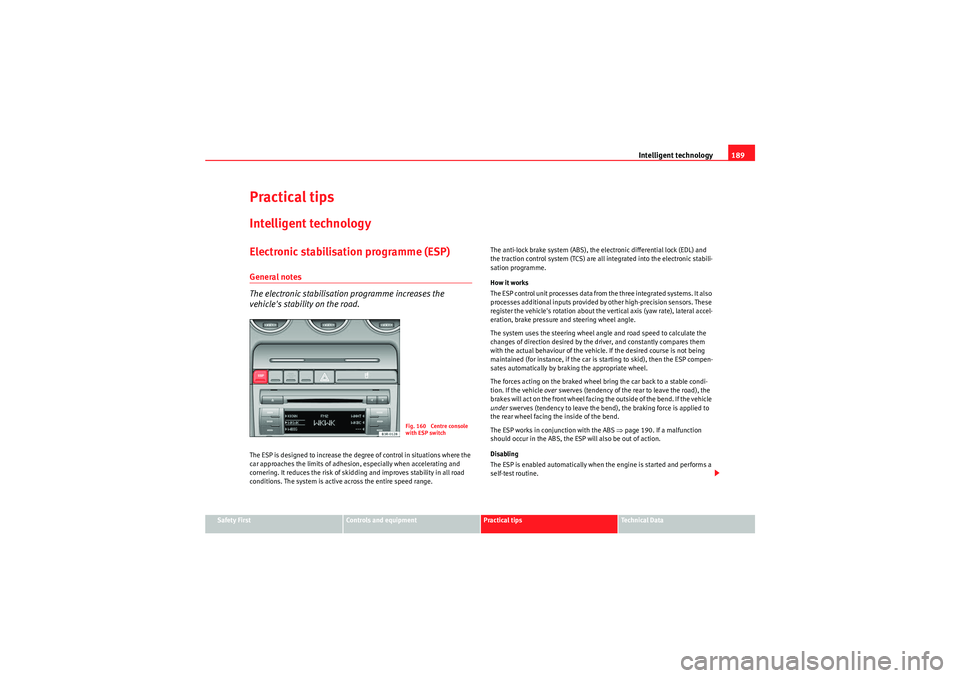
Fig. 160 Centre console
with ESP switch
ExeoST_EN.book Seite 189 Donnerstag, 3. September 2009 12:24 12
Page 193 of 316
Intelligent technology191
Safety First
Controls and equipment
Practical tips
Technical Data
the brake assist system automatically boosts the braking force to the
maximum level, up to the point where the anti-lock brake function (ABS) inter-
venes to stop the wheels from locking. You should then keep the brake pedal
pressed until the vehicle has braked to the required speed. The brake assist
system switches itself off as soon as you release the brake pedal.
The brake assist system will not be operative if there is a malfunction in the
ABS or the ESP.
WARNING
Please remember that the accident risk always increases if you drive too
fast, especially in corners or on a slippery road, or if you follow too close
behind the vehicle in front of you. An increased accident risk cannot be
compensated even by the brake assist system. Risk of accident.Electronic differential lock (EDL)
The electronic differential lock prevents the loss of traction
caused if one wheel starts spinning.General notes
The electronic differential lock (EDL) helps the car to start moving, accelerate
and climb a gradient in slippery conditions where this may otherwise be diffi-
cult or even impossible.
How it works
The EDL works automatically, i.e. without the driver's involvement. With the
aid of the ABS sensors, the system monitors the rotational speed of the
driven wheels ⇒
page 190. If a considerable difference in revs is detected
(approx. 100 rpm) in the speed of the driven wheels, e.g. when only one part
of the surface supporting the wheels is slippery, the system applies the brake
to slow down the skidding wheel so that more of the power is directed to the other wheels. The systems works up to a speed of approx. 80 km/h. The
system will make noises while it is working.
Moving away from a standstill
If one wheel has less grip and starts spinning (for instance, if one of the
driven wheels is on ice), keep pressing the accelerator gradually until the car
starts moving.
Overheating of the brakes
To prevent the brake disk of the braked wheel from overheating, the EDL cuts
out automatically if subjected to excessive loads. In this case, the vehicle will
continue to run and will have the same running properties as those of another
without EDL.
The EDL will switch on again automatically when the brake has cooled down.
WARNING
•When accelerating on a uniformly slippery surface (for instance all four
wheels on ice or snow), press the accelerator gradually and carefully.
Despite EDL, the driven wheels may otherwise start to spin. This could
impair the car's stability. Risk of accident.•Even with EDL, you should always adjust your speed to suit the condi-
tions. Do not let the extra safety features tempt you into taking any risks
when driving. Failure to do so could result in an accident.Note
If the ABS warning lamp lights up, this can also mean there is a fault in the
EDL. Please take the vehicle to a specialist garage as soon as possible.
ExeoST_EN.book Seite 191 Donnerstag, 3. September 2009 12:24 12
Page 194 of 316

Intelligent technology
192Traction control system (TCS)
The traction control system prevents the drive wheels from
spinning when the car is accelerating.General notes
The traction control system (TCS) is one of the functions incorporated in the
electronic stabilisation programme (ESP).
The traction control system (TCS) helps the car to start moving, accelerate or
climb a gradient in slippery conditions where this may otherwise be difficult
or even impossible.
How it works
The TCS acts automatically, i.e. without the driver's intervention. With the aid
of the ABS sensors ⇒page 190, the TCS monitors the speed of the driven
wheels. If the wheels start to spin, the engine power is reduced automatically
to match the amount of grip available. The system is active across the entire
speed range.
The TCS works in conjunction with the ABS. If a malfunction occurs in the ABS,
the TCS will also be inoperative.
Note
To ensure that the TCS works properly, all four wheels must be fitted with
identical tyres. The difference in size of the wheels may lead to an undesired
reduction in engine power. Also see ⇒page 248.
BrakesGeneral notesNew brake pads
New brake pads do not provide optimal performance during the first 200 km
they must be “run in”. However, the reduced braking capacity may be
compensated by pressing on the brake pedal a little harder. Avoid over-
loading the brakes during run-in.
Wear
T h e r a t e o f we a r o n t h e brake pads depends a great deal on how you drive and
the conditions in which the vehicle is operated. Negative factors are, for
instance, city traffic, frequent short trips or hard driving with abrupt starts
and stops.
Wet roads; road salt
In certain conditions, such as in heavy rain, or after washing the car or driving
through water, the full braking effect can be delayed by moisture (or in winter
by ice) on the discs and brake pads. The brakes should be “dried” by pressing
the pedal to restore full braking effect.
When the velocity is over 80 km/h windscreen wipers are on, the brake
system moves the pads towards the brake discs for a few seconds. This
occurs - without warning to the driver - at regular intervals and requires a
more rapid response from the brakes when driving on wet roads.
The effectiveness of the brakes can also be temporarily reduced if the car is
driven for some distance without using the brakes when there is a lot of salt
on the road in winter. In this case, the layer of salt on the brake discs and pads
has to wear off before braking.
ExeoST_EN.book Seite 192 Donnerstag, 3. September 2009 12:24 12
Page 265 of 316
If and when263
Safety First
Controls and equipment
Practical tips
Technical Data
Caution
Never “repair” damaged fuses and never replace them with fuses with a
higher rating. Failure to comply could result in fire. It could also cause
damage to other parts of the electrical system.
Note
If a newly replaced fuse blows again after a short time, the electrical system
must be checked by a qualified workshop as soon as possible.Fuse assignment
This list shows the fuses which can be replaced relatively
easily by the owner.No.
Consumer
Amps
1
Climate control
10
2
Footwell lamps
5
3
Heated washer jets
5
4
Radiator fan
5
5
Parking aid, automatic gearbox
10
6
Air conditioner (air purity sensor), pressure sensor
5
7
Electronic Stabilisation Program (ESP), brake light
switch, clutch pedal switch, steering angle sensor
10
8
Te le p hon e
5
9
Va can t
10
Self-directing headlights (adaptive light) right
5
11
Airbag and disconnection of the front passenger air-
bag
5
12
Diagnostic socket
10
13
Steering column unit
10
14
Brake lights
10
15
Instrument panel
10
16
Va can t
17
Tyre pressure control, rain/light sensor
10
18
Self-directing headlights (adaptive light) left
5
19
Va can t
20
Va can t
21
Va can t
22
Driver's door / front passenger's door
15
23
Rear doors
15
24
Central electrics unit for convenience equipment
20
25
Heater blower
30
26
Rear window heater
30
27
Electrical socket for trailer (control unit)
30
28
Fuel pump, auxiliary pump for diesel
20
29
Va can t
30
Sliding/tilting sunroof
20
31
Diagnosis connection, automatic anti-dazzle interior
mirror, reverse light, automatic gearbox
15
32
Towi ng s ocke t
15
No.
Consumer
Amps
ExeoST_EN.book Seite 263 Donnerstag, 3. September 2009 12:24 12
Page 307 of 316
Index305
Index
AAccessories . . . . . . . . . . . . . . . . . . . . . . . . . . . . 220
Towing . . . . . . . . . . . . . . . . . . . . . . . . . . . . . 202
Adaptive headlights . . . . . . . . . . . . . . . . . . . . . 122
Air conditioner 2C-Climatronic . . . . . . . . . . . . . . . . . . . . . . . 160
Defrosting . . . . . . . . . . . . . . . . . . . . . . . . . . . 164
Solar-powered blower/solar roof . . . . . . . . 169
Air duct Fitting . . . . . . . . . . . . . . . . . . . . . . . . . 266, 273
Removing . . . . . . . . . . . . . . . . . . . . . . 265, 272
Air purity sensor . . . . . . . . . . . . . . . . . . . . . . . . . 165
Airbag Warning lamp . . . . . . . . . . . . . . . . . . . . . . . . . 66
Airbag covers . . . . . . . . . . . . . . . . . . . . . . . . . . . . 33
Airbag system . . . . . . . . . . . . . . . . . . . . . . . . . . . 28 Curtain airbags . . . . . . . . . . . . . . . . . . . . . . . 41
Front airbags . . . . . . . . . . . . . . . . . . . . . . . . . 31
Side airbags . . . . . . . . . . . . . . . . . . . . . . . . . . 37
Warning lamp . . . . . . . . . . . . . . . . . . . . . . . . . 29
Alternator Warning lamp . . . . . . . . . . . . . . . . . . . . . . . . . 69
Ambient temperature display . . . . . . . . . . . . . . . 72
Anti-freeze . . . . . . . . . . . . . . . . . . . . . . . . . . . . . 231
Anti-lock brake system How it works . . . . . . . . . . . . . . . . . . . . . . . . . 190
Anti-puncture tyres . . . . . . . . . . . . . . . . . . . . . . 247 Anti-theft alarm system . . . . . . . . . . . . . . . . . . . 107
Interior monitoring . . . . . . . . . . . . . . . . . . . 108
Aquaplaning . . . . . . . . . . . . . . . . . . . . . . . . . . . 246
Armrest Storage compartment in front armrest . . . . 142
Armrests Adjusting the front armrest . . . . . . . . . . . . . 142
Ashtray Front . . . . . . . . . . . . . . . . . . . . . . . . . . . . . . . 154
Rear . . . . . . . . . . . . . . . . . . . . . . . . . . . . . . . 154
Athermic windscreen . . . . . . . . . . . . . . . . . . . . . 221
Auto-check system . . . . . . . . . . . . . . . . . . . . . . . 75
Automatic car wash tunnel . . . . . . . . . . . . . . . . 212
Automatic gearbox Dynamic gear control program . . . . . . . . . . 186
Kick-down feature . . . . . . . . . . . . . . . . . . . . 185
multitronic® . . . . . . . . . . . . . . . . . . . . . . . . 181
Paddle levers (tiptronic mode) . . . . . . . . . . 188
Safety interlock for ignition key . . . . . . . . . 171
Selector lever lock . . . . . . . . . . . . . . . . . . . . 185
Selector lever positions . . . . . . . . . . . . . . . . 183
Steering wheel with paddle levers . . . . . . . 188
tiptronic . . . . . . . . . . . . . . . . . . . . . . . 181, 187
Automatic headlight control . . . . . . . . . . . . . . . 116
BBackground lighting . . . . . . . . . . . . . . . . . . . . . 125 Battery . . . . . . . . . . . . . . . . . . . . . . . . . . . . . . . . 238
Battery voltage . . . . . . . . . . . . . . . . . . . . . . . . 81
Charging . . . . . . . . . . . . . . . . . . . . . . . . . . . . 240
Disconnection . . . . . . . . . . . . . . . . . . . . . . . 238
Long periods of non-use . . . . . . . . . . . . . . . 238
Replacing . . . . . . . . . . . . . . . . . . . . . . 238, 239
Testing . . . . . . . . . . . . . . . . . . . . . . . . . . . . . 238
Winter operations . . . . . . . . . . . . . . . 238, 239
Belt tension device Disposal . . . . . . . . . . . . . . . . . . . . . . . . . . . . . 27
Warning lamp . . . . . . . . . . . . . . . . . . . . . . . . 29
Belt tension devices . . . . . . . . . . . . . . . . . . . . . . 26
Bicycle rack Towing . . . . . . . . . . . . . . . . . . . . . . . . . . . . . 202
Biodiesel . . . . . . . . . . . . . . . . . . . . . . . . . . . . . . 224
Biodiesel fuel . . . . . . . . . . . . . . . . . . . . . . . . . . . 224
Bonnet . . . . . . . . . . . . . . . . . . . . . . . . . . . . . . . . 226 Closing . . . . . . . . . . . . . . . . . . . . . . . . . . . . . 228
Opening . . . . . . . . . . . . . . . . . . . . . . . . . . . . 226
Releasing . . . . . . . . . . . . . . . . . . . . . . . . . . . 226
Brake light Failure control . . . . . . . . . . . . . . . . . . . . . . . . 80
Brake pads . . . . . . . . . . . . . . . . . . . . . . . . . . . . . 195
Brake servo . . . . . . . . . . . . . . . . . . . . . . . . . . . . 195
Brake system Brake servo . . . . . . . . . . . . . . . . . . . . . . . . . 192
Brakes . . . . . . . . . . . . . . . . . . . . . . . . . . . . . 192
Malfunction . . . . . . . . . . . . . . . . . . . . . . . . . . 77
ExeoST_EN.book Seite 305 Donnerstag, 3. September 2009 12:24 12
Page 308 of 316
Index
306Brakes . . . . . . . . . . . . . . . . . . . . . . . . . . . . . . . . 195
Brake assist system . . . . . . . . . . . . . . . . . . 190
Brake fluid . . . . . . . . . . . . . . . . . . . . . . . . . . 237
Worn brake pads . . . . . . . . . . . . . . . . . . . . . . 80
Braking distance . . . . . . . . . . . . . . . . . . . . . . . . 195
Bulb change general notes . . . . . . . . . . . . . . . . . . . . . . . 264CCar keys . . . . . . . . . . . . . . . . . . . . . . . . . . . . . . . . 96
Catalytic converter . . . . . . . . . . . . . . . . . . . . . . 196
CD-ROM player . . . . . . . . . . . . . . . . . . . . . . . . . 149
Central locking . . . . . . . . . . . . . . . . . . . . . . . . . . 98Manual locking . . . . . . . . . . . . . . . . . . . . . . 102
Sunroof: opening and closing . . . . . . . . . . 113
Central locking system Anti-theft security system . . . . . . . . . . . . . . 100
Locking . . . . . . . . . . . . . . . . . . . . . . . . . . . . . 99
Locking and unlocking the vehicle from inside100
Opening and closing the windows . . . . . . 111
Security central locking . . . . . . . . . . . . . . . 101
Switch on the driver's door . . . . . . . . . . . . . 100
Tailgate . . . . . . . . . . . . . . . . . . . . . . . . . . . . 103
Unlocking . . . . . . . . . . . . . . . . . . . . . . . . . . . . 99
Cetane number . . . . . . . . . . . . . . . . . . . . . . . . . 224
Changing the main headlight bulb Main headlight . . . . . . . . . . . . . . . . . . . . . . 268
Changing the main headlight bulbs Dipped beam headlight . . . . . . . . . . . . . . . 269 Changing the rear lights
luggage compartment lights . . . . . . . . . . . 283
Changing windscreen wiper blades . . . . . . . . . 235
Chassis number . . . . . . . . . . . . . . . . . . . . . . . . 292
Child safety . . . . . . . . . . . . . . . . . . . . . . . . . . . . . 46
Child safety seat ISOFIX system . . . . . . . . . . . . . . . . . . . . . . . . 52
Child seat . . . . . . . . . . . . . . . . . . . . . . . . . . . . . . . 48 Categorisation in groups . . . . . . . . . . . . . . . 48
Group 1 . . . . . . . . . . . . . . . . . . . . . . . . . . . . . 49
Group 2 . . . . . . . . . . . . . . . . . . . . . . . . . . . . . 49
Group 3 . . . . . . . . . . . . . . . . . . . . . . . . . . . . . 49
Groups 0 and 0+ . . . . . . . . . . . . . . . . . . . . . . 48
Safety notes . . . . . . . . . . . . . . . . . . . . . . . . . . 46
Securing . . . . . . . . . . . . . . . . . . . . . . . . . . . . . 51
Child seats on the front passenger seat . . . . . . . . . . . . . 29
Childproof lock Rear doors . . . . . . . . . . . . . . . . . . . . . . . . . . 104
Cigarette lighter . . . . . . . . . . . . . . . . . . . . . . . . 155
Cleaning alloy wheel rims . . . . . . . . . . . . . . . . 216
Cleaning chrome . . . . . . . . . . . . . . . . . . . . . . . . 215
Cleaning engine compartment . . . . . . . . . . . . . 217
Cleaning steel wheel rims . . . . . . . . . . . . . . . . 216
Cleaning windows . . . . . . . . . . . . . . . . . . . . . . . 214
Climate control Air distribution . . . . . . . . . . . . . . . . . . . . . . 167
Air outlets . . . . . . . . . . . . . . . . . . . . . . . . . . 167
Air purity sensor . . . . . . . . . . . . . . . . . . . . . 165
Air recirculation . . . . . . . . . . . . . . . . . . . . . . 164
Air recirculation (automatic) . . . . . . . . . . . . 165 Automatic mode . . . . . . . . . . . . . . . . . . . . . 163
Blower . . . . . . . . . . . . . . . . . . . . . . . . . . . . . 166
Controls . . . . . . . . . . . . . . . . . . . . . . . . . . . . 162
ECON Mode (economy) . . . . . . . . . . . . . . . . 164
Economical use . . . . . . . . . . . . . . . . . . . . . . 168
Key settings . . . . . . . . . . . . . . . . . . . . . . . . . 168
Temperature selection . . . . . . . . . . . . . . . . 163
Clock, setting . . . . . . . . . . . . . . . . . . . . . . . . . . . 61
Cloth seat covers cleaning . . . . . . . . . . . . . . . . 218
Coat hooks . . . . . . . . . . . . . . . . . . . . . . . . . . . . 158
Cockpit . . . . . . . . . . . . . . . . . . . . . . . . . . . . . . . . . 57 Overview . . . . . . . . . . . . . . . . . . . . . . . . . . . . 57
Compartments . . . . . . . . . . . . . . . . . . . . . . . . . . 156 In the door trim . . . . . . . . . . . . . . . . . . . . . . 158
In the front seats . . . . . . . . . . . . . . . . . . . . . 159
Cool box in glove compartment . . . . . . . . . . . . 157
Cooling system Coolant temperature gauge . . . . . . . . . . . . . 60
Malfunction . . . . . . . . . . . . . . . . . . . . . . . . . . 78
Cruise control . . . . . . . . . . . . . . . . . . . . . . . . . . 178
Cruise control system Adjust stored speed . . . . . . . . . . . . . . . . . . 179
Disabling . . . . . . . . . . . . . . . . . . . . . . . . . . . 180
Disabling temporarily . . . . . . . . . . . . . . . . . 180
Setting speed . . . . . . . . . . . . . . . . . . . . . . . 179
Curtain airbags . . . . . . . . . . . . . . . . . . . . . . . . . . 41 Description . . . . . . . . . . . . . . . . . . . . . . . . . . 41
Function . . . . . . . . . . . . . . . . . . . . . . . . . . . . . 42
Safety notes . . . . . . . . . . . . . . . . . . . . . . . . . . 42
ExeoST_EN.book Seite 306 Donnerstag, 3. September 2009 12:24 12
Page 310 of 316
Index
308Engine oil . . . . . . . . . . . . . . . . . . . . . . . . . . . . . . 228
Checking oil level . . . . . . . . . . . . . . . . . . . . 230
Consumption . . . . . . . . . . . . . . . . . . . . . . . . 230
Oil pressure too low . . . . . . . . . . . . . . . . . . . 78
Oil properties . . . . . . . . . . . . . . . . . . . . . . . . 229
Oil sensor defective . . . . . . . . . . . . . . . . . . . 80
Topping up . . . . . . . . . . . . . . . . . . . . . . . . . . 230
Environment . . . . . . . . . . . . . . . . . . . . . . . . . . . 197 Environmental friendliness . . . . . . . . . . . . 198
Environmental tip Avoiding pollution . . . . . . . . . . . . . . . . . . . . 223
Environmentally friendly driving . . . . . . . . . . . 197
Exhaust gas purification system . . . . . . . . . . . 196
Exterior mirrors . . . . . . . . . . . . . . . . . . . . . . . . . 214FFabric trim cleaning . . . . . . . . . . . . . . . . . . . . . 218
Fastening rings . . . . . . . . . . . . . . . . . . . . . . . . . . 17
Filling the tank Releasing the tank flap manually . . . . . . . 223
Floor mats . . . . . . . . . . . . . . . . . . . . . . . . . . . . . . 16
Fog lights . . . . . . . . . . . . . . . . . . . . . . . . . . . . . . 118
Front airbags . . . . . . . . . . . . . . . . . . . . . . . . . . . . 31 Description . . . . . . . . . . . . . . . . . . . . . . . . . . 31
Front drink holders . . . . . . . . . . . . . . . . . . . . . . 153
Front passenger airbag deactivation . . . . . . . . . 44
Frontal airbags Operation . . . . . . . . . . . . . . . . . . . . . . . . . . . . 32
safety notes . . . . . . . . . . . . . . . . . . . . . . . . . . 34 Fuel
Diesel . . . . . . . . . . . . . . . . . . . . . . . . . . . . . . 224
Fuel gauge . . . . . . . . . . . . . . . . . . . . . . . . . . . 63
Fuel level low . . . . . . . . . . . . . . . . . . . . . . . . . 80
Instantaneous fuel consumption . . . . . . . . . 85
Petrol . . . . . . . . . . . . . . . . . . . . . . . . . . . . . . 224
Fuel range . . . . . . . . . . . . . . . . . . . . . . . . . . . 73, 85
Fuel tank opening the fuel tank flap . . . . . . . . . . . . . 222
Fuel: save . . . . . . . . . . . . . . . . . . . . . . . . . . . . . . 197
Fuse Assignment . . . . . . . . . . . . . . . . . . . . . . . . . 263
Changing . . . . . . . . . . . . . . . . . . . . . . . . . . . 262
GGear display . . . . . . . . . . . . . . . . . . . . . . . . . . . . . 73
Gear shift pattern . . . . . . . . . . . . . . . . . . . . . . . 181
General overview of the engine compartment 295
Glove compartment . . . . . . . . . . . . . . . . . . . . . . 157Cool box . . . . . . . . . . . . . . . . . . . . . . . . . . . . 157
Light . . . . . . . . . . . . . . . . . . . . . . . . . . . . . . . 124
GRA . . . . . . . . . . . . . . . . . . . . . . . . . . . . . . . . . . . 178HHandbrake . . . . . . . . . . . . . . . . . . . . . . . . . . . . . 174
Hazard warning lights . . . . . . . . . . . . . . . . . . . . 122
Head restraint Rear seat . . . . . . . . . . . . . . . . . . . . . . . . . . . 142 Head restraints
Front seats . . . . . . . . . . . . . . . . . . . . . . . . . . 140
Rear seats . . . . . . . . . . . . . . . . . . . . . . . . . . 141
Removing and fitting . . . . . . . . . . . . . . . . . 141
head restraints, correct adjustment . . . . . . . . . 13 In-use and non-use positions . . . . . . . . . . . 14
Headlight range control . . . . . . . . . . . . . . . . . . 120 Dynamic . . . . . . . . . . . . . . . . . . . . . . . . . . . . 121
Faulty . . . . . . . . . . . . . . . . . . . . . . . . . . . . . . . 81
Headlights . . . . . . . . . . . . . . . . . . . . . . . . . . . . . 116 Adaptive headlights . . . . . . . . . . . . . . . . . . 122
Automatic headlight control . . . . . . . . . . . 117
Automatic headlight control photo sensors . . .117
Coming home function . . . . . . . . . . . . . . . . 119
Driving abroad . . . . . . . . . . . . . . . . . . . . . . . 199
Front fog lights . . . . . . . . . . . . . . . . . . . . . . 118
Headlight range control . . . . . . . . . . . . . . . 120
Headlight washer system . . . . . . . . . . . . . . 131
Leaving home function . . . . . . . . . . . . . . . . 119
Heated Seats . . . . . . . . . . . . . . . . . . . . . . . . . . . . . . 169
Heated rear window . . . . . . . . . . . . . . . . . . . . . 127
Heated seat . . . . . . . . . . . . . . . . . . . . . . . . . . . . 169
High pressure cleaners . . . . . . . . . . . . . . . . . . . 213
Horn . . . . . . . . . . . . . . . . . . . . . . . . . . . . . . . . . . . 57
IIdentification number . . . . . . . . . . . . . . . . . . . . 292
ExeoST_EN.book Seite 308 Donnerstag, 3. September 2009 12:24 12