checking oil Seat Exeo ST 2010 User Guide
[x] Cancel search | Manufacturer: SEAT, Model Year: 2010, Model line: Exeo ST, Model: Seat Exeo ST 2010Pages: 325, PDF Size: 9.34 MB
Page 242 of 325
Checking and refilling levels
240
Removing the wiper blade
– Lift the wiper arm away from the glass ⇒page 239, fig. 183
– Slide the blade adapter in the direction of the arrow and remove the blade ⇒page 239, fig. 183 .
Fitting the wiper blade
– With one hand, hold the top end of the wiper arm.
– Place the blade as shown in the ⇒page 239, fig. 184 and slide
the adapter along until it engages.Check the condition of the wiper blade regularly. Change as required.
If the windscreen wiper scrapes , it should be replaced if damaged, or
cleaned if soiled.
If this is not sufficient, refer to a qualified workshop.
WARNING
Do not drive unless you have good visibility through all windows!•Clean the windscreen wiper blades and all windows regularly.•The wiper blades should be changed once or twice a year.Caution
•A damaged or dirty window wiper could scratch the rear window.•Never use fuel, nail varnish remover, paint thinner or similar products to
clean the window.•Never move the windscreen wiper by hand. This could cause damage.
Brake fluidChecking the brake fluid level
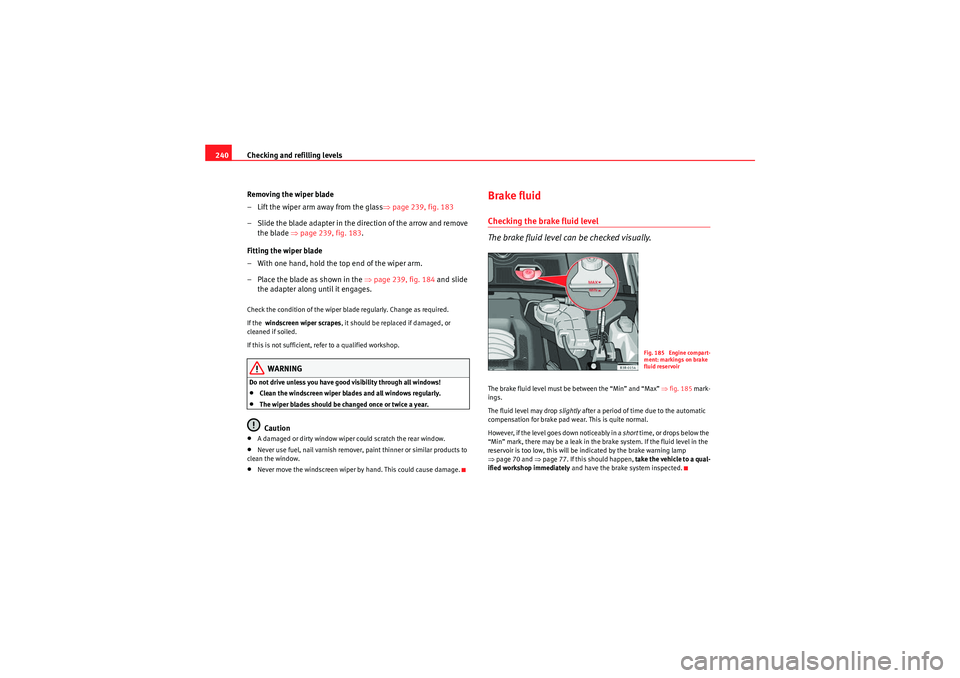
The brake fluid level can be checked visually.The brake fluid level must be between the “Min” and “Max” ⇒ fig. 185 mark-
ings.
The fluid level may drop slightly after a period of time due to the automatic
compensation for brake pad wear. This is quite normal.
However, if the level goes down noticeably in a short time, or drops below the
“Min” mark, there may be a leak in the brake system. If the fluid level in the
reservoir is too low, this will be indicated by the brake warning lamp
⇒ page 70 and ⇒ page 77. If this should happen, take the vehicle to a qual-
ified workshop immediately and have the brake system inspected.
Fig. 185 Engine compart-
ment: markings on brake
fluid reservoir
ExeoST_EN.book Seite 240 Freitag, 3. September 2010 11:41 11
Page 243 of 325

Checking and refilling levels241
Safety First
Operating Instructions
Practical Tips
Technical Specifications
Topping up and changing the brake fluid
It is best to have the brake fluid changed by a professional.Brake fluid absorbs moisture. Therefore, in the course of time it will absorb
water from the air. If the water content in the brake fluid is too high, the brake
system could corrode. In addition, the boiling point of the brake fluid will be
considerably reduced. This could adversely affect the braking ability in
certain circumstances.
For this reason the brake fluid must be changed periodically.
Your vehicle's Service Plan will tell you when the brake fluid has to be
renewed.
We recommend you have the brake fluid changed as part of a regular Inspec-
tion Service at a workshop. They are familiar with the procedure and have the
necessary special tools and spare parts as well as the proper facilities for
disposing of the old fluid.
Use only approved brake fluid. Specialised workshops are informed about
the factory-approved brake fluid -DOT 4-. The brake fluid must be new.
WARNING
•Brake fluid must always be kept closed in its original container. Keep
out of the reach of children. Failure to comply could result in poisoning.•If the brake fluid is left in the system for too long and the brakes are
subjected to heavy use, vapour bubbles may form in the brake system. This
would seriously affect the efficiency of the brakes and the safety of the
vehicle, leading to the risk of accident.Caution
Please note that brake fluid will attack the paintwork on contact.
For the sake of the environment
The brake pads and fluid must be collected and disposed of according the
applicable regulations. The SEAT service network has the necessary equip-
ment and qualified personnel for collecting and disposing of this waste
material.Vehicle batteryGeneral notes
All work on batteries requires specialist knowledge.The battery is virtually maintenance-free and is checked in the Inspection
Services.
We recommend replacing the battery after 5 years.
Disconnecting the battery
If the battery is disconnected, some of the vehicle's functions will become
inoperative (e.g. electric windows). These functions will require resetting
after the battery is reconnected. For this reason, the battery should only be
disconnected from the vehicle's electrical system when absolutely necessary.
Long periods of non-use
The battery will gradually lose its charge because certain electrical equip-
ment continues to draw current even when the ignition is off. If you park the
vehicle for long periods of time in winter you should take the battery out of
the vehicle and store it in a place protected from frost. This way it will not
freeze and become damaged. At warm outside temperatures it is sufficient to
disconnect the negative terminal of the battery. Even when the battery is not
connected you should charge it from time to time.
ExeoST_EN.book Seite 241 Freitag, 3. September 2010 11:41 11
Page 247 of 325
Wheels and tyres245
Safety First
Operating Instructions
Practical Tips
Technical Specifications
Wheels and tyresWheelsGeneral notesAvoiding damage
– If you have to drive over a kerb or similar obstacle, drive very
slowly and at a right angle.
– Keep grease, oil and fuel off the tyres.
– Inspect the tyres regularly for da mage (cuts, cracks or blisters,
etc.). Remove any foreign objects embedded in the treads.
Storing tyres
– Mark tyres when you remove them to indicate the direction of rotation. This ensures you will be able to install them correctly
when you replace them.
– When removed, the wheels and/or tyres should be stored in a cool, dry and preferably dark location.
– Store tyres in a vertical position if they are not fitted on wheel
rims.New tyres
New tyres have to be run in.
The tread depth of new tyres may vary, according to the type and make of tyre
and the tread pattern. Concealed damage
Damage to tyres and rims is often not readily visible. If you notice unusual
vibrations or the vehicle pulling to one side, this may indicate that one of the
tyres is damaged. The tyres should be checked immediately by an Authorised
Service Centre.
Tyres with directional tread pattern
An arrow on the tyre sidewall indicates the direction of rotation on tyres with
directional tread. Always observe the direction of rotation indicated when
fitting the wheel. This guarantees optimum grip and helps to avoid aqua-
planing, excessive noise and wear.
WARNING
•New tyres do not have maximum grip during the first 500 km. Drive
particularly carefully to avoid possible accidents.•Never drive with damaged tyres. This may cause an accident.•If you notice unusual vibrations or if the vehicle pulls to one side when
driving, stop the vehicle immediately and check the tyres for damage.
Checking tyre pressure
The correct tyre pressure can be seen on the sticker on the
inside of the tank flap.1. Read the required tyre inflatio n pressure from the sticker. The
values refer to Summer tyres. For Winter tyres, you must add 0.2
bar to the values given on the sticker.
ExeoST_EN.book Seite 245 Freitag, 3. September 2010 11:41 11
Page 303 of 325

Technical Specifications301
Safety First
Operating Instructions
Practical Tips
Technical Specifications
Technical SpecificationsChecking fluid levelsFrom time to time, the levels of the different fluids in the
vehicle must be checked. Never fill with incorrect fluids,
otherwise serious damage to the engine may be caused.Fig. 248 Diagram for the location of the various elements
Vehicle battery
Engine oil filler cap
Brake fluid reservoir
Engine oil dipstick
Coolant expansion tank
Windscreen washer fluid container
Hydraulic fluid reservoir for power steering
The checking and refilling of service fluids are carried out on the components
mentioned above. These operations are described in the ⇒page 229.
Overview
You will find further explanations, instructions and restrictions on the tech-
nical specifications as of ⇒page 297.Note
The layout of parts may vary depending on the engine.A1A2A3A4A5A6A7
ExeoST_EN.book Seite 301 Freitag, 3. September 2010 11:41 11
Page 318 of 325

Index
316Electronic Stability Programme
Description . . . . . . . . . . . . . . . . . . . . . . . . . 172
How the system works . . . . . . . . . . . . . . . . 191
Warning lamp . . . . . . . . . . . . . . . . . . . . . . . 173
Emergencies Changing a wheel . . . . . . . . . . . . . . . . . . . . 257
Disconnecting the battery . . . . . . . . . . . . . 241
Jack . . . . . . . . . . . . . . . . . . . . . . . . . . . . 254, 259
Sunroof emergency activation . . . . . . . . . . 114
Tools . . . . . . . . . . . . . . . . . . . . . . . . . . . . . . . 254
Tyre mobility system . . . . . . . . . . . . . . . . . . 255
Engine Running in . . . . . . . . . . . . . . . . . . . . . . . . . . 197
Starting . . . . . . . . . . . . . . . . . . . . . . . . . . . . 174
Stop . . . . . . . . . . . . . . . . . . . . . . . . . . . . . . . 175
Engine compartment Safety instructions . . . . . . . . . . . . . . . . . . . 229
Engine oil . . . . . . . . . . . . . . . . . . . . . . . . . . . . . . 230 Checking oil level . . . . . . . . . . . . . . . . . . . . 232
Consumption . . . . . . . . . . . . . . . . . . . . . . . . 232
Oil pressure too low . . . . . . . . . . . . . . . . . . . 78
Oil properties . . . . . . . . . . . . . . . . . . . . . . . . 231
Oil sensor defective . . . . . . . . . . . . . . . . . . . 80
Topping up . . . . . . . . . . . . . . . . . . . . . . . . . . 233
Engine speed governing . . . . . . . . . . . . . . . . . . . 80
Environment . . . . . . . . . . . . . . . . . . . . . . . . . . . 199 Environmental friendliness . . . . . . . . . . . . 201
Roof racks . . . . . . . . . . . . . . . . . . . . . . . . . . 152
Environmental tip Avoiding pollution . . . . . . . . . . . . . . . . . . . . 226
Environmentally friendly driving . . . . . . . . . . . 199 ESP
See Electronic Stability Programme . . . . . . 172
Exhaust gas purification system . . . . . . . . . . . 198
Exterior mirrors . . . . . . . . . . . . . . . . . . . . . . . . . 217
FFabric trim cleaning . . . . . . . . . . . . . . . . . . . . . 221
Fastening rings . . . . . . . . . . . . . . . . . . . . . . . . . . 17
Floor mats . . . . . . . . . . . . . . . . . . . . . . . . . . . . . . 16
Fog lights . . . . . . . . . . . . . . . . . . . . . . . . . . . . . . 118
Front airbags . . . . . . . . . . . . . . . . . . . . . . . . . . . . 32 Description . . . . . . . . . . . . . . . . . . . . . . . . . . 32
Operation . . . . . . . . . . . . . . . . . . . . . . . . . . . . 33
Safety notes . . . . . . . . . . . . . . . . . . . . . . . . . . 35
Front drink holder . . . . . . . . . . . . . . . . . . . . . . . 153
Front passenger airbag deactivation . . . . . . . . . 44
Fuel Diesel . . . . . . . . . . . . . . . . . . . . . . . . . . . . . . 227
Fuel gauge . . . . . . . . . . . . . . . . . . . . . . . . . . . 63
Fuel level low . . . . . . . . . . . . . . . . . . . . . . . . . 80
Instantaneous fuel consumption . . . . . . . . . 85
Petrol . . . . . . . . . . . . . . . . . . . . . . . . . . . . . . 226
Fuel tank opening the fuel tank flap . . . . . . . . . . . . . 225
Fuel: save . . . . . . . . . . . . . . . . . . . . . . . . . . . . . . 199
Fuse Assignment . . . . . . . . . . . . . . . . . . . . . . . . . 266
Changing . . . . . . . . . . . . . . . . . . . . . . . . . . . 265
GGear display . . . . . . . . . . . . . . . . . . . . . . . . . . . . 73
Gear shift pattern . . . . . . . . . . . . . . . . . . . . . . . 183
General overview of the engine compartment 301
Glove compartment . . . . . . . . . . . . . . . . . . . . . 159Light . . . . . . . . . . . . . . . . . . . . . . . . . . . . . . . 124
GRA . . . . . . . . . . . . . . . . . . . . . . . . . . . . . . . . . . 180HHandbrake . . . . . . . . . . . . . . . . . . . . . . . . . . . . . 176
Hazard warning lights . . . . . . . . . . . . . . . . . . . . 122
Head restraint Rear seat . . . . . . . . . . . . . . . . . . . . . . . . . . . 142
Head restraints Front seats . . . . . . . . . . . . . . . . . . . . . . . . . . 140
Rear seats . . . . . . . . . . . . . . . . . . . . . . . . . . 141
Removing and fitting . . . . . . . . . . . . . . . . . 141
Headlight range control . . . . . . . . . . . . . . . . . . 120 Dynamic . . . . . . . . . . . . . . . . . . . . . . . . . . . . 121
Faulty . . . . . . . . . . . . . . . . . . . . . . . . . . . . . . . 81
Headlights Adaptive headlights . . . . . . . . . . . . . . . . . . 122
Automatic headlight control . . . . . . . . . . . 117
Automatic headlight control photosensors 117
Coming home function . . . . . . . . . . . . . . . . 119
Driving abroad . . . . . . . . . . . . . . . . . . . . . . . 202
Front fog lights . . . . . . . . . . . . . . . . . . . . . . 118
Headlight range control . . . . . . . . . . . . . . . 120
ExeoST_EN.book Seite 316 Freitag, 3. September 2010 11:41 11