tailgate Seat Exeo ST 2010 Owner's Guide
[x] Cancel search | Manufacturer: SEAT, Model Year: 2010, Model line: Exeo ST, Model: Seat Exeo ST 2010Pages: 325, PDF Size: 9.34 MB
Page 154 of 325
Seats and storage compartments
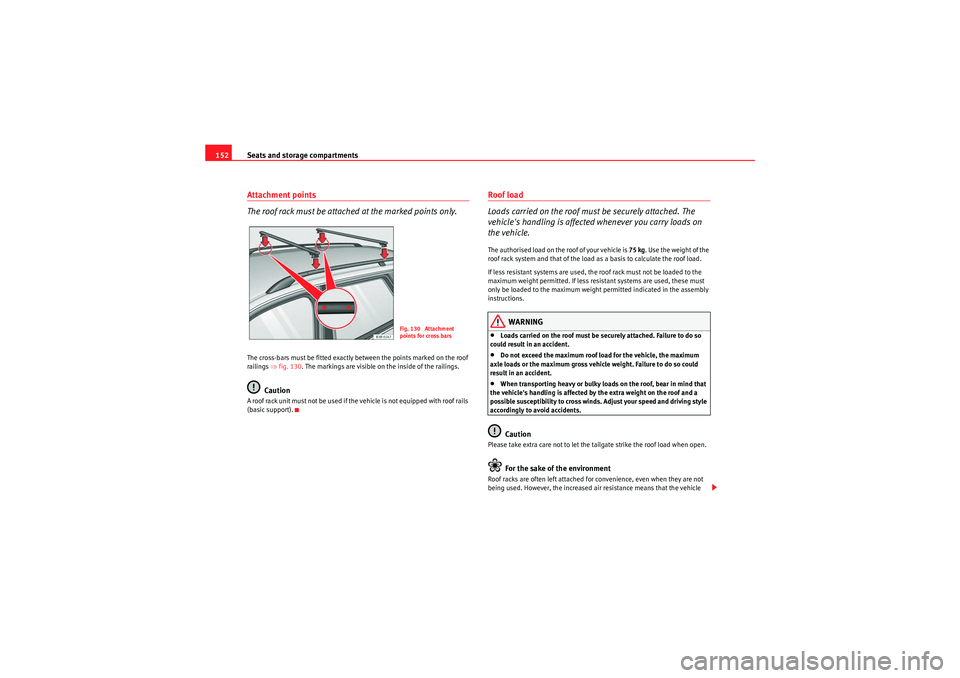
152Attachment points
The roof rack must be attached at the marked points only.The cross-bars must be fitted exactly between the points marked on the roof
railings ⇒fig. 130 . The markings are visible on the inside of the railings.
Caution
A roof rack unit must not be used if the vehicle is not equipped with roof rails
(basic support).
Roof load
Loads carried on the roof must be securely attached. The
vehicle's handling is affected whenever you carry loads on
the vehicle.The authorised load on the roof of your vehicle is 75 kg. Use the weight of the
roof rack system and that of the load as a basis to calculate the roof load.
If less resistant systems are used, the roof rack must not be loaded to the
maximum weight permitted. If less resistant systems are used, these must
only be loaded to the maximum weight permitted indicated in the assembly
instructions.
WARNING
•Loads carried on the roof must be securely attached. Failure to do so
could result in an accident.•Do not exceed the maximum roof load for the vehicle, the maximum
axle loads or the maximum gross vehicle weight. Failure to do so could
result in an accident.•When transporting heavy or bulky loads on the roof, bear in mind that
the vehicle's handling is affected by the extra weight on the roof and a
possible susceptibility to cross winds. Adjust your speed and driving style
accordingly to avoid accidents.Caution
Please take extra care not to let the tailgate strike the roof load when open.
For the sake of the environment
Roof racks are often left attached for convenience, even when they are not
being used. However, the increased air resistance means that the vehicle
Fig. 130 Attachment
points for cross bars
ExeoST_EN.book Seite 152 Freitag, 3. September 2010 11:41 11
Page 218 of 325
Vehicle maintenance and cleaning
216
Caution•Never remove dirt, mud or dust if the vehicle surface is dry. Never use a
dry cloth or sponge for cleaning purposes. This could scratch the paintwork
or glass on your vehicle.•Washing the vehicle in low temperatures: when washing the vehicle with
a hose, do not direct water into the lock cylinders or the gaps around the
doors, tailgate, or sunroof. Risk of freezing.For the sake of the environment
To protect environment, the vehicle should be washed only in specially
provided wash bays. This prevents toxic, oil-laden waste water entering the
sewerage system. In some places, washing vehicles outside wash bays is
prohibited.
Note
Do not wash the vehicle in direct sunlight.Washing the vehicle with a high pressure cleaner
Be particularly careful when using a high pressure cleaner!– Always observe the instructions for the high-pressure cleaner,
particularly those concerning the pressure and the spraying
distance.
– Increase the spraying distance for soft materials and painted bumpers.
– Do not use a high pressure cleaner to remove ice or snow from windows ⇒page 217. – Never use concentrated jet nozzles (“rotating jets”)
⇒.
– After washing, avoid sudden and sharp braking. Dry the brakes by braking several times ⇒page 197.
WARNING
•Never wash tyres with a concentrated jet (“rotating nozzle”). Even at
large spraying distances and short cleaning times, visible and invisible
damage can occur to the tyres. This may cause an accident.•Water, ice and salt on the brakes can reduce braking efficiency. Risk of
accident.Caution
•Do not use water hotter than 60 °C. This could damage the vehicle.•To avoid damage to the vehicle, keep a sufficient distance from sensitive
materials such as flexible hoses, plastic, soundproofing material, etc. This is
also important for bumpers painted in the colour of the bodywork. The closer
the nozzle is to the surface, the greater the wear on the material.Vehicle paint maintenance
Regular waxing protects the paintwork.You need to apply wax to your vehicle if water does not form small drops and
run off the paintwork when it is clean .
Good quality hard wax products are available at your Authorised Service
Centre.
ExeoST_EN.book Seite 216 Freitag, 3. September 2010 11:41 11
Page 220 of 325
Vehicle maintenance and cleaning
218screen washer fluid prevents wiper blades from juddering, but wax deposits
are not removed.
Caution
•Never use warm or hot water to remove snow and ice from windows and
mirrors. This could cause the glass to crack!•The heating element for the rear window is located on the inner side of the
window. To prevent damage, do not put stickers on the heating elements
inside the window.Cleaning windscreen wiper bladesClean wiper blades are essential to provide clear vision.
1. Use a soft cloth to remove dust and dirt from the windscreen wiper blades.
2. Use window cleaner to clean the windscreen wiper blades. Use a sponge or a cloth to remove stubborn dirt.Rubber seals maintenance
If rubber seals are well looked after, they will not freeze so
quickly.1. Use a soft cloth to remove dust and dirt from the rubber seals.
2. Apply a specialist care product to the rubber seals.
The rubber strips on the doors, windows, bonnet and tailgate will remain
pliable and last longer if they are treated with a suitable care product (for
example silicone spray).
Caring for rubber seals will also prevent premature ageing and leaks. The
doors will be easier to open. If rubber seals are well looked after, they will not
freeze so quickly in winter.Door lock cylinders
The door lock cylinders can freeze up in winter.To de-ice the lock cylinders you should only use spray with lubricating and
anti-corrosive properties.Cleaning chrome parts1. Clean chrome parts with a damp cloth.
2. Polish chrome parts with a soft, dry cloth.If this does not provide satisfying results, use a specialist chrome cleaning
product . Chrome cleaning products will remove stains from the surface.
Caution
To prevent scratching chrome surfaces:•Never use an abrasive cleaning product on chrome.•Do not clean or polish chrome parts in a sandy or dusty environment.
ExeoST_EN.book Seite 218 Freitag, 3. September 2010 11:41 11
Page 227 of 325
Checking and refilling levels225
Safety First
Operating Instructions
Practical Tips
Technical Specifications
Checking and refilling levelsRefuellingThe tank flap is released manually. The tank holds approxi-
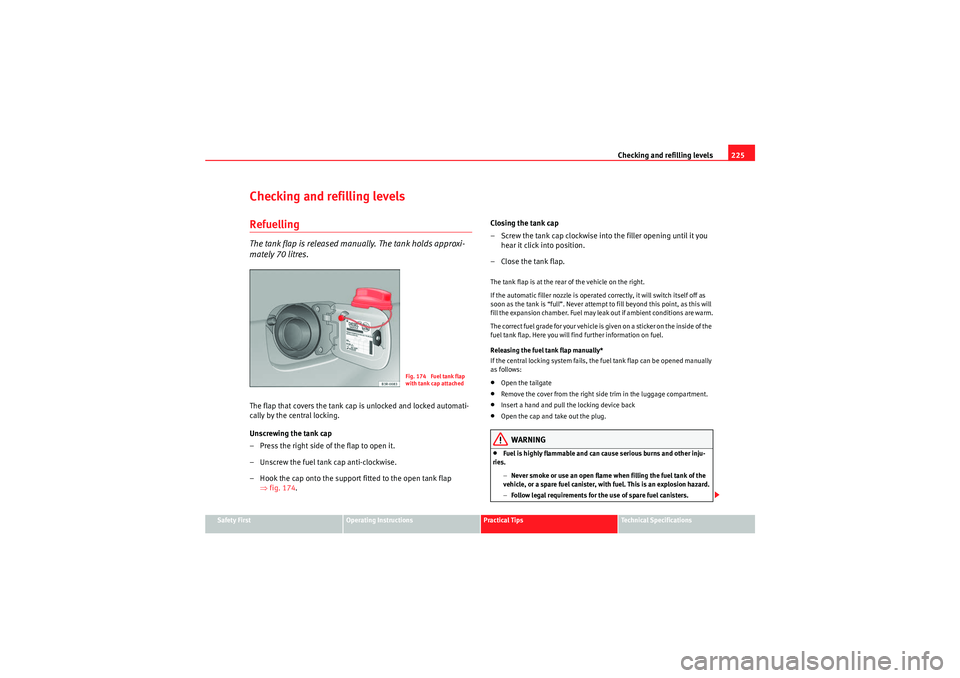
mately 70 litres.The flap that covers the tank cap is unlocked and locked automati-
cally by the central locking.
Unscrewing the tank cap
– Press the right side of the flap to open it.
– Unscrew the fuel tank cap anti-clockwise.
– Hook the cap onto the support fitted to the open tank flap
⇒fig. 174 . Closing the tank cap
– Screw the tank cap clockwise into the filler opening until it you
hear it click into position.
– Close the tank flap.
The tank flap is at the rear of the vehicle on the right.
If the automatic filler nozzle is operated correctly, it will switch itself off as
soon as the tank is “full”. Never attempt to fill beyond this point, as this will
fill the expansion chamber. Fuel may leak out if ambient conditions are warm.
The correct fuel grade for your vehicle is given on a sticker on the inside of the
fuel tank flap. Here you will find further information on fuel.
Releasing the fuel tank flap manually*
If the central locking system fails, the fuel tank flap can be opened manually
as follows:•Open the tailgate•Remove the cover from the right side trim in the luggage compartment.•Insert a hand and pull the locking device back•Open the cap and take out the plug.WARNING
•Fuel is highly flammable and can cause serious burns and other inju-
ries.
−Never smoke or use an open flame when filling the fuel tank of the
vehicle, or a spare fuel canister, with fuel. This is an explosion hazard.
− Follow legal requirements for the use of spare fuel canisters.
Fig. 174 Fuel tank flap
with tank cap attached
ExeoST_EN.book Seite 225 Freitag, 3. September 2010 11:41 11
Page 258 of 325

If and when
256Spare steel rim wheel
The spare steel rim wheel is carried in the wheel well under
the floor panel in the luggage compartment. It is only
intended for temporary use over short distances.Taking out the spare wheel
–Turn the plastic knob ⇒fig. 192 anti-clockwise.
– Take out the spare wheel.
Securing the defective wheel in the spare wheel well
– Place wheel in spare wheel well in the luggage compartment.
– Secure the wheel by turning plastic knob clockwise.
– Replace the floor panel before closing the tailgate.
Your vehicle can be factory-equipped with a spare steel wheel. The spare
wheel does not usually meet the same performance standards as the wheels
fitted on the vehicle because of the wheel/tyre dimensions, rubber composi-
tion, tread pattern, etc. Therefore, note the following restrictions:•The spare steel wheel is designed only for your vehicle model. Do not
attempt to mount the wheel on any vehicle but your own.•Your vehicle will have different driving characteristics when the spare
steel rim wheel is mounted ⇒ .•The spare wheel is only intended for temporary use after having a flat tyre.
Replace the spare wheel with a normal wheel that has the proper tyre dimen-
sions as soon as possible.•If the size of the spare steel rim wheel is different to that of the other
wheels, it is unlikely that snow chains suitable for the other wheels will fit it.WARNING
•After mounting the spare steel rim wheel, the tyre pressure must be
checked and corrected as soon as possible. The tyre pressure must corre-
spond to the vehicle load (consult the table containing the inflation pres-
sures). Otherwise there is danger of causing an accident. Use the highest
tyre pressure as indicated in the table.•Do not drive faster than 80 km/h, as higher speeds can cause an acci-
dent.•Avoid heavy acceleration, hard braking and fast cornering, as this could
cause an accident.
Fig. 192 Spare steel rim
wheel
ExeoST_EN.book Seite 256 Freitag, 3. September 2010 11:41 11
Page 283 of 325

If and when281
Safety First
Operating Instructions
Practical Tips
Technical Specifications
Removing the tail light
To change the bulbs you must remove the tail light assembly.
Removing the light requires a certain degree of practical skill.
A special retaining screw is used to secure and guide the tail light.
– Check which of the bulbs is defective.
–Open the tailgate.
– Take the screwdriver out of the vehicle's tool kit ⇒page 254.
– Use the flat-blade side of th e reversible screwdriver insert.
– Prise off the cover with a screwdriver in the slot ⇒fig. 224
and remove the cover (with the retaining clips) from the opening.
– Carefully loosen the screw located behind the cover with the screwdriver, turning it anti-clockwise (arrows) .
– Gradually ease the tail light out of the housing ( ⇒fig. 225 posi-
tions and ) by pulling alternately in positions and .
– Remove the bulb holder ⇒page 282.
CautionWhen removing or installing the tail light, take care not to cause any damage.•Removing the tail light in particular can lead to the paintwork or tail light
becoming damaged. This is another reason why we recommend having the
bulbs changed by a qualified workshop.Note
Make sure you have a soft cloth ready to place under the glass on the tail
light, to avoid any scratches.
Fig. 224 Luggage
compartment: Location of
the bolt securing the tail
light unitFig. 225 Removing tail
light from side panel
A1
A2
A3
A4
A1
A2
ExeoST_EN.book Seite 281 Freitag, 3. September 2010 11:41 11
Page 287 of 325

If and when285
Safety First
Operating Instructions
Practical Tips
Technical Specifications
Caution
Take care when fitting the tail light unit to make sure there is no damage to
the paintwork or any of its components.Changing tail light bulbs (on tailgate)Overview of tail lightsTail lights on the tailgate•Rear side lights•Rear fog light•Reverse lights
Overview of tail lights. LED lampsTail lights on the tailgate•Rear side lights•Rear fog light•Reverse lightsNote
•It is only possible to replace the rear fog lamp and the reversing light.•If the warning lamp for the side light (LED lamp) lights up, the tail light
assembly should be replaced. •The failure of the lamp is only shown when the LED function goes out
completely. Sometimes, a LED will stop working, without displaying the
warning as the function continues to operate.
Fig. 232 Overview of tail
lights
Fig. 233 Overview of tail
lights
ExeoST_EN.book Seite 285 Freitag, 3. September 2010 11:41 11
Page 288 of 325
If and when
286Remove the bulb holder
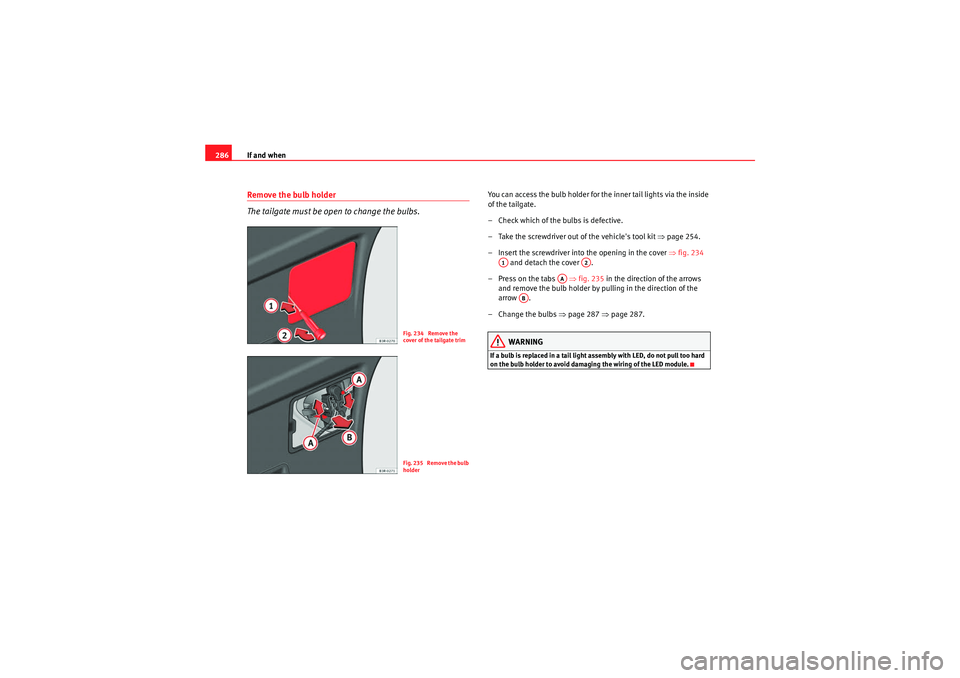
The tailgate must be open to change the bulbs.
You can access the bulb holder for the inner tail lights via the inside
of the tailgate.
– Check which of the bulbs is defective.
– Take the screwdriver out of the vehicle's tool kit ⇒page 254.
– Insert the screwdriver into the opening in the cover ⇒fig. 234
and detach the cover .
– Press on the tabs ⇒ fig. 235 in the direction of the arrows
and remove the bulb holder by pulling in the direction of the
arrow .
– Change the bulbs ⇒page 287 ⇒page 287.
WARNING
If a bulb is replaced in a tail light assembly with LED, do not pull too hard
on the bulb holder to avoid damaging the wiring of the LED module.
Fig. 234 Remove the
cover of the tailgate trimFig. 235 Remove the bulb
holder
A1
A2
AA
AB
ExeoST_EN.book Seite 286 Freitag, 3. September 2010 11:41 11
Page 289 of 325

If and when287
Safety First
Operating Instructions
Practical Tips
Technical Specifications
Changing bulbs
All bulbs can be changed easily in the bulb holder.The bulbs are secured with a bayonet fastener. The table below
gives an overview of the bulb positions.
– Lightly press the defective bulb into the bulb holder, then turn it
to the left and remove it.
– Fit the new bulb, pressing it into the bulb holder and turn it to the
right as far as it will go.
– Use a cloth to remove any fingerp rints from the glass part of the
bulb.
– Check whether the new bulb is working.
– Re-install the bulb holder ⇒page 288.
Position of the bulbsChanging bulbs. LED lamps
All bulbs can be changed easily in the bulb holder.The bulbs are secured with a bayonet fastener. The table below
gives an overview of the bulb positions.
– Lightly press the defective bulb into the bulb holder, then turn it
to the left and remove it.
Fig. 236 Position of the
bulbs in the bulb holder.
Example: Tail lights on the
tailgate
Pos. ⇒ fig. 236
Bulb function
A
Reverse lights
B
Rear side lights
C
Rear fog light
Fig. 237 Position of the
bulbs in the bulb holder.
Example: Tail lights on the
tailgate
ExeoST_EN.book Seite 287 Freitag, 3. September 2010 11:41 11
Page 316 of 325

Index
314Bonnet . . . . . . . . . . . . . . . . . . . . . . . . . . . . . . . . 228
Closing . . . . . . . . . . . . . . . . . . . . . . . . . . . . . 230
Opening . . . . . . . . . . . . . . . . . . . . . . . . . . . . 229
Releasing . . . . . . . . . . . . . . . . . . . . . . . . . . . 228
Brake light Failure control . . . . . . . . . . . . . . . . . . . . . . . . 80
Brake pads . . . . . . . . . . . . . . . . . . . . . . . . . . . . . 197
Brake servo . . . . . . . . . . . . . . . . . . . . . . . . . . . . 197
Brake system Brake servo . . . . . . . . . . . . . . . . . . . . . . . . . 194
Brakes . . . . . . . . . . . . . . . . . . . . . . . . . . . . . 194
Malfunction . . . . . . . . . . . . . . . . . . . . . . . . . . 77
Brakes . . . . . . . . . . . . . . . . . . . . . . . . . . . . . . . . 197 Brake assist system . . . . . . . . . . . . . . . . . . 193
Brake fluid . . . . . . . . . . . . . . . . . . . . . . . . . . 240
Worn brake pads . . . . . . . . . . . . . . . . . . . . . . 81
Braking distance . . . . . . . . . . . . . . . . . . . . . . . . 197
Bulb change General notes . . . . . . . . . . . . . . . . . . . . . . . 267CCatalytic converter . . . . . . . . . . . . . . . . . . . . . . 198
CD-ROM player . . . . . . . . . . . . . . . . . . . . . . . . . 149
Central locking . . . . . . . . . . . . . . . . . . . . . . . . . . 98
Manual locking . . . . . . . . . . . . . . . . . . . . . . 102
Sunroof: opening and closing . . . . . . . . . . 113
Central locking system Anti-theft security system . . . . . . . . . . . . . . 100
Locking . . . . . . . . . . . . . . . . . . . . . . . . . . . . . 99 Locking and unlocking the vehicle from inside
100
Opening and closing the windows . . . . . . 111
Security central locking . . . . . . . . . . . . . . . 101
Switch on the driver door . . . . . . . . . . . . . . 100
Tailgate . . . . . . . . . . . . . . . . . . . . . . . . . . . . 103
Unlocking . . . . . . . . . . . . . . . . . . . . . . . . . . . 99
Cetane number . . . . . . . . . . . . . . . . . . . . . . . . . 227
Changing the main headlight bulb Main headlight . . . . . . . . . . . . . . . . . . . . . . 271
Changing the main headlight bulbs Dipped beam headlight . . . . . . . . . . . . . . . 272
Changing the tail lights Luggage compartment lights . . . . . . . . . . . 289
Changing windscreen wiper blades . . . . . . . . . 238
Chassis number . . . . . . . . . . . . . . . . . . . . . . . . 298
Child safety . . . . . . . . . . . . . . . . . . . . . . . . . . . . . 46
Child safety seat ISOFIX system . . . . . . . . . . . . . . . . . . . . . . . . 52
Child seat . . . . . . . . . . . . . . . . . . . . . . . . . . . . . . . 48 Categorisation in groups . . . . . . . . . . . . . . . 48
Group 1 . . . . . . . . . . . . . . . . . . . . . . . . . . . . . 49
Group 2 . . . . . . . . . . . . . . . . . . . . . . . . . . . . . 49
Group 3 . . . . . . . . . . . . . . . . . . . . . . . . . . . . . 49
Groups 0 and 0+ . . . . . . . . . . . . . . . . . . . . . . 48
Securing . . . . . . . . . . . . . . . . . . . . . . . . . . . . . 51
Child seats on the front passenger seat . . . . . . . . . . . . . 29
Safety notes . . . . . . . . . . . . . . . . . . . . . . . . . . 46
Childproof lock Rear doors . . . . . . . . . . . . . . . . . . . . . . . . . . 104 Cigarette lighter . . . . . . . . . . . . . . . . . . . . . . . . 155
Cleaning alloy wheel rims . . . . . . . . . . . . . . . . 219
Cleaning chrome . . . . . . . . . . . . . . . . . . . . . . . . 218
Cleaning engine compartment . . . . . . . . . . . . . 220
Cleaning steel wheel rims . . . . . . . . . . . . . . . . 219
Cleaning windows . . . . . . . . . . . . . . . . . . . . . . . 217
Clock, setting . . . . . . . . . . . . . . . . . . . . . . . . . . . 61
Cloth seat covers cleaning . . . . . . . . . . . . . . . . 221
Coat hooks . . . . . . . . . . . . . . . . . . . . . . . . . . . . 160
Cockpit . . . . . . . . . . . . . . . . . . . . . . . . . . . . . . . . . 57
Overview . . . . . . . . . . . . . . . . . . . . . . . . . . . . 57
Compartments . . . . . . . . . . . . . . . . . . . . . . . . . . 159 In the door trim . . . . . . . . . . . . . . . . . . . . . . 160
In the front seats . . . . . . . . . . . . . . . . . . . . . 161
Coolant Checking the level . . . . . . . . . . . . . . . . . . . 234
Coolant fluid Antifreeze . . . . . . . . . . . . . . . . . . . . . . . . . . 233
Coolant fluid additive . . . . . . . . . . . . . . . . . 233
Topping up . . . . . . . . . . . . . . . . . . . . . . . . . 235
Cooling system Coolant temperature gauge . . . . . . . . . . . . . 60
Malfunction . . . . . . . . . . . . . . . . . . . . . . . . . . 78
Correct adjustment of front seat head restraints . . 13
Correct adjustment of rear seat head restraints In-use and non-use positions . . . . . . . . . . . 14
Correct sitting position Front passenger . . . . . . . . . . . . . . . . . . . . . . 12
Incorrect sitting position . . . . . . . . . . . . . . . 14
Cruise control . . . . . . . . . . . . . . . . . . . . . . . . . . 180
ExeoST_EN.book Seite 314 Freitag, 3. September 2010 11:41 11