oil Seat Exeo ST 2010 Owner's Guide
[x] Cancel search | Manufacturer: SEAT, Model Year: 2010, Model line: Exeo ST, Model: Seat Exeo ST 2010Pages: 325, PDF Size: 9.34 MB
Page 254 of 325

Wheels and tyres
252
For the sake of the environmentOld tyres must be disposed of according to the laws in the country concerned.
Note
•For technical reasons, it is not generally possible to use the wheels from
other vehicles. This can also apply to wheels of the same model. The use of
wheels or tyres which have not been approved by SEAT for use with your
model may invalidate the vehicle's type approval for use on public roads.•If the spare tyre is not the same as the tyres that are mounted on the
vehicle - for example with winter tyres - you should only use the spare tyre for
a short period of time and drive with extra care. Refit the normal road wheel
as soon as possible.Wheel bolts
Wheel bolts must be tightened to the correct torque.The design of wheel bolts is matched to the rims. If different wheel rims are
fitted, the correct wheel bolts with the right length and correctly shaped bolt
heads must be used. This ensures that wheels are fitted securely and that the
brake system functions correctly.
In certain circumstances, you should not use wheel bolts from a different
vehicle, even if it is the same model ⇒page 223.
After the wheels have been changed, the tightening torque of the wheel bolts
s ho uld b e che cke d as s o on as p ossible wit h a to rqu e w re nch. ⇒ The tight-
ening torque for steel and alloy wheels is 120 Nm.
WARNING
If the wheel bolts are not tightened correctly, the wheel could become
loose while driving. Risk of accident.•The wheel bolts must be clean and turn easily. Never apply grease or oil
to them.•Use only wheel bolts which belong to the wheel.•If the torque of the wheel bolts is too low, they could loosen whilst the
vehicle is in motion. Risk of accident! If the tightening torque is too high,
the wheel bolts and threads can be damaged.Caution
The prescribed tightening torque for wheel bolts for steel and alloy wheels is
120 Nm.Winter tyres
Winter tyres will improve the vehicles handling on snow and
ice.In winter conditions winter tyres will considerably improve the vehicle's
handling. The design of summer tyres (width, rubber compound, tread
pattern) gives less grip on ice and snow.
Winter tyres must be inflated to a pressure 0.2 bar higher than the pressures
specified for summer tyres (see sticker on tank flap).
Winter tyres must be fitted on all four wheels.
Information on permitted winter tyre sizes can be found in the vehicle's regis-
tration documents. Use only radial winter tyres. All tyre sizes listed in the
vehicle documentation also apply to winter tyres.
ExeoST_EN.book Seite 252 Freitag, 3. September 2010 11:41 11
Page 265 of 325
If and when263
Safety First
Operating Instructions
Practical Tips
Technical Specifications
•If you do come into contact with the sealant immediately rinse the eyes
or skin affected with clean water.•Change clothing immediately if it becomes soiled with the tyre sealant.•Make sure you do not breathe in the fumes!•If any of the tyre sealant is accidentally ingested, immediately rinse the
mouth thoroughly and drink lots of water.
−Do not induce vomiting. Seek medical assistance if needed.•If any allergic reactions should occur get medical help immediately.•Keep the sealant away from children.For the sake of the environment
If you have to dispose of a sealant can, go to a specialised waste ser vice or to
a SEAT Technical Service, where the product can be recycled in an appropriate
waste container.
Note
•If sealant should leak out, leave it to dry. When it has dried, you can pull
it off like a piece of foil.•Observe the expiry date stated on the sealing compound can. Have the
sealing compound exchanged by a qualified workshop.
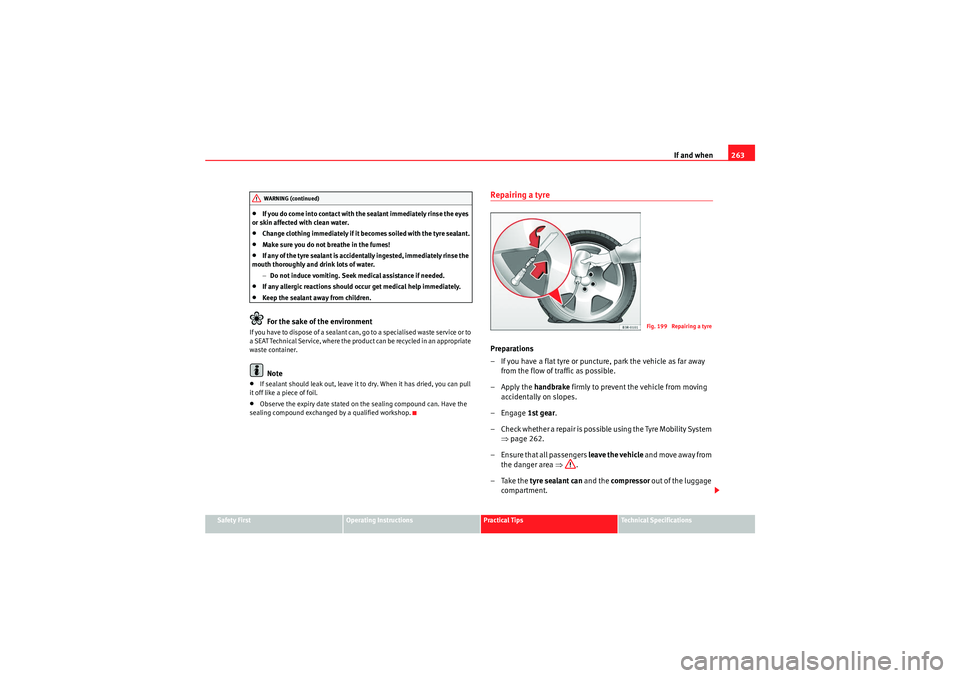
Repairing a tyrePreparations
– If you have a flat tyre or puncture, park the vehicle as far away from the flow of traffic as possible.
–Apply the handbrake firmly to prevent the vehicle from moving
accidentally on slopes.
– Engage 1st gear .
– Check whether a repair is possibl e using the Tyre Mobility System
⇒ page 262.
– Ensure that all passengers leave the vehicle and move away from
the danger area ⇒ .
–Take the tyre sealant can and the compressor out of the luggage
compartment.
WARNING (continued)
Fig. 199 Repairing a tyre
ExeoST_EN.book Seite 263 Freitag, 3. September 2010 11:41 11
Page 266 of 325
If and when
264
– Stick the “max. 80 km/h” adhesive, which is included with the tyre sealant can, onto the instrument panel where the driver will
see it.
Filling the tyre
– Shake the tyre sealant can well.
– Screw the enclosed filling hose onto the sealant can as far as it will go. This will automatically pierce the foil sealing the can.
– Take the valve cap off the tyre valve and use the enclosed valve insert tool to unscrew the valve insert ⇒page 263, fig. 199 .
– Place the valve insert onto a clean surface.
– Remove the sealing plug from the filling hose and insert the hose into the tyre valve.
– Hold the tyre sealant can upside down and fill the complete contents of the can into the tyre.
– Then disconnect the hose and screw the valve insert firmly back into the tyre valve.
Inflating the tyre
– Screw the compressor filling hose onto the tyre valve and plug the connector into the cigarette lighter.
– Pump the tyre up to 2.0 to 2.5 bar and monitor the pressure shown on the pressure gauge. – If the tyre pressure remains lowe
r than the value specified above
drive the vehicle approx. 10 metres forwards or backwards, so
that the sealant can spread evenly in the tyre. If the pressure is
still lower than the specification the tyre is too badly damaged
and cannot be repaired using the tyre sealant.
Final check
– After about 10 minutes, stop to check the tyre pressure.
– If tyre pressure is less than 1.3 bar, the tyre is too badly damaged. Do not drive on! You should obtain professional
assistance.
WARNING
•If you have a puncture in heavy traffic, switch on the hazard warning
lights and place the warning triangle in a visible location. This is for your
own safety and also warns other road users.•Make su re your pass engers wait in a safe place ( for instance beh ind the
roadside crash barrier).•Please observe the manufacturer's safety notes on the compressor and
the instructions supplied with the tyre sealant can.•If it is not possible to build up a tyre pressure of 2.0 bar within 6
minutes this means that the tyre is too badly damaged. Do not drive on!•Seek professional assistance if the repair of a tyre puncture is not
possible with the sealing compound.•If tyre pressure is less than 1.3 bar after driving about 10 minutes, the
tyre is too badly damaged. Do not drive on! Obtain technical assistance.Caution
Take special care if you have to repair a tyre on a slope.
ExeoST_EN.book Seite 264 Freitag, 3. September 2010 11:41 11
Page 267 of 325

If and when265
Safety First
Operating Instructions
Practical Tips
Technical Specifications
Note
•Do not use the compressor for longer than 6 minutes. Otherwise, it might
overheat. When the compressor has cooled down, you can use it again.•If tyre sealant should leak out, leave it to dry and then pull it off like foil.•After carrying out a tyre repair remember to buy a new tyre sealant can at
a qualified workshop. This will ensure that the Tyre Mobility System is opera-
tive again.•Please observe legal requirements when doing so.FusesChanging fuses
If a fuse has blown, it must be replaced.
– Switch off the ignition and its failed electrical component.
– Remove the fuse cover using a screwdriver ⇒fig. 200 .
– Identify the fuse corresponding to the damaged electric consumer ⇒page 266, “Fuse assignment”.
– Take the plastic clip from inside the fuse cover, fit it onto the blown fuse, and pull the fuse out.
– Replace the blown fuse (which will have a melted metal strip) with a new fuse of the same amp rating.
–Fit the fuse cover back on.The individual electrical circuits are protected by fuses. The fuses are located
behind a cover at the left-hand end of the dash panel.
Two spare fuses and a sticker identifying the fuses are provided on the inside
of the fuse cover. There is also a crank handle for operating the sunroof* by
hand (if the electrical system fails).
Fig. 200 Left side of dash
panel: Fuse box cover
Fig. 201 Schematic
drawing of fuse box at the
left-hand end of dash
panel: Fuses (without fuse
cover)
ExeoST_EN.book Seite 265 Freitag, 3. September 2010 11:41 11
Page 303 of 325

Technical Specifications301
Safety First
Operating Instructions
Practical Tips
Technical Specifications
Technical SpecificationsChecking fluid levelsFrom time to time, the levels of the different fluids in the
vehicle must be checked. Never fill with incorrect fluids,
otherwise serious damage to the engine may be caused.Fig. 248 Diagram for the location of the various elements
Vehicle battery
Engine oil filler cap
Brake fluid reservoir
Engine oil dipstick
Coolant expansion tank
Windscreen washer fluid container
Hydraulic fluid reservoir for power steering
The checking and refilling of service fluids are carried out on the components
mentioned above. These operations are described in the ⇒page 229.
Overview
You will find further explanations, instructions and restrictions on the tech-
nical specifications as of ⇒page 297.Note
The layout of parts may vary depending on the engine.A1A2A3A4A5A6A7
ExeoST_EN.book Seite 301 Freitag, 3. September 2010 11:41 11
Page 305 of 325

Technical Specifications303
Safety First
Operating Instructions
Practical Tips
Technical Specifications
Engine oil capacity
Petrol engine 1.8 118 kW (160 PS)Engine specifications
Performance
Weights
Approximate engine oil capacity with oil filter change
4.6 litres
Power output in kW (PS) rpm 118 (160) / 4500-6200
Maximum torque in Nm at rpm 250 / 1500-4500
No. of cylinders/ capacity in cm
3
4 / 1798
Fuel Super 95 RON
a)/Super 91 RON
b)
a)Research- Octane- Number = Anti-detonation rating of the petrol.b)Slight power loss.Maximum speed in km/h 218
Acceleration from 0-80 km/h in sec. 6.1
Acceleration from 0-100 km/h in sec. 8.9
Gross vehicle weight in kg 2040
Weight in running order (with driver) in kg 1555
Gross front axle weight in kg 1075
Gross rear axle weight in kg 1090
Permitted roof load in kg 75
ExeoST_EN.book Seite 303 Freitag, 3. September 2010 11:41 11
Page 306 of 325
Technical Specifications
304Trailer weight
Engine oil capacityPetrol engine 2.0 147 kW (200 PS)Engine specifications
Performance Trailer without brakes
750
Trailer with brakes, gradients up to 8% 1600
Trailer with brakes, gradients up to 12% 1400
Approximate engine oil capacity with oil filter change 4.6 litres
Power output in kW (PS) rpm 147 (200) / 5100-6000
Maximum torque in Nm at rpm 280 / 1800-5000
No. of cylinders/ capacity in cm
3
4 / 1984
Fuel Super 98 RON
a)/Super 95 RON
b)
a)Research- Octane- Number = Anti-detonation rating of the petrol.b)Slight power loss.
Manual Automatic
Maximum speed in km/h 235230
Acceleration from 0-80 km/h in sec. 5.65.4
Acceleration from 0-100 km/h in sec. 7.67.6
ExeoST_EN.book Seite 304 Freitag, 3. September 2010 11:41 11
Page 307 of 325

Technical Specifications305
Safety First
Operating Instructions
Practical Tips
Technical Specifications
Weights
Trailer weight
Engine oil capacity
Petrol engine 2.0 155 kW (210 PS)Engine specifications
Manual
Automatic
Gross vehicle weight in kg 20502075
Weight in running order (with driver) in kg 15651590
Gross front axle weight in kg 10901115
Gross rear axle weight in kg 10901090
Permitted roof load in kg 7575
Manual Automatic
Trailer without brakes 750750
Trailer with brakes, gradients up to 8% 16001700
Trailer with brakes, gradients up to 12% 14001500
Approximate engine oil capacity with oil filter change 4.5 litres
Power output in kW (PS) rpm 155 (210) / 4600-6000
Maximum torque in Nm at rpm 320 / 1500-4600
No. of cylinders/ capacity in cm
3
4 / 1984
Fuel Super 95 RON
a)/Super 91 RON
b)
a)Research- Octane- Number = Anti-detonation rating of the petrol.b)Slight power loss.
ExeoST_EN.book Seite 305 Freitag, 3. September 2010 11:41 11
Page 308 of 325

Technical Specifications
306Performance
Weights
Trailer weight
Engine oil capacity Maximum speed
in km/h 239
Acceleration from 0-80 km/h in sec. 5.4
Acceleration from 0-100 km/h in sec. 7.3
Gross vehicle weight in kg 2050
Weight in running order (with driver) in kg 1565
Gross front axle weight in kg 1090
Gross rear axle weight in kg 1135
Permitted roof load in kg 75
Trailer without brakes 750
Trailer with brakes, gradients up to 8% 1700
Trailer with brakes, gradients up to 12% 1500
Approximate engine oil capacity with oil filter change 4.6 litres
ExeoST_EN.book Seite 306 Freitag, 3. September 2010 11:41 11
Page 310 of 325

Technical Specifications
308Engine oil capacityDiesel engine 2.0 TDI CR 105 kW (143 PS)Engine specifications
Performance
Weights Approximate engine oil capacity with oil filter change
4.3 litres
Power output in kW (PS) rpm 105 (143) / 4200
Maximum torque in Nm at rpm 320 / 1750-2500
No. of cylinders/ capacity in cm
3
4 / 1968
Fuel Min. 51 CN
a)
a)Cetane- Number (cetane index) = Measure of the combustion power of the dieselMaximum speed in km/h 209
Acceleration from 0-80 km/h in sec. 6.5
Acceleration from 0-100 km/h in sec. 9.6
Gross vehicle weight in kg 2050
Weight in running order (with driver) in kg 1565
Gross front axle weight in kg 1100
Gross rear axle weight in kg 1105
Permitted roof load in kg 75
ExeoST_EN.book Seite 308 Freitag, 3. September 2010 11:41 11