ignition Seat Exeo ST 2010 Workshop Manual
[x] Cancel search | Manufacturer: SEAT, Model Year: 2010, Model line: Exeo ST, Model: Seat Exeo ST 2010Pages: 325, PDF Size: 9.34 MB
Page 131 of 325

Lights and visibility129
Safety First
Operating Instructions
Practical Tips
Technical Specifications
– In vehicles equipped with a rain sensor*, you can move the
switch up and down to set the sensitivity of the rain sensor.
Slow wipe
– Move the lever up to position .
Continuous wipe
– Move the lever up to position .
Automatic wash and wipe
– Pull the lever towards the steering wheel, , to activate the windscreen washer.
– Release the lever. The washer will stop and the wipers will keep running for approximately 4 seconds.
Deactivating the windscreen wiper
– Pull the lever to basic position .General notes
The washers and wipers will work only when the ignition is switched on.
If you stop briefly, e.g. at traffic lights, the wiper speed will automatically be
reduced. The rain sensor* will automatically be set to the intermittent wipe
function.
The windscreen washer jets are heated when the ignition is switched on.
The wiper intervals in the intermittent wipe setting are also varied automati-
cally according to the road speed (in addition to the manual delay setting).
When the lights are switched on you should only pull the lever briefly to wash
the windscreen, otherwise the headlight washers* will also be enabled. This
will use an unnecessary amount of fluid from the reservoir. Rain sensor
The rain sensor* will only function in the intermittent wipe position. The inter-
mittent wipe function is enabled automatically when it starts to rain.
If the windscreen wiper lever was in the intermittent wipe position when the
ignition was off, the rain sensor will not activate until you reach a speed of 6
km/h.
Use switch to set the sensitivity of the rain sensor*.
If you have selected a high sensitivity level for the rain sensor the windscreen
wipers will react sooner to any moisture on the windscreen.
The wiper intervals in the intermittent wipe setting are also varied automati-
cally according to the road speed (in addition to the sensitivity setting).
WARNING
•For correct visibility and safe driving, the wiper must be in perfect
condition ⇒page 218. Failure to do so could result in an accident.•The rain sensor* is only intended to assist the driver. The driver is still
obliged to manually operate the windscreen wipers as required depending
on visibility.•Do not use water-repellent coatings on the windscreen. In bad visibility
conditions such as light rain, low sun or when driving at night, these coat-
ings can cause increased dazzle, which is a serious safety hazard. Such
coatings can also cause the wiper blades to make noise.Caution
•In the event of frost, check that the wiper blade has not frozen before acti-
vating the windscreen wipers. Should the windscreen wiper system be
enabled when the blade is frozen, this could damage it or even the wind-
screen wiper system motor.
AA
A3A4
A5
A0
AA
ExeoST_EN.book Seite 129 Freitag, 3. September 2010 11:41 11
Page 134 of 325

Lights and visibility
132
Switching off the anti-dazzle function
–Press button ⇒page 131, fig. 104 . Indicator lamp goes
off.
Switching on the anti-dazzle function
–Press button ⇒page 131, fig. 104 . Indicator lamp turns
on.Anti-dazzle function
The anti-dazzle function is activated every time the ignition is switched on.
The green indicator lamp lights up in the mirror housing.
When the anti-dazzle function is enabled, the interior mirror will darken auto-
matically according to the amount of light it receives. The anti-dazzle function
is disabled if:•the interior lighting is switched on•reverse gear is engaged
Sensors for automatic headlights*
When the light switch is set to the AUTO position, the dipped beam head-
lights are switched on and off automatically according to the ambient light
level with the aid of the sensors located in the interior mirror ⇒page 117.WARNING
Electrolyte fluid can leak from a broken mirror. This fluid can cause irrita-
tion to the skin, eyes and respiratory organs. Wash thoroughly with clean
water should you come into contact with this fluid. Seek medical assist-
ance if needed!
Caution
Electrolyte fluid leaking from a broken mirror can cause damage to plastic
surfaces. Use a sponge or similar to remove the fluid as soon as possible.
Note
•The interior mirror automatic anti-dazzle function* will only work properly
if the sun blind* for the rear window is retracted and if there are no other
objects preventing light from reaching the mirror.•If you have to stick any type of sticker on the windscreen, do not do so in
front of the sensors. Doing so could prevent the automatic headlight or anti-
dazzle function from working correctly or even from working at all.Exterior mirrors
The exterior mirrors are adjusted electrically.
AA
AB
AA
AB
Fig. 105 Detailed view of
the armrest: Adjuster
knob
ExeoST_EN.book Seite 132 Freitag, 3. September 2010 11:41 11
Page 139 of 325

Seats and storage compartments137
Safety First
Operating Instructions
Practical Tips
Technical Specifications
Control switches
Seat adjustment
Backrest adjustment
Lumbar support*
WARNING
•The electrical seat adjustment also works when the ignition is off or
when the key is not in the ignition. To avoid accidental injuries, never leave
children unattended in the vehicle.•For safety reasons, the seat must only be adjusted when the vehicle is
at a standstill. Failure to do so could result in an accident.•Be careful when adjusting the seat height. Injuries can be caused if the
seat height is adjusted without due care and attention.
Adjusting the backrest angle
– Press the button in the appr opriate direction of the arrow
⇒ fig. 109 to adjust the backrest ⇒.
WARNING
The front backrests must not be reclined for driving. Otherwise, seat belts
and the airbag system might not protect as they should, with the subse-
quent danger of injury.Lumbar support*The lumbar support can be adjusted to fit the natural curve of
the spine.
AAABAC
Fig. 109 Front seat: Back-
rest adjuster switch
Fig. 110 Front seat:
Adjuster switch for lumbar
support
ExeoST_EN.book Seite 137 Freitag, 3. September 2010 11:41 11
Page 158 of 325
Seats and storage compartments
156
– Insert the plug of the electrical appliance into the cigarette lighter socket.The cigarette lighter ⇒fig. 135 e m ploys a standa rd 12 volt so cket , wh ich can
also be used as a power source for electrical appliances. The appliances
connected to the socket must not exceed a power rating of 100 W.
WARNING
•Be careful when using the electric cigarette lighter. Carelessness or
negligence when using the cigarette lighter can cause burns.•The lighter will only work when the ignition is switched on.•The electrical sockets and, therefore, any appliances connected to
them will only work when the ignition is switched on.Caution
Always use the correct type of plugs to avoid damaging the sockets.
Note
The use of electrical appliances with the engine switched off will cause a
battery discharge.
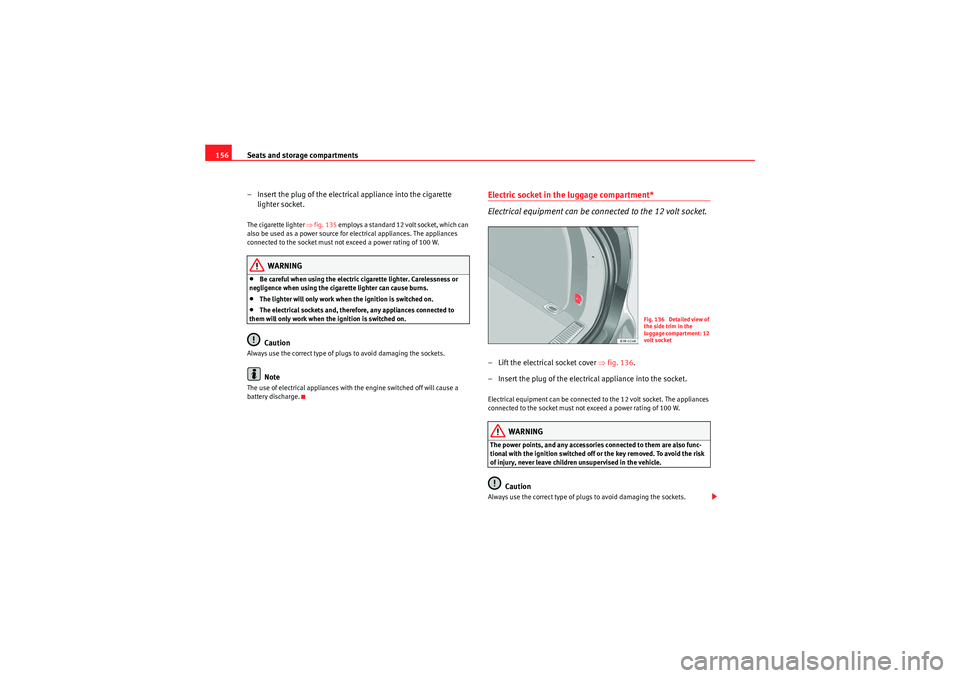
Electric socket in the luggage compartment*
Electrical equipment can be connected to the 12 volt socket.– Lift the electrical socket cover ⇒ fig. 136.
– Insert the plug of the electrical appliance into the socket.Electrical equipment can be connected to the 12 volt socket. The appliances
connected to the socket must not exceed a power rating of 100 W.
WARNING
The power points, and any accessories connected to them are also func-
tional with the ignition switched off or the key removed. To avoid the risk
of injury, never leave children unsupervised in the vehicle.
Caution
Always use the correct type of plugs to avoid damaging the sockets.
Fig. 136 Detailed view of
the side trim in the
luggage compartment: 12
volt socket
ExeoST_EN.book Seite 156 Freitag, 3. September 2010 11:41 11
Page 169 of 325

Air conditioning167
Safety First
Operating Instructions
Practical Tips
Technical Specifications
due to a defect in one of the air conditioner components. If a malfunction
should occur, please contact a specialised workshop.
Air recirculation: automatic activation*
If the outside air is polluted by diesel and petrol emissions,
an air quality sensor in the vehicle will automatically switch
on the air recirculation.Activating air recirculation mode
– Press the button
⇒fig. 142 .
Deactivating air recirculation mode
– Press the button again or
– Press the button or – Press button .
The automatic air recirculation mode should normally be left switched on at
all times.
The system is ready to operate approx. 30 seconds after the engine ignition
key has been turned. During this initial period, fresh air is fed into the vehicle.
If the
air purity sensor in the air conditioner detects a certain concentration
of fumes in the outside air, the control unit will either pass the incoming air
through the pollution filter or automatically switch on the air recirculation. If
there is a high concentration of pollution in the outside air, the air conditioner
automatically switches to air recirculation and the supply of air from the
outside is cut off. As soon as the level of pollution decreases, air is fed into
the vehicle from the outside again.
The automatic air recirculation operates for a maximum period of 12 minutes.
If the windows mist up when the automatic air recirculation is on, press the button immediately.
The automatic air recirculation switches itself off under certain circumstances
(for instance if or is selected). In “ECON” and at temperatures lower
than approx. 8 °C below zero, the automatic air recirculation mode is limited
to 12 seconds.Switching the temperature display from °C to °F and vice versa
The temperature display can be switched from °C (degrees
Celsius) to °F (degrees Fahrenheit) and vice versa.– Press and hold the button for air recirculation mode and briefly press the plus button of the left-hand temperature
selector ⇒page 164, fig. 141 .
Fig. 142 Button for auto-
matic air recirculation
AUTO
<
<
<
ExeoST_EN.book Seite 167 Freitag, 3. September 2010 11:41 11
Page 172 of 325
Air conditioning
170Each of the three buttons has a specific function. The numbers relate to the
air outlets ⇒page 169, fig. 143.
Air directed to windows
This setting directs all the air to outlets 1 and 2. Unlike in setting , the
volume of air delivery remains the same.
Air to the driver/front passenger
All the air comes from outlets 3 and 4 in the dash panel and from the rear of
the centre console.
Air to the footwells
Most of the air emerges from outlets 5 and the outlets under the front seats.
Some of the air will also be issued from outlets 3 and 4.
Note
In all of the above air distribution settings, a small amount of air will still
come from the other outlets.Economical use of the air conditioner
Economical use of the air conditioner will help save fuel.Engine power is reduced and fuel consumption increases when the
air conditioner is in co oling mode. To ensure that the system is only
switched on when it is really necessary, please note the following
points:
– Select ECON mode if you wish to save fuel.
– S e le c t ECO N m o d e i f yo u d e ci d e t o o p e n t h e w i n d o w s o r su n r o o f * while driving. – If the vehicle has heated up after standing in the sun, open the
windows and doors for a short time to cool the vehicle.
For the sake of the environment
By saving fuel you also reduce the amount of pollutants emitted from your
vehicle.Key settings
When the ignition is switched on, the air conditioner settings
assigned to the key are selected automatically.The air conditioner settings selected are automatically stored and assigned
to the key in use. When the vehicle is started, the air conditioner automati-
cally selects the settings assigned to the key. Hence, every driver automati-
cally obtains his/her preferred settings without having to select them manu-
ally.
Note
Should another driver use the key and enter other settings, the previous
settings will be deleted.
<
ExeoST_EN.book Seite 170 Freitag, 3. September 2010 11:41 11
Page 173 of 325

Air conditioning171
Safety First
Operating Instructions
Practical Tips
Technical Specifications
Solar-powered blower/sunroof*
If the vehicle is parked in sufficiently strong sunlight, the
blower will operate in solar-powered mode when the ignition
is switched off.After the ignition is switched off, the blower is supplied with electrical power
from the sunroof. Please ensure that outlets 3 and 4 are open ⇒page 169,
fig. 143 to ensure the best possible ventilation.
The blower only works when the sunroof is closed or tilted open at the rear.
If the air recirculation mode is on when you switch off the engine, the air
conditioner will automatically switch to fresh air ventilation.Auxiliary heater*Diesel vehicles are fitted with an auxiliary heater
2) to raise the temperature of
the interior as quickly as possible. At outdoor temperatures below +5 °C and
with the engine running, the auxiliary heater will switch on and off automati-
cally depending on the temperature of the coolant.
In order to save fuel, the auxiliary heater can be can be switched off by briefly
pressing the button on the air conditioner.
Seat heating*
The surface and backrest of the front seats can be electrically
heated.Turn thumbwheel or ⇒fig. 144 to switch on and adjust the
heating on the left or right front seats.The heating is switched off when the thumbwheel is set to 0. The temperature
settings range from 1 to 6.
Caution
To avoid damaging the heating elements of the seat heating, please do not
kneel on the seat or apply sharp pressure to a single point.
2)For Nordic countries only.
%#/.
Fig. 144 Detailed view of
the dash panel: Thum-
bwheel controls for seat
heating
A1
A2
ExeoST_EN.book Seite 171 Freitag, 3. September 2010 11:41 11
Page 175 of 325

Driving173
Safety First
Operating Instructions
Practical Tips
Technical Specifications
The Electronic Stability Programme (ESP) contains the electronic differential
lock (EDL) and the traction control system (TCS). The ESP function works
together with the ABS. If a fault in the ABS occurs, both warning lamps light
up, but if the ESP fails, only the ESP warning lamp lights up.
The ESP is started automatically when the engine is started.
The ESP switch deactivates both TCS and ESP functions. The ESP, in spite of
being deactivated, will always self-connect when necessary if brakes are
being used.
The TCS can be deactivated when in cases where wheel sliding is desirable.
For example:
•When driving with snow chains,•when driving in deep snow or on loose surfaces,•when rocking the vehicle backwards and forwards to free it from mud, for
example.
Next, the button should be pressed to reactivate the TCS.
When does the warning lamp switch on or flash?•On switching the ignition on, it lights up for about two seconds to carry
out a function control.•The warning lamp will start flashing when the vehicle is moving if the ESP
or the TCS is activated.•It will light up continuously if there is a malfunction in the ESP.WARNING
•The Electronic Stability Programme (ESP) cannot defy the laws of
physics. This should be kept in mind, particularly on slippery and wet
roads and when towing a trailer.•Always adapt your driving style to suit the condition of the roads and
the traffic situation. Do not let the extra safety afforded by ESP tempt you
into taking any risks when driving, as this can cause accidents.
•Please refer to the corresponding warning notes on ESP in ⇒page 191,
“Intelligent technology”.
Ignition lockIgnition key positions
The ignition key is used to start and stop the engine.Position
The ignition key is inserted in this position. To engage the steering wheel
lock , take out the key and turn the wheel until you hear the pin engage. You
should always engage the steering lock when you leave the vehicle. This will
help to deter thefts ⇒.
WARNING (continued)
Fig. 147 Ignition key
positions
A1
ExeoST_EN.book Seite 173 Freitag, 3. September 2010 11:41 11
Page 176 of 325
Driving
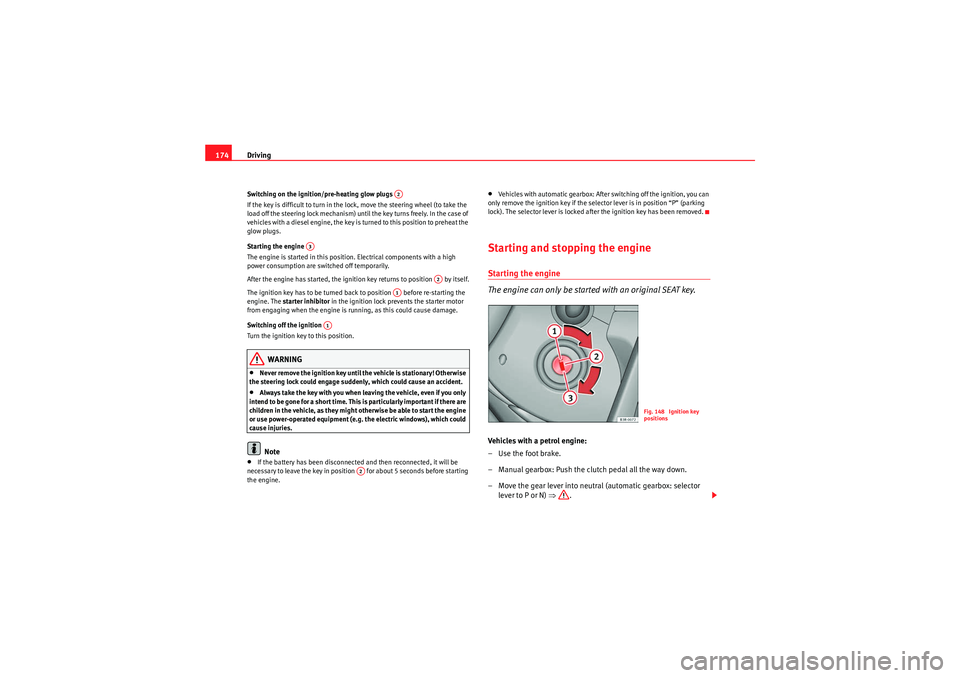
174Switching on the ignition/pre-heating glow plugs
If the key is difficult to turn in the lock, move the steering wheel (to take the
load off the steering lock mechanism) until the key turns freely. In the case of
vehicles with a diesel engine, the key is turned to this position to preheat the
glow plugs.
Starting the engine
The engine is started in this position. Electrical components with a high
power consumption are switched off temporarily.
After the engine has started, the ignition key returns to position by itself.
The ignition key has to be turned back to position before re-starting the
engine. The starter inhibitor in the ignition lock prevents the starter motor
from engaging when the engine is running, as this could cause damage.
Switching off the ignition
Turn the ignition key to this position.
WARNING
•Never remove the ignition key until the vehicle is stationary! Otherwise
the steering lock could engage suddenly, which could cause an accident.•Always take the key with you when leaving the vehicle, even if you only
intend to be gone for a short time. This is particularly important if there are
children in the vehicle, as they might otherwise be able to start the engine
or use power-operated equipment (e.g. the electric windows), which could
cause injuries.Note
•If the battery has been disconnected and then reconnected, it will be
necessary to leave the key in position for about 5 seconds before starting
the engine.
•Vehicles with automatic gearbox: After switching off the ignition, you can
only remove the ignition key if the selector lever is in position “P” (parking
lock). The selector lever is locked after the ignition key has been removed.Starting and stopping the engineStarting the engine
The engine can only be started with an original SEAT key.Vehicles with a petrol engine:
– Use the foot brake.
– Manual gearbox: Push the clutch pedal all the way down.
– Move the gear lever into neutral (automatic gearbox: selector lever to P or N) ⇒.
A2
A3
A2
A1
A1
A2
Fig. 148 Ignition key
positions
ExeoST_EN.book Seite 174 Freitag, 3. September 2010 11:41 11
Page 177 of 325
Driving175
Safety First
Operating Instructions
Practical Tips
Technical Specifications
– Turn the ignition key to position without pressing the acceler-
ator.
– Release the ignition key as soon as the engine starts (the starter motor must not be allowed to run on with the engine).
Vehicles with a diesel engine:
– Use the foot brake.
– Manual gearbox: Push the clutch pedal all the way down.
– Move the gear lever into neutral (automatic gearbox: selector lever to P or N) ⇒.
– Turn the ignition key to position . The pre-heating indicator light
D comes on while the glow plugs are preheating.
– When the indicator light
D goes out, turn the ignition key to
position . Do not press the accelerator.
– Release the ignition key as soon as the engine starts (the starter motor must not be allowed to run on with the engine).
When starting a very cold engine, it may be a little noisy for the first few
seconds until oil pressure has built up in the hydraulic valve compensators.
This is quite normal, and no cause for concern.
If the engine fails to start straight away, stop after 10 seconds and try again
after about half a minute.
Glow plug system*
To assist starting at low temperatures, diesel engines are equipped with a
glow plug preheating system. The preheating time depends on the coolant
temperature and the outside temperature. Start the engine as soon as the
glow plug indicator light
D goes out. When the engine is warm or at outside temperatures above +8 °C, the glow
plug indicator light will only come on for about one second. This means that
the engine can be started
immediately.
If the engine will not start...
•⇒ page 291•⇒page 294•⇒page 225, “Refuelling”WARNING
Never run the engine in confined spaces, as the exhaust gases are
poisonous.
Caution
Avoid high engine speeds, full throttle and extreme load conditions until the
engine has reached its normal operating temperature, otherwise this can
damage the engine.
For the sake of the environment
Do not warm up the engine by running the engine with the vehicle stationary.
Start immediately. This will help avoid unnecessary exhaust emissions.Stopping the engine– Turn the ignition key to position ⇒page 174, fig. 148 .
WARNING
•Never switch the engine off until the vehicle is stationary.
A3A2
A3
A1
ExeoST_EN.book Seite 175 Freitag, 3. September 2010 11:41 11