alarm Seat Exeo ST 2010 Owner's manual
[x] Cancel search | Manufacturer: SEAT, Model Year: 2010, Model line: Exeo ST, Model: Seat Exeo ST 2010Pages: 325, PDF Size: 9.34 MB
Page 5 of 325
Contents3
ContentsManual structure
. . . . . . . . . . . . . . . . . . . .
Content
. . . . . . . . . . . . . . . . . . . . . . . . . . . . . . . .
Safety First
. . . . . . . . . . . . . . . . . . . . . . . . . . .
Safe driving
. . . . . . . . . . . . . . . . . . . . . . . . . . . . . .
Brief introduction . . . . . . . . . . . . . . . . . . . . . . . .
Proper sitting position for occupants . . . . . . . . .
Pedal area . . . . . . . . . . . . . . . . . . . . . . . . . . . . . .
Storing objects . . . . . . . . . . . . . . . . . . . . . . . . . .
Seat belts
. . . . . . . . . . . . . . . . . . . . . . . . . . . . . . . .
Brief introduction . . . . . . . . . . . . . . . . . . . . . . . .
Why wear seat belts? . . . . . . . . . . . . . . . . . . . . . .
Seat belts . . . . . . . . . . . . . . . . . . . . . . . . . . . . . . .
Seat belt tensioners . . . . . . . . . . . . . . . . . . . . . .
Airbag system
. . . . . . . . . . . . . . . . . . . . . . . . . . . .
Brief introduction . . . . . . . . . . . . . . . . . . . . . . . .
Front airbags . . . . . . . . . . . . . . . . . . . . . . . . . . . .
Knee airbag* . . . . . . . . . . . . . . . . . . . . . . . . . . . .
Side airbags* . . . . . . . . . . . . . . . . . . . . . . . . . . . .
Curtain airbags . . . . . . . . . . . . . . . . . . . . . . . . . .
Deactivating airbags . . . . . . . . . . . . . . . . . . . . . .
Child safety
. . . . . . . . . . . . . . . . . . . . . . . . . . . . . .
Brief introduction . . . . . . . . . . . . . . . . . . . . . . . .
Child seats . . . . . . . . . . . . . . . . . . . . . . . . . . . . . .
Securing child seats . . . . . . . . . . . . . . . . . . . . . .
Operating Instructions
. . . . . . . . . . . .
Cockpit
. . . . . . . . . . . . . . . . . . . . . . . . . . . . . . . . . . .
Overview . . . . . . . . . . . . . . . . . . . . . . . . . . . . . . .
Instruments . . . . . . . . . . . . . . . . . . . . . . . . . . . . .
Warning and indicator lamps . . . . . . . . . . . . . . .
Driver information system . . . . . . . . . . . . . . . . . .
Auto-check system . . . . . . . . . . . . . . . . . . . . . . .
Speed warning* . . . . . . . . . . . . . . . . . . . . . . .
Onboard computer . . . . . . . . . . . . . . . . . . . . . . .
Menu display . . . . . . . . . . . . . . . . . . . . . . . . . . . .
Tyre pressure monitoring* . . . . . . . . . . . . . . . . .
Steering wheel controls
. . . . . . . . . . . . . . . . . . .
Multifunction steering wheel* . . . . . . . . . . . . . .
Unlocking and locking
. . . . . . . . . . . . . . . . . . . .
Remote control keys . . . . . . . . . . . . . . . . . . . . . .
Central locking . . . . . . . . . . . . . . . . . . . . . . . . . . .
Tailgate . . . . . . . . . . . . . . . . . . . . . . . . . . . . . . . . .
Childproof lock . . . . . . . . . . . . . . . . . . . . . . . . . .
Remote control key . . . . . . . . . . . . . . . . . . . . . . .
Anti-theft alarm system* . . . . . . . . . . . . . . . . . . .
Electric windows . . . . . . . . . . . . . . . . . . . . . . . . .
Sliding/tilting sunroof* . . . . . . . . . . . . . . . . . . . .
Lights and visibility
. . . . . . . . . . . . . . . . . . . . . . .
Lights . . . . . . . . . . . . . . . . . . . . . . . . . . . . . . . . . .
Interior lights . . . . . . . . . . . . . . . . . . . . . . . . . . . .
Visibility . . . . . . . . . . . . . . . . . . . . . . . . . . . . . . . .
Windscreen wipers . . . . . . . . . . . . . . . . . . . . . . .
Rear view mirrors . . . . . . . . . . . . . . . . . . . . . . . . .
Seats and storage compartments
. . . . . . . . . .
Manual adjustment of the front seats . . . . . . . .
Electric adjustment of front seats* . . . . . . . . . . .
Lumbar support* . . . . . . . . . . . . . . . . . . . . . . . . . Driver seat memory* . . . . . . . . . . . . . . . . . . . . . .
Head restraints . . . . . . . . . . . . . . . . . . . . . . . . . .
Armrests . . . . . . . . . . . . . . . . . . . . . . . . . . . . . . . .
Luggage compartment . . . . . . . . . . . . . . . . . . . .
Roof rack / roof rails* . . . . . . . . . . . . . . . . . . . . .
Drink holder . . . . . . . . . . . . . . . . . . . . . . . . . . . . .
Ashtray*, cigarette lighter* and electric sockets*
Compartments . . . . . . . . . . . . . . . . . . . . . . . . . . .
Air conditioning
. . . . . . . . . . . . . . . . . . . . . . . . . .
2C-Climatronic . . . . . . . . . . . . . . . . . . . . . . . . . . .
Driving
. . . . . . . . . . . . . . . . . . . . . . . . . . . . . . . . . . .
Steering . . . . . . . . . . . . . . . . . . . . . . . . . . . . . . . .
Safety . . . . . . . . . . . . . . . . . . . . . . . . . . . . . . . . . .
Ignition lock . . . . . . . . . . . . . . . . . . . . . . . . . . . . .
Starting and stopping the engine . . . . . . . . . . .
Handbrake . . . . . . . . . . . . . . . . . . . . . . . . . . . . . .
Parking aid acoustic system . . . . . . . . . . . . . . . .
Cruise control* . . . . . . . . . . . . . . . . . . . . . . . . . . .
Manual gearbox . . . . . . . . . . . . . . . . . . . . . . . . . .
Automatic gearbox* . . . . . . . . . . . . . . . . . . . . . .
Practical Tips
. . . . . . . . . . . . . . . . . . . . . . . .
Intelligent technology
. . . . . . . . . . . . . . . . . . . . .
Electronic Stability Programme (ESP) . . . . . . . .
Brakes . . . . . . . . . . . . . . . . . . . . . . . . . . . . . . . . .
Power steering . . . . . . . . . . . . . . . . . . . . . . . . . . .
Servotronic* . . . . . . . . . . . . . . . . . . . . . . . . . . . . .
Driving and the environment
. . . . . . . . . . . . . .
Running-in . . . . . . . . . . . . . . . . . . . . . . . . . . . . . .
Exhaust gas purification system . . . . . . . . . . . . .
5
6
7
7
7
10
15
16
18
18
19
22
26
28
28
32
35
38
41
44
46
46
48
51 57
57
57
59
65
71
75
82
85
87
89
91
91
96
96
98
103
104
105
107
109
112
116
116
124
127
128
131
134
134
136
137 138
140
142
143
151
153
154
159
162
162
172
172
172
173
174
176
177
180
183
183
191
191
191
194
196
196
197
197
198
ExeoST_EN.book Seite 3 Freitag, 3. September 2010 11:41 11
Page 101 of 325

Unlocking and locking99
Safety First
Operating Instructions
Practical Tips
Technical Specifications
Automatic locking function (Auto Lock)*
The
Auto Lock* function automatically locks all doors and the tailgate when
the vehicle exceeds a speed of about 15 km/h.
The vehicle is unlocked again automatically when the ignition key is
removed. Alternatively, the driver can also unlock the vehicle using the
central locking switch
or by opening one of the doors.
WARNING
Do not leave anyone (especially children) in the vehicle if it is locked from
the outside and the anti-theft security system is enabled, as the doors and
windows cannot then be opened from the inside. Locked doors could delay
assistance in an emergency, potentially putting lives at risk.
Note
•Should the central locking system fail to work, you can still lock and
unlock the driver door and the tailgate using the key. Locking the doors
manually if central locking fails to work ⇒page 102.•The anti-theft mechanism and the anti-theft alarm* cannot be enabled if
the central locking is not working.•Never leave any valuable items in the vehicle unattended. Even a locked
vehicle is not a safe.
Unlocking the vehicle with the key– To unlock the vehicle, turn the key in the driver door to position ⇒ fig. 70 .
– Pull the handle to open the door.•This will unlock all the doors, the tailgate and the tank flap simultane-
ously.•The anti-theft security system will be disabled.Locking the vehicle with the key– To lock the vehicle, turn the key in the driver door to position ⇒fig. 70 ⇒ .•This will lock all the doors and the tailgate.
Fig. 70 Turning the key to
enable the open and close
functions
AA
AB
ExeoST_EN.book Seite 99 Freitag, 3. September 2010 11:41 11
Page 102 of 325
Unlocking and locking
100•The interior lights are switched off, provided the light switch is in the cour-
tesy light position.•The windows and the sunroof* will close as the key is held in the locking
position.•The anti-theft security system will be enabled immediately.
Locking the vehicle without activating the anti-theft security system
With the anti-theft security system enabled, it is more difficult to break into
the vehicle. If the anti-theft security system has been enabled, the inside
door handles and the central locking switch will not work ⇒.
If you are leaving passengers in the vehicle while it is parked, it is possible to
lock the vehicle without activating the anti-theft security system.
To do so, turn the key in the driver door twice in quick succession to position
⇒ page 99, fig. 70.WARNING
Do not leave anyone (especially children) in the vehicle if it is locked from
the outside and the anti-theft security system is enabled, as the doors and
windows cannot then be opened from the inside. Locked doors could delay
assistance in an emergency, potentially putting lives at risk.
Caution
If the driver door is locked using the key while open, the vehicle will be auto-
matically immobilised and the alarm triggered.
Note
•Please note that when the vehicle is locked without activating the anti-
theft mechanism, the anti-theft alarm* remains operative. You should there-
fore switch off the interior monitoring* before locking the vehicle, as other-
wise the alarm* could be triggered unintentionally.
•The driver door cannot be locked using the central locking system when it
is still open. The door must be locked separately after it has been closed. This
helps to prevent you from being locked out of the vehicle.Central locking switch
The central locking system can be enabled from inside the
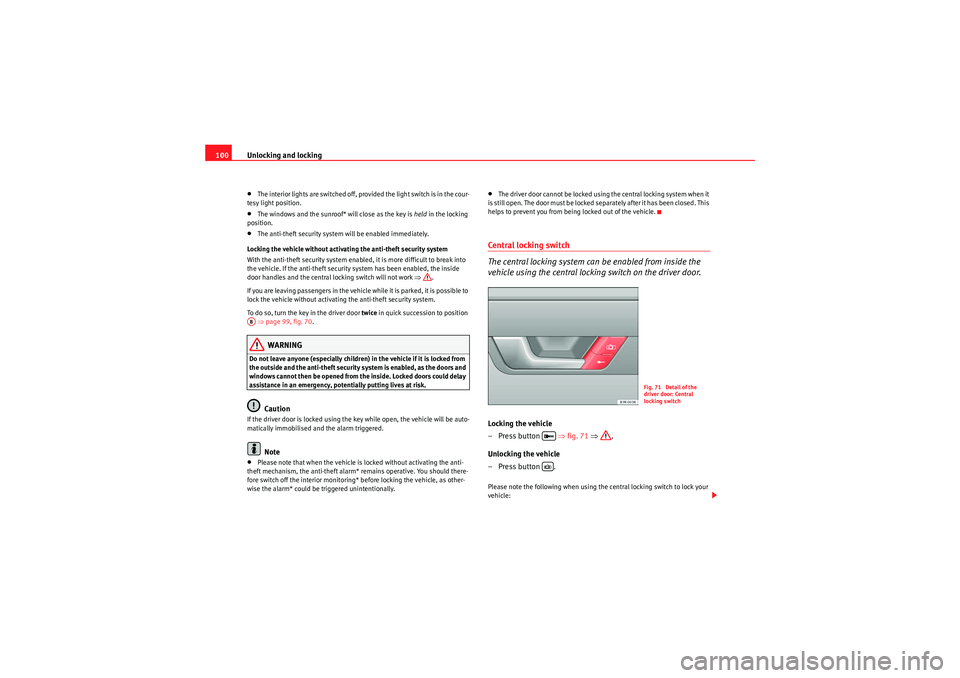
vehicle using the central locking switch on the driver door.Locking the vehicle
–Press button ⇒fig. 71 ⇒ .
Unlocking the vehicle
–Press button .Please note the following when using the central locking switch to lock your
vehicle:
AB
Fig. 71 Detail of the
driver door: Central
locking switch
ExeoST_EN.book Seite 100 Freitag, 3. September 2010 11:41 11
Page 103 of 325

Unlocking and locking101
Safety First
Operating Instructions
Practical Tips
Technical Specifications
•The doors and the tailgate cannot be opened from the outside (for secu-
rity reasons, e.g. when stopped at traffic lights).•You can open the doors individually from the inside by pulling the inside
door handle.•When the driver door is open, it cannot be locked by pressing the central
locking switch and then closing the door. This helps to prevent you from
being locked out of the vehicle. The door has to be locked separately after it
has been closed.•In the event of an accident in which the airbags inflate, doors locked from
the inside will be automatically unlocked to facilitate access and assistance.WARNING
The central locking switch is still operative when the ignition is switched
off. This switch can be used to automatically lock all the doors and the tail-
gate. However, since this makes it difficult to enter the vehicle from the
outside, you should never leave children unattended in the vehicle. Locked
doors could delay assistance in an emergency, potentially putting lives at
risk.
Note
The central locking switch inside the vehicle will not be operative if the anti-
theft mechanism has been enabled.
Security central locking*
The security central locking feature allows you to only unlock
the driver door and the tank flap. All other doors and the tail-
gate remain locked.Unlocking the driver door and tank flap
–Turn the key once to the unlock position, or press the unlock
button on the remote control once.
Unlocking all the doors, the tailgate and the tank flap
simultaneously.
–Turn the key twice within five seconds, or press the unlock button
on the remote control twice within five seconds.The security system and the anti-theft alarm* are immediately disabled if you
unlock only the driver door, without unlocking the other doors ⇒page 107.
ExeoST_EN.book Seite 101 Freitag, 3. September 2010 11:41 11
Page 108 of 325
Unlocking and locking
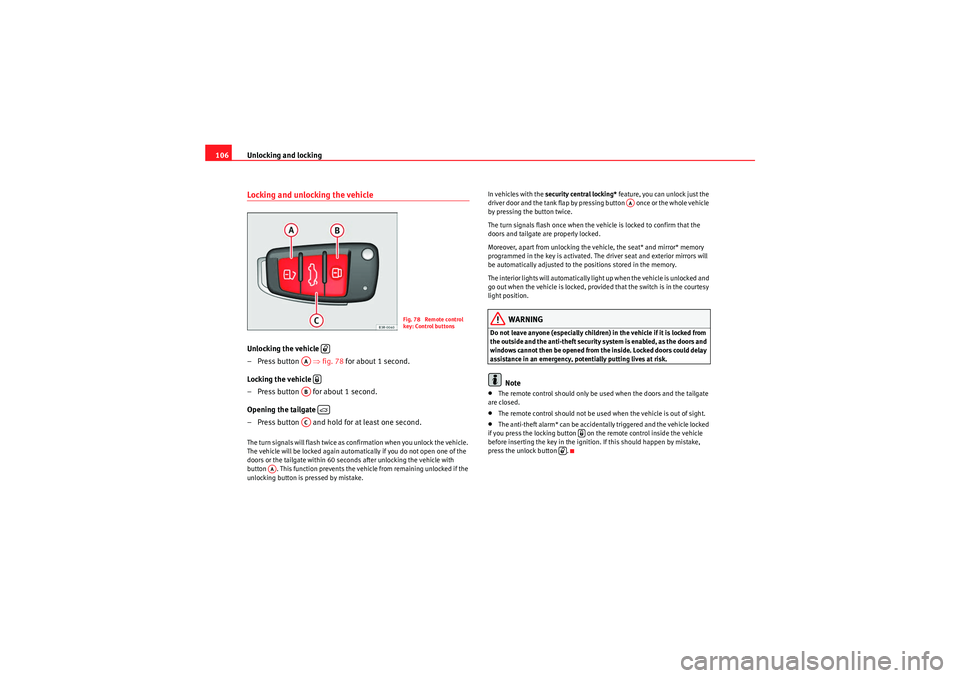
106Locking and unlocking the vehicleUnlocking the vehicle
–Press button ⇒fig. 78 for about 1 second.
Locking the vehicle
– Press button for about 1 second.
Opening the tailgate
– Press button and hold for at least one second.The turn signals will flash twice as confirmation when you unlock the vehicle.
The vehicle will be locked again automatically if you do not open one of the
doors or the tailgate within 60 seconds after unlocking the vehicle with
button . This function prevents the vehicle from remaining unlocked if the
unlocking button is pressed by mistake. In vehicles with the
security central locking* feature, you can unlock just the
driver door and the tank flap by pressing button once or the whole vehicle
by pressing the button twice.
The turn signals flash once when the vehicle is locked to confirm that the
doors and tailgate are properly locked.
Moreover, apart from unlocking the vehicle, the seat* and mirror* memory
programmed in the key is activated. The driver seat and exterior mirrors will
be automatically adjusted to the positions stored in the memory.
The interior lights will automatically light up when the vehicle is unlocked and
go out when the vehicle is locked, provided that the switch is in the courtesy
light position.
WARNING
Do not leave anyone (especially children) in the vehicle if it is locked from
the outside and the anti-theft security system is enabled, as the doors and
windows cannot then be opened from the inside. Locked doors could delay
assistance in an emergency, potentially putting lives at risk.
Note
•The remote control should only be used when the doors and the tailgate
are closed.•The remote control should not be used when the vehicle is out of sight.•The anti-theft alarm* can be accidentally triggered and the vehicle locked
if you press the locking button on the remote control inside the vehicle
before inserting the key in the ignition. If this should happen by mistake,
press the unlock button .
Fig. 78 Remote control
key: Control buttons
AA
AB
˜
AC
AA
AA
ExeoST_EN.book Seite 106 Freitag, 3. September 2010 11:41 11
Page 109 of 325

Unlocking and locking107
Safety First
Operating Instructions
Practical Tips
Technical Specifications
Re-synchronising
Should the remote control fail to lock or unlock the vehicle,
the system must be re-synchronised.– If the vehicle is locked, use the key to unlock the driver door.
– Press the unlock button on the remote control.
– Insert the key into the ignition and switch on the ignition.
– Switch off the ignition and remove the key.
– Press the unlock or the lock button .Anti-theft alarm system*Description
The system triggers an alarm if anyone attempts to break into
the vehicle.The anti-theft alarm helps to prevent the vehicle being broken into or stolen.
If the system senses interference with the vehicle, it triggers an audible and
visible alarm.
How is the system enabled?
The anti-theft alarm system is enabled automatically when the vehicle is
locked with the remote control or by turning the key in the driver door (if the
door is closed). The anti-theft alarm is enabled about 30 seconds after the
vehicle is locked. How is the system disabled?
The anti-theft alarm is only disabled when the vehicle is unlocked using the
remote control. The vehicle will lock again automatically if none of the doors
is opened within 60 seconds after pressing the remote control button.
If the vehicle is unlocked by turning the key in the driver door, all the other
doors, the tailgate and the tank flap will remain locked.
If the vehicle has been unlocked with the key in the driver door, the key must
be inserted in the ignition lock and the ignition switched on within 15
seconds of opening the door in order to disable the alarm. The alarm will be
triggered
if the ignition is not switched on within 15 seconds.
When does the system trigger the alarm?
The following parts of the vehicle are monitored when the vehicle is locked:
•Engine compartment (bonnet)•Luggage compartment•Doors•Tilt angle (tow-away protection)•Ignition•Radio (only with a factory-fitted SEAT radio)•Interior ⇒page 108
If any of these areas are entered, the alarm will be triggered.
How is the alarm disabled?
The alarm can be switched off by unlocking the vehicle using the remote
control, or by switching on the ignition with the key, thus “disabling” the
alarm system. The alarm will also switch off when it comes to the end of its
cycle.
Turn sig nals
The turn signals flash briefly when the vehicle is locked to confirm that the
doors, the engine bonnet and the tailgate are properly closed and locked.
ExeoST_EN.book Seite 107 Freitag, 3. September 2010 11:41 11
Page 110 of 325
Unlocking and locking
108If the turn signals do not flash, check the doors, the bonnet and the tailgate
to make sure they are properly closed. The turn signals will also flash briefly
if one of the doors or the tailgate or engine bonnet is closed after the alarm
system has been enabled.
LED
When the vehicle is locked, the LED on the top of the driver door trim will flash
rapidly for about 30 seconds and then continue flashing slowly. This is to
indicate that the anti-theft alarm system (including the interior monitoring
and tow-away protection ) is operative. If the LED lights up continuously for
about 30 seconds when the vehicle is locked instead of flashing, this means
the alarm system is not working properly.
Note
•To make sure that the alarm is fully operative when leaving the vehicle,
briefly check that all the doors and windows and the sunroof* are closed.•The alarm is triggered immediately if one of the battery cables is discon-
nected while the alarm system is enabled.
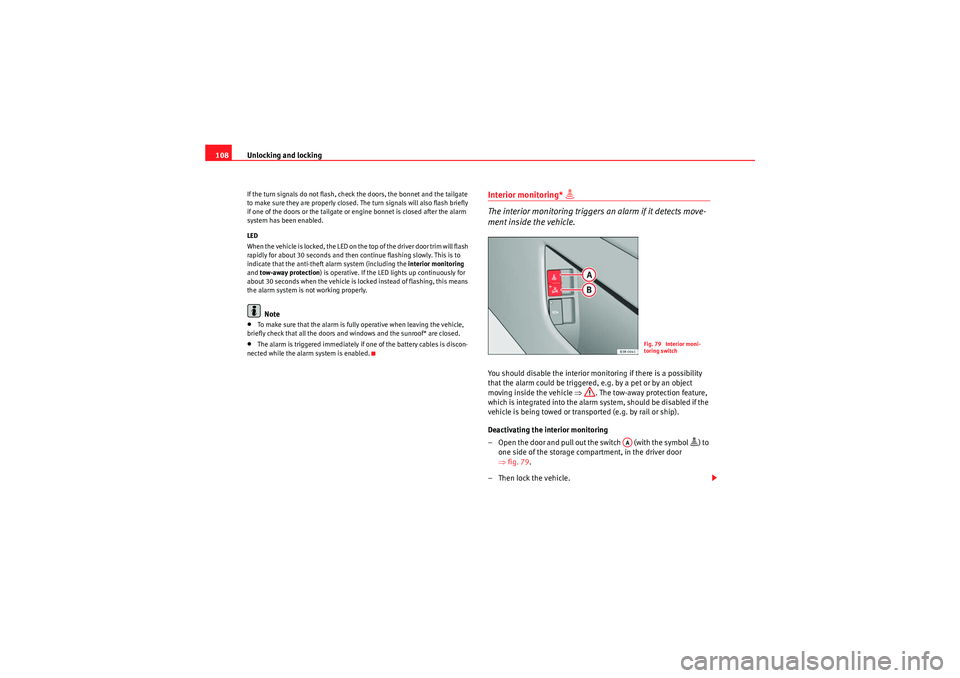
Interior monitoring*
The interior monitoring triggers an alarm if it detects move-
ment inside the vehicle.You should disable the interior monitoring if there is a possibility
that the alarm could be triggered, e.g. by a pet or by an object
moving inside the vehicle ⇒. The tow-away protection feature,
which is integrated into the alarm system, should be disabled if the
vehicle is being towed or transported (e.g. by rail or ship).
Deactivating the interior monitoring
– Open the door and pull out the switch (with the symbol
) to
one side of the storage compartment, in the driver door
⇒ fig. 79 .
– Then lock the vehicle.
Fig. 79 Interior moni-
toring switch
AA
ExeoST_EN.book Seite 108 Freitag, 3. September 2010 11:41 11
Page 245 of 325

Checking and refilling levels243
Safety First
Operating Instructions
Practical Tips
Technical Specifications
•A highly explosive mixture of gases is released when the battery is
under charge. The batteries should be charged in a well-ventilated room
only.•Keep children away from acid and batteries.•Before working on the electrical system, you must switch off the
engine, the ignition and all consumers. The negative cable on the battery
must be disconnected. When a light bulb is changed, you need only switch
off the light.•Deactivate the anti-theft alarm by unlocking the vehicle before you
disconnect the battery! The alarm will otherwise be triggered.•When disconnecting the battery from the vehicle electrical system,
disconnect first the negative cable and then the positive cable.•Switch off all electrical consumers before reconnecting the battery.
Reconnect first the positive cable and then the negative cable. Never
reverse the polarity of the connections. This could cause an electrical fire.•Never charge a frozen battery, or one which has thawed. This could
result in explosions and chemical burns. Always replace a battery which
has frozen. A flat battery can freeze at temperatures around 0 °C.•Ensure that the vent hose is always connected to the battery.•Never use a defective battery. This could cause an explosion. Replace a
damaged battery immediately.Caution
•Never disconnect the battery if the ignition is switched on or if the engine
is running. This could damage the electrical system or electronic compo-
nents.•Do not expose the battery to direct sunlight over a long period of time, as
the intense ultraviolet radiation can damage the battery housing.•If the vehicle is left standing in cold conditions for a long period, protect
the battery from frost. If it freezes it will be damaged.
Charging the battery
A fully-charged battery is important for reliable starting.–Note the warnings ⇒ in “Important safety warnings for
handling a vehicle battery” on page 242 and ⇒.
– Switch off the ignition and all electrical equipment.
– Only if fast-charging: both battery cables must be disconnected (first the negative cable, then the positive cable).
– Connect the charger cables to the battery terminals, noting the colour code (red = positive; black or brown = negative).
– Now connect the battery charger to the power socket and switch on.
– After charging the battery: switch off the battery charger and disconnect the power point cable.
– Finally disconnect the charger cables from the battery.
– If necessary, reconnect both battery cables to the battery (first the positive cable, then the negative cable).When charging with a low current (for instance with a small battery charger)
the battery does not normally have to be disconnected. However, both
battery cables must be disconnected before fast-charging the battery with a
high current. However, always follow the instructions given by the manufac-
turer of the battery charger.
The fast-charging procedure for a battery is dangerous ⇒ in “Important
safety warnings for handling a vehicle battery” on page 242, as it requires a
special charger and the corresponding level of knowledge. We therefore
recommend that this work should only be performed by a qualified workshop.
WARNING (continued)
ExeoST_EN.book Seite 243 Freitag, 3. September 2010 11:41 11
Page 269 of 325

If and when267
Safety First
Operating Instructions
Practical Tips
Technical Specifications
Some of the electrical items listed in the table are only fitted on certain
models or are optional extras.
The electric windows and electric seat adjusters are protected by circuit
breakers
. These reset automatically after a few seconds when the overload
(caused for example by frozen windows) has been corrected.
Note
Please note that the above list contains all data at the time of going to press,
so it is subject to modifications. If discrepancies should occur, please refer to
the sticker on the inside of the fuse cover for the correct information for your
model.
BulbsGeneral informationYou can change the following bulbs for exterior lights yourself:•Main headlights: all bulbs (except xenon headlights)•Tail lights: all bulbs•Side turn signal bulb
The following bulbs can only be changed by a qualified workshop:•Main headlights: Xenon* bulb ⇒page 274•Front fog light bulbs
As a rule, you require a certain degree of practical skill to change defective
bulbs. This applies in particular to those bulbs which are only accessible from
the engine compartment.
If in doubt, we recommend that you have defective bulbs changed by a qual-
ified workshop or qualified mechanic.
If you do decide to change bulbs in the engine compartment yourself, be
aware of the safety risks involved ⇒page 229 ⇒ in “Types of bulbs”.Changing bulbs. Halogen headlightsTypes of bulbsYou must only replace a bulb with a bulb of the same type. The name can be
found on the base of the bulb holder.
33
Lighter
20
34
Lambda probe heater
5
35
Luggage compartment power socket*
20
36
Wiper system
30
37
Pump for windscreen washer and headlight washer
system
30
38
Luggage compartment illumination, alarm
15
39
Radio, amplifier
20
40
Horn
25
41
230 volt socket
30
42
Electronic Stability Programme (ESP)
25
43
Engine management
15
44
Seat heating
35
No.
Consumer
Amps
ExeoST_EN.book Seite 267 Freitag, 3. September 2010 11:41 11
Page 315 of 325

Index313
Index230 V socket . . . . . . . . . . . . . . . . . . . . . . . . . . . 157AAccessories . . . . . . . . . . . . . . . . . . . . . . . . . . . . 223
Towing . . . . . . . . . . . . . . . . . . . . . . . . . . . . . 205
Adaptive headlights . . . . . . . . . . . . . . . . . . . . . 122 Faulty . . . . . . . . . . . . . . . . . . . . . . . . . . . . . . . 81
Air conditioner 2C-Climatronic . . . . . . . . . . . . . . . . . . . . . . . 162
Air distribution . . . . . . . . . . . . . . . . . . . . . . . 169
Air outlets . . . . . . . . . . . . . . . . . . . . . . . . . . . 169
Air purity sensor . . . . . . . . . . . . . . . . . . . . . . 167
Air recirculation . . . . . . . . . . . . . . . . . . . . . . 166
Air recirculation (automatic) . . . . . . . . . . . . 167
Automatic mode . . . . . . . . . . . . . . . . . . . . . 165
Blower . . . . . . . . . . . . . . . . . . . . . . . . . . . . . . 168
Controls . . . . . . . . . . . . . . . . . . . . . . . . . . . . 164
Defrosting . . . . . . . . . . . . . . . . . . . . . . . . . . . 166
ECON Mode (economy) . . . . . . . . . . . . . . . . 166
Economical use . . . . . . . . . . . . . . . . . . . . . . 170
Key settings . . . . . . . . . . . . . . . . . . . . . . . . . 170
Solar-powered blower/sunroof . . . . . . . . . . 171
Temperature selection . . . . . . . . . . . . . . . . . 165
Air duct Fitting . . . . . . . . . . . . . . . . . . . . . . . . . 269, 276
Removing . . . . . . . . . . . . . . . . . . . . . . 268, 275 Air purity sensor . . . . . . . . . . . . . . . . . . . . . . . . . 167
Airbag
Warning lamp . . . . . . . . . . . . . . . . . . . . . . . . . 66
Airbag covers . . . . . . . . . . . . . . . . . . . . . . . . . . . . 34
Airbag system . . . . . . . . . . . . . . . . . . . . . . . . . . . 28 Curtain airbags . . . . . . . . . . . . . . . . . . . . . . . 41
Front airbags . . . . . . . . . . . . . . . . . . . . . . . . . 32
Side airbags . . . . . . . . . . . . . . . . . . . . . . . . . . 38
Warning lamp . . . . . . . . . . . . . . . . . . . . . . . . . 29
Alternator Warning lamp . . . . . . . . . . . . . . . . . . . . . . . . . 69
Ambient lighting . . . . . . . . . . . . . . . . . . . . . . . . 125
Antifreeze . . . . . . . . . . . . . . . . . . . . . . . . . . . . . . 233
Anti-lock brake system How it works . . . . . . . . . . . . . . . . . . . . . . . . . 192
Anti-theft alarm system . . . . . . . . . . . . . . . . . . . 107 Interior monitoring . . . . . . . . . . . . . . . . . . . 108
Aquaplaning . . . . . . . . . . . . . . . . . . . . . . . . . . . 249
Armrest Storage compartment in front armrest . . . . 142
Armrests Adjusting the front armrest . . . . . . . . . . . . . 142
Ashtray Front . . . . . . . . . . . . . . . . . . . . . . . . . . . . . . . 154
Rear . . . . . . . . . . . . . . . . . . . . . . . . . . . . . . . 154
Athermic windscreen . . . . . . . . . . . . . . . . . . . . . 224
Auto-check system . . . . . . . . . . . . . . . . . . . . . . . 75
Automatic car wash tunnel . . . . . . . . . . . . . . . . 215 Automatic gearbox
Dynamic gear control programme . . . . . . . 188
Kick-down feature . . . . . . . . . . . . . . . . . . . . 187
multitronic® . . . . . . . . . . . . . . . . . . . . . . . . 183
Paddle levers (tiptronic mode) . . . . . . . . . . 190
Safety interlock for ignition key . . . . . . . . . 173
Selector lever lock . . . . . . . . . . . . . . . . . . . . 187
Selector lever positions . . . . . . . . . . . . . . . 185
Steering wheel with paddle levers . . . . . . . 190
tiptronic . . . . . . . . . . . . . . . . . . . . . . . 183, 189
Automatic headlight control . . . . . . . . . . . . . . . 116
Auxiliary heater . . . . . . . . . . . . . . . . . . . . . . . . . 171
BBattery . . . . . . . . . . . . . . . . . . . . . . . . . . . . . . . . 241 Battery voltage . . . . . . . . . . . . . . . . . . . . . . . . 81
Charging . . . . . . . . . . . . . . . . . . . . . . . . . . . . 243
Disconnection . . . . . . . . . . . . . . . . . . . . . . . 241
Long periods of non-use . . . . . . . . . . . . . . . 241
Replacing . . . . . . . . . . . . . . . . . . . . . . 241, 242
Testing . . . . . . . . . . . . . . . . . . . . . . . . . . . . . 241
Winter operation . . . . . . . . . . . . . . . . 241, 242
Bicycle rack Towing . . . . . . . . . . . . . . . . . . . . . . . . . . . . . 205
Biodiesel . . . . . . . . . . . . . . . . . . . . . . . . . . . . . . 227
Biodiesel fuel . . . . . . . . . . . . . . . . . . . . . . . . . . . 227
ExeoST_EN.book Seite 313 Freitag, 3. September 2010 11:41 11