engine coolant Seat Exeo ST 2011 User Guide
[x] Cancel search | Manufacturer: SEAT, Model Year: 2011, Model line: Exeo ST, Model: Seat Exeo ST 2011Pages: 319, PDF Size: 5.12 MB
Page 232 of 319
230Checking and refilling levels
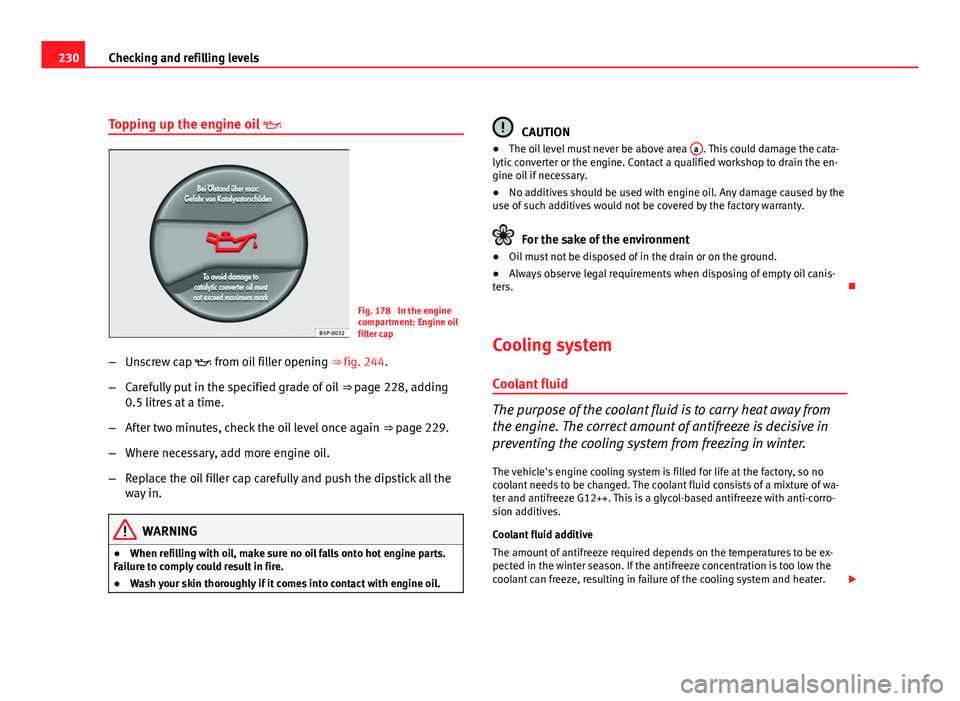
Topping up the engine oil
Fig. 178 In the engine
compartment: Engine oil
filler cap
– Unscrew cap from oil filler opening ⇒ fig. 244.
– Carefully put in the specified grade of oil ⇒ page 228, adding
0.5 litres at a time.
– After two minutes, check the oil level once again ⇒ page 229.
– Where necessary, add more engine oil.
– Replace the oil filler cap carefully and push the dipstick all the
way in.
WARNING
● When refilling with oil, make sure no oil falls onto hot engine parts.
Failure to comply could result in fire.
● Wash your skin thoroughly if it comes into contact with engine oil.
CAUTION
● The oil level must never be above area a. This could damage the cata-
lytic converter or the engine. Contact a qualified workshop to drain the en-
gine oil if necessary.
● No additives should be used with engine oil. Any damage caused by the
use of such additives would not be covered by the factory warranty.
For the sake of the environment
● Oil must not be disposed of in the drain or on the ground.
● Always observe legal requirements when disposing of empty oil canis-
ters.
Cooling system Coolant fluid
The purpose of the coolant fluid is to carry heat away from
the engine. The correct amount of antifreeze is decisive in
preventing the cooling system from freezing in winter. The vehicle's engine cooling system is filled for life at the factory, so no
coolant needs to be changed. The coolant fluid consists of a mixture of wa-
ter and antifreeze G12++. This is a glycol-based antifreeze with anti-corro-
sion additives.
Coolant fluid additive
The amount of antifreeze required depends on the temperatures to be ex-
pected in the winter season. If the antifreeze concentration is too low the
coolant can freeze, resulting in failure of the cooling system and heater.
Page 233 of 319
231
Checking and refilling levels
The cooling system is filled at the factory with the correct amount of anti-
freeze for the country concerned.
In most cases, the mixture consists of 60% water and 40% antifreeze. This
mixture gives the required antifreeze protection at temperatures down to
-25 °C and particularly protects the metal parts of the cooling system
against corrosion. It also prevents scaling and significantly raises the boil-
ing point of the coolant fluid.
Countries with warm climate
The coolant fluid concentration must not be reduced by adding plain water,
even in the summer or in warm climates. The concentration of the antifreeze
must always be at least 40%.
Countries with cold climate
If greater freeze protection is required in very cold climates, the proportion
of antifreeze G12++ can be increased. A concentration of 60% offers anti-
freeze protection of temperatures down to approx. -40 °C. However, the con-
centration of antifreeze must not exceed 60%, as the antifreeze protection
would then drop and the performance of the coolant system would suffer.
Vehicles for countries with cold climates (e.g. Sweden, Norway and Finland)
have factory-filled antifreeze protection for temperatures down to -35 °C. In
these countries, the concentration of antifreeze should always be at least
50%.
CAUTION
● It is advisable to have the cooling system checked before the winter sea-
son to make sure that the antifreeze concentration is adequate for the con-
ditions to be expected. This applies particularly if you intend to take the ve-
hicle into a colder climate zone. If necessary, have the antifreeze concentra-
tion increased to 50 - 60% as required.
● Use only G12++ antifreeze, an additive meeting the “TL-VW 774G” speci-
fication. Other antifreezes may give considerably inferior corrosion protec-
tion. The damage caused by the use of these antifreezes may lead to a loss
of coolant fluid, causing serious damage to the engine.
● G12++ antifreeze can only be mixed with antifreeze additives G11, G12
and G12+.
Checking the coolant level
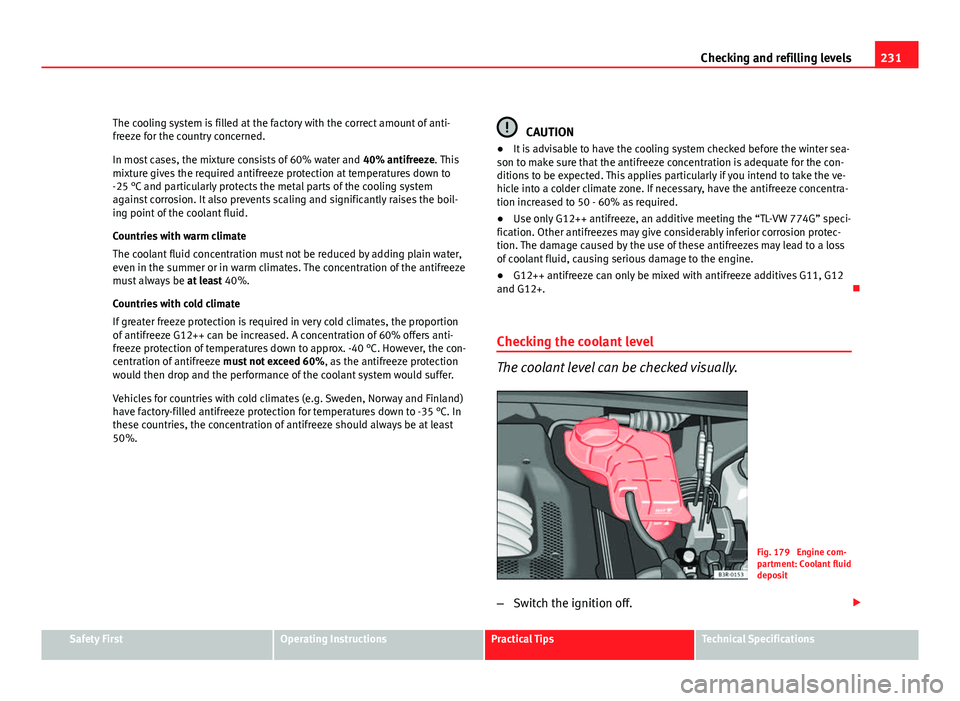
The coolant level can be checked visually.
Fig. 179 Engine com-
partment: Coolant fluid
deposit
– Switch the ignition off.
Safety FirstOperating InstructionsPractical TipsTechnical Specifications
Page 234 of 319
232Checking and refilling levels
–Check the coolant level on coolant fluid expansion tank
⇒ fig. 179. When the engine is cold, it should be between the
“min” and “max” marks. When the engine is hot, it may be
slightly above the “max” mark.
Its location is shown in the corresponding general overview of the engine
compartment.
The coolant level should be checked with the engine switched off.
The coolant level is monitored by a warning lamp on the instrument panel
display ⇒ page 78. However, we recommend that it should be checked oc-
casionally.
Coolant fluid loss
Any loss of coolant fluid normally indicates a leak in the cooling system. In
this case the cooling system should be inspected by a qualified workshop
without delay. It is not sufficient merely to top up the coolant fluid.
If there are no leaks in the system, a loss of coolant fluid can only occur if
the coolant boils and is forced out of the system as a result of overheating.
CAUTION
Radiator sealants must not be added to the coolant fluid. Such additives
could seriously impair the function of the cooling system.
Topping up the coolant fluid
Be careful when topping up with coolant fluid. – Switch the engine off.
– Wait for the engine to cool down. –
Cover the cap on the expansion tank ⇒ fig. 179 with a cloth,
and carefully unscrew the cap anti-clockwise ⇒
.
– Add coolant fluid.
– Screw on the cap tightly.
Make sure that the coolant fluid meets the required specifications
⇒ page 230, Coolant fluid. Do not use a different type of antifreeze if G12+
+ antifreeze is not available. In this case, use only water and bring the anti-
freeze concentration back up to the correct level as soon as possible.
Always top up with new coolant fluid.
Do not fill above the “max” mark. Excess coolant fluid is forced out of the
system through the valve in the filler cap when the engine gets hot.
If a lot of coolant fluid has been lost, wait for the engine to cool down before
putting in cold coolant. Failure to do so could result in serious engine dam-
age.
WARNING
● The cooling system is under pressure. Do not unscrew the cap on the
expansion tank when the engine is hot. Failure to comply could result in
burns.
● The antifreeze and coolant fluid can be a health hazard. Therefore,
the antifreeze should be stored in the original container in a safe place
out of reach of children. Failure to comply could result in poisoning.
For the sake of the environment
Drained off coolant should not be used again. Drain off the used coolant in-
to a suitable container and dispose of it in the proper manner (observe envi-
ronmental regulations).
Page 235 of 319
233
Checking and refilling levels
Radiator fan
The radiator fan can start running spontaneously. The auxiliary fan can continue to run for as long as 10 minutes after stop-
ping the engine, even after the ignition is switched off. It may also start run-
ning suddenly ⇒
after some while if
● Stored heat raises the coolant temperature, or
● The hot engine compartment is additionally heated up by the sun.
WARNING
When working in the engine compartment be aware that the radiator fan
may start running suddenly, leading to the risk of injury.
Washer fluid and windscreen wiper blades
Windscreen washer system
Plain water is not sufficient for the windscreen washer sys-
tem.
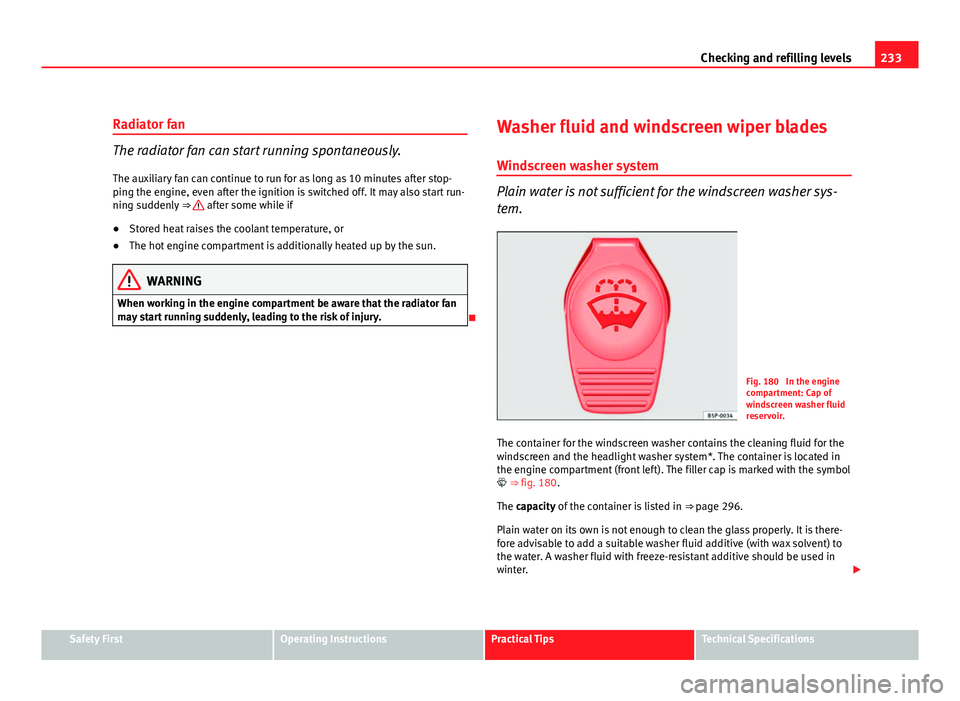
Fig. 180 In the engine
compartment: Cap of
windscreen washer fluid
reservoir.
The container for the windscreen washer contains the cleaning fluid for the
windscreen and the headlight washer system*. The container is located in
the engine compartment (front left). The filler cap is marked with the symbol
⇒ fig. 180.
The capacity of the container is listed in ⇒ page 296.
Plain water on its own is not enough to clean the glass properly. It is there-
fore advisable to add a suitable washer fluid additive (with wax solvent) to
the water. A washer fluid with freeze-resistant additive should be used in
winter.
Safety FirstOperating InstructionsPractical TipsTechnical Specifications
Page 298 of 319
296Technical specifications
Technical specifications
Engine specifications Checking fluid levels
From time to time, the levels of the different fluids in the ve-
hicle must be checked. Never fill with incorrect fluids, other-
wise serious damage to the engine may be caused.
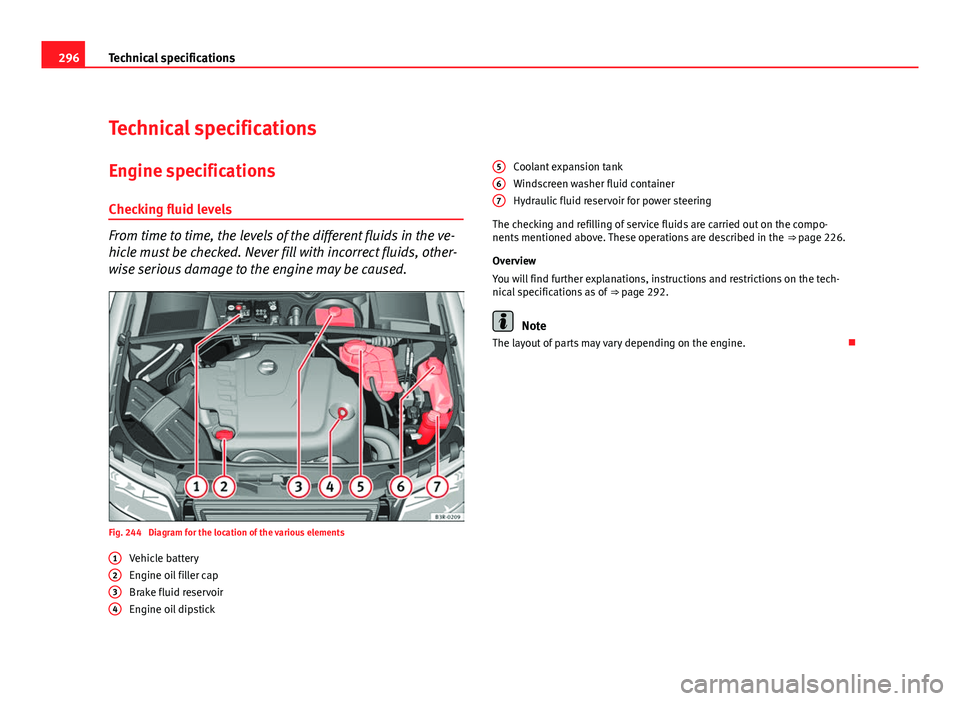
Fig. 244 Diagram for the location of the various elements Vehicle battery
Engine oil filler cap
Brake fluid reservoir
Engine oil dipstick
1
234
Coolant expansion tank
Windscreen washer fluid container
Hydraulic fluid reservoir for power steering
The checking and refilling of service fluids are carried out on the compo-
nents mentioned above. These operations are described in the ⇒ page 226.
Overview
You will find further explanations, instructions and restrictions on the tech-
nical specifications as of ⇒ page 292.
Note
The layout of parts may vary depending on the engine.
567
Page 310 of 319
Bonnet . . . . . . . . . . . . . . . . . . . . . . . . . . . . . . . 225Closing . . . . . . . . . . . . . . . . . . . . . . . . . . . . 227
Opening . . . . . . . . . . . . . . . . . . . . . . . . . . . 226
Releasing . . . . . . . . . . . . . . . . . . . . . . . . . . 225
Brake light Failure control . . . . . . . . . . . . . . . . . . . . . . . . 80
Brake pads . . . . . . . . . . . . . . . . . . . . . . . . . . . . 196
Brakes . . . . . . . . . . . . . . . . . . . . . . . . . . . . . . . . 196 Brake assist system . . . . . . . . . . . . . . . . . . 192
Brake fluid . . . . . . . . . . . . . . . . . . . . . . . . . 236
Worn brake pads . . . . . . . . . . . . . . . . . . . . . 81
Brake servo . . . . . . . . . . . . . . . . . . . . . . . . . . . . 196
Brake system Brakes . . . . . . . . . . . . . . . . . . . . . . . . . . . . . 193
Brake servo . . . . . . . . . . . . . . . . . . . . . . . . . 193
Malfunction . . . . . . . . . . . . . . . . . . . . . . . . . 77
Braking distance . . . . . . . . . . . . . . . . . . . . . . . 196
Bulb change general notes . . . . . . . . . . . . . . . . . . . . . . . 264
C
Car care Exterior . . . . . . . . . . . . . . . . . . . . . . . . . . . . 212
Catalytic converter . . . . . . . . . . . . . . . . . . . . . . 197
CCS . . . . . . . . . . . . . . . . . . . . . . . . . . . . . . . . . . 179
CD-ROM player . . . . . . . . . . . . . . . . . . . . . . . . . 148
Central locking . . . . . . . . . . . . . . . . . . . . . . . . . . 99 Manual locking . . . . . . . . . . . . . . . . . . . . . . 102
Sunroof: opening and closing . . . . . . . . . . 113 Central locking system
Anti-theft security system . . . . . . . . . . . . . 100
Locking . . . . . . . . . . . . . . . . . . . . . . . . . . . . 100
Locking and unlocking the vehicle from in-side . . . . . . . . . . . . . . . . . . . . . . . . . . . . . 101
Opening and closing the windows . . . . . . 111
Security central locking . . . . . . . . . . . . . . . 101
Switch on the driver door . . . . . . . . . . . . . . 101
Tailgate . . . . . . . . . . . . . . . . . . . . . . . . . . . . 103
Unlocking . . . . . . . . . . . . . . . . . . . . . . . . . . . 99
Cetane number . . . . . . . . . . . . . . . . . . . . . . . . . 224
Changing the main headlight bulb Main headlight . . . . . . . . . . . . . . . . . . . . . . 268
Changing the main headlight bulbs Dipped beam headlight . . . . . . . . . . . . . . . 269
Changing the tail lights Luggage compartment lights . . . . . . . . . . 284
Changing windscreen wiper blades . . . . . . . . 234
Chassis number . . . . . . . . . . . . . . . . . . . . . . . . 293
Childproof lock Rear doors . . . . . . . . . . . . . . . . . . . . . . . . . . 104
Child safety . . . . . . . . . . . . . . . . . . . . . . . . . . . . . 47
Child safety seat ISOFIX system . . . . . . . . . . . . . . . . . . . . . . . . 53
Child seat . . . . . . . . . . . . . . . . . . . . . . . . . . . . . . 49 Categorisation in groups . . . . . . . . . . . . . . . 49
Group 1 . . . . . . . . . . . . . . . . . . . . . . . . . . . . . 50
Group 2 . . . . . . . . . . . . . . . . . . . . . . . . . . . . . 50
Group 3 . . . . . . . . . . . . . . . . . . . . . . . . . . . . . 50
Groups 0 and 0+ . . . . . . . . . . . . . . . . . . . . . . 49
Safety notes . . . . . . . . . . . . . . . . . . . . . . . . . 47
Securing . . . . . . . . . . . . . . . . . . . . . . . . . . . . 52 Child seats
on the front passenger seat . . . . . . . . . . . . . 30
Cigarette lighter . . . . . . . . . . . . . . . . . . . . . . . . 154
Cleaning alloy wheel rims . . . . . . . . . . . . . . . . 216
Cleaning chrome . . . . . . . . . . . . . . . . . . . . . . . 215
Cleaning engine compartment . . . . . . . . . . . . 217
Cleaning steel wheel rims . . . . . . . . . . . . . . . . 215
Cleaning windows . . . . . . . . . . . . . . . . . . . . . . 214
Clock, setting . . . . . . . . . . . . . . . . . . . . . . . . . . . 61
Cloth seat covers cleaning . . . . . . . . . . . . . . . . 218
Coat hooks . . . . . . . . . . . . . . . . . . . . . . . . . . . . 159
Cockpit . . . . . . . . . . . . . . . . . . . . . . . . . . . . . . . . 57 Overview . . . . . . . . . . . . . . . . . . . . . . . . . . . . 57
Compartments . . . . . . . . . . . . . . . . . . . . . . . . . 158 In the door trim . . . . . . . . . . . . . . . . . . . . . . 159
In the front seats . . . . . . . . . . . . . . . . . . . . 160
Coolant Checking the level . . . . . . . . . . . . . . . . . . . 231
Coolant fluid Antifreeze . . . . . . . . . . . . . . . . . . . . . . . . . . 230
Coolant fluid additive . . . . . . . . . . . . . . . . . 230
Topping up . . . . . . . . . . . . . . . . . . . . . . . . . 232
Cooling system Coolant temperature gauge . . . . . . . . . . . . . 60
Malfunction . . . . . . . . . . . . . . . . . . . . . . . . . 78
Correct adjustment of front seat head re- straints . . . . . . . . . . . . . . . . . . . . . . . . . . . . . . . 13
Correct adjustment of rear seat head restraints In-use and non-use positions . . . . . . . . . . . 14
Correct sitting position Front passenger . . . . . . . . . . . . . . . . . . . . . . 12
Incorrect sitting position . . . . . . . . . . . . . . . 14
308 Index