oil change Seat Exeo ST 2011 User Guide
[x] Cancel search | Manufacturer: SEAT, Model Year: 2011, Model line: Exeo ST, Model: Seat Exeo ST 2011Pages: 319, PDF Size: 5.12 MB
Page 248 of 319
246Wheels and tyres
Wheel balance
The wheels on new vehicles are balanced. However, various factors encoun-
tered in normal driving can cause them to become unbalanced, which re-
sults in steering vibration.
Unbalanced wheels should be rebalanced, as they otherwise cause exces-
sive wear on steering, suspension and tyres. A wheel must also be reba-
lanced when a new tyre is fitted.
Incorrect wheel alignment
Incorrect wheel alignment causes excessive tyre wear, impairing the safety
of the vehicle. If tyres show excessive wear, you should have the wheel
alignment checked by an Authorised Service Centre.
WARNING
There is a serious danger of accidents if a tyre bursts during driving!
● The tyres must be replaced at the latest when the tread wear indica-
tors are worn ⇒ page 245. Failure to do so could result in an accident.
Worn tyres do not grip well at high speeds on wet roads. There is also a
greater risk of aquaplaning.
● At continuously high speeds, a tyre with insufficient pressure flexes
more. This causes it to overheat. This can cause tread separation and tyre
blow-out. Risk of accident. Always observe the recommended tyre pres-
sures.
● If tyres show excessive wear, you should have the running gear
checked by an Authorised Service Centre.
● Keep chemicals such as oil, fuel and brake fluid away from tyres.
● Damaged wheels and tyres must be replaced immediately!
For the sake of the environment
Under-inflated tyres will increase fuel consumption. Run-flat tyres*
Run-flat tyres allow you to continue driving even with a
punctured tyre, in the majority of cases.
In vehicles that are factory-fitted with run-flat tyres 1)
the loss of tyre
pressure is indicated on the instrument panel.
Driving with run-flat tyres (emergency running)
– Leave the ESP/TCS (Electronic Stability Programme) switched
on, or switch on ⇒ page 68.
– Continue driving carefully and slowly (80 km/h maximum).
– Avoid sudden manoeuvres and sharp turns.
– Avoid driving over obstacles (for example kerbs) or potholes.
– Look out for the ESP/TCS intervening often, smoke coming from
the tyres or the smell of rubber, the vehicle vibrating or a clat-
tering noise. If any of these occur, stop the vehicle.
The run-flat tyres have a tag on the side of the tyre, with the description:
“DSST”, “Eufonia”, “RFT”, “ROF”, “RSC”, “SSR” or “ZP”.
The sides of this type of tyre are reinforced. When the tyres lose air they are
supported on the sides (emergency driving).
The loss of pressure in the tyre is shown on the instrument panel. You can
then drive a maximum of 80 km and if the circumstances are favourable (for
example, low load), even more.
The damaged tyre should be changed as soon as possible. The rim should
be checked in a specialist workshop to detect possible damage and replace
1)
Depending upon version and country.
Page 261 of 319
259
If and when
The sealing compound must not be used in the following cases:
● If the cuts and punctures on the tyre are longer than 4 mm ⇒ fig. 197 1
●
If the wheel rim has been damaged 2●
If you have been driving with very low pressure or a completely flat tyre
3
How to use the TMS (tyre mobility system) is described in the section Re-
pairing a tyre ⇒ page 260 and in the instructions supplied with the tyre
sealant can.
The TMS (tyre mobility system) can be used at outside temperatures down
to -20 °C.
WARNING
After repairing a tyre please note the following points:
● Do not drive faster than 80 km/h.
● Avoid heavy acceleration, hard braking and fast cornering.
● Vehicle handling could be impaired.
● Tyres which have been sealed using the Tyre Mobility System are only
suitable for temporary use over a short period.
● After using the tyre sealant the tyre pressure monitoring system* may
malfunction. Therefore, please drive carefully to the next available quali-
fied workshop.
● The Tyre Mobility System must NOT be used:
– If the cuts and punctures on the tyre are longer or wider than
4 mm.
– if the wheel rim has been damaged.
– if you have been driving with very low pressure or a completely flat
tyre.
● Seek professional assistance if the repair of a tyre puncture is not
possible with the sealing compound.
WARNING (Continued)
● Do not allow the sealant to come into contact with your eyes, skin or
clothing.
● If you do come into contact with the sealant immediately rinse the
eyes or skin affected with clean water.
● Change clothing immediately if it becomes soiled with the tyre seal-
ant.
● Make sure you do not breathe in the fumes!
● If any of the tyre sealant is accidentally ingested, immediately rinse
the mouth thoroughly and drink lots of water.
–Do not induce vomiting. Seek medical assistance if needed.
● If any allergic reactions should occur get medical help immediately.
● Keep the sealant away from children.
For the sake of the environment
If you have to dispose of a sealant can, go to a specialised waste service or
to a SEAT Technical Service, where the product can be recycled in an appro-
priate waste container.
Note
● If sealant should leak out, leave it to dry. This way you can pull it off like
a piece of foil.
● Observe the expiry date stated on the sealing compound can. Have the
sealing compound exchanged by a specialised workshop.
Safety FirstOperating InstructionsPractical TipsTechnical Specifications
Page 299 of 319
297
Technical specifications
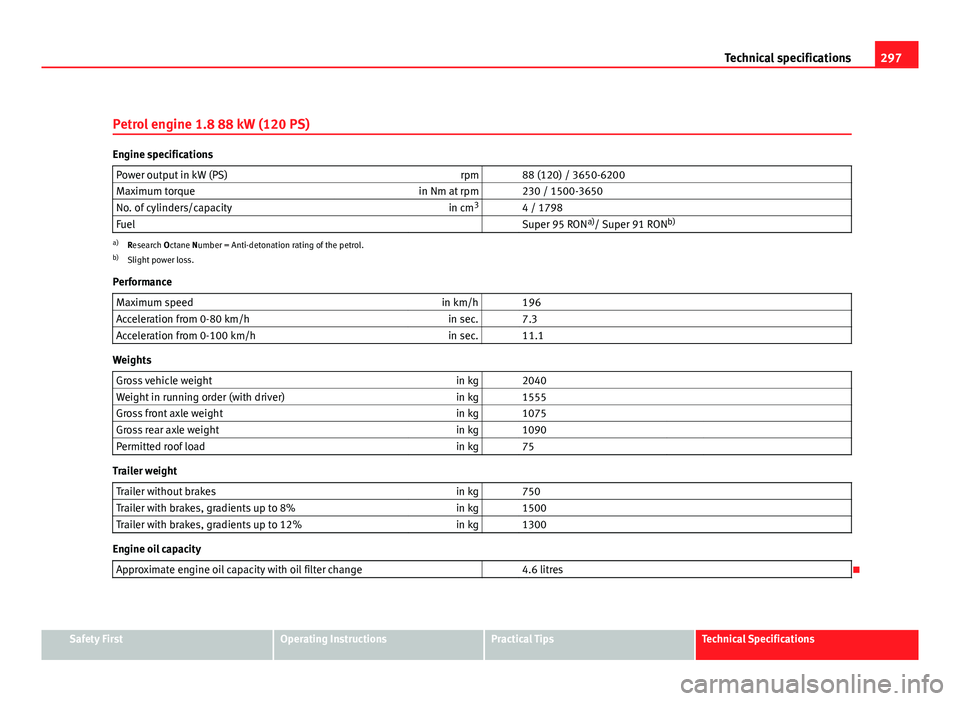
Petrol engine 1.8 88 kW (120 PS)
Engine specifications Power output in kW (PS) rpm 88 (120) / 3650-6200
Maximum torque in Nm at rpm 230 / 1500-3650
No. of cylinders/capacity in cm3
4 / 1798
Fuel Super 95 RON a)
/ Super 91 RON b)
a)
Research Octane Number = Anti-detonation rating of the petrol.
b) Slight power loss.
Performance Maximum speed in km/h 196
Acceleration from 0-80 km/h in sec. 7.3
Acceleration from 0-100 km/h in sec. 11.1
Weights
Gross vehicle weight in kg 2040
Weight in running order (with driver) in kg 1555
Gross front axle weight in kg 1075
Gross rear axle weight in kg 1090
Permitted roof load in kg 75
Trailer weight
Trailer without brakes in kg 750
Trailer with brakes, gradients up to 8% in kg 1500
Trailer with brakes, gradients up to 12% in kg 1300
Engine oil capacity
Approximate engine oil capacity with oil filter change 4.6 litres
Safety FirstOperating InstructionsPractical TipsTechnical Specifications
Page 300 of 319
298Technical specifications
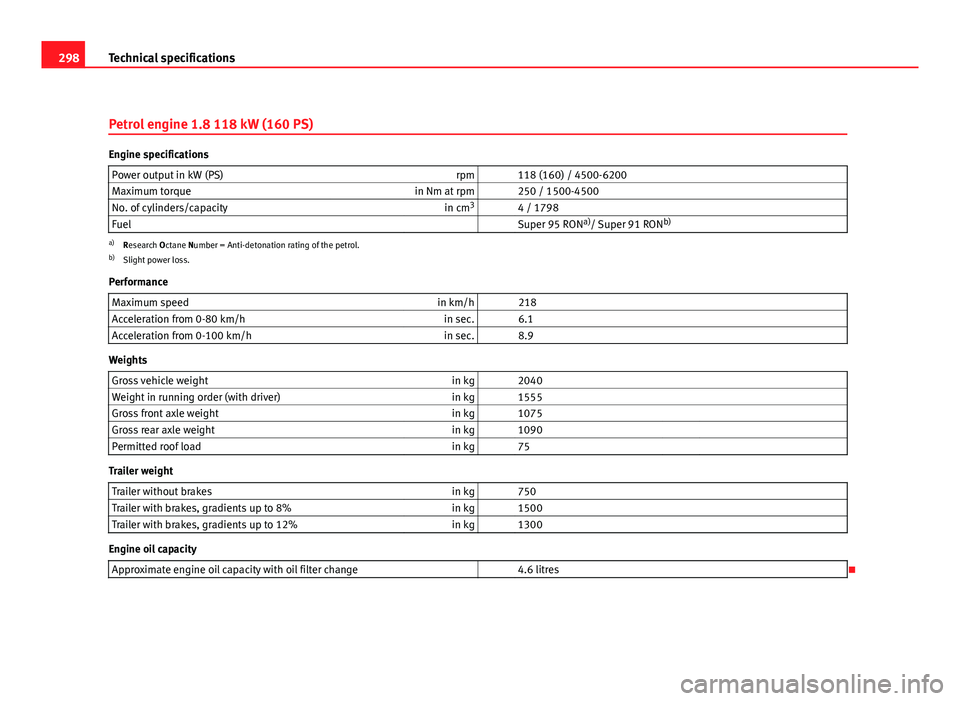
Petrol engine 1.8 118 kW (160 PS)
Engine specifications
Power output in kW (PS) rpm 118 (160) / 4500-6200
Maximum torque in Nm at rpm 250 / 1500-4500
No. of cylinders/capacity in cm3
4 / 1798
Fuel Super 95 RON a)
/ Super 91 RON b)
a)
Research Octane Number = Anti-detonation rating of the petrol.
b) Slight power loss.
Performance Maximum speed in km/h 218
Acceleration from 0-80 km/h in sec. 6.1
Acceleration from 0-100 km/h in sec. 8.9
Weights
Gross vehicle weight in kg 2040
Weight in running order (with driver) in kg 1555
Gross front axle weight in kg 1075
Gross rear axle weight in kg 1090
Permitted roof load in kg 75
Trailer weight
Trailer without brakes in kg 750
Trailer with brakes, gradients up to 8% in kg 1500
Trailer with brakes, gradients up to 12% in kg 1300
Engine oil capacity
Approximate engine oil capacity with oil filter change 4.6 litres
Page 302 of 319
300Technical specifications
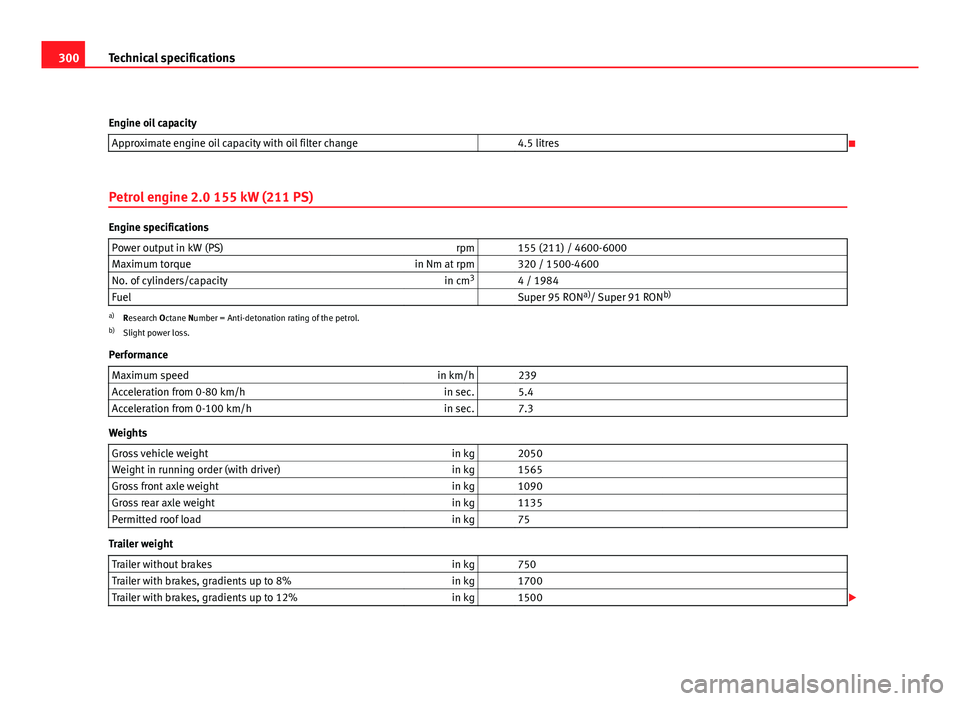
Engine oil capacity Approximate engine oil capacity with oil filter change 4.5 litres
Petrol engine 2.0 155 kW (211 PS)
Engine specifications Power output in kW (PS) rpm 155 (211) / 4600-6000
Maximum torque in Nm at rpm 320 / 1500-4600
No. of cylinders/capacity in cm3
4 / 1984
Fuel Super 95 RON a)
/ Super 91 RON b)
a)
Research Octane Number = Anti-detonation rating of the petrol.
b) Slight power loss.
Performance Maximum speed in km/h 239
Acceleration from 0-80 km/h in sec. 5.4
Acceleration from 0-100 km/h in sec. 7.3
Weights
Gross vehicle weight in kg 2050
Weight in running order (with driver) in kg 1565
Gross front axle weight in kg 1090
Gross rear axle weight in kg 1135
Permitted roof load in kg 75
Trailer weight
Trailer without brakes in kg 750
Trailer with brakes, gradients up to 8% in kg 1700
Trailer with brakes, gradients up to 12% in kg 1500
Page 303 of 319
301
Technical specifications
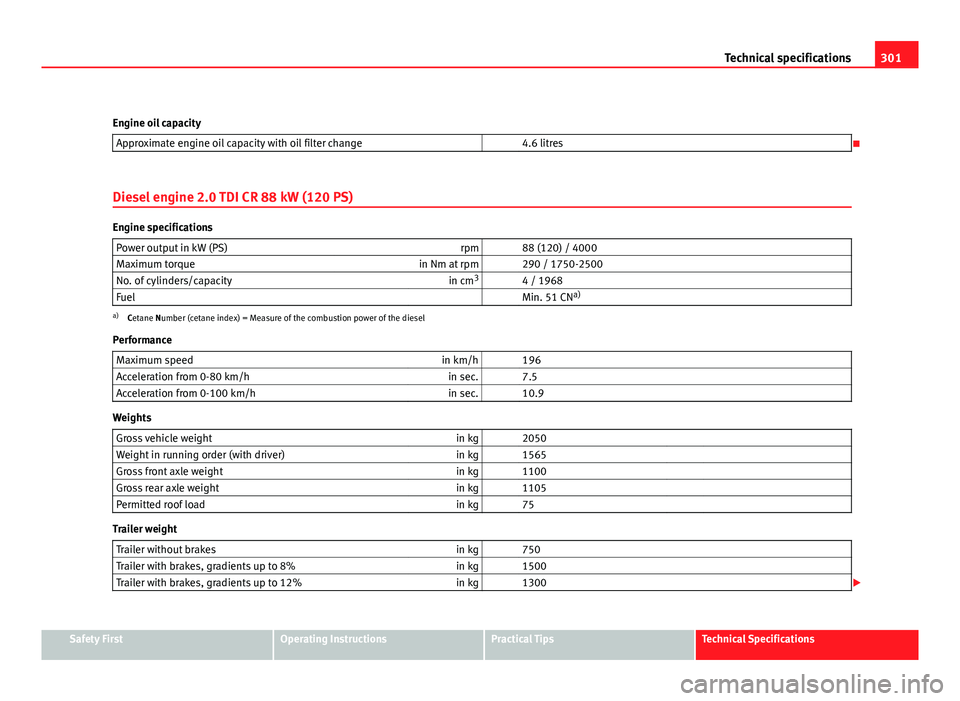
Engine oil capacity Approximate engine oil capacity with oil filter change 4.6 litres
Diesel engine 2.0 TDI CR 88 kW (120 PS)
Engine specifications Power output in kW (PS) rpm 88 (120) / 4000
Maximum torque in Nm at rpm 290 / 1750-2500
No. of cylinders/capacity in cm3
4 / 1968
Fuel Min. 51 CN a)
a)
Cetane Number (cetane index) = Measure of the combustion power of the diesel
Performance Maximum speed in km/h 196
Acceleration from 0-80 km/h in sec. 7.5
Acceleration from 0-100 km/h in sec. 10.9
Weights
Gross vehicle weight in kg 2050
Weight in running order (with driver) in kg 1565
Gross front axle weight in kg 1100
Gross rear axle weight in kg 1105
Permitted roof load in kg 75
Trailer weight
Trailer without brakes in kg 750
Trailer with brakes, gradients up to 8% in kg 1500
Trailer with brakes, gradients up to 12% in kg 1300
Safety FirstOperating InstructionsPractical TipsTechnical Specifications
Page 304 of 319
302Technical specifications
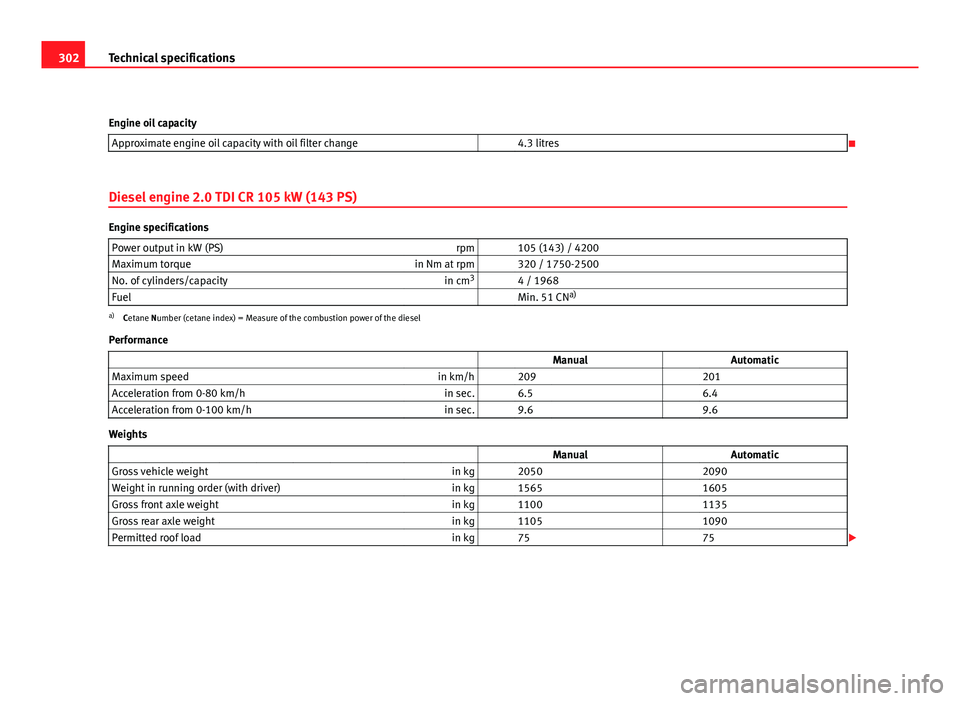
Engine oil capacity Approximate engine oil capacity with oil filter change 4.3 litres
Diesel engine 2.0 TDI CR 105 kW (143 PS)
Engine specifications Power output in kW (PS) rpm 105 (143) / 4200
Maximum torque in Nm at rpm 320 / 1750-2500
No. of cylinders/capacity in cm3
4 / 1968
Fuel Min. 51 CN a)
a)
Cetane Number (cetane index) = Measure of the combustion power of the diesel
Performance ManualAutomatic
Maximum speed in km/h 209 201
Acceleration from 0-80 km/h in sec. 6.5 6.4
Acceleration from 0-100 km/h in sec. 9.6 9.6
Weights
Manual Automatic
Gross vehicle weight in kg 2050 2090
Weight in running order (with driver) in kg 1565 1605
Gross front axle weight in kg 1100 1135
Gross rear axle weight in kg 1105 1090
Permitted roof load in kg 75 75
Page 305 of 319
303
Technical specifications
Trailer weight ManualAutomatic
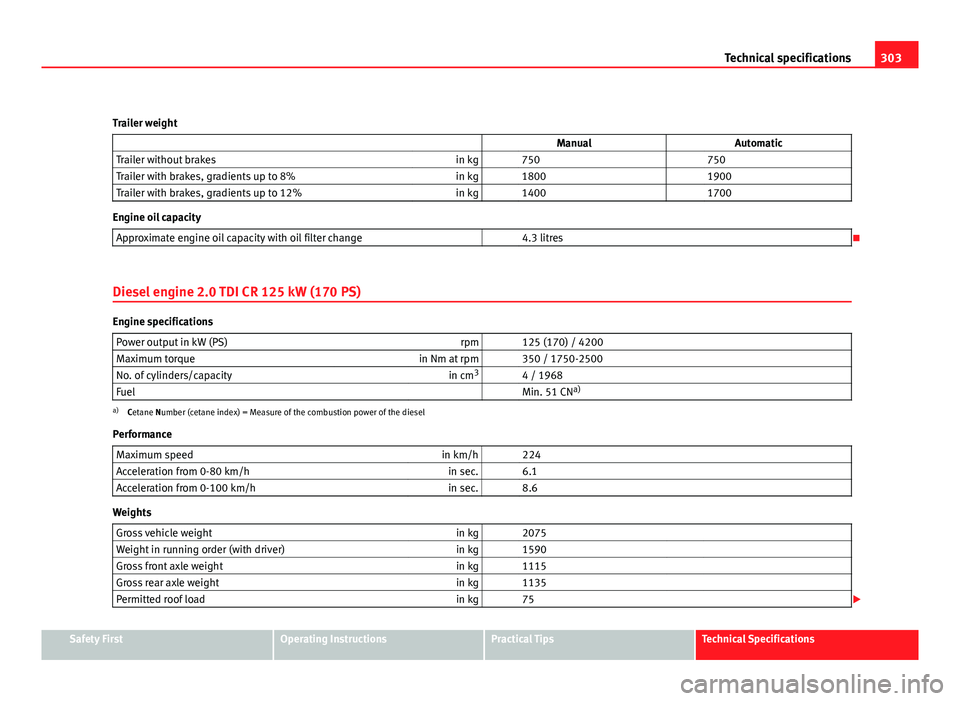
Trailer without brakes in kg 750 750
Trailer with brakes, gradients up to 8% in kg 1800 1900
Trailer with brakes, gradients up to 12% in kg 1400 1700
Engine oil capacity
Approximate engine oil capacity with oil filter change 4.3 litres
Diesel engine 2.0 TDI CR 125 kW (170 PS)
Engine specifications Power output in kW (PS) rpm 125 (170) / 4200
Maximum torque in Nm at rpm 350 / 1750-2500
No. of cylinders/capacity in cm3
4 / 1968
Fuel Min. 51 CN a)
a)
Cetane Number (cetane index) = Measure of the combustion power of the diesel
Performance Maximum speed in km/h 224
Acceleration from 0-80 km/h in sec. 6.1
Acceleration from 0-100 km/h in sec. 8.6
Weights
Gross vehicle weight in kg 2075
Weight in running order (with driver) in kg 1590
Gross front axle weight in kg 1115
Gross rear axle weight in kg 1135
Permitted roof load in kg 75
Safety FirstOperating InstructionsPractical TipsTechnical Specifications
Page 306 of 319
304Technical specifications
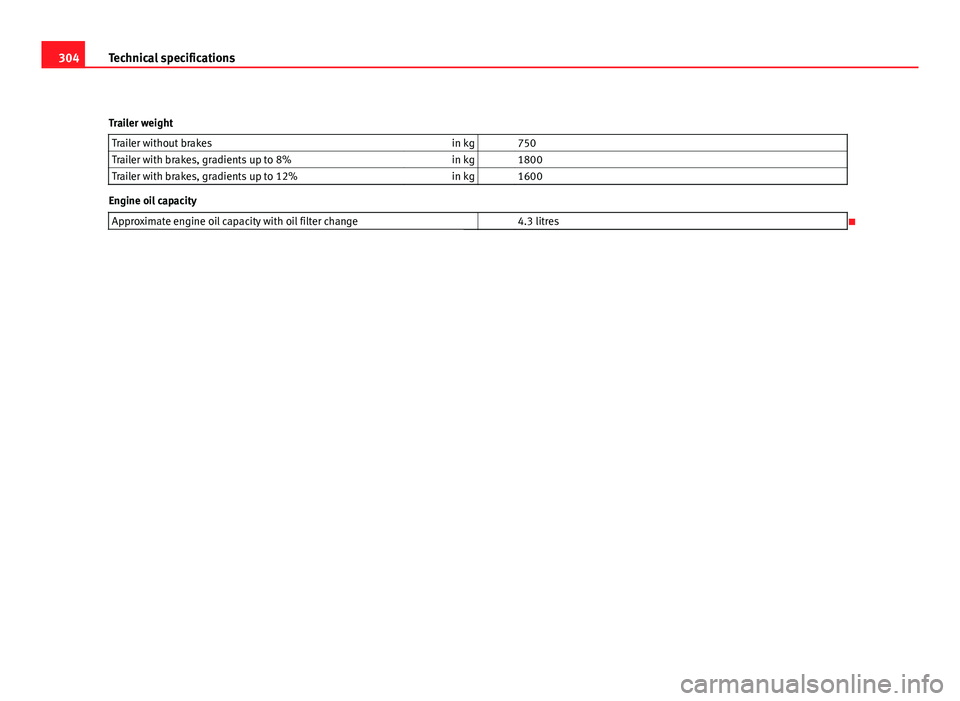
Trailer weight Trailer without brakes in kg 750
Trailer with brakes, gradients up to 8% in kg 1800
Trailer with brakes, gradients up to 12% in kg 1600
Engine oil capacity
Approximate engine oil capacity with oil filter change 4.3 litres