heating Seat Exeo ST 2011 Owner's Guide
[x] Cancel search | Manufacturer: SEAT, Model Year: 2011, Model line: Exeo ST, Model: Seat Exeo ST 2011Pages: 319, PDF Size: 5.12 MB
Page 201 of 319
199
Driving and the environment
Avoid idling
It is worthwhile switching off the engine when waiting in a traffic jam, at lev-
el crossings or at traffic lights with a long red phase. The fuel saved after
only 30 - 40 seconds is greater than the amount of fuel needed to restart
the engine.
The engine takes a long time to warm up when it is idling. Mechanical wear
and pollutant emissions are also especially high during this initial warm-up
phase. It is therefore best to drive off immediately after starting the engine.
Avoid running the engine at high speed.
Periodic maintenance
Periodic maintenance work guarantees that, before beginning a journey,
you will not consume more than the required amount of fuel. A well-serviced
engine gives you the benefit of improved fuel efficiency as well as maxi-
mum reliability and an enhanced resale value.
A badly serviced engine can consume up to 10% more fuel than necessary.
Avoid short journeys
To reduce the consumption and emission of polluting gases, the engine and
the exhaust filtration systems should reach the optimum service tempera-
ture.
With the engine cold, fuel consumption is proportionally higher. The engine
does not warm up and fuel consumption does not normalise until having
driven approximately four kilometres. This is why we recommend avoiding
short trips whenever possible.
Maintain the correct tyre pressures
Bear in mind that keeping the tyres at an adequate pressure saves fuel. If
the tyre pressure is just one bar too low, fuel consumption can increase by
as much as 5%. Due to the greater rolling resistance, under-inflation also
increases tyre wear and impairs handling.
The tyre pressures should always be checked when the tyres are cold.Do not use
winter tyres all year round as they increase fuel consumption by
up to 10%.
Avoid unnecessary weight
Every kilo of extra weight will put up the fuel consumption, so it is worth
checking the luggage compartment occasionally to make sure that no un-
necessary loads are being transported.
A roof rack is often left in place for the sake of convenience, even when it is
no longer needed. At a speed of 100-120 km/h your vehicle will use about
12% more fuel as a result of the extra wind resistance caused by the roof
rack even when it is not in use.
Save electricity
The engine activates the alternator, which produces electricity. With the
need for electricity, fuel consumption is also increased. Because of this, al-
ways turn off electrical components when you do not need them. Examples
of components that use a lot of electricity are: the fan at high speeds, the
rear window heating or the seat heaters*.
Note
● If you vehicle has Start-Stop, it is not recommended to disconnect this
function.
● It is recommended to close the windows when driving at more than 60
km/h
● Do not drive with your foot resting on the clutch pedal, as the pressure
can make the plate spin, more fuel will be used and it can burn the clutch
plate lining, causing a serious fault.
● Do not hold the vehicle on a hill with the clutch, use the foot brake or
hand brake, using the latter to start. The fuel consumption will be lower and
you will prevent the clutch plate from being damaged.
● On descents, use the engine brake, changing to the gear that is more
suitable for the slope. The fuel consumption will be lower and the brakes
will not suffer.
Safety FirstOperating InstructionsPractical TipsTechnical Specifications
Page 204 of 319
202Trailer towing
Where possible, operate the trailer with the maximum permitted drawbar
load on the ball joint of the towing bracket, but do not exceed the specified
limit.
Tyre pressure
Check the tyre pressures on your vehicle, and adjust for “full load” condi-
tions (refer to the sticker listing the tyre pressures on the door pillar). It may
also be necessary to adjust the tyre pressures on the trailer according to the
recommendations of the trailer manufacturer.
Exterior mirrors
Check whether you can see enough of the road behind the trailer with the
standard mirrors. If this is not the case you should have additional mirrors
fitted. The two exterior mirrors should be fitted on folding arms. Adjust the
mirrors to give sufficient rear vision.
Headlights
Before starting a journey, check the headlight beam settings with the trailer
hitched up. If necessary, alter the height of the headlight beams by means
of the headlight range control. See ⇒ page 119.
Power supply
When you remove the ignition key, the power supply to the trailer is inter-
rupted.
Removable ball joint coupling
Vehicles with a factory-fitted towing bracket are equipped with a removable
ball joint coupling. This is stored in the spare wheel well in the luggage
compartment together with the necessary fitting instructions.
Note
If you frequently tow, we recommend you also have the vehicle serviced be-
tween services. Notes on towing
Towing a trailer involves additional attention by the driver.
Weight distribution
The weight distribution of a loaded trailer with an unladen vehicle is very
unfavourable. However, if this cannot be avoided, drive extra slow to allow
for the unbalanced weight distribution.
Speed
The stability of the vehicle and trailer is reduced with increasing speed.
Therefore, it is advisable not to drive at the maximum permissible speed in
unfavourable road, weather or wind conditions. This especially applies
when driving downhill.
You should always reduce speed immediately if the trailer shows the slight-
est sign of swaying. Never try to stabilise the trailer by accelerating.
Anticipate hazards and brake in good time. If towing a trailer with an inertia
brake, first brake gently and then harder. This will prevent brake tapping by
the trailer wheels when they lock. Select a low gear in due course before go-
ing down a steep downhill. This enables you to use the engine braking to
slow down the vehicle.
Swaying and pitching can be reduced by stabiliser aids. We recommend
having stabiliser aids installed when towing trailers with a high trailer
weight. They can be purchased and installed at a Technical Service.
Reheating
When climbing long hills in hot weather with the engine running fast in low
gear, you should keep an eye on the coolant temperature gauge ⇒ page 60.
Reduce speed immediately if the needle moves to the right end of the scale.
If the temperature warning lamp in the instrument panel should start
flashing, stop the vehicle and let the engine cool down by running it at
idling speed for a few minutes.
Page 217 of 319
215
Vehicle maintenance and cleaning
CAUTION
● Never use warm or hot water to remove snow and ice from windows and
mirrors. This could cause the glass to crack!
● The heating element for the rear window is located on the inner side of
the window. To prevent damage, do not put stickers on the heating ele-
ments inside the window.
Cleaning windscreen wiper blades
Clean wiper blades improve visibility.
1. Use a soft cloth to remove dust and dirt from the windscreen wiper blades.
2. Use window cleaner to clean the windscreen wiper blades. Use a sponge or a cloth to remove stubborn dirt.
Rubber seals maintenance
If rubber seals are well looked after, they will not freeze so
quickly. 1. Use a soft cloth to remove dust and dirt from the rubber seals.
2. Apply a specialist care product to the rubber seals.
The rubber strips on the doors, windows, bonnet and tailgate will remain
pliable and last longer if they are treated with a suitable care product (for
example silicone spray). Caring for rubber seals will also prevent premature ageing and leaks. The
doors will be easier to open. If rubber seals are well looked after, they will
not freeze so quickly in winter.
Door lock cylinders
The door lock cylinders can freeze up in winter.
To de-ice the lock cylinders you should only use spray with lubricating and
anti-corrosive properties.
Cleaning chrome parts
1. Clean chrome parts with a damp cloth.
2. Polish chrome parts with a soft, dry cloth. If this does not provide satisfying results, use a specialist chrome cleaning
product. Chrome cleaning products will remove stains from the surface.
CAUTION
To prevent scratching chrome surfaces:
● Never use an abrasive cleaning product on chrome.
● Do not clean or polish chrome parts in a sandy or dusty environment.
Steel wheel rims
– Clean steel wheel rims regularly using a separate sponge.
Safety FirstOperating InstructionsPractical TipsTechnical Specifications
Page 234 of 319
232Checking and refilling levels
–Check the coolant level on coolant fluid expansion tank
⇒ fig. 179. When the engine is cold, it should be between the
“min” and “max” marks. When the engine is hot, it may be
slightly above the “max” mark.
Its location is shown in the corresponding general overview of the engine
compartment.
The coolant level should be checked with the engine switched off.
The coolant level is monitored by a warning lamp on the instrument panel
display ⇒ page 78. However, we recommend that it should be checked oc-
casionally.
Coolant fluid loss
Any loss of coolant fluid normally indicates a leak in the cooling system. In
this case the cooling system should be inspected by a qualified workshop
without delay. It is not sufficient merely to top up the coolant fluid.
If there are no leaks in the system, a loss of coolant fluid can only occur if
the coolant boils and is forced out of the system as a result of overheating.
CAUTION
Radiator sealants must not be added to the coolant fluid. Such additives
could seriously impair the function of the cooling system.
Topping up the coolant fluid
Be careful when topping up with coolant fluid. – Switch the engine off.
– Wait for the engine to cool down. –
Cover the cap on the expansion tank ⇒ fig. 179 with a cloth,
and carefully unscrew the cap anti-clockwise ⇒
.
– Add coolant fluid.
– Screw on the cap tightly.
Make sure that the coolant fluid meets the required specifications
⇒ page 230, Coolant fluid. Do not use a different type of antifreeze if G12+
+ antifreeze is not available. In this case, use only water and bring the anti-
freeze concentration back up to the correct level as soon as possible.
Always top up with new coolant fluid.
Do not fill above the “max” mark. Excess coolant fluid is forced out of the
system through the valve in the filler cap when the engine gets hot.
If a lot of coolant fluid has been lost, wait for the engine to cool down before
putting in cold coolant. Failure to do so could result in serious engine dam-
age.
WARNING
● The cooling system is under pressure. Do not unscrew the cap on the
expansion tank when the engine is hot. Failure to comply could result in
burns.
● The antifreeze and coolant fluid can be a health hazard. Therefore,
the antifreeze should be stored in the original container in a safe place
out of reach of children. Failure to comply could result in poisoning.
For the sake of the environment
Drained off coolant should not be used again. Drain off the used coolant in-
to a suitable container and dispose of it in the proper manner (observe envi-
ronmental regulations).
Page 244 of 319
242Wheels and tyres
2. The tyre pressures should only be checked when the tyres are
cold. The slightly raised pressures of warm tyres must not be re-
duced.
3. Adjust the tyre pressure to the load you are carrying.
Tyre pressure
The correct tyre pressure is especially important at high speeds. The pres-
sure should therefore be checked at least once a month and before starting
a journey.
The sticker with the tyre pressure values can be found on the inside of the
tank flap. The tyre pressure values given are for cold tyres. Do not reduce
the slightly raised pressures of warm tyres ⇒
.
WARNING
● Check the tyre pressure at least once per month. Checking the tyre
pressure is very important. If the tyre pressure is too high or too low,
there is an increased danger of accidents - particularly at high speeds.
● A tyre can easily burst if the pressure is too low, causing an accident!
● At continuously high speeds, a tyre with insufficient pressure flexes
more. In this way it becomes too hot, and this can cause tread separation
and tyre blow-out. Always observe the recommended tyre pressures.
● If the tyre pressure is too low or too high, the tyres will wear prema-
turely and the vehicle will not handle well. Risk of accident!
For the sake of the environment
Under-inflated tyres will increase fuel consumption. Tyre pressure monitoring*
The tyre pressure monitoring system constantly checks the
pressure of the tyres.
The system warns the driver in the event of a loss of pressure by means of
symbols and messages in the instrument panel display.
Note that tyre pressure also depends on tyre temperature. Tyre pressure in-
creases about 0.1 bar for each 10 °C in tyre temperature increase. The tyre
heats up while the vehicle is being driven and the tyre pressure will rise ac-
cordingly. For this reason, you should only adjust the tyre pressures when
they are cold (i.e. approximately at ambient temperature).
To ensure that the tyre pressure monitoring system works reliably, you
should check and, if necessary, adjust the tyre pressures at regular intervals
and store the correct pressures (reference values) in the system.
A tyre pressure information label is attached to the inside of the fuel tank
flap.
WARNING
● Never adjust tyre pressure when the tyres are hot. This may damage
or even burst the tyres. Risk of accident!
● An insufficiently inflated tyre flexes a lot more at high speeds and
causes significant heating of the tyre. Under these conditions, the tyre
bead may be released or the tyre may burst. Risk of accident!
For the sake of the environment
Under-inflated tyres lead to increased fuel consumption and tyre wear.
Page 249 of 319
247
Wheels and tyres
it if necessary. We recommend you contact Technical Service. If more than
one tyre is being used under emergency conditions, this reduces the dis-
tance which can be travelled.
Starting driving in emergency conditions
When loss in tyre pressure is displayed on the instrument panel, this means
that at least one tyre is being driven in emergency conditions ⇒
.
End of emergency operation
Do not drive on if:
● smoke is coming from one of the tyres,
● there is a smell of rubber,
● the vehicle vibrates,
● there is a rattling noise.
When is it no longer possible to continue driving even using run-flat tyres?
● If the Electronic Stability Programme (ESP) is out of operation.
● If the tyre pressure monitoring system* does not work.
● If one of the tyres has been severely damaged in an accident, etc. If a
tyre has been badly damaged there is a risk that parts of the tread can be
thrown off and cause damage to the fuel lines, brake pipes or fuel filler.
● It is also advisable to stop driving if severe vibrations occur, or if the
wheel starts overheating and gives off smoke.
WARNING
When driving in emergency conditions, the driving quality of the vehicle
is considerably impaired.
● The maximum permitted speed of 80 km/h is subject to road and
weather conditions. Please observe legal requirements when doing so.
● Avoid sharp turns and rapid manoeuvres, and brake earlier than usu-
al.
WARNING (Continued)
● Avoid driving over obstacles (for example kerbs) or potholes.
● If one or more tyres are being driven in emergency conditions, the
driving quality of the vehicle is impaired and there is a risk of accident.
Note
● The run-flat tyres do not “deflate” on losing pressure because they are
supported on the reinforced sides. Therefore defects in the tyre cannot be
detected with a visual inspection.
● Snow chains must not be used on front tyres used in emergency condi-
tions.
New tyres and wheels
New tyres and wheels have to be run in.
The tyres and wheel rims are an essential part of the vehicle's design. The
tyres and rims approved by SEAT are specially matched to the characteris-
tics of the vehicle and make a major contribution to good road holding and
safe handling ⇒
.
Tyres should be replaced at least in pairs and not individually (i.e. both front
tyres or both rear tyres together). A knowledge of tyre designations makes it
easier to choose the correct tyres. Radial tyres have the tyre designations
marked on the sidewall, for example: 195/65 R15 91T
This contains the following information: Tyre width in mm
Height/width ratio in %
Tyre construction: Radial
195
65
R
Safety FirstOperating InstructionsPractical TipsTechnical Specifications
Page 265 of 319
263
If and when
Fuse assignment
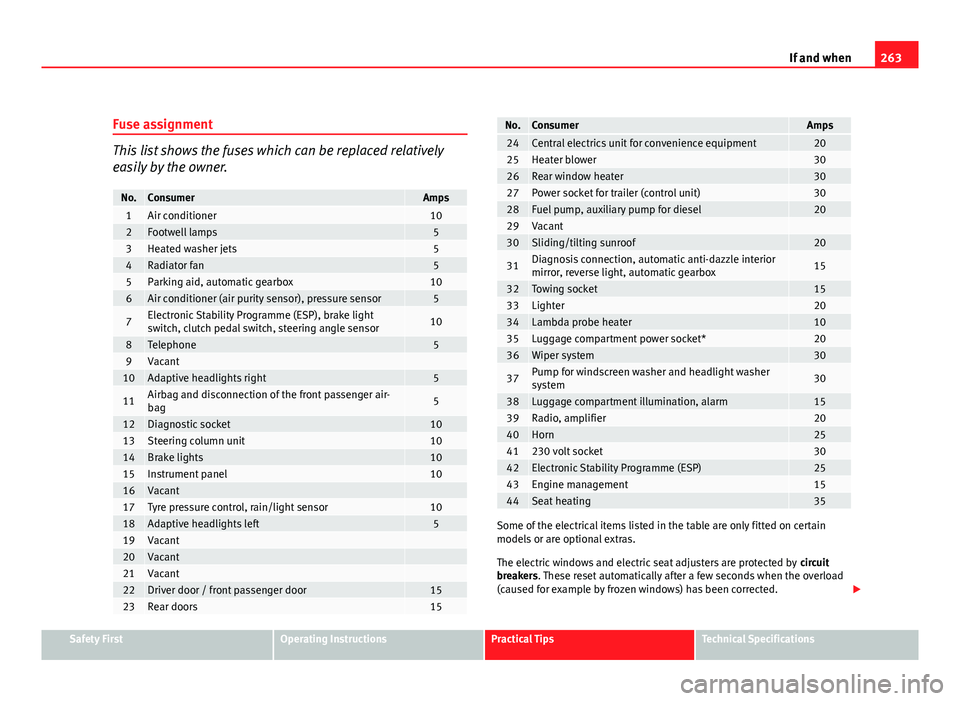
This list shows the fuses which can be replaced relatively
easily by the owner.
No.ConsumerAmps1Air conditioner102Footwell lamps53Heated washer jets54Radiator fan55Parking aid, automatic gearbox106Air conditioner (air purity sensor), pressure sensor5
7Electronic Stability Programme (ESP), brake light
switch, clutch pedal switch, steering angle sensor10
8Telephone59Vacant 10Adaptive headlights right5
11Airbag and disconnection of the front passenger air-
bag5
12Diagnostic socket1013Steering column unit1014Brake lights1015Instrument panel1016Vacant 17Tyre pressure control, rain/light sensor1018Adaptive headlights left519Vacant 20Vacant 21Vacant 22Driver door / front passenger door1523Rear doors15
No.ConsumerAmps24Central electrics unit for convenience equipment2025Heater blower3026Rear window heater3027Power socket for trailer (control unit)3028Fuel pump, auxiliary pump for diesel2029Vacant 30Sliding/tilting sunroof20
31Diagnosis connection, automatic anti-dazzle interior
mirror, reverse light, automatic gearbox15
32Towing socket1533Lighter2034Lambda probe heater1035Luggage compartment power socket*2036Wiper system30
37Pump for windscreen washer and headlight washer
system30
38Luggage compartment illumination, alarm1539Radio, amplifier2040Horn2541230 volt socket3042Electronic Stability Programme (ESP)2543Engine management1544Seat heating35
Some of the electrical items listed in the table are only fitted on certain
models or are optional extras.
The electric windows and electric seat adjusters are protected by circuit
breakers. These reset automatically after a few seconds when the overload
(caused for example by frozen windows) has been corrected.
Safety FirstOperating InstructionsPractical TipsTechnical Specifications
Page 312 of 319
Electronic Stability ProgrammeControl lamp . . . . . . . . . . . . . . . . . . . . . . . . 172
Description . . . . . . . . . . . . . . . . . . . . . . . . . 171
Emergencies Changing a wheel . . . . . . . . . . . . . . . . . . . 254
Disconnecting the battery . . . . . . . . . . . . . 237
Jack . . . . . . . . . . . . . . . . . . . . . . . . . . . 251, 256
Sunroof emergency activation . . . . . . . . . . 113
Tools . . . . . . . . . . . . . . . . . . . . . . . . . . . . . . 251
Tyre mobility system . . . . . . . . . . . . . . . . . . 252
Engine Running in . . . . . . . . . . . . . . . . . . . . . . . . . 196
Starting . . . . . . . . . . . . . . . . . . . . . . . . . . . . 173
Stop . . . . . . . . . . . . . . . . . . . . . . . . . . . . . . . 175
Engine compartment Safety instructions . . . . . . . . . . . . . . . . . . . 226
Engine oil . . . . . . . . . . . . . . . . . . . . . . . . . . . . . 227 Checking oil level . . . . . . . . . . . . . . . . . . . . 229
Checking the level . . . . . . . . . . . . . . . . . . . . 80
Consumption . . . . . . . . . . . . . . . . . . . . . . . 229
Engine oil pressure too low . . . . . . . . . . . . . 78
Oil properties . . . . . . . . . . . . . . . . . . . . . . . 228
Oil sensor defective . . . . . . . . . . . . . . . . . . . 80
Topping up . . . . . . . . . . . . . . . . . . . . . . . . . 230
Engine speed governing . . . . . . . . . . . . . . . . . . 80
Environment . . . . . . . . . . . . . . . . . . . . . . . . . . . 198 Environmental friendliness . . . . . . . . . . . . 200
Roof racks . . . . . . . . . . . . . . . . . . . . . . . . . . 152
Environmentally friendly driving . . . . . . . . . . . 198
Environmental tip Avoiding pollution . . . . . . . . . . . . . . . . . . . 223
ESP see Electronic Stability Programme . . . . . 171 Exhaust gas purification system . . . . . . . . . . . 197
Exterior mirrors . . . . . . . . . . . . . . . . . . . . . . . . . 214
F
Fabric trim cleaning . . . . . . . . . . . . . . . . . . . . . 218
Fastening rings . . . . . . . . . . . . . . . . . . . . . . . . . . 17
Floor mats . . . . . . . . . . . . . . . . . . . . . . . . . . . . . . 16
Fog lights . . . . . . . . . . . . . . . . . . . . . . . . . . . . . 117
Front airbags . . . . . . . . . . . . . . . . . . . . . . . . . . . 33 Description . . . . . . . . . . . . . . . . . . . . . . . . . . 33
Operation . . . . . . . . . . . . . . . . . . . . . . . . . . . 34
Safety notes . . . . . . . . . . . . . . . . . . . . . . . . . 36
Front drink holder . . . . . . . . . . . . . . . . . . . . . . . 152
Front passenger airbag deactivation . . . . . . . . 45
Fuel Diesel . . . . . . . . . . . . . . . . . . . . . . . . . . . . . 224
Fuel gauge . . . . . . . . . . . . . . . . . . . . . . . . . . 63
Fuel level low . . . . . . . . . . . . . . . . . . . . . . . . 80
Instantaneous fuel consumption . . . . . . . . 85
Petrol . . . . . . . . . . . . . . . . . . . . . . . . . . . . . . 223
Fuel consumption . . . . . . . . . . . . . . . . . . . . . . . 293
Fuel tank opening the fuel tank flap . . . . . . . . . . . . . 222
Fuel: save . . . . . . . . . . . . . . . . . . . . . . . . . . . . . 198
Fuse Assignment . . . . . . . . . . . . . . . . . . . . . . . . . 263
Changing . . . . . . . . . . . . . . . . . . . . . . . . . . 262
G
Gear display . . . . . . . . . . . . . . . . . . . . . . . . . . . . 73 Gear shift pattern . . . . . . . . . . . . . . . . . . . . . . . 182
General overview of the engine compartment 296
Glove compartment . . . . . . . . . . . . . . . . . . . . . 158
Light . . . . . . . . . . . . . . . . . . . . . . . . . . . . . . 123
H
Handbrake . . . . . . . . . . . . . . . . . . . . . . . . . . . . 175
Hazard warning lights . . . . . . . . . . . . . . . . . . . 121
Headlight range control . . . . . . . . . . . . . . . . . . 119 Dynamic . . . . . . . . . . . . . . . . . . . . . . . . . . . 120
Faulty . . . . . . . . . . . . . . . . . . . . . . . . . . . . . . . 81
Headlights Adaptive headlights . . . . . . . . . . . . . . . . . . 121
Automatic headlight control . . . . . . . . . . . 116
Automatic headlight control photosensors . .116
Driving abroad . . . . . . . . . . . . . . . . . . . . . . 200
Front fog lights . . . . . . . . . . . . . . . . . . . . . . 117
Headlight range control . . . . . . . . . . . . . . . 119
Headlight washer system . . . . . . . . . . . . . 130
Head restraint Rear seat . . . . . . . . . . . . . . . . . . . . . . . . . . . 141
Head restraints Front seats . . . . . . . . . . . . . . . . . . . . . . . . . 139
Rear seats . . . . . . . . . . . . . . . . . . . . . . . . . . 140
Removing and fitting . . . . . . . . . . . . . . . . . 139
Heated Seats . . . . . . . . . . . . . . . . . . . . . . . . . . . . . . 170
Heated rear window . . . . . . . . . . . . . . . . . . . . . 126 Heating element wires . . . . . . . . . . . . . . . . 215
Heated seats . . . . . . . . . . . . . . . . . . . . . . . . . . . 170
High pressure cleaners . . . . . . . . . . . . . . . . . . 213
310 Index
Page 315 of 319
RepairsAirbags . . . . . . . . . . . . . . . . . . . . . . . . . . . . . 31
Replacement of parts . . . . . . . . . . . . . . . . . . . . 220
Rev counter . . . . . . . . . . . . . . . . . . . . . . . . . . . . . 61
Reverse gear Automatic gearbox . . . . . . . . . . . . . . . . . . . 184
Manual gearbox . . . . . . . . . . . . . . . . . . . . . 182
Roof rack . . . . . . . . . . . . . . . . . . . . . . . . . . . . . . 150 Attachment points . . . . . . . . . . . . . . . . . . . 151
Roof load . . . . . . . . . . . . . . . . . . . . . . . . . . . 151
Roof rails . . . . . . . . . . . . . . . . . . . . . . . . . . . . . . 150
Rubber seals . . . . . . . . . . . . . . . . . . . . . . . . . . . 215
Run-flat tyres . . . . . . . . . . . . . . . . . . . . . . . . . . 246
Running in Engine . . . . . . . . . . . . . . . . . . . . . . . . . . . . . 196
S SAFE . . . . . . . . . . . . . . . . . . . . . . . . . . . . . . . . . . 98
Safe driving . . . . . . . . . . . . . . . . . . . . . . . . . . . . . 7 Aspects to take into account . . . . . . . . . . . . . 8
Before setting off . . . . . . . . . . . . . . . . . . . . . . 8
Driving safety . . . . . . . . . . . . . . . . . . . . . . . . . 8
Safety . . . . . . . . . . . . . . . . . . . . . . . . . . . . . . . . . . 9
Safety equipment . . . . . . . . . . . . . . . . . . . . . . . . . 7
Safety instructions Engine compartment . . . . . . . . . . . . . . . . . 226
Safety notes Airbags . . . . . . . . . . . . . . . . . . . . . . . . . . . . . 31
Curtain airbags . . . . . . . . . . . . . . . . . . . . . . . 43
Deactivating front passenger airbag . . . . . . 46
Front airbags . . . . . . . . . . . . . . . . . . . . . . . . 36 Seat belt tensioners . . . . . . . . . . . . . . . . . . . 28
Side airbags . . . . . . . . . . . . . . . . . . . . . . . . . 41
Using child seats . . . . . . . . . . . . . . . . . . . . . 47
Using seat belts . . . . . . . . . . . . . . . . . . . . . . 22
Seals . . . . . . . . . . . . . . . . . . . . . . . . . . . . . . . . . 215
Seat adjustment Lumbar support . . . . . . . . . . . . . . . . . . . . . 136
Seat belt cleaning . . . . . . . . . . . . . . . . . . . . . . 219
Seat belt position Pregnant women . . . . . . . . . . . . . . . . . . . . . 26
Seat belts . . . . . . . . . . . . . . . . . . . . . . . . . . . 25
Seat belt protection . . . . . . . . . . . . . . . . . . . . . . 22
Seat belt release . . . . . . . . . . . . . . . . . . . . . . . . 26
Seat belts . . . . . . . . . . . . . . . . . . . . . . . . . . . . . . 19 Adjustment . . . . . . . . . . . . . . . . . . . . . . . . . . 24
Height adjustment . . . . . . . . . . . . . . . . . . . . 27
Incorrectly fastened . . . . . . . . . . . . . . . . . . . 27
Not worn . . . . . . . . . . . . . . . . . . . . . . . . . . . . 21
Safety notes . . . . . . . . . . . . . . . . . . . . . . . . . 22
Warning lamp . . . . . . . . . . . . . . . . . . . . . 19, 68
Seat belt tensioner Warning lamp . . . . . . . . . . . . . . . . . . . . . . . . 31
Seat belt tensioners . . . . . . . . . . . . . . . . . . . . . . 28
Seat belt warning lamp . . . . . . . . . . . . . . . . . . . 19
Seat heating . . . . . . . . . . . . . . . . . . . . . . . . . . . 170
Seats Electric adjustment . . . . . . . . . . . . . . . . . . 135
Electric backrest adjustment . . . . . . . . . . . 136
Manual adjustment . . . . . . . . . . . . . . . . . . 133
Manual adjustment of lumbar support . . . 134
Manual backrest angle adjustment . . . . . 134 Moving the seat forwards and backwards 133
Seat height adjustment . . . . . . . . . . . . . . . 133
Selector lever positions . . . . . . . . . . . . . . . . . . 184
Service indicator . . . . . . . . . . . . . . . . . . . . . . . . 74
Servotronic . . . . . . . . . . . . . . . . . . . . . . . . . . . . 195
Side airbags . . . . . . . . . . . . . . . . . . . . . . . . . . . . 39 Description . . . . . . . . . . . . . . . . . . . . . . . . . . 39
Operation . . . . . . . . . . . . . . . . . . . . . . . . . . . 40
Safety notes . . . . . . . . . . . . . . . . . . . . . . . . . 41
Side lights . . . . . . . . . . . . . . . . . . . . . . . . . . . . . 115
Sitting position Driver . . . . . . . . . . . . . . . . . . . . . . . . . . . . . . . 10
Front passenger . . . . . . . . . . . . . . . . . . . . . . 11
Sitting position, occupants . . . . . . . . . . . . . . . . 10
Ski bag . . . . . . . . . . . . . . . . . . . . . . . . . . . . . . . 149
Sliding/tilting sunroof . . . . . . . . . . . . . . . . . . . 111 Automatic close function . . . . . . . . . . . . . . 113
Closing . . . . . . . . . . . . . . . . . . . . . . . . . . . . 112
Emergency activation . . . . . . . . . . . . . . . . . 113
Manual operation . . . . . . . . . . . . . . . . . . . . 114
Opening . . . . . . . . . . . . . . . . . . . . . . . . . . . 112
Snow chains . . . . . . . . . . . . . . . . . . . . . . . 249, 295
Solar-powered blower/sunroof . . . . . . . . . . . . 169
Solar sunroof . . . . . . . . . . . . . . . . . . . . . . . . . . 113
Spare keys . . . . . . . . . . . . . . . . . . . . . . . . . . . . . 96
Spare parts . . . . . . . . . . . . . . . . . . . . . . . . . . . . 220
Spare wheel Steel rim . . . . . . . . . . . . . . . . . . . . . . . . . . . 253
Speedometer . . . . . . . . . . . . . . . . . . . . . . . . . . . 63
Speed warning . . . . . . . . . . . . . . . . . . . . . . . 81, 82
Speed warning function . . . . . . . . . . . . . . . . . . . 82
Steam jets . . . . . . . . . . . . . . . . . . . . . . . . . . . . . 213
313
Index