engine Seat Exeo ST 2011 Repair Manual
[x] Cancel search | Manufacturer: SEAT, Model Year: 2011, Model line: Exeo ST, Model: Seat Exeo ST 2011Pages: 319, PDF Size: 5.12 MB
Page 228 of 319
226Checking and refilling levels
Opening the bonnet
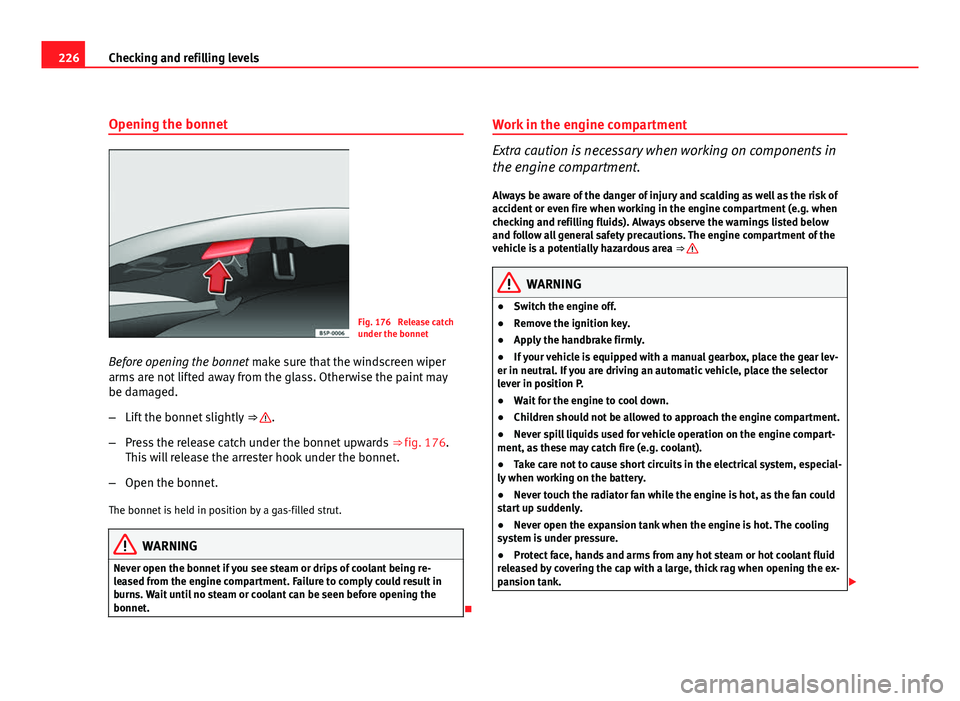
Fig. 176 Release catch
under the bonnet
Before opening the bonnet make sure that the windscreen wiper
arms are not lifted away from the glass. Otherwise the paint may
be damaged.
– Lift the bonnet slightly ⇒
.
– Press the release catch under the bonnet upwards ⇒ fig. 176.
This will release the arrester hook under the bonnet.
– Open the bonnet.
The bonnet is held in position by a gas-filled strut.
WARNING
Never open the bonnet if you see steam or drips of coolant being re-
leased from the engine compartment. Failure to comply could result in
burns. Wait until no steam or coolant can be seen before opening the
bonnet.
Work in the engine compartment
Extra caution is necessary when working on components in
the engine compartment.
Always be aware of the danger of injury and scalding as well as the risk of
accident or even fire when working in the engine compartment (e.g. when
checking and refilling fluids). Always observe the warnings listed below
and follow all general safety precautions. The engine compartment of the
vehicle is a potentially hazardous area ⇒
WARNING
● Switch the engine off.
● Remove the ignition key.
● Apply the handbrake firmly.
● If your vehicle is equipped with a manual gearbox, place the gear lev-
er in neutral. If you are driving an automatic vehicle, place the selector
lever in position P.
● Wait for the engine to cool down.
● Children should not be allowed to approach the engine compartment.
● Never spill liquids used for vehicle operation on the engine compart-
ment, as these may catch fire (e.g. coolant).
● Take care not to cause short circuits in the electrical system, especial-
ly when working on the battery.
● Never touch the radiator fan while the engine is hot, as the fan could
start up suddenly.
● Never open the expansion tank when the engine is hot. The cooling
system is under pressure.
● Protect face, hands and arms from any hot steam or hot coolant fluid
released by covering the cap with a large, thick rag when opening the ex-
pansion tank.
Page 229 of 319
227
Checking and refilling levels
WARNING (Continued)
● If any tests have to be performed with the engine running, there is an
added safety risk from the rotating parts (e.g. drive belts, alternator, ra-
diator fan, etc.) and from the high-voltage ignition system.
● Observe the following additional warnings if work on the fuel system
or the electrical system is necessary:
–Always disconnect the battery.
– Do not smoke.
– Never work near open flames.
– Always keep an approved fire extinguisher immediately available.
CAUTION
When topping up fluids, make sure the correct fluid is put into the correct
filler opening. This can otherwise cause serious malfunctions or engine
damage.
For the sake of the environment
Inspect the ground underneath your vehicle regularly so that any leaks are
detected at an early stage. If you find spots of oil or other fluids, have your
vehicle inspected at the workshop.
● When the external temperature and level of humidity are high or when
the engine stops, it is possible for water to drop from the air conditioning
system evaporator potentially forming a small puddle on the ground. This is
normal and does not indicate a leak.
Note
On right-hand drive vehicles some of the reservoirs mentioned below are lo-
cated on the other side of the engine compartment. Closing the bonnet
–
To close the bonnet, push it down until it overcomes the spring
pressure.
– Let the bonnet engage in the locking part. Do not force it ⇒
.
WARNING
● For safety reasons the bonnet must always be completely closed
when the vehicle is moving. After closing it always check that it is proper-
ly secured. The bonnet must be flush with the adjacent body panels.
● Should you notice that the bonnet is not safely secured when the ve-
hicle is moving, stop the vehicle immediately and close the bonnet. Fail-
ure to do so could result in an accident.
Engine oil General notes
The engine comes with a special, high quality, multi grade oil that can be
used in all seasons of the year except for those regions affected by extreme
cold.
As the use of good quality oil is necessary for the correct operation and long
service life of the engine, when it becomes necessary to replenish or
change the oil, always use an oil that complies to the VW standards.
The specifications (VW standards) set out in the following page should ap-
pear on the container of the service oil; when the container displays the
specific standards for petrol and diesel engines together, it means that the
oil can be used for both types of engines.
Safety FirstOperating InstructionsPractical TipsTechnical Specifications
Page 230 of 319

228Checking and refilling levels
We recommend that the oil change, indicated in the Maintenance Pro-
gramme, be performed by an Authorised Service Centre or a specialised
workshop.
The correct oil specifications for your engine are listed in ⇒ page 228, Oil
properties.
Service intervals
Service intervals can be flexible (LongLife service) or fixed (dependent on
time/distance travelled).
If the PR code that appears on the back of the Maintenance Programme
booklet is QG1, this means that your vehicle has the LongLife service pro-
grammed. If it has the codes QG0 or QG2 the interval service is dependent
on time/distance travelled.
Flexible service intervals (LongLife*)
Special oils and processes have been developed which, depending on the
characteristics and individual driving profiles, allow to extend the oil
change service (LongLife service intervals).
Because this oil is essential for extending the service intervals, it must only
be used observing the following indications:
● Avoid mixing it with oil for fixed service intervals.
● Only in exceptional circumstances, if the engine oil level is too low
⇒ page 229 and LongLife oil is not available, it is permitted to top up
(once) with oil for fixed service intervals (up to a maximum of 0.5 litres).
Fixed service intervals*
If your vehicle does not have the “LongLife service interval” or it has been
disabled (by request), you may use oils for fixed service intervals, which al-
so appear in ⇒ page 228, Oil properties. In this case, your vehicle must be
serviced after a fixed interval of 1 year / 15 000 km (whatever comes first)
⇒ Booklet Maintenance Programme. ●
In exceptional circumstances, if the engine oil level is too low
⇒ page 229 and you cannot obtain the oil specified for your vehicle, you
can put in a small quantity of oil conforming to the specification ACEA A2 or
ACEA A3 (petrol engines) or ACEA B3 or ACEA B4 (diesel engines) (up to 0.5
l).
Vehicles with diesel particulate filter*
All Exeo vehicles with a diesel engine have a diesel particulate filter and
must only be filled with VW 507 00 engine oil, which has a low level of soot
formation. Using other types of oil will cause a higher soot concentration
and reduce the life of the DPF. Therefore:
● Avoid mixing this oil with other engine oils.
● Only in exceptional circumstances, if the engine oil level is too low
⇒ page 229 and you cannot obtain the oil specified for your vehicle, you
can use a small quantity of oil (once) conforming to the VW 506 00,
VW 506 01, VW 505 00, VW 505 01 or ACEA B3 / ACEA B4 specification. (up
to 0.5 l).
Oil properties
Engine typeSpecificationPetrolVW 502 00/ VW 504 00Diesel. Engines with particu-
late filter (DPF) a)VW 507 00
a)
Only use recommended oils, otherwise you may damage the engine.
Oils for LongLife service intervals *Engine typeSpecificationPetrolVW 504 00DieselVW 507 00
Page 231 of 319
229
Checking and refilling levels
Engine oil additives
No type of additive should be mixed with the engine oil. The deterioration
caused by these additives is not covered by the warranty.
Note
Before a long trip, we recommend finding an engine oil that conforms to the
corresponding VW specifications and keeping it in the vehicle. This way, the
correct engine oil will always be available for a top-up if needed.
Checking the oil level
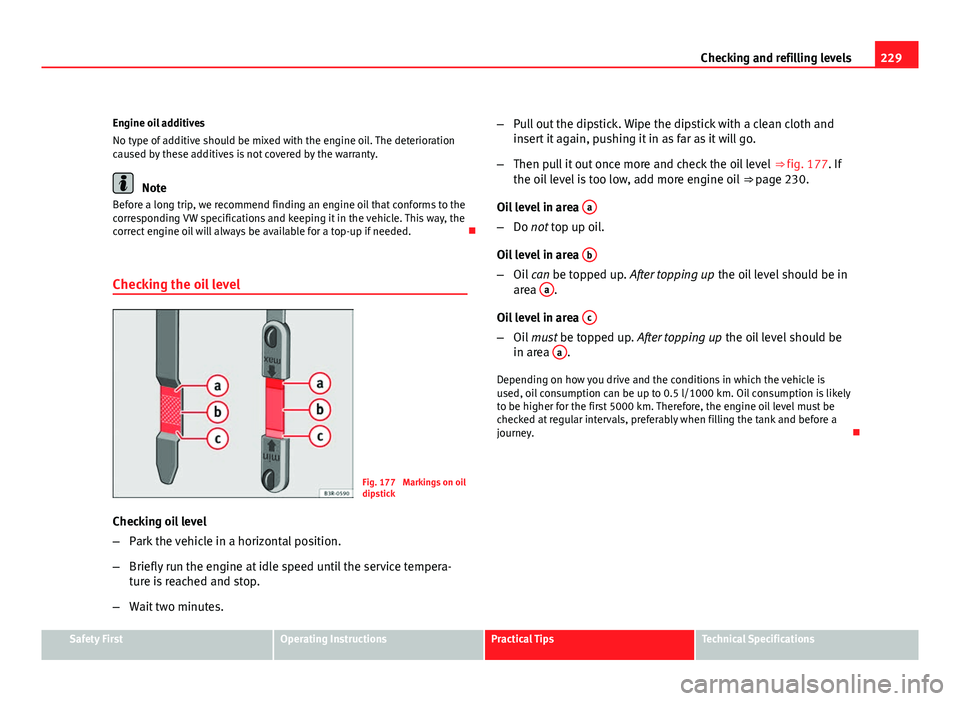
Fig. 177 Markings on oil
dipstick
Checking oil level
– Park the vehicle in a horizontal position.
– Briefly run the engine at idle speed until the service tempera-
ture is reached and stop.
– Wait two minutes. –
Pull out the dipstick. Wipe the dipstick with a clean cloth and
insert it again, pushing it in as far as it will go.
– Then pull it out once more and check the oil level ⇒ fig. 177. If
the oil level is too low, add more engine oil ⇒ page 230.
Oil level in area a
–
Do not top up oil.
Oil level in area b
–
Oil can be topped up. After topping up the oil level should be in
area a.
Oil level in area c
–
Oil must be topped up. After topping up the oil level should be
in area a.
Depending on how you drive and the conditions in which the vehicle is
used, oil consumption can be up to 0.5 l/1000 km. Oil consumption is likely
to be higher for the first 5000 km. Therefore, the engine oil level must be
checked at regular intervals, preferably when filling the tank and before a
journey.
Safety FirstOperating InstructionsPractical TipsTechnical Specifications
Page 232 of 319
230Checking and refilling levels
Topping up the engine oil
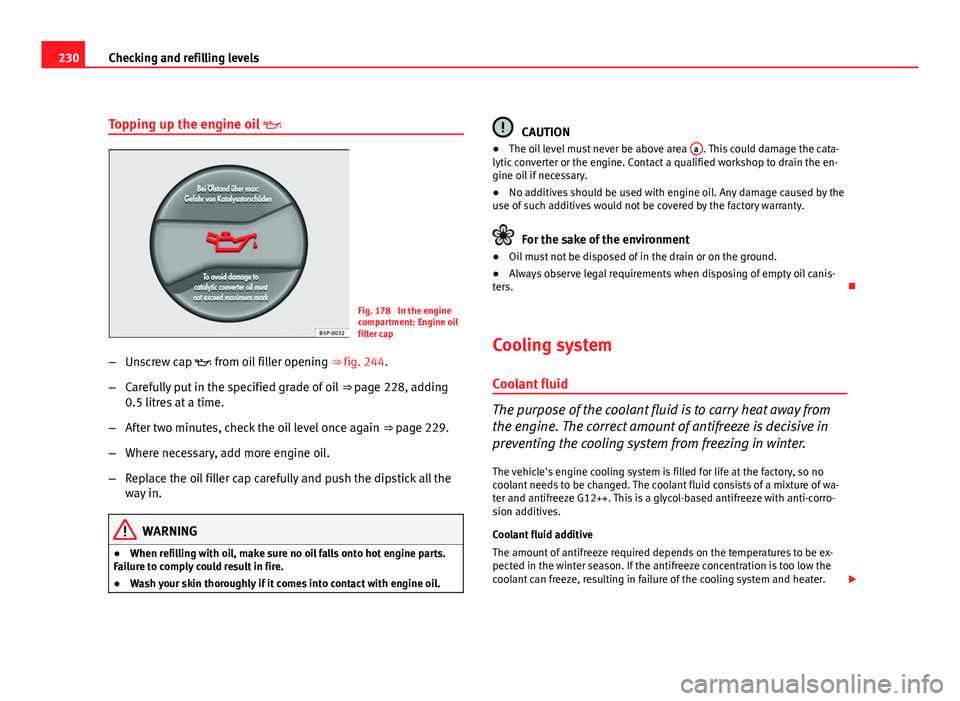
Fig. 178 In the engine
compartment: Engine oil
filler cap
– Unscrew cap from oil filler opening ⇒ fig. 244.
– Carefully put in the specified grade of oil ⇒ page 228, adding
0.5 litres at a time.
– After two minutes, check the oil level once again ⇒ page 229.
– Where necessary, add more engine oil.
– Replace the oil filler cap carefully and push the dipstick all the
way in.
WARNING
● When refilling with oil, make sure no oil falls onto hot engine parts.
Failure to comply could result in fire.
● Wash your skin thoroughly if it comes into contact with engine oil.
CAUTION
● The oil level must never be above area a. This could damage the cata-
lytic converter or the engine. Contact a qualified workshop to drain the en-
gine oil if necessary.
● No additives should be used with engine oil. Any damage caused by the
use of such additives would not be covered by the factory warranty.
For the sake of the environment
● Oil must not be disposed of in the drain or on the ground.
● Always observe legal requirements when disposing of empty oil canis-
ters.
Cooling system Coolant fluid
The purpose of the coolant fluid is to carry heat away from
the engine. The correct amount of antifreeze is decisive in
preventing the cooling system from freezing in winter. The vehicle's engine cooling system is filled for life at the factory, so no
coolant needs to be changed. The coolant fluid consists of a mixture of wa-
ter and antifreeze G12++. This is a glycol-based antifreeze with anti-corro-
sion additives.
Coolant fluid additive
The amount of antifreeze required depends on the temperatures to be ex-
pected in the winter season. If the antifreeze concentration is too low the
coolant can freeze, resulting in failure of the cooling system and heater.
Page 233 of 319
231
Checking and refilling levels
The cooling system is filled at the factory with the correct amount of anti-
freeze for the country concerned.
In most cases, the mixture consists of 60% water and 40% antifreeze. This
mixture gives the required antifreeze protection at temperatures down to
-25 °C and particularly protects the metal parts of the cooling system
against corrosion. It also prevents scaling and significantly raises the boil-
ing point of the coolant fluid.
Countries with warm climate
The coolant fluid concentration must not be reduced by adding plain water,
even in the summer or in warm climates. The concentration of the antifreeze
must always be at least 40%.
Countries with cold climate
If greater freeze protection is required in very cold climates, the proportion
of antifreeze G12++ can be increased. A concentration of 60% offers anti-
freeze protection of temperatures down to approx. -40 °C. However, the con-
centration of antifreeze must not exceed 60%, as the antifreeze protection
would then drop and the performance of the coolant system would suffer.
Vehicles for countries with cold climates (e.g. Sweden, Norway and Finland)
have factory-filled antifreeze protection for temperatures down to -35 °C. In
these countries, the concentration of antifreeze should always be at least
50%.
CAUTION
● It is advisable to have the cooling system checked before the winter sea-
son to make sure that the antifreeze concentration is adequate for the con-
ditions to be expected. This applies particularly if you intend to take the ve-
hicle into a colder climate zone. If necessary, have the antifreeze concentra-
tion increased to 50 - 60% as required.
● Use only G12++ antifreeze, an additive meeting the “TL-VW 774G” speci-
fication. Other antifreezes may give considerably inferior corrosion protec-
tion. The damage caused by the use of these antifreezes may lead to a loss
of coolant fluid, causing serious damage to the engine.
● G12++ antifreeze can only be mixed with antifreeze additives G11, G12
and G12+.
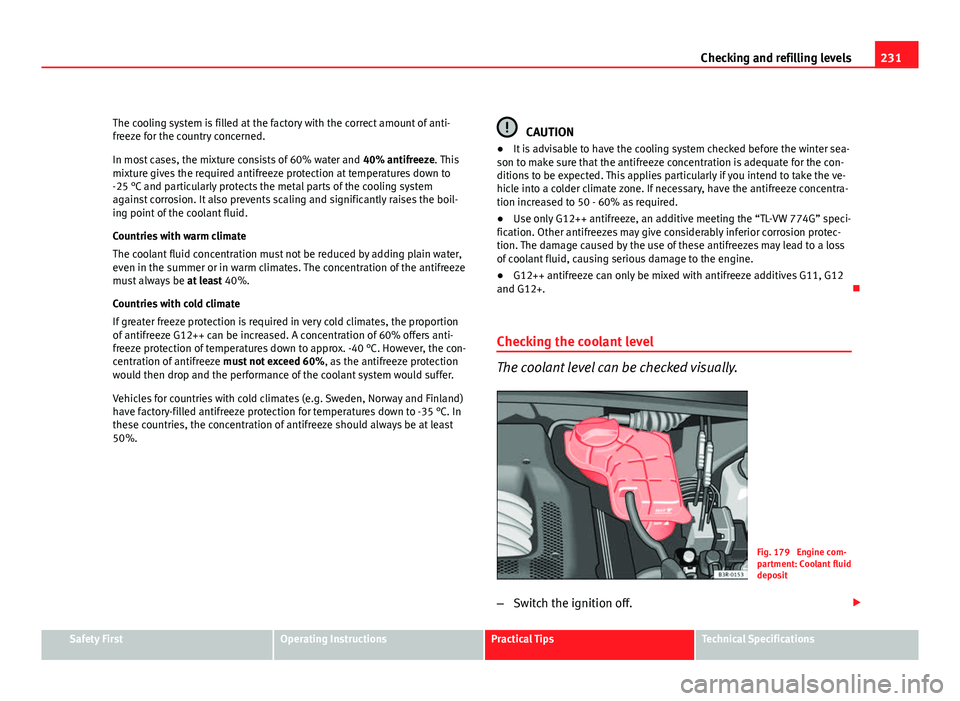
Checking the coolant level
The coolant level can be checked visually.
Fig. 179 Engine com-
partment: Coolant fluid
deposit
– Switch the ignition off.
Safety FirstOperating InstructionsPractical TipsTechnical Specifications
Page 234 of 319
232Checking and refilling levels
–Check the coolant level on coolant fluid expansion tank
⇒ fig. 179. When the engine is cold, it should be between the
“min” and “max” marks. When the engine is hot, it may be
slightly above the “max” mark.
Its location is shown in the corresponding general overview of the engine
compartment.
The coolant level should be checked with the engine switched off.
The coolant level is monitored by a warning lamp on the instrument panel
display ⇒ page 78. However, we recommend that it should be checked oc-
casionally.
Coolant fluid loss
Any loss of coolant fluid normally indicates a leak in the cooling system. In
this case the cooling system should be inspected by a qualified workshop
without delay. It is not sufficient merely to top up the coolant fluid.
If there are no leaks in the system, a loss of coolant fluid can only occur if
the coolant boils and is forced out of the system as a result of overheating.
CAUTION
Radiator sealants must not be added to the coolant fluid. Such additives
could seriously impair the function of the cooling system.
Topping up the coolant fluid
Be careful when topping up with coolant fluid. – Switch the engine off.
– Wait for the engine to cool down. –
Cover the cap on the expansion tank ⇒ fig. 179 with a cloth,
and carefully unscrew the cap anti-clockwise ⇒
.
– Add coolant fluid.
– Screw on the cap tightly.
Make sure that the coolant fluid meets the required specifications
⇒ page 230, Coolant fluid. Do not use a different type of antifreeze if G12+
+ antifreeze is not available. In this case, use only water and bring the anti-
freeze concentration back up to the correct level as soon as possible.
Always top up with new coolant fluid.
Do not fill above the “max” mark. Excess coolant fluid is forced out of the
system through the valve in the filler cap when the engine gets hot.
If a lot of coolant fluid has been lost, wait for the engine to cool down before
putting in cold coolant. Failure to do so could result in serious engine dam-
age.
WARNING
● The cooling system is under pressure. Do not unscrew the cap on the
expansion tank when the engine is hot. Failure to comply could result in
burns.
● The antifreeze and coolant fluid can be a health hazard. Therefore,
the antifreeze should be stored in the original container in a safe place
out of reach of children. Failure to comply could result in poisoning.
For the sake of the environment
Drained off coolant should not be used again. Drain off the used coolant in-
to a suitable container and dispose of it in the proper manner (observe envi-
ronmental regulations).
Page 235 of 319
233
Checking and refilling levels
Radiator fan
The radiator fan can start running spontaneously. The auxiliary fan can continue to run for as long as 10 minutes after stop-
ping the engine, even after the ignition is switched off. It may also start run-
ning suddenly ⇒
after some while if
● Stored heat raises the coolant temperature, or
● The hot engine compartment is additionally heated up by the sun.
WARNING
When working in the engine compartment be aware that the radiator fan
may start running suddenly, leading to the risk of injury.
Washer fluid and windscreen wiper blades
Windscreen washer system
Plain water is not sufficient for the windscreen washer sys-
tem.
Fig. 180 In the engine
compartment: Cap of
windscreen washer fluid
reservoir.
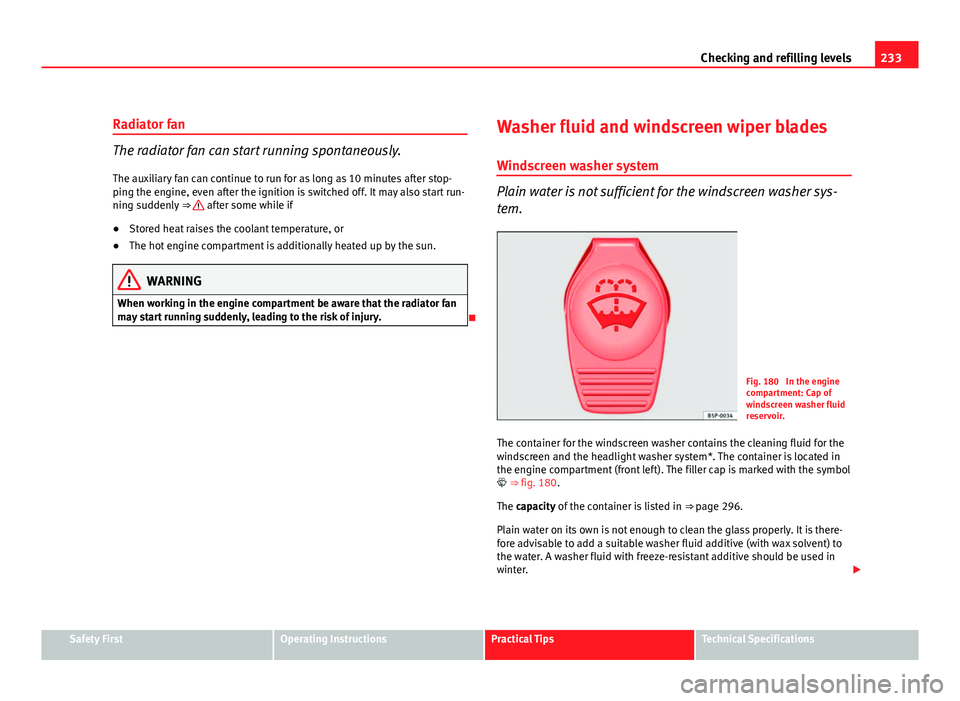
The container for the windscreen washer contains the cleaning fluid for the
windscreen and the headlight washer system*. The container is located in
the engine compartment (front left). The filler cap is marked with the symbol
⇒ fig. 180.
The capacity of the container is listed in ⇒ page 296.
Plain water on its own is not enough to clean the glass properly. It is there-
fore advisable to add a suitable washer fluid additive (with wax solvent) to
the water. A washer fluid with freeze-resistant additive should be used in
winter.
Safety FirstOperating InstructionsPractical TipsTechnical Specifications
Page 238 of 319
236Checking and refilling levels
Removing the wiper blade
–Lift the wiper arm away from the glass ⇒ fig. 183
– Slide the blade adapter in the direction of the arrow and remove
the blade ⇒ fig. 183.
Fitting the wiper blade
– With one hand, hold the top end of the wiper arm.
– Place the blade as shown in the ⇒ fig. 184 and slide the adapt-
er along until it engages.
Check the condition of the wiper blade regularly. Change as required.
If the windscreen wiper scrapes, it should be replaced if damaged, or
cleaned if soiled.
If this is not sufficient, refer to a specialised workshop.
WARNING
Do not drive unless you have good visibility through all windows!
● Clean the windscreen wiper blades and all windows regularly.
● The wiper blades should be changed once or twice a year.
CAUTION
● A damaged or dirty window wiper could scratch the rear window.
● Never use fuel, nail varnish remover, paint thinner or similar products to
clean the window.
● Never move the windscreen wiper by hand. This could cause damage. Brake fluid
Checking the brake fluid level
The brake fluid level can be checked visually.
Fig. 185 Engine com-
partment: markings on
brake fluid reservoir
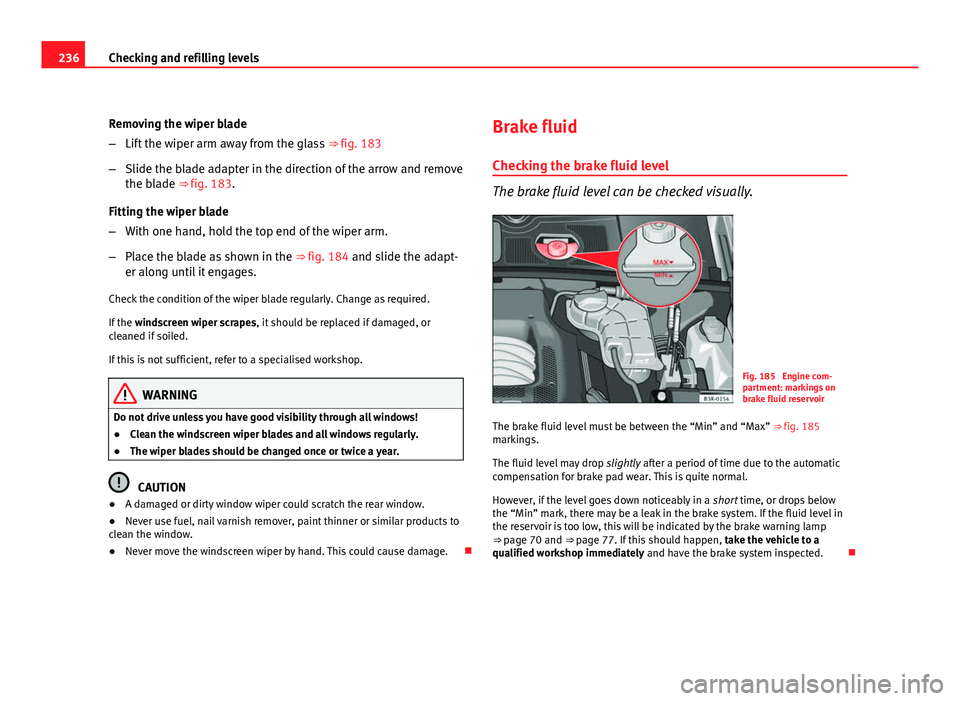
The brake fluid level must be between the “Min” and “Max” ⇒ fig. 185
markings.
The fluid level may drop slightly after a period of time due to the automatic
compensation for brake pad wear. This is quite normal.
However, if the level goes down noticeably in a short time, or drops below
the “Min” mark, there may be a leak in the brake system. If the fluid level in
the reservoir is too low, this will be indicated by the brake warning lamp
⇒ page 70 and ⇒ page 77. If this should happen, take the vehicle to a
qualified workshop immediately and have the brake system inspected.
Page 240 of 319
238Checking and refilling levels
Winter operation
The battery is drained more in cold weather, which means that the starting
power is reduced. For this reason, have the battery checked and charged if
necessary before the start of winter.
Replacing the battery
A replacement battery must have the same capacity, voltage and current rat-
ing. It must also have the same dimensions as the original, factory-fitted
battery and have sealed caps. The SEAT batteries which have been specially
developed fulfil the maintenance, performance and safety specifications for
your vehicle.
We recommend you use maintenance-free batteries.
WARNING
● All work on batteries requires specialist knowledge. If work is re-
quired on the battery, this should be performed by a Technical Service or
qualified workshop. Danger of caustic burns and explosion!
● The battery must not be opened. Never try to change the battery's liq-
uid level. Explosive gas is released from the battery that could cause an
explosion.
CAUTION
● The battery holder and clamps must always be correctly secured.
● Before starting any work on the battery, always observe the warnings
listed under ⇒
.
For the sake of the environment
Batteries contain toxic substances including sulphuric acid and lead.
Therefore, they must be disposed of in line with environmental regulations
and must not be disposed of with ordinary household waste. Make sure dis-
connected batteries cannot tip over. Sulphuric acid could be spilt! Important safety warnings for handling a vehicle battery
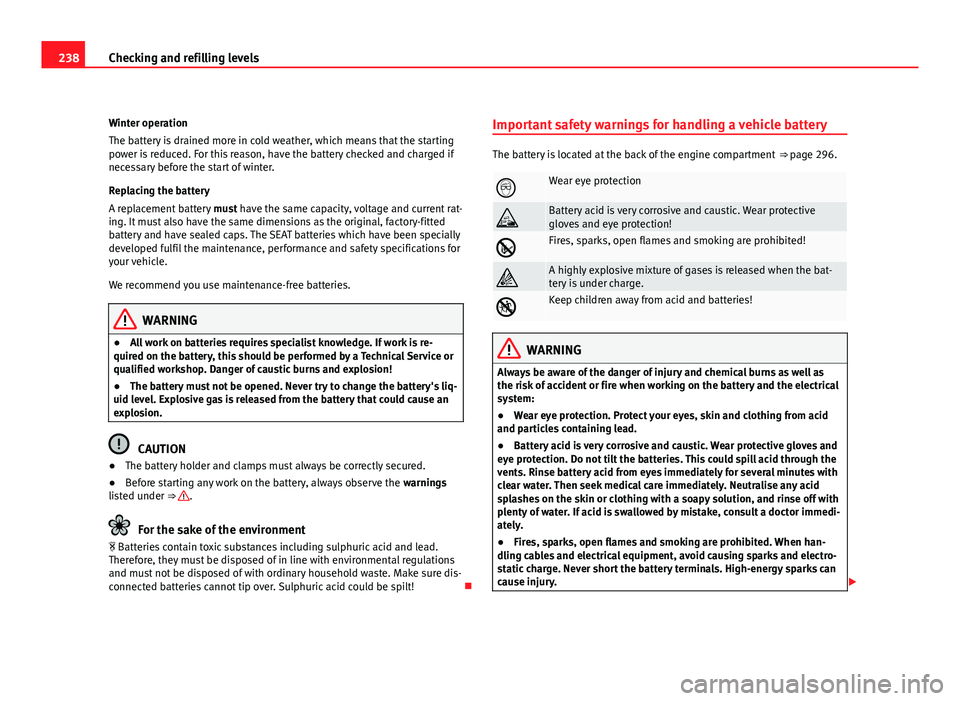
The battery is located at the back of the engine compartment
⇒ page 296.
Wear eye protection
Battery acid is very corrosive and caustic. Wear protective
gloves and eye protection!
Fires, sparks, open flames and smoking are prohibited!
A highly explosive mixture of gases is released when the bat-
tery is under charge.
Keep children away from acid and batteries!
WARNING
Always be aware of the danger of injury and chemical burns as well as
the risk of accident or fire when working on the battery and the electrical
system:
● Wear eye protection. Protect your eyes, skin and clothing from acid
and particles containing lead.
● Battery acid is very corrosive and caustic. Wear protective gloves and
eye protection. Do not tilt the batteries. This could spill acid through the
vents. Rinse battery acid from eyes immediately for several minutes with
clear water. Then seek medical care immediately. Neutralise any acid
splashes on the skin or clothing with a soapy solution, and rinse off with
plenty of water. If acid is swallowed by mistake, consult a doctor immedi-
ately.
● Fires, sparks, open flames and smoking are prohibited. When han-
dling cables and electrical equipment, avoid causing sparks and electro-
static charge. Never short the battery terminals. High-energy sparks can
cause injury.