wiper fluid Seat Exeo ST 2011 Owner's manual
[x] Cancel search | Manufacturer: SEAT, Model Year: 2011, Model line: Exeo ST, Model: Seat Exeo ST 2011Pages: 319, PDF Size: 5.12 MB
Page 6 of 319
Trailer towing . . . . . . . . . . . . . . . . . . . . . . . . . . . . . . 201
Trailer towing . . . . . . . . . . . . . . . . . . . . . . . . . . . . . 201
Removable towing bracket . . . . . . . . . . . . . . . . . . 204
Vehicle maintenance and cleaning . . . . . . . . . 211
General notes . . . . . . . . . . . . . . . . . . . . . . . . . . . . 211
Care of the vehicle exterior . . . . . . . . . . . . . . . . . . 212
Vehicle interior maintenance . . . . . . . . . . . . . . . . 217
Accessories, parts replacement and
modifications . . . . . . . . . . . . . . . . . . . . . . . . . . . . . 220
Accessories and spare parts . . . . . . . . . . . . . . . . 220
Technical modifications . . . . . . . . . . . . . . . . . . . . 220
Mobile phones and two-way radios . . . . . . . . . . . 221
Athermic windscreen* . . . . . . . . . . . . . . . . . . . . . 221
Checking and refilling levels . . . . . . . . . . . . . . . 222
Refuelling . . . . . . . . . . . . . . . . . . . . . . . . . . . . . . . 222
Petrol . . . . . . . . . . . . . . . . . . . . . . . . . . . . . . . . . . . 223
Diesel . . . . . . . . . . . . . . . . . . . . . . . . . . . . . . . . . . . 224
Bonnet . . . . . . . . . . . . . . . . . . . . . . . . . . . . . . . . . . 225
Engine oil . . . . . . . . . . . . . . . . . . . . . . . . . . . . . . . . 227
Cooling system . . . . . . . . . . . . . . . . . . . . . . . . . . . 230
Washer fluid and windscreen wiper blades . . . . 233
Brake fluid . . . . . . . . . . . . . . . . . . . . . . . . . . . . . . . 236
Vehicle battery . . . . . . . . . . . . . . . . . . . . . . . . . . . 237
Wheels and tyres . . . . . . . . . . . . . . . . . . . . . . . . . . 241
Wheels . . . . . . . . . . . . . . . . . . . . . . . . . . . . . . . . . . 241
If and when . . . . . . . . . . . . . . . . . . . . . . . . . . . . . . . 251
Tools, tyre repair kit and spare wheel . . . . . . . . . 251
Changing a wheel . . . . . . . . . . . . . . . . . . . . . . . . . 254
Tyre repair* (Tyre-Mobility-System) . . . . . . . . . . . 258
Fuses . . . . . . . . . . . . . . . . . . . . . . . . . . . . . . . . . . . 262
Bulbs . . . . . . . . . . . . . . . . . . . . . . . . . . . . . . . . . . . 264
Changing bulbs. Halogen headlights . . . . . . . . . 265
Changing bulbs. Bi-Xenon AFS headlights . . . . . 271
Changing tail light bulbs (on side panel) . . . . . . 275
Changing tail light bulbs (on tailgate) . . . . . . . . . 280
Side turn signals . . . . . . . . . . . . . . . . . . . . . . . . . . 283 Luggage compartment lights . . . . . . . . . . . . . . . . 284
Registration light . . . . . . . . . . . . . . . . . . . . . . . . . . 285
Sun visor light . . . . . . . . . . . . . . . . . . . . . . . . . . . . 286
Jump-starting . . . . . . . . . . . . . . . . . . . . . . . . . . . . . 286
Towing and tow-starting . . . . . . . . . . . . . . . . . . . . 289
Technical Specifications . . . . . . . . . . . 292
Description of specifications . . . . . . . . . . . . . . . 292
Important information . . . . . . . . . . . . . . . . . . . . . 292
Information on fuel consumption . . . . . . . . . . . . 294
Towing a trailer . . . . . . . . . . . . . . . . . . . . . . . . . . . 294
Wheels . . . . . . . . . . . . . . . . . . . . . . . . . . . . . . . . . . 295
Technical specifications . . . . . . . . . . . . . . . . . . . . 296
Engine specifications . . . . . . . . . . . . . . . . . . . . . . 296
Dimensions and capacities . . . . . . . . . . . . . . . . . 305
Index . . . . . . . . . . . . . . . . . . . . . . . . . . . . . . . . . . . 307
4Table of Contents
Page 83 of 319
81
Cockpit
Photosensor/rain sensor faulty
Automatic headlights / automatic wipers faulty
If the symbol lights up, this means that the photosensor/rain sensor is
not working. For safety reasons, the dipped beam headlights will then be
switched on permanently when the light switch is set to the AUTO position.
However, you can still switch the lights on and off in the normal way with
the light switch. If the rain sensor is faulty, the functions operated via the
windscreen wiper lever will still be available. You should have the photosen-
sor/rain sensor checked by a specialised workshop as soon as possible.
Worn brake pads
If the symbol lights up, have the front brake pads (and, for safety rea-
sons, the rear pads as well) inspected by a specialised workshop.
Speed warning 1
If the symbol lights up, this means you are exceeding the speed that has
been pre-set with the speed warning function. You should reduce your
speed accordingly ⇒ page 82.
Headlight range control faulty
This symbol indicates a malfunction in the dynamic headlight range con-
trol. Take the vehicle to a qualified workshop to have the dynamic headlight
range control function repaired. Adaptive headlights* faulty
Adaptive headlights faulty
This symbol indicates that the adaptive headlight system is faulty. Take
the vehicle to a qualified workshop to have the headlights or the adaptive
headlight control unit repaired.
Washer fluid level low
If the symbol lights up, top up the fluid for the windscreen washer and
headlight washer system* ⇒ page 233.
Speed warning 2
If the symbol lights up, this means you are exceeding the speed that has
been pre-set. You should reduce your speed accordingly ⇒ page 82.
Battery voltage too high or too low
If the symbol lights up, take the vehicle to a qualified workshop and
have the following items checked:
● Poly V-belt
● Battery condition
It is also advisable to check whether the alternator warning lamp has come
on ⇒ page 69.
Safety FirstOperating InstructionsPractical TipsTechnical Specifications
Page 130 of 319
128Lights and visibility
–In vehicles equipped with a rain sensor*, you can move the
switch A
up and down to set the sensitivity of the rain sensor.
Slow wipe
– Move the lever up to position 3
.
Continuous wipe
– Move the lever up to position 4
.
Automatic wash and wipe
– Pull the lever towards the steering wheel, 5
, to activate the
windscreen washer.
– Release the lever. The washer will stop and the wipers will keep
running for approximately 4 seconds.
Deactivating the windscreen wiper
– Pull the lever to basic position 0
.
General notes
The washers and wipers will work only when the ignition is switched on.
If you stop briefly, e.g. at traffic lights, the wiper speed will automatically be
reduced. The rain sensor* will automatically be set to the intermittent wipe
function.
The windscreen washer jets are heated when the ignition is switched on.
The wiper intervals in the intermittent wipe setting are also varied automati-
cally according to the road speed (in addition to the manual delay setting).
When the lights are switched on you should only pull the lever briefly to
wash the windscreen, otherwise the headlight washers* will also be ena-
bled. This will use an unnecessary amount of fluid from the reservoir. Rain sensor
The rain sensor* will only function in the intermittent wipe position. The in-
termittent wipe function is enabled automatically when it starts to rain.
If the windscreen wiper lever was in the intermittent wipe position when the
ignition was off, the rain sensor will not activate until you reach a speed of 6
km/h.
Use switch
A
to set the sensitivity of the rain sensor*.
If you have selected a high sensitivity level for the rain sensor the wind-
screen wipers will react sooner to any moisture on the windscreen.
The wiper intervals in the intermittent wipe setting are also varied automati-
cally according to the road speed (in addition to the sensitivity setting).
WARNING
● For correct visibility and safe driving, the wiper must be in perfect
condition ⇒ page 215. Failure to do so could result in an accident.
● The rain sensor* is only intended to assist the driver. The driver is
still obliged to manually operate the windscreen wipers as required de-
pending on visibility.
● Do not use water-repellent coatings on the windscreen. In bad visibili-
ty conditions such as light rain, low sun or when driving at night, these
coatings can cause increased dazzle, which is a serious safety hazard.
Such coatings can also cause the wiper blades to make noise.
CAUTION
● In the event of frost, check that the wiper blade has not frozen before
activating the windscreen wipers. Should the windscreen wiper system be
enabled when the blade is frozen, this could damage it or even the wind-
screen wiper system motor.
● Make sure you switch off the windscreen wiper system (lever in position
0) before you use an automatic car wash. This will avoid inadvertent trigger-
ing of the wipers and possible damage to the wiper system.
Page 131 of 319
129
Lights and visibility
Note
● Check that the washer fluid reservoir is full before starting a long jour-
ney. Fill the reservoir ⇒ page 233.
● Worn or dirty wiper blades can cause smearing on the glass which can
also impair the effectiveness of the rain sensor*. Check the condition of
windscreen wiper blades at regular intervals.
Rear window wiper
The windscreen wiper lever also operates the rear window
wiper and the automatic wash and wipe.
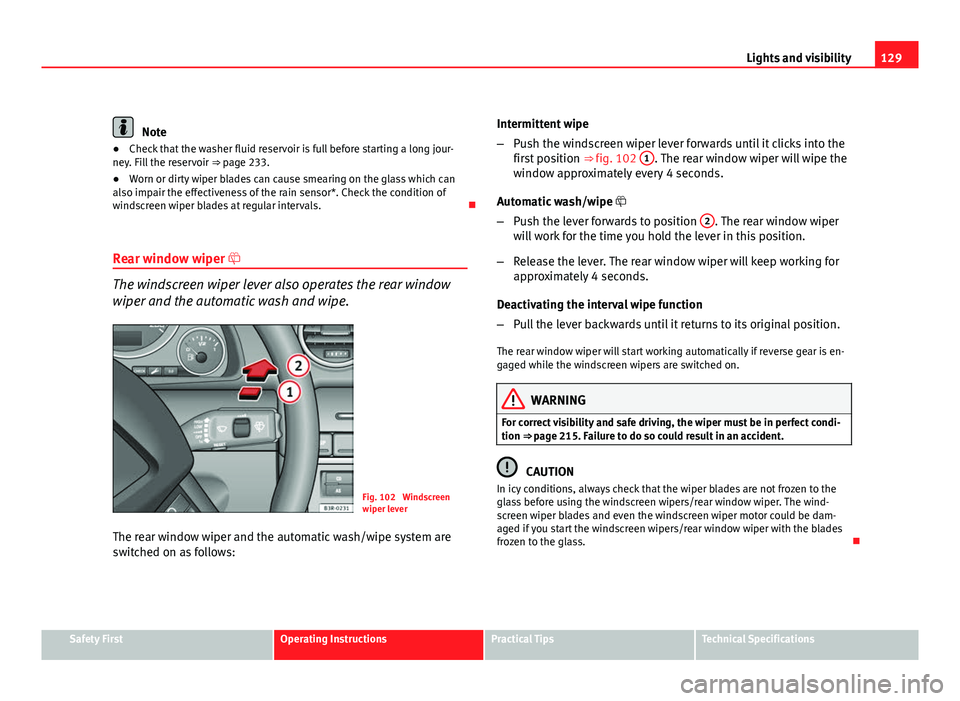
Fig. 102 Windscreen
wiper lever
The rear window wiper and the automatic wash/wipe system are
switched on as follows: Intermittent wipe
–
Push the windscreen wiper lever forwards until it clicks into the
first position ⇒ fig. 102 1
. The rear window wiper will wipe the
window approximately every 4 seconds.
Automatic wash/wipe
– Push the lever forwards to position 2
. The rear window wiper
will work for the time you hold the lever in this position.
– Release the lever. The rear window wiper will keep working for
approximately 4 seconds.
Deactivating the interval wipe function
– Pull the lever backwards until it returns to its original position.
The rear window wiper will start working automatically if reverse gear is en-
gaged while the windscreen wipers are switched on.
WARNING
For correct visibility and safe driving, the wiper must be in perfect condi-
tion ⇒ page 215. Failure to do so could result in an accident.
CAUTION
In icy conditions, always check that the wiper blades are not frozen to the
glass before using the windscreen wipers/rear window wiper. The wind-
screen wiper blades and even the windscreen wiper motor could be dam-
aged if you start the windscreen wipers/rear window wiper with the blades
frozen to the glass.
Safety FirstOperating InstructionsPractical TipsTechnical Specifications
Page 216 of 319
214Vehicle maintenance and cleaning
Polishing the paintwork
Polishing brings back gloss to the paintwork.
Polishing is only necessary if the paint has lost its shine, and the gloss can-
not be brought back by applying wax. Polishing products can be purchased
in your Authorised Service Centre.
The vehicle must be waxed after polishing if the polish used does not con-
tain wax compounds to seal the paint ⇒ page 213, Vehicle paint mainte-
nance.
CAUTION
To prevent damage to the paintwork:
● Do not use polishes and hard wax on painted parts with a matte finish
or on plastic parts.
● Do not polish your vehicle in a sandy or dusty environment.
Caring for plastic parts
Solvents damage plastic parts.
If normal washing fails to clean plastic parts, clean them with approved sol-
vent-free plastic cleaning and care products.
CAUTION
● The use of liquid air freshener directly over the air vents of the vehicle
may damage the plastic parts if the liquid is accidentally spilled.
● Cleaning products which contain solvents will damage the material. Cleaning windows and exterior mirrors
Cleaning windows
–
Moisten the windows with commercially available, alcohol
based glass cleaner.
– Dry the windows with a clean chamois leather or a lint-free
cloth.
Removing snow
– Use a small brush to remove snow from the windows and mir-
rors.
Removing ice
– Use a de-icer spray.
Use a clean cloth or chamois leather to dry the windows. The chamois leath-
ers used on painted surfaces are not suitable to clean windows because
they are soiled with wax deposits which could smear the windows.
If possible, use a de-icing spray to remove ice. If you use an ice scraper,
push it in one direction only without swinging it.
Use window cleaner or a silicone remover to clean rubber, oil, grease and
silicone deposits off.
Wax deposits can be removed with a special cleaner available in your Au-
thorised Service Centre. Wax deposits on the windscreen could cause the
wiper blades to judder. Adding a window cleaner that dissolves wax to the
windscreen washer fluid prevents wiper blades from juddering, but wax de-
posits are not removed.
Page 228 of 319
226Checking and refilling levels
Opening the bonnet
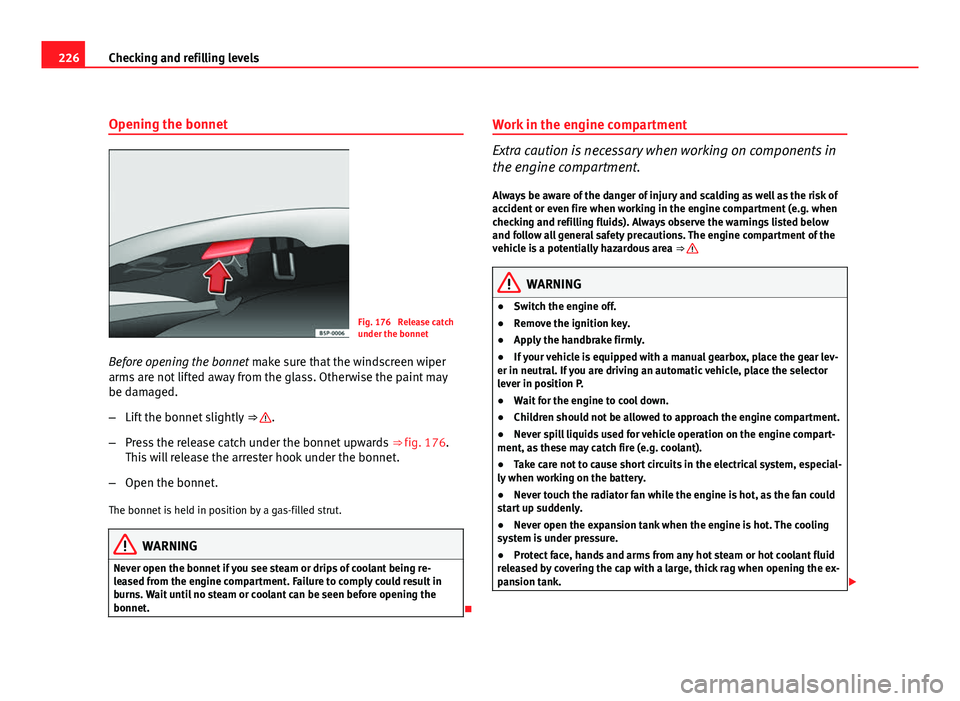
Fig. 176 Release catch
under the bonnet
Before opening the bonnet make sure that the windscreen wiper
arms are not lifted away from the glass. Otherwise the paint may
be damaged.
– Lift the bonnet slightly ⇒
.
– Press the release catch under the bonnet upwards ⇒ fig. 176.
This will release the arrester hook under the bonnet.
– Open the bonnet.
The bonnet is held in position by a gas-filled strut.
WARNING
Never open the bonnet if you see steam or drips of coolant being re-
leased from the engine compartment. Failure to comply could result in
burns. Wait until no steam or coolant can be seen before opening the
bonnet.
Work in the engine compartment
Extra caution is necessary when working on components in
the engine compartment.
Always be aware of the danger of injury and scalding as well as the risk of
accident or even fire when working in the engine compartment (e.g. when
checking and refilling fluids). Always observe the warnings listed below
and follow all general safety precautions. The engine compartment of the
vehicle is a potentially hazardous area ⇒
WARNING
● Switch the engine off.
● Remove the ignition key.
● Apply the handbrake firmly.
● If your vehicle is equipped with a manual gearbox, place the gear lev-
er in neutral. If you are driving an automatic vehicle, place the selector
lever in position P.
● Wait for the engine to cool down.
● Children should not be allowed to approach the engine compartment.
● Never spill liquids used for vehicle operation on the engine compart-
ment, as these may catch fire (e.g. coolant).
● Take care not to cause short circuits in the electrical system, especial-
ly when working on the battery.
● Never touch the radiator fan while the engine is hot, as the fan could
start up suddenly.
● Never open the expansion tank when the engine is hot. The cooling
system is under pressure.
● Protect face, hands and arms from any hot steam or hot coolant fluid
released by covering the cap with a large, thick rag when opening the ex-
pansion tank.
Page 235 of 319
233
Checking and refilling levels
Radiator fan
The radiator fan can start running spontaneously. The auxiliary fan can continue to run for as long as 10 minutes after stop-
ping the engine, even after the ignition is switched off. It may also start run-
ning suddenly ⇒
after some while if
● Stored heat raises the coolant temperature, or
● The hot engine compartment is additionally heated up by the sun.
WARNING
When working in the engine compartment be aware that the radiator fan
may start running suddenly, leading to the risk of injury.
Washer fluid and windscreen wiper blades
Windscreen washer system
Plain water is not sufficient for the windscreen washer sys-
tem.
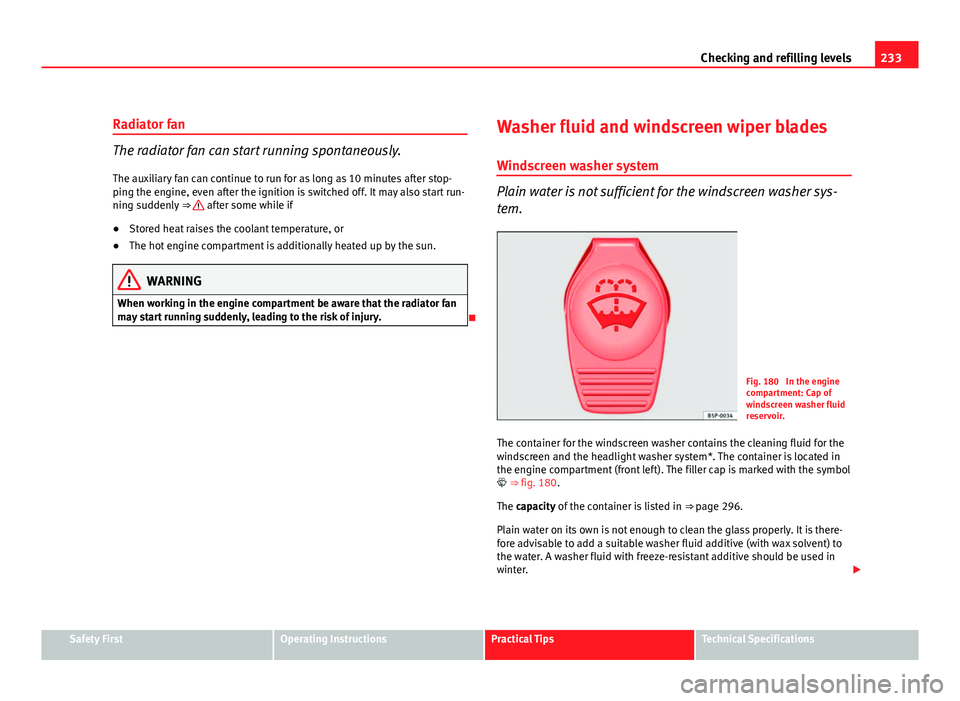
Fig. 180 In the engine
compartment: Cap of
windscreen washer fluid
reservoir.
The container for the windscreen washer contains the cleaning fluid for the
windscreen and the headlight washer system*. The container is located in
the engine compartment (front left). The filler cap is marked with the symbol
⇒ fig. 180.
The capacity of the container is listed in ⇒ page 296.
Plain water on its own is not enough to clean the glass properly. It is there-
fore advisable to add a suitable washer fluid additive (with wax solvent) to
the water. A washer fluid with freeze-resistant additive should be used in
winter.
Safety FirstOperating InstructionsPractical TipsTechnical Specifications
Page 236 of 319
234Checking and refilling levels
CAUTION
● Never put radiator antifreeze or other additives into the windscreen
washer fluid.
● Never use washer fluid which contains paint thinners or solvents as it
can damage the paintwork.
Changing windscreen wiper blades
If the windscreen wiper blades are in perfect condition, you
will benefit from an improved visibility. Damaged wiper
blades should be replaced immediately.
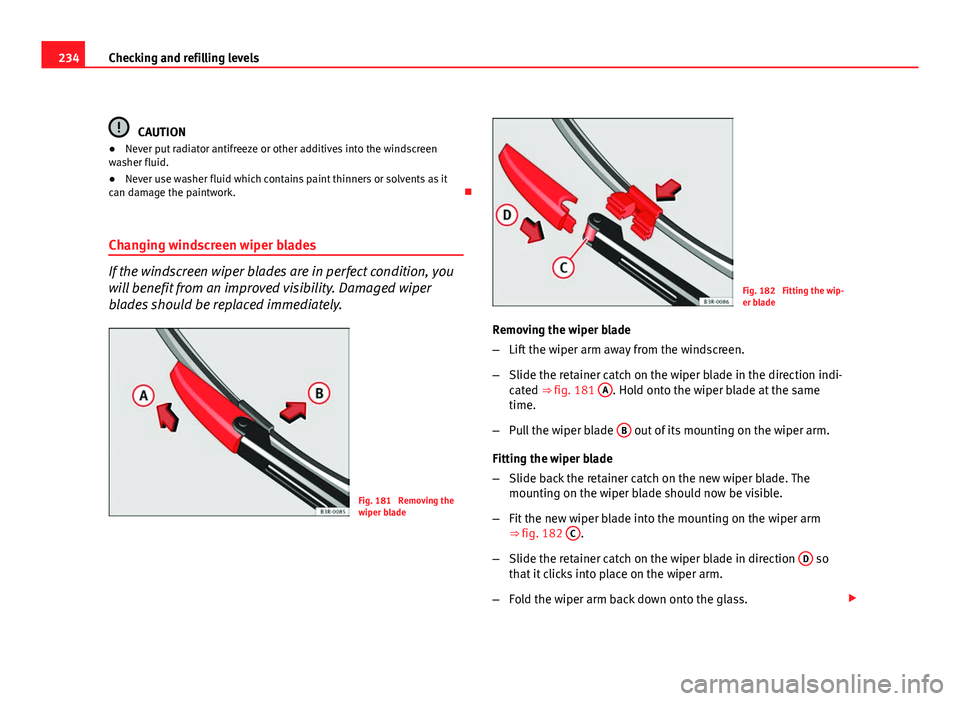
Fig. 181 Removing the
wiper blade
Fig. 182 Fitting the wip-
er blade
Removing the wiper blade
– Lift the wiper arm away from the windscreen.
– Slide the retainer catch on the wiper blade in the direction indi-
cated ⇒ fig. 181 A
. Hold onto the wiper blade at the same
time.
– Pull the wiper blade B
out of its mounting on the wiper arm.
Fitting the wiper blade
– Slide back the retainer catch on the new wiper blade. The
mounting on the wiper blade should now be visible.
– Fit the new wiper blade into the mounting on the wiper arm
⇒ fig. 182 C
.
– Slide the retainer catch on the wiper blade in direction D
so
that it clicks into place on the wiper arm.
– Fold the wiper arm back down onto the glass.
Page 238 of 319
236Checking and refilling levels
Removing the wiper blade
–Lift the wiper arm away from the glass ⇒ fig. 183
– Slide the blade adapter in the direction of the arrow and remove
the blade ⇒ fig. 183.
Fitting the wiper blade
– With one hand, hold the top end of the wiper arm.
– Place the blade as shown in the ⇒ fig. 184 and slide the adapt-
er along until it engages.
Check the condition of the wiper blade regularly. Change as required.
If the windscreen wiper scrapes, it should be replaced if damaged, or
cleaned if soiled.
If this is not sufficient, refer to a specialised workshop.
WARNING
Do not drive unless you have good visibility through all windows!
● Clean the windscreen wiper blades and all windows regularly.
● The wiper blades should be changed once or twice a year.
CAUTION
● A damaged or dirty window wiper could scratch the rear window.
● Never use fuel, nail varnish remover, paint thinner or similar products to
clean the window.
● Never move the windscreen wiper by hand. This could cause damage. Brake fluid
Checking the brake fluid level
The brake fluid level can be checked visually.
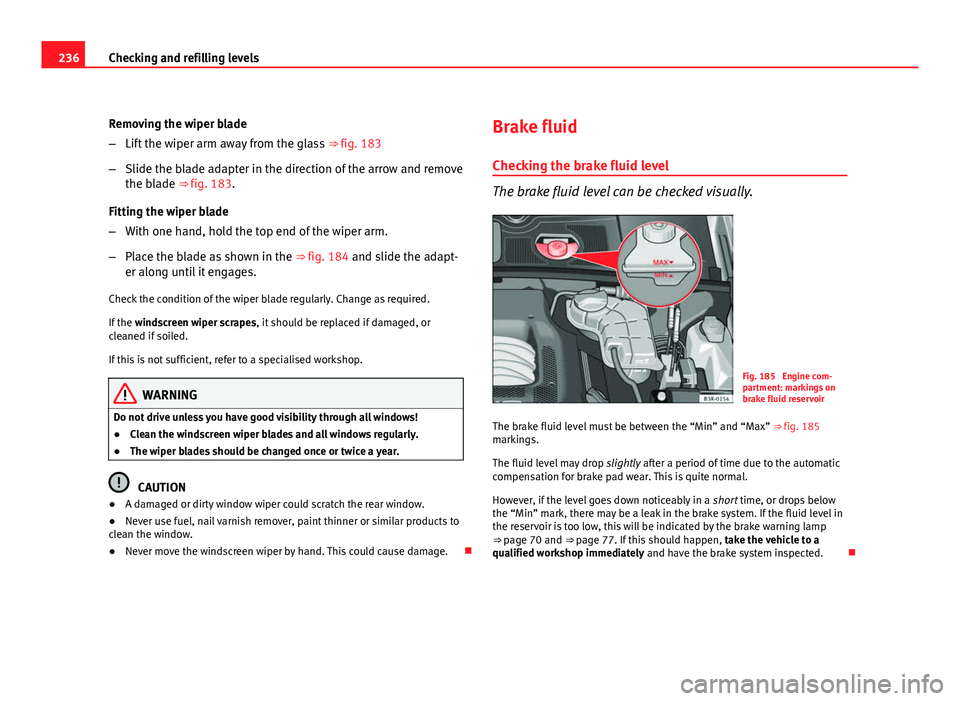
Fig. 185 Engine com-
partment: markings on
brake fluid reservoir
The brake fluid level must be between the “Min” and “Max” ⇒ fig. 185
markings.
The fluid level may drop slightly after a period of time due to the automatic
compensation for brake pad wear. This is quite normal.
However, if the level goes down noticeably in a short time, or drops below
the “Min” mark, there may be a leak in the brake system. If the fluid level in
the reservoir is too low, this will be indicated by the brake warning lamp
⇒ page 70 and ⇒ page 77. If this should happen, take the vehicle to a
qualified workshop immediately and have the brake system inspected.
Page 310 of 319
Bonnet . . . . . . . . . . . . . . . . . . . . . . . . . . . . . . . 225Closing . . . . . . . . . . . . . . . . . . . . . . . . . . . . 227
Opening . . . . . . . . . . . . . . . . . . . . . . . . . . . 226
Releasing . . . . . . . . . . . . . . . . . . . . . . . . . . 225
Brake light Failure control . . . . . . . . . . . . . . . . . . . . . . . . 80
Brake pads . . . . . . . . . . . . . . . . . . . . . . . . . . . . 196
Brakes . . . . . . . . . . . . . . . . . . . . . . . . . . . . . . . . 196 Brake assist system . . . . . . . . . . . . . . . . . . 192
Brake fluid . . . . . . . . . . . . . . . . . . . . . . . . . 236
Worn brake pads . . . . . . . . . . . . . . . . . . . . . 81
Brake servo . . . . . . . . . . . . . . . . . . . . . . . . . . . . 196
Brake system Brakes . . . . . . . . . . . . . . . . . . . . . . . . . . . . . 193
Brake servo . . . . . . . . . . . . . . . . . . . . . . . . . 193
Malfunction . . . . . . . . . . . . . . . . . . . . . . . . . 77
Braking distance . . . . . . . . . . . . . . . . . . . . . . . 196
Bulb change general notes . . . . . . . . . . . . . . . . . . . . . . . 264
C
Car care Exterior . . . . . . . . . . . . . . . . . . . . . . . . . . . . 212
Catalytic converter . . . . . . . . . . . . . . . . . . . . . . 197
CCS . . . . . . . . . . . . . . . . . . . . . . . . . . . . . . . . . . 179
CD-ROM player . . . . . . . . . . . . . . . . . . . . . . . . . 148
Central locking . . . . . . . . . . . . . . . . . . . . . . . . . . 99 Manual locking . . . . . . . . . . . . . . . . . . . . . . 102
Sunroof: opening and closing . . . . . . . . . . 113 Central locking system
Anti-theft security system . . . . . . . . . . . . . 100
Locking . . . . . . . . . . . . . . . . . . . . . . . . . . . . 100
Locking and unlocking the vehicle from in-side . . . . . . . . . . . . . . . . . . . . . . . . . . . . . 101
Opening and closing the windows . . . . . . 111
Security central locking . . . . . . . . . . . . . . . 101
Switch on the driver door . . . . . . . . . . . . . . 101
Tailgate . . . . . . . . . . . . . . . . . . . . . . . . . . . . 103
Unlocking . . . . . . . . . . . . . . . . . . . . . . . . . . . 99
Cetane number . . . . . . . . . . . . . . . . . . . . . . . . . 224
Changing the main headlight bulb Main headlight . . . . . . . . . . . . . . . . . . . . . . 268
Changing the main headlight bulbs Dipped beam headlight . . . . . . . . . . . . . . . 269
Changing the tail lights Luggage compartment lights . . . . . . . . . . 284
Changing windscreen wiper blades . . . . . . . . 234
Chassis number . . . . . . . . . . . . . . . . . . . . . . . . 293
Childproof lock Rear doors . . . . . . . . . . . . . . . . . . . . . . . . . . 104
Child safety . . . . . . . . . . . . . . . . . . . . . . . . . . . . . 47
Child safety seat ISOFIX system . . . . . . . . . . . . . . . . . . . . . . . . 53
Child seat . . . . . . . . . . . . . . . . . . . . . . . . . . . . . . 49 Categorisation in groups . . . . . . . . . . . . . . . 49
Group 1 . . . . . . . . . . . . . . . . . . . . . . . . . . . . . 50
Group 2 . . . . . . . . . . . . . . . . . . . . . . . . . . . . . 50
Group 3 . . . . . . . . . . . . . . . . . . . . . . . . . . . . . 50
Groups 0 and 0+ . . . . . . . . . . . . . . . . . . . . . . 49
Safety notes . . . . . . . . . . . . . . . . . . . . . . . . . 47
Securing . . . . . . . . . . . . . . . . . . . . . . . . . . . . 52 Child seats
on the front passenger seat . . . . . . . . . . . . . 30
Cigarette lighter . . . . . . . . . . . . . . . . . . . . . . . . 154
Cleaning alloy wheel rims . . . . . . . . . . . . . . . . 216
Cleaning chrome . . . . . . . . . . . . . . . . . . . . . . . 215
Cleaning engine compartment . . . . . . . . . . . . 217
Cleaning steel wheel rims . . . . . . . . . . . . . . . . 215
Cleaning windows . . . . . . . . . . . . . . . . . . . . . . 214
Clock, setting . . . . . . . . . . . . . . . . . . . . . . . . . . . 61
Cloth seat covers cleaning . . . . . . . . . . . . . . . . 218
Coat hooks . . . . . . . . . . . . . . . . . . . . . . . . . . . . 159
Cockpit . . . . . . . . . . . . . . . . . . . . . . . . . . . . . . . . 57 Overview . . . . . . . . . . . . . . . . . . . . . . . . . . . . 57
Compartments . . . . . . . . . . . . . . . . . . . . . . . . . 158 In the door trim . . . . . . . . . . . . . . . . . . . . . . 159
In the front seats . . . . . . . . . . . . . . . . . . . . 160
Coolant Checking the level . . . . . . . . . . . . . . . . . . . 231
Coolant fluid Antifreeze . . . . . . . . . . . . . . . . . . . . . . . . . . 230
Coolant fluid additive . . . . . . . . . . . . . . . . . 230
Topping up . . . . . . . . . . . . . . . . . . . . . . . . . 232
Cooling system Coolant temperature gauge . . . . . . . . . . . . . 60
Malfunction . . . . . . . . . . . . . . . . . . . . . . . . . 78
Correct adjustment of front seat head re- straints . . . . . . . . . . . . . . . . . . . . . . . . . . . . . . . 13
Correct adjustment of rear seat head restraints In-use and non-use positions . . . . . . . . . . . 14
Correct sitting position Front passenger . . . . . . . . . . . . . . . . . . . . . . 12
Incorrect sitting position . . . . . . . . . . . . . . . 14
308 Index