ECU Seat Exeo ST 2012 User Guide
[x] Cancel search | Manufacturer: SEAT, Model Year: 2012, Model line: Exeo ST, Model: Seat Exeo ST 2012Pages: 325, PDF Size: 5.56 MB
Page 26 of 325
24Seat belts
Seat belts
Seat belt adjustment
The seat belts for the front and rear occupants are locked in-
to position by a latch.
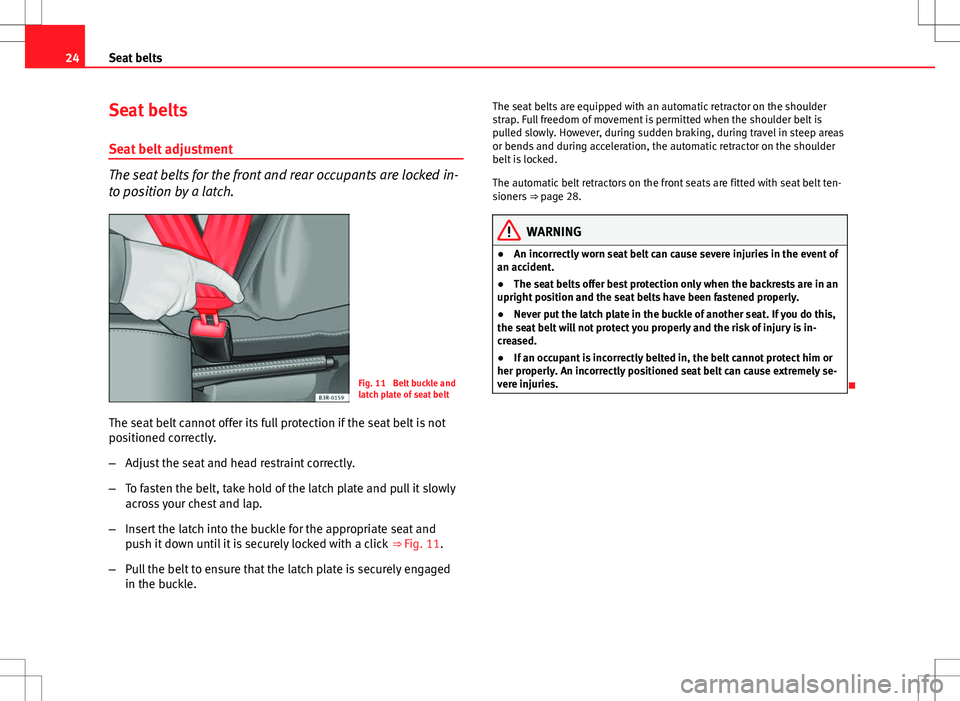
Fig. 11 Belt buckle and
latch plate of seat belt
The seat belt cannot offer its full protection if the seat belt is not
positioned correctly.
– Adjust the seat and head restraint correctly.
– To fasten the belt, take hold of the latch plate and pull it slowly
across your chest and lap.
– Insert the latch into the buckle for the appropriate seat and
push it down until it is securely locked with a click ⇒ Fig. 11.
– Pull the belt to ensure that the latch plate is securely engaged
in the buckle. The seat belts are equipped with an automatic retractor on the shoulder
strap. Full freedom of movement is permitted when the shoulder belt is
pulled slowly. However, during sudden braking, during travel in steep areas
or bends and during acceleration, the automatic retractor on the shoulder
belt is locked.
The automatic belt retractors on the front seats are fitted with seat belt ten-
sioners
⇒ page 28.
WARNING
● An incorrectly worn seat belt can cause severe injuries in the event of
an accident.
● The seat belts offer best protection only when the backrests are in an
upright position and the seat belts have been fastened properly.
● Never put the latch plate in the buckle of another seat. If you do this,
the seat belt will not protect you properly and the risk of injury is in-
creased.
● If an occupant is incorrectly belted in, the belt cannot protect him or
her properly. An incorrectly positioned seat belt can cause extremely se-
vere injuries.
Page 28 of 325
26Seat belts
Pregnant women must also fasten their seat belts properly
The best protection for the unborn child is for the mother to
wear the seat belt properly at all times during the pregnan-
cy.
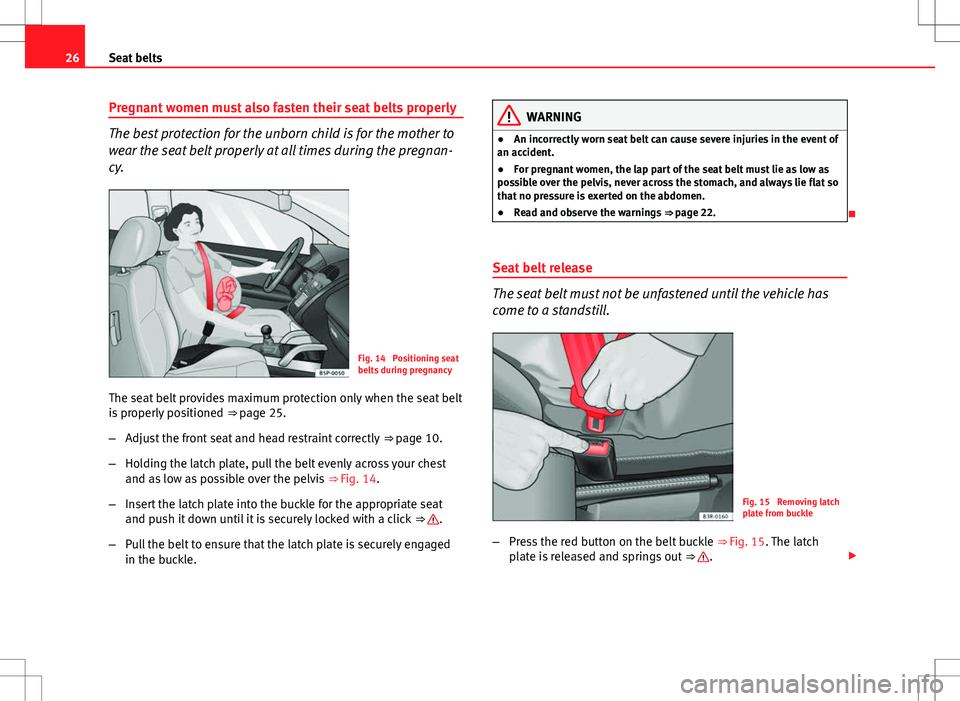
Fig. 14 Positioning seat
belts during pregnancy
The seat belt provides maximum protection only when the seat belt
is properly positioned ⇒ page 25.
– Adjust the front seat and head restraint correctly ⇒ page 10.
– Holding the latch plate, pull the belt evenly across your chest
and as low as possible over the pelvis ⇒ Fig. 14.
– Insert the latch plate into the buckle for the appropriate seat
and push it down until it is securely locked with a click ⇒
.
– Pull the belt to ensure that the latch plate is securely engaged
in the buckle.
WARNING
● An incorrectly worn seat belt can cause severe injuries in the event of
an accident.
● For pregnant women, the lap part of the seat belt must lie as low as
possible over the pelvis, never across the stomach, and always lie flat so
that no pressure is exerted on the abdomen.
● Read and observe the warnings ⇒ page 22.
Seat belt release
The seat belt must not be unfastened until the vehicle has
come to a standstill.
Fig. 15 Removing latch
plate from buckle
– Press the red button on the belt buckle ⇒
Fig. 15. The latch
plate is released and springs out ⇒
.
Page 29 of 325
27
Seat belts
– Guide the belt back by hand so that it rolls up easily and the
trim is not damaged
WARNING
Never unbuckle a seat belt while the vehicle is in motion. If you do, you
increase the risk of sustaining severe or fatal injuries.
Seat belt height adjustment
Seat belt height adjusters can be used to adjust the height
of the shoulder area of the seat belt.
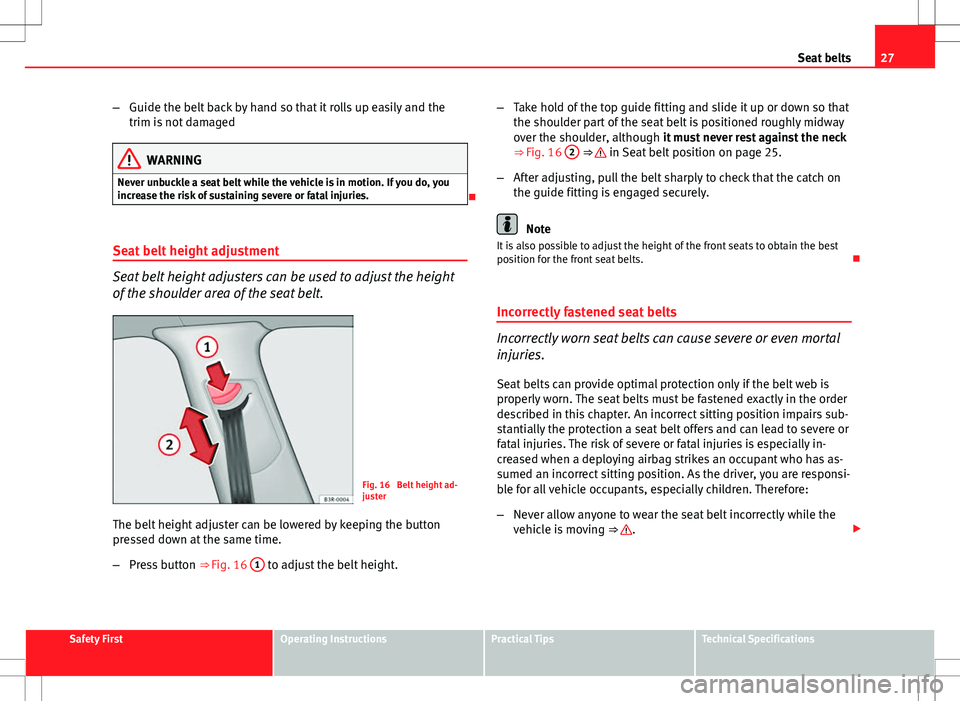
Fig. 16 Belt height ad-
juster
The belt height adjuster can be lowered by keeping the button
pressed down at the same time.
– Press button ⇒
Fig. 16 1
to adjust the belt height. –
Take hold of the top guide fitting and slide it up or down so that
the shoulder part of the seat belt is positioned roughly midway
over the shoulder, although it must never rest against the neck
⇒ Fig. 16 2
⇒ in Seat belt position on page 25.
– After adjusting, pull the belt sharply to check that the catch on
the guide fitting is engaged securely.
Note
It is also possible to adjust the height of the front seats to obtain the best
position for the front seat belts.
Incorrectly fastened seat belts
Incorrectly worn seat belts can cause severe or even mortal
injuries. Seat belts can provide optimal protection only if the belt web is
properly worn. The seat belts must be fastened exactly in the order
described in this chapter. An incorrect sitting position impairs sub-
stantially the protection a seat belt offers and can lead to severe or
fatal injuries. The risk of severe or fatal injuries is especially in-
creased when a deploying airbag strikes an occupant who has as-
sumed an incorrect sitting position. As the driver, you are responsi-
ble for all vehicle occupants, especially children. Therefore:
– Never allow anyone to wear the seat belt incorrectly while the
vehicle is moving ⇒
.
Safety FirstOperating InstructionsPractical TipsTechnical Specifications
Page 32 of 325
30Airbag system
WARNING (Continued)
● To reduce the risk of injury from an inflating airbag, always wear the
seat belt properly ⇒ page 19.
● Always adjust the front seats properly.
The danger of fitting a child seat on the front passenger
seat
Rear-facing child seats must never be used on the front pas-
senger seat when the front passenger airbag is enabled. The front passenger airbag is a serious risk for a child if it is activated. The
front passenger seat is life threatening to a child if he/she is transported in
a rear-facing child seat. Children up to 12 years old should always travel on
the rear seat.
If a rear-facing child seat is secured to the front passenger seat, an inflating
airbag can strike it with such force that it can cause critical or fatal injuries.
Therefore we strongly recommend you to transport children on the rear
seats. That is the safest place for children in the vehicle. Alternatively, the
front passenger airbag can be disabled with a key-operated switch
⇒ page 45. When transporting children, use a child seat appropriate to
the age and size of each child ⇒ page 47.
For those vehicles that do not include a key lock switch to disconnect the
airbag, the vehicle must be taken to a Technical Service.
WARNING
● If a child seat is secured to the front passenger seat, the risk to the
child of sustaining critical or fatal injuries in the event of an accident in-
creases.
● Never secure a rear-facing child seat to the front passenger seat if the
front passenger airbag is enabled. The child can suffer critical or fatal in-
juries if the front passenger airbag is triggered.
● An inflating front passenger airbag can strike the rear-facing child
seat and hurl it with great force against the door, the roof or the back-
rest.
● If, under special circumstances, it is necessary to transport a child in
a rear-facing child seat on the front passenger seat, it is absolutely es-
sential that you observe the following safety measures:
–Deactivate the front passenger airbag ⇒ page 45, Deactivating
airbags.
– The child seat must be approved by the child seat manufacturer for
use on a front passenger seat with front or side airbag.
– Follow the installation instructions given by the child seat manu-
facturer and observe the safety instructions ⇒ page 47, Child safe-
ty.
– Before properly installing the child seat, push the front passenger
seat completely backwards so that the greatest possible distance to
the front passenger airbag is ensured.
– Ensure that no objects prevent the front passenger seat from being
pushed completely back.
– The backrest of the front passenger seat must be in an upright po-
sition.
Page 38 of 325
36Airbag system
Safety notes on the front airbag system
If you use airbags correctly, they can considerably reduce
the risk of injury in many kinds of accident.
WARNING
● It is important for the driver and front passenger to keep a distance of
at least 25 cm from the steering wheel and dash panel. If the minimum
distance is not observed then the airbags do not correctly protect the ve-
hicle occupants; risk of fatal injuries! In addition, the front seats and
head restraints must always be positioned correctly for the height of the
occupant.
● If you are not wearing a seat belt, if you lean forward or to the side
while travelling or assume an incorrect sitting position, there is a sub-
stantially increased risk of injury. This increased risk of injury will be fur-
ther increased if you are struck by an inflating airbag.
● Never let a child travel on the front seat without an appropriate re-
straint system. If the airbag is triggered in an accident, children can sus-
tain serious or fatal injuries from the airbag as it inflates ⇒ page 47,
Child safety.
● The deployment space between the front passengers and the airbags
must not in any case be occupied by other passenger, pets and objects.
● The airbags provide protection for just one accident; replace them
once they have deployed.
● It is also important not to attach any objects such as cup holders or
telephone mountings to the surfaces covering the airbag units.
● Do not attempt to modify components of the airbag system in any
way.
Knee airbag*
Description of the knee airbag
The airbag system provides additional protection to front
seat passengers if they are properly secured.
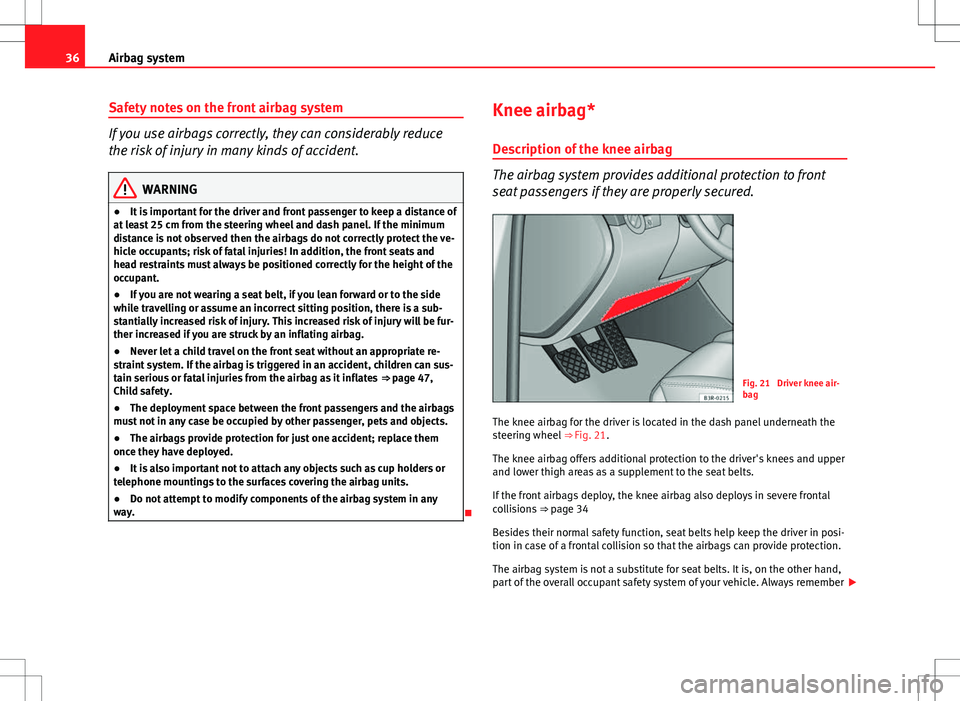
Fig. 21 Driver knee air-
bag
The knee airbag for the driver is located in the dash panel underneath the
steering wheel ⇒ Fig. 21.
The knee airbag offers additional protection to the driver's knees and upper
and lower thigh areas as a supplement to the seat belts.
If the front airbags deploy, the knee airbag also deploys in severe frontal
collisions ⇒ page 34
Besides their normal safety function, seat belts help keep the driver in posi-
tion in case of a frontal collision so that the airbags can provide protection.
The airbag system is not a substitute for seat belts. It is, on the other hand,
part of the overall occupant safety system of your vehicle. Always remember
Page 50 of 325
48Child safety
WARNING
● Never install a child seat facing backwards on the front passenger
seat unless the front passenger airbag has been disabled. This could
lead to a risk of potentially fatal injuries to the child! However, if it is nec-
essary, in exceptional cases, to transport a child in the front passenger
seat, the front passenger airbag must always be disabled ⇒ page 45, De-
activating airbags. If the passenger seat has a height adjustment option,
move it to the highest position.
● For those vehicles that do not include a key lock switch to disconnect
the airbag, the vehicle must be taken to a Technical Service.
● All passengers, especially children, must assume the proper sitting
position and be properly belted in while travelling.
● Never hold children or babies on your lap, this can result in potential-
ly fatal injuries to the child!
● Never allow a child to be transported in a vehicle without being prop-
erly secured, or to stand up or kneel on a seat while travelling. In an acci-
dent, the child could be flung through the vehicle, causing possibly fatal
injuries to themselves and to the other passengers.
● If children assume an improper sitting position when the vehicle is
moving, they expose themselves to greater risk of injury in the event of a
sudden braking manoeuvre or in an accident. This is particularly impor-
tant if the child is travelling on the front passenger seat and the airbag
system is triggered in an accident; as this could cause serious injury or
even death.
● A suitable child seat can protect your child!
● Never leave an unsupervised child alone on a child seat or in the vehi-
cle.
● Depending on weather conditions, it may become extremely hot or
cold inside the vehicle. This can be fatal.WARNING (Continued)
● Children who are less than 1.5 metres tall must not wear a normal
seat belt without a child seat, as this could cause injuries to the abdomi-
nal and neck areas during a sudden braking manoeuvre or in an accident.
● Do not allow the seat belt to become twisted or jammed, or to rub on
any sharp edges.
● Incorrectly worn seat belts can cause injuries even in a minor colli-
sion or in sudden braking manoeuvres.
● The seat belt provides maximum protection only when the seat belt is
properly positioned ⇒ page 24, Seat belts.
● Only one child may occupy a child seat ⇒ page 49, Child seats.
Page 54 of 325

52Child safety
Securing child seats
Ways to secure a child seat
A child seat can be secured differently on the rear seat and
on the front passenger seat. You can secure a child seat to the rear seat or front passenger seat in the
following ways:
● Child seats in groups 0 to 3 can be secured with a seat belt.
● Seats for children aged 0, 0+ and 1 with the “ISOFIX” system can be se-
cured without fastening seat belts, using the “ISOFIX” and/or Top Tether se-
curing rings ⇒ page 53.
Mass groupSeating positionFront passenger
seatRear side seatRear centralseat
Group 0
to 10 kgU*UU
Group 0+ to 13 kgU*UU
Group I
9 to 18 kgU*UU
Group II
15 to 25 kgU*UU
Group III
22 to 36 kgU*UU
Suitable for universal restraint systems for use in this mass group.
Move the front passenger seat as far back as possible, as high as pos-
sible and always disable the airbag.
WARNING
● When travelling, children must be secured in the vehicle with a re-
straint system suitable for age, weight and size.
● Never install a child seat facing backwards on the front passenger
seat unless the front passenger airbag has been disabled. This could
cause fatal injuries to the child! However, if, in exceptional cases, it is
necessary to transport a child in the front passenger seat, the front pas-
senger airbag ⇒ page 45, Deactivating airbags must always be disabled
and the seat adjusted to its highest position, where possible.
● Read and always observe information and warnings concerning the
use of child seats ⇒
in Safety notes on using child seats on page 48.
U:
*:
Page 55 of 325

53
Child safety
Child seat mounting using the “ISOFIX” and/or Top Tether system
The Child restraint systems may be fitted to the rear seat quickly and safely with the “ISOFIX” and/or Top Tether system (fitted
to the rear backrest).
Fig. 32 Position of the
ISOFIX anchors on the
side rear seat
Fig. 33 The ISOFIX child
seat anchors slide along
the fitted plastic guides
until secured in the vehi-
cle's ISOFIX anchorages Following the instructions given by the child seat manufacturer
when installing and removing the seat.
–
Fit the plastic guides on the vehicle's ISOFIX anchorages be-
tween the backrest and the seat ⇒ Fig. 32.
– Slide the child seat anchorages along the plastic guides until
secured in the vehicle's ISOFIX rings (when correctly closed, you
will hear a “click”). The seat should also have a visual indicator
to confirm it is correctly secured ⇒ Fig. 33.
– Check that the ISOFIX system is correctly secured by pulling on
the child seat.
Detailed fitting instructions are supplied with the child safety seat.
Child seats with “ISOFIX” mountings are available from Technical Services
and specialist retailers.
Safety FirstOperating InstructionsPractical TipsTechnical Specifications
Page 56 of 325

54Child safety
Mass groupSize classElectrical equipmentMounting directionVehicle Isofix positionsRear side seats
Baby carrierFISO/L1Backward-facingXGISO/L2Backward-facingXGroup 0 to 10 kgEISO/R1Backward-facingIU
Group 0+ to 13 kgEISO/R1Backward-facingIUDISO/R2Backward-facingIUCISO/R3Backward-facingX
Group I 9 to 18 kg
DISO/R2Backward-facingIUCISO/R3Backward-facingXBISO/F2Forward-facingIUB1ISO/F2XForward-facingIUAISO/F3Forward-facingIUGroup II 15 to 25 kg------Forward-facing---Group III 22 to 36 kg------Forward-facing---
Suitable for ISOFIX universal child restraint systems approved for use in
this mass group
ISOFIX position not suitable for ISOFIX child restraint systems for this
mass group or size class
WARNING
The retainers employed for this child safety seat are specially designed
for the “ISOFIX” system. Never secure other child seats, seat belts or
other items into the retainers. If you do, you increase the risk of sustain-
ing severe or fatal injuries.
IU:
X:
Page 57 of 325

55
Child safety
Top Tether retainer straps
Some child restraint seats have a third Top Tether anchoring
point, apart from both ISOFIX anchoring points, which allow
better child retention.
Fig. 34 Position of the
Top Tether rings on the
rear tray
The Top Tether system has an upper strap for attachment to the vehicle's
upper anchoring point, which is found on the rear luggage compartment
cover.
The retainer strap is used to reduce forwards movements of the safety seat
in a crash, helping reduce the risk of injuries to the head from hitting the
inside of the vehicle.
It is foreseen that an EU Directive will introduce requirements related to the
retention of child restraint systems by means of ISOFIX and Top Tether an-
chorages (probably compulsory for new types from 2010), which will entail
improved retention of the child restraint seat and less head movement in
case of frontal collisions. Use of retainer straps on rear-facing seats
At present there are very few rear-facing child safety seats fitted with a re-
tainer strap. Please carefully read and follow the safety seat manufacturer's
instructions for information on how to install the retainer strap properly.
WARNING
An undue installation of the safety seat will increase the risk of injury in
the event of a crash.
● Never tie the retainer strap to a hook in the luggage compartment.
● Never secure or tie luggage or other items to the lower anchorages
(ISOFIX) or the upper ones (Top Tether).
Fitting the Top Tether child restraint to the anchoring point
Fig. 35 Retainer strap:
correct adjustment and
fitting
Safety FirstOperating InstructionsPractical TipsTechnical Specifications