brake fluid Seat Exeo ST 2012 User Guide
[x] Cancel search | Manufacturer: SEAT, Model Year: 2012, Model line: Exeo ST, Model: Seat Exeo ST 2012Pages: 325, PDF Size: 5.56 MB
Page 218 of 325
216Vehicle maintenance and cleaning
Vehicle maintenance and cleaning
General notes
Regular washing and care help maintain the value of your
vehicle.Vehicle maintenance
Regular care and washing help to maintain the value of the vehicle. This
may also be one of the requirements for acknowledging warranty claims in
the event of bodywork corrosion or paint defects.
The best way to protect your vehicle against the harmful effects of the envi-
ronment is through correct maintenance and frequent washing. The longer
substances such as insect remains, bird droppings, resinous tree sap, road
dirt, industrial deposits, tar, soot or road salt and other aggressive materi-
als remain on the vehicle, the more damage they do to the paintwork. High
temperatures (for instance in strong sunlight) further intensify the corrosive
effect.
After winter, a period when salt is put on the roads, it is important to have
the underside of the vehicle washed thoroughly.
Products for vehicle maintenance
Car care products are available in your Technical Services. Keep the product
instructions until you have used them up.
WARNING
● Car care products can be toxic. Because of this, they must always be
kept closed in their original container. Keep them out of the reach of chil-
dren. Failure to comply could result in poisoning.
● Always read and observe the instructions and warnings on the pack-
age before using vehicle care products. Improper use could cause health
problems or damage the vehicle. The use of certain products may pro-
duce noxious vapours; they should be used in well ventilated areas.
● Never use fuel, turpentine, engine oil, nail varnish remover or other
volatile fluids. These are toxic and highly flammable. Risk of fire and ex-
plosion.
● Before washing your vehicle, or carrying out any maintenance, switch
the engine off, apply the handbrake firmly and remove the key from the
ignition.
CAUTION
Never attempt to remove dirt, mud or dust if the surface of the vehicle is dry.
Never use a dry cloth or sponge for cleaning purposes. This could damage
the paintwork or the windows of your vehicle. Soak dirt, mud or dust with
plenty of water.
For the sake of the environment
● When purchasing products for your vehicle maintenance, select the
ones which are not harmful to the environment.
● The waste from car care products should not be disposed of with ordina-
ry household waste. Observe the disposal information on the package.
Page 236 of 325
234Checking and refilling levels
Opening the bonnet
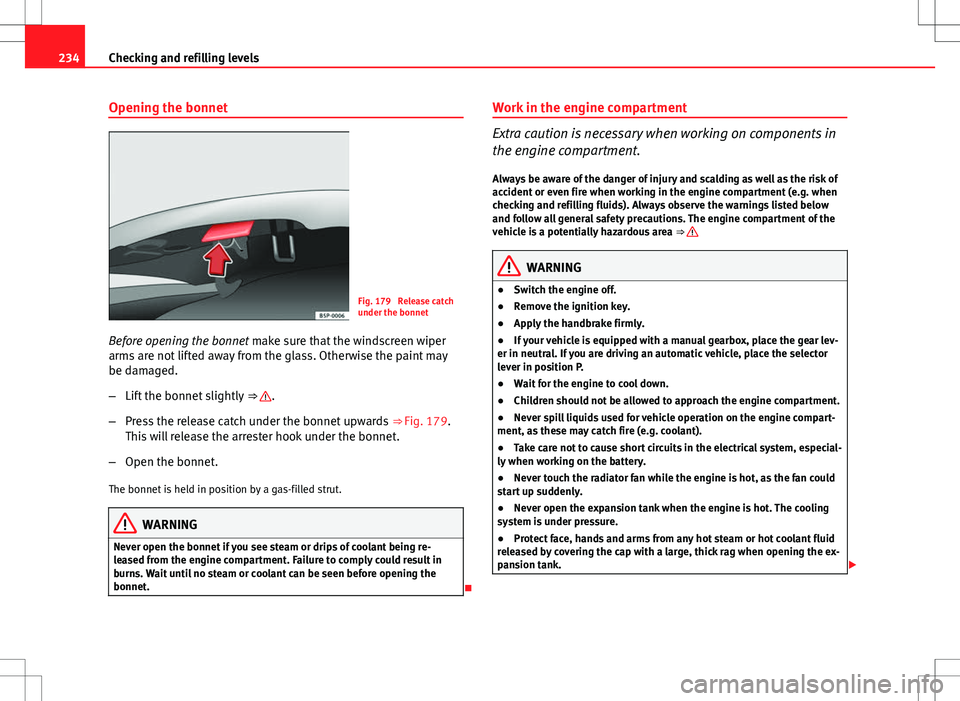
Fig. 179 Release catch
under the bonnet
Before opening the bonnet make sure that the windscreen wiper
arms are not lifted away from the glass. Otherwise the paint may
be damaged.
– Lift the bonnet slightly ⇒
.
– Press the release catch under the bonnet upwards ⇒ Fig. 179.
This will release the arrester hook under the bonnet.
– Open the bonnet.
The bonnet is held in position by a gas-filled strut.
WARNING
Never open the bonnet if you see steam or drips of coolant being re-
leased from the engine compartment. Failure to comply could result in
burns. Wait until no steam or coolant can be seen before opening the
bonnet.
Work in the engine compartment
Extra caution is necessary when working on components in
the engine compartment.
Always be aware of the danger of injury and scalding as well as the risk of
accident or even fire when working in the engine compartment (e.g. when
checking and refilling fluids). Always observe the warnings listed below
and follow all general safety precautions. The engine compartment of the
vehicle is a potentially hazardous area ⇒
WARNING
● Switch the engine off.
● Remove the ignition key.
● Apply the handbrake firmly.
● If your vehicle is equipped with a manual gearbox, place the gear lev-
er in neutral. If you are driving an automatic vehicle, place the selector
lever in position P.
● Wait for the engine to cool down.
● Children should not be allowed to approach the engine compartment.
● Never spill liquids used for vehicle operation on the engine compart-
ment, as these may catch fire (e.g. coolant).
● Take care not to cause short circuits in the electrical system, especial-
ly when working on the battery.
● Never touch the radiator fan while the engine is hot, as the fan could
start up suddenly.
● Never open the expansion tank when the engine is hot. The cooling
system is under pressure.
● Protect face, hands and arms from any hot steam or hot coolant fluid
released by covering the cap with a large, thick rag when opening the ex-
pansion tank.
Page 246 of 325
244Checking and refilling levels
Removing the wiper blade
–Lift the wiper arm away from the glass ⇒ Fig. 186
– Slide the blade adapter in the direction of the arrow and remove
the blade ⇒ Fig. 186.
Fitting the wiper blade
– With one hand, hold the top end of the wiper arm.
– Place the blade as shown in the ⇒ Fig. 187 and slide the adapt-
er along until it engages.
Check the condition of the wiper blade regularly. Change as required.
If the windscreen wiper scrapes, it should be replaced if damaged, or
cleaned if soiled.
If this is not sufficient, refer to a specialised workshop.
WARNING
Do not drive unless you have good visibility through all windows!
● Clean the windscreen wiper blades and all windows regularly.
● The wiper blades should be changed once or twice a year.
CAUTION
● A damaged or dirty window wiper could scratch the rear window.
● Never use fuel, nail varnish remover, paint thinner or similar products to
clean the window.
● Never move the windscreen wiper by hand. This could cause damage. Brake fluid
Checking the brake fluid level
The brake fluid level can be checked visually.
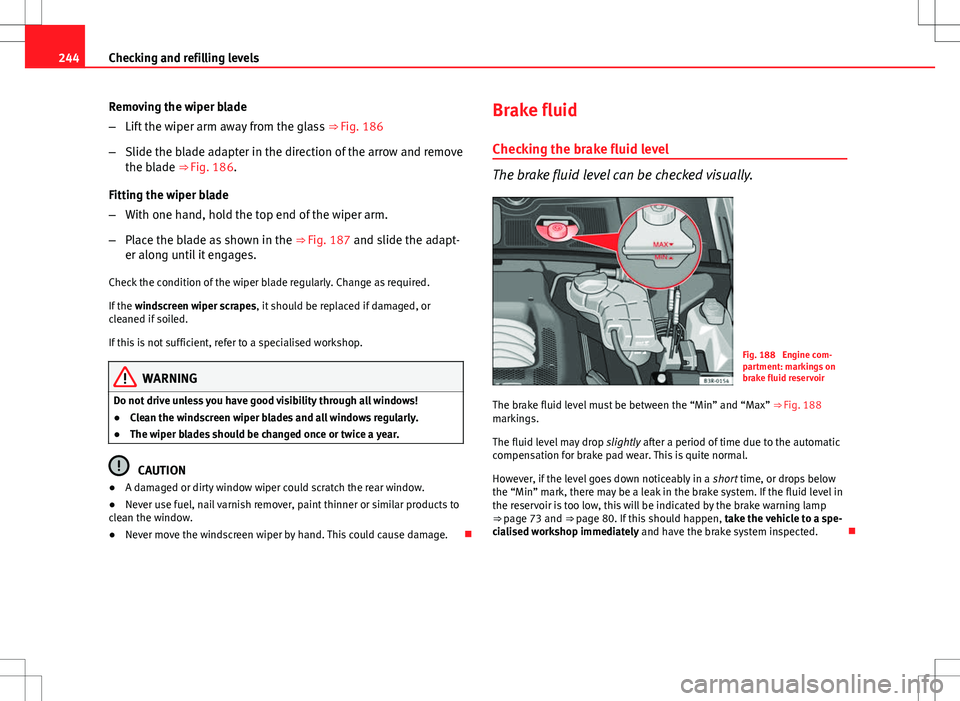
Fig. 188 Engine com-
partment: markings on
brake fluid reservoir
The brake fluid level must be between the “Min” and “Max” ⇒ Fig. 188
markings.
The fluid level may drop slightly after a period of time due to the automatic
compensation for brake pad wear. This is quite normal.
However, if the level goes down noticeably in a short time, or drops below
the “Min” mark, there may be a leak in the brake system. If the fluid level in
the reservoir is too low, this will be indicated by the brake warning lamp
⇒ page 73 and
⇒ page 80. If this should happen,
take the vehicle to a spe-
cialised workshop immediately and have the brake system inspected.
Page 247 of 325
245
Checking and refilling levels
Topping up and changing the brake fluid
It is best to have the brake fluid changed by a professional. Brake fluid absorbs moisture. Therefore, in the course of time it will absorb
water from the air. If the water content in the brake fluid is too high, the
brake system could corrode. In addition, the boiling point of the brake fluid
will be considerably reduced. This could adversely affect the braking ability
in certain circumstances.
For this reason the brake fluid must be changed periodically.
Your vehicle's Service Plan will tell you when the brake fluid has to be re-
newed.
We recommend you have the brake fluid changed as part of a regular In-
spection Service at a Technical Service. They are familiar with the procedure
and have the necessary special tools and spare parts as well as the proper
facilities for disposing of the old fluid.
Be sure to always use the correct brake fluid. Only use brake fluid that ex-
pressly meets VW 501 14 standards.
You can buy VW 501 14 standard brake fluid in a SEAT dealership or SEAT
Official Service. If none is available, use only high quality brake fluid that
meets DIN ISO 4925 CLASS 4 standards, or USA Standards FMVSS 116 DOT
4.
Using any other kind of brake fluid or one that is not of a high quality may
affect operation of the brake system and reduce its effectiveness. Never use
a brake fluid if the container does not state that it complies with VW 501 14,
DIN ISO 4925 CLASS 4 standards, or USA standards FMVSS 116 DOT 4.WARNING
● Brake fluid must always be kept closed in its original container. Keep
out of the reach of children. Failure to comply could result in poisoning.
● If the brake fluid is left in the system for too long and the brakes are
subjected to heavy use, vapour bubbles may form in the brake system.
This would seriously affect the efficiency of the brakes and the safety of
the vehicle, leading to the risk of accident.
CAUTION
Please note that brake fluid will attack the paintwork on contact.
For the sake of the environment
The brake pads and fluid must be collected and disposed of according the
applicable regulations. The SEAT Technical Service network has the neces-
sary equipment and qualified personnel for collecting and disposing of this
waste material.
Vehicle battery General notes
All work on batteries requires specialist knowledge.
The battery is virtually maintenance-free and is checked in the Inspection
Services.
We recommend replacing the battery after 5 years.
Safety FirstOperating InstructionsPractical TipsTechnical Specifications
Page 256 of 325
254Wheels and tyres
Wheel balance
The wheels on new vehicles are balanced. However, various factors encoun-
tered in normal driving can cause them to become unbalanced, which re-
sults in steering vibration.
Unbalanced wheels should be rebalanced, as they otherwise cause exces-
sive wear on steering, suspension and tyres. A wheel must also be reba-
lanced when a new tyre is fitted.
Incorrect wheel alignment
Incorrect wheel alignment causes excessive tyre wear, impairing the safety
of the vehicle. If tyres show excessive wear, you should have the wheel
alignment checked by a Technical Service.
WARNING
There is a serious danger of accidents if a tyre bursts during driving!
● The tyres must be replaced at the latest when the tread wear indica-
tors are worn ⇒ page 253. Failure to do so could result in an accident.
Worn tyres do not grip well at high speeds on wet roads. There is also a
greater risk of aquaplaning.
● At continuously high speeds, a tyre with insufficient pressure flexes
more. This causes it to overheat. This can cause tread separation and tyre
blow-out. Risk of accident. Always observe the recommended tyre pres-
sures.
● If tyres show excessive wear, you should have the running gear
checked by a Technical Service.
● Keep chemicals such as oil, fuel and brake fluid away from tyres.
● Damaged wheels and tyres must be replaced immediately!
For the sake of the environment
Under-inflated tyres will increase fuel consumption. Run-flat tyres*
Run-flat tyres allow you to continue driving even with a
punctured tyre, in the majority of cases.
In vehicles that are factory-fitted with run-flat tyres 1)
the loss of tyre
pressure is indicated on the instrument panel.
Driving with run-flat tyres (emergency running)
– Leave the ESC/ASR on (Electronic Stability Control), or switch it
on ⇒ page 71.
– Continue driving carefully and slowly (80 km/h maximum).
– Avoid sudden manoeuvres and sharp turns.
– Avoid driving over obstacles (for example kerbs) or potholes.
– Pay attention if the ESC/ASR activates often, if smoke comes
from the tyres or there is a smell of rubber, if the vehicle vi-
brates or there are clattering noises. If any of these occur, stop
the vehicle.
The run-flat tyres have a tag on the side of the tyre, with the description:
“DSST”, “Eufonia”, “RFT”, “ROF”, “RSC”, “SSR” or “ZP”.
The sides of this type of tyre are reinforced. When the tyres lose air they are
supported on the sides (emergency driving).
The loss of pressure in the tyre is shown on the instrument panel. You can
then drive a maximum of 80 km and if the circumstances are favourable (for
example, low load), even more.
1)
Depending upon version and country.
Page 306 of 325
304Technical specifications
Technical specifications
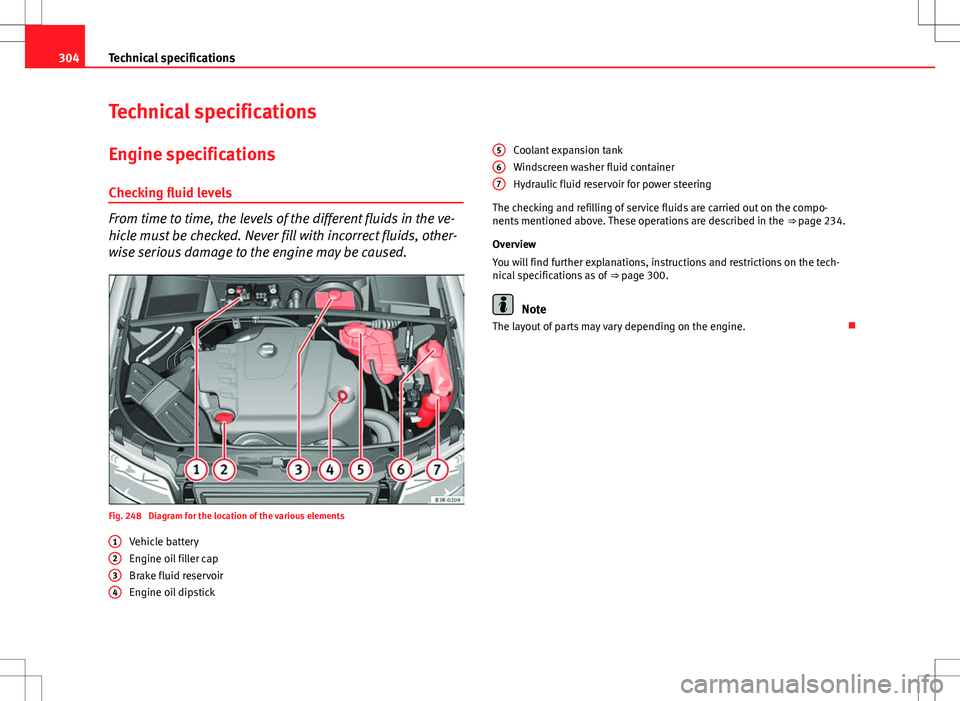
Engine specifications Checking fluid levels
From time to time, the levels of the different fluids in the ve-
hicle must be checked. Never fill with incorrect fluids, other-
wise serious damage to the engine may be caused.
Fig. 248 Diagram for the location of the various elements Vehicle battery
Engine oil filler cap
Brake fluid reservoir
Engine oil dipstick
1
234
Coolant expansion tank
Windscreen washer fluid container
Hydraulic fluid reservoir for power steering
The checking and refilling of service fluids are carried out on the compo-
nents mentioned above. These operations are described in the ⇒ page 234.
Overview
You will find further explanations, instructions and restrictions on the tech-
nical specifications as of ⇒ page 300.
Note
The layout of parts may vary depending on the engine.
567
Page 316 of 325
Bonnet . . . . . . . . . . . . . . . . . . . . . . . . . . . . . . . 233Closing . . . . . . . . . . . . . . . . . . . . . . . . . . . . 235
Opening . . . . . . . . . . . . . . . . . . . . . . . . . . . 234
Releasing . . . . . . . . . . . . . . . . . . . . . . . . . . 233
Brake light Failure control . . . . . . . . . . . . . . . . . . . . . . . . 83
Brake pads . . . . . . . . . . . . . . . . . . . . . . . . . . . . 201
Brakes . . . . . . . . . . . . . . . . . . . . . . . . . . . . . . . . 201 Brake assist system . . . . . . . . . . . . . . . . . . 196
Brake fluid . . . . . . . . . . . . . . . . . . . . . . . . . 244
Worn brake pads . . . . . . . . . . . . . . . . . . . . . 84
Brake servo . . . . . . . . . . . . . . . . . . . . . . . . . . . . 201
Brake system Brakes . . . . . . . . . . . . . . . . . . . . . . . . . . . . . 198
Brake servo . . . . . . . . . . . . . . . . . . . . . . . . . 198
Malfunction . . . . . . . . . . . . . . . . . . . . . . . . . 80
Braking distance . . . . . . . . . . . . . . . . . . . . . . . 201
Bulb change general notes . . . . . . . . . . . . . . . . . . . . . . . 272
C
Car care Exterior . . . . . . . . . . . . . . . . . . . . . . . . . . . . 217
Catalytic converter . . . . . . . . . . . . . . . . . . . . . . 202
CCS . . . . . . . . . . . . . . . . . . . . . . . . . . . . . . . . . . 183
CD-ROM player . . . . . . . . . . . . . . . . . . . . . . . . . 150
Central locking . . . . . . . . . . . . . . . . . . . . . . . . . 101 Manual locking . . . . . . . . . . . . . . . . . . . . . . 105
Sunroof: opening and closing . . . . . . . . . . 116 Central locking system
Anti-theft security system . . . . . . . . . . . . . 103
Locking . . . . . . . . . . . . . . . . . . . . . . . . . . . . 102
Locking and unlocking the vehicle from in-side . . . . . . . . . . . . . . . . . . . . . . . . . . . . . 103
Opening and closing the windows . . . . . . 114
Rear lid . . . . . . . . . . . . . . . . . . . . . . . . . . . . 106
Security central locking . . . . . . . . . . . . . . . 104
Switch on the driver door . . . . . . . . . . . . . . 103
Unlocking . . . . . . . . . . . . . . . . . . . . . . . . . . 102
Cetane number . . . . . . . . . . . . . . . . . . . . . . . . . 232
Changing the main headlight bulb Main headlight . . . . . . . . . . . . . . . . . . . . . . 276
Changing the main headlight bulbs Dipped beam headlight . . . . . . . . . . . . . . . 277
Changing the tail lights Luggage compartment lights . . . . . . . . . . 292
Changing windscreen wiper blades . . . . . . . . 242
Chassis number . . . . . . . . . . . . . . . . . . . . . . . . 301
Checklist Seat upholstery . . . . . . . . . . . . . . . . . . . . . 223
Childproof lock Rear doors . . . . . . . . . . . . . . . . . . . . . . . . . . 107
Child safety . . . . . . . . . . . . . . . . . . . . . . . . . . . . . 47
Child safety seat ISOFIX system . . . . . . . . . . . . . . . . . . . . . . . . 53
Child seat . . . . . . . . . . . . . . . . . . . . . . . . . . . . . . 49 Categorisation in groups . . . . . . . . . . . . . . . 49
Group 1 . . . . . . . . . . . . . . . . . . . . . . . . . . . . . 50
Group 2 . . . . . . . . . . . . . . . . . . . . . . . . . . . . . 50
Group 3 . . . . . . . . . . . . . . . . . . . . . . . . . . . . . 50
Groups 0 and 0+ . . . . . . . . . . . . . . . . . . . . . . 49 Safety notes . . . . . . . . . . . . . . . . . . . . . . . . . 47
Securing . . . . . . . . . . . . . . . . . . . . . . . . . . . . 52
Child seats on the front passenger seat . . . . . . . . . . . . . 30
Cigarette lighter . . . . . . . . . . . . . . . . . . . . . . . . 155
Cleaning alloy wheel rims . . . . . . . . . . . . . . . . 221
Cleaning chrome . . . . . . . . . . . . . . . . . . . . . . . 220
Cleaning engine compartment . . . . . . . . . . . . 222
Cleaning steel wheel rims . . . . . . . . . . . . . . . . 220
Cleaning windows . . . . . . . . . . . . . . . . . . . . . . 219
Clock, setting . . . . . . . . . . . . . . . . . . . . . . . . . . . 63
Coat hooks . . . . . . . . . . . . . . . . . . . . . . . . . . . . 160
Cockpit . . . . . . . . . . . . . . . . . . . . . . . . . . . . . . . . 59 Overview . . . . . . . . . . . . . . . . . . . . . . . . . . . . 59
Compartments . . . . . . . . . . . . . . . . . . . . . . . . . 159 In the door trim . . . . . . . . . . . . . . . . . . . . . . 160
In the front seats . . . . . . . . . . . . . . . . . . . . 161
Coolant Checking the level . . . . . . . . . . . . . . . . . . . 239
Coolant fluid Topping up . . . . . . . . . . . . . . . . . . . . . . . . . 240
Cooling system Coolant temperature gauge . . . . . . . . . . . . . 62
Malfunction . . . . . . . . . . . . . . . . . . . . . . . . . 81
Correct adjustment of front seat head re- straints . . . . . . . . . . . . . . . . . . . . . . . . . . . . . . . 13
Correct adjustment of rear seat head restraints In-use and non-use positions . . . . . . . . . . . 14
Correct sitting position Front passenger . . . . . . . . . . . . . . . . . . . . . . 12
Incorrect sitting position . . . . . . . . . . . . . . . 14
314 Index
Page 323 of 325
natural leather . . . . . . . . . . . . . . . . . . . . . . 225
non-electrically adjustable seats . . . . . . . 224
seats with airbag components . . . . . . . . . 224
seats without airbag components . . . . . . 224
trim fabrics . . . . . . . . . . . . . . . . . . . . . . . . . 224
unheated seats . . . . . . . . . . . . . . . . . . . . . . 224
Vehicle modifications . . . . . . . . . . . . . . . . . . . 228
Vehicle paintwork Maintenance . . . . . . . . . . . . . . . . . . . . . . . . 218
Products for vehicle maintenance . . . . . . . 216
Vehicle washing . . . . . . . . . . . . . . . . . . . . . . . . 217
Ventilation slits . . . . . . . . . . . . . . . . . . . . . . . . . 17
W Warning lamp . . . . . . . . . . . . . . . . . . . . . . . . . . . 31 Alternator . . . . . . . . . . . . . . . . . . . . . . . . . . . 72
Warning lamps Airbag . . . . . . . . . . . . . . . . . . . . . . . . . . . . . . 68
Anti-lock brake system . . . . . . . . . . . . . . . . . 70
Electronic differential lock . . . . . . . . . . . . . . 70
Engine management (EPC) . . . . . . . . . . . . . 72
Exhaust emission control system . . . . . . . . 68
Handbrake . . . . . . . . . . . . . . . . . . . . . . . . . . 73
Red symbols in central display . . . . . . . . . . 80
Seat belt warning lamp . . . . . . . . . . . . . . . . 70
Yellow symbols on central display . . . . . . . 82
Warning lamps - overview . . . . . . . . . . . . . . . . . 67
Washer fluid level . . . . . . . . . . . . . . . . . . . . . . . . 84
Washing by hand . . . . . . . . . . . . . . . . . . . . . . . 217
Washing the vehicle . . . . . . . . . . . . . . . . . . . . . 217
Washing with high pressure cleaners . . . . . . . 218 Wear indicators . . . . . . . . . . . . . . . . . . . . . . . . 253
Wearing suitable shoes . . . . . . . . . . . . . . . . . . . 16
Wheel bolts . . . . . . . . . . . . . . . . . . . . . . . . . . . . 303
Tightening torque . . . . . . . . . . . . . . . . . . . . 256
Wheels . . . . . . . . . . . . . . . . . . . . . . . . . . . 249, 303 Changing a wheel . . . . . . . . . . . . . . . . . . . 262
Why assume the correct sitting position? . . . . . 29
Why should head restraints be correctly adjus- ted? . . . . . . . . . . . . . . . . . . . . . . . . . . . . . . . . . 13
Why wear seat belts? . . . . . . . . . . . . . . . 19, 20, 29
Windows Defrosting . . . . . . . . . . . . . . . . . . . . . . . . . . 166
Windscreen washer system . . . . . . . . . . . . . . . 241
Windscreen wiper blades Cleaning . . . . . . . . . . . . . . . . . . . . . . . . . . . 220
Windscreen wipers . . . . . . . . . . . . . . . . . . . . . . 129 Changing blades . . . . . . . . . . . . . . . . . . . . 242
Changing the rear wiper blade . . . . . . . . . 243
Rain sensor . . . . . . . . . . . . . . . . . . . . . . . . . 129
Washer jets . . . . . . . . . . . . . . . . . . . . . . . . . 129
Winter Battery . . . . . . . . . . . . . . . . . . . . . . . . . . . . . 245
Winter conditions Defrost function . . . . . . . . . . . . . . . . . . . . . 166
Winter driving Diesel engine . . . . . . . . . . . . . . . . . . . . . . . 233
Winter operation Battery . . . . . . . . . . . . . . . . . . . . . . . . . . . . . 246
Winter tyres . . . . . . . . . . . . . . . . . . . . . . . . . . . . 257
Wiper and washer system . . . . . . . . . . . . . . . . 129
Wooden trim cleaning . . . . . . . . . . . . . . . . . . . 226
321
Index