change time Seat Exeo ST 2012 User Guide
[x] Cancel search | Manufacturer: SEAT, Model Year: 2012, Model line: Exeo ST, Model: Seat Exeo ST 2012Pages: 325, PDF Size: 5.56 MB
Page 238 of 325
236Checking and refilling levels
We recommend that the oil change, indicated in the Maintenance Pro-
gramme, be performed by a Technical Service or a specialised workshop.
The correct oil specifications for your engine are listed in ⇒ page 236, Oil
properties.
Service intervals
Service intervals can be flexible (LongLife service) or fixed (dependent on
time/distance travelled).
If the PR code that appears on the back of the “Maintenance Programme”
booklet is PR QI6, this means that your vehicle has the LongLife service pro-
grammed. If it lists the codes QI1, QI2, QI3, QI4 or QI7, the interval service
is dependent on time/distance travelled.
Flexible service intervals (LongLife*)
Special oils and processes have been developed which, depending on the
characteristics and individual driving profiles, allow to extend the oil
change service (LongLife service intervals).
Because this oil is essential for extending the service intervals, it must only
be used observing the following indications:
● Avoid mixing it with oil for fixed service intervals.
● Only in exceptional circumstances, if the engine oil level is too low
⇒ page 237 and LongLife oil is not available, it is permitted to top up
(once) with oil for fixed service intervals (up to a maximum of 0.5 litres).
Fixed service intervals*
If your vehicle does not have the “LongLife service interval” or it has been
disabled (by request), you may use oils for fixed service intervals, which al-
so appear in ⇒ page 236, Oil properties. In this case, your vehicle must be
serviced after a fixed interval of 1 year / 15 000 km (whatever comes first)
⇒ Booklet Maintenance Programme. ●
In exceptional circumstances, if the engine oil level is too low
⇒ page 237 and you cannot obtain the oil specified for your vehicle, you
can put in a small quantity of oil conforming to the specification ACEA A2 or
ACEA A3 (petrol engines) or ACEA B3 or ACEA B4 (diesel engines) (up to 0.5
l).
Vehicles with diesel particulate filter*
All Exeo vehicles with a diesel engine have a diesel particulate filter and
must only be filled with VW 507 00 engine oil, which has a low level of soot
formation. Using other types of oil will cause a higher soot concentration
and reduce the life of the DPF. Therefore:
● Avoid mixing this oil with other engine oils.
● Only in exceptional circumstances, if the engine oil level is too low
⇒ page 237 and you cannot obtain the oil specified for your vehicle, you
can use a small quantity of oil (once) conforming to the VW 506 00,
VW 506 01, VW 505 00, VW 505 01 or ACEA B3 / ACEA B4 specification. (up
to 0.5 l).
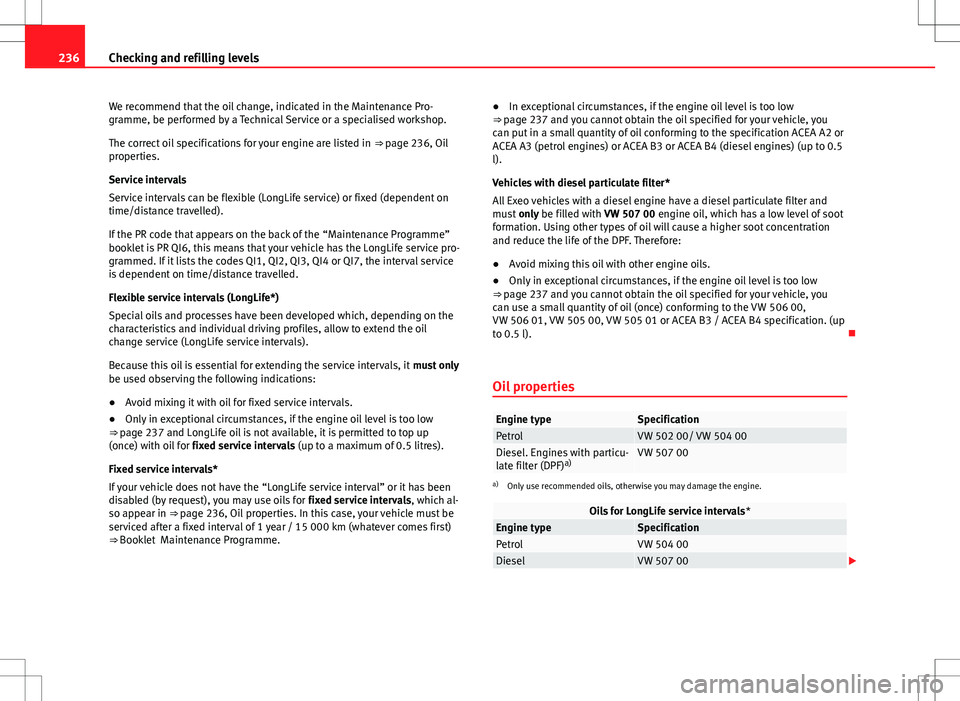
Oil properties
Engine typeSpecificationPetrolVW 502 00/ VW 504 00Diesel. Engines with particu-
late filter (DPF) a)VW 507 00
a)
Only use recommended oils, otherwise you may damage the engine.
Oils for LongLife service intervals *Engine typeSpecificationPetrolVW 504 00DieselVW 507 00
Page 246 of 325
244Checking and refilling levels
Removing the wiper blade
–Lift the wiper arm away from the glass ⇒ Fig. 186
– Slide the blade adapter in the direction of the arrow and remove
the blade ⇒ Fig. 186.
Fitting the wiper blade
– With one hand, hold the top end of the wiper arm.
– Place the blade as shown in the ⇒ Fig. 187 and slide the adapt-
er along until it engages.
Check the condition of the wiper blade regularly. Change as required.
If the windscreen wiper scrapes, it should be replaced if damaged, or
cleaned if soiled.
If this is not sufficient, refer to a specialised workshop.
WARNING
Do not drive unless you have good visibility through all windows!
● Clean the windscreen wiper blades and all windows regularly.
● The wiper blades should be changed once or twice a year.
CAUTION
● A damaged or dirty window wiper could scratch the rear window.
● Never use fuel, nail varnish remover, paint thinner or similar products to
clean the window.
● Never move the windscreen wiper by hand. This could cause damage. Brake fluid
Checking the brake fluid level
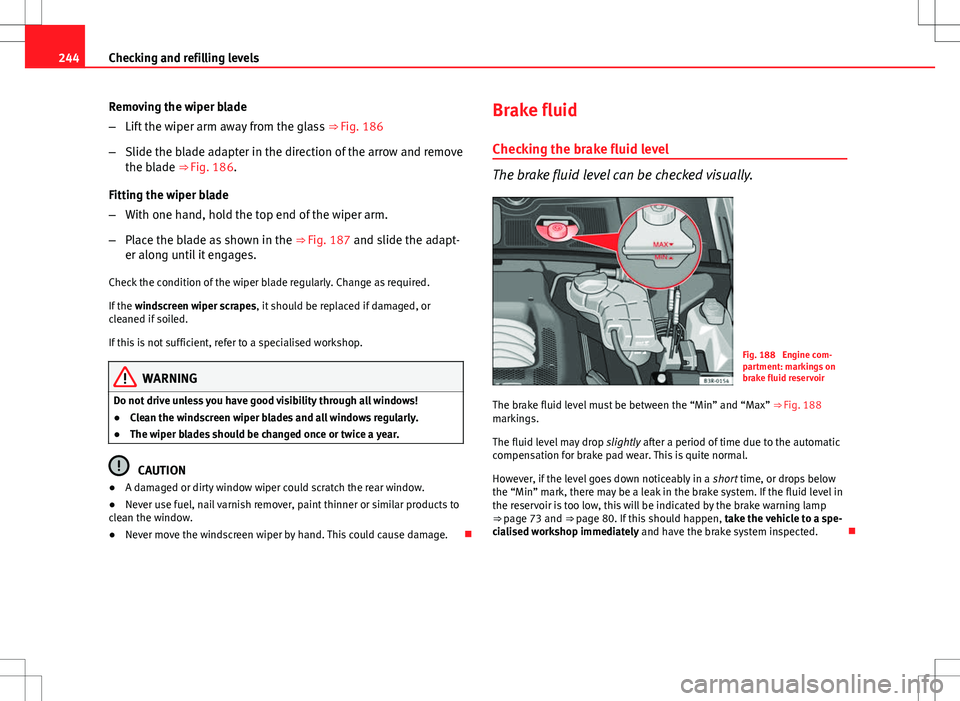
The brake fluid level can be checked visually.
Fig. 188 Engine com-
partment: markings on
brake fluid reservoir
The brake fluid level must be between the “Min” and “Max” ⇒ Fig. 188
markings.
The fluid level may drop slightly after a period of time due to the automatic
compensation for brake pad wear. This is quite normal.
However, if the level goes down noticeably in a short time, or drops below
the “Min” mark, there may be a leak in the brake system. If the fluid level in
the reservoir is too low, this will be indicated by the brake warning lamp
⇒ page 73 and
⇒ page 80. If this should happen,
take the vehicle to a spe-
cialised workshop immediately and have the brake system inspected.
Page 247 of 325
245
Checking and refilling levels
Topping up and changing the brake fluid
It is best to have the brake fluid changed by a professional. Brake fluid absorbs moisture. Therefore, in the course of time it will absorb
water from the air. If the water content in the brake fluid is too high, the
brake system could corrode. In addition, the boiling point of the brake fluid
will be considerably reduced. This could adversely affect the braking ability
in certain circumstances.
For this reason the brake fluid must be changed periodically.
Your vehicle's Service Plan will tell you when the brake fluid has to be re-
newed.
We recommend you have the brake fluid changed as part of a regular In-
spection Service at a Technical Service. They are familiar with the procedure
and have the necessary special tools and spare parts as well as the proper
facilities for disposing of the old fluid.
Be sure to always use the correct brake fluid. Only use brake fluid that ex-
pressly meets VW 501 14 standards.
You can buy VW 501 14 standard brake fluid in a SEAT dealership or SEAT
Official Service. If none is available, use only high quality brake fluid that
meets DIN ISO 4925 CLASS 4 standards, or USA Standards FMVSS 116 DOT
4.
Using any other kind of brake fluid or one that is not of a high quality may
affect operation of the brake system and reduce its effectiveness. Never use
a brake fluid if the container does not state that it complies with VW 501 14,
DIN ISO 4925 CLASS 4 standards, or USA standards FMVSS 116 DOT 4.WARNING
● Brake fluid must always be kept closed in its original container. Keep
out of the reach of children. Failure to comply could result in poisoning.
● If the brake fluid is left in the system for too long and the brakes are
subjected to heavy use, vapour bubbles may form in the brake system.
This would seriously affect the efficiency of the brakes and the safety of
the vehicle, leading to the risk of accident.
CAUTION
Please note that brake fluid will attack the paintwork on contact.
For the sake of the environment
The brake pads and fluid must be collected and disposed of according the
applicable regulations. The SEAT Technical Service network has the neces-
sary equipment and qualified personnel for collecting and disposing of this
waste material.
Vehicle battery General notes
All work on batteries requires specialist knowledge.
The battery is virtually maintenance-free and is checked in the Inspection
Services.
We recommend replacing the battery after 5 years.
Safety FirstOperating InstructionsPractical TipsTechnical Specifications
Page 248 of 325
246Checking and refilling levels
Disconnecting the battery
If the battery is disconnected, some of the vehicle's functions will become
inoperative (e.g. electric windows). These functions will require resetting af-
ter the battery is reconnected. For this reason, the battery should only be
disconnected from the vehicle's electrical system when absolutely necessa-
ry.
Long periods of non-use
The battery will gradually lose its charge because certain electrical equip-
ment continues to draw current even when the ignition is off. If you park the
vehicle for long periods of time in winter you should take the battery out of
the vehicle and store it in a place protected from frost. This way it will not
freeze and become damaged. At warm outside temperatures it is sufficient
to disconnect the negative terminal of the battery. Even when the battery is
not connected you should charge it from time to time.
Winter operation
The battery is drained more in cold weather, which means that the starting
power is reduced. For this reason, have the battery checked and charged if
necessary before the start of winter.
Replacing the battery
A replacement battery must have the same capacity, voltage and current rat-
ing. It must also have the same dimensions as the original, factory-fitted
battery and have sealed caps. The SEAT batteries which have been specially
developed fulfil the maintenance, performance and safety specifications for
your vehicle.
We recommend you use maintenance-free batteries.
WARNING
● All work on batteries requires specialist knowledge. If work is re-
quired on the battery, this should be performed by a Technical Service or
specialised workshop. Danger of caustic burns and explosion!
● The battery must not be opened. Never try to change the battery's liq-
uid level. Explosive gas is released from the battery that could cause an
explosion.
CAUTION
● The battery holder and clamps must always be correctly secured.
● Before starting any work on the battery, always observe the warnings
listed under ⇒
.
For the sake of the environment
Batteries contain toxic substances including sulphuric acid and lead.
Therefore, they must be disposed of in line with environmental regulations
and must not be disposed of with ordinary household waste. Make sure dis-
connected batteries cannot tip over. Sulphuric acid could be spilt!
Important safety warnings for handling a vehicle battery
The battery is located at the back of the engine compartment ⇒ page 304.
Wear eye protection
Battery acid is very corrosive and caustic. Wear protective
gloves and eye protection!
Fires, sparks, open flames and smoking are prohibited!
Page 249 of 325

247
Checking and refilling levels
A highly explosive mixture of gases is released when the bat-
tery is under charge.
Keep children away from acid and batteries!
WARNING
Always be aware of the danger of injury and chemical burns as well as
the risk of accident or fire when working on the battery and the electrical
system:
● Wear eye protection. Protect your eyes, skin and clothing from acid
and particles containing lead.
● Battery acid is very corrosive and caustic. Wear protective gloves and
eye protection. Do not tilt the batteries. This could spill acid through the
vents. Rinse battery acid from eyes immediately for several minutes with
clear water. Then seek medical care immediately. Neutralise any acid
splashes on the skin or clothing with a soapy solution, and rinse off with
plenty of water. If acid is swallowed by mistake, consult a doctor immedi-
ately.
● Fires, sparks, open flames and smoking are prohibited. When han-
dling cables and electrical equipment, avoid causing sparks and electro-
static charge. Never short the battery terminals. High-energy sparks can
cause injury.
● A highly explosive mixture of gases is released when the battery is
under charge. The batteries should be charged in a well-ventilated room
only.
● Keep children away from acid and batteries.
● Before working on the electrical system, you must switch off the en-
gine, the ignition and all consumers. The negative cable on the battery
must be disconnected. When a light bulb is changed, you need only
switch off the light.
WARNING (Continued)
● Deactivate the anti-theft alarm by unlocking the vehicle before you
disconnect the battery! The alarm will otherwise be triggered.
● When disconnecting the battery from the vehicle electrical system,
disconnect first the negative cable and then the positive cable.
● Switch off all electrical consumers before reconnecting the battery.
Reconnect first the positive cable and then the negative cable. Never re-
verse the polarity of the connections. This could cause an electrical fire.
● Never charge a frozen battery, or one which has thawed. This could
result in explosions and chemical burns. Always replace a battery which
has frozen. A flat battery can also freeze at temperatures close to 0°C.
● Ensure that the vent hose is always connected to the battery.
● Never use a defective battery. This could cause an explosion. Replace
a damaged battery immediately.
CAUTION
● Never disconnect the battery if the ignition is switched on or if the en-
gine is running. This could damage the electrical system or electronic com-
ponents.
● Do not expose the battery to direct sunlight over a long period of time,
as the intense ultraviolet radiation can damage the battery housing.
● If the vehicle is left standing in cold conditions for a long period, protect
the battery from freezing. If it freezes it will be damaged.
Charging the battery
A fully-charged battery is important for reliable starting. – Note the warnings ⇒
in Important safety warnings for han-
dling a vehicle battery on page 247 and ⇒ .
Safety FirstOperating InstructionsPractical TipsTechnical Specifications
Page 255 of 325
253
Wheels and tyres
Tyre service life
The service life of tyres is dependent on tyre pressure, driv-
ing style and fitting.
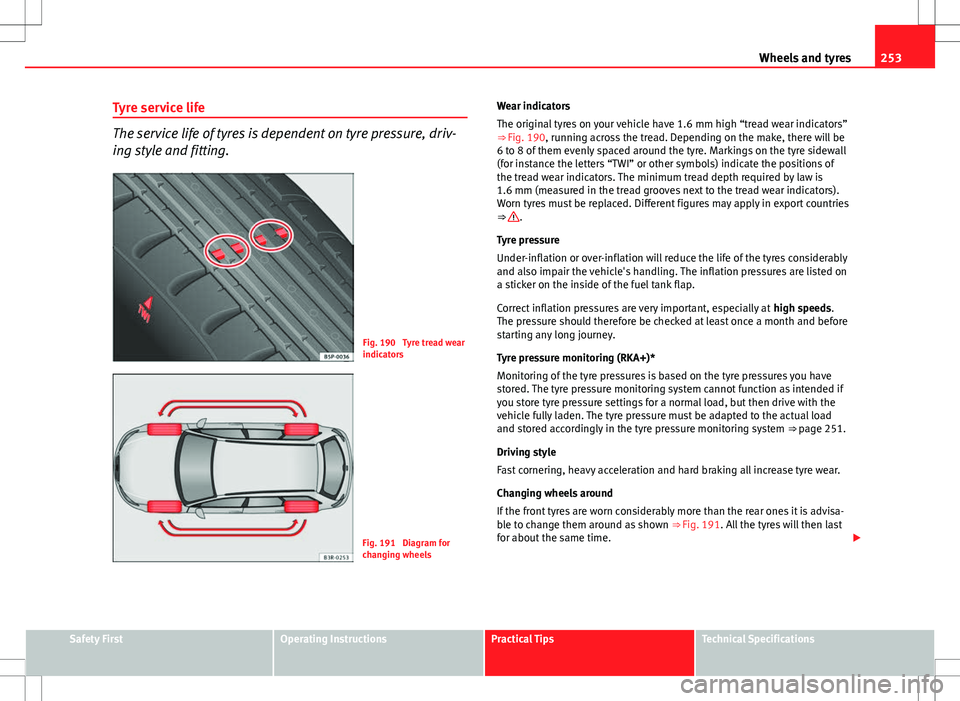
Fig. 190 Tyre tread wear
indicators
Fig. 191 Diagram for
changing wheels Wear indicators
The original tyres on your vehicle have 1.6 mm high “tread wear indicators”
⇒ Fig. 190, running across the tread. Depending on the make, there will be
6 to 8 of them evenly spaced around the tyre. Markings on the tyre sidewall
(for instance the letters “TWI” or other symbols) indicate the positions of
the tread wear indicators. The minimum tread depth required by law is
1.6 mm (measured in the tread grooves next to the tread wear indicators).
Worn tyres must be replaced. Different figures may apply in export countries
⇒
.
Tyre pressure
Under-inflation or over-inflation will reduce the life of the tyres considerably
and also impair the vehicle's handling. The inflation pressures are listed on
a sticker on the inside of the fuel tank flap.
Correct inflation pressures are very important, especially at high speeds.
The pressure should therefore be checked at least once a month and before
starting any long journey.
Tyre pressure monitoring (RKA+)*
Monitoring of the tyre pressures is based on the tyre pressures you have
stored. The tyre pressure monitoring system cannot function as intended if
you store tyre pressure settings for a normal load, but then drive with the
vehicle fully laden. The tyre pressure must be adapted to the actual load
and stored accordingly in the tyre pressure monitoring system ⇒ page 251.
Driving style
Fast cornering, heavy acceleration and hard braking all increase tyre wear.
Changing wheels around
If the front tyres are worn considerably more than the rear ones it is advisa-
ble to change them around as shown ⇒ Fig. 191. All the tyres will then last
for about the same time.
Safety FirstOperating InstructionsPractical TipsTechnical Specifications
Page 274 of 325
272If and when
Note
Please note that the above list contains all data at the time of going to
press, so it is subject to modifications. If discrepancies should occur,
please refer to the sticker on the inside of the fuse cover for the correct in-
formation for your model.
Bulbs
General information
You can change the following bulbs for exterior lights yourself:
● Main headlights: all bulbs (except xenon headlights)
● Tail lights: all bulbs
● Side turn signal bulb
The following bulbs can only be changed by a specialised workshop:
● Main headlights: Xenon* bulb ⇒ page 279
● Front fog lights: Bulb
As a rule, you require a certain degree of practical skill to change defective
bulbs. This applies in particular to those bulbs which are only accessible
from the engine compartment.
If in doubt, we recommend that you have defective bulbs changed by a spe-
cialised workshop or qualified mechanic.
If you do decide to change bulbs in the engine compartment yourself, be
aware of the safety risks involved ⇒ page 234 ⇒
in Types of bulbs on
page 273. The name of many of the lamps fitted by SEAT ends in "LL". This means Long
Life. These lamps are used for functions with a long service time (dipped
beam, side lights, daylight driving, etc.). This does not apply to lamps with
a shorter service time (turn signals, etc.). A lamp with the same name ex-
cept for the last two letters, "LL“ or “SLL”, is compatible, but will have a
service life of approximately half of the LongLife lamps.
When replacing lamp bulbs, the same type of bulb as originally fitted
should always be used where possible.
Page 285 of 325
283
If and when
Changing tail light bulbs (on side panel)
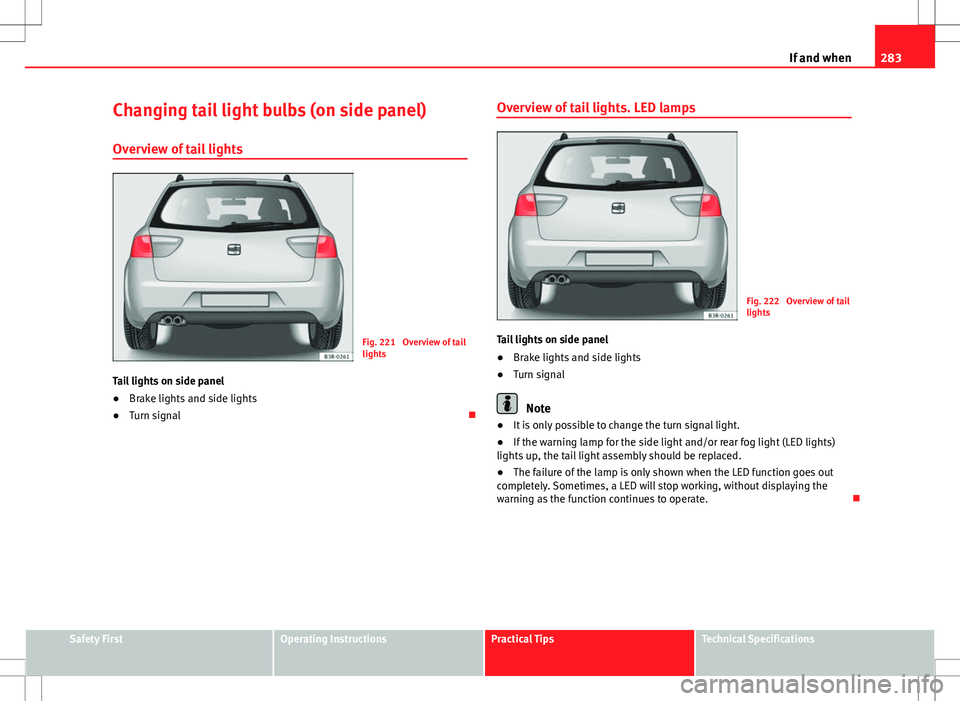
Overview of tail lights
Fig. 221 Overview of tail
lights
Tail lights on side panel
● Brake lights and side lights
● Turn signal Overview of tail lights. LED lamps
Fig. 222 Overview of tail
lights
Tail lights on side panel
● Brake lights and side lights
● Turn signal
Note
● It is only possible to change the turn signal light.
● If the warning lamp for the side light and/or rear fog light (LED lights)
lights up, the tail light assembly should be replaced.
● The failure of the lamp is only shown when the LED function goes out
completely. Sometimes, a LED will stop working, without displaying the
warning as the function continues to operate.
Safety FirstOperating InstructionsPractical TipsTechnical Specifications
Page 299 of 325
297
If and when
Towing and tow-starting
Tow-starting
The use of jump leads is preferable to tow-starting.
We recommend that you do not tow-start your vehicle. Jump-start-
ing is preferable ⇒ page 293.
However, if your vehicle has to be tow-started:
– Engage the 2nd or the 3rd gear.
– Keep the clutch pressed down.
– Switch the ignition on.
– Once both vehicles are moving, release the clutch.
– As soon as the engine starts, press the clutch and move the
gear lever into neutral. This helps to prevent driving into the
towing vehicle.
WARNING
The risk of accidents is high when tow-starting. The vehicle being towed
can easily collide with the towing vehicle.
CAUTION
When tow-starting, fuel could enter the catalytic converter and damage it. General notes
Please observe the following points if you use a tow rope:
Notes for the driver of the towing vehicle
–
Drive slowly at first until the tow rope is taut. Then accelerate
gradually.
– Begin and change gears cautiously. If you are driving an auto-
matic vehicle, accelerate gently.
– Remember that the brake servo and power steering are not
working in the vehicle you are towing. Brake sooner than nor-
mal and pressing the pedal gently.
Notes for the driver of the towed vehicle
– Ensure that the tow rope remains taut at all times when towing.
Tow rope or tow bar
It is easier and safer to tow a vehicle with a tow bar. You should only use a
tow rope if you do not have a tow bar.
A tow rope should be slightly elastic to reduce the loading on both vehicles.
It is advisable to use a tow rope made of synthetic fibre or similarly elastic
material.
Attach the tow rope or the tow bar only to the towing eyes provided or a tow-
ing bracket.
Driving style
Towing requires some experience, especially when using a tow rope. Both
drivers should be familiar with the technique required for towing. Inexper-
ienced drivers should not attempt to tow.
Safety FirstOperating InstructionsPractical TipsTechnical Specifications
Page 324 of 325
SEAT S.A. is permanently concerned about continuous development of its t\�ypes and models. For this reason we ask you to under-
stand, that at any given time, changes regarding shape, equipment and te\�chnique may take place on the car delivered. For this reason
no right at all may derive based on the data, drawings and descriptions \�in this current handbook.
All texts, illustrations and standards in this handbook are based on the\� status of information at the time of printing. Except for error
or omission, the information included in the current handbook is valid a\�s of the date of closing print.
Re-printing, copying or translating, whether total or partial is not all\�owed unless SEAT allows it in written form.
SEAT reserves all rights in accordance with the “Copyright” Act.
All rights on changes are reserved.
❀This paper has been manufactured using bleached non-chlorine cellulose.
© SEAT S.A. - Reprint: 15.07.12