ECO mode Seat Exeo ST 2012 Owner's Guide
[x] Cancel search | Manufacturer: SEAT, Model Year: 2012, Model line: Exeo ST, Model: Seat Exeo ST 2012Pages: 325, PDF Size: 5.56 MB
Page 205 of 325
203
Driving and the environment
Diesel engine particulate filter*
The diesel engine particulate filter eliminates soot produced
by burning diesel.
The diesel engine particulate filter eliminates most of the soot from the ex-
haust gas system. Under normal driving conditions, the filter cleans itself. If
the driving conditions do not allow the filter to clean itself (for example,
multiple short trips) the filter will be obstructed by dust and pollen and the
indicator for the diesel engine particulate filter indicator will light up.
This does not represent a fault, it is a warning that indicates that the filter
has not been able to regenerate automatically and that you must carry out a
cleaning cycle, as indicated in ⇒ page 83.
WARNING
● The diesel engine particulate filter may reach extremely high temper-
atures; the vehicle should be parked so that the exhaust pipe does not
come into contact with flammable materials underneath the vehicle. Oth-
erwise there is a risk of fire.
CAUTION
● Your vehicle is not designed to use biodiesel fuel. Never, under any cir-
cumstances refuel with biodiesel. The use of biodiesel fuel could damage
the engine and the fuel system. The addition of biodiesel to diesel by the
diesel producer in accordance with standard EN 590 is authorised and will
not cause damage to the engine or the fuel system.
● Using diesel fuel with a high sulphur content may significantly reduce
the useful life of the diesel particulate filter. Your Technical Service will be
able to tell you which countries have diesel with a high sulphur content. Economical and environmentally friendly
driving
Economical and environmentally friendly driving
Fuel consumption, environmental pollution and wear to the engine, brakes
and tyres depends in large part on your driving style. By adopting an eco-
nomical driving style and anticipating the traffic situation ahead, you can
easily reduce fuel consumption by 10-15%. Some tips on how to help you
reduce pollution while saving money are listed below.
Drive anticipating the traffic situation
A vehicle uses most fuel when accelerating. When you anticipate the situa-
tion, you have to brake less often and, thus, accelerate less. If it is possible,
let the vehicle roll with a
gear engaged, for example, if you see a red light
ahead. The braking effect achieved in this way helps to reduce the wear of
brakes and tyres; emissions and fuel consumption are reduced to zero (dis-
connection due to inertia).
Change gear early to save energy
An effective way of saving fuel is to change up quickly through the gears.
Running the engine at high rpm in the lower gears uses an unnecessary
amount of fuel.
Manual gearbox: Change from first to second gear as quickly as possible.
We recommend that, whenever possible, you change to a higher gear upon
reaching 2000 rpm. Follow the “recommended gear” indication that ap-
pears on the instrument panel ⇒ page 76.
Avoid driving at high speed
We advise you not to drive at the top speed permitted by the vehicle. Fuel
consumption, exhaust emissions and noise levels all increase very rapidly
at higher speeds. Driving at moderate speeds will help to save fuel.
Safety FirstOperating InstructionsPractical TipsTechnical Specifications
Page 207 of 325
205
Driving and the environment
Environmental friendliness
Environmental protection is a top priority in the design, choice of materials
and production of your new Seat.
Design measures for economical recycling
● Joints and connections designed for easy dismantling
● Modular construction to facilitate dismantling
● Increased use of single-grade materials
● Plastic parts and elastomers are marked in accordance with ISO 1043,
ISO 11469 and ISO 1629
Choice of materials
● Nearly all materials used can be recycled
● Similar types of plastics grouped together for easy recycling
● Recycled materials used in manufacture
● Reduction of volatile compounds in plastics
● CFC-free refrigerant in air conditioner
Compliance with prohibited materials regulation : cadmium, lead, mercury,
chrome VI.
Manufacturing methods
● Use of recycled material for manufacturing plastic parts
● Solvent-free cavity sealing
● Solvent-free wax for protecting the vehicles in transit
● Solvent-free adhesives
● No CFCs used in production
● Surplus materials used extensively for energy conversion and building
materials
● Overall water consumption reduced
● Heat recovery systems
● Use of water-soluble paints Driving abroad
Observations
To drive abroad, the following must be taken into consideration:
● For vehicles fitted with a catalytic converter ensure that unleaded petrol
is available for the journey. See the chapter “Refuelling”. Automobile organ-
isations will have information about service station networks selling unlea-
ded fuel.
● In some countries, it is possible that your vehicle model is not sold, and
therefore spare parts are not available or the Technical Services can only
carry out limited repairs.
SEAT importers and distributors will gladly provide information about the
technical preparations that you vehicle requires and also about necessary
maintenance and repair possibilities.
Adhesive strips for headlights
If you have to drive a right-hand drive vehicle in a left-hand drive country, or
vice versa, the asymmetric dipped beam headlights will dazzle oncoming
traffic.
To prevent dazzling, you must apply stickers to certain parts of the head-
light lenses. Further information is available at your Technical Service.
In vehicles with adaptive headlights, the rotation system must previously be
disconnected. To do this, please go to a specialised workshop.
Safety FirstOperating InstructionsPractical TipsTechnical Specifications
Page 224 of 325
222Vehicle maintenance and cleaning
Cleaning the engine compartment
Take special care when cleaning the engine compartment.
Anti-corrosion treatment
The engine compartment and the surface of the power unit are given anti-
corrosion treatment at the factory.
Good corrosion protection is particularly important in winter when the vehi-
cle is frequently driven on salted roads. To prevent the salt corroding the ve-
hicle, the entire engine compartment should be thoroughly cleaned before
and after winter.
Your Technical Service has got the necessary equipment to provide the cor-
rect cleaning and preserving products. For this reason, we recommend hav-
ing this work performed by them.
The anti-corrosion protection is usually removed if the engine compartment
is cleaned with grease removing solutions, or if you have the engine
cleaned. On commissioning this work, ensure that all surfaces, seams,
joints and components in the engine compartment are given anti-corrosion
treatment.
WARNING
● When working in the engine compartment, always observe the safety
warnings ⇒ page 234.
● Before opening the bonnet, switch the engine off, apply the hand-
brake firmly and always remove the key from the ignition.
● Allow the engine to cool before you clean the engine compartment.
● Do not clean the vehicle underbody, wheel arches or wheel trims
without protecting your hands and arms. You may cut yourself on sharp-
edged metal parts. Failure to comply could result in injury.
WARNING (Continued)
● Moisture, ice and salt on the brakes may affect braking efficiency.
Risk of accident. Directly after washing, avoid sudden and sharp braking.
● Never touch the radiator fan. It is temperature-controlled and could
start automatically, even when the key is removed from the ignition!
For the sake of the environment
Fuel, grease and oil deposits could be removed when the engine is washed.
The polluted water must be cleaned in an oil separator. For this reason, en-
gine washing should be carried out only by a specialised workshop or a pet-
rol station.
Vehicle interior maintenance Introduction
The dye used in many modern garments, for example dark jeans, is not al-
ways sufficiently colour-fast. Seat upholstery (material and leather), espe-
cially when light-coloured, may visibly discolour if the dye comes out of
clothing (even when used correctly). This is not an upholstery defect but in-
dicates that the dye in the item of clothing is not sufficiently colour-fast.
The longer stains or dirt remain on the vehicle surfaces, especially the fab-
rics covering the padded upholstery, the more difficult it becomes to clean
and maintain them. If stains and dirt are left for a long time, it may be that
they are impossible to remove.
Page 258 of 325
256Wheels and tyres
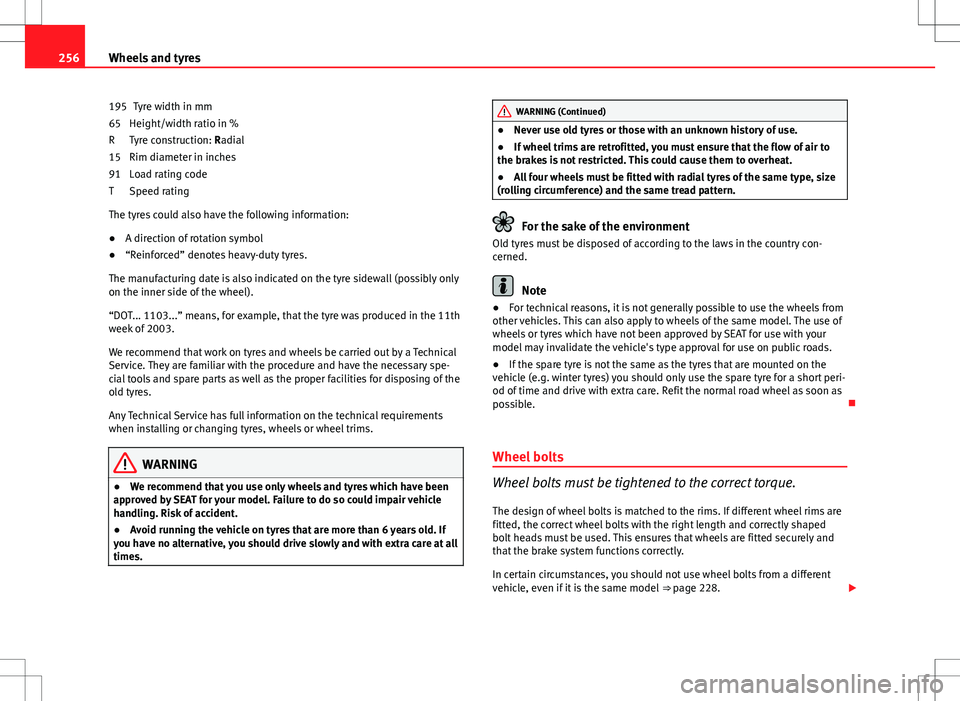
Tyre width in mm
Height/width ratio in %
Tyre construction: Radial
Rim diameter in inches
Load rating code
Speed rating
The tyres could also have the following information:
● A direction of rotation symbol
● “Reinforced” denotes heavy-duty tyres.
The manufacturing date is also indicated on the tyre sidewall (possibly only
on the inner side of the wheel).
“DOT... 1103...” means, for example, that the tyre was produced in the 11th
week of 2003.
We recommend that work on tyres and wheels be carried out by a Technical
Service. They are familiar with the procedure and have the necessary spe-
cial tools and spare parts as well as the proper facilities for disposing of the
old tyres.
Any Technical Service has full information on the technical requirements
when installing or changing tyres, wheels or wheel trims.
WARNING
● We recommend that you use only wheels and tyres which have been
approved by SEAT for your model. Failure to do so could impair vehicle
handling. Risk of accident.
● Avoid running the vehicle on tyres that are more than 6 years old. If
you have no alternative, you should drive slowly and with extra care at all
times.
195
65
R
15
91
TWARNING (Continued)
● Never use old tyres or those with an unknown history of use.
● If wheel trims are retrofitted, you must ensure that the flow of air to
the brakes is not restricted. This could cause them to overheat.
● All four wheels must be fitted with radial tyres of the same type, size
(rolling circumference) and the same tread pattern.
For the sake of the environment
Old tyres must be disposed of according to the laws in the country con-
cerned.
Note
● For technical reasons, it is not generally possible to use the wheels from
other vehicles. This can also apply to wheels of the same model. The use of
wheels or tyres which have not been approved by SEAT for use with your
model may invalidate the vehicle's type approval for use on public roads.
● If the spare tyre is not the same as the tyres that are mounted on the
vehicle (e.g. winter tyres) you should only use the spare tyre for a short peri-
od of time and drive with extra care. Refit the normal road wheel as soon as
possible.
Wheel bolts
Wheel bolts must be tightened to the correct torque.
The design of wheel bolts is matched to the rims. If different wheel rims are
fitted, the correct wheel bolts with the right length and correctly shaped
bolt heads must be used. This ensures that wheels are fitted securely and
that the brake system functions correctly.
In certain circumstances, you should not use wheel bolts from a different
vehicle, even if it is the same model ⇒ page 228.
Page 274 of 325
272If and when
Note
Please note that the above list contains all data at the time of going to
press, so it is subject to modifications. If discrepancies should occur,
please refer to the sticker on the inside of the fuse cover for the correct in-
formation for your model.
Bulbs
General information
You can change the following bulbs for exterior lights yourself:
● Main headlights: all bulbs (except xenon headlights)
● Tail lights: all bulbs
● Side turn signal bulb
The following bulbs can only be changed by a specialised workshop:
● Main headlights: Xenon* bulb ⇒ page 279
● Front fog lights: Bulb
As a rule, you require a certain degree of practical skill to change defective
bulbs. This applies in particular to those bulbs which are only accessible
from the engine compartment.
If in doubt, we recommend that you have defective bulbs changed by a spe-
cialised workshop or qualified mechanic.
If you do decide to change bulbs in the engine compartment yourself, be
aware of the safety risks involved ⇒ page 234 ⇒
in Types of bulbs on
page 273. The name of many of the lamps fitted by SEAT ends in "LL". This means Long
Life. These lamps are used for functions with a long service time (dipped
beam, side lights, daylight driving, etc.). This does not apply to lamps with
a shorter service time (turn signals, etc.). A lamp with the same name ex-
cept for the last two letters, "LL“ or “SLL”, is compatible, but will have a
service life of approximately half of the LongLife lamps.
When replacing lamp bulbs, the same type of bulb as originally fitted
should always be used where possible.
Page 315 of 325
Index
Numbers and Symbols
230 V socket . . . . . . . . . . . . . . . . . . . . . . . . . . . 157
A
Accessories . . . . . . . . . . . . . . . . . . . . . . . . . . . . 228 Towing . . . . . . . . . . . . . . . . . . . . . . . . . . . . . 208
Adaptive headlights . . . . . . . . . . . . . . . . . . . . . 123 Faulty . . . . . . . . . . . . . . . . . . . . . . . . . . . . . . . 84
Airbag Warning lamp . . . . . . . . . . . . . . . . . . . . . . . . 68
Airbag covers . . . . . . . . . . . . . . . . . . . . . . . . . . . 35
Airbag system . . . . . . . . . . . . . . . . . . . . . . . . . . . 29 Curtain airbags . . . . . . . . . . . . . . . . . . . . . . . 42
Front airbags . . . . . . . . . . . . . . . . . . . . . . . . 33
Side airbags . . . . . . . . . . . . . . . . . . . . . . . . . 39
Warning lamp . . . . . . . . . . . . . . . . . . . . . . . . 31
Air conditioner 2C-Climatronic . . . . . . . . . . . . . . . . . . . . . . 162
Air distribution . . . . . . . . . . . . . . . . . . . . . . 169
Air outlets . . . . . . . . . . . . . . . . . . . . . . . . . . 169
Air purity sensor . . . . . . . . . . . . . . . . . . . . . 167
Air recirculation . . . . . . . . . . . . . . . . . . . . . 166
Air recirculation (automatic) . . . . . . . . . . . 167
Automatic mode . . . . . . . . . . . . . . . . . . . . . 165
Blower . . . . . . . . . . . . . . . . . . . . . . . . . . . . . 168
Controls . . . . . . . . . . . . . . . . . . . . . . . . . . . . 164
Defrosting . . . . . . . . . . . . . . . . . . . . . . . . . . 166
ECON Mode (economy) . . . . . . . . . . . . . . . 166 Economical use . . . . . . . . . . . . . . . . . . . . . 170
Key settings . . . . . . . . . . . . . . . . . . . . . . . . 170
Solar-powered blower/sunroof . . . . . . . . . 170
Temperature selection . . . . . . . . . . . . . . . . 165
Air duct Fitting . . . . . . . . . . . . . . . . . . . . . . . . . 274, 281
Removing . . . . . . . . . . . . . . . . . . . . . . 274, 280
Air purity sensor . . . . . . . . . . . . . . . . . . . . . . . . 167
Alcantara . . . . . . . . . . . . . . . . . . . . . . . . . . . . . . 224
Alternator Warning lamp . . . . . . . . . . . . . . . . . . . . . . . . 72
Ambient lighting . . . . . . . . . . . . . . . . . . . . . . . 126
Anti-lock brake system How it works . . . . . . . . . . . . . . . . . . . . . . . . 196
Anti-theft alarm system . . . . . . . . . . . . . . . . . . 110 Interior monitoring . . . . . . . . . . . . . . . . . . . 111
Antifreeze . . . . . . . . . . . . . . . . . . . . . . . . . . . . . 238
Aquaplaning . . . . . . . . . . . . . . . . . . . . . . . . . . . 254
Armrest Storage compartment in front armrest . . . 143
Armrests Adjusting the front armrest . . . . . . . . . . . . 143
Ashtray Front . . . . . . . . . . . . . . . . . . . . . . . . . . . . . . 154
Rear . . . . . . . . . . . . . . . . . . . . . . . . . . . . . . . 155
ASR How the system works . . . . . . . . . . . . . . . . 197
Warning lamp . . . . . . . . . . . . . . . . . . . . . . . . 71
Athermic windscreen . . . . . . . . . . . . . . . . . . . . 229 Auto-check system . . . . . . . . . . . . . . . . . . . . . . . 78
Automatic car wash tunnel . . . . . . . . . . . . . . . 217
Automatic gearbox
Dynamic gear control programme . . . . . . . 191
Kick-down feature . . . . . . . . . . . . . . . . . . . . 191
multitronic® . . . . . . . . . . . . . . . . . . . . . . . . 187
Paddle levers (tiptronic mode) . . . . . . . . . 193
Safety interlock for ignition key . . . . . . . . . 173
Selector lever lock . . . . . . . . . . . . . . . . . . . 190
Selector lever positions . . . . . . . . . . . . . . . 189
Steering wheel with paddle levers . . . . . . 193
tiptronic . . . . . . . . . . . . . . . . . . . . . . . . . . . 187
tiptronic mode . . . . . . . . . . . . . . . . . . . . . . 192
Automatic headlight control . . . . . . . . . . . . . . 117
Auxiliary heater . . . . . . . . . . . . . . . . . . . . . . . . 171
B
Battery . . . . . . . . . . . . . . . . . . . . . . . . . . . . . . . . 245 Battery voltage . . . . . . . . . . . . . . . . . . . . . . . 84
Charging . . . . . . . . . . . . . . . . . . . . . . . . . . . 247
Disconnection . . . . . . . . . . . . . . . . . . . . . . . 246
Long periods of non-use . . . . . . . . . . 245, 246
Replacing . . . . . . . . . . . . . . . . . . . . . . 245, 246
Testing . . . . . . . . . . . . . . . . . . . . . . . . . . . . 245
Winter operation . . . . . . . . . . . . . . . . 245, 246
Bicycle rack Towing . . . . . . . . . . . . . . . . . . . . . . . . . . . . . 208
Biodiesel . . . . . . . . . . . . . . . . . . . . . . . . . . . . . . 232
Biodiesel fuel . . . . . . . . . . . . . . . . . . . . . . . . . . 232
313
Index
Page 322 of 325
Emergency activation . . . . . . . . . . . . . . . . . 116
Opening . . . . . . . . . . . . . . . . . . . . . . . . . . . 115
Snow chains . . . . . . . . . . . . . . . . . . . . . . . 258, 303
Solar-powered blower/sunroof . . . . . . . . . . . . 170
Solar sunroof . . . . . . . . . . . . . . . . . . . . . . . . . . 116
Spare keys . . . . . . . . . . . . . . . . . . . . . . . . . . . . . 99
Spare parts . . . . . . . . . . . . . . . . . . . . . . . . . . . . 228
Spare wheel Steel rim . . . . . . . . . . . . . . . . . . . . . . . . . . . 261
Speedometer . . . . . . . . . . . . . . . . . . . . . . . . . . . 65
Speed warning . . . . . . . . . . . . . . . . . . . . . . . 84, 85
Speed warning function . . . . . . . . . . . . . . . . . . . 85
Start-Stop Activating and deactivating . . . . . . . . . . . . 177
Function . . . . . . . . . . . . . . . . . . . . . . . . . . . 176
Steam jets . . . . . . . . . . . . . . . . . . . . . . . . . . . . . 218
Steering Locking . . . . . . . . . . . . . . . . . . . . . . . . . . . . 173
Manual steering wheel adjustment . . . . . 172
Steering wheel controls . . . . . . . . . . . . . . . . . . . 94
Stopping the engine . . . . . . . . . . . . . . . . . . . . 175
Sun visors . . . . . . . . . . . . . . . . . . . . . . . . . . . . . 128
Switches on the driver door Electric windows . . . . . . . . . . . . . . . . . . . . . 112
Symbols Red symbols in central display . . . . . . . . . . 80
Yellow symbols on central display . . . . . . . 82
T Technical modifications . . . . . . . . . . . . . . . . . . 228
The danger of not using the seat belt . . . . . . . . 21 The environment
Heated rear window . . . . . . . . . . . . . . . . . . 128
Leaks . . . . . . . . . . . . . . . . . . . . . . . . . . . . . . 235
Warming up the engine . . . . . . . . . . . . . . . 174
Tightening torque of wheel bolts . . . . . . . . . . 303
tiptronic . . . . . . . . . . . . . . . . . . . . . . . . . . . . . . 187
tiptronic mode . . . . . . . . . . . . . . . . . . . . . . . . . 192
Tools . . . . . . . . . . . . . . . . . . . . . . . . . . . . . . . . . 259
Tow-starting . . . . . . . . . . . . . . . . . . . . . . . . . . . 297
Towing . . . . . . . . . . . . . . . . . . . . . . . . . . . . 206, 297 Accessories . . . . . . . . . . . . . . . . . . . . . . . . . 208
Notes on towing . . . . . . . . . . . . . . . . . 206, 207
Removable towing bracket . . . . . . . . . . . . 209
Technical requirements . . . . . . . . . . . . . . . 206
Towing a trailer . . . . . . . . . . . . . . . . . . . . . . . . . 302
Towing bracket, fitting . . . . . . . . . . . . . . . . . . . 214
Towing eye . . . . . . . . . . . . . . . . . . . . . . . . . . . . 297
Towing eyes . . . . . . . . . . . . . . . . . . . . . . . . . . . 298
Tow starting General notes . . . . . . . . . . . . . . . . . . . . . . . 297
Traction control system How the system works . . . . . . . . . . . . . . . . 197
Traction control system (ASR) warning lamp . . . . . . . . . . . . . . . . . . . . . . . . 71
Trailer weights . . . . . . . . . . . . . . . . . . . . . . . . . 302
Trip recorder . . . . . . . . . . . . . . . . . . . . . . . . . . . . 65
Turn signal lamps Hazard warning lights . . . . . . . . . . . . . . . . . 71
Trailer turn signals . . . . . . . . . . . . . . . . . . . . 69
Turn signals . . . . . . . . . . . . . . . . . . . . . . . . . 71
Turn signals . . . . . . . . . . . . . . . . . . . . . . . . . . . 124
Tyre mobility system . . . . . . . . . . . . . . . . . . . . . 260 Tyre Mobility System . . . . . . . . . . . . . . . . . . . . 266
Tyre pressure . . . . . . . . . . . . . . . . . . . 69, 93, 249
Loss . . . . . . . . . . . . . . . . . . . . . . . . . . . . . . . 251
Tyre pressure monitoring . . . . . . . . . . . . . . . . . 250
Tyre pressure monitoring system . . . . . . . . . . . 92
Tyre pressures . . . . . . . . . . . . . . . . . . . . . . . . . . 303
Tyre repair kit Tyre Mobility System . . . . . . . . . . . . . . . . . 266
Tyres and wheels Dimensions . . . . . . . . . . . . . . . . . . . . . . . . . 255
Tyres service life . . . . . . . . . . . . . . . . . . . . . . . . 253
Tyres tread depth . . . . . . . . . . . . . . . . . . . . . . . 253
Tyres with directional tread pattern . . . . . . . . 249
U Underbody protection . . . . . . . . . . . . . . . . . . . 221
Upholstery Treating your upholstery . . . . . . . . . . . . . . 223
V
Vehicle care synthetic leather . . . . . . . . . . . . . . . . . . . . 226
Treating your upholstery . . . . . . . . . . . . . . 223
Vehicle data . . . . . . . . . . . . . . . . . . . . . . . . . . . 301
Vehicle identification data . . . . . . . . . . . . . . . . 301
Vehicle identification number . . . . . . . . . . . . . 301
Vehicle keys . . . . . . . . . . . . . . . . . . . . . . . . . . . . 99
Vehicle maintenance electrically adjustable seats . . . . . . . . . . . 224
heated seats . . . . . . . . . . . . . . . . . . . . . . . . 224
320 Index