check oil Seat Exeo ST 2012 Owner's Guide
[x] Cancel search | Manufacturer: SEAT, Model Year: 2012, Model line: Exeo ST, Model: Seat Exeo ST 2012Pages: 325, PDF Size: 5.56 MB
Page 256 of 325
254Wheels and tyres
Wheel balance
The wheels on new vehicles are balanced. However, various factors encoun-
tered in normal driving can cause them to become unbalanced, which re-
sults in steering vibration.
Unbalanced wheels should be rebalanced, as they otherwise cause exces-
sive wear on steering, suspension and tyres. A wheel must also be reba-
lanced when a new tyre is fitted.
Incorrect wheel alignment
Incorrect wheel alignment causes excessive tyre wear, impairing the safety
of the vehicle. If tyres show excessive wear, you should have the wheel
alignment checked by a Technical Service.
WARNING
There is a serious danger of accidents if a tyre bursts during driving!
● The tyres must be replaced at the latest when the tread wear indica-
tors are worn ⇒ page 253. Failure to do so could result in an accident.
Worn tyres do not grip well at high speeds on wet roads. There is also a
greater risk of aquaplaning.
● At continuously high speeds, a tyre with insufficient pressure flexes
more. This causes it to overheat. This can cause tread separation and tyre
blow-out. Risk of accident. Always observe the recommended tyre pres-
sures.
● If tyres show excessive wear, you should have the running gear
checked by a Technical Service.
● Keep chemicals such as oil, fuel and brake fluid away from tyres.
● Damaged wheels and tyres must be replaced immediately!
For the sake of the environment
Under-inflated tyres will increase fuel consumption. Run-flat tyres*
Run-flat tyres allow you to continue driving even with a
punctured tyre, in the majority of cases.
In vehicles that are factory-fitted with run-flat tyres 1)
the loss of tyre
pressure is indicated on the instrument panel.
Driving with run-flat tyres (emergency running)
– Leave the ESC/ASR on (Electronic Stability Control), or switch it
on ⇒ page 71.
– Continue driving carefully and slowly (80 km/h maximum).
– Avoid sudden manoeuvres and sharp turns.
– Avoid driving over obstacles (for example kerbs) or potholes.
– Pay attention if the ESC/ASR activates often, if smoke comes
from the tyres or there is a smell of rubber, if the vehicle vi-
brates or there are clattering noises. If any of these occur, stop
the vehicle.
The run-flat tyres have a tag on the side of the tyre, with the description:
“DSST”, “Eufonia”, “RFT”, “ROF”, “RSC”, “SSR” or “ZP”.
The sides of this type of tyre are reinforced. When the tyres lose air they are
supported on the sides (emergency driving).
The loss of pressure in the tyre is shown on the instrument panel. You can
then drive a maximum of 80 km and if the circumstances are favourable (for
example, low load), even more.
1)
Depending upon version and country.
Page 259 of 325
257
Wheels and tyres
After the wheels have been changed, the tightening torque of the wheel
bolts should be checked as soon as possible with a torque wrench. ⇒
The tightening torque for steel and alloy wheels is 120 Nm.
WARNING
If the wheel bolts are not tightened correctly, the wheel could become
loose while driving. Risk of accident.
● The wheel bolts must be clean and turn easily. Never apply grease or
oil to them.
● Use only wheel bolts which belong to the wheel.
● If the torque of the wheel bolts is too low, they could loosen whilst
the vehicle is in motion. Risk of accident! If the tightening torque is too
high, the wheel bolts and threads can be damaged.
CAUTION
The prescribed torque for wheel bolts for steel and alloy wheels is 120 Nm.
Winter tyres
Winter tyres will improve the vehicles handling on snow and
ice.
In winter conditions winter tyres will considerably improve the vehicle's han-
dling. The design of summer tyres (width, rubber compound, tread pattern)
gives less grip on ice and snow.
Winter tyres must be inflated to a pressure 0.2 bar higher than the pres-
sures specified for summer tyres (see sticker on tank flap).
Winter tyres must be fitted on all four wheels. Information on permitted winter tyre sizes can be found in the vehicle's reg-
istration documents. Use only radial winter tyres. All tyre sizes listed in the
vehicle documentation also apply to winter tyres.
Winter tyres lose their effectiveness when the tread is worn down to a depth
of 4 mm.
The speed rating code ⇒
page 255, New tyres and wheels determines the
following speed limits for winter tyres: ⇒
max. 160 km/h
max. 180 km/h
max. 190 km/h
max. 210 km/h
In some countries, vehicles which can exceed the speed rating of the fitted
tyre must have an appropriate sticker in the driver's field of view. These
stickers are available from your Technical Service. The legal requirements of
each country must be followed.
Do not have winter tyres fitted for unnecessarily long periods. Vehicles with
summer tyres handle better when the roads are free of snow and ice.
If you have a flat tyre, please refer to the notes on the spare wheel
⇒ page 255, New tyres and wheels.
WARNING
The maximum speed for the winter tyres must not be exceeded. Other-
wise, this could lead to tyre damage and risk of accident.
For the sake of the environment
Fit your summer tyres again as soon as possible. They are quieter, do not
wear so quickly and reduce fuel consumption.
Q
S
T
H
Safety FirstOperating InstructionsPractical TipsTechnical Specifications
Page 270 of 325
268If and when
Repairing a tyre
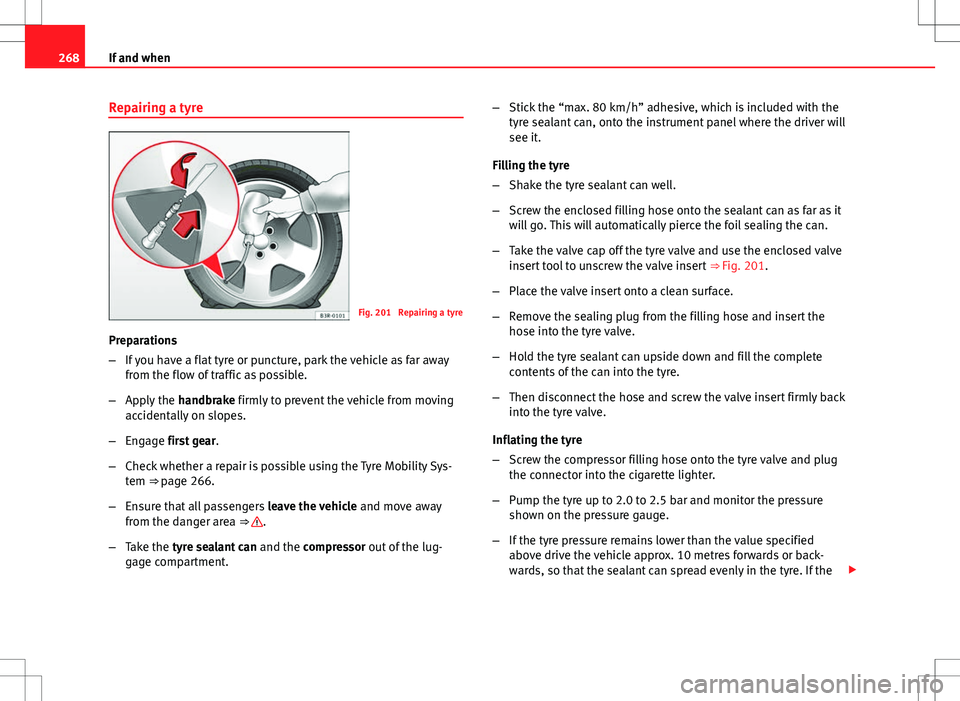
Fig. 201 Repairing a tyre
Preparations
– If you have a flat tyre or puncture, park the vehicle as far away
from the flow of traffic as possible.
– Apply the handbrake firmly to prevent the vehicle from moving
accidentally on slopes.
– Engage first gear .
– Check whether a repair is possible using the Tyre Mobility Sys-
tem ⇒ page 266.
– Ensure that all passengers leave the vehicle and move away
from the danger area ⇒
.
– Take the tyre sealant can and the compressor out of the lug-
gage compartment. –
Stick the “max. 80 km/h” adhesive, which is included with the
tyre sealant can, onto the instrument panel where the driver will
see it.
Filling the tyre
– Shake the tyre sealant can well.
– Screw the enclosed filling hose onto the sealant can as far as it
will go. This will automatically pierce the foil sealing the can.
– Take the valve cap off the tyre valve and use the enclosed valve
insert tool to unscrew the valve insert ⇒ Fig. 201.
– Place the valve insert onto a clean surface.
– Remove the sealing plug from the filling hose and insert the
hose into the tyre valve.
– Hold the tyre sealant can upside down and fill the complete
contents of the can into the tyre.
– Then disconnect the hose and screw the valve insert firmly back
into the tyre valve.
Inflating the tyre
– Screw the compressor filling hose onto the tyre valve and plug
the connector into the cigarette lighter.
– Pump the tyre up to 2.0 to 2.5 bar and monitor the pressure
shown on the pressure gauge.
– If the tyre pressure remains lower than the value specified
above drive the vehicle approx. 10 metres forwards or back-
wards, so that the sealant can spread evenly in the tyre. If the
Page 271 of 325
269
If and when
pressure is still lower than the specification the tyre is too badly
damaged and cannot be repaired using the tyre sealant.
Final check
– After about 10 minutes, stop to check the tyre pressure.
– If tyre pressure is less than 1.3 bar, the tyre is too badly dam-
aged. Do not drive on! You should obtain professional assis-
tance.
WARNING
● If you have a puncture in heavy traffic, switch on the hazard warning
lights and place the warning triangle in a visible location. This is for your
own safety and also warns other road users.
● Make sure your passengers wait in a safe place (for instance behind
the roadside crash barrier).
● Please observe the manufacturer's safety notes on the compressor
and the instructions supplied with the tyre sealant can.
● If it is not possible to build up a tyre pressure of 2.0 bar within 6 mi-
nutes this means that the tyre is too badly damaged. Do not drive on!
● Seek professional assistance if the repair of a tyre puncture is not
possible with the sealing compound.
● If tyre pressure is less than 1.3 bar after driving about 10 minutes,
the tyre is too badly damaged. Do not drive on! Obtain technical assis-
tance.
CAUTION
Take special care if you have to repair a tyre on a slope.
Note
● Do not use the compressor for longer than 6 minutes. Otherwise, it
might overheat. When the compressor has cooled down, you can use it
again.
● If tyre sealant should leak out, leave it to dry and then pull it off like foil.
● After carrying out a tyre repair remember to buy a new tyre sealant can at
a specialised workshop. This will ensure that the Tyre Mobility System is op-
erative again.
● Please observe legal requirements when doing so.
Safety FirstOperating InstructionsPractical TipsTechnical Specifications
Page 306 of 325
304Technical specifications
Technical specifications
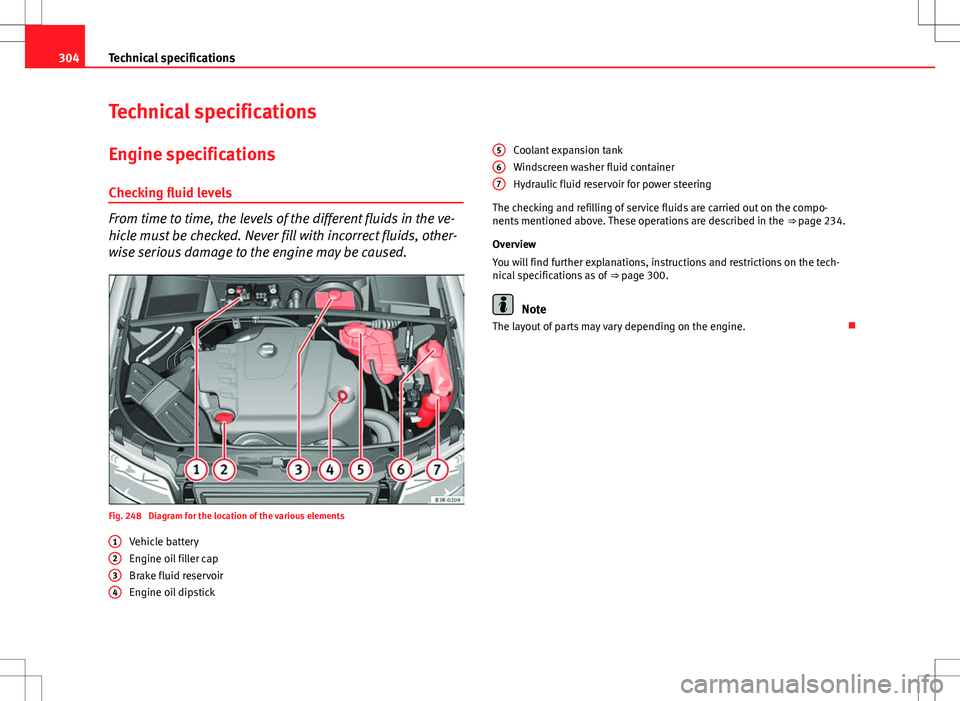
Engine specifications Checking fluid levels
From time to time, the levels of the different fluids in the ve-
hicle must be checked. Never fill with incorrect fluids, other-
wise serious damage to the engine may be caused.
Fig. 248 Diagram for the location of the various elements Vehicle battery
Engine oil filler cap
Brake fluid reservoir
Engine oil dipstick
1
234
Coolant expansion tank
Windscreen washer fluid container
Hydraulic fluid reservoir for power steering
The checking and refilling of service fluids are carried out on the compo-
nents mentioned above. These operations are described in the ⇒ page 234.
Overview
You will find further explanations, instructions and restrictions on the tech-
nical specifications as of ⇒ page 300.
Note
The layout of parts may vary depending on the engine.
567
Page 317 of 325
Cruise control system . . . . . . . . . . . . . . . . . . . . 183Adjust the stored speed . . . . . . . . . . . . . . . 185
Deactivating . . . . . . . . . . . . . . . . . . . . . . . . 186
Deactivating temporarily . . . . . . . . . . . . . . 185
Setting the speed . . . . . . . . . . . . . . . . . . . . 184
Cruise speed . . . . . . . . . . . . . . . . . . . . . . . . . . . 183
Curtain airbags . . . . . . . . . . . . . . . . . . . . . . . . . . 42 Description . . . . . . . . . . . . . . . . . . . . . . . . . . 42
Operation . . . . . . . . . . . . . . . . . . . . . . . . . . . 43
Safety notes . . . . . . . . . . . . . . . . . . . . . . . . . 43
D Danger of fitting a child seat on the front pas- senger seat . . . . . . . . . . . . . . . . . . . . . . . . . . . 30
Dash panel cleaning . . . . . . . . . . . . . . . . . . . . 226
Data entry control . . . . . . . . . . . . . . . . . . . . . . . . 92
Date display . . . . . . . . . . . . . . . . . . . . . . . . . . . . 63
Daytime running lights . . . . . . . . . . . . . . . . . . 122
Deactivating front passenger airbag Safety notes . . . . . . . . . . . . . . . . . . . . . . . . . 46
Deactivating the airbag Front passenger airbag . . . . . . . . . . . . . . . . 45
Diesel . . . . . . . . . . . . . . . . . . . . . . . . . . . . . . . . 232
Diesel engine Winter driving . . . . . . . . . . . . . . . . . . . . . . . 233
Diesel engine particulate filter . . . . . . . . . . . . 203
Diesel particulate filter . . . . . . . . . . . . . . . . . . . 83 Engine oil . . . . . . . . . . . . . . . . . . . . . . . . . . 235
Digital clock . . . . . . . . . . . . . . . . . . . . . . . . . . . . 63
Dipped beam headlights . . . . . . . . . . . . . . . . . 117 DIS
Average fuel consumption . . . . . . . . . . . . . . 88
Average speed . . . . . . . . . . . . . . . . . . . . . . . 88
Driving time . . . . . . . . . . . . . . . . . . . . . . . . . 88
Instantaneous fuel consumption . . . . . . . . 88
Disposal Airbags . . . . . . . . . . . . . . . . . . . . . . . . . . . . . 31
Seat belt tensioners . . . . . . . . . . . . . . . . . . . 28
Distance covered . . . . . . . . . . . . . . . . . . . . . . . . 89
Distance to empty . . . . . . . . . . . . . . . . . . . . 76, 88
Door and rear lid warning . . . . . . . . . . . . . . . . . 77
Door lock cylinders . . . . . . . . . . . . . . . . . . . . . . 220
Doors Childproof lock . . . . . . . . . . . . . . . . . . . . . . 107
Locking the doors manually if the centrallocking fails to work . . . . . . . . . . . . . . . . 105
Driver see Correct sitting position . . . . . . . 10, 11, 12
Driver information system . . . . . . . . . . . . . . . . . 74 Auto-check system . . . . . . . . . . . . . . . . . . . . 78
CD and radio display . . . . . . . . . . . . . . . . . . 75
Door and rear lid warning . . . . . . . . . . . . . . 77
Driver messages . . . . . . . . . . . . . . . . . . . . . . 79
Handbrake warning . . . . . . . . . . . . . . . . . . . 79
Menu display . . . . . . . . . . . . . . . . . . . . . . . . 91
Onboard computer . . . . . . . . . . . . . . . . . . . . 88
Outside temperature display . . . . . . . . . . . . 75
Red symbols . . . . . . . . . . . . . . . . . . . . . . . . . 80
Speed warning . . . . . . . . . . . . . . . . . . . . . . . 85
Warning messages . . . . . . . . . . . . . . . . . . . . 79
Yellow symbols . . . . . . . . . . . . . . . . . . . . . . . 82
Driver messages . . . . . . . . . . . . . . . . . . . . . . . . . 79 driver seat
Assigning the key to the seat . . . . . . . . . . 141
Driver seat Activating stored settings . . . . . . . . . . . . . 140
With memory . . . . . . . . . . . . . . . . . . . . . . . 139
Driving Driving abroad . . . . . . . . . . . . . . . . . . . . . . 205
Economically / Environmentally friendly . 203
Driving abroad . . . . . . . . . . . . . . . . . . . . . . . . . 205 Headlights . . . . . . . . . . . . . . . . . . . . . . . . . 205
Driving safety . . . . . . . . . . . . . . . . . . . . . . . . . . . . 9
DRP see Dynamic gear control programme . . . 191
Dynamic gear control programme . . . . . . . . . . 191
E
Economical driving . . . . . . . . . . . . . . . . . . . . . . 203
Electric socket . . . . . . . . . . . . . . . . . . . . . . . . . 156
Electric windows . . . . . . . . . . . . . . . . . . . . . . . . 112 Central locking system . . . . . . . . . . . . . . . . 114
Possible malfunctions . . . . . . . . . . . . . . . . 114
Rear doors . . . . . . . . . . . . . . . . . . . . . . . . . . 113
Switches on the driver door . . . . . . . . . . . . 112
Switch on front passenger's door . . . . . . . 113
Electronic differential lock How it works . . . . . . . . . . . . . . . . . . . . . . . . 197
Electronic immobiliser . . . . . . . . . . . . . . . . . . . 101
Electronic Stability Control . . . . . . . . . . . . . . . . 71 description . . . . . . . . . . . . . . . . . . . . . . . . . 172
Operation . . . . . . . . . . . . . . . . . . . . . . . . . . 195
warning lamp . . . . . . . . . . . . . . . . . . . . . . . 173
315
Index
Page 318 of 325
EmergenciesChanging a wheel . . . . . . . . . . . . . . . . . . . 262
Disconnecting the battery . . . . . . . . . . . . . 246
Jack . . . . . . . . . . . . . . . . . . . . . . . . . . . 259, 264
Sunroof emergency activation . . . . . . . . . . 116
Tools . . . . . . . . . . . . . . . . . . . . . . . . . . . . . . 259
Tyre mobility system . . . . . . . . . . . . . . . . . . 260
Engine Running in . . . . . . . . . . . . . . . . . . . . . . . . . 201
Starting . . . . . . . . . . . . . . . . . . . . . . . . . . . . 174
Stop . . . . . . . . . . . . . . . . . . . . . . . . . . . . . . . 175
Engine compartment Safety instructions . . . . . . . . . . . . . . . . . . . 234
Engine coolant G 12 plus-plus . . . . . . . . . . . . . . . . . . . . . . 238
G 13 . . . . . . . . . . . . . . . . . . . . . . . . . . . . . . . 238
Specifications . . . . . . . . . . . . . . . . . . . . . . . 238
Engine oil . . . . . . . . . . . . . . . . . . . . . . . . . . . . . 235 Checking oil level . . . . . . . . . . . . . . . . . . . . 237
Checking the level . . . . . . . . . . . . . . . . . . . . 83
Consumption . . . . . . . . . . . . . . . . . . . . . . . 237
Engine oil pressure too low . . . . . . . . . . . . . 81
Oil properties . . . . . . . . . . . . . . . . . . . . . . . 236
Oil sensor defective . . . . . . . . . . . . . . . . . . . 83
Topping up . . . . . . . . . . . . . . . . . . . . . . . . . 238
Engine speed governing . . . . . . . . . . . . . . . . . . 83
Environment . . . . . . . . . . . . . . . . . . . . . . . . . . . 203 Environmental friendliness . . . . . . . . . . . . 205
Roof racks . . . . . . . . . . . . . . . . . . . . . . . . . . 153
Environmentally friendly driving . . . . . . . . . . . 203
Environmental tip Avoiding pollution . . . . . . . . . . . . . . . . . . . 231 ESC . . . . . . . . . . . . . . . . . . . . . . . . . . . . . . . . . . . 71
see also Electronic Stability Control . . . . . 172
Exhaust gas purification system . . . . . . . . . . . 202
Exterior mirrors . . . . . . . . . . . . . . . . . . . . . . . . . 219
F
Fastening rings . . . . . . . . . . . . . . . . . . . . . . . . . . 17
Floor mats . . . . . . . . . . . . . . . . . . . . . . . . . . . . . . 16
Fog lights . . . . . . . . . . . . . . . . . . . . . . . . . . . . . 119
Front airbags . . . . . . . . . . . . . . . . . . . . . . . . . . . 33 Description . . . . . . . . . . . . . . . . . . . . . . . . . . 33
Operation . . . . . . . . . . . . . . . . . . . . . . . . . . . 34
Safety notes . . . . . . . . . . . . . . . . . . . . . . . . . 36
Front drink holder . . . . . . . . . . . . . . . . . . . . . . . 153
Front passenger airbag deactivation . . . . . . . . 45
Fuel Diesel . . . . . . . . . . . . . . . . . . . . . . . . . . . . . 232
Fuel gauge . . . . . . . . . . . . . . . . . . . . . . . . . . 65
Fuel level low . . . . . . . . . . . . . . . . . . . . . . . . 83
Instantaneous fuel consumption . . . . . . . . 88
Petrol . . . . . . . . . . . . . . . . . . . . . . . . . . . . . . 231
Fuel consumption . . . . . . . . . . . . . . . . . . . 203, 301
Fuel tank opening the fuel tank flap . . . . . . . . . . . . . 230
Fuel: save . . . . . . . . . . . . . . . . . . . . . . . . . . . . . 203
Fuse Assignment . . . . . . . . . . . . . . . . . . . . . . . . . 271
Changing . . . . . . . . . . . . . . . . . . . . . . . . . . 270 G
Gear display . . . . . . . . . . . . . . . . . . . . . . . . . . . . 76
Gear shift pattern . . . . . . . . . . . . . . . . . . . . . . . 186
General overview of the engine compartment 304
Glove compartment . . . . . . . . . . . . . . . . . . . . . 159 Light . . . . . . . . . . . . . . . . . . . . . . . . . . . . . . 125
H Handbrake . . . . . . . . . . . . . . . . . . . . . . . . . . . . 179 Control lamp . . . . . . . . . . . . . . . . . . . . . . . . . 72
Hazard warning lights . . . . . . . . . . . . . . . . . . . 123
Headlight range control . . . . . . . . . . . . . . . . . . 121 Dynamic . . . . . . . . . . . . . . . . . . . . . . . . . . . 122
Faulty . . . . . . . . . . . . . . . . . . . . . . . . . . . . . . . 84
Headlights Adaptive headlights . . . . . . . . . . . . . . . . . . 123
Automatic headlight control . . . . . . . . . . . 118
Automatic headlight control photosensors . .118
Driving abroad . . . . . . . . . . . . . . . . . . . . . . 205
Front fog lights . . . . . . . . . . . . . . . . . . . . . . 119
Headlight range control . . . . . . . . . . . . . . . 121
Headlight washer system . . . . . . . . . . . . . 132
Head restraint Rear seat . . . . . . . . . . . . . . . . . . . . . . . . . . . 142
Head restraints Front seats . . . . . . . . . . . . . . . . . . . . . . . . . 141
Rear seats . . . . . . . . . . . . . . . . . . . . . . . . . . 142
Removing and fitting . . . . . . . . . . . . . . . . . 141
Heated Seats . . . . . . . . . . . . . . . . . . . . . . . . . . . . . . 171
Heated rear window . . . . . . . . . . . . . . . . . . . . . 128
316 Index